Ever read your own sentence a few times and still feel like something is off, but you cannot quite figure out why?
Maybe the sentence feels rushed. Maybe one thought seems to crash into the next.
Or maybe someone told you that you wrote a run-on sentence, and you are still not completely sure what that actually means.
If that sounds familiar, you are in the right place.
Run-on sentences can be tricky because they are not always long, and they do not always look obviously wrong at first glance.
The real problem usually comes down to how complete thoughts are connected.
That is exactly what this guide will help you understand.
You will learn what a run-on sentence is, how to recognize the different types, why these errors happen, and the simplest ways to fix them.
You will also see plenty of clear examples along the way so the rules actually make sense instead of feeling like another grammar lesson you have to memorize.
So for that reason, keep reading, because by the end of this guide, spotting and fixing run-on sentences should feel much easier.
Let’s get started with -
What Is a Run-On Sentence?
A run-on sentence occurs when two or more independent clauses are joined without the punctuation or connecting words needed to link them correctly.
For example:
Run-on: The library was closing I borrowed the book quickly.
There are actually two complete thoughts here:
Independent clause 1: The library was closing.
Independent clause 2: I borrowed the book quickly.
Each could stand alone as a sentence. Putting them together without a proper connection creates the run-on.
A correctly connected version could be:
The library was closing, so I borrowed the book quickly.
Or:
The library was closing. I borrowed the book quickly.
Or even:
The library was closing; I borrowed the book quickly.
That last point matters because there is rarely only one possible correction for a run-on sentence.
The best fix depends on the relationship you want to show between the ideas.
Now you might be thinking -
What Is an Independent Clause?
An independent clause contains a subject and a verb and expresses a complete thought.
Take this sentence:
The baby laughed.
- Subject: the baby
- Verb: laughed
- Complete thought: yes
Now look at this:
The baby laughed everyone looked over.
You can divide it into two complete thoughts:
The baby laughed.
Everyone looked over.
Because those independent clauses are pushed together without a proper connection, the result is a run-on sentence.
10 Run-On Sentence Examples that You Need to Know
The easiest way to understand a run-on sentence is to see what goes wrong and how a small change can fix it.
As you go through the examples below, pay attention to two things: where the complete thoughts are and how they are connected.
Some sentences need a period, others need a conjunction or semicolon, and in many cases there is more than one correct way to rewrite them.
Once you start noticing that pattern, run-on sentences become much easier to recognize in your own writing.
Here are 10 common run-on sentence examples, along with their corrections and a quick explanation of what changed:
| Run-On Sentence | Correct Sentence | What Changed |
|---|---|---|
| I finished my homework I went outside. | I finished my homework. I went outside. | Added a period |
| Maya wanted coffee, the café was closed. | Maya wanted coffee, but the café was closed. | Added a conjunction |
| The bus was late we missed the beginning of the movie. | The bus was late, so we missed the beginning of the movie. | Added a comma + conjunction |
| Liam loves photography he takes his camera everywhere. | Liam loves photography; he takes his camera everywhere. | Added a semicolon |
| I opened the window it was getting hot. | I opened the window because it was getting hot. | Added a subordinating conjunction |
| The meeting ended, everyone returned to work. | The meeting ended. Everyone returned to work. | Replaced the comma with a period |
| My phone battery was low I needed a charger. | My phone battery was low, so I needed a charger. | Connected the ideas properly |
| Emma studied all night, she still felt nervous. | Emma studied all night, but she still felt nervous. | Added a coordinating conjunction |
| We reached the restaurant it had already closed. | We reached the restaurant; it had already closed. | Added a semicolon |
| The dog heard a noise it started barking. | The dog heard a noise, and it started barking. | Added a comma + conjunction |
Notice the pattern?
The problem is not the topic, sentence length, or number of words. The problem is how complete clauses are connected.
What Are the Types of Run-On Sentences?
What makes run-on sentences a little confusing is that they do not all look the same.
The error can happen in more than one way, depending on how the independent clauses are joined.
The two main types you need to know are fused sentences and comma splices. Both incorrectly connect complete thoughts, but the mistake between those thoughts is different.
Understanding that difference makes it much easier to identify the problem and choose the right correction.
1. Fused Sentence
A fused sentence occurs when independent clauses are placed next to one another with no appropriate punctuation or conjunction between them.
Example:
My alarm didn't ring I woke up late.
Both parts can stand alone:
My alarm didn't ring.
I woke up late.
To fix the fused sentence, you could write:
Period: My alarm didn't ring. I woke up late.
Semicolon: My alarm didn't ring; I woke up late.
Conjunction: My alarm didn't ring, so I woke up late.
The meaning remains similar, but the relationship between the ideas becomes much clearer.
2. Comma Splice
A comma splice happens when two independent clauses are joined using only a comma.
Incorrect:
The shop was busy, we waited outside.
The comma is trying to do more work than it can handle. A lonely little comma was never hired to separate two complete sentences.
You could fix it in several ways:
Period: The shop was busy. We waited outside.
Semicolon: The shop was busy; we waited outside.
Comma + conjunction: The shop was busy, so we waited outside.
If comma splices keep slipping into your drafts, reviewing them with a Comma Splice Checker can help you find patterns you may miss during manual proofreading.
So, now the most common question that might come to your mind is -
How Can You Tell If a Sentence Is a Run-On?
A run-on sentence is not necessarily a long sentence, and that is exactly where many people get confused.
A sentence can be short and still be a run-on if it contains two complete thoughts that are joined incorrectly.
So counting words or reading until you run out of breath will not really tell you much about the grammar.
What matters is the sentence structure.
To identify a run-on, you need to figure out where the complete thoughts are and then check whether they have been connected correctly.
Instead of trying to judge the whole sentence at once, you can break the process into three simple steps.
Start with the basic building blocks of the sentence:
Step 1: Find the Subjects and Verbs
Consider:
Daniel finished the presentation he emailed it to the team.
You can identify:
- Daniel finished
- he emailed
That is your first clue that more than one clause may be present.
Step 2: Look for Complete Thoughts
Ask whether each part could stand alone.
Daniel finished the presentation.
Yes.
He emailed it to the team.
Also yes. You now have two independent clauses.
Step 3: Check How the Clauses Are Connected
Look between those complete thoughts.
Do you see:
- a period?
- a semicolon?
- a comma plus a coordinating conjunction?
- a subordinating conjunction?
In our example, there is nothing:
Daniel finished the presentation [nothing] he emailed it to the team.
That makes it a fused run-on.
A quick test is to mentally place a period between the ideas.
If both sides still make complete sentences, pay close attention to whatever is connecting them.
Now, comes the interesting part -
How to Fix a Run-On Sentence
Once you have spotted a run-on sentence, the next question is simple: how do you fix it without changing what you meant to say?
The good thing is that there is usually more than one correct way to repair a run-on.
You can separate the ideas, connect them more clearly, or change the sentence structure depending on the relationship between the thoughts.
The key is not just to make the sentence grammatically correct, but to choose a fix that keeps the meaning clear and natural.
There are four common ways to do that.
To make the differences easier to understand, we will use the same run-on sentence and correct it in four different ways -
1. Separate the Clauses With a Period
Sometimes the cleanest fix is simply to stop the sentence.
Correct: The weather became worse. We canceled the picnic.
Use a period when both thoughts deserve their own emphasis or when combining them makes the sentence unnecessarily busy.
There is no prize for squeezing every thought into a single sentence.
2. Use a Semicolon
A semicolon can connect two closely related independent clauses.
Correct: The weather became worse; we canceled the picnic.
Both sides could still stand independently, but the semicolon signals that their meanings are closely connected.
3. Add a Comma and Coordinating Conjunction
You can also use a coordinating conjunction:
Correct: The weather became worse, so we canceled the picnic.
The seven coordinating conjunctions are commonly remembered as FANBOYS:
- For
- And
- Nor
- But
- Or
- Yet
- So
The conjunction you choose matters.
Compare:
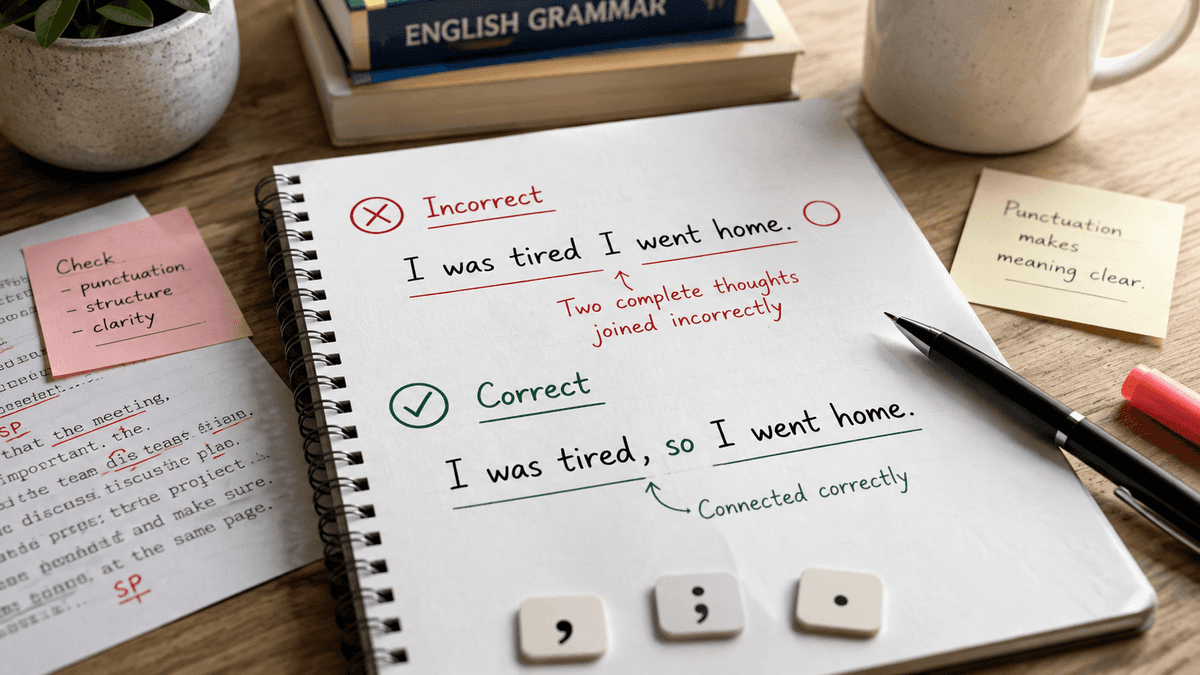
I wanted to go, but I was tired.
I was tired, so I went home.
But shows contrast. So shows a result. Choosing the right conjunction helps the reader understand how your ideas relate.
4. Use a Subordinating Conjunction
You can turn one independent clause into a dependent clause using words such as because, although, since, while, if, or when.
Correct: Because the weather became worse, we canceled the picnic.
Now the first idea explains why the second happened.
The sentence is not merely grammatically correct. It is also more informative.
If a correction starts changing too much of the original idea, these methods for rewriting a sentence without changing its meaning can help you restructure it more carefully.
If you know what the sentence should mean but are struggling to restructure it clearly, a paraphrasing tool can help you explore a different way to phrase the same idea.
More Run-On Sentence Examples With Corrections
Different types of writing create different opportunities for run-ons. Here are some examples of run-on sentences you might actually encounter.
Run-On Sentence Examples for Students
Run-on: I studied for the test I still found the last section difficult.
Correct: I studied for the test, but I still found the last section difficult.
Why: The two ideas contrast, so but shows their relationship.
Run-on: Our assignment is due tomorrow I have finished only half of it.
Correct: Our assignment is due tomorrow, and I have finished only half of it.
Why: The comma and coordinating conjunction correctly connect two complete thoughts.
Run-on: The lecture ended, I stayed behind to ask a question.
Correct: The lecture ended. I stayed behind to ask a question.
Why: A comma alone cannot separate the two independent clauses.
Run-On Sentence Examples in Everyday Writing
Run-on: I forgot my wallet my friend paid for lunch.
Correct: I forgot my wallet, so my friend paid for lunch.
Why: The second event is a result of the first.
Run-on: The movie starts at eight, we should leave soon.
Correct: The movie starts at eight; we should leave soon.
Why: A semicolon correctly joins two closely related independent clauses.
Run-on: My coffee was getting cold I drank it quickly.
Correct: Because my coffee was getting cold, I drank it quickly.
Why: Because makes the cause-and-effect relationship explicit.
Run-On Sentence Examples in Academic Writing
Run-on: The survey included 300 participants the researchers removed incomplete responses.
Correct: The survey included 300 participants. The researchers removed incomplete responses.
Why: Both statements are complete and can work clearly as separate sentences.
Run-on: The first experiment produced inconsistent results, the researchers repeated the procedure.
Correct: The first experiment produced inconsistent results, so the researchers repeated the procedure.
Why: So clearly communicates the result.
Run-on: The evidence supports the initial hypothesis additional research is still necessary.
Correct: The evidence supports the initial hypothesis; additional research is still necessary.
Why: The semicolon preserves the close relationship while separating two independent clauses.
Run-On Sentence Examples in Emails and Workplace Writing
Run-on: I've attached the revised proposal please review it before Friday.
Correct: I've attached the revised proposal. Please review it before Friday.
Run-on: The client approved the design, we can begin development.
Correct: The client approved the design, so we can begin development.
Run-on: Our meeting has been moved to Thursday everyone should update their calendars.
Correct: Our meeting has been moved to Thursday; everyone should update their calendars.
Small punctuation mistakes may seem harmless in a quick message, but clear sentence boundaries make professional writing easier to scan and understand.
The same problems also show up frequently in assignments, which is why understanding the wider rules of essay grammar can be useful when you are editing academic work.
Can a Long Sentence Be Grammatically Correct?
Yes. A long sentence is not automatically a run-on sentence.
Consider this:
Although the train arrived late, we still reached the museum before noon, and because we had bought our tickets online, we walked straight through the entrance and joined the tour that had just started.
That sentence is long, but its clauses are connected correctly.
Now compare it with:
I called she answered.
Four words. Still a run-on.
Grammarly similarly notes that sentence length alone does not determine whether a sentence is a true run-on.
What matters is whether complete clauses have been joined correctly.
Sentence length can affect how readable your writing feels, but it still cannot tell you whether a sentence is a run-on.
So do not judge a sentence by its word count. Judge it by its structure.
Why Are Run-On Sentences Easy to Miss?
Run-ons often appear when your thoughts move faster than your punctuation.
You know what you mean, so your brain naturally supplies pauses and connections that may not actually exist on the page.
That is one reason proofreading your own work can be surprisingly difficult.
Research also shows that sentence-structure errors remain a real challenge for language learners.
A 2023 study analyzing 246 English writing samples from Vietnamese pre-intermediate learners recorded 107 run-on sentence errors, reported as 9.2% of the grammatical errors analyzed.
A second pass focused specifically on sentence boundaries can therefore be more useful than simply rereading the entire piece and hoping something feels wrong.
Run-On Sentence vs. Comma Splice vs. Sentence Fragment
A sentence can sound incomplete, awkward, or incorrectly connected for several reasons, and that is why run-on sentences, comma splices, and sentence fragments are easy to mix up.
They are related sentence-structure problems, but they do not happen in the same way.
A run-on incorrectly joins complete thoughts, a comma splice connects them with only a comma, while a fragment does not express a complete thought at all.
Knowing which error you are dealing with matters because each one requires a different kind of fix.
The table below breaks down the differences so you can quickly see what goes wrong in each case and how to tell them apart.
| Error | What Goes Wrong | Example |
|---|---|---|
| Fused run-on | Independent clauses have no proper separation | I called her she answered. |
| Comma splice | Independent clauses are joined using only a comma | I called her, she answered. |
| Sentence fragment | The words do not express a complete independent thought | Because she answered. |
A run-on has too many complete clauses connected incorrectly.
A fragment does not contain a complete sentence on its own.
That difference is worth remembering.
If incomplete sentences are another recurring problem in your writing, a Sentence Fragment Checker can help separate fragments from run-ons instead of treating every sentence problem as the same error.
So, almost know now everything related to run-on sentences; let’s find out about -
Common Mistakes When Fixing Run-On Sentences
Fixing a run-on sentence is not always as simple as adding a comma or dropping in a conjunction and moving on.
In fact, one of the easiest ways to create a new grammar problem is to correct a run-on too quickly without checking how the clauses actually relate to each other.
You might replace a fused sentence with a comma splice, choose the wrong conjunction, misuse a semicolon, or break apart ideas that would read better together.
So before you consider a sentence fixed, it helps to know the most common mistakes people make during correction and why those fixes don't always work.
If these problems tend to appear together in your drafts, reviewing other common grammar mistakes can help you spot the wider pattern -
1. Using Only a Comma
Suppose you start with:
The room was crowded we left early.
Adding a comma does not fully solve it:
The room was crowded, we left early.
You have simply upgraded your fused sentence into a comma splice.
Progress, technically, but in the wrong direction.
Use:
The room was crowded, so we left early.
Or:
The room was crowded. We left early.
2. Choosing the Wrong Conjunction
Compare:
The rain became heavier, so we went inside.
That makes sense because the second event results from the first.
Now:
The rain became heavier, but we went inside.
Grammatically possible, but the relationship is odd unless the context gives us a reason to expect the opposite.
Grammar and meaning need to work together.
3. Misusing a Semicolon
A semicolon normally connects complete independent clauses.
Correct: The deadline is Friday; we still have plenty of time.
But not:
Incorrect: The deadline is Friday; because we still have plenty of time.
Because we still have plenty of time is dependent, so it cannot stand alone after the semicolon in that construction.
4. Splitting Every Long Sentence
Do not attack every lengthy sentence with a period.
Long sentences can express relationships, build rhythm, and explain complex ideas clearly.
Break a sentence when doing so improves clarity, not simply because it looks long on the screen.
So, now the major concern can be how to resolve all these mistake and here are -
Simple Ways to Avoid Run-On Sentences in Your Writing
You do not need to stop after every line and diagram the sentence like you are preparing evidence for a grammar trial. A few habits are usually enough:
Identify complete thoughts while editing
When a sentence feels crowded, ask:
How many complete statements am I making here?
If the answer is two or more, check how they are connected.
Watch commas between complete sentences
A comma sitting between two independent clauses deserves attention.
It may need:
- a conjunction,
- a semicolon, or
- a period.
Vary your sentence lengths
A paragraph made entirely of very long sentences becomes tiring. A paragraph made entirely of tiny sentences sounds robotic.
Mixing short, medium, and longer sentences usually creates a more natural rhythm.
The same idea applies beyond individual sentences: how many sentences belong in a paragraph depends more on purpose and clarity than on hitting a fixed number.
Proofread sentence boundaries separately
Instead of checking spelling, punctuation, clarity, tone, and sentence structure simultaneously, make one editing pass just for sentence boundaries.
It is much easier to catch run-ons when that is the only thing you are looking for.
Use a second check before submitting
For essays, reports, articles, and other longer drafts, use reliable Grammar Checker to review broader grammar and punctuation issues, while the Run-On Sentence Checker focuses specifically on sentences whose clauses may have been connected incorrectly.
CopyChecker's Run-On Sentence Checker accepts pasted or typed text and provides corrected text alongside an explanation of detected run-ons.
A Self Test on Can You Find the Run-On Sentences?
Think you have the hang of run-on sentences now? Time to find out.
Below are eight sentences, but not all of them are run-ons.
Some are completely correct, while others contain a comma splice, a fragment, or a fused sentence.
Your job is simple: read each one and decide which sentences need fixing and why.
Try not to peek at the answers too soon.
The point is to train your eye to notice sentence structure on your own, because apparently grammar also needs pop quizzes.
- The deadline changed, so we moved the meeting.
- My laptop froze I lost the last paragraph.
- Because the road was flooded.
- We ordered pizza, everyone chose a different topping.
- Although the article was long, it was easy to follow because every section covered one clear idea.
- The alarm rang; nobody moved.
- She finished the draft, she forgot to attach it.
- The package arrived after lunch.
Once you have made your choices, compare them with the answers below to see how many you identified correctly.
Answers
1. Correct. The independent clauses are properly joined with a comma and so.
2. Run-on sentence. Two complete thoughts are fused together.
Correction: My laptop froze, and I lost the last paragraph.
3. Sentence fragment. Because the road was flooded leaves the reader waiting for the main idea.
Correction: Because the road was flooded, we took another route.
4. Comma splice. A comma alone joins two independent clauses.
Correction: We ordered pizza, and everyone chose a different topping.
5. Correct. It is longer than the others, but its clauses are connected properly.
6. Correct. The semicolon correctly joins two independent clauses.
7. Comma splice.
Correction: She finished the draft, but she forgot to attach it.
8. Correct. It contains one complete independent clause.
If you got all eight right, sentence boundaries are probably no longer plotting against you.
Check Run-On Sentences With CopyChecker
You now know how to identify run-ons manually, but doing it across a long essay or report can become tedious quickly.
CopyChecker's Run-On Sentence Checker is built specifically for that job.
Paste your text, run the check, and review the suggested corrections along with explanations of why a sentence was flagged.
The tool detects problems such as fused sentences and comma splices, helping you fix them without manually inspecting every clause.
If the sentence is grammatically correct but still sounds awkward, you can also use
The Sentence Rewriter tool to explore clearer ways to express the same idea while preserving its meaning.
The goal is not to make every sentence short. It is to make every sentence easy to follow.
Frequently Asked Questions About Run-On Sentences
What are the two main types of run-on sentences?
The two main types are fused sentences and comma splices. A fused sentence joins independent clauses without proper separation, while a comma splice joins them using only a comma.
Is a comma splice a run-on sentence?
Yes. A comma splice is generally treated as a type of run-on because two independent clauses are incorrectly joined with only a comma.
Is a long sentence always a run-on sentence?
No. A sentence can be very long and still be grammatically correct. A run-on depends on incorrect clause connections, not word count.
Can a short sentence be a run-on?
Yes. I ran she followed is short but still a run-on because it contains two independent clauses without proper separation.
How do you fix a run-on sentence?
You can usually fix a run-on by adding a period, using a semicolon, adding a comma with a coordinating conjunction, or restructuring one clause with a subordinating conjunction.
Can a run-on sentence have a comma?
Yes. A comma splice is a run-on in which independent clauses are joined using only a comma. Let’s say, I called him, he answered. Correction is, I called him, and he answered.
How can I identify a run-on sentence?
Find the independent clauses and check what connects them. If two complete thoughts have no proper punctuation or are joined only by a comma, you probably have a run-on.
What is the difference between a run-on sentence and a sentence fragment?
A run-on sentence contains complete clauses that are joined incorrectly. Whereas, a sentence fragment is incomplete and cannot stand alone as a full sentence.
What is the easiest way to fix a run-on sentence?
Splitting the independent clauses into separate sentences is usually the simplest fix.
For example: The bus was late I missed class. Becomes: The bus was late. I missed class.
Final Takeaway
Run-on sentences may seem confusing at first, but once you know what is actually happening, they become much easier to handle.
Remember, the problem is not that a sentence is too long.
It is that two or more complete thoughts have been connected incorrectly.
Once you can spot those independent clauses, you can usually fix the sentence with a period, semicolon, coordinating conjunction, or a small change in structure.
And that is really the goal: not shorter writing, but clearer writing that flows naturally from one idea to the next.
Still unsure whether a sentence is a run-on? Or working through a long essay, article, email, or report where checking every sentence manually sounds like a fairly miserable use of an afternoon?
Use our run-on sentence checker to scan your text, identify possible run-on sentences, and review suggested corrections with explanations.
Check your writing with CopyChecker's Run-On Sentence Checker before you submit, send, or publish it, and give every sentence the clear connection it deserves.