You write three sentences, stop, and look at the paragraph.
Is that enough? Should a paragraph have five sentences? What if it has only one?
It is an easy thing to overthink, especially when many of us were taught in school that paragraphs should follow a certain length.
But there is actually no universal rule for how many sentences are in a paragraph.
A commonly used guideline is 3–5 sentences, but that number is only a starting point.
Think about what different paragraphs are expected to do.
An academic paragraph may need several sentences to introduce an argument, provide evidence, explain that evidence, and connect it back to the main point.
A blog paragraph, on the other hand, may explain the same idea in just two or three short sentences because online readers usually prefer information that is easier to scan.
In creative writing, even one sentence can stand alone as a paragraph when the writer wants to create emphasis or change the pace.
So, rather than asking, “Have I written enough sentences?”, ask a better question: “Have I fully explained this one idea?”
That is really what decides paragraph length.
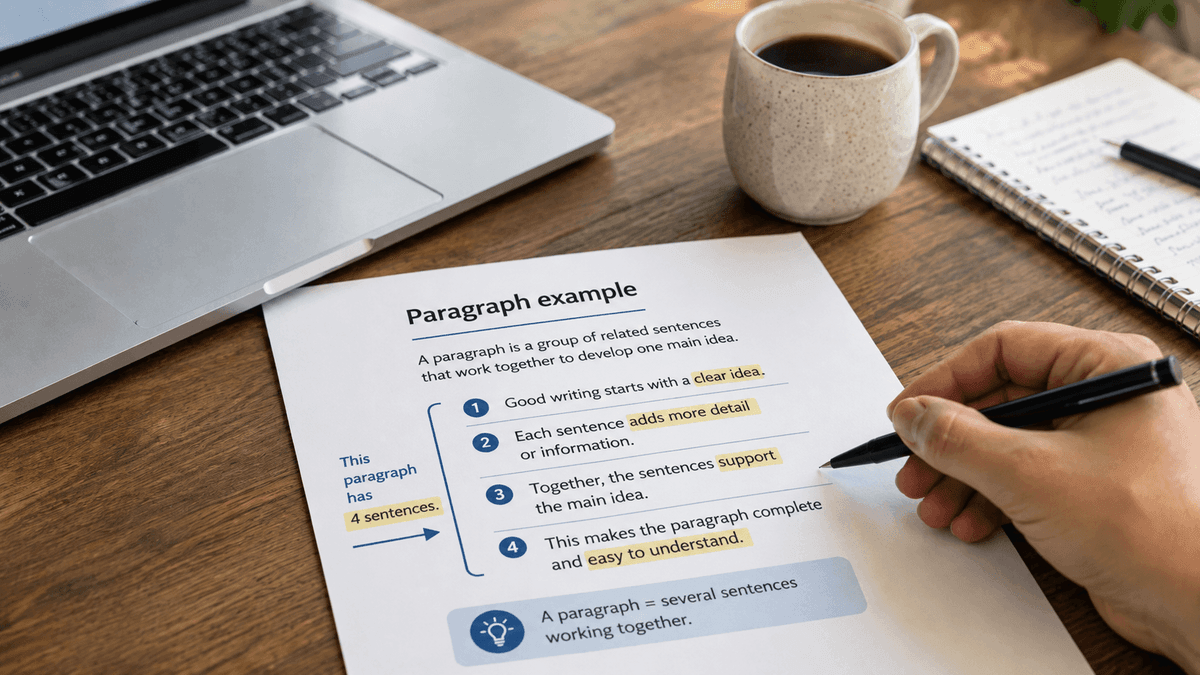
A good paragraph focuses on one clear main idea, develops it enough for the reader to understand, and ends when the discussion is ready to move on to something new.
How Many Sentences Should Be in a Paragraph?
For most everyday writing, a paragraph of 3–5 sentences is a comfortable starting point.
It gives you enough room to introduce an idea, explain it, and support it without turning the paragraph into a wall of text.
But 3–5 is a guideline, not a grammar rule.
A paragraph might contain:
- 1–2 sentences when the point is simple or needs emphasis
- 3–5 sentences for general writing
- 6–8 or more sentences when an idea needs detailed explanation, evidence, or analysis
- One sentence or many sentences in fiction, depending on pacing and style
The right length of any sentence basically depends on four things: purpose, type of writing, audience, and complexity of the idea.
Here is a useful quick reference:
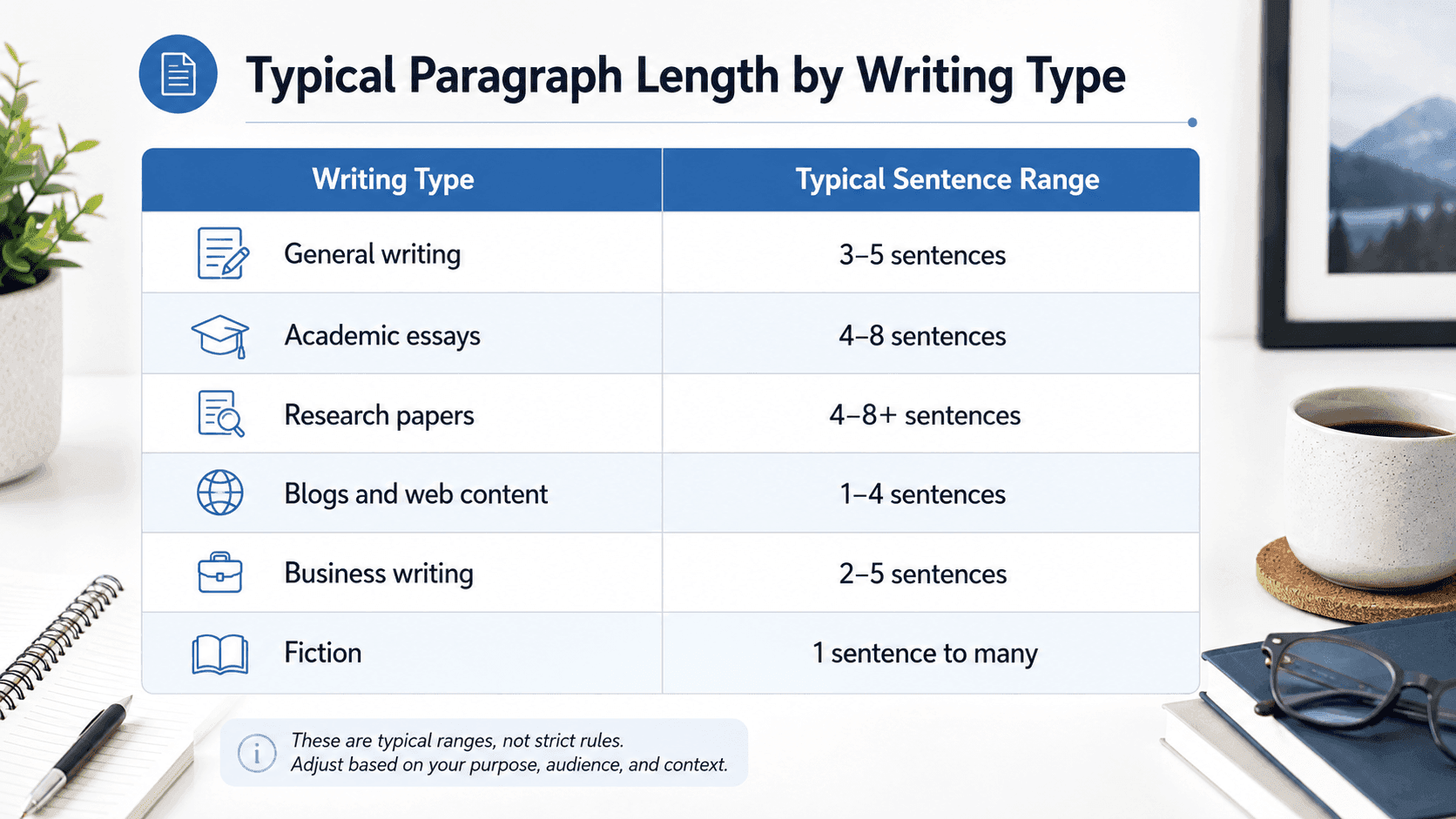
These ranges are not laws. Different writing guides give slightly different recommendations because paragraphs are built around ideas, not a sentence counter.
For example, the University of Wisconsin–Madison Writing Center suggests using four to six sentences as a drafting target when you need enough room to introduce an idea, support it with evidence, and explain why that evidence matters. It also warns against treating that number as a fixed formula.
Quick Tip: If your paragraph makes its point clearly in three sentences, adding two useless sentences just to reach five does not improve it. It merely makes your reader work overtime for no salary.
Is There a Minimum Number of Sentences in a Paragraph?
There is no universal minimum number of sentences in a paragraph.
Grammatically, a paragraph can contain just one sentence.
That means this is a perfectly valid paragraph:
The experiment failed for one unexpected reason.
Whether that paragraph is good depends on where and why you use it.
Honestly, a teacher, university, publisher, or employer may have its own requirements.
If an assignment says every body paragraph needs detailed evidence and analysis, a one-sentence paragraph probably will not do enough work.
Academic writing is especially sensitive to underdeveloped paragraphs.
The University of Toronto notes that a series of academic paragraphs containing only two or three sentences can make writing seem disconnected or too lightly developed. It recommends checking whether those short paragraphs need more explanation or could be combined logically.
So the practical answer is:
Minimum possible: 1 sentence Minimum required: Whatever your purpose or assignment needs
Those are not always the same thing.
Can a Paragraph Be One Sentence?
Yes, a paragraph can consist of one sentence.
Writers use one-sentence paragraphs all the time.
The trick is to use them for a reason, not to press Enter every few seconds because a large rectangle of text looks frightening.
A one-sentence paragraph can work well for:
- Emphasis: making an important statement stand out
- Transitions: creating a clear shift between sections
- Dialogue: separating different speakers
- Journalism: delivering information quickly
- Creative writing: controlling tension and pacing
- Web writing: making an important point easy to scan
For example:
Then the power went out.
That sentence becomes more dramatic when it stands alone than when it is buried halfway through a long paragraph.
One-sentence paragraphs are less suitable when the paragraph is supposed to develop an argument.
In academic essays and research papers, a claim often needs evidence, explanation, and analysis before the reader can accept it.
If you are unsure whether a short line is a complete sentence or an unfinished thought, CopyChecker’s Sentence Fragment Checker can help you spot the difference.
Use a one-sentence paragraph when the idea is complete, or the emphasis is intentional, not simply because one-sentence paragraphs are technically allowed.
And if school rules have made you suspicious of every short or unusual sentence, this guide to grammar rules that are often broken explains why some “rules” depend on context.
How Many Sentences Are in an Academic Paragraph?
An academic paragraph often contains about 4–8 sentences, although no official sentence requirement applies to every university, subject, or assignment.
Academic paragraphs tend to be longer because they normally have more work to do.
A developed academic paragraph may include:
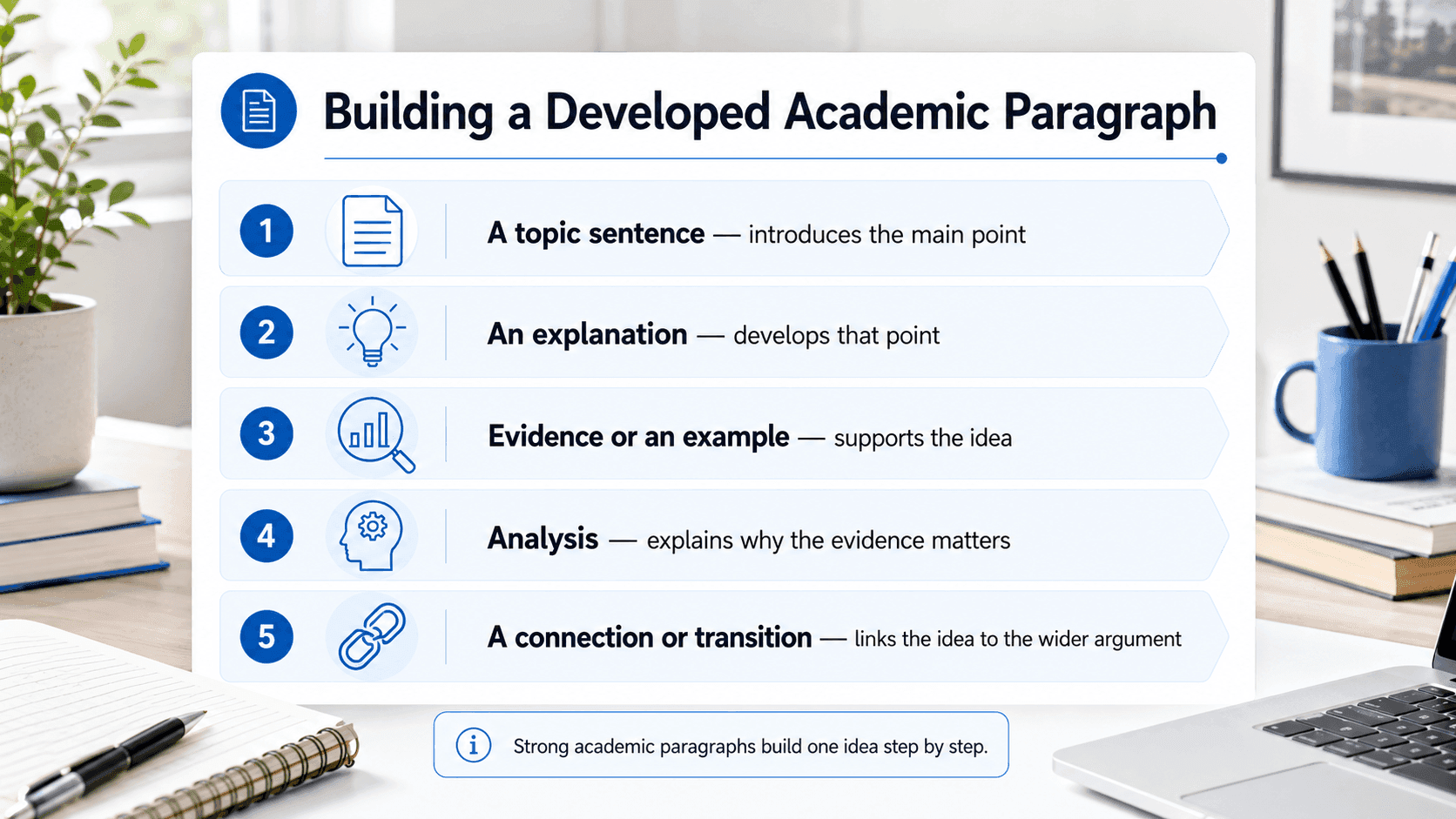
UW–Madison recommends four to six sentences as a useful drafting goal, while stressing that final length should depend on how fully you develop the idea.
Purdue University's Writing Lab gives similar advice from another angle:
A strong academic paragraph should have a clear central idea, enough support to develop that idea, and a length that informs the reader without becoming confusing or tedious.
So if your academic paragraph reaches eight sentences but every sentence supports the same point, that may be completely appropriate.
If it reaches eight sentences and has quietly started discussing three unrelated topics, the problem is not the number eight.
The problem is the paragraph.
How Many Sentences Are in a Body Paragraph?
A body paragraph in an essay commonly contains around 4–8 sentences, but the exact number depends on the argument.
Body paragraphs usually need more development than short transitions because they are responsible for proving something.
For example, imagine your topic sentence says:
Regular exercise can improve students' ability to concentrate during lessons.
You cannot simply stop there. A strong body paragraph may need to:
- explain the relationship
- provide research or an example
- discuss what the evidence shows
- connect the point back to the essay's argument
That naturally requires several sentences.
A useful formula for planning a body paragraph is:
Point → Explanation → Evidence → Analysis → Connection
Treat that as a thinking tool, not a template that must produce exactly five sentences.
How Many Sentences Should an Introduction Paragraph Have?
An introduction paragraph often works well with 3–5 sentences, but there is no fixed requirement.
Its job is to give the reader enough context to understand the topic and lead naturally toward the main argument or thesis.
A short essay might need only three sentences:
- Introduce the topic
- Narrow the focus
- Present the thesis
A longer or more complex paper may need a much fuller introduction.
The University of Toronto specifically warns against rigid rules about introductions and thesis placement.
The length of the introduction should depend on the argument rather than an arbitrary formula.
How Many Sentences Should a Conclusion Paragraph Have?
A conclusion is also often around 3–5 sentences, but again, the purpose matters more than the count.
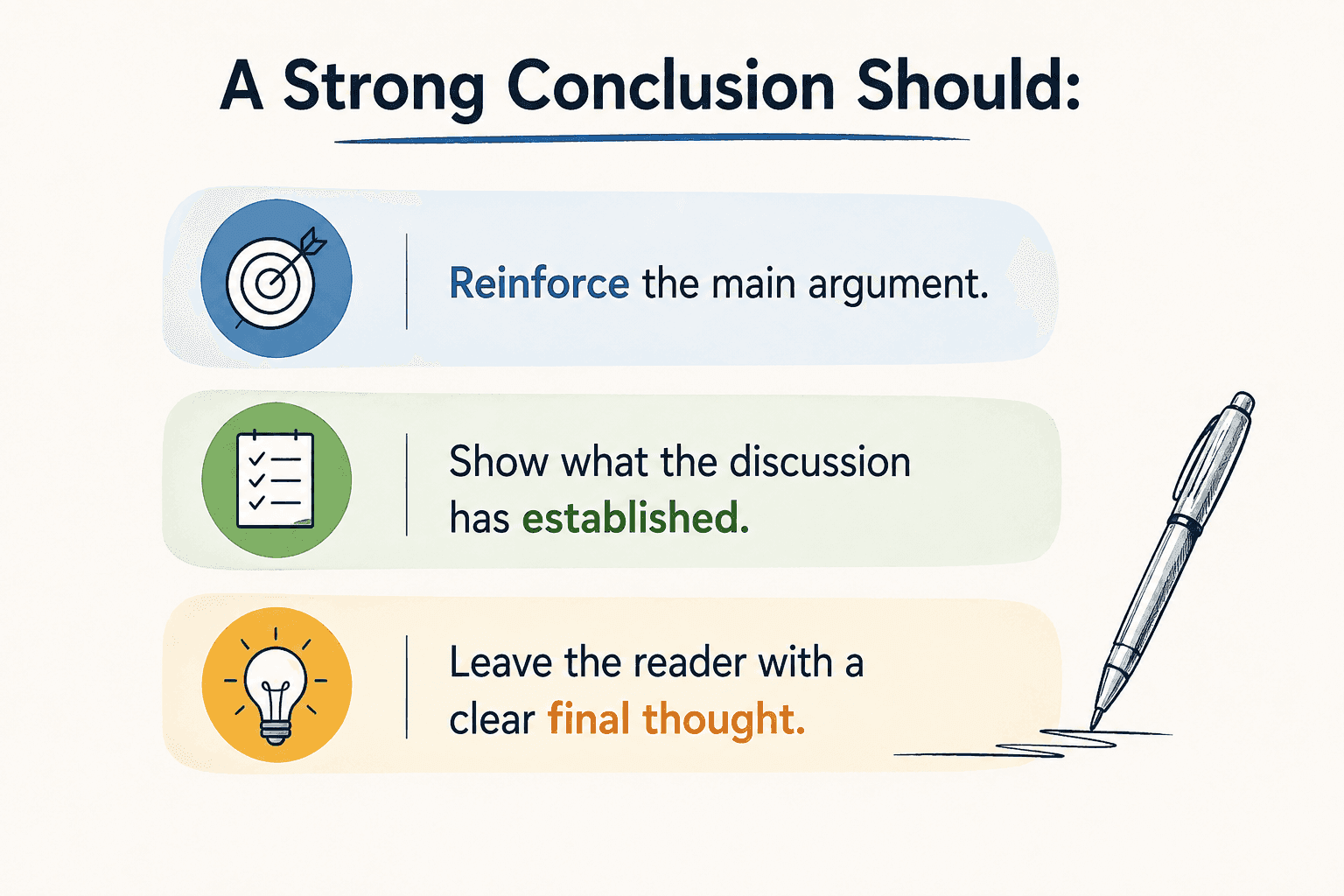
Avoid introducing a major new argument just because sentence number four is sitting there looking lonely.
For many essays, one developed conclusion paragraph is enough, although longer papers may require more.
The University of Toronto recommends matching conclusion length to the essay's overall length and complexity.
How Many Sentences Should Be in a Paragraph for Different Types of Writing?
Different writing situations ask paragraphs to do different jobs.
That is why a paragraph that works beautifully in a novel might look strange in a research paper.
Let’s go through the following parts for more details -
Essays
Usually, essay paragraphs are more developed because they need to make and support arguments.
A typical body paragraph may contain:
- a main claim
- an explanation
- evidence
- an example
- analysis
- a link to the wider argument
That often produces paragraphs of around 4–8 sentences, although more or fewer can work.
If you are writing for school, always check your assignment instructions first. Your teacher's requirements take priority over a general guideline you found online.
A tragic victory for bureaucracy, but there it is.
Research Papers
To be honest, research-paper paragraphs can be longer because research writing often requires you to present evidence and then explain its meaning.
A paragraph might need to:
- introduce a finding
- provide data or evidence
- compare it with earlier research
- discuss limitations
- explain why the finding matters
As a result, 4–8 or more sentences can be completely normal.
The important thing is keeping related evidence and analysis together.
If the paragraph begins answering a different research question halfway through, that is usually a good place to start another paragraph.
Blogs and Online Content
Most of the time, blog paragraphs are shorter, often around 1–4 sentences.
Why?
People reading online frequently scan for useful information instead of reading every word from beginning to end.
Nielsen Norman Group's eye-tracking research has repeatedly found scanning patterns on both desktop and mobile screens, particularly when pages contain large blocks of poorly formatted text.
Shorter paragraphs help readers:
- spot answers quickly
- follow an argument on smaller screens
- identify important points
- move between sections without losing their place
That does not mean every blog paragraph must contain two sentences.
A complicated explanation may still need five or six sentences.
The same principle applies to the article as a whole, as there is no magic length, and the ideal word count for a blog post, so chasing a fixed number is not the ultimate answer.
Just make sure readers don't face an enormous gray block of text that looks like a software license agreement.
Business Writing
Among the other types, business paragraphs are usually short and purpose-driven, often around 2–5 sentences.
Emails, reports, proposals, and internal documents generally work best when readers can quickly understand:
- what happened
- why it matters
- what needs to happen next
If one paragraph contains the problem, the company's full history, three proposed solutions, and someone's lunch order, split it.
Fiction and Creative Writing
Basically, fiction has the widest range.
A paragraph can contain one sentence, several sentences, or a very long passage depending on:
- dialogue
- scene changes
- emphasis
- tension
- pacing
- narrative style
Reedsy's guidance on paragraph length notes that shorter paragraphs can speed up the reading experience, while longer paragraphs can slow the pace and allow more description or reflection.
You can consider these two versions:
Longer
Maya walked slowly through the empty house, checking each room as she tried to remember where she had left the envelope. Nothing seemed disturbed, but the silence made every small sound feel louder than it should.
Shorter
Maya opened the bedroom door.
Nothing.
Then she heard footsteps upstairs.
Neither approach is automatically better. They just create different rhythms.
What Makes a Good Paragraph?
A good paragraph is not simply a group of sentences trapped between two blank spaces.
Mainly, it is a small unit of thought.
Most effective paragraphs use some combination of three elements: a central idea, supporting information, and a logical ending or connection.
Let’s know more about them -
1. Topic Sentence
The topic sentence tells readers what the paragraph is mainly about.
For example:
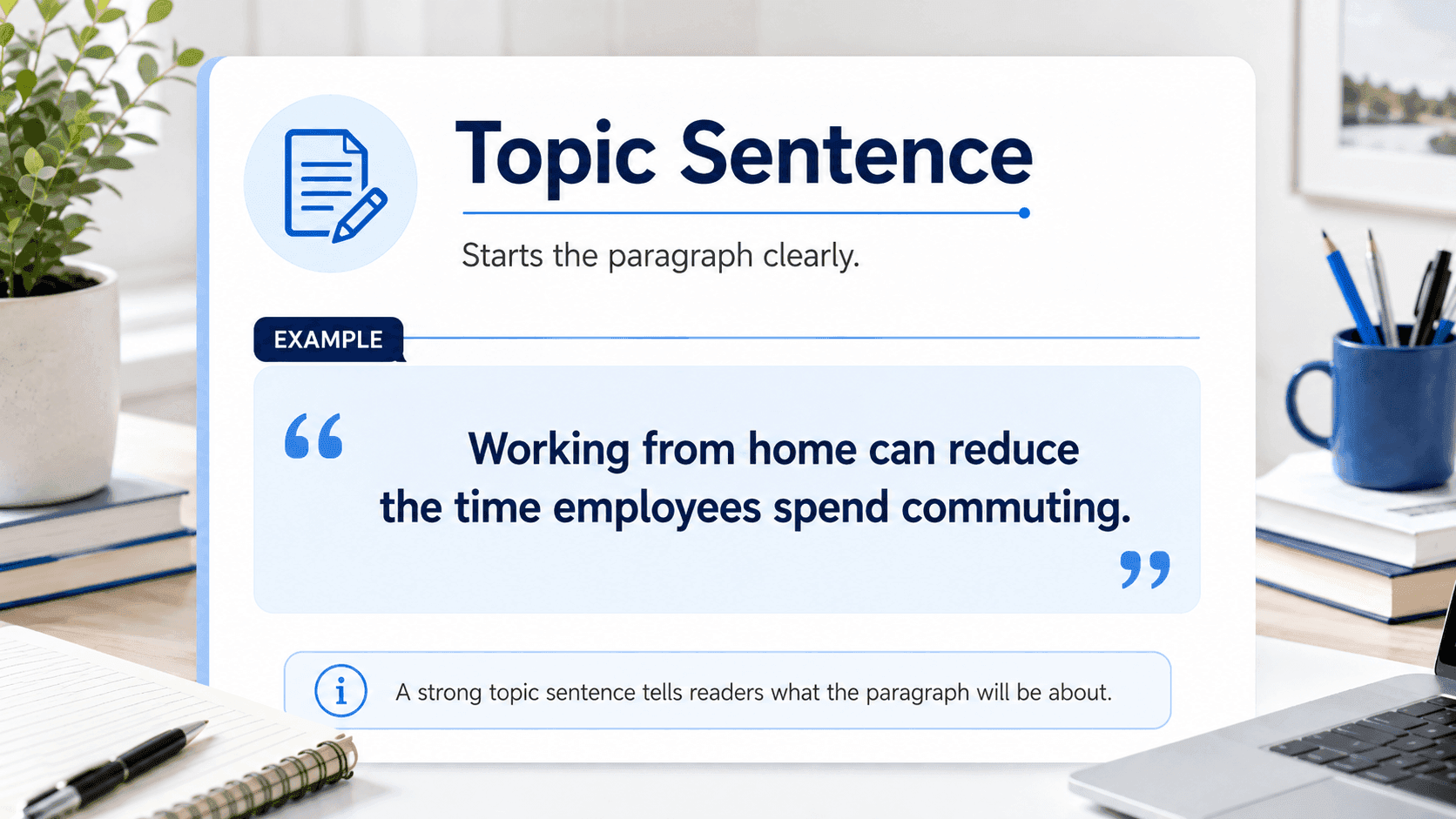
Now the reader knows what to expect.
Topic sentences often appear at the beginning of a paragraph, but they do not have to.
Purdue notes that writers can position them differently depending on structure and purpose.
Here, the real requirement is clarity.
2. Supporting Sentences
After the topic, supporting sentences develop the main point. So, they may provide:
- explanations
- evidence
- examples
- statistics
- comparisons
- reasons
- details
Suppose the topic sentence is:
Drinking enough water can help students stay alert during long school days.
A supporting sentence might explain why, give an example, or introduce evidence.
Without support, the topic sentence is only a claim.
3. Concluding or Transition Sentence
Some paragraphs end by reinforcing the main point or connecting it with the next idea.
For example:
For students who struggle to stay focused in afternoon classes, simple hydration habits may therefore be worth paying attention to.
But not every paragraph needs a formal concluding sentence.
Sometimes the final supporting sentence already completes the idea.
Forcing another sentence onto the end can make the writing sound repetitive.
Once the structure feels right, a quick pass through Grammar Checker can help catch grammar, punctuation, and clarity issues without changing the paragraph’s main point.
What Matters More Than the Number of Sentences?
The most useful rule is much simpler, and that is: one paragraph should develop one central idea.
Sentence count matters far less than unity, coherence, development, flow, and readability.
Purdue's guidance on paragraph-level flow recommends keeping one clear idea or argument in each paragraph and giving it enough support to make the point effectively.
Here is what those qualities mean in plain English:
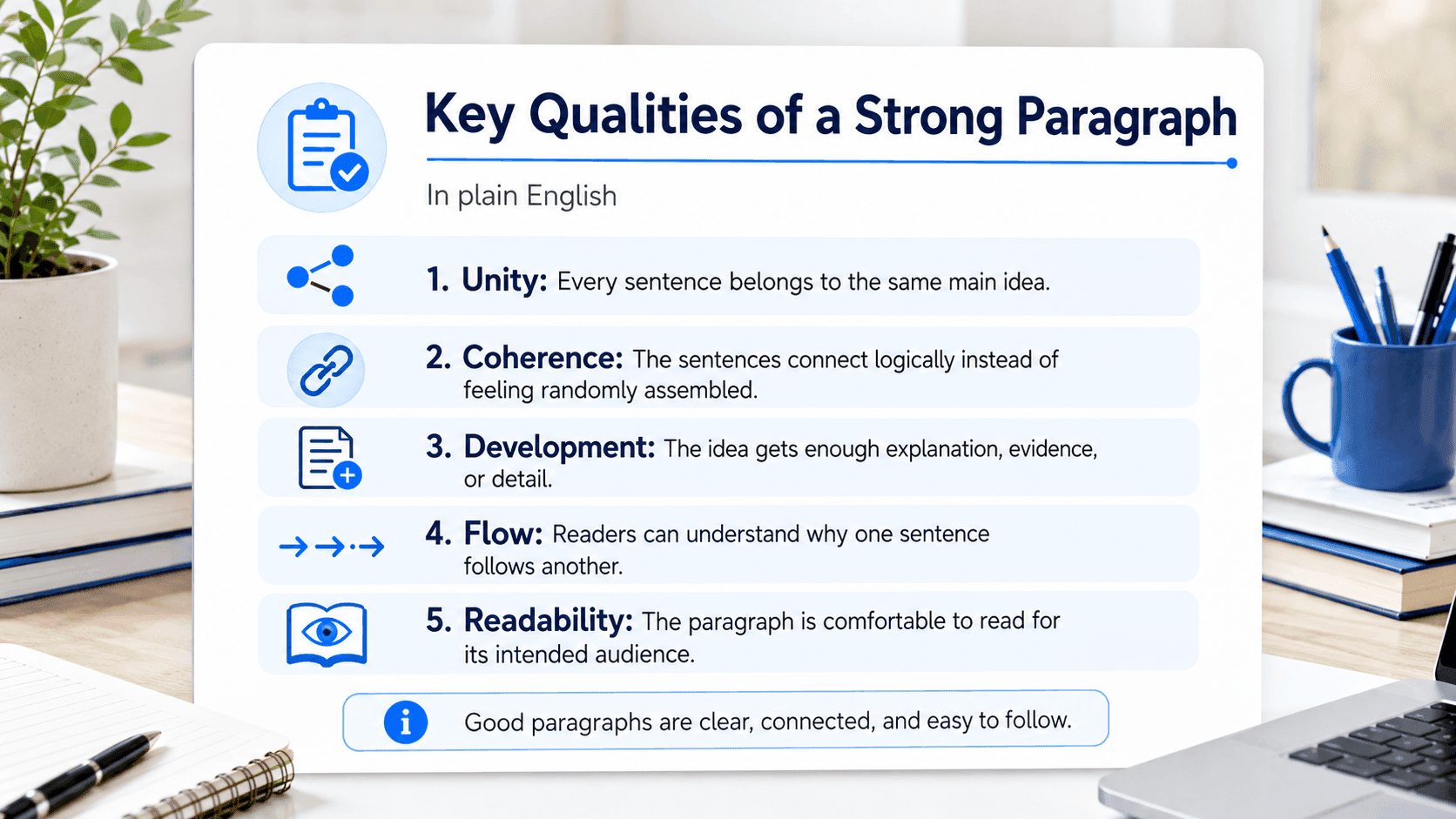
Consider this five-sentence paragraph:
Dogs are popular pets. Mars has two moons. Some dogs need regular exercise. Coffee grows in many countries. Training can improve a dog's behavior.
It contains five sentences. It is also a terrible paragraph.
Now consider this three-sentence paragraph:
Dogs need regular exercise to stay physically and mentally active. Daily walks give them a chance to move, explore, and use their senses. The right amount of exercise depends on factors such as the dog's breed, age, and health.
Only three sentences, but one clear idea is properly developed.
Counting sentences can help you notice a problem. It cannot tell you whether the writing is good.
When Is a Paragraph Too Short?
A paragraph may be too short when its idea has not been developed enough for the reader to understand or believe it.
Watch for these signs:
- a claim has no explanation
- evidence appears without analysis
- the idea feels unfinished
- several tiny paragraphs all discuss the same point
- the paragraph consists only of a quotation
- the reader is expected to make an important connection on their own
Example of a Paragraph That Is Too Short
Social media can affect student productivity. Students use their phones often.
There is a possible argument here, but it has barely started.
A stronger version could be:
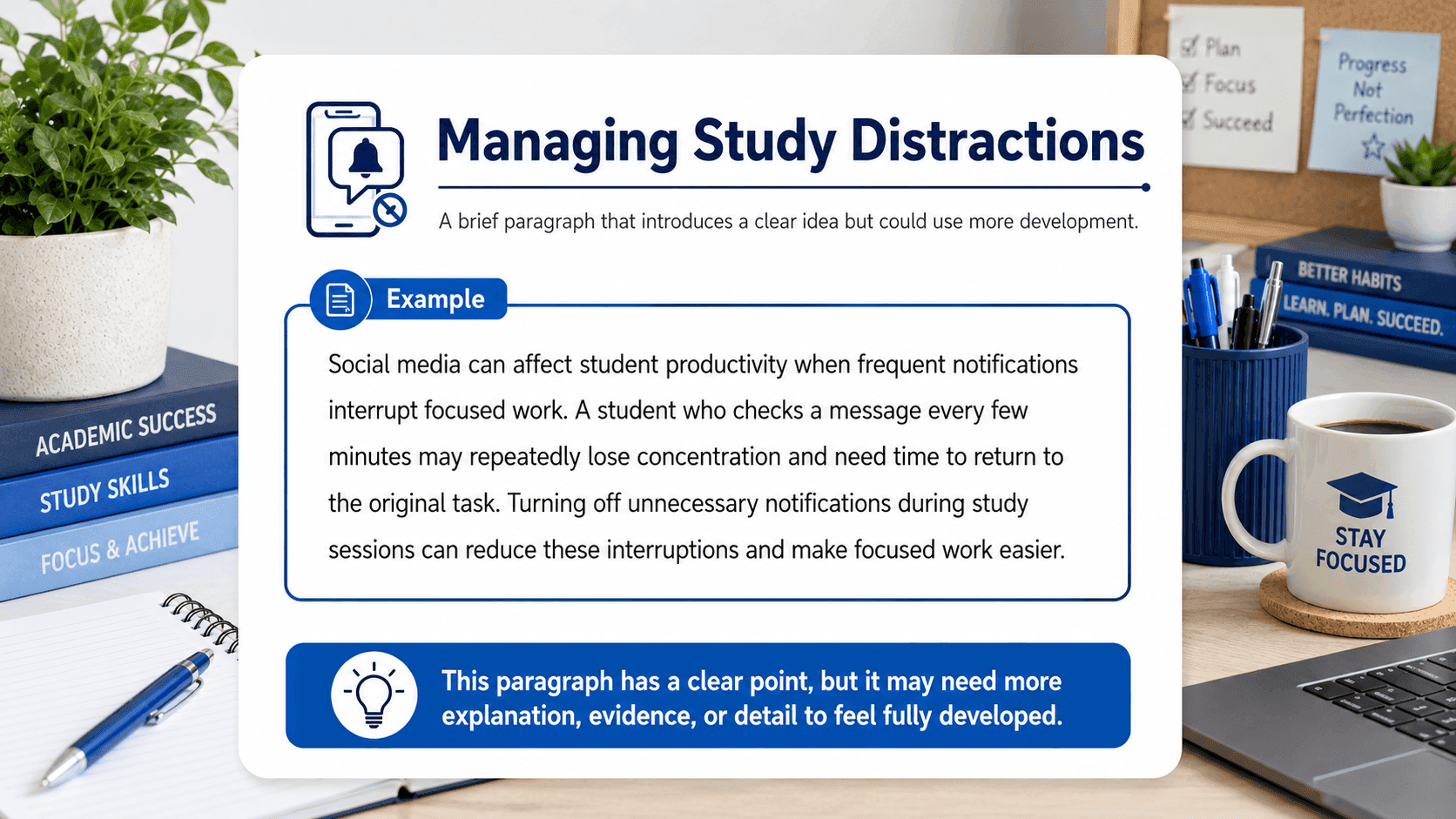
The improved version does not win because it contains three sentences.
It wins because it finishes the thought.
University of Toronto guidance makes a similar point for academic work: repeated two- or three-sentence paragraphs may signal that ideas need more development.
When Is a Paragraph Too Long?
A paragraph is too long when its length begins to hurt focus or readability. Common warning signs include:
- more than one major idea
- a clear topic change halfway through
- several unrelated examples
- a large wall of text that is hard to follow
- the reader may forget the original point before reaching the end
- part of the paragraph could stand alone without losing meaning
Suppose a paragraph begins by explaining why students need sleep, moves into school start times, then discusses energy drinks, then suddenly explains how caffeine is produced.
At some point, that paragraph escaped its original assignment.
Do not split a paragraph simply because it reaches six, eight, or ten sentences. Split it when the focus changes or when a logical break would make the content easier to understand.
Also check the sentences inside the paragraph.
If punctuation is the problem, the guide to comma splices shows how two complete thoughts can be joined incorrectly with only a comma.
The University of Toronto recommends checking especially long academic paragraphs for natural places where the focus shifts and a new paragraph would clarify the structure.
When Should You Start a New Paragraph?
Start a new paragraph when the reader needs a clear signal that something has changed.
Mainly, the most common reasons include:
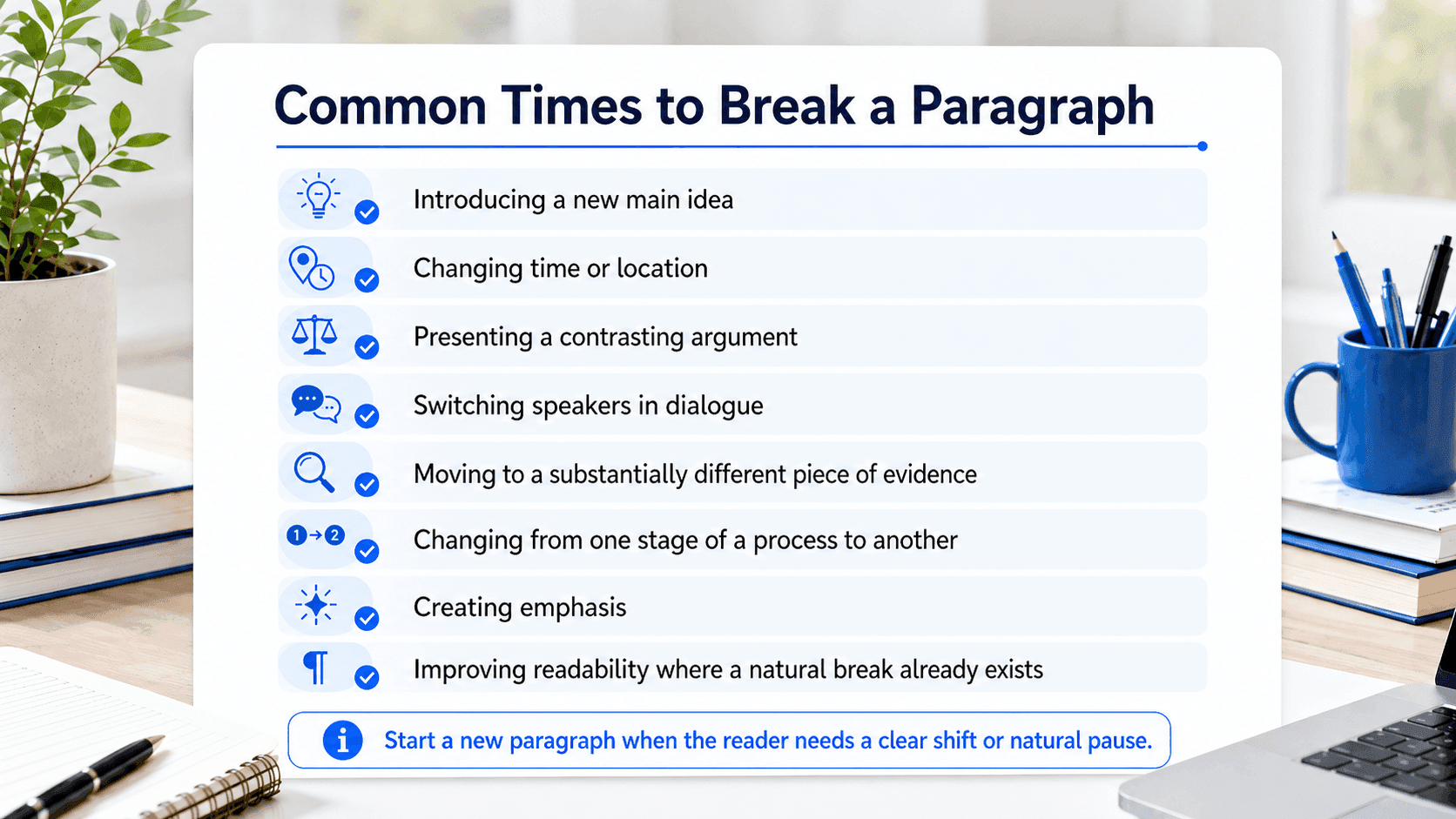
The strongest signal is usually a change in focus.
For example:
Electric cars produce no exhaust emissions while being driven. This can reduce direct air pollution in busy cities. Their overall environmental effect, however, also depends on how the electricity used to charge them is produced.
Cost is a different issue. Although some electric cars have higher purchase prices, operating and maintenance expenses may differ from those of petrol-powered vehicles.
The second paragraph begins because the discussion has moved from environmental impact to cost.
That break helps the reader see the structure at a glance.
Examples of Different Paragraph Lengths
Seeing paragraph structure in action is more useful than memorizing a number, so here are four examples.
One-Sentence Paragraph Example
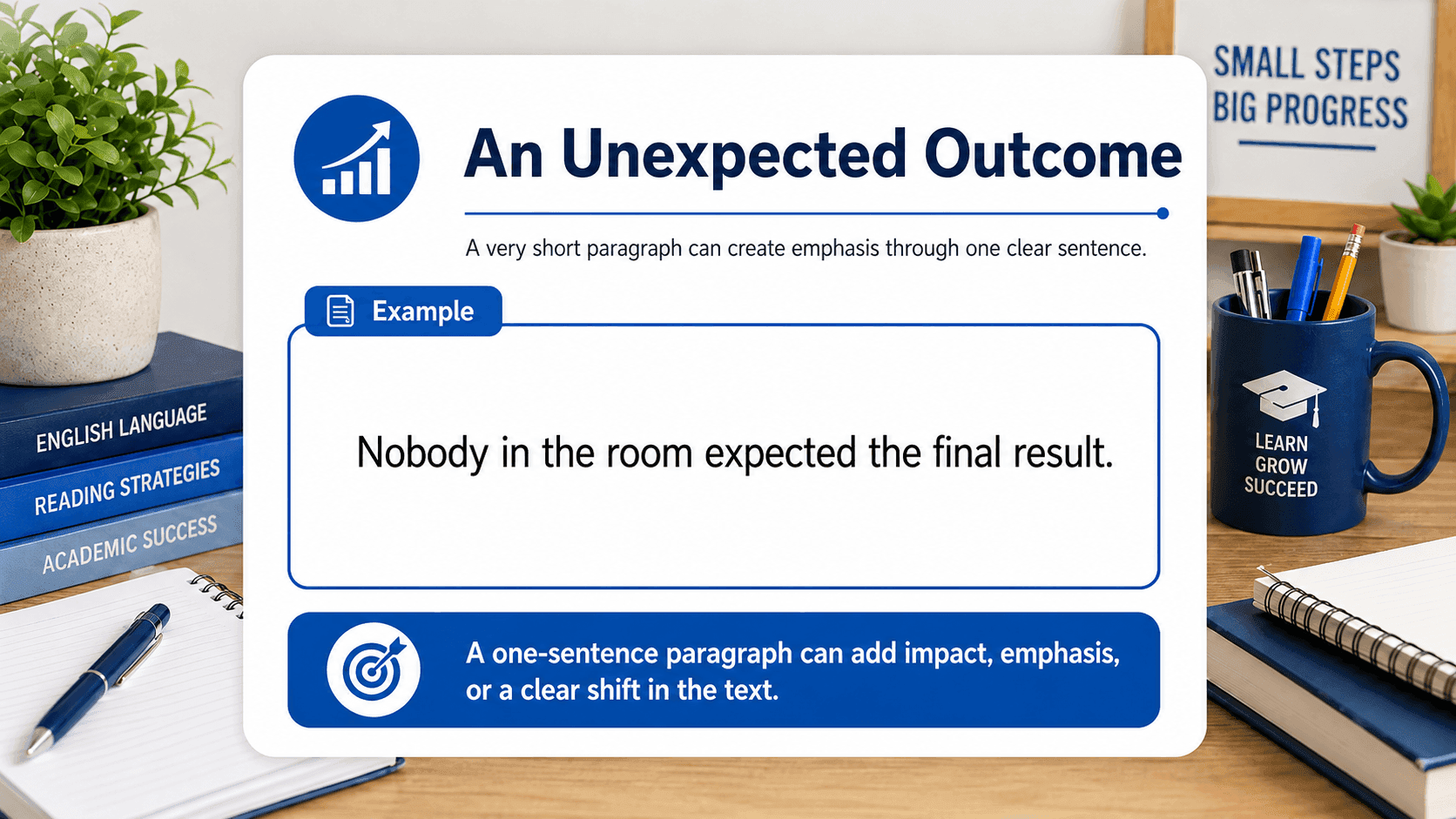
This works because the sentence is being used for emphasis.
It would be less suitable as a full academic body paragraph because there is no evidence or explanation.
Three-Sentence Paragraph Example
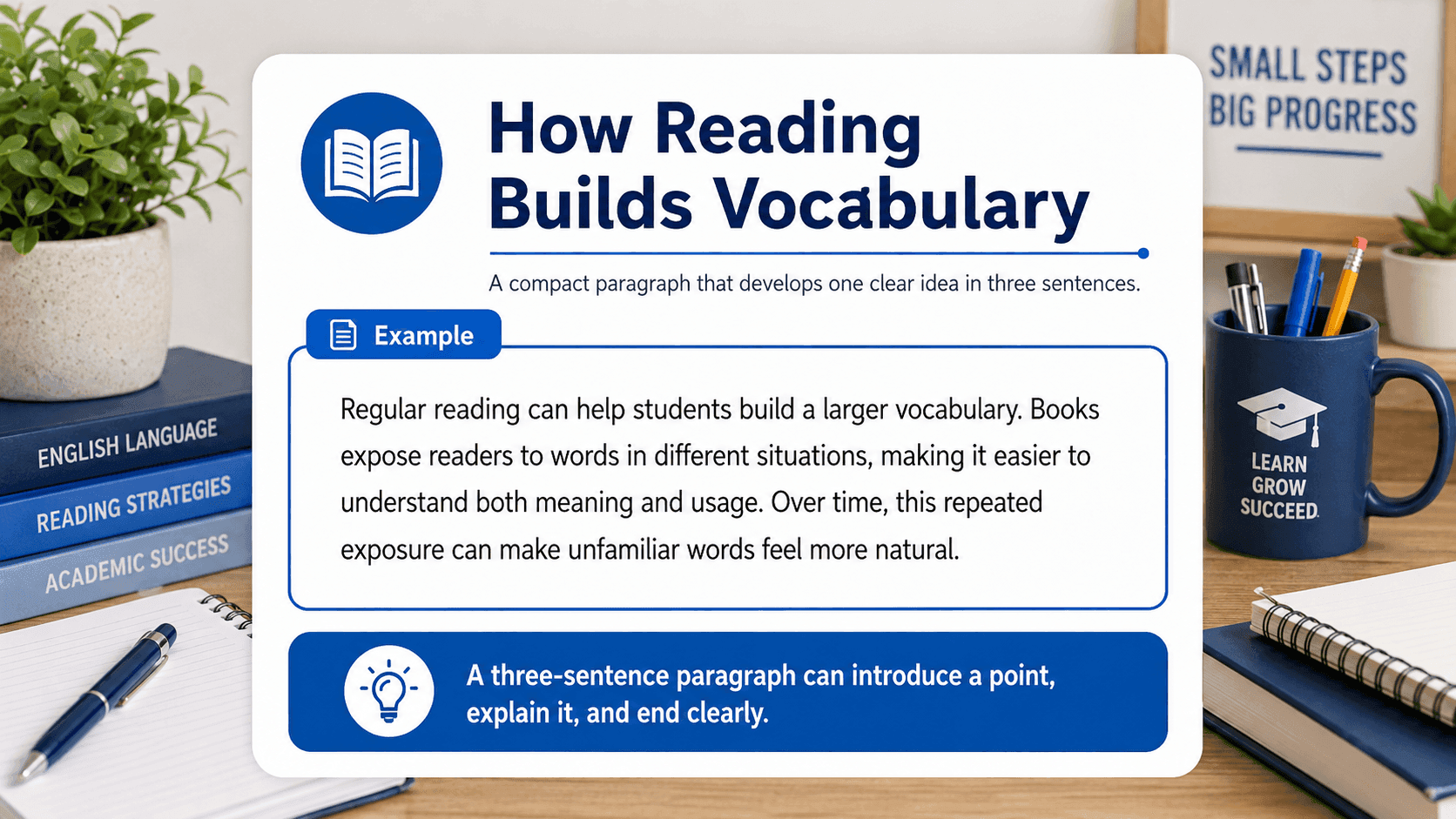
Structure:
Topic → Support → Conclusion
The paragraph is short, but the idea feels complete.
Five-Sentence Paragraph Example
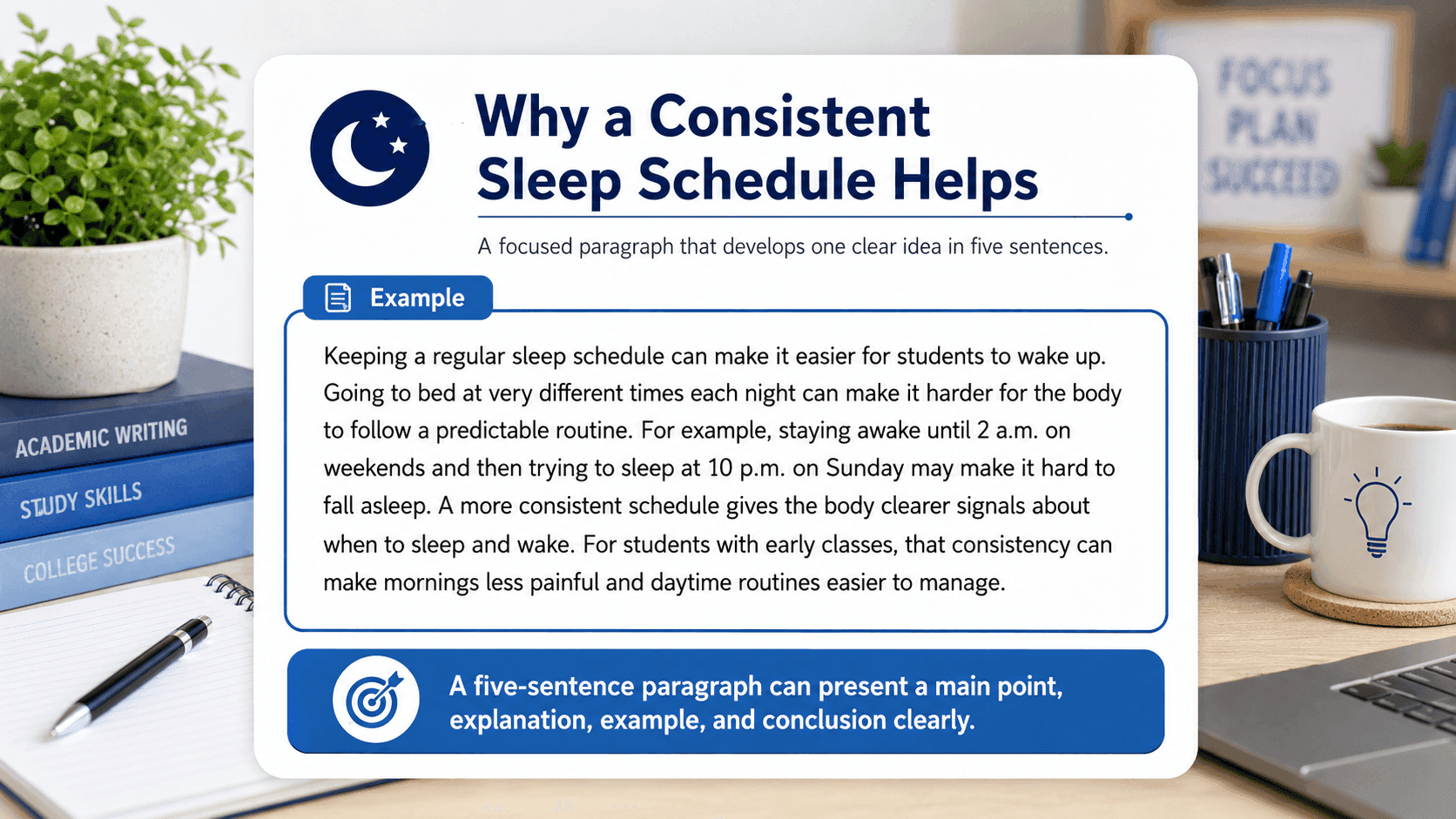
Structure:
Topic → Explanation → Example → Analysis → Connection
Notice that the paragraph works because each sentence moves the same idea forward.
Longer Academic Paragraph Example
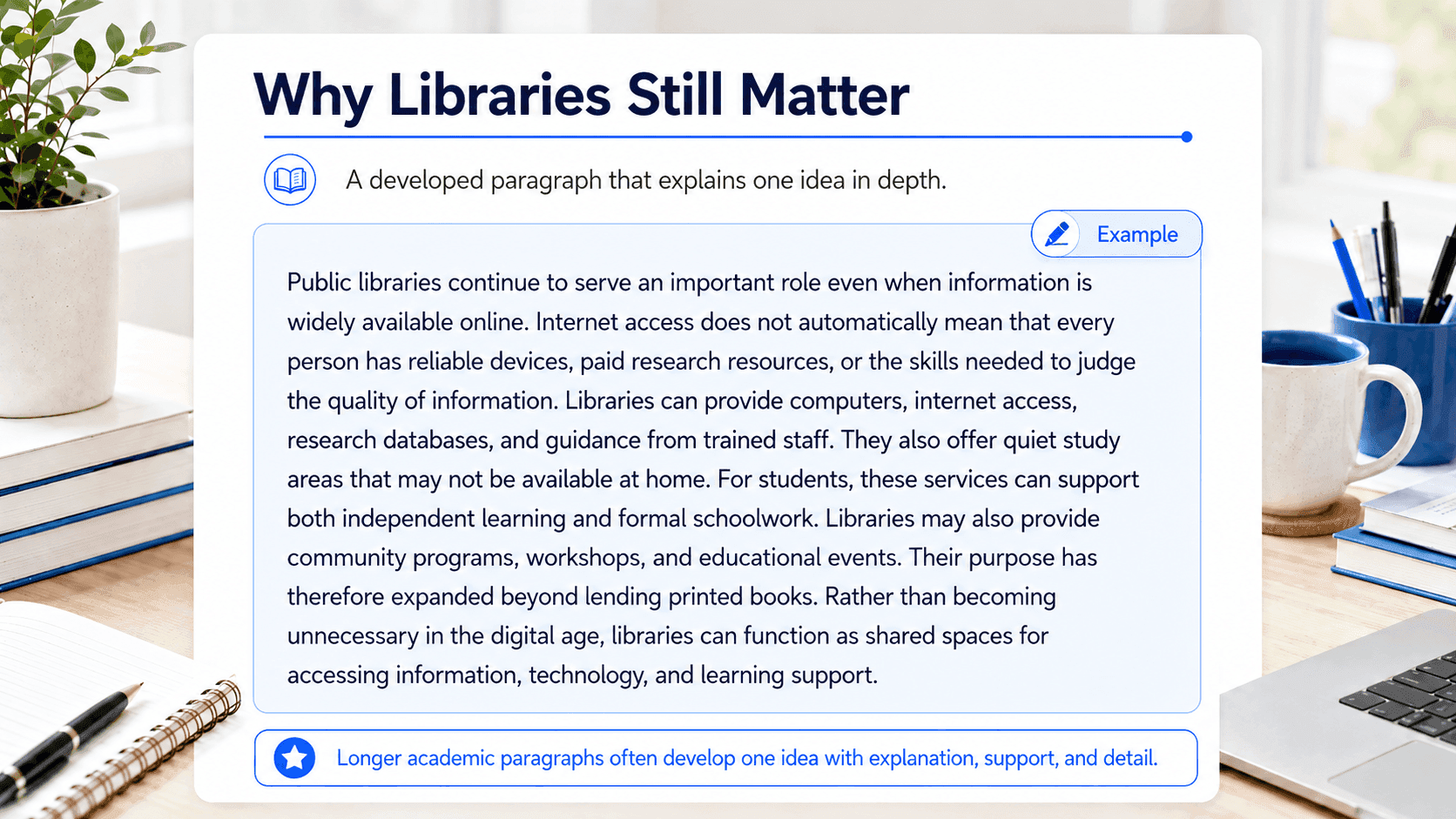
That paragraph contains eight sentences, yet it remains readable because every sentence develops the same central point: why libraries still matter.
A long paragraph is not automatically bad.
But a wandering paragraph is.
Does Paragraph Length Affect Readability?
Yes. Paragraph length can have a noticeable effect on how easy writing feels to read.
This is especially important online.
A four-sentence paragraph that looks comfortable on a laptop may take up much more vertical space on a phone because the lines are narrower.
That is why web writers often use shorter paragraphs even when longer ones would be grammatically correct.
Research from Nielsen Norman Group shows that web users often scan pages rather than read every word carefully, especially when content lacks useful formatting and includes large blocks of text.
Their eye-tracking work has found scanning behavior on both desktop and mobile screens.
Short paragraphs can make web content easier to scan, but they also have a downside.
Too many extremely short paragraphs can make writing feel:
- jumpy
- fragmented
- shallow
- repetitive
This is especially noticeable in academic writing.
Sentence length matters too. A three-sentence paragraph made from three enormous 70-word sentences may be harder to read than a six-sentence paragraph made from clear, varied sentences.
If you want to understand how sentence length and word complexity are turned into readability scores, find out the details of how a content readability checker works.
A Useful Readability Tip
After finishing a draft, look at the page rather than only counting sentences.
If you see a huge block of uninterrupted text, check whether it contains a natural paragraph break.
If you see fifteen tiny paragraphs in a row, check whether related ideas should be joined.
Paragraph breaks create visual rhythm and logical structure.
How to Know If Your Paragraph Is the Right Length?
Instead of counting every sentence like a nervous accountant, run this quick paragraph test.
Ask yourself the following questions:
- Does this paragraph discuss one central idea?
- Is that idea clearly introduced?
- Have I provided enough explanation, evidence, or detail?
- Does every sentence contribute to the main point?
- Has the paragraph shifted into a different idea?
- Would splitting it make the writing easier to read?
If the paragraph has one clear idea, develops it properly, and does not contain an unnecessary topic shift, its length is probably working.
If you are reviewing a longer essay or article, a reliable Paragraph Counter can give you a quick overview of how the text is divided before you inspect each paragraph more closely.
Here is an even shorter version to remember:
Start the idea. Develop the idea. Stop when the idea is complete.
That principle is more reliable than forcing every paragraph to contain exactly three, five, or seven sentences.
FAQs on Sentence Count in a Paragraph
Is 3 Sentences Enough for a Paragraph?
Yes. Three sentences can be enough for a paragraph if they fully develop the main point. But academic paragraphs sometimes need more because claims may require evidence and analysis.
Can a Paragraph Have 2 Sentences?
Yes. A paragraph can have two sentences. Two-sentence paragraphs are common in web writing, journalism, transitions, and other forms of concise writing.
Can a Paragraph Have 1 Sentence?
Yes. A one-sentence paragraph is grammatically valid. It can be useful for emphasis, dialogue, transitions, journalism, fiction, and web content.
Can a Paragraph Have 10 Sentences?
Yes. A paragraph can contain 10 sentences or even more. There is no maximum sentence count.
How Many Sentences Are in a Body Paragraph?
A body paragraph often contains around 4–8 sentences in academic writing, although this varies with the topic, evidence, writing level, and assignment.
How Many Words Are in a Paragraph?
There is no fixed number of words in a paragraph. A paragraph could contain 20 words or several hundred. For that reason, word count and sentence count should both be treated as rough measurements rather than definitions of what makes a paragraph.
How Long Should a Paragraph Be in an Essay?
An essay paragraph should be long enough to develop one important point and short enough to keep that point clear.
The Final Rule to Remember
So, how many sentences are in a paragraph? No single number works for every type of writing.
Three to five sentences is a useful general guideline, but a strong paragraph can be shorter or longer depending on the idea, audience, and purpose.
What matters most is whether the paragraph stays focused, gives the reader enough information, and moves naturally from one point to the next.
If you are editing an essay, article, report, or assignment and want to quickly check how your writing is structured, try CopyChecker’s Sentence Counter.
It can show how many sentences your text contains, making it easier to spot sections that may need more development, trimming, or a cleaner paragraph break.
Use the sentence count as a guide, then let clarity and complete ideas decide where each paragraph should end.