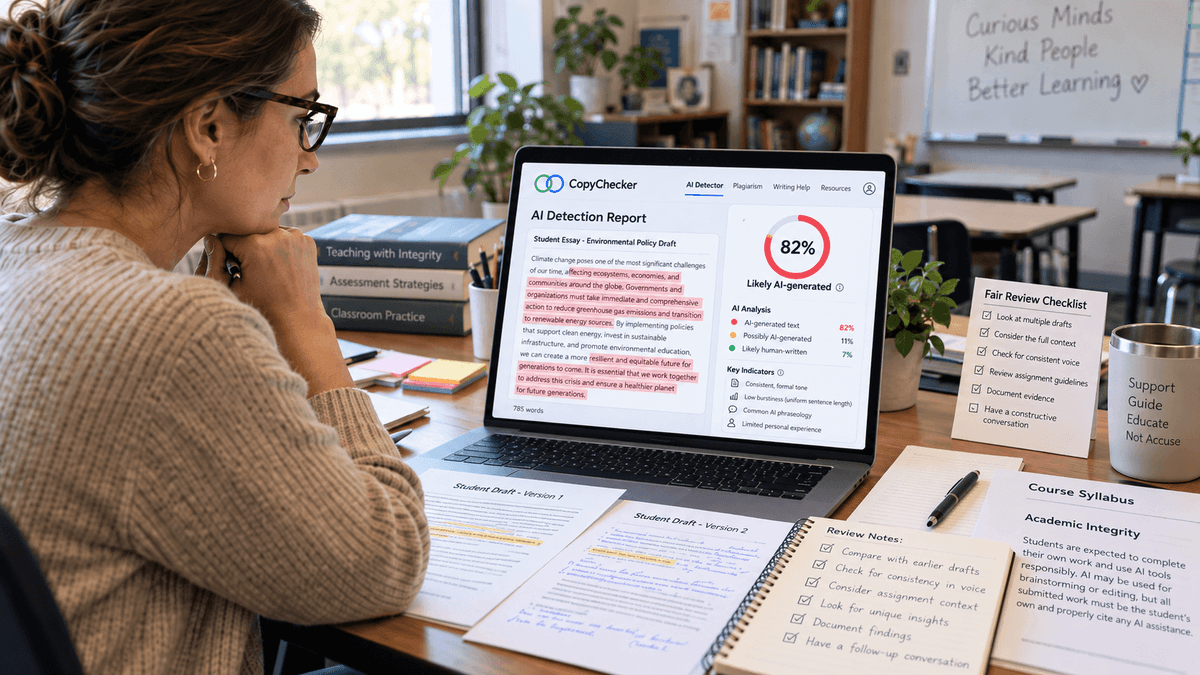
A student submits an essay.
You run it through an AI detector, and a percentage appears on the screen.
Now what?
This is where AI detection best practices for teachers matter much more than the number itself.
A detector can point out writing that deserves a closer look, but it cannot sit across from the student, ask how the paper was written, check earlier drafts, or understand what happened during the assignment.
That part still belongs to the teacher.
So, instead of waiting for a suspicious score and deciding what to do in the moment, it helps to build a clear process before the first paper is flagged.
That process does not have to be complicated.
In simple terms, teachers should:
- Set a clear classroom AI-use policy.
- Use AI detectors consistently.
- Treat the score as a signal rather than proof.
- Check other evidence around the student's writing.
- Talk to the student before reaching a conclusion.
- Record how the case was reviewed.
We will go through each of these steps one by one, because they work best as part of the same process rather than as separate rules.
And the best place to start is with the moment that usually creates the most confusion: the AI detection score itself.
A percentage can look certain on the screen, but it does not automatically tell you what happened during the student's writing process.
Before checking drafts, asking questions, or making any decision, teachers first need to understand what that score can actually tell them and, just as importantly, what it cannot -
Treat a Score as One Signal, Not Proof
Start with one rule that makes almost everything else easier:
An AI detection score should begin a review, not finish one.
Suppose an essay receives a high AI score. It can be tempting to think the percentage tells the whole story.
It does not.
AI detectors look for patterns that may be associated with AI-generated writing.
However, they do not directly observe who wrote the paper or how it was created.
Even Turnitin tells educators that its AI writing model may sometimes misidentify human-written or AI-generated text and that the result should not be used alone as the basis for taking action against a student.
That distinction is important.
A detector can essentially tell you:
“This writing deserves another look.”
It cannot reliably tell you:
“This student definitely cheated.”
A Better Way to Read the Result
When reviewing a score, ask:
- Which sections were flagged?
- Is the concern spread across the paper or limited to one section?
- Does the writing style change suddenly?
- Does the paper match the student's usual writing?
- Is there other evidence showing how the student developed the work?
If you want to understand the percentages themselves in more detail, understanding how to interpret an AI detection score can naturally help.
Quick Tip: Avoid creating automatic rules such as “Anything over 30% means AI cheating.”
A simple cutoff feels convenient, but writing rarely behaves that neatly.
Two papers with the same score may have completely different explanations.
That is why responsible AI detection in the classroom requires context.
A percentage can point you toward a concern, but the next step is to look at the evidence around the writing itself.
So, once you have reviewed the score, do not stop there.
Look at how the paper was developed, what drafts exist, whether the student has notes or version history, and whether the writing process supports what appears in the final submission.
That brings us to the next part of the review.
Combine Detection With Process Evidence
Now imagine two students both receive a similar AI detection result.
Student A can show an outline, research notes, an early draft, revision history, and feedback from a previous version.
Student B only has the final document.
The detector score may be similar, but the amount of information available to the teacher is very different. In that case a similarity checker can help to check.
That is why process evidence matters.
Instead of asking only:
“Does this paper look AI-generated?”
also ask:
“What evidence shows how this paper was created?”
Useful process evidence can include:
- early drafts;
- Google Docs or Word version history;
- handwritten notes;
- research notes;
- outlines;
- source lists;
- teacher feedback;
- planning documents;
- previous versions of the assignment.
None of these automatically proves that AI was or was not used.
However, together they provide a much clearer picture than a detector score alone.
And this is where the process should become proactive rather than reactive.
If drafts, notes, outlines, or version history are only requested after a paper is flagged, students may not have kept them.
That makes the review harder for everyone.
So, instead of waiting for a problem to appear, make process evidence part of the normal classroom routine from the beginning.
Make Process Evidence Normal Before You Need It
Teachers should not suddenly ask students for drafts only after a problem appears.
Instead, build simple documentation into normal coursework.
For example, students might submit:
Outline → First Draft → Revision → Final Submission
Now, if a concern appears later, both the teacher and the student have something concrete to review.
You can also point students toward how students can document their writing process so they understand why keeping drafts can protect them as well as support better writing.
Classroom Fact: Process evidence is useful for more than AI detection, as it can also help teachers see how students research, revise, organize ideas, respond to feedback, and develop their own writing voice.
In other words, a good AI-review process can quietly improve writing instruction too.
Humans occasionally invent a system that solves more than one problem.
But keeping evidence of the writing process solves only one part of the problem.
Students also need to know what kind of AI use is acceptable before they begin an assignment.
Otherwise, a teacher may have plenty of evidence to review later but no clear standard for deciding whether the student's AI use actually crossed a line.
So, once you have a system for tracking how students write, the next step is to make AI expectations equally clear from the start.
Set Clear Classroom AI-Use Policy in Advance
The fairest AI case is often the one that never becomes a dispute.
And that usually starts with a clear classroom AI use policy.
Students cannot follow a rule they do not understand.
Yet unclear AI expectations are still common.
A 2026 Lumina Foundation and Gallup report found that 52% of currently enrolled college students said at least some of their courses did not have clear policies about how AI could or could not be used.
So, before the first assignment, explain three things.
1. What AI use is allowed?
For example:
- brainstorming;
- generating practice questions;
- explaining difficult concepts;
- checking grammar;
- suggesting an outline.
2. What AI use must be disclosed?
Students might be required to mention when they used AI to:
- reorganize writing;
- improve wording;
- develop ideas;
- summarize research;
- receive feedback.
3. What AI use is prohibited?
For example:
- generating the complete assignment;
- submitting AI-written paragraphs as original work;
- inventing citations;
- using AI where the assignment specifically tests independent writing.
The exact policy can vary by school, subject, assignment, and institution.
What matters is that students know the expectations before they submit their work.
A policy only helps when students can clearly understand it and easily return to it whenever they are unsure.
That means the next step is to -
Make the AI Usage Policy Easy to Find
Do not explain the AI policy once during the first class and expect everyone to remember it fourteen weeks later.
Put it somewhere students can return to:
- the course syllabus;
- assignment instructions;
- the learning management system;
- an academic integrity page.
You can even add a short reminder beside major assignments.
AI reminder: Check the course AI-use rules before submitting. If AI tools were used in an allowed way, disclose that use as required.
Clear expectations make later conversations much easier because the question becomes:
“Did the submitted work follow the policy we already agreed on?”
rather than:
“What should the rule be now that something has happened?”
Once those expectations are clear, the next challenge is making sure they are applied fairly.
A good policy can still create problems if one student is reviewed closely while another is treated differently for the same kind of work.
So the classroom process should not only be clear, but also consistent from one student to the next. That is why -
Use the Same Detection Process for Every Student
Consistency is an overlooked part of how teachers should use AI detectors.
Imagine scanning one student's essay because their writing suddenly seems unusually polished, while another student's paper is never checked.
Even if the teacher has good intentions, the process can become inconsistent.
A better approach is to decide your detection procedure ahead of time.
For example:
All essays in this assignment are checked using the same AI detector and reviewed under the same classroom policy.
That gives students a common standard.
If you use any reliable AI Detector, the important part is not simply running the scan. It is using the same review method each time.
That means the detector supports your process rather than becoming the process itself.
Think of an AI detector like a smoke alarm.
A smoke alarm tells you something might require attention.
You would not see an alarm blinking and immediately declare the building destroyed.
You investigate.
AI detection deserves the same basic logic.
And that brings us to the next question.
Once a paper is flagged, what should that investigation actually include?
A fair review should follow the same basic steps every time, so teachers don't make decisions based on instinct, pressure, or one percentage on a screen.
What Is a Fair Process for Reviewing a Flagged Paper?
Suppose a paper is flagged.
This is where teachers often need a repeatable process.
A fair process for reviewing flagged papers can look like this:
| Step | What the Teacher Does | Why It Matters |
|---|---|---|
| 1. Review the report | Look at the flagged passages, not only the percentage | Shows where the concern actually appears |
| 2. Check the policy | Confirm which classroom AI rules apply | Keeps the review connected to established expectations |
| 3. Look for process evidence | Review drafts, notes, outlines, or version history | Gives context about how the paper developed |
| 4. Compare carefully | Look at earlier writing where appropriate | May reveal changes worth discussing |
| 5. Speak with the student | Ask about the writing process without starting with an accusation | Gives the student a chance to explain |
| 6. Review everything together | Consider the detector result, evidence, conversation, and policy | Prevents one signal from becoming the entire case |
| 7. Record the outcome | Note what was checked and what decision was made | Helps maintain consistency |
This process also creates a useful pause between seeing a score and making a decision.
That pause matters.
If you suspect the result itself may be wrong, AI Detection False Positives Teacher's Guide can help you review that possibility more carefully.
Once you have checked the report, policy, and available writing evidence, the next step is usually a conversation with the student.
But that conversation should not begin the moment a score appears on the screen.
A few simple checks beforehand can help you enter the discussion with better context, clearer questions, and fewer assumptions -
Check These Things Before Talking to the Student
Talking to a student about AI detection should not begin five seconds after opening the detector report.
Do a short review first, and here's a Pre-Conversation Checklist to make things easier for you -
| Before the Conversation | Check |
|---|---|
| I reviewed the highlighted passages rather than only the overall score | ☐ |
| I checked which classroom AI policy applies | ☐ |
| I reviewed available drafts or version history | ☐ |
| I checked relevant notes, outlines, or research evidence | ☐ |
| I considered whether a false positive could be possible | ☐ |
| I prepared questions rather than accusations | ☐ |
If several boxes are still empty, you probably need more information before raising the concern.
Once those checks are complete, you are in a much better position to speak with the student fairly.
At that point, the goal is not to catch them saying the wrong thing.
It is to understand how the work was created and whether their explanation matches the evidence you already reviewed.
That makes the way you open the conversation especially important.
So, let’s talk about -
How to Talk to a Student About a Flagged Score
This conversation can determine whether the student feels invited to explain or forced to defend themselves.
Compare these two openings.
Accusatory
“Your essay was detected as AI-generated. Why did you use AI?”
That sentence already assumes the conclusion.
Now compare it with:
Neutral
“This section was flagged by our AI detector. Can you walk me through how you approached writing it?”
The second version opens a conversation.
From there, you might ask:
- How did you begin the assignment?
- What sources did you use?
- Do you have an earlier draft?
- How did this paragraph change during revision?
- Did you use any AI tools while working?
- If so, what did you use them for?
- Can you explain this argument in your own words?
These questions are useful because a genuine writing process usually has a story behind it.
Students remember why they chose an example, where an argument came from, what part they struggled with, or how a paragraph changed.
However, no single answer should automatically determine the outcome either.
The point of talking to a student about AI detection is to gather context, not stage a confession scene from a courtroom drama.
Teacher tip
Keep the discussion focused on the work and the process, not on the student's character.
Say:
“I want to understand how this assignment was created.”
rather than:
“I don't believe you wrote this.”
That small change can make the conversation much more productive.
Document the Review Process for Fairness
After the conversation, write down what happened.
The record does not need to become a five-page report.
A simple note can include:
- assignment name;
- date reviewed;
- detector result;
- sections reviewed;
- process evidence checked;
- questions discussed with the student;
- relevant classroom policy;
- final outcome.
Why bother?
Because memories become fuzzy, semesters become busy, and similar cases may appear later.
Documentation helps you check whether students are being treated under the same process.
It can also help if a student, parent, administrator, or academic integrity office later asks how the decision was reached.
A Standing Classroom AI Detection Checklist
The easiest way to follow AI detection best practices for teachers is to make them part of the normal course routine.
Here is a simple system.
| Step | When to Do It |
|---|---|
| Publish a written classroom AI-use policy | Start of the term |
| Explain allowed, disclosed, and prohibited AI use | Before major assignments |
| Apply the same detection process across comparable submissions | During assessment |
| Review highlighted sections rather than relying only on the score | Whenever a result needs review |
| Check drafts or other process evidence | Before contacting the student |
| Consider the possibility of a false positive | Before reaching a conclusion |
| Start the student conversation neutrally | During the review |
| Consider the detector, evidence, conversation, and policy together | Before deciding |
| Record what was reviewed and discussed | After the case |
| Revisit the classroom policy as AI tools change | During course or syllabus updates |
Save this checklist somewhere accessible.
Once the process becomes routine, teachers do not need to invent a new response every time a detector raises a concern.
More importantly, the checklist helps keep serious decisions tied to the same review process rather than to one score or one moment of suspicion.
That becomes especially important when the possible outcome could affect a student's grade or lead to an academic misconduct decision.
So, after building a fair review process, there is one question teachers should answer clearly -
Should a Teacher Fail a Student Based on an AI Detector Score Alone?
No.
A detector score alone should not determine whether a student fails an assignment or receives an academic misconduct penalty.
AI detection tools provide information that can support a review, but the result needs context.
Turnitin itself states that its AI detection result should not be used as the sole basis for adverse action and says further review and human judgment are needed.
So, before deciding on a penalty, review:
Detection result + classroom policy + writing process + supporting evidence + student
explanation
That creates a much stronger decision-making process than simply applying:
Score = punishment
FAQs
How should teachers use AI detectors?
Teachers should use AI detectors as one part of a wider review process that also considers classroom policy, writing evidence, drafts, and the student's explanation.
Should a teacher fail a student based on an AI detector score alone?
No. AI detector score should not be treated as standalone proof of academic misconduct.
What is a fair process for reviewing a flagged paper?
Review the flagged passages, check the course policy and writing evidence, speak with the student, and then consider all available information before deciding.
How should classroom AI policy be communicated?
Put the policy in writing at the start of the term and clearly explain what AI use is allowed, what must be disclosed, and what is prohibited.
What should teachers do before talking to a student about AI detection?
Review the flagged passages, classroom policy, drafts, version history, and other available writing evidence before starting the conversation.
Can AI detectors make mistakes?
Yes. AI detectors can produce false positives and false negatives, which is why results need human review and supporting evidence.
What should a teacher say when an essay is flagged?
Start neutrally by explaining what was flagged and asking the student to describe how they developed and wrote the assignment.
Final Takeaway
The best classroom AI-detection system is not the one that catches the highest number of students.
It is the one that teachers can apply clearly, consistently, and fairly.
Start with a classroom AI-use policy.
Then make sure students understand it.
When you use a detector, treat the result as one signal.
Review the actual flagged writing, check the student's process evidence, and talk with the student before reaching a conclusion.
Finally, document what happened and use the same basic process the next time.
That is what responsible AI detection in the classroom looks like.
The technology will keep changing.
Detector models will change. Student use of AI will change too.
A fair process, however, gives teachers something much more stable to work with.
Give your class a consistent standard by running submissions through CopyChecker's AI Detector the same way, every time, and then using the result as the beginning of a careful review rather than the end of one.