Think of it as if you have just finished the essay.
The references are there.
The file is named FINAL_final_v3_really-final.docx.
All good; now comes the part nobody enjoys, and that is the final check before submission.
Did you cite every source?
Is that paraphrased paragraph different enough from the original?
Is the similarity score okay?
What about the AI tool you used to fix a few awkward sentences?
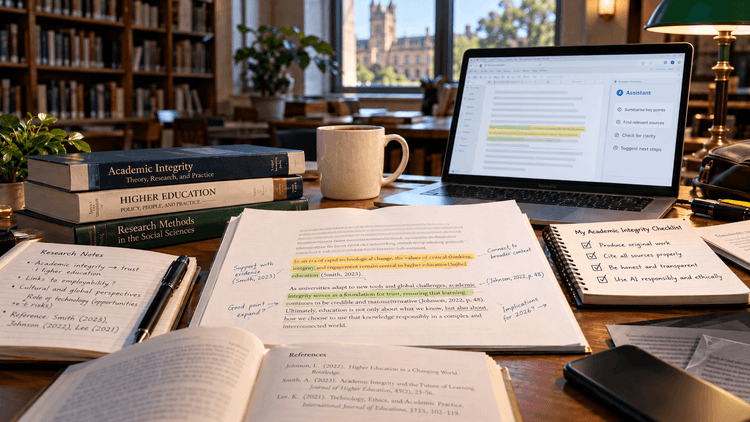
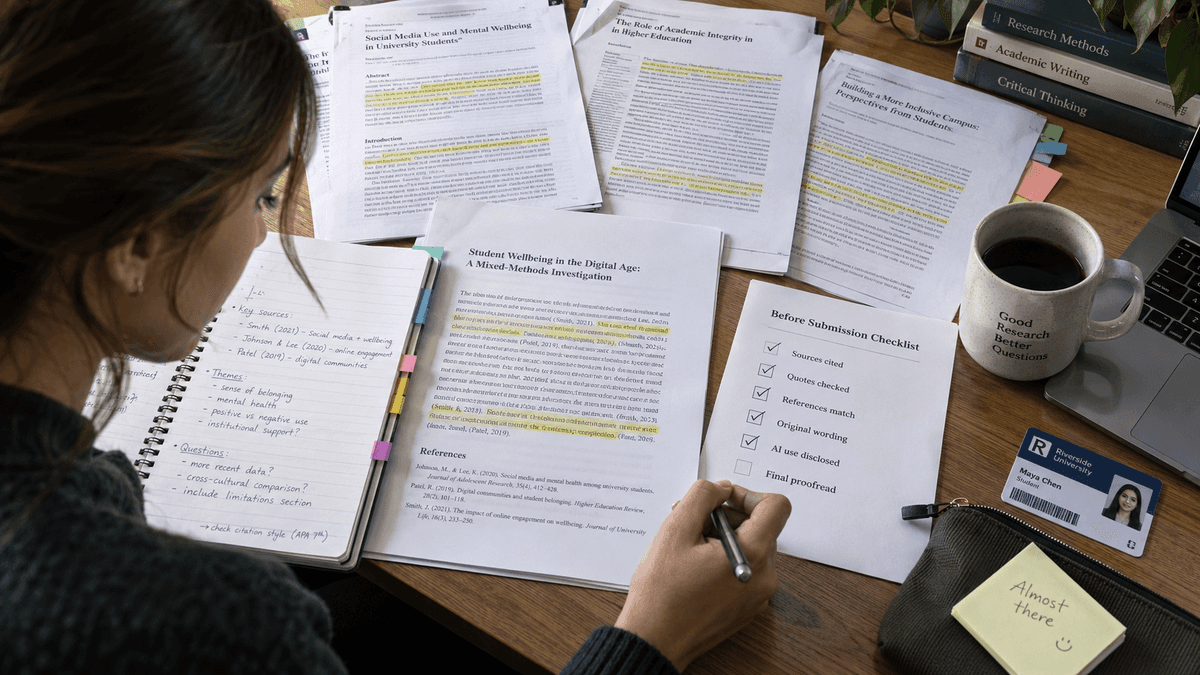
This academic integrity checklist for students helps you answer those questions before you hit Submit.
It works for essays, research papers, reports, dissertations, theses, and most other academic assignments.
And no, the goal is not to reach some magical 0% plagiarism and 0% AI score.
The goal is much simpler!
You just have to make sure the work is yours, your sources are clear, and anything that helped you write it follows your course rules.
That means checking more than just citations or a similarity percentage.
You also need to think about paraphrasing, AI use, outside help, and whether you can show how your work developed.
This checklist walks you through each of those areas, so let’s see -
What's in This Checklist?
- The 60-Second Academic Integrity Check
- Citations and Sources
- Paraphrasing
- Plagiarism and Similarity Reports
- AI Rules and Disclosure
- AI Detection Results
- Proof of Your Writing Process
- Collaboration and Outside Help
- Final Submission Checks
- Quick FAQs
You can work through the full checklist from top to bottom, or jump straight to the section you are unsure about.
But if your deadline is already staring at you, start with the quick check below without any second thought -
The 60-Second Academic Integrity Check
Before you go through everything in detail, use this as a quick final scan.
If you can confidently check every box, you are probably ready to move on to the final submission review.
If something makes you hesitate, the sections that follow will show you what to look at more closely.
- I cited ideas, facts, quotes, data, and other material taken from sources.
- My reference list matches the sources I actually used.
- I paraphrased ideas properly instead of only swapping a few words.
- I reviewed my plagiarism or similarity report.
- I checked individual matches instead of judging my work only by the percentage.
- I re-read my assignment's rules about AI tools.
- Any AI assistance I used was allowed.
- I disclosed AI use if my instructor or university requires it.
- I reviewed any AI detection results in context.
- I followed the rules for group work and collaboration.
- I saved drafts, notes, or version history showing how my work developed.
- I am submitting the correct final file.
Unchecked something?
That does not automatically mean you have a problem.
It means that part deserves another look before submission.
And before we go through each of those checks one by one, it helps to understand what they are actually protecting you from.
Academic integrity is broader than avoiding copied text or getting a low similarity score.
It is about being clear about what work is yours, where outside ideas came from, and what kind of help you used along the way.
That is why the first thing to get straight is what academic integrity really means.
Why Academic Integrity Isn't Just About Not Cheating?
Academic integrity is often reduced to one rule, and that is don't copy someone else's work.
That is important, but it is only part of the picture.
Academic integrity also means being clear about where ideas came from, what work you completed yourself, what help you received, and whether that help was allowed.
A student can run into problems like unintentional plagiarism without deliberately trying to cheat.
You might:
- forget an in-text citation;
- paraphrase a source too closely;
- reuse part of an old assignment without permission;
- collaborate when an assignment requires individual work;
- use an AI tool in a way your instructor does not allow.
So think of academic integrity less as a trap and more as a record of how you created your work.
Once you look at it that way, the final review becomes much less confusing.
Instead of worrying about whether you have somehow “passed” academic integrity, you can simply check the parts of your work that matter: where your ideas came from, how you used them, what help you received, and whether everything followed the rules.
We have already done the quick scan.
Now, let’s go back through those areas one by one and make sure nothing important has been missed.
The Complete Pre-Submission Checklist
Think of this as your final walk-through before submission.
We’ll start with the easiest parts to verify, like citations and sources, then move into paraphrasing, similarity reports, AI use, outside help, and finally the last submission checks.
You do not need to fix everything at once.
Just work through each section, deal with anything that looks unclear, and move on when you are confident it is in order.
Step 1: Check Every Citation and Source
Start with the basics.
Go through your paper and ask:
- Did I cite every borrowed idea, fact, statistic, image, table, or piece of data?
- Are direct quotes inside quotation marks or formatted correctly?
- Does every in-text citation point to the correct source?
- Does every source in my reference list actually appear in the paper?
- Am I using the citation style my course requested?
- Did I open important sources and confirm that they actually support what I said?
If formatting the references is the part slowing you down, a citation generator can build APA, MLA, Chicago, and Harvard citations quickly.
Just give the final result a quick check before adding it to your paper.
Quick tip: Do not check only the bibliography. A perfect reference list cannot rescue a paragraph that uses someone else's idea without an in-text citation.
Using previous work?
Reusing part of an older assignment may still be restricted even though you originally wrote it. It’s mainly known as self plagiarism.
So don’t forget to check your course policy before submitting it again.
Step 2: Make Sure Your Paraphrases Are Actually Paraphrases
This one catches a surprising number of students.
Changing:
"Students experience increased pressure during examination periods."
into:
"Students face higher pressure during exam periods."
is not much of a paraphrase.
The sentence changed clothes. It did not change identity.
A proper paraphrase should explain the idea using your own wording and sentence structure, while still crediting the original source.
If that sounds harder than it should, rewriting the idea in your own structure is the part worth slowing down for.
Check:
- Did I understand the source before rewriting it?
- Did I change both the wording and structure?
- Did I keep the original meaning accurate?
- Did I cite the source after paraphrasing it?
When writing stays too close to the source, it is sometimes called patchwriting.
A paraphrasing tool can help you explore different wording, but it still does not replace your own understanding or the citation the source needs.
If you are unsure whether your rewrite is still too close to the source, check that before you submit.
Step 3: Review Your Plagiarism or Similarity Report
Running a plagiarism checker is useful.
Looking only at the big percentage and closing the tab is considerably less useful.
A similarity score tells you that parts of your text resemble material found elsewhere. It doesn't automatically mean plagiarism happened.
Turnitin, for example, explains that its Similarity Report compares writing against its databases and highlights matching text. It does not simply determine whether a paper is plagiarized.
So check:
- Did I open and review the matched passages?
- Are legitimate quotations correctly cited?
- Are common phrases creating harmless matches?
- Is any uncited sentence unusually close to a source?
- Do I need to rewrite, quote, or cite anything more clearly?
Quick Reality Check
A low similarity score is not automatically safe. A high score is not automatically plagiarism.
Proper quotations, references, and commonly used phrases can all create legitimate matches.
Instead of chasing one perfect number, ask why each meaningful match exists.
Still wondering whether your similarity percentage is actually a problem?
That breakdown will help you read the number in context.
Step 4: Re-Read the Assignment's AI Policy
Used ChatGPT to brainstorm?
Used an AI writing assistant to improve grammar?
Asked a tool to summarize a difficult source?
Before deciding whether that is acceptable, check the actual rules.
AI policies can vary between universities, courses, instructors, and even individual assignments.
Check:
- Does the assignment allow generative AI?
- Are brainstorming or outlining allowed?
- Can AI be used for grammar or editing?
- Is AI-assisted rewriting allowed?
- Are AI-generated paragraphs prohibited?
- Does your instructor require disclosure?
- Am I allowed to upload the information in my assignment to the AI tool I am using?
That last question matters if your work contains personal information, confidential material, unpublished research, participant data, or restricted documents.
Important: Do not assume that "I only used AI for editing" automatically means disclosure is unnecessary.
If the instructions are unclear, ask your instructor. Your class group chat's resident expert who is "pretty sure" is not an academic policy.
Step 5: Disclose AI Assistance When Required
Using AI and plagiarism are not exactly the same issue.
Plagiarism generally involves presenting someone else's words or ideas without proper acknowledgment.
Improper AI use can happen when you use AI in a way that breaks an assignment or course rule, even if you did not copy another person's work.
They can overlap, but they are not identical. In fact, AI and plagiarism two checks are answering different questions, even when both are used before submission.
If AI use was allowed, check:
- Did I disclose the tool where required?
- Did I explain how I used it if required?
- Did I verify facts, quotations, references, and data suggested by AI?
- Did I keep relevant prompts or outputs if my course asks for them?
AI can produce a reference that looks impressively academic while having only a distant relationship with reality.
Verify it yourself.
Step 6: Review AI Detection Results in Context
Students often ask:
What AI percentage is safe?
There is no universal number that guarantees an assignment is acceptable.
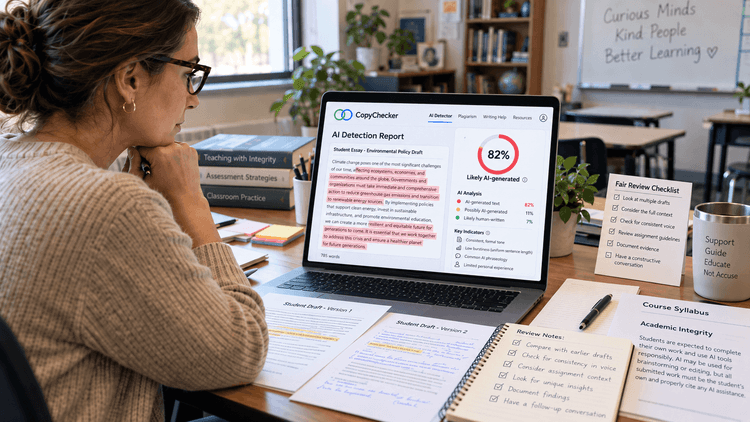
An AI detector estimates whether writing contains patterns associated with generated text.
It does not know your writing process, your university rules, or whether you wrote a sentence at 2:13 a.m. while surviving on instant coffee.
Even Turnitin states that its AI detection model can misidentify writing and should not be used as the sole basis for taking action against a student.
Human judgment and academic policy still matter.
Check:
- Did I review the passages that were flagged?
- Can I explain how I wrote them?
- Does my actual AI use follow the assignment policy?
- Am I treating the score as a signal rather than a verdict?
If you are still trying to decide whether an AI detector score is too high, the full breakdown explains why the number needs context.
And if something you genuinely wrote yourself gets flagged, there are several reasons that can happen besides actual AI use.
Step 7: Save Proof of Your Writing Process
Do not delete every draft the second your final version looks clean.
Keep:
- research notes;
- outlines;
- reading notes;
- early drafts;
- feedback versions;
- document version history;
- relevant AI prompts or transcripts;
- source lists.
These records can help show how your ideas and writing developed over time.
That can be particularly useful if questions ever come up about authorship or permitted AI use.
It also helps to understand what usually teachers do for AI detection if authorship is questioned.
Student Tip
Use filenames that actually mean something:
Essay-v1.docx Essay-after-feedback.docx Essay-final.docx
This works considerably better than FINAL2-USE-THIS-ONE-NEW.docx, although students continue heroically testing that system every semester.
Step 8: Check Collaboration Rules and Outside Help
A friend reading your introduction is different from a friend writing your introduction.
Before submitting group-related or independently assessed work, check:
- Was collaboration allowed?
- Did another person contribute actual writing or ideas?
- Did I follow the rules for peer feedback?
- If this is group work, are contributions recorded correctly?
- Did I avoid asking or paying another person or service to complete assessed work that I was expected to do myself?
Academic integrity includes unauthorized collaboration and outside assistance, not just plagiarism and AI use.
Step 9: Do One Final Assignment Check
Now zoom out.
Before submission:
- Correct file?
- Correct module/course?
- Correct assignment?
- Word count within the allowed range?
- Required cover sheet or declaration included?
- References complete?
- AI disclosure included if needed?
- File opens properly?
- Submitted before the deadline?
Once the integrity checks are done, a final online proofreader can catch small spelling, punctuation, and grammar slips, while an essay checker is more useful if you also want to review structure before uploading the file.
But submitting the right file is only the final step.
Before you click Submit, there is one bigger question to answer: Is your work actually ready to go?
That’s why next comes -
What's Considered "Safe" Before Submission?
So, when can you finally stop checking the same paragraph for the seventh time and submit your work?
No single plagiarism percentage or AI score magically makes an assignment safe.
A low detector score is useful information, but it cannot tell you whether you followed your course rules, cited your sources properly, or actually wrote the work yourself.
A better final test is to check these four things:
1. Your Sources Are Clear
Someone reading your paper should be able to tell which ideas are yours and which came from somewhere else.
Quotes should be marked. Paraphrased ideas should still be cited. Statistics, research findings, images, and other borrowed material should lead back to the original source.
Think of citations as little signposts saying, “This idea started over here.” If the reader has to guess where something came from, revisit that part.
2. You Followed the Assignment Rules
Good academic work is not only about avoiding copied text.
Did your instructor allow AI for brainstorming? Was collaboration permitted? Were you required to disclose editing assistance? Could you reuse part of an older assignment?
The rules can change from one course or assignment to another, so “my friend did it in another class” is not much of a policy document.
Before submitting, make sure the help you used was actually allowed.
3. You Reviewed Detection Results Instead of Chasing a Perfect Score
A plagiarism checker finds a match? Open it and see why.
An AI detector flags a paragraph? Read the paragraph and think about how it was written.
Do not keep rewriting perfectly good sentences just because you are trying to push a percentage from 8% to 3% or make every warning disappear.
The useful question is not:
“How do I get the lowest possible score?”
It is:
“Is there anything in this result that I genuinely need to fix?”
That small mindset shift can save you from a lot of unnecessary last-minute editing.
4. You Can Explain How You Created the Work
If someone asked how your paper developed, could you show the process?
Your research notes, outline, sources, earlier drafts, feedback, document history, and permitted AI records can all help tell that story.
You probably will never need to produce a detective board covered in drafts and red string.
Still, keeping evidence of your writing process is a smart habit, especially for major essays, dissertations, and research work.
But before submitting, ask yourself this question -
Can I explain where my information came from, what help I used, what the detector results mean, and how this paper developed?
If the answer is yes, you are in a much better position than someone who simply sees a low percentage, closes the report, and declares victory.
A low score can look reassuring. A clear, honest writing process is far more reassuring.
That's exactly why these final checks matter.
Most students are not deliberately trying to break academic-integrity rules.
Problems often begin with something much smaller: a forgotten citation, an overly close paraphrase, an undisclosed AI tool, or help that the assignment did not actually allow.
What Can Happen If You Miss an Academic Integrity Check?
Not every mistake turns into an academic misconduct case, so there is no need to imagine an academic tribunal appearing because one comma escaped your reference list.
A missing citation might simply lead to feedback or a correction.
A more serious issue could result in a reduced mark, a request to resubmit the work, a meeting with your instructor, or an academic-integrity review.
If plagiarism is the concern, what happens after a confirmed plagiarised issue can vary by institution and severity.
What happens depends on what went wrong, how serious it was, and your university's policies.
That is why spending a few extra minutes on these checks before submission is worthwhile.
It is much easier to fix a questionable citation or clarify your AI use now than explain it after the assignment has already been submitted.
Still, some checks are easier than others.
You might know that something needs another look without knowing exactly what to do next.
Maybe your similarity score seems high, a paraphrase feels suspiciously close to the original, or an AI detector has decided that a paragraph you wrote yourself looks artificial.
In those cases, you do not need to restart the entire assignment.
Just try to focus on the part that raised the question and dig a little deeper.
Need Help With One of These Academic Integrity Checks?
You do not need to fix every possible academic-integrity issue at once.
Usually, one specific thing causes the uncertainty: a similarity score that looks too high, a paraphrase that feels too close to the source, or an AI result that doesn't make sense.
Use the guide below to match that problem with the right next step.
Each resource goes deeper into one part of the checklist, so you can focus on what actually needs attention instead of rereading the whole paper and questioning every sentence you have ever written.
So, let’s dive into it -
| Risk Area | Related Deep-Dive Article or Tool |
|---|---|
| You're worried about your similarity percentage | What Percentage of Plagiarism Is Acceptable? |
| A paraphrase feels too close to the source | Paraphrasing Vs Plagiarism |
| You're worried about an AI detection score | What AI Percentage Is Acceptable? |
| Your own writing was flagged as AI | Why Is My Human Writing Detected as AI? |
| You want to find matching text and sources | CopyChecker Plagiarism Checker |
| You want to review possible AI-written passages | CopyChecker AI Detector |
Use this page as your final checklist. Use the deeper guides when one box needs more than a yes-or-no answer.
Quick Academic Integrity FAQs
What should I check before submitting an essay or thesis?
Check your citations, references, quotations, paraphrases, similarity report, AI-use rules, required disclosures, collaboration, outside assistance, and final file. Keep drafts or version history too, especially for major assignments.
What's the difference between plagiarism and improper AI use?
Plagiarism generally involves using another person's words or ideas without proper acknowledgment. Improper AI use means using AI in a way that breaks your course or assignment rules. An assignment can involve one, both, or neither.
Do I need to disclose AI if I only used it for editing?
It depends on the assignment policy. Some courses allow AI-assisted grammar or editing, while others require students to disclose any AI assistance. Check the instructions for your specific assignment rather than assuming editing is automatically exempt.
Is a 0% plagiarism score necessary?
No. Similarity does not automatically mean plagiarism. Quotes, references, technical phrases, and correctly cited material can create legitimate matches. What matters is why the text matched and whether you handled sources correctly.
What AI percentage is safe for an assignment?
There is no universal safe percentage. Your course policy and actual writing process matter more than one detector score. Treat AI detection as a review signal, not proof.
Can human writing be detected as AI?
Yes. AI detection tools can produce false positives. If your own writing is flagged, review the passages, keep evidence of your writing process, and follow your institution's procedure if questions arise.
And now that you know what to check, there is no reason to memorize all of this every time another deadline appears.
Keep the whole process within reach with a simple one-page checklist you can save, print, and run through before every submission.
Download the Printable Academic Integrity Checklist
Want something you can keep beside you while finishing an assignment?
Grab this academic integrity checklist for students and use it as your final pre-submission check for essays, theses, research papers, reports, and other academic work.
It brings the most important checks from this guide into one quick page.
So the next time you are five minutes from a deadline, you do not have to scroll through an entire article while questioning your life choices. And here it is -
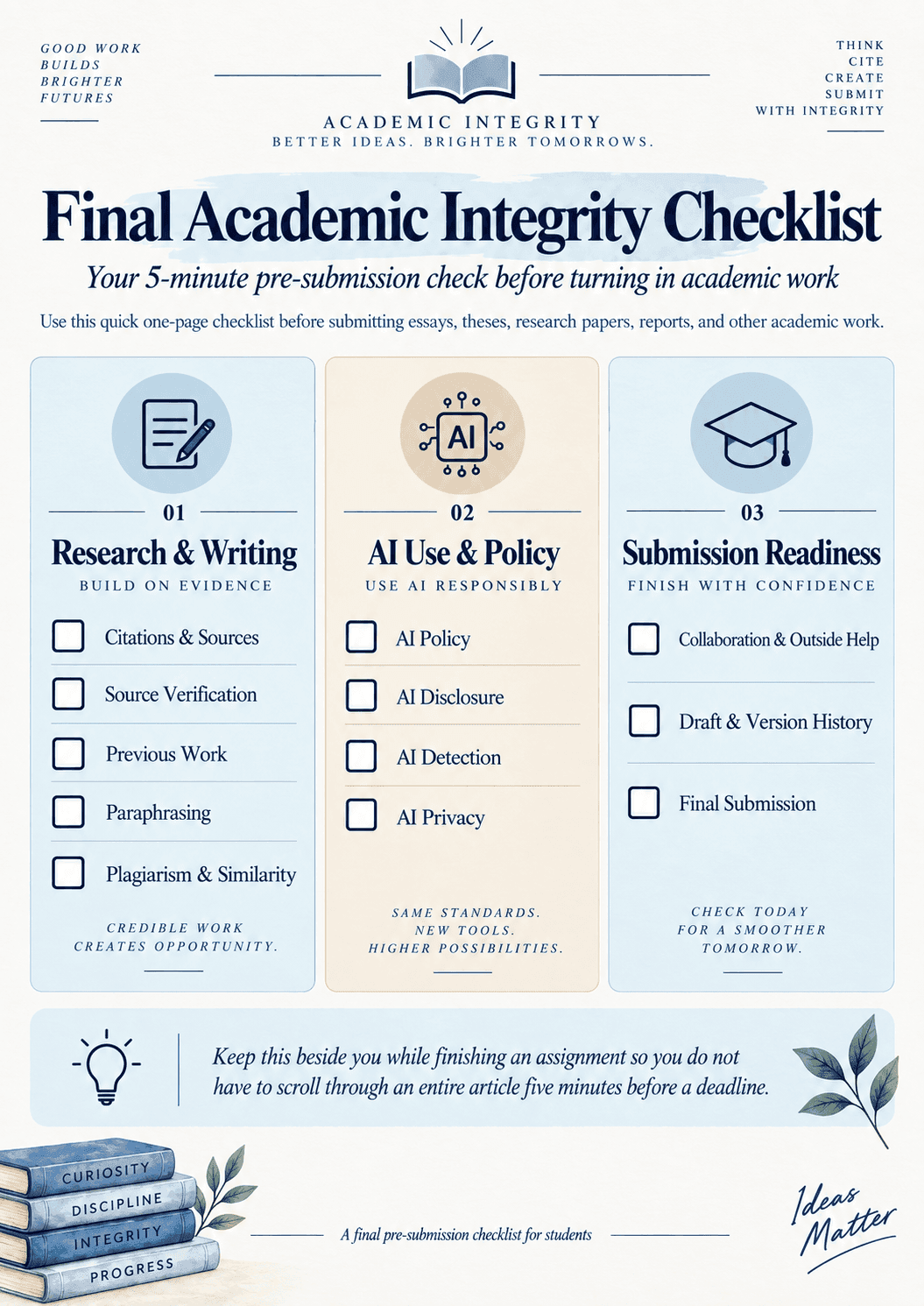
The idea is simple here, keep this checklist somewhere easy to reach and use it whenever you are about to submit an important piece of academic work.
It gives you one last chance to catch a missing citation, questionable paraphrase, forgotten disclosure, or simple submission mistake before it becomes a problem.
You do not need to remember every academic-integrity rule while racing against a deadline.
Just work through the boxes, fix anything that needs attention, and submit knowing you have checked the things that matter most.
One Last Check Before You Submit
Finished the checklist?
Run your work through CopyChecker's Plagiarism Checker to review similarity, matching passages, and available source information.
Then use the AI Detector to review passages that may show patterns associated with AI-generated writing.
Do not treat either result as a simple pass-or-fail button.
Review what was flagged, understand why, and make changes only when needed.
You can also use their Essay Checker to review essay structure, grammar, punctuation, and readability, or the Grammar Checker to catch writing mistakes that survived your final edit.
Check your sources. Check your writing. Understand the results.
Then submit with confidence.