You finish your essay at 1:47 a.m.
The citations are in place. The conclusion finally makes sense.
You read it one last time, fix a typo, and decide to run it through an AI detector before submitting.
18% AI.
Not ideal, maybe. But probably nothing to panic about.
Then curiosity gets the better of you.
You paste the exact same essay into another detector.
41% AI.
Now you're staring at the screen, wondering how your perfectly ordinary assignment managed to become twice as “AI-written” in less than two minutes.
And that leads to the question thousands of students, writers, and marketers are asking in 2026:
What AI Percentage is Acceptable?
The short answer is that no universal AI percentage is acceptable.
Whether AI use is okay depends on your university, professor, client, publisher, or workplace policy.
Even more importantly, an AI detector works with its score, which is an estimate from a particular detection model, not unquestionable proof of how much of your writing was created by AI.
That means 20% isn't automatically safe, 50% isn't automatically misconduct, and 0% isn't a magical certificate of human authorship.
Here's how to make sense of the numbers.
Is There One “Official” Acceptable AI Percentage?
No. There is no official percentage that applies everywhere.
Universities don't share one global AI rule.
Freelance clients can set their own requirements.
Google doesn't tell publishers to stay below a certain AI percentage.
Even some of the best AI detectors calculate and display their results differently.
The more useful question is:
Was AI used in a way that is allowed for this particular piece of work?
For example, Harvard Graduate School of Education says that, unless an instructor specifies otherwise, using generative AI to create all or part of an assignment and submitting it as your own violates its academic integrity policy.
It does, however, identify activities such as exploring ideas and clarifying concepts as potentially permissible uses.
Notice what neither policy says:
“Students are allowed 20% AI.”
That is the key point.
This distinction will save you unnecessary panic.
Suppose an AI detector reports 35% AI.
That doesn't necessarily mean AI literally wrote 35 out of every 100 words.
Different detectors calculate their results differently.
Some classify individual sentences.
Others estimate the probability that a document's patterns resemble AI-generated writing.
Originality.ai, for example, describes its system as a classification model trained using large collections of known human-written and AI-generated text.
GPTZero says it uses deep-learning models alongside sentence-level classification.
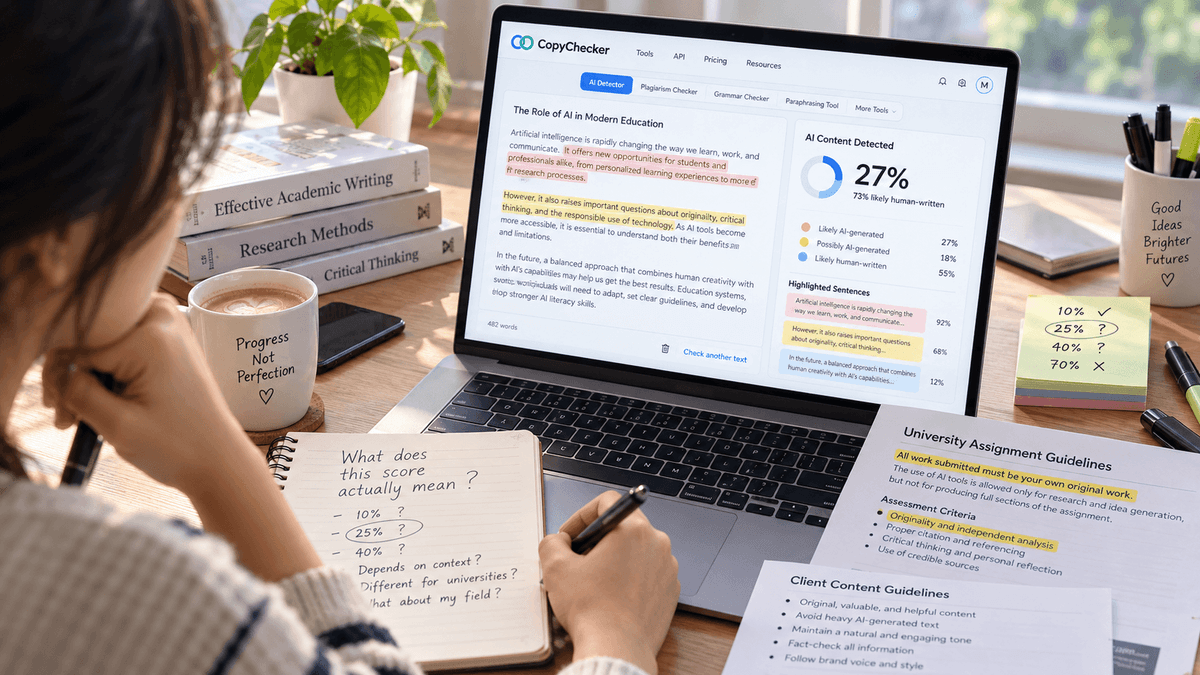
So if a detector shows 10%, 25%, or even 40%, the score alone does not tell you whether the work is acceptable.
It signals you to investigate, not a final verdict.
Here is a more practical way to think about what different AI detection scores may mean in different situations -
| Context | Practical Target | What Really Determines Whether It's Acceptable |
|---|---|---|
| Academic work where AI is prohibited | 0% intentional AI-generated submission | Course and assignment rules |
| Academic work where AI is allowed | No universal detector percentage | Permitted uses and disclosure rules |
| Content marketing / SEO | No fixed percentage | Quality, originality, accuracy, and value |
| Freelance work | Whatever the client permits | Brief, contract, and client expectations |
| Publishing | No universal percentage | Publisher/editorial policy |
Remember: these are practical guidelines, not official detector pass marks.
A human-written essay can receive a non-zero AI score, while AI-assisted writing can sometimes receive a very low score.
That's one reason the number alone should never replace context.
What AI Percentage Is Acceptable for Academic Work?
For students, this is where things become particularly important.
Your professor is unlikely to care that a random blog somewhere told you “under 20% is safe.”
They will care about the policy attached to your assignment.
Universities increasingly distinguish between different ways of using AI. For example, AI may sometimes be permitted for:
- brainstorming possible topics
- explaining a difficult concept
- generating practice questions
- correcting basic grammatical mistakes
- helping you explore ideas
But using AI to generate the analysis, argument, or paragraphs that you then submit as your own may be prohibited.
Oxford's current student guidance states that students must not present AI-generated material as their own unless the relevant department or examiners have authorized AI use for that assessment.
So before worrying about your detector percentage, ask three questions:
- Was AI allowed?
- What kind of AI assistance was allowed?
- Did I need to acknowledge using it?
Those answers matter much more than an arbitrary number.
Now that most educational institutions use Turnitin, checking the results can sometimes be fruitful.
So, the question might arise now -
What AI Percentage Is Acceptable on Turnitin?
Turnitin is probably responsible for more student anxiety per percentage point than most statistics ever created, so this deserves a closer look.
Turnitin's AI Writing Report shows the percentage of qualifying text it identifies as likely AI-generated or as likely AI-generated text later modified using an AI paraphrasing tool.
But there's an important detail.
Does Turnitin Consider Less Than 20% Acceptable?
No. Turnitin currently doesn't show an exact percentage when its AI detection result falls between 1% and 19%.
Instead, it displays *%.
Why?
Because Turnitin says its testing found more false positives in the lower range, it hides those exact scores to reduce the risk of misinterpretation.
That's very different from saying:
“Anything under 20% is approved.”
Basically, Turnitin's 20% display threshold is about reliability, not an academic allowance.
Turnitin also explicitly warns that its AI writing assessment may misidentify both human and AI-generated writing and should not be the sole basis for adverse action against a student.
Human judgment and the institution's academic policies still matter.
So, just don’t trust tools solely.
But one question remains in students' minds, and that is -
What Percentage Triggers an Academic Misconduct Review?
Honestly, there is no worldwide misconduct percentage.
A university could investigate suspected misuse at 25%, 60%, or another score.
Teachers' AI detection process usually depends on:
- its academic-integrity policy
- the assignment instructions
- the passages being flagged
- the student's drafts and writing history
- conversations with the instructor
- other available evidence
The reverse matters too.
A low detector score doesn't automatically make prohibited AI use acceptable.
Imagine two students:
Student A: Uses ChatGPT to brainstorm three thesis ideas, writes the entire paper independently, and follows the instructor's disclosure requirements.
Student B: Has ChatGPT generate an essay, heavily edits it, and receives a low detector score.
The lower percentage doesn't suddenly make Student B's process more academically honest.
Now the question can be -
What AI Percentage Is Acceptable for Content Marketing?
Students aren't the only people staring suspiciously at AI percentages.
Content writers and marketers often worry that publishing AI-assisted SEO blog writing will get a website penalized by Google.
Does Google Penalize AI-Written Content?
Not simply because AI was used.
Google's current guidance says generative AI can help with research and structuring original content.
The problem arises when automation generates many pages without adding value for users, which may violate Google's scaled-content-abuse policies.
Google advises creators to focus on:
- accuracy
- quality
- relevance
- originality
- helpfulness
Its 2026 guidance goes further, encouraging creators to produce unique, valuable, non-commodity content rather than simply repackaging information already available elsewhere, like any spinning articles.
So there is no official:
“Google-approved AI percentage = 10%.”
A useful, expert-reviewed article could score highly on an AI detector.
Meanwhile, a completely human-written article could be inaccurate, generic, and useless.
Humans were perfectly capable of publishing bad content before ChatGPT arrived.
Next comes -
How Much AI Is OK in Freelance and Client Work?
For freelancers, the most important AI detector may actually be a document nobody enjoys reading:
the contract.
If a client says:
“Do not use generative AI for this project.”
then a 5% detector score isn't permission to ignore the requirement.
If the client allows AI for research or outlining, the situation changes completely.
Upwork's current guidance recommends that freelance contracts clearly specify whether AI may be used and in what capacity, which tools are permitted, how confidential information should be handled, and who remains responsible for the final work.
So for freelancers:
The client's agreement is your real AI threshold.
If you're unsure, clarify before starting instead of hoping a detector will settle the argument afterward.
Therefore, what comes now -
Is 20% AI Acceptable? What about 50%?
Seeing a percentage on an AI detector can make the result feel more precise than it really is.
20% AI sounds manageable. 50% AI sounds much more serious.
But those numbers need interpretation before they mean anything useful.
An AI detection score generally reflects how much text a particular detector considers likely to match patterns associated with AI-generated writing.
It is not the same as saying, “20% of this document was definitely written by AI.”
That distinction matters, especially when human-written passages can still be flagged, and different detectors may score the same text differently.
So, rather than treating each percentage as a pass-or-fail mark.
Here is a practical way to understand what common AI scores may indicate and when they deserve a closer look -
0% AI
It means that particular detector did not identify qualifying text as AI-generated. It does not prove that no AI tool was ever involved.
1–19%
A low score deserves context, not panic. Turnitin treats this range cautiously because false positives are more likely. Other detectors may still show exact numbers.
20% AI
20% is not a universal safe zone. If your course prohibits AI-generated writing, a percentage doesn't override that rule. Also, if you're writing marketing content, however, Google doesn't have a rule saying “20% AI is allowed.”
50% AI
A 50% score is certainly worth reviewing, especially if you expected the document to be entirely human-written.
Check the flagged passages, your drafts, and the applicable policy.
But don't automatically interpret 50% as:
“AI definitely wrote exactly half my paper.”
So, What AI Score Is Too High?
Basically, a score becomes concerning when it conflicts with how the document was supposed to be created.
That's a much more useful definition than choosing one universal percentage.
Now that you know the requirements for different areas, let’s talk about some common issues like -
Why Do AI Detectors Give Different Percentages for the Same Text?
You've probably seen something like this:
Detector A: 12% AI; Detector B: 37% AI; and Detector C: 68% AI;
Same essay. Same afternoon. Not a single word changed.
So how can three AI detectors look at the same text and come back with such different scores?
The simple reason is that AI detectors do not use one universal formula.
Each detector is its own machine-learning system, built with different training data, models, classification methods, thresholds, and scoring rules.
Some analyze individual sentences, while others make broader judgments about patterns across a document.
They can also differ in how they handle paraphrased writing, short passages, supported languages, and newer AI models.
That means a score from one detector isn't necessarily directly comparable to a score from another.
GPTZero, for example, says its system uses deep learning trained on human, educational, web, and AI-generated text, alongside sentence-level classification.
Originality.ai describes its own model architecture and training datasets containing both human-written and AI-generated text.
Turnitin, meanwhile, uses its own proprietary system designed primarily around academic writing.
So when one essay receives three different percentages, it does not automatically mean two detectors are broken.
They may simply be applying different models and decision boundaries to the same writing.
Here are some of the main differences that can lead to conflicting results:
| Difference | Turnitin | GPTZero | Originality.ai | Why It Matters |
|---|---|---|---|---|
| Main audience | Education | Education/general use | Publishing, marketing, academic use | Their systems may be optimized for different types of writing |
| Scoring approach | Percentage of qualifying text detected | Document + sentence classification | Model-based AI confidence/classification | The numbers are not directly equivalent |
| Low-score treatment | 1–19% hidden as *% | Uses its own result system | Uses its own scoring system | A “15%” result does not mean the same thing everywhere |
| Training data | Proprietary | Human + AI datasets | Human + AI datasets | Different training examples can create different classification boundaries |
| Model updates | Ongoing | Ongoing | Multiple/updating models | The same text may score differently as detection systems change |
Think of it like three professors grading the same essay using slightly different rubrics.
One gives you 72. Another gives you 78. The third gives you 83.
That does not necessarily mean one of them has forgotten how grading works. They are judging the same work using different criteria.
AI detection has a similar problem, except the professors are neural networks.
So when two detectors disagree, don't treat the highest percentage as automatically correct or the lowest as automatically safe.
Look at the flagged passages, understand how the detector reports its result, and consider the score alongside the context in which the writing will actually be used.
Why Can Human Writing Still Get an AI Score?
AI detectors work by recognizing patterns.
Unfortunately, human writing also contains patterns because humans use language consistently enough for civilization to function.
A detector may struggle more with:
- highly predictable sentences
- repetitive structures
- very formal prose
- short text samples
- heavily edited writing
- unusual writing styles
GPTZero's own explanation shows that the distributions of human and AI writing overlap, which means classification errors are unavoidable.
Originality.ai also says AI-detection scores alone shouldn't determine academic disciplinary action because false positives remain possible.
That is why evidence such as notes, drafts, references, and document version history can matter if your authorship is ever questioned.
Can You Get 0% AI After Using AI Assistance?
Possibly.
But there's no guarantee.
Using AI to brainstorm a topic is very different from pasting AI-generated paragraphs directly into an essay.
For example, you might ask an AI tool:
“Give me five angles I could research about fast fashion.”
Then you choose one idea, research it using credible sources, develop your own argument, and write the paper yourself.
In that case, your final document might contain no AI-generated prose at all, even though AI helped during the early brainstorming stage.
If your institution allows that kind of assistance, you should also know how to cite ChatGPT or acknowledge its use properly when disclosure is required.
Still, trying to force every detector to show 0% AI shouldn't become the goal.
A better goal is:
Make sure the work genuinely represents your thinking, follows the rules of the assignment, and discloses AI assistance when required.
How to Lower Your AI Score Without Ruining Your Writing
If a draft contains too much AI-generated material, don't start swapping random synonyms until the paragraph sounds like a thesaurus suffered a head injury.
Improve the writing itself.
Rewrite From Your Own Understanding
Read the idea, move away from the generated answer, and explain it yourself by paraphrasing without any kind of issues.
If you can't explain the point without looking at the AI response, you probably don't understand it well enough yet.
1. Add Specific Examples and Original Insight
Generic:
Social media has changed communication significantly.
More useful:
A student group project that once required four people to find the same free hour can now be coordinated through a WhatsApp poll before anyone leaves the lecture hall.
Specificity makes writing more useful and gives it your perspective.
2. Change the Thinking, Not Just the Words
Replacing:
“important” with “significant”
Is definitely not meaningful rewriting.
Ask instead:
- Do I agree with this claim?
- What evidence supports it?
- What's missing?
- Can I challenge it?
- What example would make it clearer?
3. Fact-Check AI-Generated Claims
Never blindly trust:
- statistics
- quotations
- citations
- publication dates
- research findings
AI can produce confident-looking information that doesn't survive a thirty-second source check.
4. Keep Good Academic Language
Don't deliberately make your essay clumsy because you're afraid formal writing will trigger a detector.
Clear academic writing is still the goal.
You can take help from any reliable essay checker to make things easier for yourself.
5. Disclose AI Use When Required
If your university or client requires disclosure, disclose it.
A transparent two-line declaration is considerably safer than trying to play hide-and-seek with six detection tools.
FAQs about What AI Percentage Is Acceptable
Is 20% AI acceptable?
No universal rule says 20% AI is acceptable. Turnitin's 20% threshold relates to how it displays lower-confidence detection results, not an academic permission limit.
Is 50% AI too high?
A 50% score is worth reviewing, especially when AI-generated writing is prohibited. However, it should not automatically be interpreted as proof that AI wrote exactly half of the document.
What AI percentage is acceptable for college?
There is no standard college-wide percentage. Follow your institution's, instructor's, and assignment-specific rules on AI use and disclosure.
What AI percentage is acceptable on Turnitin?
Turnitin does not define an acceptable percentage. Its AI Writing Report is intended to support review alongside institutional policy and human judgment.
Does Google penalize AI-written content?
Google does not penalize content merely because AI was involved. Its guidance focuses on useful, original, accurate content and warns against scaled automated content created without added user value.
Why does GPTZero show a different percentage from Turnitin?
They use different models, training data, thresholds, and scoring approaches. Their percentages therefore aren't directly interchangeable.
Can human-written content be detected as AI?
Yes. False positives are possible because human and AI writing patterns can overlap, so detector scores shouldn't be treated as proof on their own.
Can AI-assisted writing get a 0% AI score?
It can, depending on how AI was used and how the detector evaluates the final text. But no detector result can be guaranteed, and following the relevant AI-use policy matters more than chasing 0%.
Check Your AI Percentage Before You Submit
An AI detector can still be useful when you treat it as a review tool rather than a judge.
That’s why before submitting an essay, article, or client project, run the final draft through CopyChecker's AI Detector to see which parts may appear AI-generated.
If something gets flagged:
- Read the passage yourself.
- Compare it with your drafts.
- Check whether it reflects your own reasoning.
- Review any applicable AI policy.
- Revise where genuine improvement is needed.
You can also use the Plagiarism Checker separately because an AI detection score and a plagiarism score measure very different things.
If an AI-assisted draft sounds stiff or generic, CopyChecker's AI Humanizer can help improve its natural flow, but your final work should still reflect your own ideas, facts, and judgment.
Want to know how much of your content may be detected as AI? Check it for free with CopyChecker.