More than 60% of university students have admitted to cheating in some form, according to research highlighted by the International Center for Academic Integrity.
That sounds like a surprisingly high number, doesn’t it?
But cheating in university does not always look like someone secretly copying answers during an exam.
Sometimes, the difficult situations are far less obvious.
Imagine you are halfway through an assignment that is due tomorrow.
A friend offers to proofread it and rewrite a few awkward sentences.
While checking your notes, you remember a strong paragraph from a paper you submitted last semester and wonder if you can reuse it.
Then you open ChatGPT to brainstorm a few ideas.
Nothing here immediately feels like cheating.
Yet suddenly you are dealing with several questions at once.
How much can your friend change before the work stops being entirely yours?
Can you reuse something you wrote for another class?
How much AI assistance is acceptable?
Even paraphrasing creates another gray area.
If you completely rewrite someone else's idea in your own words, do you still need to cite the source?
This is where understanding academic integrity becomes useful.
The basic principle is simple.
Applying it to real academic situations can be much more complicated.
So rather than treating academic integrity as another long list of “don'ts,” this guide will break down those situations step by step.
Let’s start with some basics -
What Does Academic Integrity Mean?
Academic integrity is the practice of being honest and responsible in learning, writing, research, exams, and other academic work.
It applies both to the work you create and to the way you use other people's ideas.
For example, you are practicing academic integrity when you write an assignment yourself, clearly identify borrowed ideas, use reliable sources honestly, follow collaboration rules, and submit work that accurately represents what you know.
It also means resisting shortcuts that create an unfair academic advantage.
The International Center for Academic Integrity describes academic integrity through six fundamental values: honesty, trust, fairness, respect, responsibility, and courage.
So academic integrity is not simply another name for not plagiarizing intentionally.
Plagiarism is one part of the picture, but academic integrity covers the wider standards that guide how students, researchers, and educators are expected to approach academic work.
Each value adds another layer to what academic integrity looks like in practice.
Understanding them makes it easier to see that academic integrity isn't simply about avoiding misconduct, but about making responsible academic choices in the first place.
That brings us naturally to the principles behind it -
What Are the Six Values of Academic Integrity?
The International Center for Academic Integrity identifies six fundamental values that help turn academic integrity from an abstract idea into something students can actually practice.
1. Honesty
Honesty means presenting your work truthfully.
You do not pretend another person's idea is yours, invent research data, make up references, or claim you completed work that somebody else produced.
It also means being honest about the help you received.
If your instructor requires you to disclose the use of AI, editing assistance, collaboration, or other support, hiding that assistance defeats the purpose.
2. Trust
Academic communities work only when people can trust submitted work.
An instructor should be able to trust that your assignment represents your own effort.
Other researchers should be able to trust that the data you report is genuine.
Students should be able to trust that everyone is being assessed under reasonably fair conditions.
Without that trust, grades, qualifications, and research become much less meaningful.
3. Fairness
Fairness means following the same rules that apply to everyone else.
Imagine two students taking a closed-book exam.
One follows the rules.
The other secretly uses an AI assistant on a second device.
Even if both submit correct answers, they did not complete the same assessment under the same conditions.
Academic integrity protects that basic fairness.
4. Respect
Respect in academic work includes recognizing that ideas have creators.
Citing a source is not merely something your professor requires because bibliography or reference lists apparently needed more punctuation.
It shows where knowledge came from and allows readers to distinguish your contribution from somebody else's.
Respect also matters in group work.
You should acknowledge teammates' contributions, follow agreed responsibilities, and avoid presenting another person's effort as your own.
5. Responsibility
Students are responsible for understanding the rules that apply to their assignments.
That includes rules for:
- citations
- group work
- outside assistance
- reused work
- open-book assessments
- online resources
- generative AI
- calculators or software
- research methods
“I didn't know” may explain a mistake, but it does not automatically make the problem disappear.
Academic expectations can vary between courses, instructors, and institutions, so checking the instructions matters.
6. Courage
Courage sounds slightly dramatic until you are exhausted, the deadline is six hours away, and someone offers to send you their completed assignment.
Academic integrity sometimes means choosing the harder option.
It means asking for an extension instead of copying, admitting you don't understand something, reporting results that contradict your hypothesis, or submitting imperfect work that is genuinely yours.
That is why courage belongs alongside honesty and fairness.
And when these values come together, they do more than shape individual behavior.
They help create an academic environment where people can trust the work being submitted, the grades being awarded, the research being reported, and the qualifications people earn.
That wider impact is what makes academic integrity important in the first place.
So let’s find out -
Why Is Academic Integrity Important?
Academic integrity matters because education only works when academic work genuinely represents learning.
A grade should tell you something about a student's understanding or ability.
Research should tell readers something reliable about the subject being studied.
A degree should represent skills and knowledge that were actually developed.
If those things cannot be trusted, their value falls quickly.
Monash University similarly explains that academic integrity supports trust in a student's own work, the scholarly community, and the professional communities graduates later enter.
Integrity Makes Learning Real
Copying a correct answer may produce a better-looking assignment.
It does not produce better understanding.
When you research, compare sources, struggle through an explanation, revise your argument, and correct grammar mistakes, the inconvenient process is doing much of the actual teaching.
Shortcuts often remove exactly the part that helps you learn.
It Makes Grades and Qualifications Meaningful
Suppose two students receive the same grade.
One completed the assessment independently.
The other paid someone to complete it.
On paper, the result may look identical.
In reality, the grades represent completely different levels of ability.
Academic integrity helps keep assessment meaningful.
Academic Integrity Gives Credit Where Credit Is Due
Basically, academic knowledge builds on previous work.
Researchers, writers, scientists, and scholars spend enormous amounts of time developing ideas and evidence.
Referencing allows you to use that knowledge while still recognizing where it came from.
That is why correct citation is not simply protection against plagiarism.
It is part of participating honestly in academic conversation.
It Protects Research
Academic integrity is especially important in research because inaccurate or fabricated information can travel far beyond one assignment.
If research data is altered, invented, or deliberately misrepresented, other researchers may build future work on information that was never reliable in the first place.
Honest reporting protects the credibility of the research process.
Integrity Builds Habits That Continue Beyond University
The underlying habits do not suddenly become irrelevant after graduation.
Doctors are expected to report information accurately.
Journalists must identify sources.
Engineers cannot simply invent test results.
Businesses rely on trustworthy records.
Researchers are expected to disclose methods and conflicts.
Academic integrity is partly practice for situations where dishonesty may have consequences much larger than losing marks on an essay.
So now that we know why academic integrity matters, the next question is much more practical -
What Does Academic Integrity Look Like?
Academic integrity becomes easier to understand when you move beyond definitions and look at the choices students actually make during everyday academic work.
In real life, the difference between acceptable help and misconduct is not always obvious.
A situation may involve writing, collaboration, research, paraphrasing, AI tools, or even reusing your own previous work.
What matters is whether the work honestly represents your contribution, whether you properly acknowledge other people's ideas, and whether you follow the rules for that task.
That is why examples are so useful.
They show how the principles of honesty, fairness, responsibility, and proper attribution apply when you make real academic decisions.
So instead of keeping the idea theoretical, let’s look at a few common situations students are likely to face.
When Writing an Essay
Academic Integrity: You research several sources, develop your own argument, paraphrase ideas properly, and cite the sources you used.
Possible Violation: You copy passages from several websites, change a few words, and present them without citations.
Changing vocabulary does not magically change ownership of an idea.
When Paraphrasing
Academic Integrity: You understand the source, explain the idea genuinely in your own language, and cite where the idea came from.
Possible Violation: You replace words with synonyms while keeping the original sentence structure and omit the citation.
This is why learning to paraphrase matters properly.
A paraphrasing tool may help restructure language, but it does not remove your responsibility to acknowledge the original source.
When Quoting
Academic Integrity: You clearly mark the borrowed wording as a quotation and provide the required citation.
Possible Violation: You copy the sentence exactly and add a source somewhere in the paragraph without showing which words were borrowed.
A citation and a quotation serve related but different purposes.
During Group Work
Academic integrity: Your group collaborates on work that is officially assigned as a group task.
Possible violation: Three students work together on an assignment that the instructor said must be completed independently.
Collaboration is not automatically misconduct.
Unauthorized collaboration is the problem.
During an Exam
Academic integrity: You use only the resources specifically permitted by the exam rules.
Possible violation: You use hidden notes, communicate with another student, search online during a closed-resource exam, or access an AI assistant when external tools are prohibited.
Australia's Tertiary Education Quality and Standards Agency (TEQSA) includes unauthorized materials, communication, copying, and prohibited electronic resources among examples of exam cheating.
When Working With Research Data
Academic integrity: You report the results you actually collected, including results that do not support your original expectation.
Possible violation: You change inconvenient values or invent participants to make the outcome look stronger.
A disappointing result can still be academically valuable.
A fictional result is merely fiction wearing a lab coat.
When Reusing Your Own Work
Academic integrity: You ask whether previous work can be reused and follow your institution's rules.
Possible violation: You submit an old assignment, or a substantial part of it, for a new assessment without permission.
TEQSA identifies unauthorized recycling or resubmission of previously assessed work as behavior that can breach academic integrity.
When Using AI
Academic integrity: You use AI only in ways allowed by your instructor or institution and disclose its use when required.
Possible violation: You ask an AI tool to generate an assignment and submit the output as your own when the assessment requires independent work.
AI itself is not the ethical decision.
What matters is how you use it, what your rules allow, and how honestly you represent that use.
And that brings us to the bigger question behind all of these examples -
What Is an Academic Integrity Violation?
An academic integrity violation happens when a student breaks the rules or principles that protect honest and fair academic work.
Depending on the institution and situation, violations may include deliberate misconduct, attempted misconduct, or actions caused by careless academic practice.
Common examples include:
- plagiarism
- cheating
- unauthorized collaboration
- fabrication
- falsification
- contract cheating
- impersonation
- improper reuse of previous work
- prohibited AI use
Not every institution uses exactly the same terminology, so always check the policy that applies to your course.
Still, most academic integrity problems tend to fall into a few recognizable categories.
Knowing what those categories look like makes it easier to spot risky situations before they become violations.
What Are the Most Common Academic Integrity Violations?
Academic misconduct is broader than plagiarism.
Knowing the major forms makes it much easier to recognize risky situations before they become problems.
Plagiarism
Plagiarism occurs when you present another person's words, ideas, work, or material without proper acknowledgment.
It can involve obvious copying, but it can also happen through poor paraphrasing or missing citations.
If you're uncertain about your draft, checking it with a plagiarism checker before submission can help you spot text overlap that deserves another look.
The tool does not decide whether misconduct occurred, but it can help you review your writing.
Self-Plagiarism or Improper Reuse
Usually self-plagiarism refers to reusing your own previously submitted or published work without appropriate disclosure or permission.
The phrase sounds strange because you cannot exactly steal your own laptop and report yourself to the police.
The issue is different: the new assessment may be expected to contain new work.
If you want to build on something you submitted previously, ask first.
Cheating
Cheating includes attempts to gain an unauthorized advantage during an assessment.
Examples can include:
- copying another student's answers
- using unauthorized notes
- accessing prohibited websites
- communicating during an exam
- using software or devices that are not allowed
The precise rule depends on the assessment.
Collusion
Collusion is unauthorized cooperation on work that should be completed independently.
For example, discussing general ideas with classmates may be permitted, but writing sections of each other's individual assignments may not.
TEQSA distinguishes legitimate group work from improper cooperation on individually assessed work.
The safest rule is simple:
Don't assume collaboration is allowed merely because collaboration would be useful.
Contract Cheating
Contract cheating occurs when someone else completes academic work for a student who then submits it as their own.
The person doing the work might be:
- a paid service
- another student
- a friend
- a family member
- an online stranger
Money does not have to change hands for the basic problem to exist.
TEQSA describes contract cheating broadly as outsourcing assessment work to a third party.
Fabrication and Falsification
Fabrication means inventing information that does not exist.
That might include:
- imaginary survey responses
- invented interview quotations
- fake experimental results
- references to nonexistent publications
Falsification is closely related but involves changing or manipulating genuine information in a misleading way.
Both damage the reliability of academic work.
Impersonation
Impersonation occurs when someone completes an assessment while pretending to be another student.
A clear example is taking an exam for someone else.
It can also appear in remote or online assessment environments.
Unauthorized AI Use
AI-related misconduct usually depends on the rules of the particular assessment.
Using AI to explain a difficult idea may be permitted in one class.
Using the same tool to produce an essay may be prohibited in another.
Because policies are still evolving, the responsible question is not simply:
“Can AI do this?”
It is:
“Am I allowed to use AI for this part of this assignment?”
Once you start looking at violations this way, the broader contrast becomes much clearer.
Academic integrity means following the rules honestly and representing your work fairly, while academic dishonesty describes behaviors that break that trust.
So, before moving further, let’s learn about -
How Academic Integrity Differs From Academic Dishonesty
Academic integrity and academic dishonesty describe opposite directions of academic behavior.
Academic integrity focuses on doing the work ethically.
Academic dishonesty refers to behavior that misrepresents work, breaks assessment rules, or creates an unfair advantage.
For example:
| Academic integrity | Academic dishonesty |
|---|---|
| Writing your own assignment | Submitting somebody else's work |
| Citing borrowed ideas | Presenting borrowed ideas as your own |
| Following exam rules | Using prohibited resources |
| Authorized collaboration | Collusion |
| Reporting genuine data | Fabricating results |
| Following AI rules | Hiding prohibited AI assistance |
This distinction matters because academic integrity is not just a list of forbidden actions.
It describes the positive practices students should follow instead.
And that leads to another common point of confusion.
If plagiarism is one of the most familiar academic violations, is it basically the same thing as academic integrity?
Not quite.
Plagiarism is only one part of the broader picture -
Academic Integrity vs Plagiarism
Plagiarism is one possible breach of academic integrity, but the two terms are not interchangeable.
Academic integrity is the broader framework.
It includes:
- original work
- proper attribution
- honest research
- responsible collaboration
- fair assessment
- appropriate AI use
- truthful reporting
Plagiarism deals specifically with presenting someone else's intellectual work without adequate acknowledgment.
You can therefore violate academic integrity without plagiarizing.
Cheating on an exam, inventing research results, or asking someone else to take a test for you may involve no copied text at all.
They can still be serious academic integrity violations.
But here is where things get a little less clear-cut: does every violation happen because someone deliberately tried to cheat?
Not always.
Some academic integrity problems begin with confusion, poor citation habits, misunderstood instructions, or careless mistakes rather than deliberate dishonesty.
Can You Violate Academic Integrity Accidentally?
Yes, academic integrity problems can happen even when a student did not intend to cheat.
Common examples include:
- forgetting a citation
- misunderstanding paraphrasing
- confusing group-work rules
- reusing previous work without realizing permission was required
- using AI without understanding the course policy
- mixing personal notes with copied source material
- incorrectly formatting a quotation
However, “accidental” does not automatically mean “irrelevant.”
Policies differ, and institutions may look at factors such as intent, severity, academic experience, and the nature of the mistake.
The more useful goal is prevention.
While researching, keep a clear record of where each piece of information came from.
Mark direct quotations immediately.
Separate your own notes from copied passages.
If you're unsure about a reference, use a citation generator as a starting point and then check the required citation style.
Five minutes of source management can save a spectacular amount of confusion later.
Of course, source management is only one part of the modern academic integrity puzzle.
AI tools have introduced a newer and much less settled question -
How Does AI Affect Academic Integrity?
Generative AI has complicated academic integrity because a tool can now help with everything from explaining calculus to drafting an entire research paper.
Those uses are not automatically equivalent.
The distinction between AI-assisted writing and AI-generated writing often comes down to whether AI supported the student's own work or replaced work the student was expected to do.
The ethical question depends on what the assignment is designed to assess, what assistance is permitted, and whether disclosure is required.
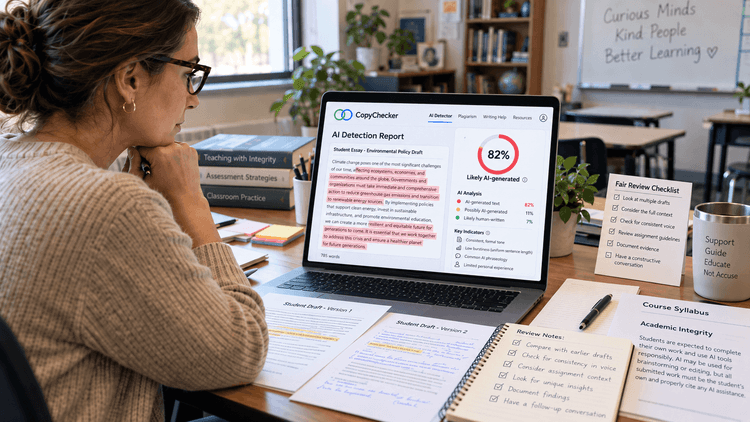
An AI detector score does not create a separate academic rule either.
There is no universally acceptable AI percentage, and even genuinely human writing can sometimes be detected as AI.
Course policy and evidence about how the work was produced matter more than treating a detector percentage as a verdict.
And that naturally brings us to the tool students ask about most often: ChatGPT.
If AI use can range from harmless study support to prohibited assistance, does using ChatGPT automatically count as academic dishonesty?
Not necessarily.
Is Using ChatGPT Academically Dishonest?
Not automatically.
Using ChatGPT or another AI tool can be acceptable when the course permits it.
For example, an instructor may allow AI for:
- brainstorming
- generating study questions
- explaining a concept
- creating an outline
- checking grammar
- exploring alternative viewpoints
Another instructor may restrict AI entirely for the same type of assignment.
So no universal rule says every use of ChatGPT is cheating.
Likewise, no universal rule says every use is acceptable.
That leaves one practical question -
When Can AI Use Become Academic Misconduct?
AI use becomes a problem when it conflicts with assessment rules or falsely represents who produced the work.
Examples may include:
- submitting AI-generated writing as entirely your own
- using AI in an exam where outside assistance is prohibited
- hiding AI use when disclosure is required
- using generated citations without checking whether the sources exist
- asking AI to complete assessed problem-solving you are expected to perform yourself
One particularly dangerous habit is trusting generated references without verification.
AI systems can sometimes produce convincing-looking citations that do not correspond to real publications.
Before including any source, confirm that it actually exists.
Academic integrity occasionally requires the radical academic technique known as checking.
And once AI has contributed something useful to your work, another question follows almost immediately -
Do You Need to Cite AI?
That depends on your institution, instructor, assignment, and required citation style.
Some courses require AI use to be declared or cited.
Others permit certain forms of assistance without formal citation.
If the instructions do not say, ask.
You are far better off sending a short question before submission than inventing your own policy afterward.
AI is not the only writing tool that raises these questions, though.
Paraphrasing tools create a similar gray area because they can help improve wording, but they can also be misused to disguise borrowed material.
So that brings us to our next question -
Does Using a Paraphrasing Tool Violate Academic Integrity?
Using a paraphrasing tool is not automatically an academic integrity violation.
The key issue is how you use it.
Suppose you read a source, understand the argument, rewrite the idea clearly, use a paraphrasing tool to improve awkward wording, and properly cite the original source.
That is very different from copying someone else's paragraph, running it through a tool solely to disguise the wording, removing the citation, and submitting it as your own idea.
This is usually counted as patchwork plagiarism.
Then again, a paraphrasing tool changes language.
It does not change who originally created the idea.
So whenever the underlying information comes from a source, check whether that source needs to be cited.
At this point, the pattern should be getting clearer: academic integrity is less about avoiding one specific tool and more about how you research, write, collaborate, cite, and follow the rules around your work.
So the next step is the practical one -
How to Maintain Academic Integrity in Your Work
Maintaining academic integrity is not usually about making one big ethical decision.
More often, it comes down to a series of small choices you make while researching, writing, collaborating, using academic tools, and preparing your final submission.
In other words, academic integrity becomes easier to maintain when it is built into your workflow from the beginning rather than treated as a final check before submission.
The best place to start is with the rules that apply to the work you are about to do.
1. Understand the Rules Before You Start
Read the assignment instructions carefully.
Check:
- whether collaboration is allowed
- which resources you can use
- whether AI is permitted
- whether previous work can be reused
- which citation style is required
- whether outside editing is acceptable
If anything is unclear, ask.
2. Keep Track of Sources While Researching
Do not wait until the final draft to remember where every statistic, argument, quotation, and mysterious browser tab came from.
Record sources while you work.
At minimum, save:
- author
- title
- publication
- date
- URL or DOI
- page number when relevant
It is boring.
It is also much less boring than trying to reconstruct twenty sources at 2:13 a.m.
3. Cite Ideas, Not Only Direct Quotes
Students sometimes assume citations are only required when words are copied exactly.
They are not.
If a distinctive idea, argument, result, or interpretation came from another source, it may still require citation even when you explain it entirely in your own words.
4. Learn to Paraphrase Properly
Good paraphrasing starts with understanding, as it doesn't change the actual meaning.
Read the source, put it aside, explain the idea naturally, compare your version with the original, and cite the source.
Merely replacing individual words rarely produces strong writing anyway.
5. Follow Collaboration Rules
Before working with another student, ask what collaboration actually means for that task.
There is a large difference between:
“Let's explain this topic to each other.”
and:
“Send me your answer, and I'll change it slightly.”
One supports learning.
The other is rapidly approaching territory you do not want to explain later.
6. Check AI Rules Every Time
Do not assume the policy from one course applies to another.
Even within the same university, instructors may set different expectations depending on what an assessment is supposed to measure.
7. Verify Sources and Data
Before submitting:
- check that citations point to real sources
- confirm quotations
- verify important statistics
- make sure you have not accidentally changed the meaning of a source
- confirm that research data has been reported accurately
A final proper use of a plagiarism checker can also help you find text that may need revision or clearer attribution.
8. Ask When You're Unsure
This may be the least exciting advice in the article and possibly the most useful.
Ask your instructor.
Academic integrity often becomes confusing around edge cases, and course-specific rules matter more than generic advice from the internet.
Following these habits can prevent many problems.
But mistakes and deliberate violations can still occur, which leads to the next practical question -
What Happens If You Violate Academic Integrity?
Consequences vary widely depending on the institution, the type of violation, its severity, the circumstances, and whether you have had previous incidents.
Possible outcomes can include:
- A warning
- Resubmitting an assessment
- Receiving reduced marks
- Failing an assignment
- Failing a course or unit
- An academic misconduct record
- Suspension
- Expulsion in serious cases
For example, TEQSA notes that academic integrity breaches can lead to consequences ranging from repeating an assessment to failing a task, unit, or course.
However, you should never assume those exact penalties apply everywhere.
Your institution's academic integrity or misconduct policy is the authority that matters.
And since avoiding a problem is considerably easier than dealing with the consequences afterward, it helps to have one final check before you submit anything.
So think of the next section as a quick last-minute review to make sure your work is genuinely yours, properly credited, and in line with the rules -
Academic Integrity Checklist Before You Submit
Before submitting, take a final moment to check that the work is genuinely yours, borrowed ideas are properly acknowledged, collaboration and AI use follow the assignment rules, and your references and data are accurate.
A more detailed academic integrity checklist for students can help you review these points systematically without turning this pillar guide into a second checklist article.
If anything still feels unclear, check the assignment instructions or ask your instructor before submitting.
FAQs about What Is Academic Integrity
What Is Academic Integrity in Simple Words?
Academic integrity means doing your academic work honestly, fairly, and responsibly while giving proper credit to others.
Why Is Academic Integrity Important?
It keeps grades, research, and qualifications trustworthy by ensuring they genuinely reflect a student’s own work and ability.
What Are Examples of Academic Integrity?
Examples include doing your own work, citing sources correctly, following exam rules, reporting accurate data, and using AI only when permitted.
What Are the Six Values of Academic Integrity?
The six values are honesty, trust, fairness, respect, responsibility, and courage.
What Is the Difference Between Academic Integrity and Plagiarism?
Academic integrity is the broader ethical principle, while plagiarism is one violation that involves using someone else’s work without proper acknowledgment.
What Is Collusion in Academic Integrity?
Collusion is unauthorized cooperation on work that should be completed independently.
Can Academic Integrity Be Violated Accidentally?
Yes. Citation mistakes, poor paraphrasing, misunderstood collaboration rules, or unclear AI policies can sometimes lead to unintentional violations.
Final Thought
Academic integrity is easier to understand when you stop treating it as a giant list of things students are forbidden to do.
At its core, the idea is much simpler.
Be honest about what you created, give credit for what came from others, and follow the rules of the work you are being assessed on.
That applies whether you're writing an essay, completing a lab report, working with classmates, paraphrasing a source, taking an exam, or experimenting with AI tools.
And when the rules are unclear, don't guess.
Check the assignment instructions, review your institution's policy, or ask your instructor before submitting.
Academic integrity is not about producing perfect work.
It is about making sure the work you submit honestly represents yours.
Before you submit, you can also use CopyChecker to give your writing one final review.
Check for possible plagiarism, review citations, improve awkward wording, and use writing tools to polish your work without losing ownership.
Review your work with CopyChecker before you submit, so the final version is clear, properly checked, and genuinely yours.