Back in the good ol days, once you wrote an essay, that was it. The work was done, the stress was over.
You know you wrote the essay yourself. You researched it, drafted it, and edited it till you didn't even remember what the first draft looked like.
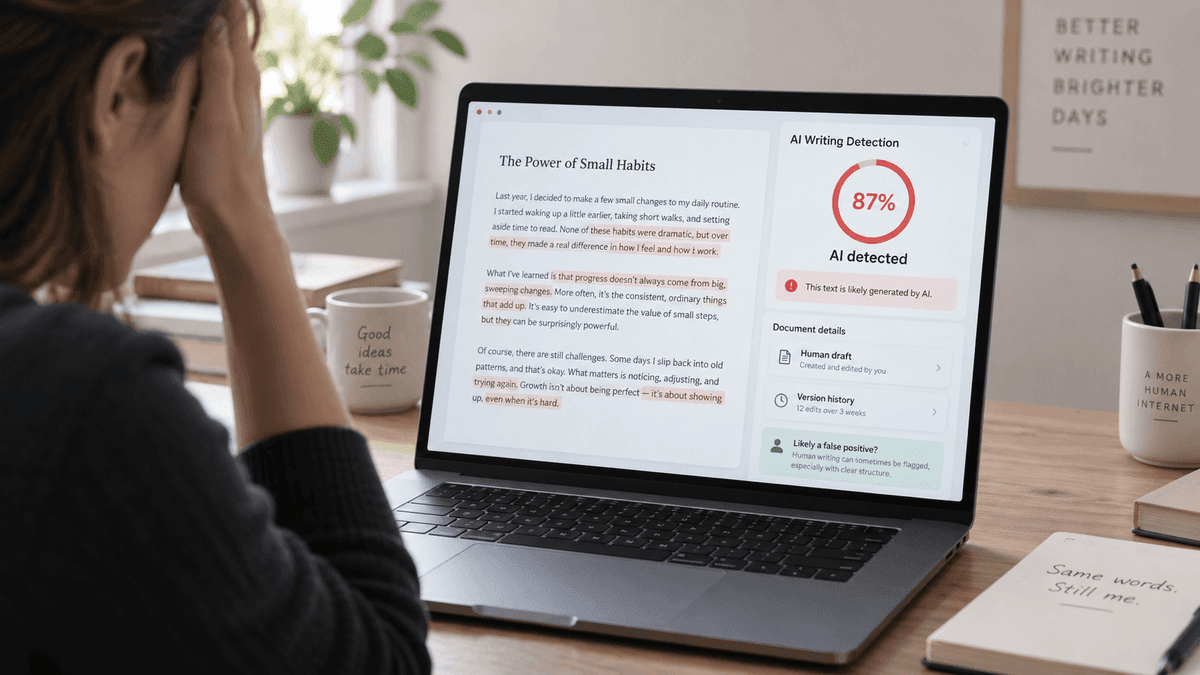
Fast forward to today, there’s another concern that looms over your head when you finish that essay—getting flagged as AI. Yes, sometimes human-written text can be flagged as AI.
It's because AI detectors do not actually know who wrote your text. They analyze patterns in the finished piece and estimate whether those patterns look more like human or AI-generated language.
That means genuinely human writing can sometimes trigger a false positive in an AI detector. Predictable sentences, formal academic language, repetitive transitions, cautious non-native English, heavy rewriting tools, and even excessive polishing can make human writing statistically resemble AI output.
The important part is this: an AI detection score is a signal to investigate, not proof of authorship.
Turnitin states that its AI model can misidentify both human and AI-generated writing and that its results should not be the sole basis for action against a student.
Let's look at why this happens and what you can actually do about it.
Is It Normal for Human Writing to Be Flagged as AI?
Human writing can be flagged as AI if it follows AI patterns. AI generates prose with perfect grammar and structure. Those, in and of themselves, aren't the problem. What matters is how AI content reads.
Machine-generated text follows a similar rhythm and sentence structure. If your writing follows a similar pattern, it can still be flagged as AI even if you spent hours typing away at your keyboard.
Modern detectors have improved considerably, but you shouldn’t treat them as the final word, since false positives are still possible.
How Do AI Detectors Work?
AI detectors generally work through pattern recognition. They examine signals such as:
- Sentence structure
- Vocabulary predictability
- Repetition
- Tone consistency
Modern detectors can use complex machine-learning classifiers. However, two concepts are especially useful for understanding the difference between human and AI writing:
- Perplexity
- Burstiness
Perplexity
Perplexity describes how predictable language is. In simple terms, how likely is it for a particular sentence to appear?
Consider this sentence:
Education plays an important role in modern society. Furthermore, education provides many benefits to students.
It feels like pretty much a boilerplate sentence. Compare it to something like this:
“The ships hung in the sky in much the same way that bricks don't.”
The above is from the book The Hitchhiker's Guide to the Galaxy, by Douglas Adams. You wouldn’t anticipate a sentence like it. It has high perplexity.
AI-generated text has low perplexity. It uses predictable sentence structures and common vocabulary, but human writing tends to have high perplexity.
So, if your writing has low perplexity, it still has a chance of getting flagged as AI.
Burstiness
Burstiness refers to variation within writing. One sentence might be short. The next might stretch further because the idea needs explanation and context.
AI-generated content is more even in rhythm. If every sentence is roughly the same length and every paragraph follows the same structure, it feels too rigid. It feels too rigid—statistical even.
Naturally, uniform writing is more likely to get flagged as AI.
Classifiers
Perplexity and burstiness can help explain what patterns an AI detector may notice, but modern detectors usually go beyond these two signals.
Modern AI detectors are trained on large collections of known human-written and AI-generated text. During training, it learns combinations of patterns that tend to appear more often in one group than the other.
When you submit a piece of writing, the classifier compares its learned patterns against your text and assigns a probability or classification, such as human-written, AI-generated, or mixed.
The important word here is probability. A classifier does not discover who actually wrote the document. It predicts which category the text most closely resembles based on what it learned during training.
That is also why false positives are possible. Human writing can sometimes contain the same patterns the classifier has learned to associate with AI. So if a detector gives your writing a percentage or classification, don’t treat that number as proof by itself. Learning how to interpret your AI score can help you understand what the result actually tells you and when it deserves a closer look.
7 Common Reasons Human Writing Gets Flagged as AI
You can use tools to humanize AI text and make it sound more human-written.
Several writing characteristics combine to create a pattern that resembles generated text. Here are 7 common ones to look out for:
1. Your Sentence Structure Is Too Simple
Writing that follows a generic pattern where every next sentence is predictable has a high chance of being flagged as AI. Sentences with similar lengths also don’t help your chances.
Students often fall into this predictable pattern because they’ve been taught to think in templates.
Templates are useful for organizing ideas, but don’t let them dictate your writing and structure.
Instead, let the idea determine the structure. Some arguments need one direct sentence. Others need qualification, evidence, contrast, or explanation.
Natural variation usually follows automatically when the writer focuses on the thought.
2. Relying Heavily On Grammar Tools
Let’s get one thing out of the way first. Using grammar and writing tools is not the problem. Using these AI tools to fix typos and grammar mistakes can enhance your writing.
The problem is when a sentence like:
The results surprised us.
becoming:
The findings revealed an unexpected outcome that challenged our initial assumptions and prompted further examination.
The first fixes grammar. The second changes the wording and style. For routine edits, a grammar checker can help you catch spelling, punctuation, and grammar mistakes without requiring you to rewrite sentences that already sound like you.
3. Your Transitions Are Too Predictable
There is nothing inherently wrong about using words like therefore, moreover, however. These words have been in our vocabulary long before ChatGPT.
It’s when you let the transition do the work instead of the idea. Use transitions when the relationship between ideas actually needs one. Sometimes the best transition is simply the next sentence.
4. Your Writing Is Extremely Formal
Academic and professional writing naturally tends to be structured. It often uses complete sentences and a neutral tone. Unfortunately, AI-generated writing shares those characteristics.
So if you've ever asked yourself, "Why does Turnitin flag my writing as AI when I wrote everything myself?" this is why.
Formal writing itself is not suspicious. But paired with identical sentence structures and repeated transitions, the overall pattern can become more machine-like.
5. Non Native and ESL Learner Bias
Non-native English and ESL writers can sometimes be more vulnerable to false AI flags because of the way they naturally use English.
When writing in a second language, people often rely on familiar vocabulary and safer sentence structures—basically low-perplexity writing.
A Stanford-led study highlighted this problem by testing AI detectors on essays written by non-native English speakers. The researchers found that the detectors frequently misclassified these human-written essays as AI-generated.
6. You Edited Out Your Personal Voice
Sometimes the first draft sounds clearly human. Then you "improve" it. You replace ordinary words with a more formal alternative. Maybe delete personal observations and awkward sentences.
You might think you’re iterating on your draft and improving it. But might just be taking out everything that makes your work unique—your voice.
7. AI Entered During the Editing Process
One awkward possibility is worth discussing. Sometimes the detector is not completely wrong.
You may have written the original essay yourself but later asked an AI tool to edit it. At that point, the ideas may still be yours, but some of the final language is AI-generated.
Does Getting Flagged as AI Mean You're in Trouble?
If you get flagged for AI, whether you’re in trouble or not depends on who is checking your work.
An AI flag simply means a detector found patterns in your writing that resemble AI-generated text. It doesn't automatically prove you used AI, especially if you wrote the work yourself.
There also isn’t one percentage that automatically makes a piece of writing acceptable or unacceptable. If you’re wondering what AI percentage is acceptable, the answer depends on the context, the detector being used, and the rules set by your school, publisher, or client.
Regardless, different institutions have different policies for AI use. Make sure to check your institution's policies.
If you’re a freelancer or content writer, a client may simply want clarification on how you produced the content.
Also, since false positives exist, knowing the techniques you can use to prove your writing is human will come in handy.
How to Prove Your Writing Is Human
False positives can create a negative perception of your work. Especially if your assignment is getting flagged as AI, or if you’re a professional writer submitting work to your clients.
If you genuinely wrote the work yourself, your strongest defense is showing you did. Make your writing process visible. There are many ways you can do this.
Be Able to Explain Your Work
When you write an essay yourself, you should be able to explain your arguments, the sources you chose, and what led you to your conclusion.
Clearly explaining and walking someone through your work is one of the strongest signals that you did the work.
Show Your Version History
If you’re working on Google Docs, Microsoft Word, and other writing platforms may preserve document history. Your teachers or clients can see the edits and the thought process behind your work.
Keep Previous Drafts
Do not delete your previous drafts. No matter how ugly you think they are. The embarrassing sentence you rewrote six times may become surprisingly useful evidence later. Drafts demonstrate how your ideas and language developed.
Document Your Research Process
Any original research you do, notes you take, and outlines you make are valuable evidence you can use to defend your work.
If your professor questions your work, these materials help connect the final argument to an actual research process.
How to Reduce Your Chances of Getting Flagged by AI Detectors
You cannot guarantee that AI text detectors will always identify anything you produce correctly as human. That’s the reality of how these things work. But you can minimize the chances.
Learn to Write Better
The best thing you can do for yourself and to avoid getting falsely flagged is to become a better writer.
Strong human writing naturally contains thoughtful word choices, varied sentence structures, specific observations, reasoning, and original voice.
The better you become at expressing your ideas in your own way, the less likely your writing will sound AI-generated.
Don’t Directly Paste AI Text
If you use AI for brainstorming, research directions, or outlining where permitted, do not automatically copy its output into your final draft.
Use it as a springboard to get you off the ground. But don’t always paste AI-generated text directly. You can feel stuck with the structure it provided.
Besides, AI-generated text often has the exact characteristics detectors are designed to notice.
Use Specific Evidence
Generic writing is easy to produce and, unfortunately, easy to make sound predictable. If you’re worried about being questioned later, it helps to document your writing process as you go, keeping drafts, notes, research, and revision history instead of trying to gather evidence after the fact.
Compare:
Many studies show that social media negatively affects young people.
with:
In a survey of 1,200 students, researchers found that students who used social media for more than four hours a day reported shorter average sleep.
The first sentence could appear in thousands of essays. The second gives the reader something concrete to evaluate.
Specific evidence also forces you to interpret information instead of filling space with broad statements. That makes the writing stronger for the reader, regardless of what an AI detector thinks about it.
Use Natural Transitions
Transitions should connect ideas. There is nothing wrong with words such as moreover, furthermore, additionally, however, or therefore. The problem is overusing them.
The second version still moves logically from one point to another, but it does not need a formal signpost before every sentence.
Use transitions when they clarify a genuine relationship. When the connection is already obvious, sometimes the most natural transition is no transition at all.
Use a Humanizer
AI humanizers can help rewrite those passages into something more natural. This is especially useful when AI or generative editing tools were involved in an allowed part of your workflow, and the final text no longer sounds like you.
Humanizers can vary sentence structure, improve flow, and replace awkward or overly predictable phrasing.
Frequently Asked Questions
Can Turnitin or GPTZero Be Wrong About AI Detection?
Yes. AI models can produce false positive results and misidentify human writing as AI-generated content if it follows typical AI text patterns.
Why Do Non-Native Speakers Get Flagged More Often?
ESL students tend to use more common vocabulary and predictable, simple sentence structures, which are more likely to be flagged as AI.
Does Using Grammarly Increase My AI Score?
Basic spelling, punctuation, and grammar corrections are unlikely to make a major difference by themselves. Generative features that rewrite or rephrase full sentences are more likely to affect AI detection.
What Should I Do If My Professor or Client Accuses Me of Using AI?
Preserve and present evidence of your process. Explain which writing tools you used and what they changed.
Are AI detectors reliable at all?
AI detectors can be useful, but they’re not 100% reliable. They estimate whether text resembles AI-generated writing based on learned patterns, which can give you both false positives and false negatives.
Wrapping Up
If your human writing is detected as AI, don't panic. First, look at what was actually flagged. AI detectors look for certain patterns. If they’re present in your own writing, it’ll be flagged as machine-generated.
Then consider whether your writing contains highly predictable structures, repetitive language, overly formal phrasing, heavy generative editing, or generic examples.
Most importantly, preserve evidence showing how you created the work. A detector can analyze the finished words.