Suppose you have just finished an essay, read it one last time, and run it through an AI detector before submitting it.
The result appears: 38% AI.
Suddenly, that small percentage feels much bigger.
Did the detector just say that 38% of the essay was written by AI?
Is 38% considered a high AI score?
Could a teacher see the same number and question the work?
This confusion is more common than it should be because an AI detection percentage looks much more precise than it really is.
And detector results can be wrong.
A 2023 Stanford study tested seven AI detectors on essays written by non-native English students.
The detectors classified 61.22% of those TOEFL essays as AI-generated, even though the essays were written by people.
The study involved specific detectors and conditions, so that number should not be treated as the false-positive rate of every AI detector today.
But it shows why a score needs context before anyone draws a conclusion.
That is exactly why knowing how to interpret an AI detection score matters.
In simple terms, an AI detection score is a tool-generated classification based on patterns found in the text.
The percentage doesn't automatically tell you exactly how much was written by AI, and you shouldn't treat it as proof on its own.
Its meaning depends on what that particular detector measures and how it presents the result.
Before reacting to any percentage, ask three things:
What does this score actually measure?
Which sentences or paragraphs were flagged?
How certain is the detector about its classification?
In this guide, we will break down each part.
You will learn what low and high AI scores can actually tell you, how sentence-level results differ from the overall percentage, and how to read a full AI detection report without jumping to the wrong conclusion.
So let’s start with some basics -
What Does an AI Detection Percentage Actually Mean?
An AI detection percentage shows how strongly a detector classifies text as AI-like, according to its own scoring system.
The key phrase is “its own scoring system.”
No single definition of an AI percentage applies to every detector.
For example, Turnitin currently describes its percentage as the amount of qualifying prose text that its model identifies as likely AI-generated or AI-generated and later modified.
Grammarly describes its result as the percentage of scanned text that appears likely to be AI-generated.
Those ideas sound similar, but they are not automatically interchangeable.
That is why you should understand the label before trying to interpret the number.
| Type of Result | What It Usually Describes | What It Does Not Automatically Tell You |
|---|---|---|
| AI-generated percentage | Text the detector classified as AI-like | Exactly how the text was created |
| AI probability or confidence | How strongly the model favors an AI classification | The exact percentage of words written by AI |
| Human score | Text or probability classified as human-like | Proof that no AI tool was involved |
| Mixed result | Text containing signals associated with both categories | Which parts of the writing process involved AI |
This distinction solves one of the most common AI detector score meaning problems.
A percentage can look simple while measuring something quite specific underneath.
That leads to the next question most readers naturally have -
Does 20% AI Mean 20% of the Text Was Written by AI?
Not necessarily.
You first need to know how the detector defines that 20%.
If a tool specifically says its percentage represents the portion of analyzed text classified as likely AI-generated, then the number relates to the amount of text the model flagged.
If another tool presents a probability or confidence score, the interpretation may be different.
Neither version means the detector somehow watched the document being written and discovered exactly which words came from ChatGPT.
It did not.
The detector works backward from the finished text, looks for patterns, and assigns a result based on its own scoring system.
That is where the labels start to matter.
Two tools may analyze the same text but describe their results as an AI score, AI probability, human score, or something similar.
Those terms can sound interchangeable, but they don't always mean the same thing.
So let’s understand more about -
If AI Score, AI Probability, and Human Score Are Same or Not?
AI detection tools use several labels that sound almost interchangeable, but they are not always the same.
An AI score is a broad term for the result a detector produces.
An AI-generated percentage usually refers to how much analyzed text the detector classifies as AI-like.
An AI probability or confidence score describes how strongly the model supports a particular classification.
A human score indicates that the analyzed writing contains patterns the detector associates more strongly with human-written text.
A mixed score generally means different parts of the text produced different signals.
The practical lesson is simple:
Do not compare two percentages until you know whether both detectors are measuring the same thing.
This is one reason the same essay can produce noticeably different results across different tools.
But even after you understand what a detector's percentage means, there is still another layer to read.
Most reports do not stop at one overall number.
They also show which sentences or passages contributed to that result.
That is where the difference between a document-level score and sentence-level detection becomes important.
So let’s find out more about it -
Overall AI Score vs Sentence-Level AI Detection
The document-level score gives you the big picture.
Sentence-level AI detection gives you the details.
Suppose a report shows an overall AI score of 42%.
That number tells you something about the document as a whole. It does not show where the AI-like patterns appeared.
Sentence-level highlighting helps answer that second question.
It may show that several paragraphs triggered the detector while the rest of the document did not.
That is much more useful than staring suspiciously at “42%” as if the number plans to explain itself.
| Report Element | Useful For | Does Not Prove |
|---|---|---|
| Overall AI score | Seeing the document-level result quickly | Who wrote the document |
| Sentence or paragraph highlights | Finding the passages that influenced the result | That every highlighted sentence was generated by AI |
| AI, Mixed, Human breakdown | Understanding how the detector classified different parts | The writer's exact process |
| Confidence language | Understanding how strongly the tool states its result | Certainty |
Sentence-level vs overall AI score is therefore not an either-or choice.
You need both.
The overall score tells you where the report stands.
The detailed analysis helps explain how it reached that result.
Once you understand those two layers, the next step is to see how they work together inside an actual report.
That is where the numbers, highlights, and labels start to make much more sense.
So instead of looking at the score in isolation, let’s walk through -
How to Read a AI Detector Report Step by Step
A real report is easier to understand than an abstract percentage.
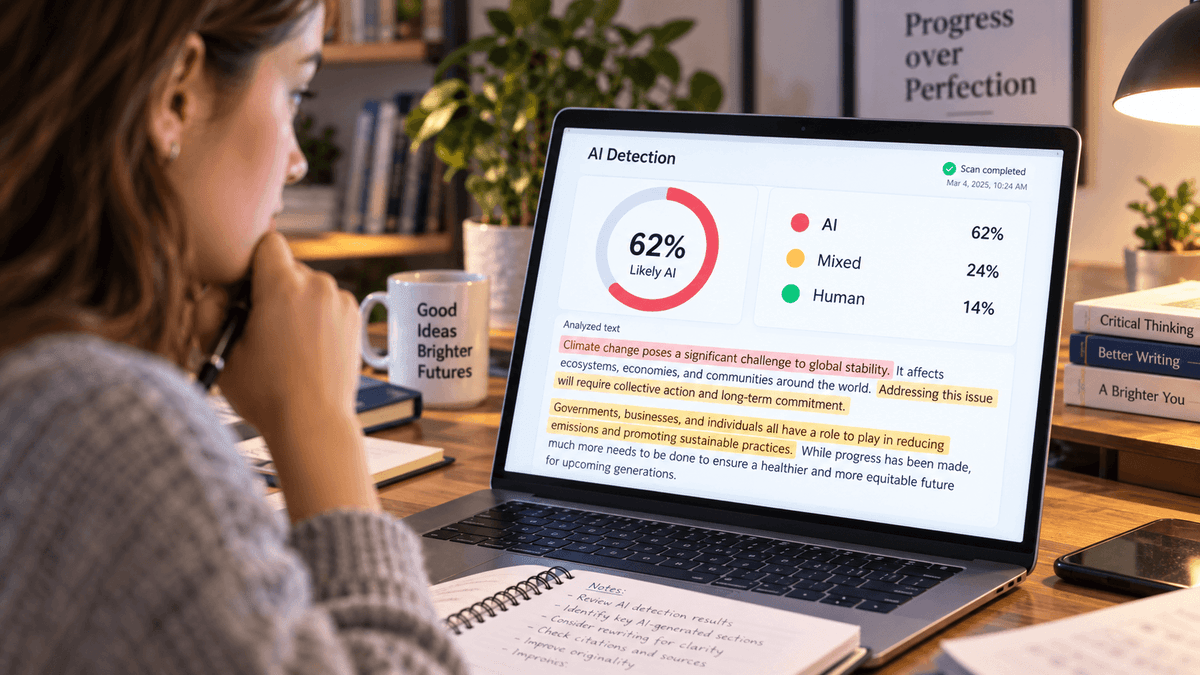
AI Detector tools usually provides percentage-based results across AI, Mixed, and Human categories.
It can also highlight specific sentences or paragraphs so users can inspect the parts of the text that contributed to the result.
Here is how to read that report without overcomplicating it.
Step 1: Start With the Overall Result
Look at the main result first.
Think of it as a summary, not a verdict.
The detector has analyzed writing patterns and produced its best classification based on the model behind the tool.
If you expected a completely human-written document but receive a strong AI result, that is a reason to inspect the report more carefully.
It is not yet an explanation of what happened.
Tip: Do not stop at the biggest number on the page. The detail underneath it often tells you more.
Step 2: Check the AI, Mixed, and Human Breakdown
Next, look at how CopyChecker divided the analyzed text.
A document may not produce one clean category.
Some passages can appear strongly human-like.
Others may contain patterns the detector associates with generated writing.
Some may fall somewhere between those categories.
That is why a mixed result can be useful.
It reminds you that a document is made of individual sentences and paragraphs, not one giant statistical sentence wandering around pretending to be an essay.
Step 3: Review the Highlighted Sentences and Paragraphs
Now move from the overall score to the actual text.
Look for patterns.
Is one paragraph responsible for most of the concern?
Are several similar sentences being flagged?
Are quotations, technical explanations, definitions, or highly formulaic passages involved?
You do not need to rewrite something merely because a detector highlighted it.
First understand why that passage deserves your attention.
If you want to understand the technical signals detectors may examine, see how AI detectors work.
Step 4: Read the Result Wording Carefully
Words such as likely, detected, classified, and estimated matter.
They communicate uncertainty.
“Likely AI-generated” does not mean the same thing as “proven to be AI-generated.”
That may sound painfully obvious when written out.
Yet the moment a percentage appears next to the sentence, humans tend to develop a touching amount of faith in decimals.
Treat probabilistic language as probabilistic.
Step 5: Keep the Report in Context
A report can tell you what the detector observed in the finished text.
It cannot see the full writing process.
It does not know whether someone spent four days researching a paragraph, drafted it from scratch, edited AI-assisted notes, received feedback from a tutor, or rewrote the same sentence twelve times because the first eleven versions sounded dreadful.
When authorship matters, the writing process can provide additional context.
Students can preserve drafts, outlines, source notes, document history, and permitted AI records.
Our guide on documenting your writing process explains a simple way to do that.
Once you keep that wider context in mind, the score itself becomes easier to judge.
Now the next question is not simply whether the number is high or low, but it is -
What Does a Low, Medium, or High AI Score Really Tell You?
No universal AI detection range works across every detector, to be exact.
That means a table claiming something like “0–20% safe, 21–50% suspicious, 51–100% AI” would look wonderfully tidy and be wonderfully misleading.
A better approach is to interpret the pattern rather than invent a universal cutoff.
The table below shows a more practical way to read those patterns and what to check before drawing a conclusion -
| Result Pattern | What It May Suggest | What It Does Not Prove | What to Check Next |
|---|---|---|---|
| Low AI signal | Few AI-like patterns were detected | That AI was never used | Any isolated flagged sections |
| Mixed result | Different sections produced different classifications | Exactly how each section was created | Sentence and paragraph-level results |
| High AI signal | Stronger or more widespread AI-like patterns were found | That AI definitely wrote the document | Highlighted text, writing history, context |
| Different scores across tools | Models interpreted the text differently | That one particular detector must be correct | How each tool defines its score |
What Is a High AI Detection Score?
A high AI detection score generally means the tool found stronger evidence of patterns it associates with AI-generated writing.
There is still no universal percentage where “high” suddenly becomes “proven.”
Even major tools handle ranges differently.
Turnitin, for example, currently does not display an exact numerical score for results between 1% and 19%. It says false positives occur more often in that range, so those results are shown as an asterisk instead.
And that policy belongs to Turnitin's system.
It is not a universal rule for every AI detector.
If your real question is whether 20%, 40%, or another score is acceptable for school or work, see what AI percentage is acceptable.
That is a policy question.
This article is about what the score itself means.
Now that the idea of a universal “safe” or “risky” percentage is out of the way, it is easier to look at each result type on its own.
Start with the one that often feels the most reassuring: a low score.
It may suggest the detector found fewer AI-like patterns, but that doesn't automatically prove the writing was entirely human.
That’s why you might need the following section -
Why a Low AI Score Does Not Prove Human Writing
A low AI score means the detector found little evidence matching its AI classification patterns.
That is useful information.
It is not a certificate of human authorship.
AI-generated text can sometimes avoid detection.
Editing, rewriting, text length, model differences, and writing style can all affect results.
How the text was created matters too. A document that involved AI-assisted rather than AI-generated writing may have a very different writing process even if parts of the finished text produce similar detection signals.
Even a 0% result should therefore be read narrowly:
This detector did not identify enough AI-like signals in this version of the text to produce a higher result.
That is more accurate than saying:
This proves no AI was involved.
The same caution works in the opposite direction too.
If a low score is not proof of human authorship, then a high score should not be treated as automatic proof of AI authorship either.
It tells you that the detector found stronger AI-like patterns in the text.
The next step is to understand why those patterns appeared and whether other evidence supports the same conclusion.
So let’s find out -
Why a High AI Score Does Not Prove AI Authorship
The reverse is also true.
Human writing can be incorrectly classified as AI-generated.
A useful example comes from a 2023 Stanford-led study published in Patterns.
Researchers tested seven GPT detectors on 91 TOEFL essays written by non-native English writers.
Across those detectors, the average false-positive rate for those essays was 61.3%.
That does not mean modern AI detectors have a 61.3% false-positive rate.
The study tested specific detectors, samples, and conditions in 2023.
It does show something important, though:
Detector performance can vary sharply across writing types and groups of writers.
That is one reason high scores need context.
If human-written work has been flagged unexpectedly, check out AI Detection False Positives Teacher's Guide for a deeper explanation of why that can happen.
But false positives are only one part of the bigger accuracy question.
If results can change depending on the writer, the text, and the detector being used, then asking “How accurate is this percentage?” needs more than one universal number.
To answer it properly, we need to look at the factors that can make an AI detection score more or less reliable.
How Accurate Is an AI Detection Percentage?
No single accuracy percentage applies to every detector, model, or piece of writing.
AI detector accuracy can change based on the tool, text length, language, genre, writing style, and the AI model involved.
Even detector companies acknowledge these limits.
Grammarly states that its detector is not 100% accurate and notes that shorter passages can be harder to measure reliably.
Turnitin also sets minimum requirements for the text it analyzes.
Its current AI Writing Report requires at least 300 words of prose and explains that non-prose formats such as poetry, scripts, tables, code, and annotated bibliographies are not handled reliably in the same way.
So when asking how accurate an AI detection percentage is, consider the text being tested too.
| Factor | Why It Matters |
|---|---|
| Text length | Very short samples provide less language to analyze |
| Writing style | Highly predictable or formulaic writing may resemble machine patterns |
| Language | Performance may vary across languages and writer groups |
| Heavy editing | AI and human signals can become harder to separate |
| Type of content | Essays, code, poetry, lists, and technical writing behave differently |
| Detector model | Each tool uses its own model, data, and decision rules |
| AI model used | Newer generation systems may produce different writing patterns |
The number should therefore be treated as evidence from a model, not a measurement from a ruler.
And once you look at it that way, another common source of confusion becomes easier to understand.
If each detector uses its own model, training data, thresholds, and scoring method, the same piece of writing does not have to produce the same result everywhere.
So when two tools disagree, that difference is not automatically a sign that one of them is broken. Let’s check out -
Why Two AI Detectors Can Give Different Scores
You can paste the exact same essay into two AI detectors and receive different percentages.
Nothing supernatural occurred between browser tabs.
The tools may use different training data, classification models, thresholds, text-processing methods, and definitions of what their percentage represents.
Grammarly itself notes that its results can differ from other AI detectors because different providers use proprietary models.
That is why comparing:
18% in Tool A
with
42% in Tool B
does not automatically mean one of them malfunctioned.
First ask what each percentage measures.
Then compare the sentence-level evidence.
Once you have done that, the score has served its main purpose: it has shown you where to look more closely.
The next step is not to keep staring at the percentage.
It is to decide what to do with the information in front of you -
What Should You Do After Reading Your AI Score?
Once you understand the report, the next step depends on why you checked the text.
If it is your own writing, review the highlighted passages first.
Compare them with your drafts and writing process.
Check whether any AI use followed the relevant school, workplace, or client rules.
Students preparing academic work can also use the Academic Integrity Checklist that’s made for them before submitting.
If you are reviewing someone else's work, avoid turning the detector score into the entire investigation.
Cornell University's current academic-integrity guidance recommends looking for objective, verifiable evidence and talking with the student when concerns arise.
That’s why this institute also advises against using automatic detection algorithms as definitive evidence of an academic-integrity violation.
If you’re a teacher who needs a fuller review process, you can go through how teachers should interpret AI detector results so you can check student papers more carefully.
But always remember the simplest rule - use the score to decide what deserves a closer look. Do not use the score to skip the closer look.
FAQs on How to Interpret an AI Detector Score
What does an AI detection percentage mean?
It shows how a detector classified the analyzed text based on its scoring model. The exact meaning depends on whether the tool reports AI-like classification, probability, confidence, or another metric.
Does 20% AI mean 20% of my text was written by AI?
Not automatically. Check how that detector defines its percentage. A detector analyzes patterns in the final text; it does not directly observe how every sentence was created.
What does a 50% AI detection score mean?
It means the detector found a substantial AI-like signal based on its scoring system. Review the detailed report before assuming half the document was literally written by AI.
Is 80% AI considered a high score?
Most people would describe 80% as a strong AI signal, but no universal cutoff applies across detectors. You still need to interpret a high result using that tool's methodology and detailed flags.
Can human-written text get a high AI score?
Yes. False positives are possible. Writing style, predictability, language background, text type, and detector limitations can all influence classification.
Can AI-written text receive a low AI score?
Yes. AI detection can also produce false negatives, especially as generated text is edited or writing models change.
Why do AI detectors give different percentages?
Different detectors use different models, datasets, thresholds, and scoring methods. Their percentages therefore should not be assumed to be directly interchangeable.
Is an AI detection score the same as a plagiarism score?
No. A plagiarism checker looks for matching or copied material from other sources. An AI detector looks for writing patterns associated with generated text.
Can an AI detection score prove someone used ChatGPT?
No. A detector can identify text that resembles patterns associated with AI-generated writing, but the score alone cannot reconstruct the writer's process or prove that a specific tool such as ChatGPT was used.
Final Verdict
An AI detector score is most useful when it helps you ask better questions.
The number can point you in a direction.
But it should not make the whole decision for you.
Try to start by understanding what the score measures. Then check the sentence-level details.
Look at the context behind the writing.
And keep the bigger picture in mind.
Always remember that a high score does not automatically mean wrongdoing.
A low score does not automatically prove human authorship.
And no percentage can fully recreate how a piece of writing was produced.
The goal is not to fear the number.
It is to understand it well enough to use it responsibly.
If you want to see how your own text is classified, run it through CopyChecker's AI Detector.
You can review the AI, Mixed, and Human breakdown.
You can also inspect the highlighted sentences and paragraphs that influenced the result.
If some parts of your own writing feel stiff, repetitive, or overly mechanical, you can then use AI Humanizer to make the wording sound more natural and readable while keeping your original meaning.
That gives you a simple workflow.
Check the report. Understand the flagged sections. Improve the writing where it genuinely needs improvement.
So what are you waiting for?
Start your journey with CopyChecker now!