Suppose you're a teacher. A student of yours hands in a perfectly structured essay, where not a single comma is out of place, every argument neatly packed, every sentence just a little too smooth.
After looking at that, your gut says something's off, but you can't quite explain it.
That gut feeling? AI detectors are there for it, as they have already figured out how to bottle it.
Over the past two years, AI-generated content has literally exploded across the internet.
With tools like ChatGPT, Gemini, and Claude producing polished text in seconds, the demand for reliable detection software has never been higher.
Schools use it to catch academic dishonesty. Publishers use it to protect content integrity. Even Google has had to think carefully about how it handles AI-produced writing pages.
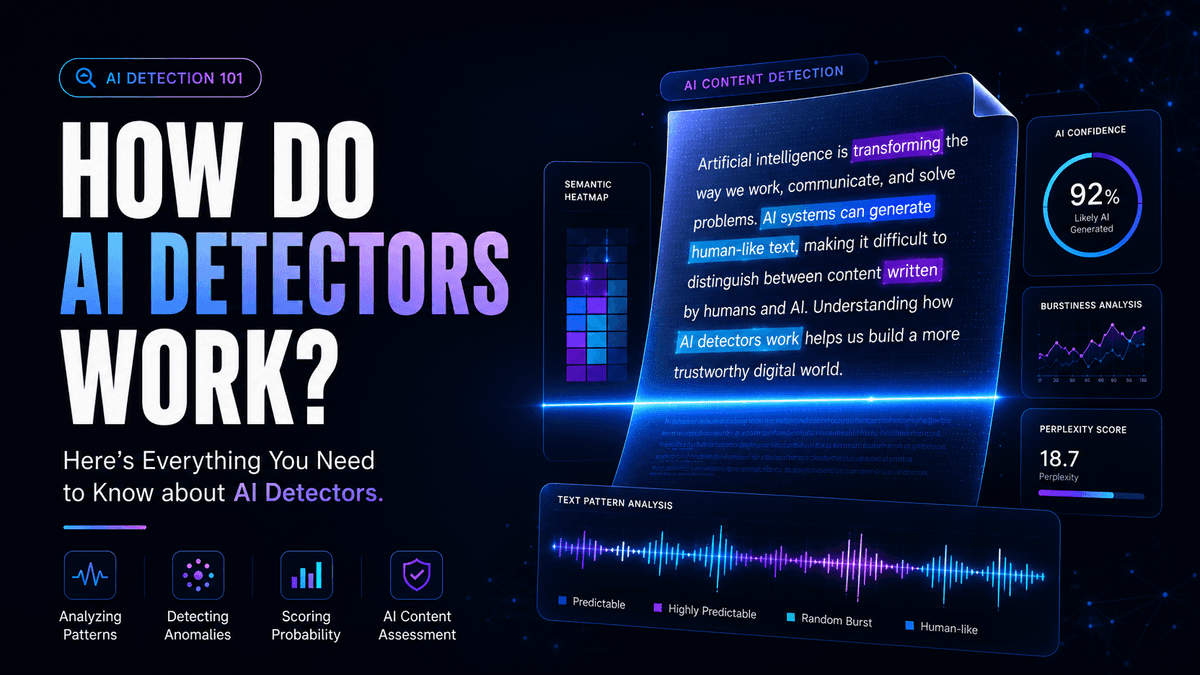
But how do AI detectors actually work? What's happening under the hood when you paste a paragraph into one of these tools and it spits back a "92% AI likelihood" result?
If you’re thinking about all these, then you’re certainly in the right place!
Because this guide breaks it all down, including the mechanisms, the metrics, the accuracy limits, and what these tools can and cannot do.
Whether you're a student, content writer, SEO professional, or just plain curious, by the end of this article, you'll understand AI detection the way most people never do.
So without further ado, let’s get started -
What Is an AI Detector?
Before we get into the science, let's nail the basics.
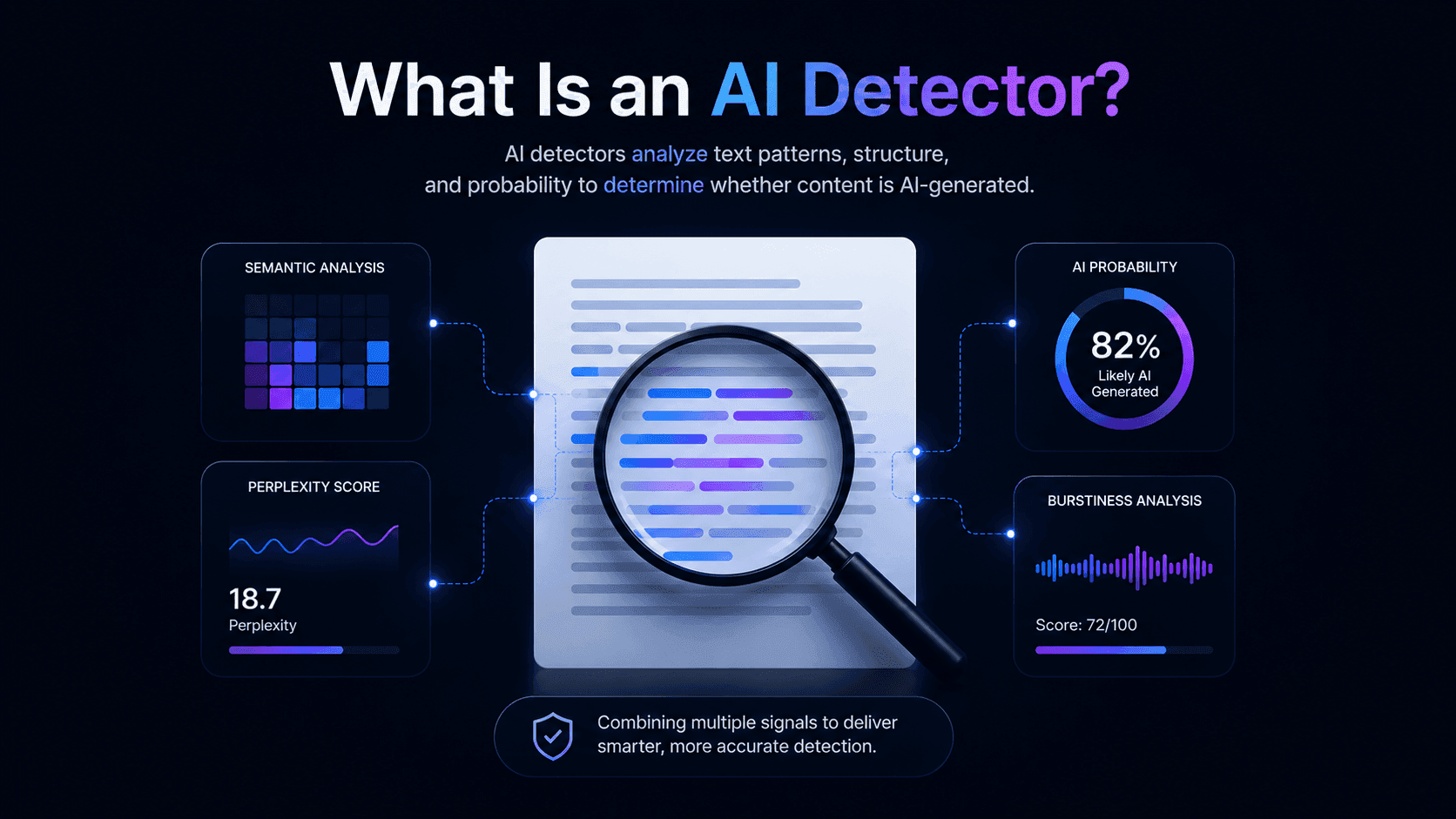
An AI detector, also called an AI content detector or AI writing detector, is a software tool that analyzes text to determine whether a human or an artificial intelligence system wrote it.
These tools don't read for meaning the way a person would. Instead, they perform what's best described as forensic text analysis, hunting for invisible fingerprints left by machine-generated text.
Popular tools in this space include Turnitin's AI detection module, GPTZero, Originality.AI, Copyleaks, CopyChecker's AI Detector, and Winston AI, among others.
One thing worth clarifying upfront: AI detectors and plagiarism checkers are not the same thing. A plagiarism checker compares your text against existing published content to find copied material.
An AI detector doesn't care whether your text appears anywhere else online. Mainly, it looks at how the text was constructed at the statistical and linguistic levels.
That's a fundamentally different process, and confusing the two leads to a lot of misplaced trust in both directions.
The Core Science Behind How Do AI Detectors Work
At its heart, AI detection is a probability problem. The software asks one question: Does this text behave the way AI-generated text statistically tends to behave?
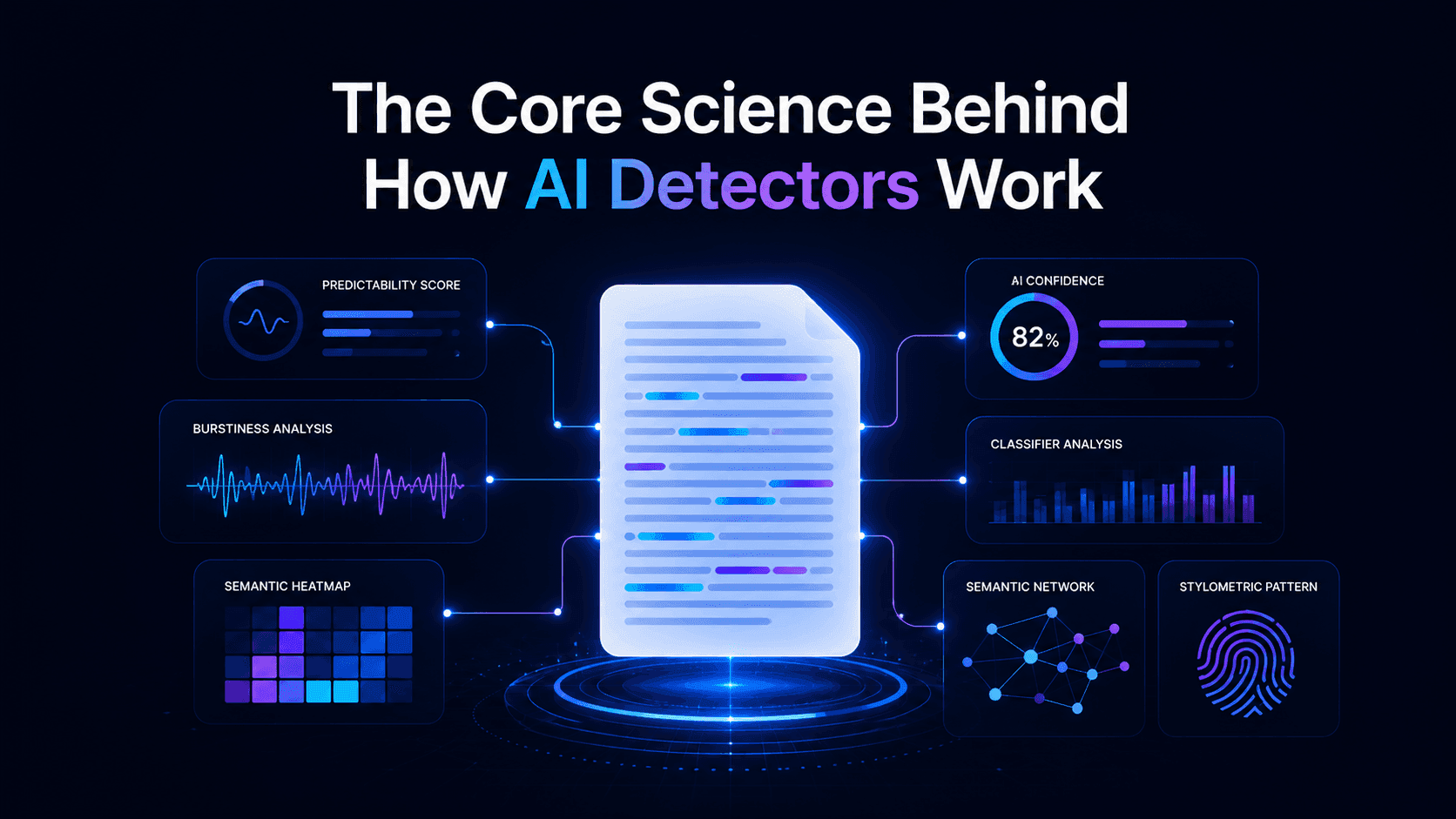
To answer that, detectors rely on several interlocking methods. Let’s know about them -
Perplexity Analysis for Measuring Predictability
Perplexity is the most fundamental concept behind how AI detectors work, and once you grasp it, machine-generated writing starts looking very different to you.
In computational linguistics, perplexity measures how "surprised" a language model is by a sequence of words.
If the next word in a sentence is easy to predict given everything before it, perplexity is low. If the next word is unexpected or unusual, perplexity is high.
Here's a quick example:
- Low perplexity (AI-like):"The sun rose slowly over the quiet, peaceful horizon."
- High perplexity (human-like):"The sun came up, and I remembered I'd left my passport in the taxi."
The second sentence is less predictable. A language model optimized for fluency would rarely produce it. A human writer would, because their thoughts follow lived experience rather than statistical likelihood.
AI writing tools like ChatGPT work as a source for almost everything and are trained to select the statistically most likely next word in a given context. The result is writing that flows smoothly and coherently but is, from a probability standpoint, boringly safe.
An AI detector assigns a perplexity score to your text, and unusually low scores raise an immediate flag.
Burstiness Analysis to Get The Rhythm of Real Writing
Even if perplexity captures AI's word-level predictability, there's another dimension where human and machine writing diverge sharply in sentence variation.
This is where burstiness comes in.
Human writers have a natural, almost unconscious rhythm. They write short, punchy sentences.
Then they shift gears entirely, launching into a longer, more meandering construction that explores an idea across multiple clauses before wrapping up with something firm.
Then a three-word sentence. See?
That variation where short bursts are clustered alongside long, flowing passages is called burstiness. Real human writing has a lot of it.
Early AI language models tended to produce writing with suspiciously consistent sentence lengths and structural patterns. Nothing was outright wrong, but the rhythm felt mechanical. Like a metronome set to "essay mode" and never touched again.
AI content detector tools measure the distribution and variation of sentence lengths and structural complexity throughout a piece of text. Low burstiness, which signals a telltale, whereas too-consistent cadence raises the detection score significantly.
Machine Learning Classifiers For The Bigger Picture
Individual metrics like perplexity and burstiness are powerful, but no single signal is reliable on its own.
That's why most tools that detect AI-generated text also deploy machine learning classifiers, in which algorithms are trained on massive datasets of labeled human writing and AI output.
A classifier doesn't analyze one feature at a time. Instead, it looks at dozens of signals simultaneously for predictability scores, word frequency distributions, syntactic patterns, semantic consistency, and more, weighing them all together.
Through training on thousands of quality essay examples, it learns which combinations of signals are characteristic of machine-written text versus genuine human prose.
When you paste text into an AI detector, you're not just getting a perplexity check.
You're running your writing through a model that has seen enormous amounts of both human and AI text and learned to distinguish the statistical signatures of each.
That percentage score on your screen? It's the classifier's probability estimate built from all those signals at once.
Stylometric Analysis For The Writer's Fingerprint
Beyond pure statistics, some advanced AI content detectors also perform stylometric analysis to examine features such as vocabulary richness, sentence complexity, the variety of connective language used, and even punctuation habits.
Human writing tends to show idiosyncratic stylistic choices. Writers overuse certain phrases, favor particular sentence openers, lean on specific transitional words, or break grammatical rules in consistent ways that feel like their own.
AI-generated text, optimized for correctness and coherence, typically lacks these small, telling imperfections.
Stylometric signals are subtler than perplexity or burstiness, but when combined with both, they can considerably sharpen a detector's accuracy.
Semantic Embeddings and Contextual Fingerprinting
Some of the newer and more sophisticated tools, like CopyChecker's AI detectors, Turnitin's AI Checkers, etc., use semantic embeddings, basically mathematical representations of meaning, to compare how ideas relate to each other throughout a text.
AI language models tend to cluster ideas within predictable semantic neighborhoods. Transitions between concepts follow trained patterns.
Human writers, drawing on real experience and non-linear thinking, often make conceptual leaps that seem surprising yet coherent in hindsight.
Tools using embedding-based comparison check whether the way a text moves between ideas matches the fingerprint of machine generation or the somewhat messier but distinctly human territory of organic thought.
Emerging Metadata and Watermarking Method
A newer, still-developing approach involves AI watermarking.
Some developers are experimenting with embedding subtle, invisible patterns into their model outputs for statistical signals that don't affect readability but can be reliably detected by the right software.
OpenAI has explored this direction, though no widely deployed watermarking system has become standard yet.
If it does, detection would shift from probabilistic guesswork to near-certain identification, at least for content produced by participating platforms.
A Step-by-Step Process of How Do AI Detectors Work in Practice
Understanding the methods behind AI plagiarism detection with tools is one thing. Watching the process unfold step by step is another. Here's exactly what happens the moment you paste text into an AI detector, broken down in a way anyone can understand.
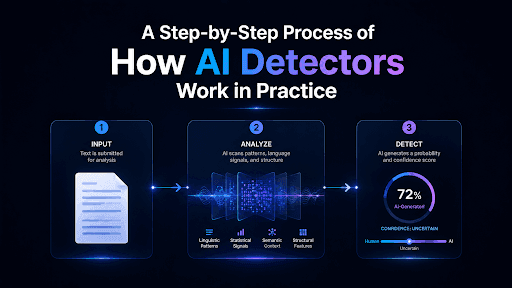
Step 1: The Text Gets Broken Into Pieces
Before anything meaningful can be analyzed, the detector splits your writing into smaller units such as individual words, phrases, and sentences.
This process, called tokenization, turns a block of human-readable text into something a machine can actually measure. Think of it as the tool putting your writing under a microscope before it starts examining anything.
Step 2: It Asks, "How Predictable Is This?"
Once the text is tokenized, the detector runs it against its internal language model and starts measuring perplexity, essentially asking: How surprised am I by each word choice?
If the writing follows the statistically safest path at every turn (smooth, obvious, risk-free word choices), the perplexity score drops. Low perplexity raises an immediate flag. The detector notices: this writing habit, even with grammar rules, never takes a risk.
Step 3: It Checks The Rhythm
Next, the AI detector examines sentence variation in length, structure, and pacing. This is the burstiness check. It's asking whether the writing breathes naturally, mixing short and long sentences the way a real person does when thinking as they write.
Writing that hums along in suspiciously even, well-balanced paragraphs that are never too short, or never too long. Basically, reads like a machine found its comfort zone and stayed there.
Step 4: Multiple Signals Get Weighed Together
Here's where individual metrics give way to the bigger picture. A machine learning classifier pulls together everything gathered so far, like perplexity, burstiness, vocabulary patterns, sentence structure, word frequency distribution, and weighs them all simultaneously.
No single signal decides the outcome. The combination works the same way a doctor doesn't diagnose based on one symptom alone, but on the full picture of what the body is doing.
Step 5: A Probability Score is Calculated
The classifier produces a final output. Mainly, not a yes-or-no, but a percentage. Something like "78% likely AI-generated."
That number reflects how closely the text's overall statistical profile matches patterns the detector has learned to associate with machine-written content.
The higher the score, the more signals point in the same direction. It is, crucially, a probability or maybe an educated estimate, not a verdict.
Step 6: You See the Result, But Context Fills the Rest
The score lands on your screen. And this is where the tool's job ends, and human judgment begins.
A 78% flag on a student essay means something different than the same score on a technical report written by someone whose first language isn't English. The number is a starting point for a conversation, not the final word on anything.
The whole process takes seconds. But behind those seconds is a genuinely sophisticated chain of analysis, one that's getting sharper with every new generation of detector, even as the AI writing tools it's chasing get better at hiding their tracks.
How Accurate Are AI Detectors?
Here's where things get honest and a little uncomfortable. Most tools that detect AI-generated text report accuracy rates between 65% and 85% respectable, but far from definitive. And accuracy isn't distributed evenly across all content types.
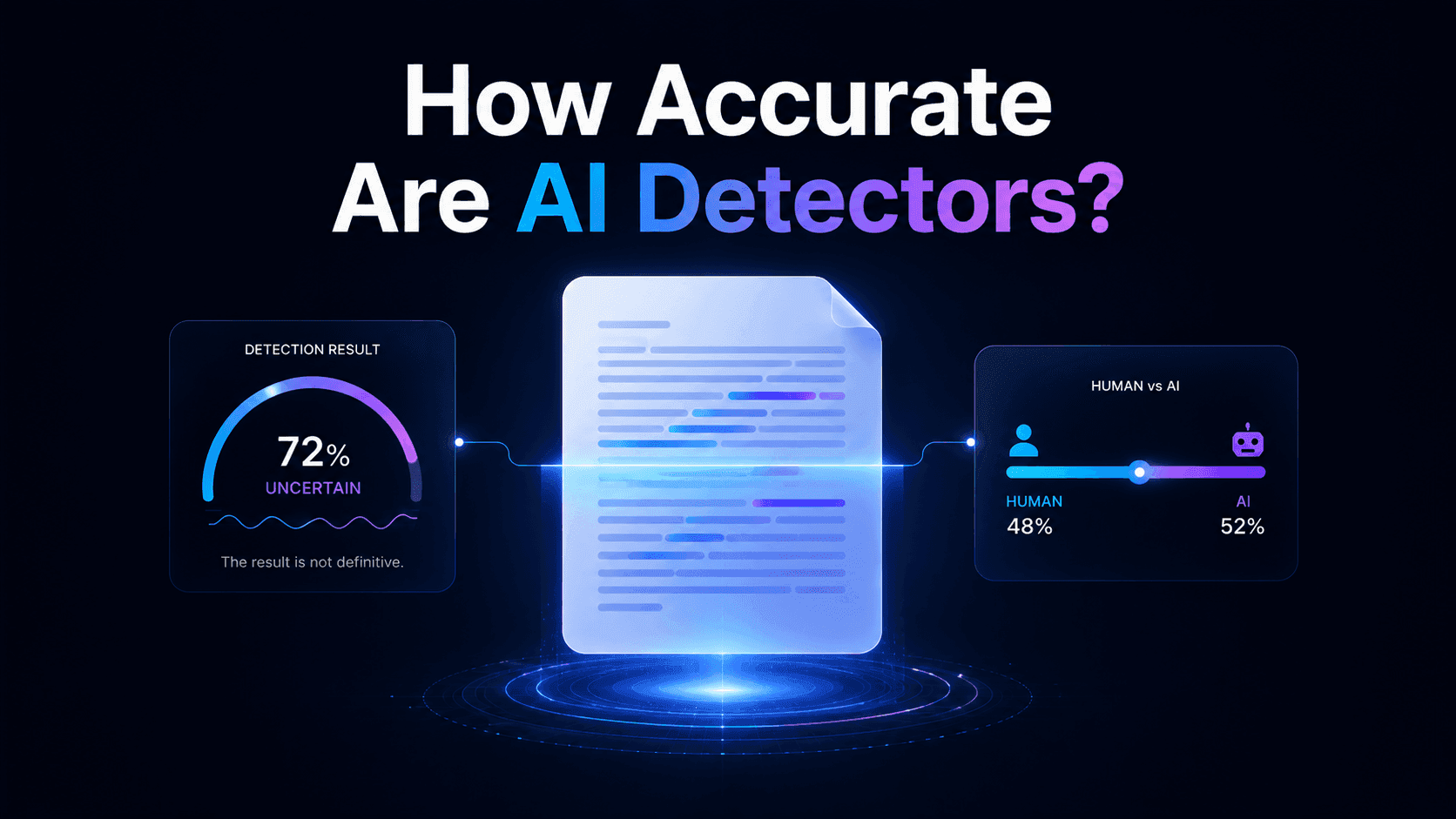
False positives are a documented problem. This is when an AI detector flags genuinely human-written text as AI-generated. Academic writing, particularly from non-native English speakers who favor structured, formal styles, is disproportionately flagged.
Dry, technical, highly predictable prose can score like AI output even when every word came from a human brain.
False negatives happen when AI-generated content slips through undetected. Heavily edited AI text, paraphrased output, or content deliberately varied in style can often evade detection altogether. If AI-generated text sounds overly predictable or mechanical, our humanize AI text tool can rewrite it with more natural sentence structures, varied phrasing, and smoother flow.
The core challenge: both the AI models that produce content and the detectors that try to catch them are locked in a continuous arms race.
As AI writing improves, detectors must constantly update their training data and methods to keep pace. Neither side stays still for long.
Read more about - How to Tell Whether an Image Is AI Generated
The Limits of AI Detection that You Need to Know
Here's the uncomfortable truth that gets buried beneath all the impressive-sounding percentage scores: AI detectors answer a very specific, very narrow question. They ask — does this text statistically resemble how AI systems tend to write? That's it.
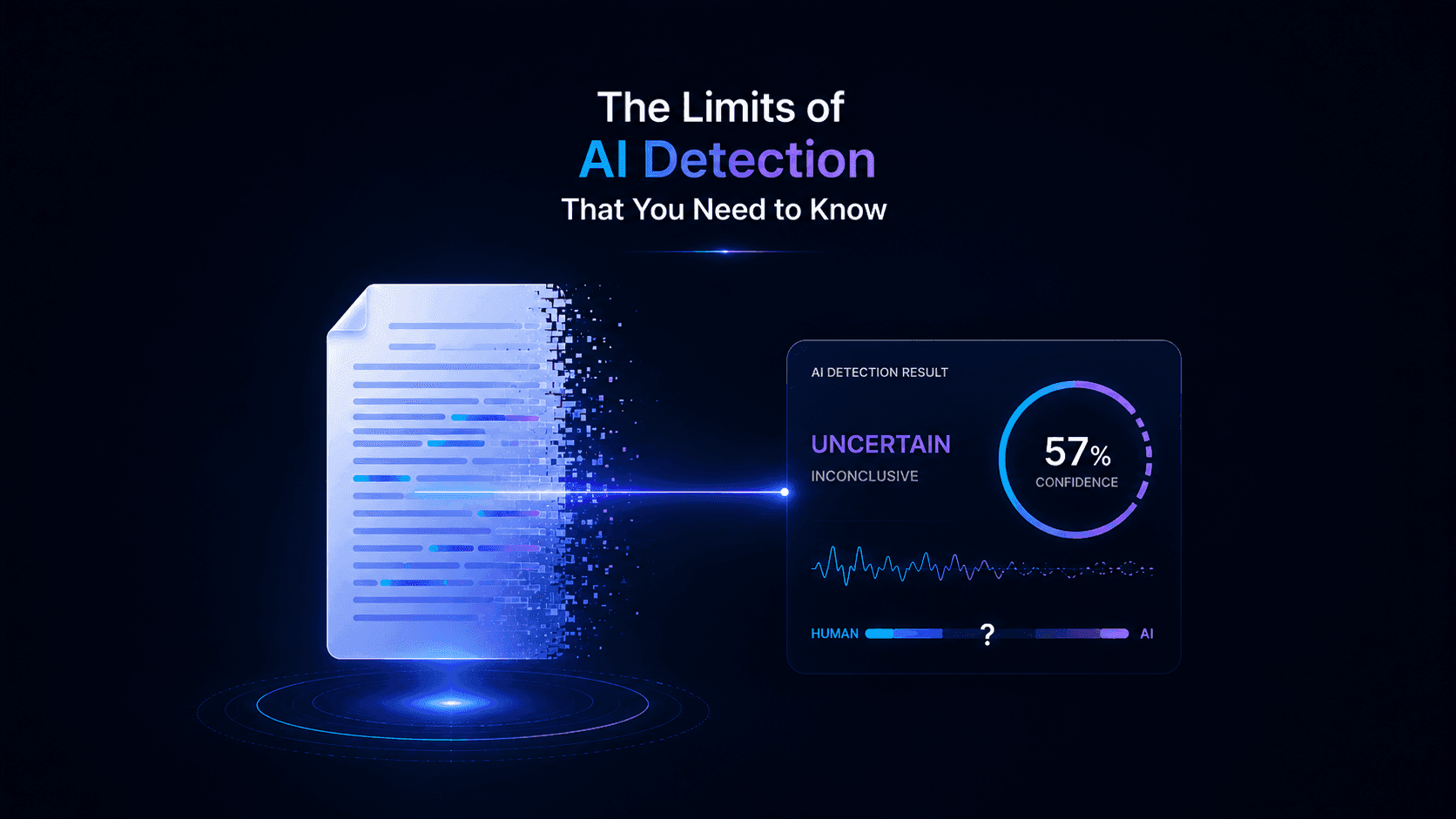
Everything else, the meaning, the accuracy, the ethics, the quality, falls completely outside their field of vision.
Think of it like a metal detector at an airport. It can tell you there's metal in your bag.
It cannot tell you whether that metal is a weapon, a harmless belt buckle, or your grandmother's antique brooch. The signal is real; the interpretation still requires a human brain.
So what exactly are these tools blind to?
- Originality of Thought is Invisible to Probability Models: A detection score says nothing about where the thinking came from. AI can summarize, repackage, and recombine existing ideas into fluent prose, but so can humans. An individual who reads three sources and paraphrases the ideas in their own words might produce text that is statistically similar to ChatGPT output. Creativity, synthesis, and genuine intellectual contribution- none of it registers on a perplexity chart.
- Confidence is Not the Same as Correctness: AI language models are extraordinarily assured writers. They produce clean, low-perplexity sentences about things that are completely and demonstrably wrong. A hallucination delivered in perfect prose sails through most AI content detectors without a second glance because the tool measures style, not substance. Factual accuracy and statistical predictability live in entirely different dimensions.
- The Human Story Behind the Text is Completely Vague: There is a meaningful ethical violation and gap between a journalist who uses AI to sketch a rough outline and then rewrites, verifies, and edits, versus someone who submits raw output under their byline. A detector sees neither story, only patterns in text. The shortcuts taken, the effort invested, the intent behind the work- all of it is invisible. Raising a flag worth investigating is within these tools' power. Rendering a verdict is not.
FAQs About How Do AI Detectors Work
As AI-generated content floods the internet, AI detectors have stepped in as a frontline defense, but there's a lot of confusion about what they actually do. These FAQs explain the technology in plain terms.
What is the main method AI detectors use to identify machine-generated text?
AI detectors most often rely on perplexity, which measures how predictable each word choice is within a sentence, flagging smoothness as a signal of machine authorship.
Do AI detectors actually work, or are they just guessing?
AI content detectors make educated, data-backed estimates, not random guesses, but not certainties either.
Why do AI detectors sometimes flag human writing as AI?
The signals they measure, such as predictability, rhythm, and formal vocabulary, aren't exclusive to machines, so when someone writes in structured, precise styles, it matches AI output.
Does editing AI-generated text help it pass detection?
Significant manual editing can reduce a detection score, yes. But lightly paraphrasing or rearranging sentences rarely fools a multi-signal detector.
Are AI detectors used by Google to penalize content?
Google has not confirmed the use of AI detection scores as a direct ranking signal, but it penalizes content that lacks genuine expertise, original perspective, and real value.
How do AI detectors handle non-English content?
Not particularly well, as most detection models were trained predominantly on English-language data, though multilingual capabilities are improving.
What does a 90% AI score actually mean?
It means the text's statistical profile, like word predictability, sentence variation, and structural patterns, closely matches what the detector associates with machine-generated writing.
End Note
Now, when someone asks how do AI detectors work, you have a real answer, not just a surface-level one, right?
Machine-generated writing leaves behind a trail it can't fully hide. Too predictable in word choices. Too consistent in rhythm. Too smooth in ways that real human thought is messy, tangential, and gloriously unpredictable.
None of these detection signals is perfect on its own. But stacked together, they build a picture that's harder to fool than most people expect. And with every new model update on both sides, that picture gets sharper.
Here's what's actually worth holding onto: understanding how AI content detection works makes you better at the thing that matters most, and that is writing with a voice that's unmistakably yours.
Not because you're trying to game a tool, but because authentic writing has always been the standard worth chasing.
Before anything goes live, though, it pays to know exactly where your content stands.
That's where CopyChecker comes in.
Paste your text, get a clear AI detection score in seconds, and publish with confidence rather than crossed fingers.
No complicated dashboards. No ambiguous results. Just a straight answer when you need one most.
Write well. Verify smart. Then let the work speak.
You May Also Like
- What is Self-Plagiarism? Know A-Z of Self Plagiarism
- Copyright vs Plagiarism: The Difference Everyone Should Know in 2026
- What is Global Plagiarism? Your Complete Guide for 2026
- Best Free Plagiarism Checker for Research Papers in 2026
- Best Free Plagiarism Checker for Students in 2026