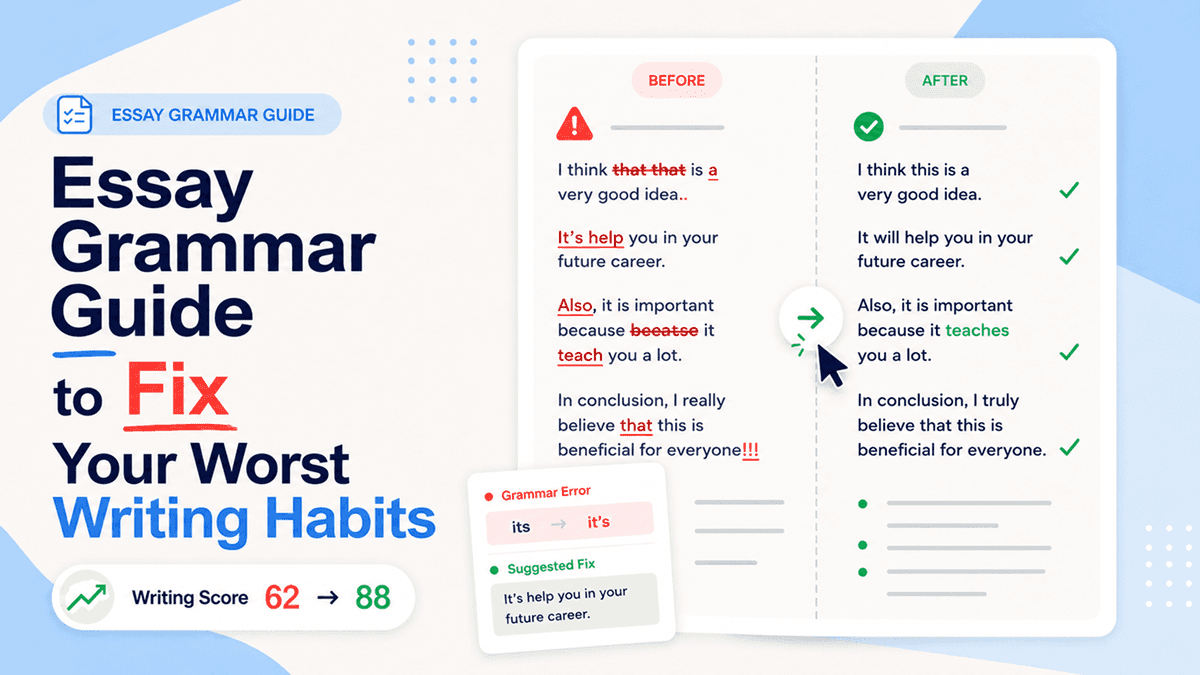
You've probably had this happen when you just completed writing an essay. Certainly, you're proud of it, hand it in, and get back the grade.
Unfortunately, you saw a grade that didn't reflect how well you thought you did.
It is because you see half the comments aren't even about your argument. They're mainly about commas. Run-on sentences. "Subject-verb agreement?" written in red ink, like it's an accusation.
That's the quiet truth about essay writing that nobody tells you early enough. Basically, grammar isn't a side issue; it's the delivery system for your ideas.
A brilliant argument wrapped in confusing sentences reads like static on a radio. The signal is there, but the listener gives up before they catch it.
That is why this essay grammar guide is built to fix that.
In this whole blog, we'll walk through the grammar rules that actually matter for essays, show you the mistakes that show up again and again, and give you a simple way to catch them before a teacher or editor does.
No jargon. No twenty-page grammar textbook. Just the stuff that moves your writing from "readable" to "convincing."
So let’s know more about it so that from now on you don’t have to struggle with any more essays -
What Is Essay Grammar?
Essay grammar is the set of rules that govern how sentences are built, connected, and punctuated in academic and formal writing.
It covers sentence structure, verb tense, subject-verb agreement, punctuation, and word choice, all working together so a reader can follow your argument without tripping over the wording.
Essay grammar isn't a separate skill from "regular" grammar. It's the same rules, just applied with a bit more discipline.
In a text message, a sentence fragment is fine. But in an essay, that same fragment can make a number of paragraphs feel unfinished or sloppy.
Think of grammar as the scaffolding around your argument. The reader doesn't notice good scaffolding; they just notice that the building stands up.
But they definitely notice when it doesn't.
Why Grammar Matters in Essay Writing?
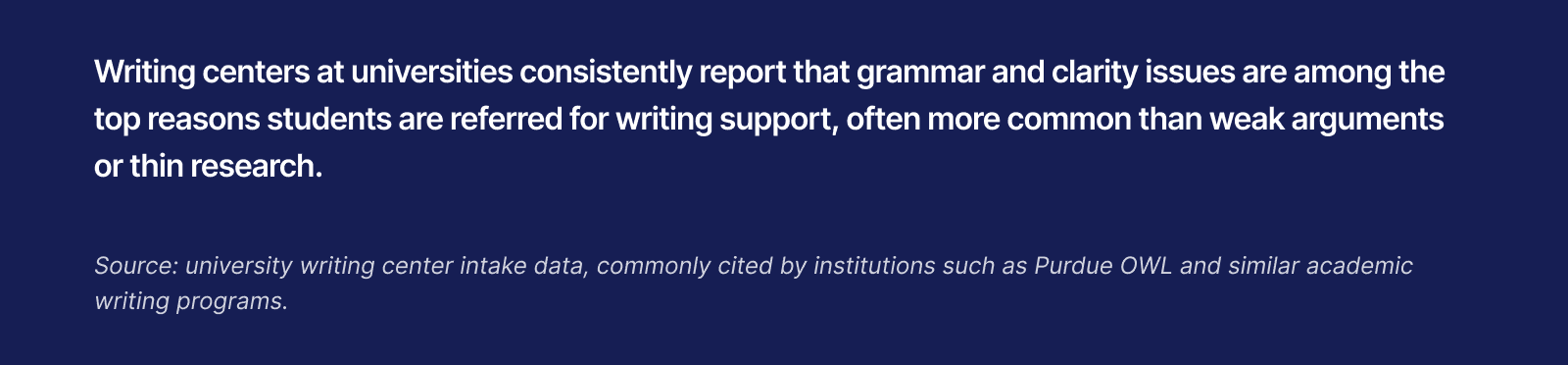
Grammar matters in essay writing because it directly affects how clearly your ideas come across. Even a strong argument can lose marks, credibility, or persuasive power if the sentences are hard to follow, ambiguous, or full of errors.
It helps to think about grammar the way you'd think about a shaky bridge. The bridge might lead somewhere worth going, but if it wobbles every few steps, people stop trusting it long before they reach the other side.
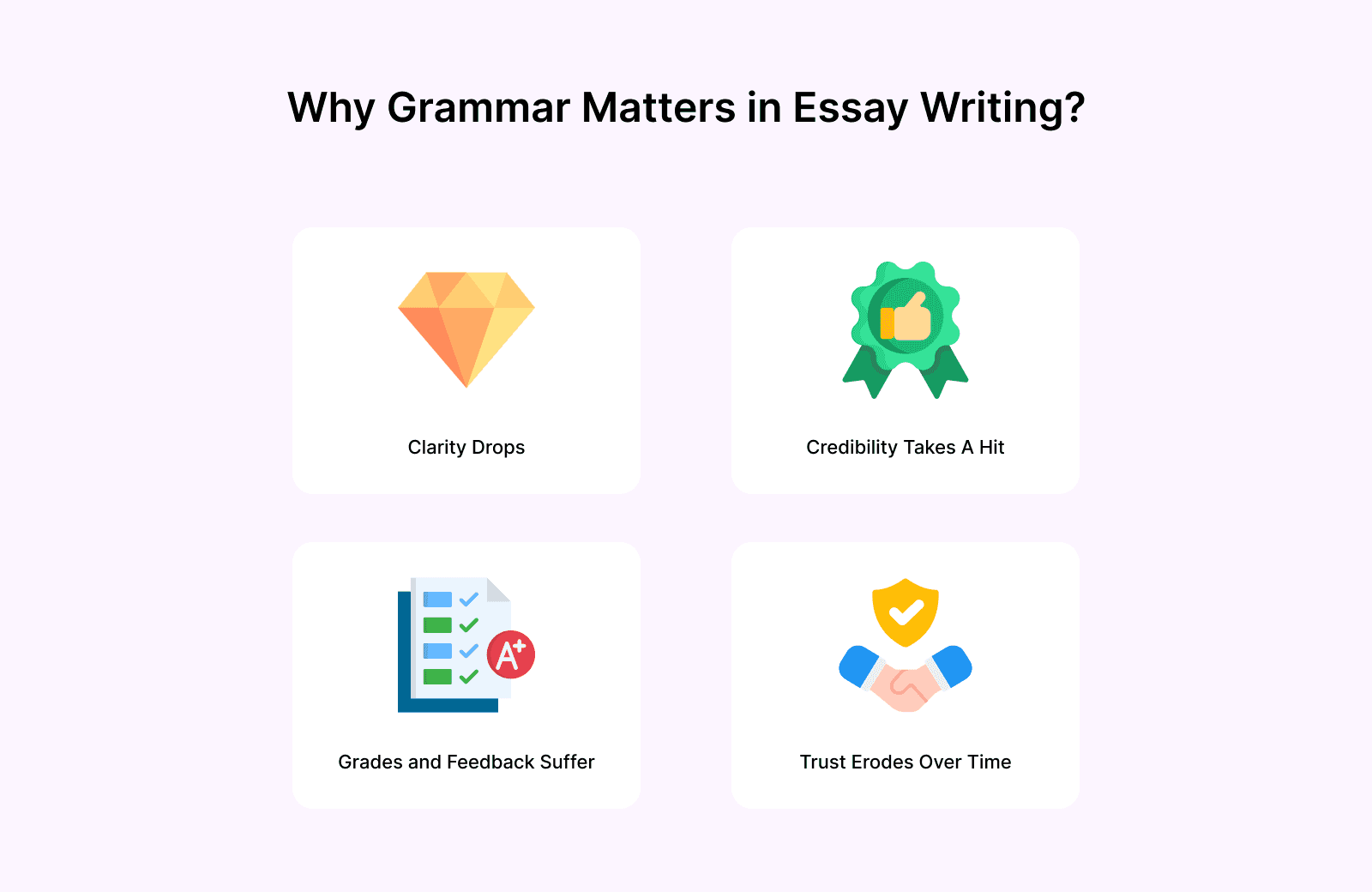
That's essentially what happens to a reader moving through a poorly written essay. So here's a closer look at what actually breaks down, and why each piece matters more than it seems at first glance.
Clarity Drops
When a sentence is tangled, the reader's brain has to stop and untangle it before moving forward. Say you write, "The policy that researchers who studied the region for several years eventually concluded was flawed and failed."
By the time a reader reaches the verb, they've lost track of who did what. They have to go back, re-read, and rebuild the sentence in their head just to get your point.
Every re-read like that pulls focus away from your argument and puts it on your wording instead, which is the opposite of what you want an essay to do.
If your sentences keep coming out stiff or overly mechanical, no matter how you phrase them, running them through CopyChecker's AI Humanizer can help smooth that out.
Credibility Takes A Hit
Readers, especially graders and editors, tend to associate sentence-level care with research-level care. That's not entirely fair, but it's how human attention works.
If a paragraph has a comma splice issue, a tense shift, and a subject-verb mismatch all in the first few lines, the reader starts reading the rest more skeptically, even if your sources are excellent and your reasoning is sound.
The errors become a kind of static that makes everything after them sound a little less convincing, whether or not that's deserved.
Grades and Feedback Suffer
Most grading systems, whether they're university rubrics or workplace style guides, separate "what you said" from "how you said it." Language mechanics, sentence construction, and clarity usually sit in their own scoring category.
That means a well-argued essay can still lose marks purely on the writing-mechanics line, completely apart from how strong the ideas are.
Two students can submit their personal statement essays with identical arguments and identical research, and the one with cleaner grammar will almost always score higher on the writing-quality portion of the rubric.
Trust Erodes Over Time
This one appears more often in professional and academic settings than in casual writing. If a reader spots several grammar mistakes in essays, reports, or proposals, they start to wonder what else might have been rushed.
Did they check their sources as carefully as they checked their sentences? Did they run their work through a plagiarism checker, or skip that step too? Did they double-check the data the way they should have proofread the paragraph?
Grammar becomes a stand-in for diligence, fairly or not, and once that doubt creeps in, it's hard to undo with the rest of the writing alone.
Basic Grammar Rules Every Essay Needs
Before we get into the mistakes that drag essays down, it's worth slowing down on the basics for a moment. Most grammar problems in essays don't come from exotic rules nobody's heard of.
Mainly, standard grammar rules come from a small set of fundamentals that quietly slip under pressure, especially when you're writing fast or juggling a deadline.
Once these five academic grammar rules feel automatic, you'll naturally write cleaner first drafts. So, here's the foundation that shows up in nearly every paragraph you'll ever write:
- Every Sentence Needs A Subject and A Verb: Without both, you have a fragment, not a sentence. A subject tells the reader who or what the sentence is about, and the verb tells them what that subject is doing or being. Drop either one, and the sentence feels like it cuts off mid-thought, even if it has a period at the end.
- Subjects and Verbs Must Agree in Number: Singular subjects take singular verbs; plural subjects take plural verbs. This sounds obvious until a few extra words land between the subject and the verb: "The list of complaints was long," not "were," because "list" is the actual subject, not "complaints."
- Verb Tense Should Stay Consistent: Unless you have a clear reason to shift. For example, you might describe past research in the past tense ("The study found...") and then shift to the present tense to state your own conclusion ("This suggests..."). What you want to avoid is drifting between tenses inside the same sentence or paragraph without any logical reason for the change.
- Pronouns Need Clear Antecedents: If "it" or "they" could refer to more than one noun, the sentence is unclear. In a sentence like "The teacher told the students they were wrong," it's not clear whether "they" refers to the teacher or the students, and that small ambiguity can quietly undermine an entire argument.
- Punctuation Separates Ideas; It Doesn't Decorate Them: Commas, periods, and semicolons each do a specific job, and mixing them up changes how a sentence is read, not just how it looks. A comma pauses, a period stops, and a semicolon links two ideas that are closely related but still complete on their own.
These five rules alone solve most essay writing grammar tips you'll ever need. The rest of this guide builds on top of them. So let’s find out about -
Common Grammar Mistakes in Essays
The most common grammar mistakes in essays are run-on sentences, sentence fragments, subject-verb agreement errors, comma splices, inconsistent verb tenses, and vague pronoun references.
Here's the thing about these mistakes: most writers don't make new ones. They make the same one or two, over and over, in slightly different costumes. The run-on sentence that pops up in your introduction will probably show up again in your conclusion if you don't catch the pattern early.
So instead of treating these as a checklist to memorize, treat them as a lineup of suspects you're learning to recognize on sight.
Moreover, grammar mistakes usually show up inside the body of an essay, but they're not the only thing that can trip a reader up early on. A vague or clunky title can lose someone's interest before they even reach your first sentence.
So, if you're staring at a blank title field and nothing sounds right, CopyChecker's Essay Title Generator is a quick way to get a handful of clean, relevant options without overthinking it.
With that out of the way, let's get into the mistakes that matter most once the writing actually starts -
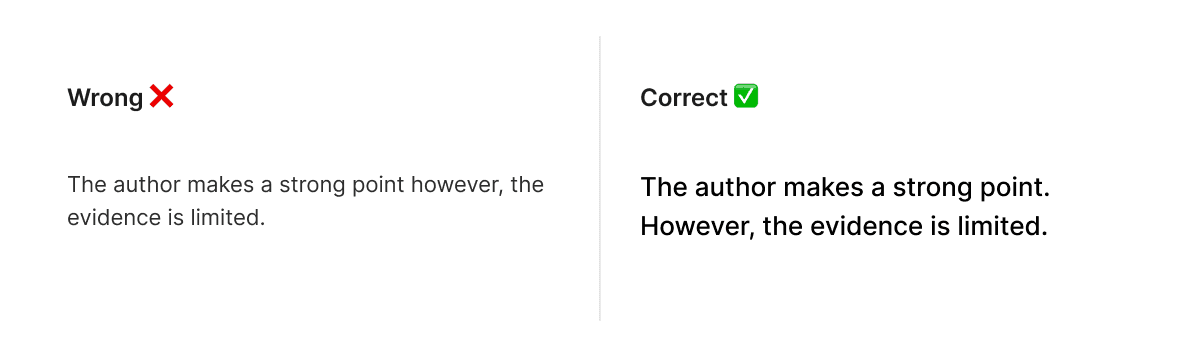
1. Run-on Sentences
A run-on sentence happens when two complete ideas are jammed together without the right punctuation in essays or connecting words.
2. Sentence Fragments
A fragment is missing a subject, a verb, or a complete thought.
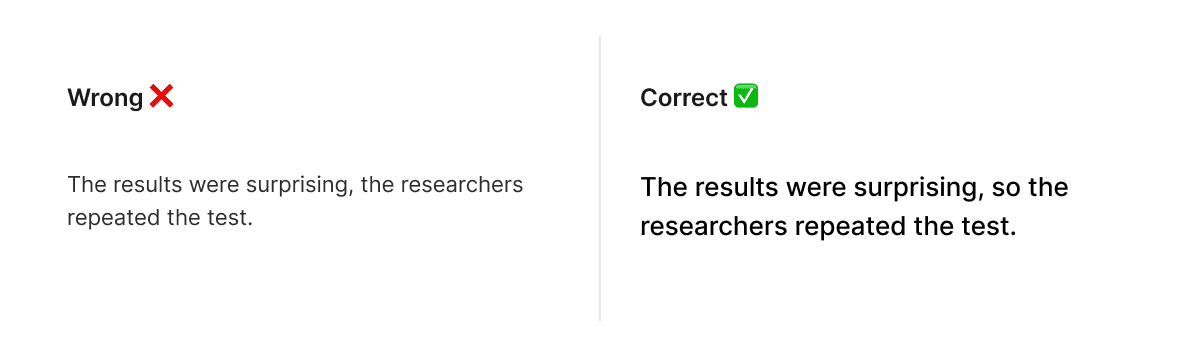
 3. Comma Splices
This is when two complete sentences are joined with only a comma, no connecting word.
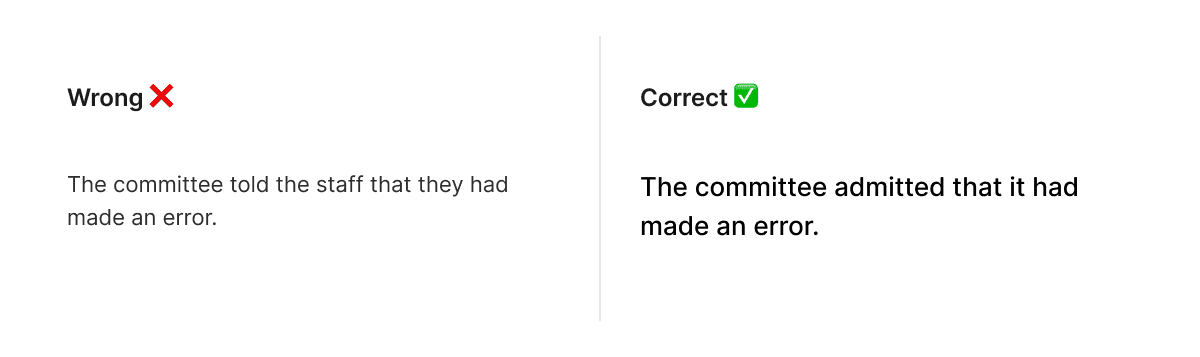
4. Vague Pronoun References
This happens when a pronoun like "it," "they," or "this" could point to more than one noun in the sentence, leaving the reader to guess which one you actually mean.
How to Fix Sentence Structure in Essays
Strong sentence structure in essays comes from varying sentence lengths, avoiding overloaded sentences, and ensuring each sentence carries one clear idea rather than stacking multiple ideas with commas.
A few practical habits fix most structural problems:
- Read sentences out loud. If you run out of breath before the period, the sentence is probably too long.
- One idea per sentence. If you find yourself writing "and" three times, split it into two sentences.
- Vary your sentence openings. Essays that start every sentence with "The" or "This" feel repetitive fast.
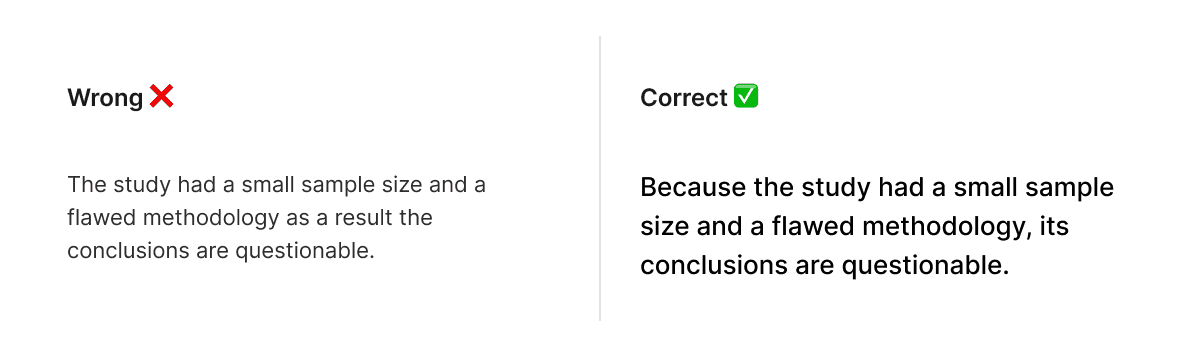
- Use subordination on purpose. Words like "although," "because," and "while" show the relationship between ideas. They're not just connectors; they're logic.
Punctuation Rules for Better Essays
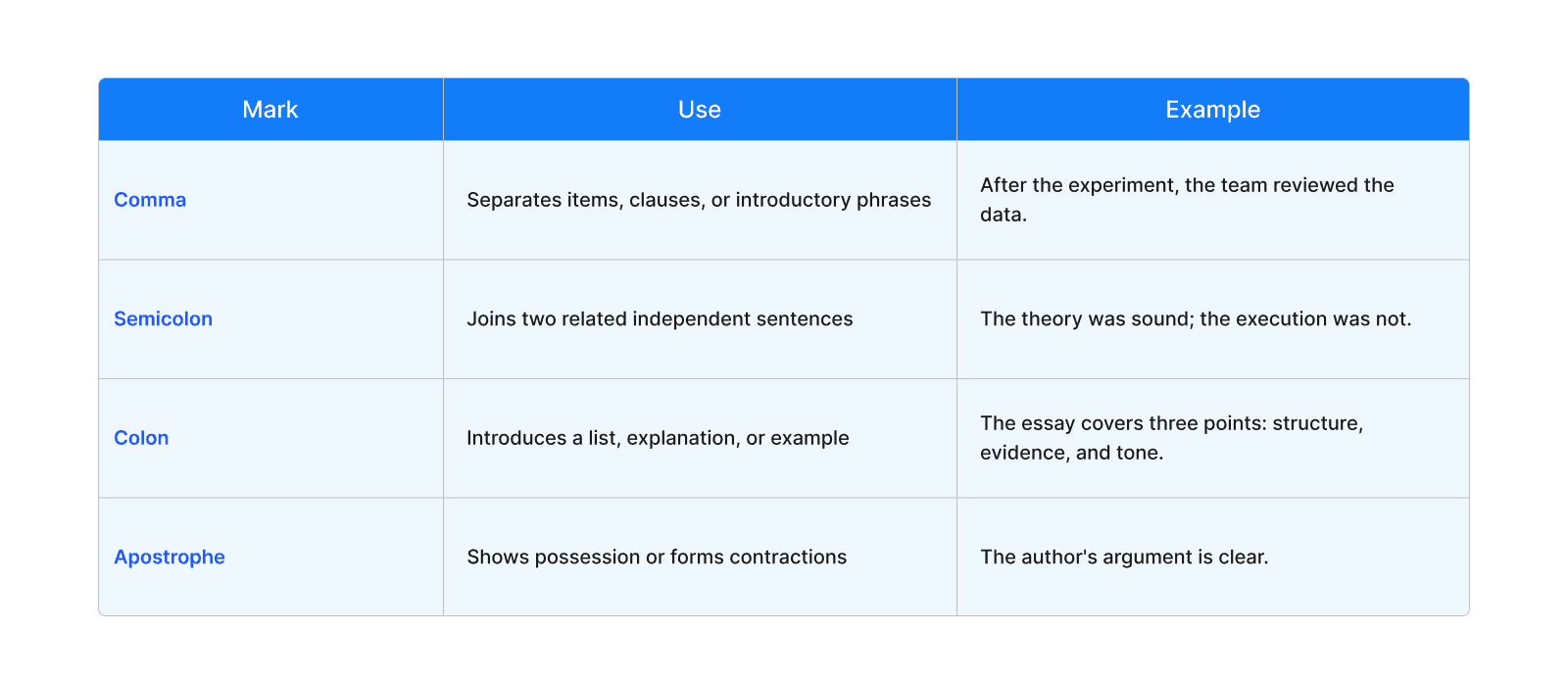
If you want to find out how to improve essay writing, then remember that punctuation in essays controls pacing and meaning.
Commas separate clauses, semicolons connect related independent sentences, and colons introduce explanations or lists. Each mark changes how a sentence is read, not just how it looks.
The Oxford Comma
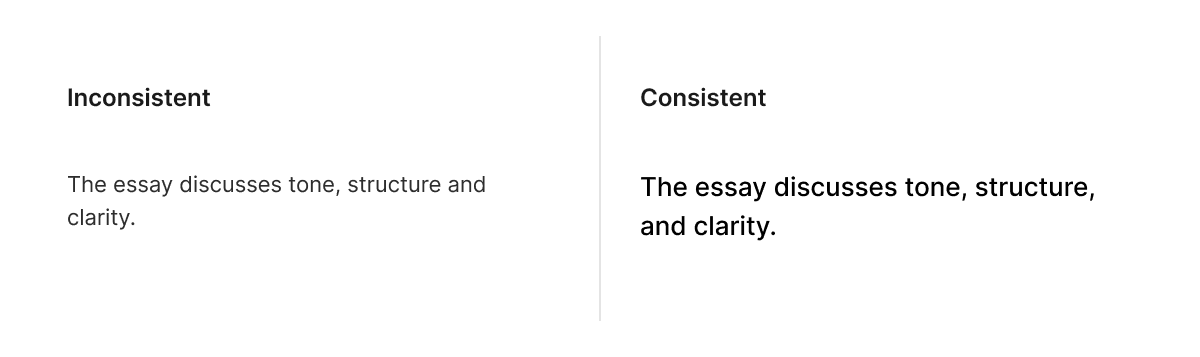
Whether you use it or not, be consistent. Academic writing typically prefers the Oxford comma for clarity.
Subject-Verb Agreement in Essay Writing
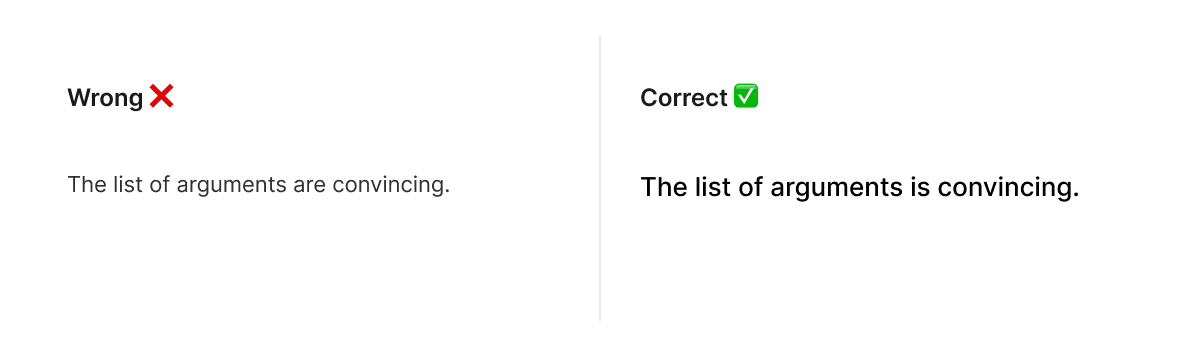
Subject-verb agreement means the verb must match the subject in number, such as singular subjects pair with singular verbs, and plural subjects pair with plural verbs, even when other words sit between them.
Most subject-verb agreement mistakes happen when a phrase sits between the subject and the verb, and the writer accidentally agrees with the wrong word.
Verb Tense Consistency in Essays
Basically, verb tense consistency means staying in one tense throughout a passage unless the timeline of events genuinely shifts. Most academic essays use the present tense for analysis and the past tense for describing completed research or events.
A common pattern in academic writing:
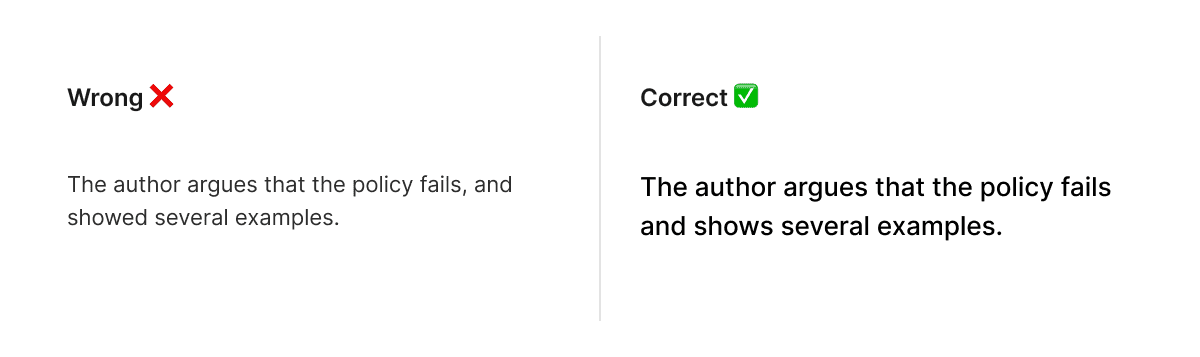
- Use past tense to describe what a study did or found ("The researchers tested...").
- Use present tense to discuss what the findings mean or argue your own point ("This suggests that...").
Word Choice and Academic Tone
Academic writing grammar favors precise, formal word choices over casual phrasing. This means avoiding contractions, slang, and vague intensifiers, and choosing specific words over general ones.
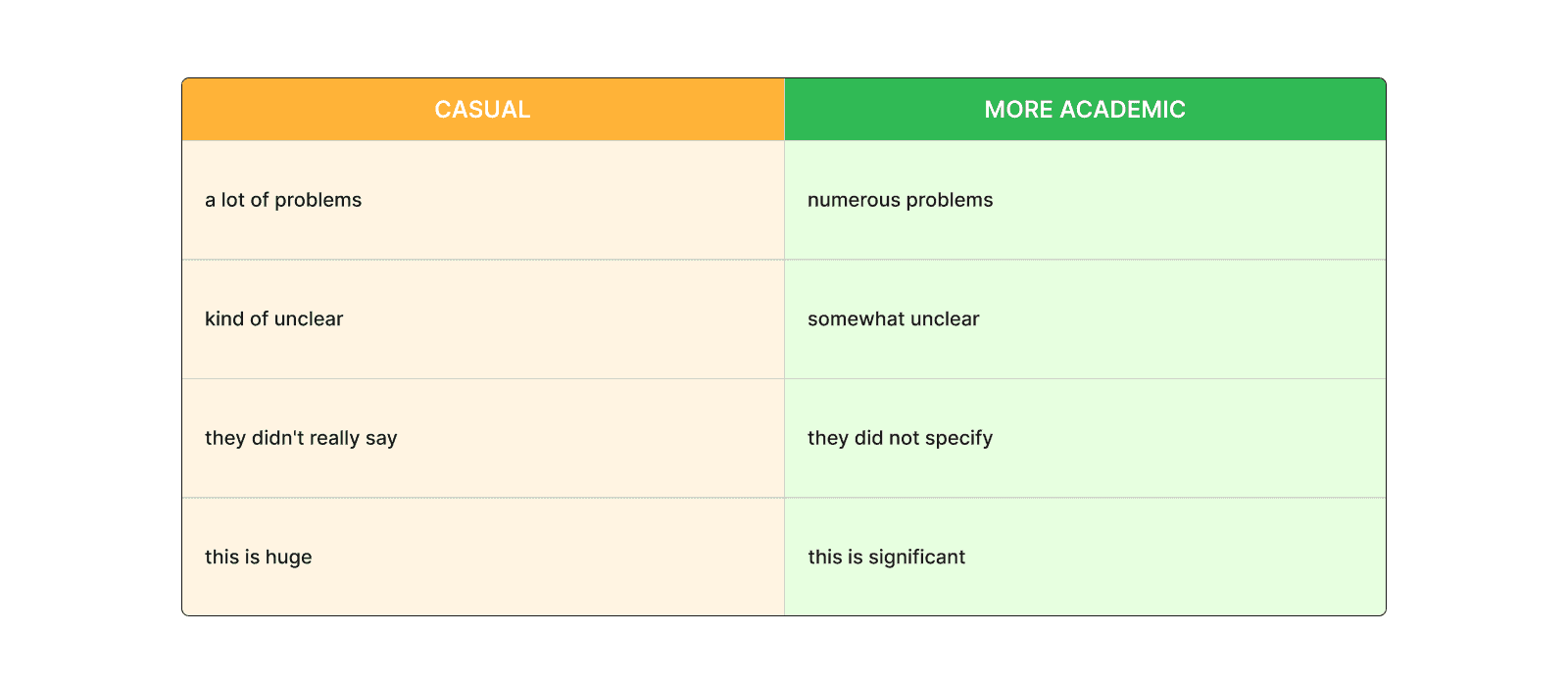
You don't need fancy vocabulary to sound academic. You need precision. "Significant" conveys more than "huge." "Numerous" is more exact than "a lot of."
How to Proofread Your Essay for Grammar
For proofreading an essay for grammar, read it slowly out loud, check one issue at a time (tense, then agreement, then punctuation), and read the conclusion before the introduction to catch errors your brain otherwise skips over from familiarity.
Most people proofread incorrectly. They read fast, looking for "anything that feels off," and skim right past the very sentences they wrote five minutes ago. Try this instead:
- Read Backward, Paragraph by Paragraph: It breaks the flow your brain expects and makes errors more visible.
- Check One Thing Per Pass: First pass for tense, second for agreement, third for punctuation. Trying to catch everything at once means catching less of everything.
- Read It Out Loud: Your ear catches awkward phrasing, and your eyes glide over.
- Take A Break Before the Final Read: Even twenty minutes resets how familiar the text feels, so errors stand out again.
- Use A Grammar Checker: For essays as a second pass, not a replacement for your own read-through. A tool catches patterns; you catch meaning.

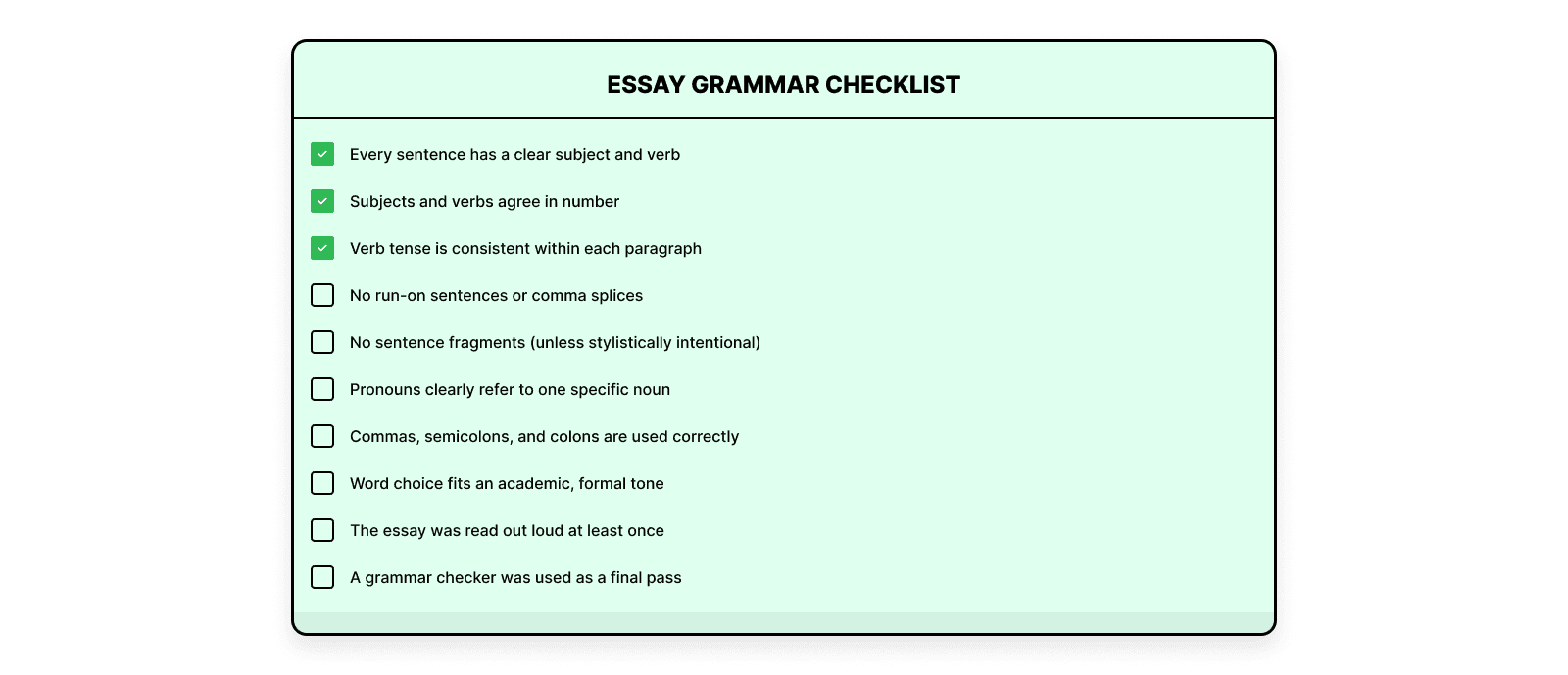
Essay Grammar Checklist that You Might Need
Every essay has a danger zone with the gap between "I'm done writing" and "I actually submitted it."
That's exactly where most common grammar mistakes slip through, usually because the writer is tired, rushed, or simply too close to their own words to see them clearly anymore.
The fix isn't more willpower. It's a system you can run on autopilot, even at midnight with a deadline closing in.
This checklist takes about 10 minutes and catches the kind of small, fixable errors that quietly cost the most marks -
Best Way to Improve Essay Grammar Over Time
The best way to improve essay grammar over time is to track your own recurring mistakes, read well-edited writing regularly, and edit in focused passes rather than trying to fix everything in one read.
Improving essay grammar isn't about memorizing more rules. It's about recognizing patterns in your own habits. So, let’s see how you can do that -
- Keep A Personal Error List: If a teacher or checker flags the same mistake twice, write it down. You'll start catching it yourself before submission.
- Read Writing That's Already Been Edited Well: Academic journals, well-edited articles, strong sample essays. You absorb sentence rhythm without realizing it.
- Write First, Fix Later: Trying to write perfect grammar on the first draft slows you down and breaks your train of thought. Draft freely, then revise with a grammar-focused eye.
- Build Proofreading Into Your Schedule: Not just your to-do list. Even great writers miss their own errors, and that's exactly what a second pass and a grammar correction tool are for.
FAQs on Essay Grammar Guide
Still have a specific question rattling around? These are the ones readers most often ask about when they're trying to clean up their essay grammar fast -
What is the best grammar guide for essays?
The best essay grammar guide covers sentence structure, subject-verb agreement, verb tense, and punctuation with real examples, not just rule lists.
How do I check grammar in my essay?
Read your essay out loud, check one grammar issue at a time (tense, then agreement, then punctuation), and finish with our online essay grammar checker as a second-pass safety net before submitting.
What are the most common grammar mistakes in essays?
The most common ones are run-on sentences, comma splices, sentence fragments, subject-verb agreement errors, inconsistent verb tenses, and vague pronoun references.
Can grammar affect essay grades?
Yes. Most grading rubrics score language mechanics separately from content and argument, so grammar mistakes can lower your grade even when your ideas are strong.
How can I improve my essay grammar fast?
Focus on the highest-impact fixes first: sentence fragments, run-ons, and subject-verb agreement. These three account for a large share of common grammar errors in essays, so fixing them yields the fastest, most visible improvement.
Is it okay to use a grammar checker for essays?
Yes. A grammar checker for essays is a helpful second-pass tool that catches patterns you might miss after staring at your own writing too long. It works best alongside your own proofreading, not instead of it.
What grammar rules are most important in academic writing?
Subject-verb agreement, consistent verb tense, clear pronoun references, and correct punctuation matter most in academic writing grammar, since these errors most often disrupt clarity and credibility.
You may also like -
- 7 Best AI Text Summarizers in 2026 (All Tested, Not Just Reviewed)
- How to Cite ChatGPT As A Source in Every Major Citation Style
- Copyright vs Plagiarism: The Difference Everyone Should Know in 2026
- 8 Best Free AI Detector Tools in 2026 (Tested & Reviewed)
- How to Save Any Webpage as a PDF in 5 Seconds (Chrome, Safari & Firefox)
Final Thought
Grammar isn't the most exciting part of essay writing, and it was never meant to be the star of the show. Your argument is the star.
Grammar is just the stage it stands on, and a shaky stage distracts from even the best performance.
The good news is that fixing essay grammar isn't about becoming a grammar expert overnight. It's about catching a handful of repeat offenders: run-ons, agreement slips, tense shifts, vague pronouns.
Once you can spot those in your own writing, the rest gets a lot easier.
Use this essay grammar guide as a reference you come back to, not something you read once and forget. Keep the checklist nearby, run through it before every submission, and let CopyChecker's Grammar Checker catch what a tired pair of eyes might miss at 1 a.m. the night before a deadline.
And if you want even more peace of mind before you hit submit, CopyChecker’s dedicated essay checker can look at your writing more holistically, beyond just grammar.
So you can catch structure and clarity issues in one pass instead of juggling several tools. Besides that, the Grammar Checker remains the fastest way to give your essay one last, careful read before it leaves your hands. You know what to do now!