In your whole lifetime, at least once, you might've probably heard to "avoid passive voice." The advisor, maybe a teacher, underlined a sentence and wrote it in the margin.
Maybe a grammar checker flagged it in red. Or maybe you even read it in a style guide and nodded along without fully understanding what the rule was actually pointing to.
But here's the thing, passive voice isn't always wrong. In fact, some of the most widely used sentences in the English language are written in passive voice, and for good reason.
To be honest, the real skill isn't avoiding it entirely; it's knowing the difference between passive voice that weakens your writing and passive voice that genuinely serves it.
In case you’re confused about the usage of passive voice sentences, you’re at the right place!
This guide covers everything from what passive voice actually is and how to recognize it, to real-world examples across different contexts, how to convert it to active voice, and, just as importantly, when to leave it exactly as it is.
So without further ado, let’s jump right in -
What Is Passive Voice?
Every sentence has an action. The question the passive voice is basically asking is:
Who's doing that action, and where do they sit in the sentence?
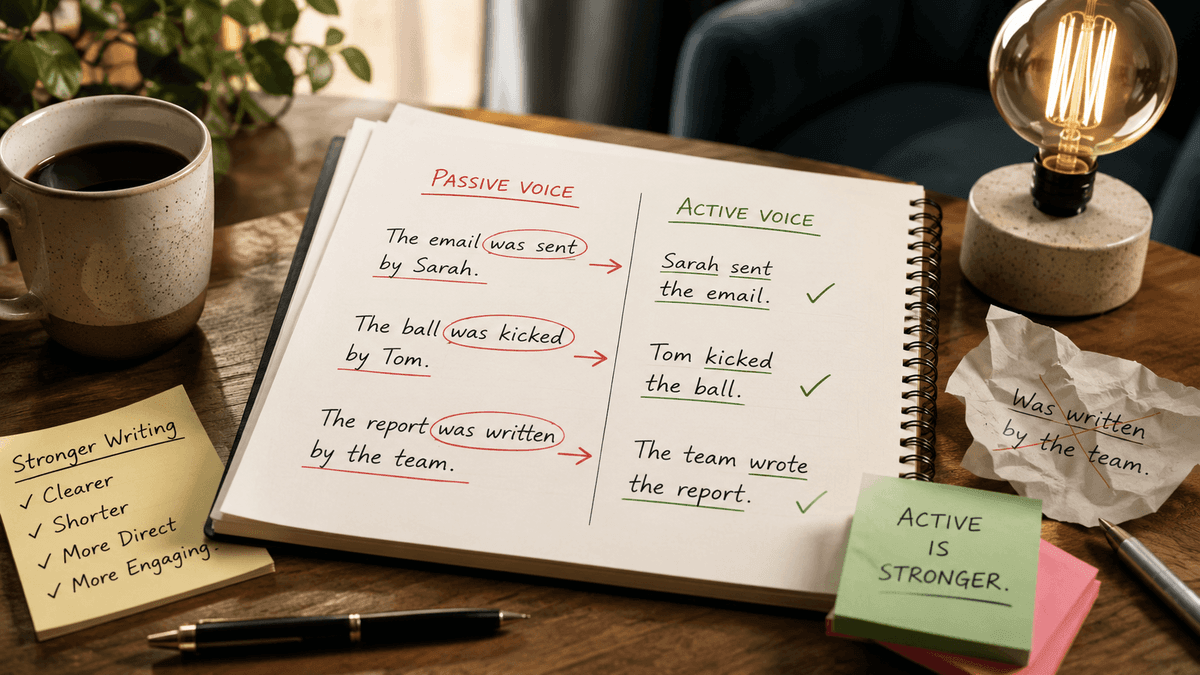
In an active voice sentence, the subject performs the action. It follows a clean, natural order: who → did what → to what.
But in a passive voice sentence, that order flips. The thing being acted upon comes first, the action follows, and whoever did it either gets pushed to the end or disappears from the sentence entirely.
Here's the simplest possible comparison:
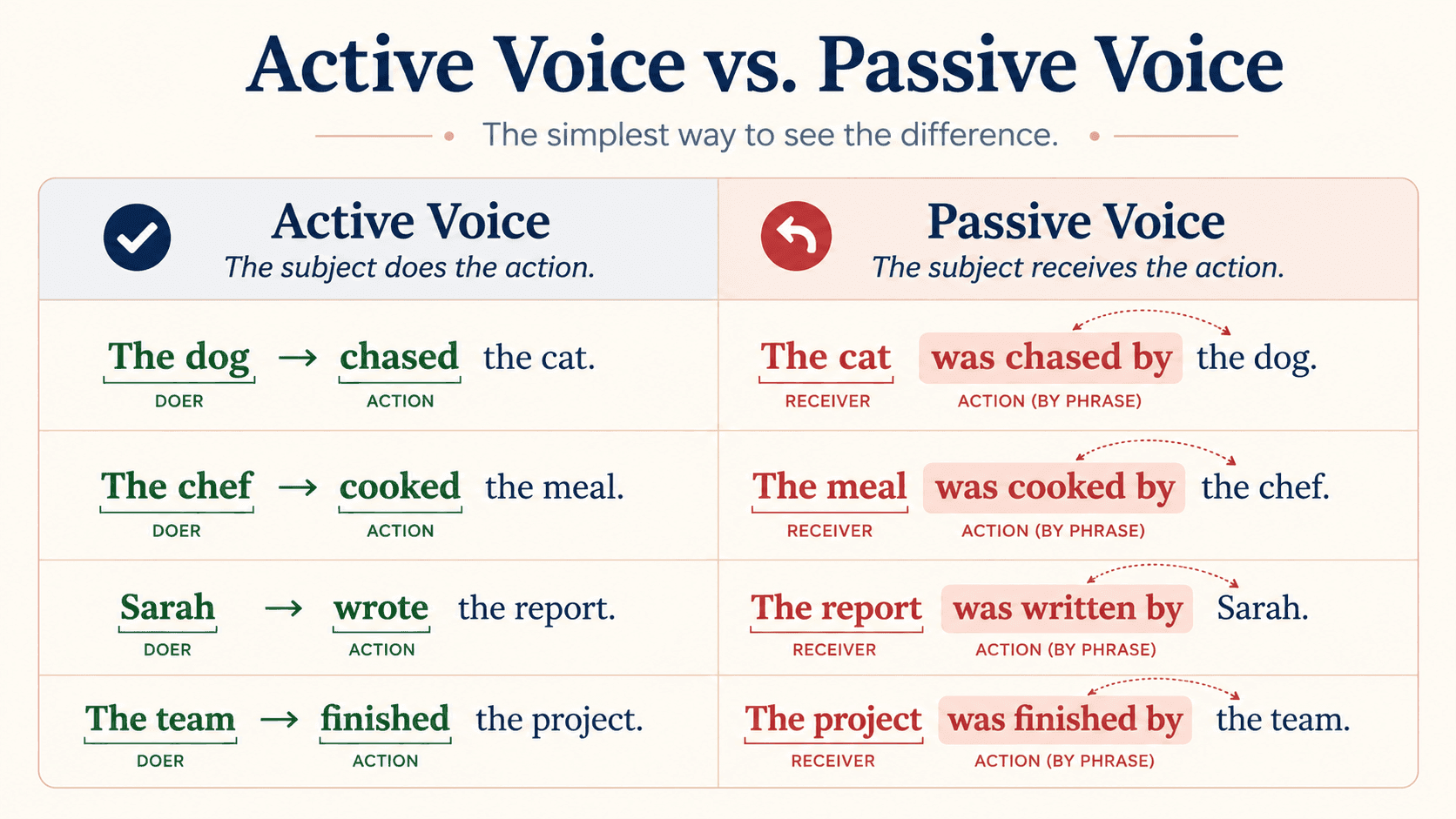
Notice the structure in every passive example: thing that received the action + a "to be" verb (was, were, is, has been) + past participle + "by" + the actor (optional).
That formula of to be verb + past participle is the fingerprint of passive voice. Once you know to look for it, you'll see it everywhere.
Passive Voice Examples in Everyday Sentences
Let's start with examples from ordinary, everyday writing and speech, the kind that slip into texts, emails, or captions without anyone noticing.
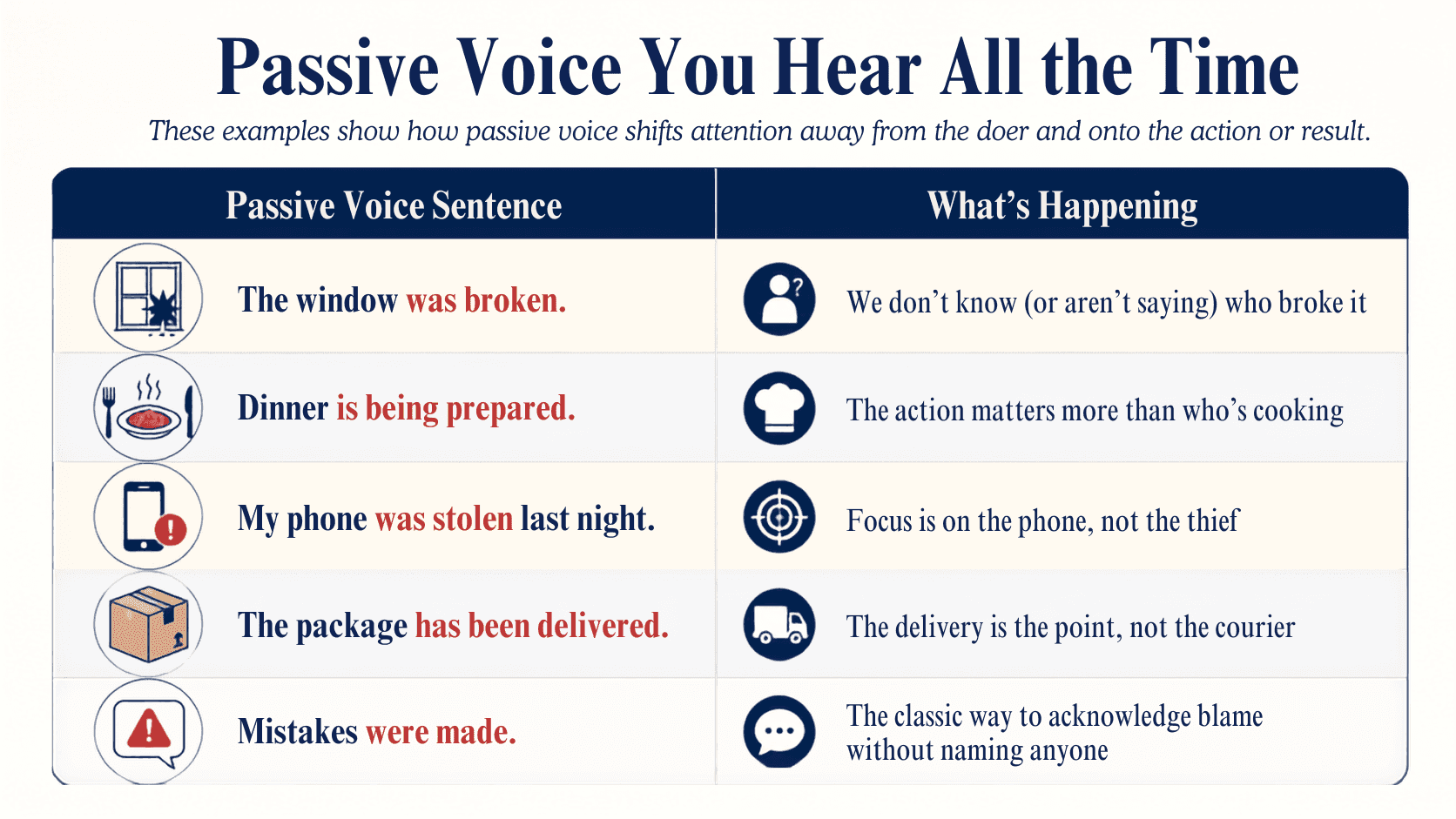
That last one- that grammar mistakes were made is arguably the most famous passive voice sentence in the English language, used by politicians and executives for decades.
Precisely because it admits something went wrong without pointing a finger at anyone.
Passive Voice Examples Across Different Types of Writing
Passive voice doesn't behave the same way in every context. It can feel weak and evasive in one situation, and objective and professional in another.
Here's how it shows up and why across five common writing types:
Academic & Scientific Writing
This is where passive voice is most at home. Scientists and researchers use it to shift the focus from themselves onto the experiment, the data, or the findings, which is often exactly the right call.
- The samples were collected from six sites across the region.
- The results were analyzed using a mixed-effects regression model.
- A significant correlation was found between sleep duration and cognitive performance.
- Participants were randomly assigned to one of three groups.
Prestigious journals, including Nature, have historically encouraged the use of the passive voice in methods sections because the research matters more than who conducted it.
When the what outweighs the who, passive voice earns its place.
News & Journalism
Reporters reach for passive voice when the actor is unknown, unconfirmed, or deliberately unnamed, common situations in breaking news.
- Three people were injured in the collision on Highway 9.
- The suspect was arrested early Sunday morning.
- A statement was released by the company late Friday.
- The building was evacuated after a gas leak was detected.
Business & Professional Writing
In corporate communication, the passive voice often softens bad news, avoids blame, or maintains a formal tone from different types of major tone of voice. It's used constantly, sometimes appropriately, sometimes as a way to duck accountability.
- Your application has been reviewed and was not selected.
- The deadline has been extended to the end of the month.
- Budget cuts were approved at the last board meeting.
- The policy was updated following feedback from the team.
Legal Writing
Legal language leans heavily on passive voice to sound neutral and to focus on the action rather than the individual who performed it.
- The contract was signed by both parties on January 14th.
- The defendant was charged with two counts of fraud.
- The evidence was submitted to the court during the hearing.
- Damages are to be paid within thirty days of the ruling.
Everyday Speech & Casual Writing
Even in conversation, passive voice slips in naturally, especially when the actor is irrelevant or obvious.
- The road is closed for construction.
- English is spoken here.
- The match has been postponed.
- Your table is ready.
Difference Between Passive Voice and Active Voice
Seeing both versions of the same sentence is the fastest way to understand what changes and whether those changes actually improve anything.
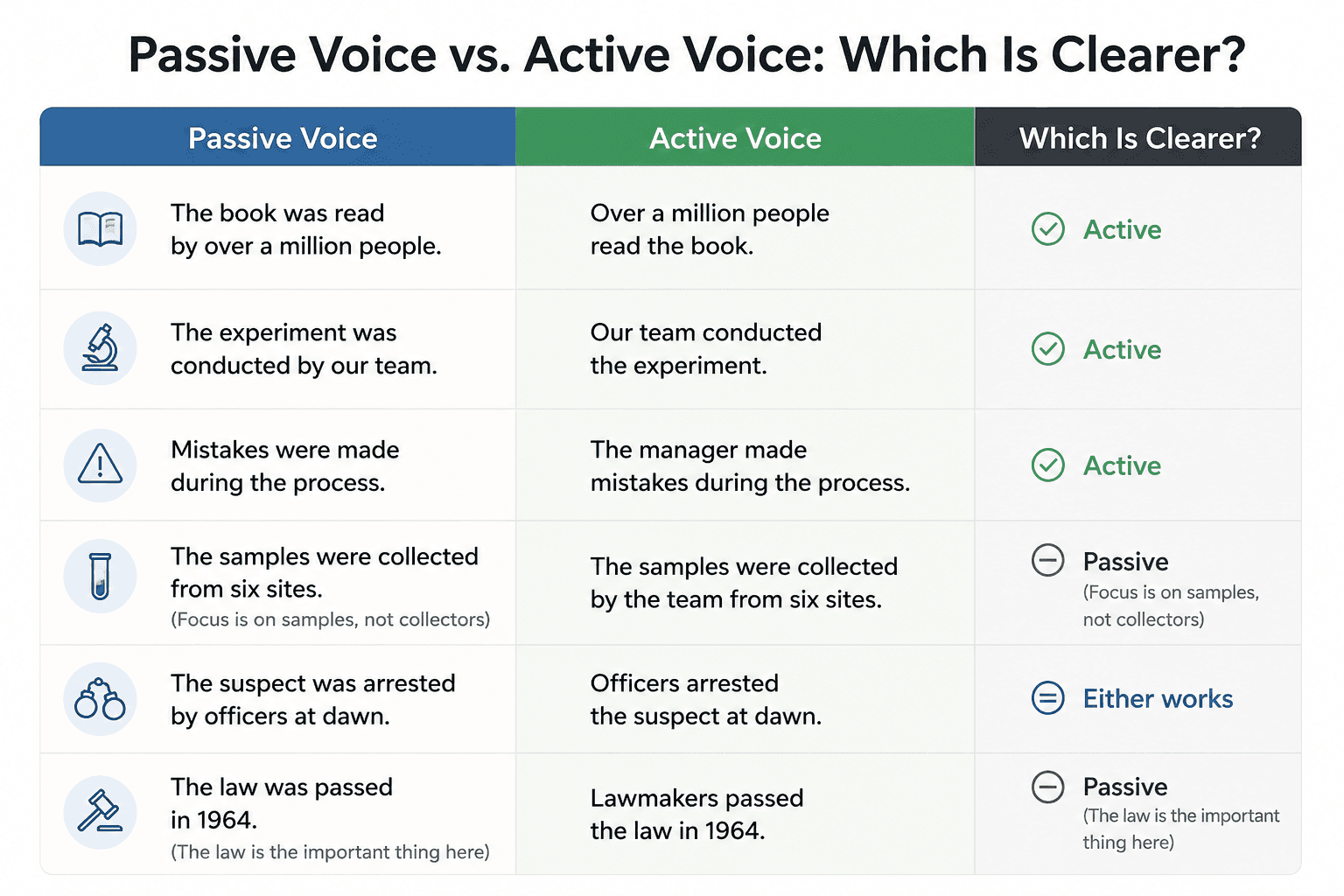
The takeaway from this table: Active voice wins most of the time, but the right answer always depends on what you want the reader to focus on.
How to Convert Passive Voice to Active Voice
Knowing that a sentence is passive is only half the job; the other half is actually fixing it.
The good news is that converting passive voice to active voice follows a reliable pattern almost every time. You don't need to rewrite the sentence from scratch or guess at it.
You just need to find the missing piece (usually the actor), bring it to the front, and let the verb do the work directly.
Once you've done it a few times, the process becomes almost automatic. Most passive sentences can be flipped to active in three steps:
- Find who or what is doing the action (the actor)
- Move the actor to the front of the sentence as the subject
- Remove or rework the "to be" verb and replace it with a direct action verb
Here's that process in action:
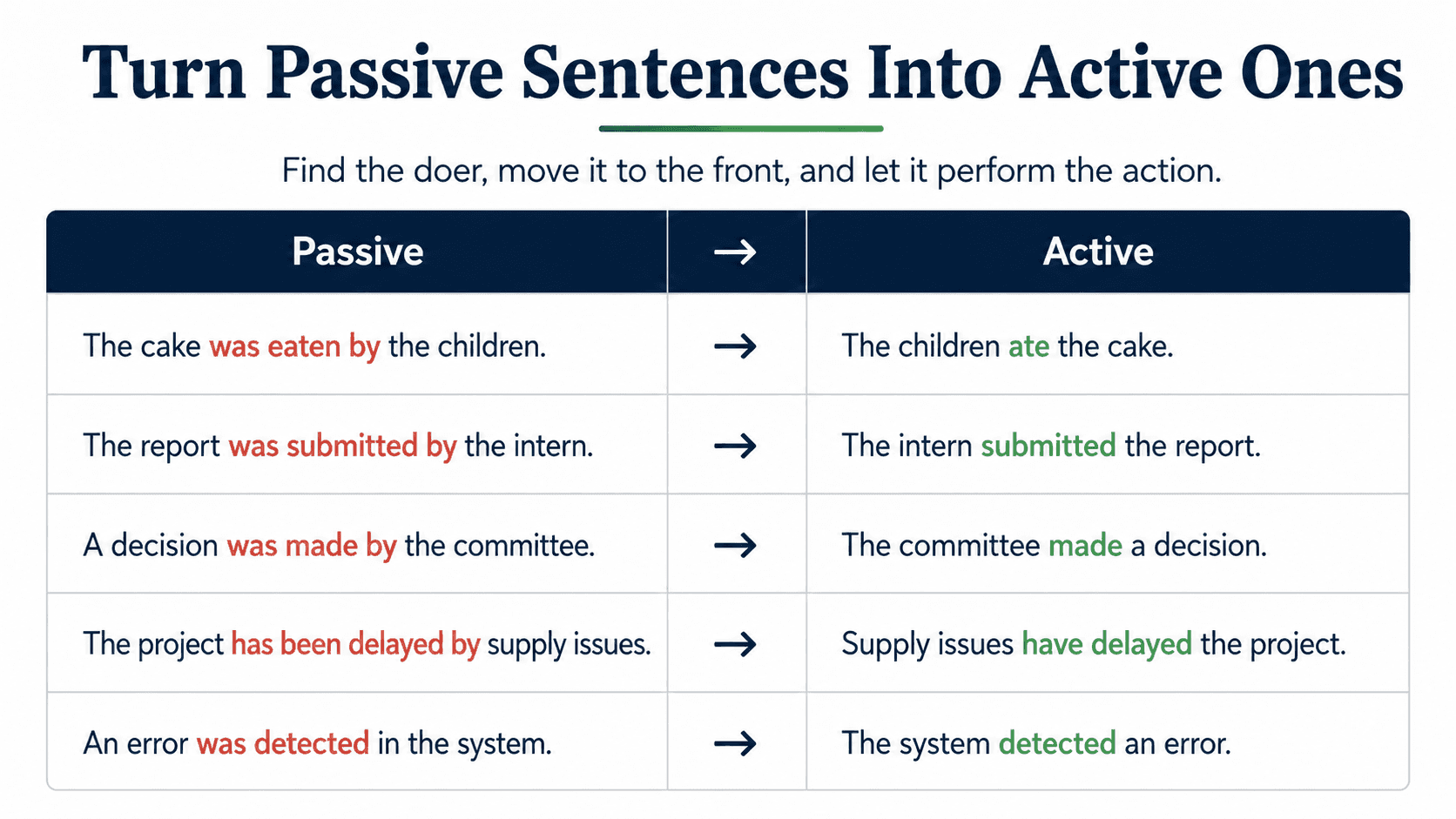
The active versions are shorter, more direct, and put the responsibility in the right place. That's the case for active voice in a nutshell.
Your Passive Voice Cheat Sheet
After going through the whole blog and reaching till here, you can certainly get one thing, and that is -
Grammar rules are easy to forget the moment you close a guide and open a blank document.
To make your essay grammar-issue-free, go for any reliable checker, but that should be your end work.
Moreover, memorizing a long list of conditions can be complicated.
So, here's a four-step checklist you can run any sentence through quickly, without overthinking it.
Keep it bookmarked, screenshot it, stick it on a Post-it next to your monitor, whatever it takes to have it within reach when you need it.
Step 1: Find the Verb and Check if it's A "To Be" Form
Look at the main verb in your sentence. Does it use one of these words?
is / was / were / has been / have been / had been / will be / being
These are called "to be" verbs, and they're the first signal that a sentence might be passive. If you don't see one of them, the sentence is almost certainly active, and you can stop here.
Step 2: Check What Comes Right After that Verb
Is the "to be" verb followed by a past participle basically a verb form that usually ends in -ed, -en, or -t? Think words like: written, made, approved, delivered, broken, chosen, sent, built, known, caught…
If you have a "to be" verb AND a past participle right after it, you're looking at the classic passive voice structure. Two checks down, one to go.
Step 3: Try the Zombie Test
Add the words "by zombies" to the end of the sentence. Does it still make grammatical sense?
- The report was written… by zombies. ✓ — Passive
- The team finished the project… by zombies. ✗ — Active
Sounds silly, but it works surprisingly well. Passive sentences almost always leave a natural slot at the end for a "by ___" phrase, because the actor is either hidden or already there.
→ If you said YES to all three steps — it's passive voice.
Step 4: Now Decide Whether You Should Actually Change It
This is the most important step, and one that most accurate grammar guides skip. Not every passive sentence needs fixing. Ask yourself one question:
Does the reader need to know who performed this action?
- YES, the actor matters → Rewrite it in active voice. Put the actor first, use a direct verb, and make the sentence clearer and more accountable.
- NO, the actor is unknown, irrelevant, or intentionally unnamed → Leave the passive voice exactly as it is. It's doing its job.
When Passive Voice Is Actually the Right Choice
One of the biggest myths about passive voice is that it's always a mistake. It isn't. Here are four situations where passive voice genuinely works better than active:
- The actor is unknown: A wallet was found outside the building; there’s no known actor to name, so passive is the only sensible option.
- The actor is irrelevant: The bridge was built in 1887. Whether we know who built it or not, the bridge is the point.
- You want to protect someone or maintain neutrality: In legal, medical, and HR contexts, avoiding direct attribution can be the appropriate and professional choice.
- The receiver of the action is more important: The patient was given a full dose of the medication. The patient's treatment is the focus, not the nurse or doctor who administered it.
Common Passive Voice Mistakes to Consider
Understanding passive voice is one thing; catching it when it's actually weakening your writing is the harder skill. Here are the patterns that show up most often:
Overuse in Professional Emails
Sentences like "Your feedback has been noted" and "A review will be conducted" can add up quickly, making an email feel distant and corporate rather than clear and direct.
Hiding Accountability
Passive voice makes it easy to describe what happened without saying who did it, which is useful in politics but a red flag in business and academic writing, where ownership matters.
Unintentionally Vague Sentences
When the actor is dropped entirely ("The data was misread"), readers are left guessing who did what, which erodes trust in the writing.
Passive Stacking in Research Writing
Academic papers sometimes run three or four passive-voice sentences back-to-back, even after using a reliable grammar checker, which slows the pace and makes already dense material harder to follow.
Google's technical writing guidelines state that “the vast majority of sentences in technical writing should be in active voice” which is a sign of how seriously clear communication takes this issue.
Passive Voice Practice to Test Yourself
Work through these before checking the suggested rewrites below. For each sentence, identify whether it's passive, then rewrite it in active voice if that's the stronger choice.
 If you rewrote three or more naturally, you've got a solid grasp on both voices and when each one fits.
FAQs
What is Passive Voice in Simple Terms?
Passive voice is when the subject of a sentence receives the action instead of doing it. The thing being acted on comes first, and whoever performs the action is moved to the end or left out entirely.
Is Passive Voice Always Wrong?
No, passive voice is a grammatical tool, not a mistake. It becomes a problem when it makes writing vague, long-winded, or evasive. Used intentionally, it's completely acceptable in scientific, legal, and formal writing.
How Do I Spot Passive Voice in My Writing?
Look for a "to be" verb (was, were, is, been) followed by a past participle (written, delivered, approved). If you can add "by zombies" to the end of the sentence and it still makes sense, it's passive.
What's the Difference Between Passive Voice and Past Tense?
They're not the same thing. Past tense is about when something happened. Passive voice is about who did it. "She wrote the letter" is past tense and active. "The letter was written" is past tense and passive. You can have passive voice in any tense.
Does Passive Voice Affect SEO or Readability?
Yes, indirectly. Passive voice tends to make sentences longer and harder to scan, which affects readability scores. Most SEO writing tools flag passive voice overuse as a readability issue because it can make content feel flat and harder to engage with.
Can Passive Voice be Used in First Person?
Absolutely. "I was told to arrive early" is both first person and passive voice. First person doesn't make a sentence active; it's still passive if the subject (I) is receiving the action rather than doing it.
Why do Scientists Use Passive Voice so Much?
Scientific writing traditionally uses the passive voice to emphasize the research paper's content rather than the researcher, with the idea that the data and findings should speak for themselves.
When Should I Switch from Passive Voice to Active Voice?
Switch to active when the actor matters, when you want clarity and directness, when the sentence feels unnecessarily long or vague, or when you've used passive voice several times in a row, and the writing is starting to feel flat.
Does Using Passive Voice Lower Grades in Academic Writing?
It can, depending on the subject. Writing courses in the humanities typically penalize overuse of passive voice. Science and social science courses may expect it in certain sections (like methods).
How much Passive Voice is Too Much?
There's no hard number, but a good rule of thumb is: if more than one in four sentences is passive, take a pass and see which ones genuinely need it. If passive voice is appearing purely out of habit rather than purpose, those are the sentences worth rewriting.
Final Verdict on Passive Voice Examples
Here's the honest truth: passive voice is easy to learn and surprisingly hard to catch in your own writing.
Once you're deep in a piece, your brain skips right over sentence structure and focuses on meaning, so the passive sentences slide through the proofreading process without a second look.
That's exactly the gap CopyChecker's Passive Voice Checker is built to close. Instead of reading your own work five times, hoping to spot every instance.
You'll be able to paste your text in and instantly see which sentences are passive, which ones are worth rewriting, and which ones you can confidently leave alone.
Whether you're polishing an essay, tightening up a business email, or checking a full blog post, it'll give you the clarity to make the right call every time.
Keep an eye on CopyChecker Writing Suite to get a whole lot cleaner outcome!