
Suppose you have received two emails after reporting the same problem.
The first says, "We received your complaint. Wait for further updates."
The second says, “We're sorry you've experienced this issue. Our team is already looking into it, and we'll keep you updated every step of the way.”
Both emails communicate the same information, yet they leave completely different impressions.
One feels cold and distant, while the other feels reassuring and human. The difference isn't the message itself but the tone of voice.
Whether you're writing an email, replying to a customer, publishing a blog post, creating marketing copy, or simply sending a text message, the tone you choose influences how people interpret your words.
It basically shapes trust, emotion, credibility, and even whether someone decides to continue reading or take action.
So, if you struggle to make your writing sound professional without becoming stiff, friendly without sounding too casual, or confident without appearing aggressive, you are in the right place!
This guide will help you recognize different tones, understand why your message may be misunderstood, and choose the right tone.
So without further ado, let’s get started with -
What Is Tone of Voice?
Tone of voice is the emotional and attitudinal layer sitting underneath every message.
It's not what you say but how it lands. Two people can share identical information and leave completely different impressions, purely because of tone.
In spoken communication, tone comes through pitch, pace, volume, and inflection. A flat, clipped "fine" sounds nothing like a warm, drawn-out "fine" even though the word never changes.
In written communication, tone has to work harder. There's no voice to lean on, so it's carried entirely by word choice, sentence length, punctuation, and formatting. A reader can't hear you, so every comma, letter, and reliable proofreader needs to do quiet emotional labor.
Tone is also shaped by context and audience. The same writer might sound playful in a text to a friend and buttoned-up in an email to a client.
It’s just the same person, same honesty, but a completely different tone. Let’s see how much tone alone can shift a single sentence.
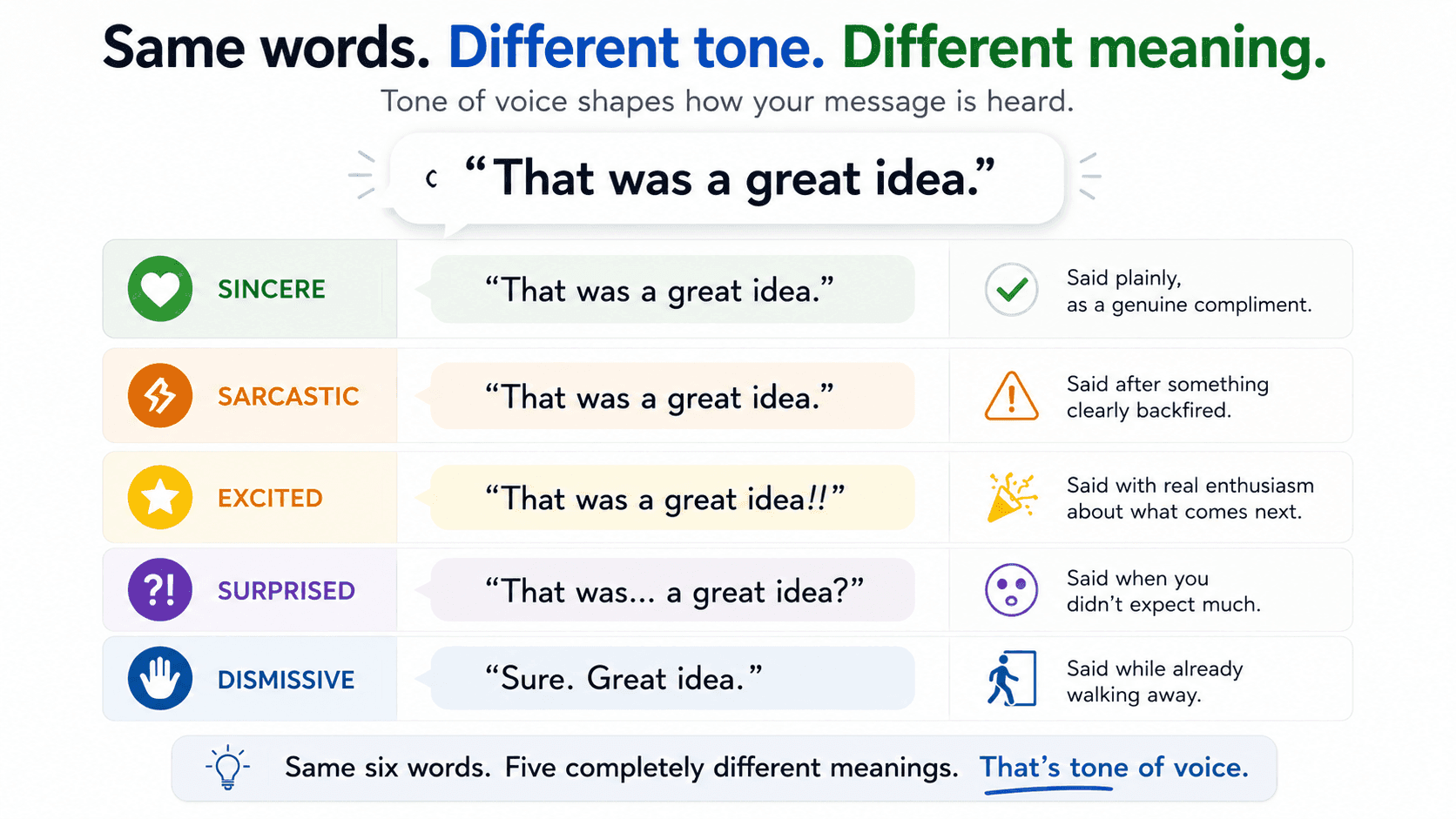
Same six words. Five completely different meanings. That's tone of voice.
What Is an Example of Tone of Voice?
An example of tone of voice is how the same message can be expressed in different ways to create a different emotional impression.
Changing the wording, sentence structure, or level of formality can make a message sound friendly, formal, empathetic, direct, or enthusiastic, even when the core meaning remains the same.
The examples below show how tone changes the way a message is perceived without changing its underlying purpose.
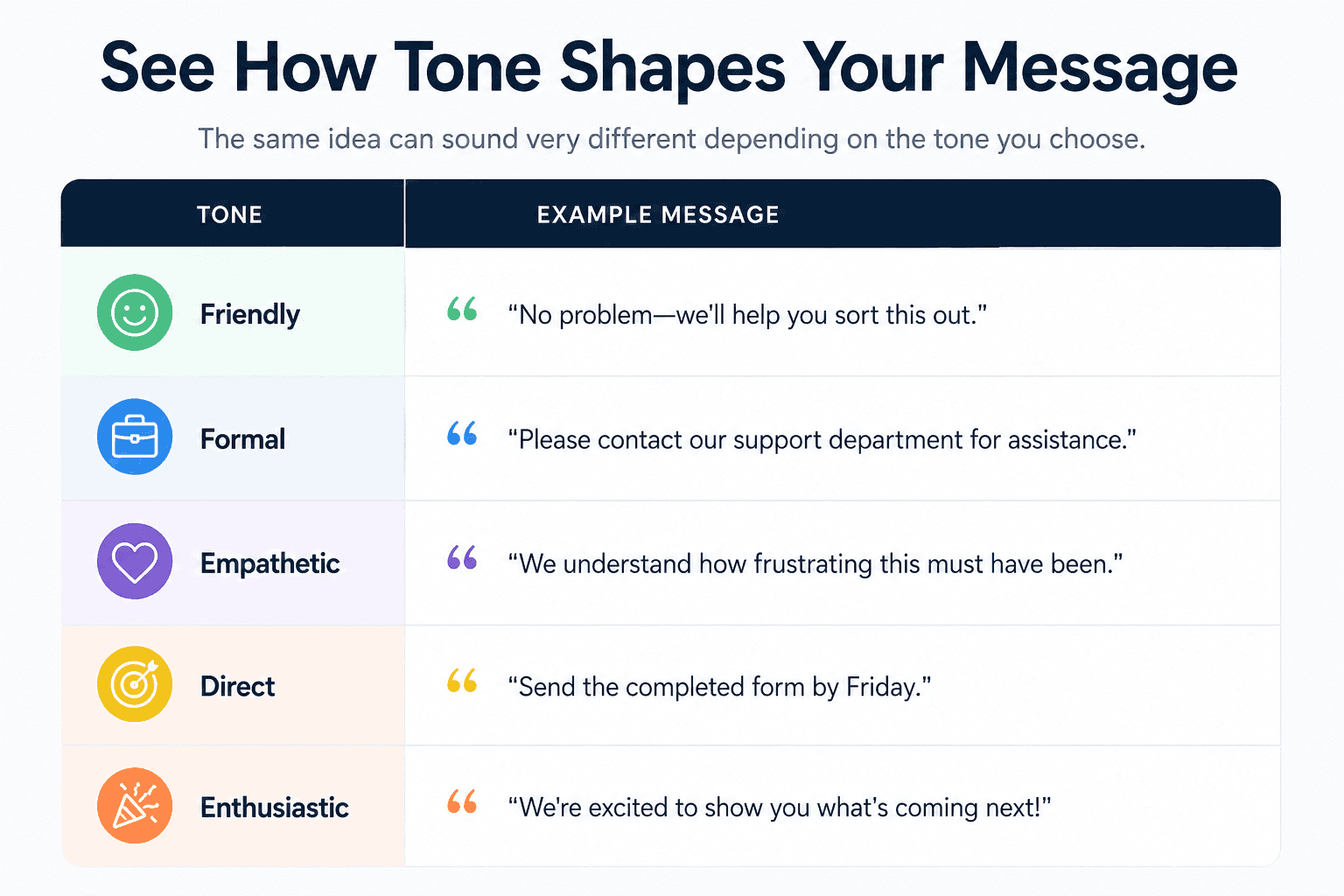
Notice that the core message barely changes across these five lines where someone is being asked to do something, or told help is available. What changes is the emotional temperature: how warm, how brisk, how personal, how upbeat.
That gap between what's said and how it feels is the tone of voice at work.
How to Choose the Right Tone of Voice
Choosing the right tone of voice means deciding how your message should sound based on what you want to achieve, who will receive it, and how you want that person to respond.
The right tone should make the message clear, appropriate, and easy to act on without creating confusion or an unintended emotional reaction.
So, if you're still working out how to find your tone of voice, the steps below break it down into something more concrete than just picking a mood and hoping it sticks -
Step 1: Identify Your Purpose
Start by deciding what the message needs to accomplish. Your purpose will shape the tone accordingly. Ask whether you are:
- Informing?
- Persuading?
- Reassuring?
- Warning?
- Entertaining?
- Requesting action?
- Apologizing?
- Teaching?
A warning should not sound playful. A customer apology should not sound defensive. A product announcement may need more energy than a policy update. That’s the point!
Step 2: Understand Your Audience
Determine who will receive the message and how familiar they are with the subject. The writer can affect which tone feels appropriate by connecting them all. So, consider the reader’s:
- Age
- Knowledge
- Expectations
- Relationship with the writer
- Emotional situation
- Cultural context
- Familiarity with the subject
A first-time customer may need more explanation than an experienced user. A distressed customer may need empathy before instructions.
Step 3: Consider the Situation
The same audience may expect a different tone depending on the situation. A product announcement can sound energetic while a complaint response may require a more serious approach. So, compare the tone needed for:
- A product announcement
- A customer complaint
- An emergency notice
- A social media post
- A research report
- A workplace email
The same brand or writer should not communicate identically in every situation.
Step 4: Choose Three or Four Tone Traits
Instead of trying to describe your tone with a long list of adjectives, focus on three or four core traits that best represent how you want your communication to sound. Select a small group of practical traits, such as:
- Clear
- Helpful
- Confident
- Respectful
An overly long list becomes difficult to apply. Writers may not know how to balance 10 or 15 competing characteristics in one message.
Step 5: Define What Each Trait Means
Avoid vague labels. Instead of writing only “friendly,” describe the behavior. As friendly means using familiar words, speaking directly to the reader, acknowledging concerns, and avoiding unnecessarily formal expressions.
Instead of writing only “confident,” define it. Because confident means making clear statements, removing excessive hesitation, and supporting important claims with evidence.
So that everything becomes easily understandable.
Step 6: Create Do-and-Don’t Examples
Show how each tone trait should and should not appear in real writing. Clear examples make abstract qualities easier to understand and help writers apply the intended tone more consistently.
 Examples make tone traits easier to apply consistently.
Step 7: Test the Tone With Real Messages
Once you've defined your tone traits, apply them to the content you create every day. But before anything, test your content readability for a better tone across real communication to identify inconsistencies and refine your guidelines.
Moreover, ensure the writing sounds natural in different situations, not just in theory. So you can apply the chosen traits to:
- Error messages
- Emails
- Social media posts
- Landing pages
- Support replies
- Notifications
- Product instructions
A tone guideline may sound effective in theory but fail when applied to a refund request or technical error message.
Now that you know how to select your tone of voice, let’s dive into the most awaited part of this blog, and that is -
The Best 30 Types of Tone of Voice With Examples
Tone types aren't strict boxes, but they overlap constantly. To be honest, A message can be both professional and friendly, or both confident and encouraging, at the same time.
So you just have to act accordingly. The list below groups the most common tones you'll encounter in writing and speech, each with an explanation and a few sentence examples -
1. Formal Tone
A formal tone is polished, structured, and respectful. It usually avoids slang, casual expressions, and unnecessary contractions.
Formal tones are commonly used in legal documents, academic writing, official announcements, policies, and high-level professional communication.
Example:
“Please submit the requested documents before the stated deadline.”
"The board will convene at 9 a.m. to review the quarterly report."
"Applicants are required to provide two forms of identification."
2. Informal Tone
An informal tone sounds relaxed and unscripted, closer to how people actually talk to each other than how they'd write a memo.
It leans on contractions, shorter phrasing, and an easy rhythm, which makes it a natural fit for texts, casual emails, and quick check-ins between colleagues who already know each other.
Example:
"Send me the files when you get a chance."
"Hey, quick one — did the invoice go out yet?"
"No rush, just circle back whenever."
3. Friendly Tone
A friendly tone is warm without trying too hard. It signals goodwill and puts the reader at ease, usually through simple, welcoming phrasing instead of anything technical or distant.
You'll spot it most in customer service replies, onboarding emails, and any message where the goal is to make someone feel taken care of.
Example:
"Thanks for reaching out—we're happy to help."
"Great question! Here's what's going on."
"You're all set — let us know if anything looks off."
4. Professional Tone
A professional tone is competent, measured, and appropriate for the workplace. It's a notch less rigid than formal tone, but it still steers clear of slang or overt emotion, favoring clarity and composure instead.
Most day-to-day business writing like status updates, client emails, and internal memos lives here, which is why professional tone of voice examples for email tend to be the ones writers reach for most often.
Example:
"I have reviewed the proposal and included my recommendations below."
"Attached is the revised timeline for your review."
"Let me know if you have questions before Thursday's call."
5. Conversational Tone
A conversational tone reads like natural speech aimed directly at the reader, rather than a lecture delivered at them.
It uses everyday words, shorter sentences, and the rhythm of a real dialogue. Which is exactly why it's become the default for blogs, help docs, and modern brand writing.
Example:
"Let's look at what this means in practice."
"Here's the thing most people miss."
"So, where does that leave you?"
6. Confident Tone
A confident tone states things plainly, without hedging or over-qualifying every claim. It signals certainty, which is exactly what builds trust with a reader who's deciding whether to believe you.
The tone basically shows up wherever a brand or writer wants to sound sure of what they're saying, like product pages, pitches, and expert advice.
Example:
“This approach will give the team a clearer and more reliable process.”
"Our results speak for themselves."
"This is the fastest way to get there."
7. Assertive Tone
An assertive tone is direct about needs or expectations without tipping over into harshness. It states a request or a boundary clearly, so there's little room left for ambiguity.
This is the tone of someone who respects the other person enough to be straightforward with them.
Example:
"I need the final version by 3 p.m. so we can meet the deadline."
"I won't be able to take that on this week."
"Let's stick to the agenda we agreed on."
8. Authoritative Tone
An authoritative tone carries the weight of expertise or official standing. It's declarative and rule-like, the kind of tone that doesn't invite negotiation.
Authoritative tone is the natural register for policy documents, compliance notices, and anywhere expert guidance needs to be followed rather than debated.
Example:
"Every account must use two-factor authentication."
"All submissions are subject to review before publication."
"This procedure must be completed before departure."
9. Respectful Tone
A respectful tone acknowledges the other person's position even while disagreeing with it or delivering a hard message. It avoids dismissiveness and keeps the exchange civil, no matter how tense the topic gets.
Example:
"I understand your position, although I see the situation differently."
"I hear what you're saying, and I'd like to offer another angle."
"That's a fair point — here's where I land, though."
10. Empathetic Tone
An empathetic tone names and validates the other person's experience before doing anything else. It shows the writer has genuinely registered how the situation feels, not just what happened.
This kind of tone is essential in customer experience, healthcare communication, and any message landing during a stressful moment.
Example:
"We understand how disruptive this delay has been for you."
"That sounds like a frustrating way to start your week."
"We know this isn't the news you were hoping for."
11. Encouraging Tone
An encouraging tone keeps the focus on progress and capability rather than dwelling on shortfalls. It's the tone of a good coach or teacher, mainly the one who wants you to keep going, not feel worse about where you are.
Example:
"You have already made progress; keep working through one section at a time."
"This is a solid draft — a couple more passes, and it's there."
"You're closer than you think."
12. Optimistic Tone
An optimistic tone frames a situation around its positive potential, even when things are genuinely difficult. This one leans forward instead of dwelling on the setback itself.
Example:
“This challenge gives us an opportunity to build a better system.”
"There's a real silver lining here if we look for it."
"Every setback so far has taught us something useful."
13. Enthusiastic Tone
An enthusiastic tone carries visible excitement, often signaled by exclamation points, upbeat phrasing, and energetic word choice. It's contagious by design, and the goal is for the reader to feel some of that energy too.
Example:
“We’re thrilled to welcome you to the team!”
"This is the update we've been waiting for!"
"You're going to love what's coming next."
14. Humorous Tone
A humorous tone uses wit, exaggeration, or unexpected phrasing to entertain the audience. It needs to be used carefully in serious, emotional, or culturally sensitive situations.
Example:
“Our printer has once again chosen chaos.”
"We regret to inform you that Monday happened again."
"Somewhere, a spreadsheet just breathed a sigh of relief."
15. Playful Tone
A playful tone is lighthearted and a little cheeky, often used to make routine communication feel less transactional and more like a conversation with a real person on the other end.
Example:
"Your inbox called—it wants a little spring cleaning."
"Plot twist: your package is already on its way."
"We see you eyeing that upgrade. Go on, then."
16. Serious Tone
A serious tone signals that a message deserves full and undivided attention. That’s why it drops humor, casual paraphrasing to sound like oneself plainly, and weighty language that won't be mistaken for anything lighter.
Example:
“This issue requires immediate attention.”
"Please read this notice in full before proceeding."
"This decision will affect every member of the team."
17. Concerned Tone
A concerned tone expresses genuine worry about an outcome, usually paired with a reason for that worry. Done well, it reads as caring rather than alarmist, so it flags a real risk without overselling the panic.
Example:
“I’m concerned that the current timeline may put the launch at risk.”
"This trend is worth watching closely over the next few weeks."
"I want to flag something before it becomes a bigger issue."
18. Cautious Tone
A cautious tone avoids overstating certainty. It mostly qualifies claims and deliberately leaves room for more information before committing to a firm conclusion.
Example:
“The early results are promising, but more testing is needed.”
"It's too soon to say for certain, but the signs are encouraging."
"We'd recommend waiting for the full data before deciding."
19. Neutral Tone
A neutral tone carries no visible emotional charge. It states facts plainly, without leaning positive or negative, which is exactly what makes this tone so useful for logistics, notices, and routine announcements.
Example:
“The meeting will begin at 10 a.m. in Conference Room B.”
"The office will be closed on Monday for the holiday."
"Version 2.3 is now available for download."
20. Objective Tone
An objective tone sticks strictly to verifiable information and avoids opinion or interpretation. It's the standard register for research papers, reporting, and anywhere the writer needs to stay out of the way of the facts.
Example:
“The survey included 500 participants from four age groups.”
"Sales increased by 12 percent over the previous quarter."
"The study was conducted over an eight-week period."
21. Informative Tone
An informative tone exists purely to explain or teach. It prioritizes clarity and completeness over persuasion or emotional appeal, which makes this tone the backbone of documentation, tutorials, and how-to content.
Example:
"The tool analyzes sentence length, vocabulary, and structural complexity."
"This setting controls how often the report refreshes."
"Each stage of the process is logged automatically."
22. Persuasive Tone
A persuasive tone is built to move the reader toward a decision or action. It highlights benefits and often creates a gentle sense of momentum, without tipping into pressure.
Example:
“Starting now will give your team more time to prepare for the change.”
"The sooner this is in place, the sooner it starts paying off."
"Most teams see the difference within the first week."
23. Inspirational Tone
An inspirational tone aims to motivate through bigger-picture meaning rather than immediate instruction. It often leans on aspirational or values-driven language that looks past the task at hand.
Example:
“Small improvements made consistently can lead to remarkable results.”
"Great work rarely happens all at once — it happens one step at a time."
"The goal isn't perfection. It's progress you can see."
24. Urgent Tone
An urgent tone signals that time matters and delay carries real risk. It leans on short, direct phrasing and action-first language, stripped of anything that might slow the reader down.
Example:
"Reset your password immediately to protect your account."
"Act now — this offer closes tonight."
"Please respond within the next hour."
25. Apologetic Tone
An apologetic tone takes responsibility and expresses genuine regret for an inconvenience or mistake. It lands best when it's specific about what went wrong, rather than a generic, one-size-fits-all sorry.
Example:
“We’re sorry for the delay and appreciate your patience.”
"This shouldn't have happened, and we're taking steps to fix it."
"We dropped the ball here, and we own that."
26. Sympathetic Tone
A sympathetic tone expresses compassion for another person’s difficult experience. Unlike empathy, it does not necessarily suggest that the speaker fully understands the person’s feelings.
Example:
“I’m sorry you’re going through such a difficult situation.”
"That sounds like a lot to deal with at once."
"I can only imagine how stressful that's been."
27. Sarcastic Tone
A sarcastic tone says one thing while meaning something closer to the opposite, usually to express irritation or irony.
It relies heavily on vocal cues or shared context, which makes it one of the tones most likely to be misread in writing. A sarcastic line can easily be taken at face value by a reader who misses the signal.
Example:
"Wonderful—another meeting that could have been an email."
"Oh good, more paperwork. Just what today needed."
“Sure, because that plan worked so well last time.”
Sarcasm can be easily misunderstood in writing because readers cannot hear vocal inflection or see facial expressions. It should be avoided when clarity and trust are important.
28. Critical Tone
A critical tone points out flaws or shortcomings directly. Used carefully, it's a useful vehicle for honest feedback.
Used carelessly, the critical tone can come across far harsher than intended. So be careful with this kind of tone.
Example:
“The proposal does not provide enough evidence to support its conclusion.”
"This section needs more supporting data before it's ready."
"The argument breaks down in the second paragraph."
29. Aggressive Tone
An aggressive tone assigns blame and pushes hard, often through accusatory phrasing. It tends to put the reader on the defensive rather than inviting a solution, since the focus lands squarely on fault rather than next steps.
Example:
“You ignored the instructions and created this problem.”
"This is the third time this has happened."
“You need to fix this now.”
This tone often causes defensiveness and shifts attention away from solving the issue. A direct or assertive tone is usually more productive.
30. Passive-Aggressive Tone
A passive-aggressive tone hides irritation or hostility inside language that looks polite on the surface.
The words themselves seem civil, but the underlying implication is pointed, which is exactly what makes it land as more cutting than an openly critical remark.
Example:
“Thanks for finally replying.”
"Must be nice to have so much free time."
“No worries, I'll just handle it myself. Again.”
The word “thanks” appears positive, but “finally” communicates irritation and criticism.
Now that most of the examples have been covered to make your concept clearer, let’s check it out -
How Tone of Voice Changes Meaning without You Trying
The tone of voice changes how a message is understood, even when the basic information remains the same.
It helps the audience interpret the speaker’s or writer’s intention, emotional state, level of urgency, politeness, confidence, and attitude toward the subject.
Small changes in a sentence can completely alter the impression a message creates. So let’s see what factors can change the meaning of tone of voice without you even trying -
Word Choice
Sometimes, words with similar definitions can create noticeably different tones, so the specific term you choose affects how polite, formal, or forceful the message sounds.
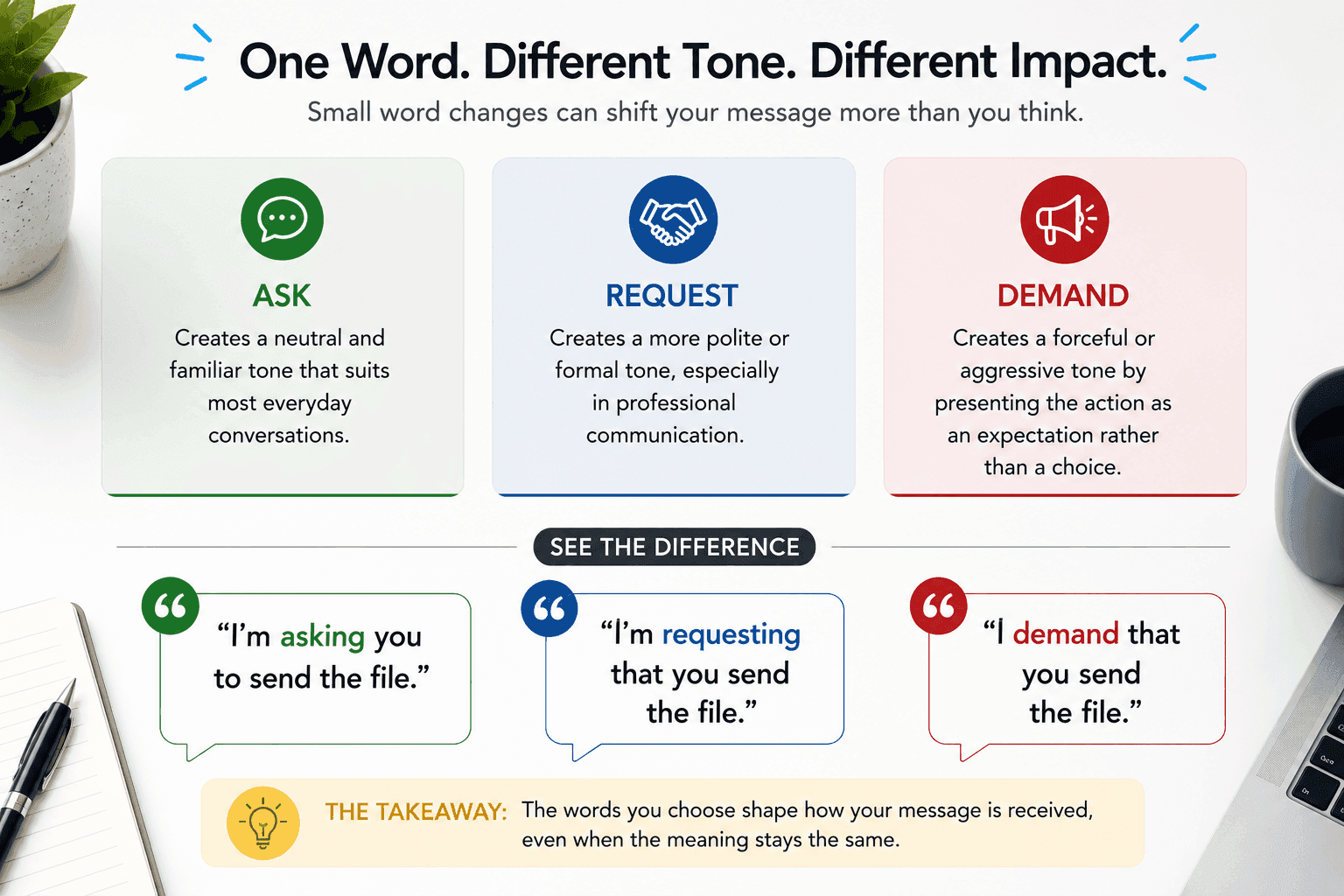
Each sentence asks for the same action, but the selected verb changes the relationship between the people and the amount of emotional pressure placed on the recipient.
Small wording swaps like this add up fast, which is why it's worth running longer drafts through a word counter to spot places where a single overloaded sentence.
Sentence Length
Most of the time, sentence length influences the pace, clarity, and emotional impression of a message.
Short sentences often feel stronger and more immediate, while longer sentences can provide context and make the wording sound more careful or diplomatic.
Short sentences can feel:
- Direct
- Urgent
- Cold
- Confident
For example:
“Stop the process now.”
Longer sentences can feel:
- Considered
- Formal
- Explanatory
- Diplomatic
For example:
“Please pause the process while we review the information and confirm the next step.”
Neither style is automatically better. The right sentence length depends on the purpose, audience, and level of explanation the situation requires.
Punctuation
The punctuation marks can significantly affect written tone because they help readers interpret emotion, emphasis, and intention when vocal cues are unavailable.
Even a familiar word can sound warm, cold, uncertain, sarcastic, or forceful depending on the punctuation used.
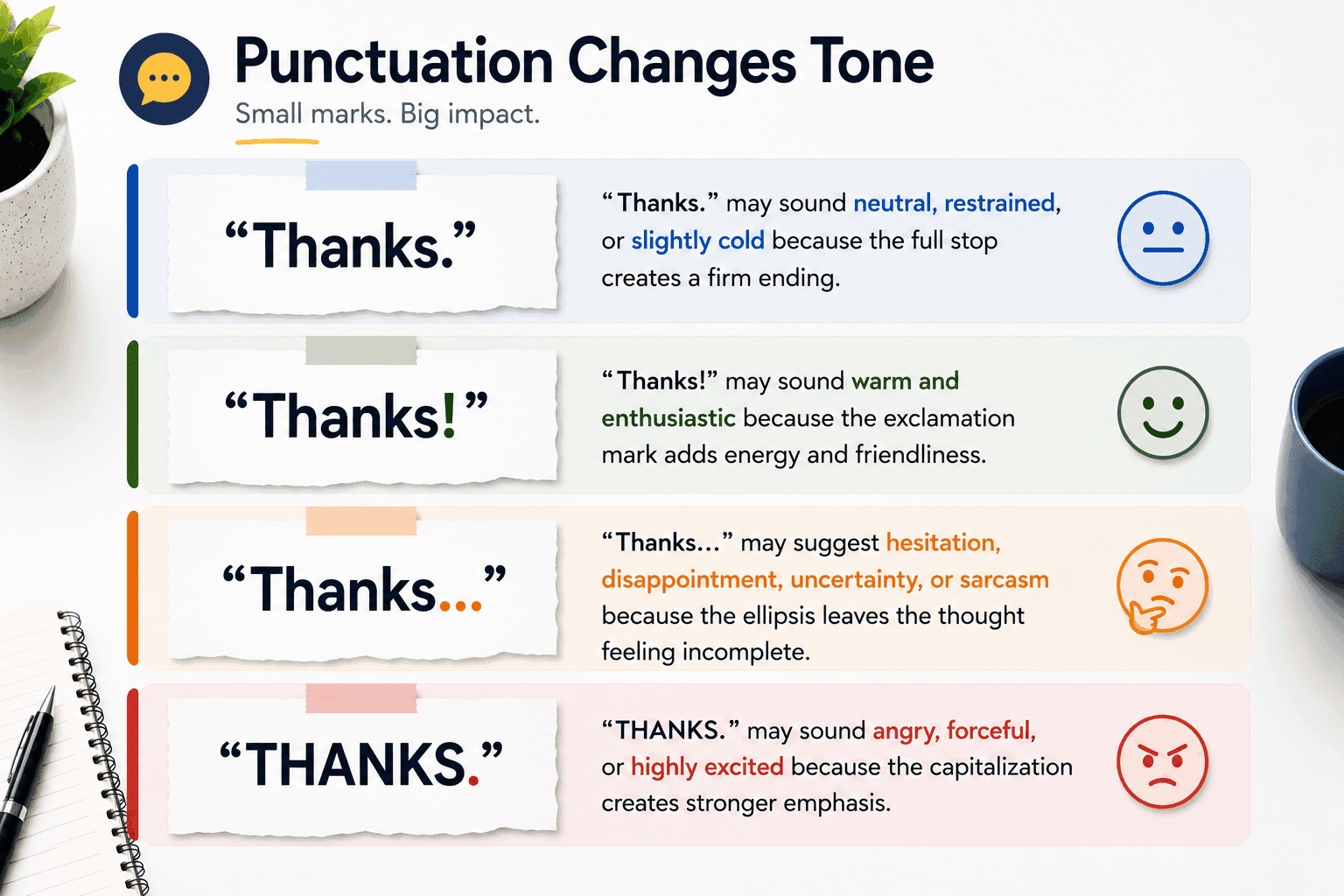
The surrounding context, relationship between the people, and rest of the message ultimately determine how the punctuation is interpreted.
Capitalization
All-capital writing can communicate urgency, anger, excitement, or emphasis.
“SUBMIT THE FORM TODAY.”
This may attract attention, but it can also feel like shouting. Clear headings or selective bold formatting are usually more professional.
Emphasis and Formatting
Emphasis and formatting help readers understand which parts of a message deserve attention and how certain words should be interpreted.
When used carefully, they can add clarity, emotion, contrast, or personality without changing the core meaning of the sentence.
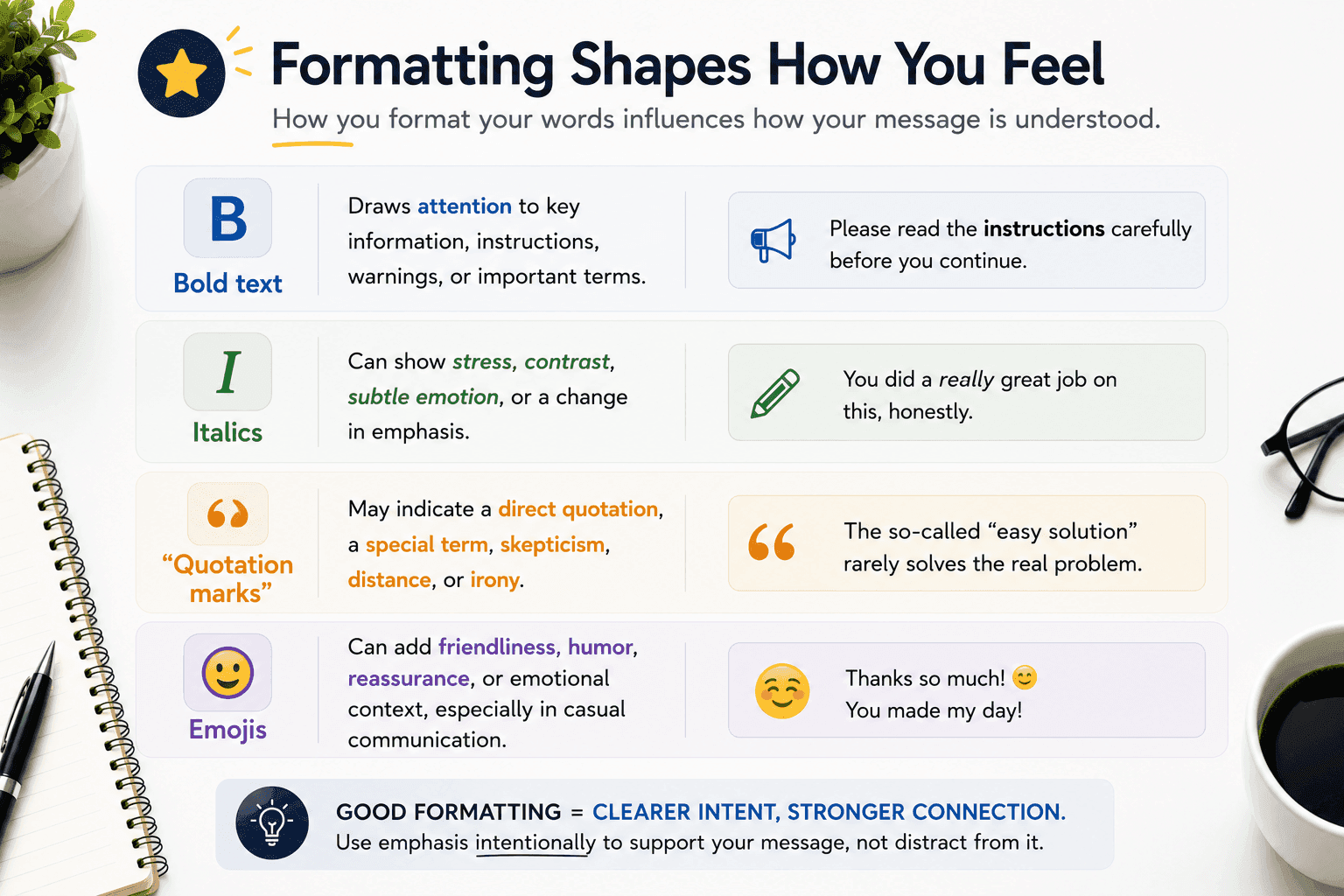
Formatting should guide the reader rather than compete with the message. Too much bold text, excessive italics, repeated quotation marks, or unnecessary emojis can make writing feel distracting, unprofessional, or difficult to interpret.
Pitch, Pace, and Volume
The exact same word can mean something different depending on how fast, how loud, and how high or low it's said before your brain even fully processes what the word was.
Take the word "okay." Said quickly, in a higher pitch, at normal volume, it can sound excited, like good news just landed.
Said slowly, in a low, quiet voice, that same "okay" can sound reluctant, like someone agreeing to something they're not thrilled about.
Nothing about the word changed. Only the delivery did. That's what pitch, pace, and volume are doing in the background of every conversation:
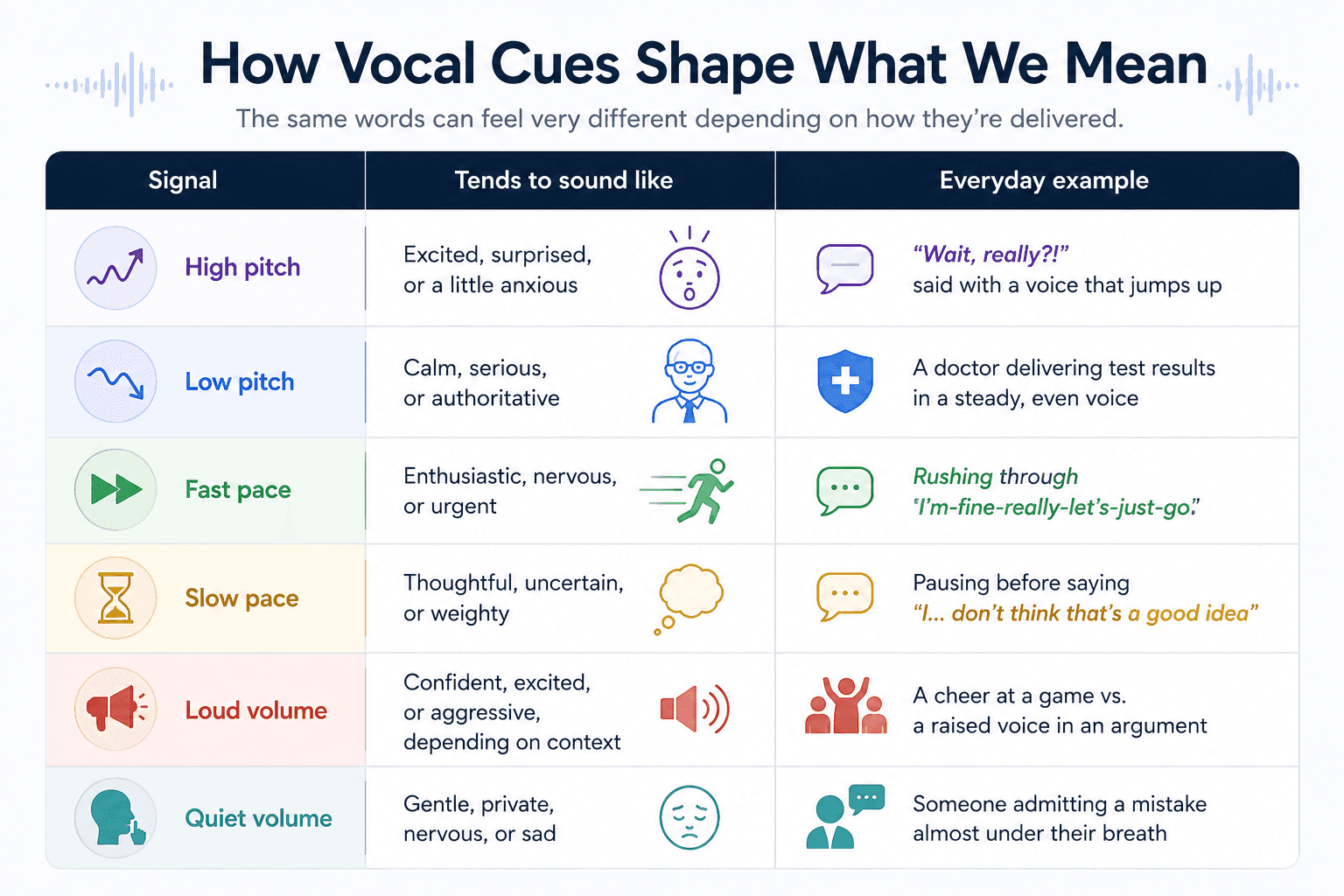
The reason this matters even for writers: readers unconsciously "hear" a version of these cues when they read your text back in their heads.
Short, punchy sentences read fast and loud. Long, softly worded ones read slow and quiet.
That's part of why the same message can land so differently depending on how it's built, even before a single word choice comes into play.
Context
Take the phrase "That's fine." On its own, it tells you almost nothing. Drop it into a real situation, though, and it suddenly says a lot:
- Genuine acceptance: A friend asks if it's okay to reschedule; you weren't attached to the original plan anyway — "That's fine" means exactly what it says.
- Frustration: This is the third time a meeting's been moved. "That's fine" now carries an edge, even though the words haven't changed.
- Resignation: Someone explains they can't fix an issue right away. "That's fine" here means I've given up expecting otherwise, not I'm happy about this.
- Disappointment: You were hoping for a bigger response and got a shrug instead. "That's fine" quietly covers for the letdown.
- A desire to end the conversation: Said flatly, with nothing added — "That's fine" can simply mean let's stop talking about this now.
Five completely different meanings, same two words. This is exactly why tone can't always be read from isolated text.
It depends more on the relationship between the people involved, what was said just before it, the setting, and what kind of response was expected.
So strip away that context, and even a perfectly ordinary phrase becomes a guessing game.
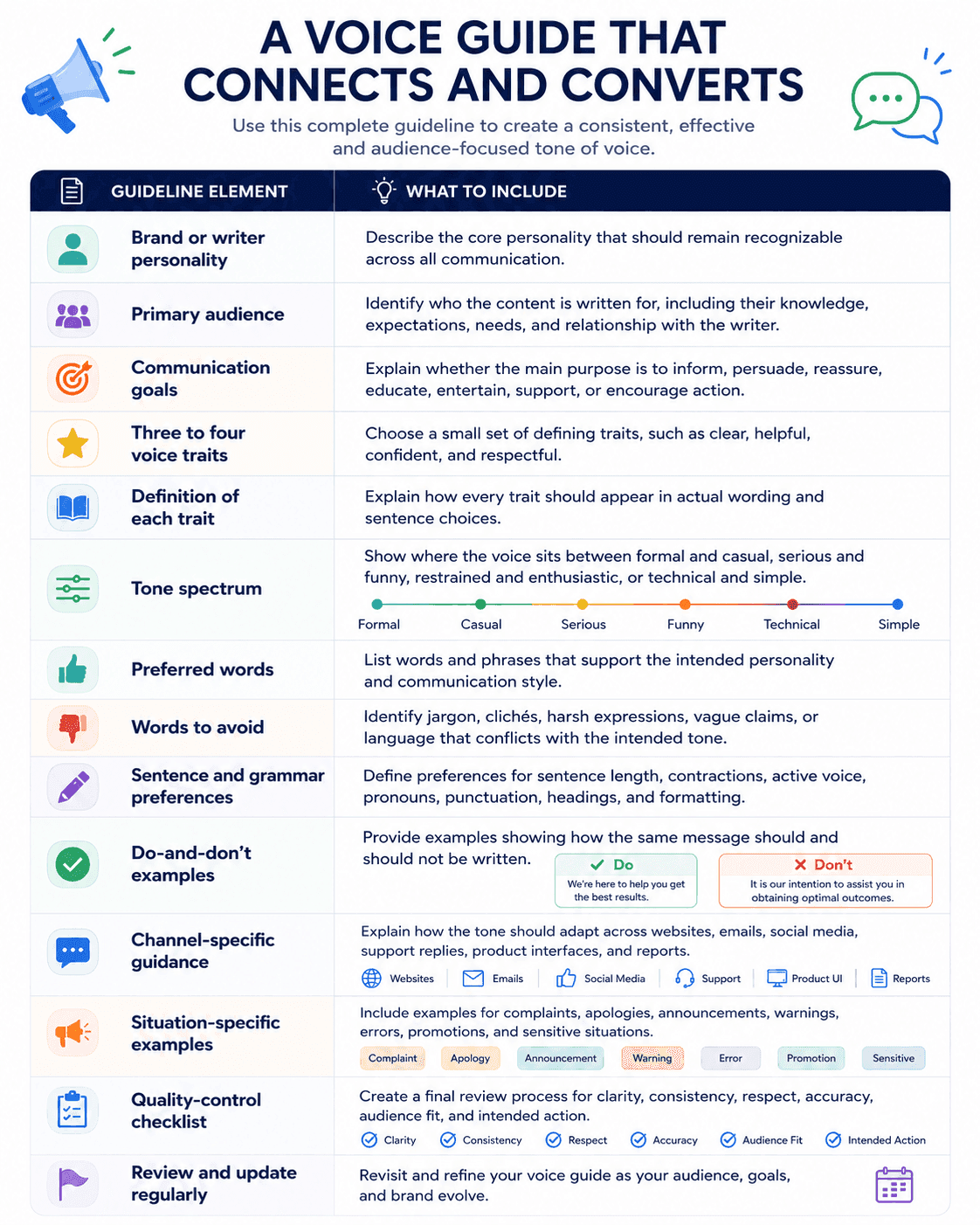
Tone of Voice Guideline to Garb Your Target Audiences
A useful tone of voice guideline doesn’t always explain how the brand or writer wants to sound, but also what that tone looks like in real sentences.
It includes preferred language, sentence style, levels of formality, tone boundaries, and examples that people can apply during everyday communication.
So, the following is a tone of voice guideline template that you might use -
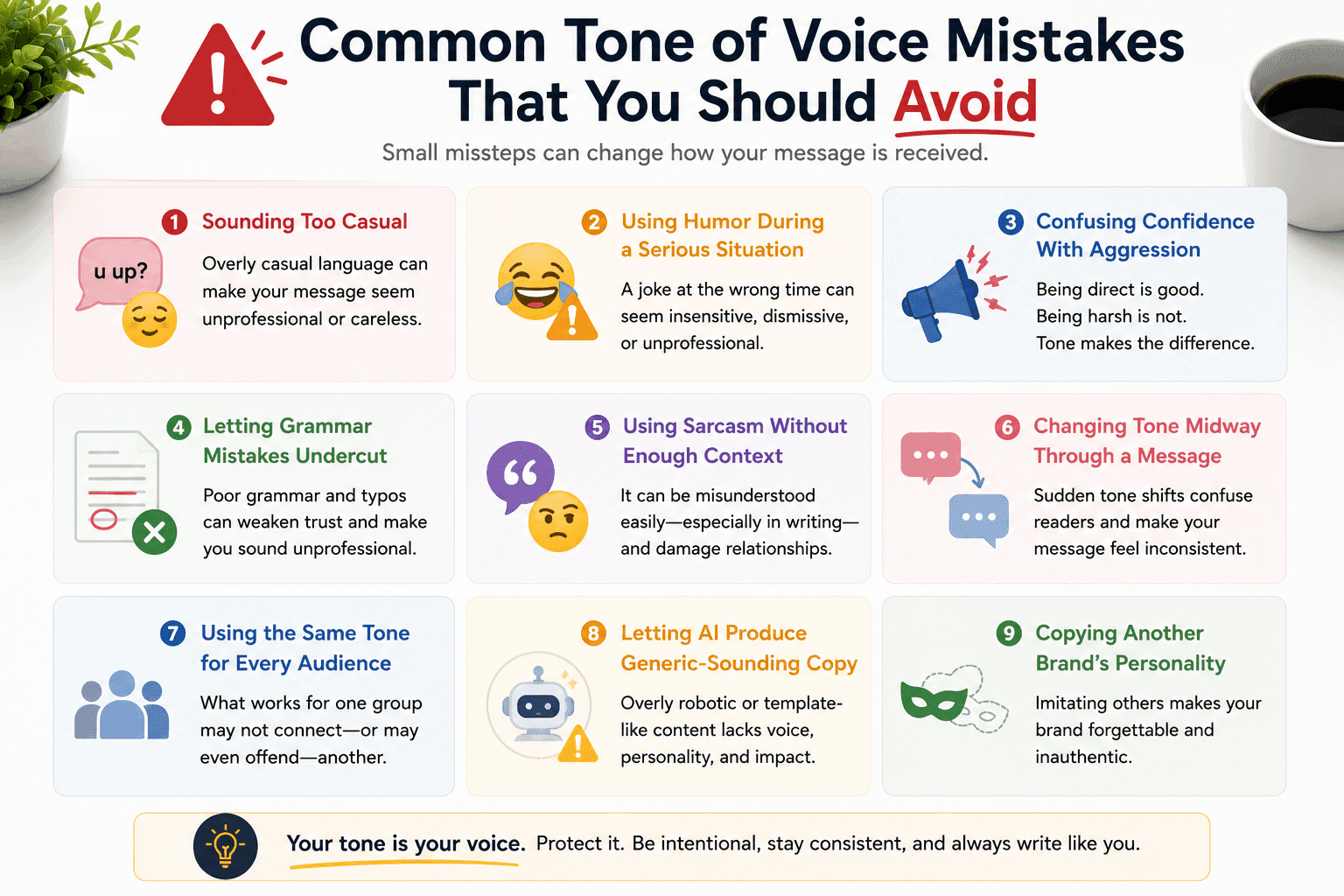
Common Tone of Voice Mistakes That You Should Avoid
The wrong tone can make a clear message sound rude, careless, defensive, or insincere. These mistakes often happen when the writer focuses only on the information and overlooks how the reader may interpret the wording.
That’s why reviewing tone before publishing or sending a message can prevent confusion, protect trust, and make communication more effective.
So let’s find out some of the common mistakes that writers make so you can avoid them easily -
Sounding Too Casual
Excess casualness can undercut credibility in serious contexts. So try to swap "Yeah no worries, we'll get to it lol" for "No problem — we'll take care of this shortly."
Using Humor During a Serious Situation
Humor in the wrong moment can be read as dismissive of real concerns. That’s why swap a joke in an outage notice for a plain, direct explanation of what happened and what's being done.
Confusing Confidence With Aggression
Confident phrasing states a position; aggressive phrasing attacks the reader. It’s better to swap "You clearly didn't read the instructions" for "Let's walk through the instructions together."
Letting Grammar Mistakes Undercut
A missing comma can make a friendly line read as blunt, or a stray typo can make even an apology careless rather than sincere. So run the message through a grammar checker before anything, as tone-sensitive writing is exactly where small grammar slips do the most damage.
Using Sarcasm Without Enough Context
Sarcasm relies on shared context that written text often can't guarantee. Corrected: swap "Great, another delay" for a direct statement of frustration or a neutral status update, depending on the audience.
Changing Tone Midway Through a Message
Shifting from formal to casual (or serious to jokey) mid-message reads as inconsistent and can confuse the reader about how seriously to take it. Corrected: pick one register and hold it for the full message.
Using the Same Tone for Every Audience
A tone that works for a technical audience may alienate a general one, and vice versa. Corrected: adjust vocabulary and formality per audience rather than reusing one template everywhere.
Letting AI Produce Generic-Sounding Copy
If an AI-generated draft doesn’t sound like you or your brand, an AI humanizer can help make the wording feel more natural and closer to the tone you actually want to use.
Copying Another Brand's Personality
Borrowing a well-known brand's tone directly rather than adapting the underlying principles usually reads as imitation rather than personality. So try to define traits based on your own audience and purpose, not someone else's playbook.
FAQs About Tone of Voice
What is the tone of voice in simple words?
Tone of voice is the attitude or emotion behind how something is said or written — the difference between a message sounding warm, blunt, sarcastic, or formal, even when the core information stays the same.
What are the main types of tone?
Common categories include formal, informal, friendly, professional, confident, empathetic, humorous, serious, urgent, and persuasive, though most real messages blend two or three tones rather than sticking to just one.
How is tone shown in writing?
Written tone comes through word choice, sentence length, punctuation, capitalization, and formatting. Since there's no voice to lean on, these small details carry the emotional weight instead.
Can tone of voice change the meaning of words?
Yes. The same sentence can shift from sincere to sarcastic, or from calm to urgent, purely based on tone, without a single word in the sentence actually changing.
Why is tone of voice important?
Tone shapes how a message is received, not just what it communicates. The wrong tone can create confusion, defensiveness, or mistrust even when the underlying information is accurate and well-intentioned.
What are some good customer service tone of voice examples?
Strong customer service tone of voice examples usually combine empathy with clarity. The goal here is to acknowledge how the customer feels before moving into the fix.
Where can I find real brand tone of voice examples?
Apple, Nike, and IKEA are some of the most commonly cited brand tone of voice examples, each recognizable for a distinct approach like minimal and confident, motivational and bold, or practical and approachable, respectively.
How can I improve my tone of voice?
Read your writing aloud, remove unnecessary hedging, check sentence length and punctuation, and compare the result against how you want the reader to feel — then adjust word by word until the two line up.
How do you choose a brand tone of voice?
Start with your brand's purpose and audience, pick three or four core traits, define what each trait actually looks like in a sentence, and build do-and-don't examples so the tone stays consistent across every writer and channel.
That’s it!
Tone of voice is more than a writing style. It basically shapes how people interpret your message, your intentions, and even your credibility.
The right tone can build trust, encourage action, resolve misunderstandings, and make communication feel more human, while the wrong tone can create confusion even when the words themselves are correct.
Whatever you’re writing, taking a few moments to review your tone can make a significant difference.
That’s why paying attention to your word choice, sentence structure, punctuation, and audience will help you communicate with greater clarity and confidence.
If you're unsure whether your writing sounds too formal, too casual, too aggressive, or simply doesn't match your intended message, CopyChecker's Tone Checker can help.
It analyzes your writing, identifies the tone you're conveying, and suggests improvements so your message sounds more professional, friendly, empathetic, confident, or whatever the situation requires.
Try it before sending your next email, publishing your next article, or responding to your next customer to make sure your words leave the impression you intended.