


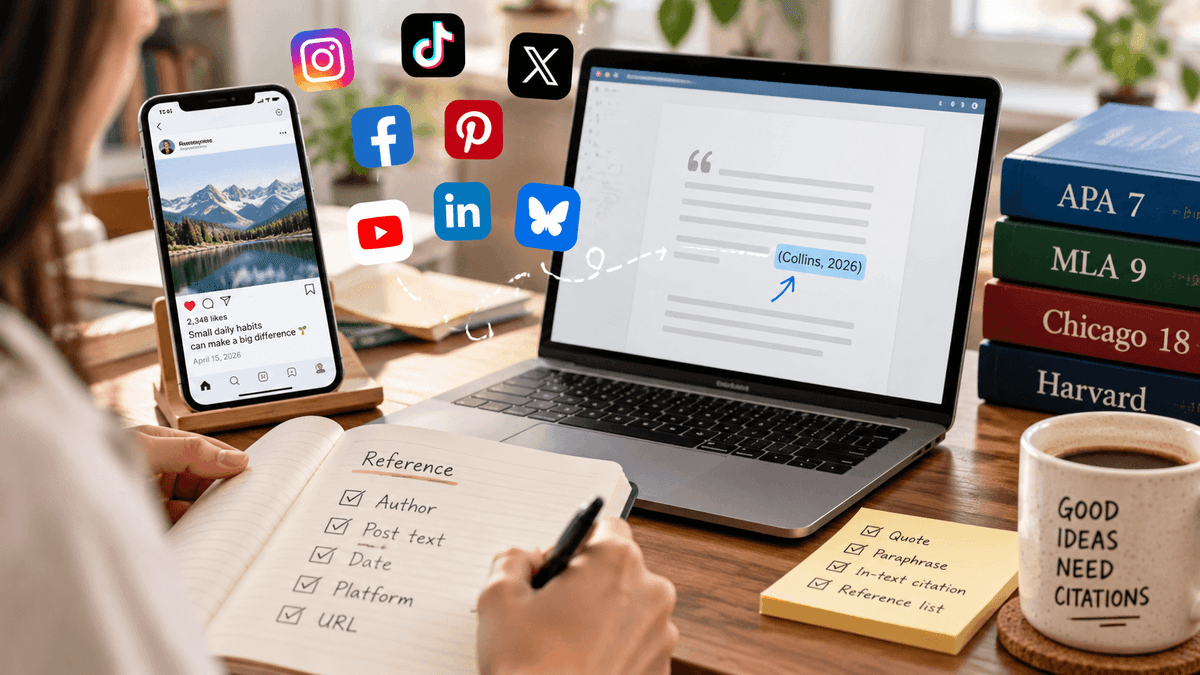
You've finally found the perfect information for your assignment.
But it isn't from a textbook or research paper.
It's an Instagram post where a scientist explains a finding you've been struggling to understand.
You read it twice, take a few notes, and realize it's exactly what your paper needs.
Then you reach the references section, and suddenly you're stuck.
How do you cite a social media post?
Do you write the person's real name or username?
Should you include the entire caption?
And what if the information came from a TikTok video or Reddit comment instead?
It's a question worth knowing the answer to, especially when social media has become such a common place to find information.
According to Pew Research Center's 2025 report, 80% of U.S. adults aged 18–29 use Instagram, while 63% use TikTok.
With researchers, universities, organizations, and experts sharing information across these platforms, useful sources aren't always found in traditional articles or books.
But finding information is one thing. Giving proper credit is another.
A missing username, incorrect date, or wrong link can make your citation difficult to verify.
And the rules change depending on whether you're using APA, MLA, Chicago, or Harvard style.
So, how do you get it right without spending another hour figuring out citation formats?
This guide walks you through how to cite social media posts step by step, with easy examples for Instagram, TikTok, Facebook, X (Twitter), Reddit, and LinkedIn.
You'll also learn how to write in-text citations and handle missing authors, unavailable dates, and deleted posts, so you can finish your references with confidence.
So let’s get started with -
How Do You Cite a Social Media Post?
To cite a social media post, identify its author, publication date, post content, platform, and direct URL.
Then arrange those details according to the citation style your teacher or institution requires.
For example, an APA social media citation usually includes the author's name, username, date, the first 20 words of the post, a description of the content, the platform, and the URL.
MLA and Chicago use different arrangements, but the purpose stays the same: help readers identify and find the original source.
Here's a quick comparison.
| Citation Style | Main Format |
|---|---|
| APA 7 | Author [@username]. (Year, Month Day). First 20 words of post [Description]. Platform. URL |
| MLA 9 | Author [@username]. "Post text." Platform, Day Month Year, URL. |
| Chicago 18 | Author or Username (@handle), "Post text," Platform, Month Day, Year, URL. |
| Harvard | Author or Username (Year) Post text or description, Platform, Day Month. Available at: URL. |
Don't worry if these formats look a little confusing right now.
We'll go through each citation style with examples later, so you won't have to figure them out from a template alone.
For now, remember that these are simplified formats.
The exact punctuation, content descriptions, and other details can vary.
Harvard referencing also differs between universities, so your institution's guidelines should always come first.
But before we start putting names, dates, and URLs into these formats, there's something we need to sort out -
What Information Do You Need to Cite a Social Media Post?
Now that you know what goes into a social media citation, let's see how to find those details in an actual post.
Fortunately, you don't have to copy everything from the post.
Just focus on the information that helps readers identify the original source.
Here's what you should look for, using our Instagram example -
| Information | What to Look For | Example |
|---|---|---|
| Author | Person, organization, or account name | Ocean Research Center |
| Username | Account handle | @oceanresearch |
| Publication date | Date the post was published | March 12, 2026 |
| Post content | Caption, opening words, or description | New research shows how plastic waste affects marine life... |
| Content type | Text, photo, video, Reel, or carousel | Instagram photograph |
| Platform | Where the post appeared | |
| URL | Direct link to the specific post | https://www.instagram.com/p/EXAMPLE/ |
The account, caption, and URL above are fictional and are used only to demonstrate the citation elements.
As you can see, most of these details are easy to find.
The author's name and username usually appear at the top of the post, while the date and caption help identify exactly what was shared.
But there's one detail in the table that's especially easy to overlook: the direct post URL.
So, let’s talk about -
Why is the Direct Post URL Important?
A profile link takes readers to someone's account, not necessarily the post you used.
For example, linking to an organization's Instagram profile could leave readers searching through hundreds of posts to find your source.
A direct post URL makes verification much easier.
This matters especially when you're citing scientific findings, statistics, public statements, or other information that readers may want to check.
Quick Tip: Save the original post's details while researching. Social media content can be edited, hidden, or deleted, and finding it again may be harder than you expect.
Now that you know what information to collect, let's put it into a citation -
How to Cite a Social Media Post in 5 Easy Steps
You don't need to memorize every punctuation rule before you begin.
Start with these five steps, then use the citation-style examples in the next section to format your reference.
Step 1: Find the Original Social Media Post
First, make sure you're looking at the original source.
Suppose someone shares a screenshot of a scientist's tweet on Facebook.
If you're discussing what the scientist actually said, try to find the original tweet rather than citing the Facebook screenshot.
That way, you can check the author, date, wording, and context.
However, if your research is about how people reacted to or shared the screenshot on Facebook, that Facebook post may be the source you need.
The important question is: Which piece of content are you actually using as evidence?
Step 2: Record the Author, Username, and Date
Next, identify who published the post.
Depending on the platform, the author might be a person, business, government department, university, or anonymous account.
Record the displayed name and username when both are available.
Also, check the publication date carefully. A post's original date is not necessarily the date someone shared it with you.
For academic citations, the original publication date is usually the relevant one.
Step 3: Copy the Direct URL
Open the post and find its Share or Copy Link option.
On most platforms, this gives you a URL that points directly to the content.
For example, a Reddit post has its own link, while an individual Reddit comment may have a separate permalink.
If you're citing the comment, use the comment's direct link when possible.
Step 4: Choose Your Citation Style
Your teacher, university, or publisher will usually tell you which citation style to use.
The most common choices include:
- APA: Often used in psychology, education, and social sciences.
- MLA: Common in literature, languages, and humanities.
- Chicago: Used in history and other academic fields.
- Harvard: An author-date referencing approach used by many institutions.
Don't mix citation styles within the same assignment unless your instructions specifically require it.
Step 5: Format and Check Your Citation
You've collected the source details and chosen your citation style. Now it's time to put everything together.
Follow the format required by your style guide, paying attention to the author's name, publication date, punctuation, content description, and direct URL.
Don't forget to check your in-text citation, too.
It should match the source listed in your references or Works Cited page.
And before moving on, open the link one more time to make sure it leads to the correct post.
After all, even a perfectly formatted citation won't help much if it takes your reader somewhere else.
Now, you might be wondering if the information stays the same, why does the citation format change?
That's because APA, MLA, Chicago, and Harvard each have their own rules for organizing source details.
Rather than making you memorize four different sets of instructions, let's take a single social media post and see how its citation changes from one style to another -
How to Cite a Social Media Post in APA, MLA, Chicago, and Harvard
Each citation style has its own rules, but you don't need to learn them all.
Find the style your assignment requires and follow its format.
To make the differences easier to understand, we'll use one fictional example throughout this section.
Example social media post
- Author: Maya Collins
- Username: @mayacollins
- Platform: Instagram
- Date: April 15, 2026
- Post text: "Small daily habits can make a big difference in reducing plastic waste."
- Content type: Photograph
- Example URL: https://www.instagram.com/p/EXAMPLE/
This is a fictional example created for learning purposes. When citing a real post, replace these details with information from the original source.
So, how would you cite Maya's Instagram post in your assignment?
Let's start with one of the most commonly used citation styles in academic writing -
How to Cite a Social Media Post in APA 7th Edition
APA 7th edition uses an author-date citation system.
For social media posts, the reference usually includes the author's name, username, date, the first 20 words of the post, a description of any attached media, the platform, and the URL.
APA Reference Format:
Author, A. A. [@username]. (Year, Month Day). First 20 words of the post [Content description]. Platform. URL
APA Citation Example:
Collins, M. [@mayacollins]. (2026, April 15). Small daily habits can make a big difference in reducing plastic waste [Photograph]. Instagram. https://www.instagram.com/p/EXAMPLE/
APA In-text Citation:
Parenthetical: (Collins, 2026)
Narrative: Collins (2026)
You could use it in a sentence like this:
Collins (2026) encourages people to reduce plastic waste through small changes in their daily routines.
Now what if the caption is longer than 20 words?
You don't need to copy the entire caption into your APA reference.
APA generally uses only the first 20 words of the post as the title element.
Hashtags, emojis, and URLs may count as words, so follow APA's guidance when selecting those opening words.
If the post includes a photograph, video, or other media, add an appropriate description in square brackets, such as [Photograph] or [Video].
And if there's no separate media attachment, don't add a description that doesn't apply.
That covers the main rules for citing social media in APA. But what if your assignment requires MLA instead?
You'll still use the same information from Maya's Instagram post. The difference is how you organize it, particularly in your Works Cited entry and in-text citation.
Let's see how that works -
How to Cite a Social Media Post in MLA 9th Edition
MLA uses a Works Cited list rather than APA's reference list.
It usually includes the author, post text or description, platform, publication date, and URL.
MLA Works Cited Format:
Author's Last Name, First Name [@username]. "Text of the Post." Platform, Day Month Year, URL.
MLA Citation Example:
Collins, Maya [@mayacollins]. "Small daily habits can make a big difference in reducing plastic waste." Instagram, 15 Apr. 2026, https://www.instagram.com/p/EXAMPLE/.
MLA In-text Citation:
(Collins)
In a sentence:
Collins suggests that simple everyday habits can help people reduce plastic waste.
See the difference?
Since Collins is already named in the sentence, you don't need to repeat the surname in parentheses.
There's another important difference worth knowing.
Unlike APA, MLA doesn't automatically limit the post text to the first 20 words.
Instead, MLA follows its own rules for post text, shortened titles, and descriptions when the content is too long or doesn't have a clear title.
So far, we've seen two approaches: APA uses the author's name and year, while MLA usually relies on the author's surname.
But what if your teacher asks you to use footnotes instead of putting citations in parentheses?
That's where Chicago style comes in -
How to Cite a Social Media Post in Chicago Style (18th Edition)
Chicago has two main citation systems: Notes and Bibliography, and Author-Date.
The Notes and Bibliography system is especially common in history and humanities.
An important difference is that Chicago often allows social media posts to be cited in the main text or a footnote without including them in the bibliography.
Chicago Footnote Format:
Author Name (@username), "Post text," Platform, Month Day, Year, URL.
Chicago Footnote Example:
- Maya Collins (@mayacollins), "Small daily habits can make a big difference in reducing plastic waste," Instagram, April 15, 2026, https://www.instagram.com/p/EXAMPLE/.
Notice how the footnote includes the details readers need to identify and find the original post.
But what if your teacher asks you to include social media sources in your bibliography as well?
In that case, you can format the entry like this:
Chicago Bibliography Example:
Collins, Maya (@mayacollins). "Small daily habits can make a big difference in reducing plastic waste." Instagram, April 15, 2026. https://www.instagram.com/p/EXAMPLE/.
Now, remember that Chicago also has an Author-Date system. If you're using that version, your in-text citation looks a little different.
Chicago Author-Date In-text Citation:
(Collins 2026)
Looks familiar, right? It's similar to APA, but Chicago doesn't use a comma between the author's surname and publication year.
The main thing to remember is that not every social media post needs a separate Chicago bibliography entry.
Follow your instructor's requirements and check the Chicago Manual of Style when you're unsure.
We've now covered APA, MLA, and Chicago. There's just one more widely used referencing approach to look at: Harvard.
If you've noticed that some of these styles use the author's name and publication year, Harvard will feel familiar.
However, there's one important detail you need to know before using it -
How to Cite a Social Media Post in Harvard Style
Harvard referencing uses an author-date system, similar in principle to APA.
However, Harvard isn't governed by one universal manual. Different universities may use different punctuation, descriptions, and access-date rules.
Here's an illustrative Harvard-style format.
Harvard Reference Format:
Author (Year) 'Post text or description', Platform, Day Month. Available at: URL (Accessed: Day Month Year).
Harvard Citation Example:
Collins, M. (2026) 'Small daily habits can make a big difference in reducing plastic waste', Instagram, 15 April. Available at: https://www.instagram.com/p/EXAMPLE/ (Accessed: 18 October 2026).
Harvard In-text Citation:
(Collins, 2026)
For example:
Small changes in daily routines may help people reduce their plastic waste (Collins, 2026).
Notice how the author's surname and year are enough to connect the sentence to the full reference.
Depending on your university's guidelines, you might also need to use the account name instead of the person's real name, include a description of the post, or write the access date differently.
That's why it's worth checking your institution's preferred format rather than copying a Harvard citation without reviewing it.
Now we've cited the same Instagram post in four different styles, and you've probably noticed something interesting: the source information stays almost the same, but the way we present it changes.
APA uses the author's surname and year, MLA usually focuses on the author's surname, Chicago may use footnotes, and Harvard follows an author-date approach with institution-specific rules.
Still a little difficult to keep track of?
Let's put all four styles side by side so you can quickly see what makes each one different -
APA vs. MLA vs. Chicago vs. Harvard: What's the Difference?
Now that you've seen how to cite the same Instagram post in all four styles, you might be wondering which details you actually need to remember.
The biggest differences come down to how you write the in-text citation, where you list the full reference, and which formatting rules you follow.
Here's a quick comparison to help you keep them straight without going back through every example -
| Style | In-text Citation | Reference Location | Important Distinction |
|---|---|---|---|
| APA 7 | (Collins, 2026) | Reference list | First 20 words of the post |
| MLA 9 | (Collins) | Works Cited | Author and post text are central |
| Chicago 18 | Footnote or (Collins 2026) | Notes, sometimes bibliography | Bibliography entry often optional for social posts |
| Harvard | (Collins, 2026) | Reference list | Rules vary by institution |
Notice that the same source can look different in each style.
That doesn't mean one citation is better than another.
It means each system organizes source information differently.
But citation styles are only half the story.
Social media platforms also publish different kinds of content.
Let's look at the most common ones you're likely to use in an assignment.
How to Cite Posts From Different Social Media Platforms
The citation style determines the format, but the platform helps you identify what kind of content you're citing.
An Instagram photo isn't quite the same as a TikTok video. A Reddit comment isn't the same as the original Reddit discussion.
Let's look at the differences.
How to Cite an Instagram Post or Reel
Instagram citations can refer to photographs, carousels, Reels, or text-based posts.
For APA, identify the account owner, username, date, caption or first 20 words, content type, and direct URL.
Example: Instagram Reel in APA 7
Fictional example for formatting practice.
Rivera, J. [@jrivera]. (2026, May 8). Three simple ways to save water at home [Reel]. Instagram. https://www.instagram.com/reel/EXAMPLE/
In-text citation: (Rivera, 2026)
For a carousel containing multiple photographs, use a suitable description such as [Photographs] where appropriate.
What about Instagram Stories?
Stories can disappear after 24 hours, making them difficult for readers to retrieve.
If a Story is saved in a publicly accessible Highlight, you may be able to cite that version.
Otherwise, follow your citation style's rules for nonrecoverable or personal communications.
How to Cite a TikTok Video
TikTok videos often include a username, caption, publication date, and unique video link.
For an APA TikTok citation, use the creator's name, username, date, first 20 words of the caption or other identifying text, video description, platform, and URL.
Example: TikTok video in APA 7
Fictional example.
Ahmed, S. [@sciencewithsam]. (2026, June 3). Why does the sky change color during sunset? Here's a simple explanation [Video]. TikTok. https://www.tiktok.com/@sciencewithsam/video/EXAMPLE
In-text citation: (Ahmed, 2026)
If you're discussing a particular moment in a video, a timestamp can help readers locate it.
For example, you might refer to a specific explanation at 00:35.
Remember that TikTok captions, on-screen text, and spoken words aren't necessarily the same.
Make sure your quotation accurately reflects the part you're citing.
How to Cite a Facebook Post
Facebook citations may involve individuals, businesses, government organizations, or public pages.
Suppose an environmental organization publishes a public update about a conservation project.
In APA, the organization can be listed as the author.
Example: Facebook post in APA 7
Fictional example.
Green Earth Foundation. (2026, July 12). Our community volunteers collected more than 500 kilograms of plastic waste during this weekend's cleanup [Status update]. Facebook. https://www.facebook.com/EXAMPLE
In-text citation: (Green Earth Foundation, 2026)
For MLA, the organization would also generally appear as the author, followed by the post text, Facebook, publication date, and URL.
If you're citing a Facebook photo or video, describe that content appropriately rather than automatically calling everything a status update.
How to Cite a Tweet or X Post
Twitter was renamed X in 2023, but older posts and citation examples may still refer to Twitter.
When citing an X post, record the author's name, handle, posting date, text, and permalink.
Example: X post in APA 7
Fictional example.
Carter, E. [@ecarter]. (2026, August 20). Reading just fifteen minutes a day can help you build a stronger reading habit [Post]. X. https://x.com/ecarter/status/EXAMPLE
In-text citation: (Carter, 2026)
If the original post was published when the platform was called Twitter, you may encounter citations that use Twitter as the platform name.
Use the platform name appropriate to the source and the instructions in your chosen style guide.
Also, don't confuse a repost with the original author's statement.
If the original post is available and that's what you're discussing, cite it directly.
How to Cite a Reddit Post or Comment
Reddit is a little different because many users don't share their real names.
In that case, the username becomes an important part of the citation.
Example: Reddit post in APA 7
Fictional example.
StudyExplorer42. (2026, September 5). What helped you stay focused while preparing for final exams? [Online forum post]. Reddit. https://www.reddit.com/r/studytips/comments/EXAMPLE/
In-text citation: (StudyExplorer42, 2026)
What if You're Citing a Reddit Comment?
Cite the person who wrote the comment, not automatically the author of the original thread.
Use the comment's permalink where available, and identify it as a comment in the reference.
This distinction matters when your research examines online discussions, public opinions, or individual experiences.
A Reddit comment may be useful as evidence of what someone said or experienced, but it shouldn't automatically be treated as proof of a wider scientific claim.
How to Cite a LinkedIn Post
LinkedIn posts often contain professional opinions, company announcements, industry statistics, and links to articles.
The citation process is similar to other platforms.
Example: LinkedIn post in APA 7
Fictional example.
Patel, R. [@rpatel]. (2026, February 18). Five lessons I learned from managing a remote team across three countries [Post]. LinkedIn. https://www.linkedin.com/posts/EXAMPLE/
In-text citation: (Patel, 2026)
However, LinkedIn posts and LinkedIn articles aren't necessarily the same source type.
If someone publishes a full article on LinkedIn, use the appropriate webpage or online-article format required by your citation style.
What About Threads, Bluesky, Pinterest, and YouTube Community Posts?
You can usually apply the same citation principles to newer or less frequently discussed platforms.
| Platform | What to Identify | Special Consideration |
|---|---|---|
| Threads | Author, handle, date, text, URL | Cite the individual thread post |
| Bluesky | Account name, handle, date, text, URL | Record the complete handle accurately |
| Creator, image or pin description, date, URL | Check whether the pin links to an original source | |
| YouTube Community | Channel, date, post text, URL | Distinguish Community posts from regular videos |
If you're citing an actual YouTube video, the citation rules can differ from those used for a Community post.
Learning properly about how to cite a YouTube video explains that process separately.
The MLA Style Center also explains how its general citation principles apply across different platforms. <Cite refs={["turn316331search0","turn316331search5"]}/>
By now, you've seen how to cite social media posts from several platforms, and most of our examples have had something in common: a clear author, publication date, and working link.
But what happens when one of those details is missing?
Maybe you found a useful Reddit comment from someone using an anonymous username.
Perhaps an Instagram post doesn't show a publication date, or the original tweet has been deleted.
These situations can make citing social media a little trickier, but they don't always mean you have to leave the source out.
Let's look at -
How Do You Cite a Social Media Post With Missing Information?
Imagine finding a useful post from an anonymous account.
The explanation is relevant to your research, but there's no real name.
Or perhaps the post has been deleted, and you only have a screenshot.
You can still work through these situations.
The important thing is to avoid making up missing details.
What if the Author's Real Name Is Unknown?
Use the account name or username when the author's real name isn't available.
For example, if a Reddit user publishes a post under the name BookLover88, you can use that username as the author.
Don't search for or guess the person's private identity just to complete a citation.
What if the Post Has No Publication Date?
First, check whether the platform shows the date when you open the individual post.
Some feeds show relative times such as "three weeks ago," while the full post page may display a more precise date.
If no publication date can be established, use your citation style's no-date convention where applicable, such as n.d. in APA.
Never invent a publication date based on when you first saw the post.
What if the Post Has No Caption or Title?
Some Instagram posts contain only photographs.
Others include a video with no written caption.
In these cases, use an appropriate description of the content.
For example:
Photograph of a coastal cleanup event
The exact formatting depends on your citation style. MLA, for example, allows descriptions in place of missing titles. <Cite refs={["turn316331search0","turn316331search2"]}/>
What if the Social Media Post Has Been Deleted?
Now, imagine you've already found the perfect social media post for your assignment, taken notes from it, and moved on with your research.
A few days later, you return to copy the link, only to discover that the post has been deleted.
Frustrating, right? Especially when you've already used the information in your writing.
The problem is that your readers may no longer be able to access the original post to check what was said.
If you saved its URL, keep it with your research notes.
You can also check whether a reliable public archive has preserved a copy.
But be careful about how you cite it.
A deleted public post isn't automatically considered personal communication.
The correct approach depends on whether the content was originally public, has been archived, or was shared privately.
If you're using the post to support an important factual claim, finding another accessible primary source is often the safer choice.
Research Tip: Whenever you find a useful social media post, save a screenshot along with its URL, publication date, and the date you accessed it. This gives you a record if the content changes or disappears later.
Just remember that a screenshot doesn't automatically replace a proper citation.
The Chicago Manual of Style also recognizes that social media posts can change or disappear and recommends keeping copies of cited content.
So, whether your source has a missing username, an unclear date, or a broken link, the goal remains the same: give readers enough accurate information to identify the content without inventing details.
Now that you know how to handle these tricky situations, there's one more important part of citing social media we haven't fully explored -


