Suppose you have just spent an hour on a paragraph. After completing it, you read it back, and the whole paragraph sounds smart, polished, and professional.
Just exactly the tone you were going for!
Then you paste it into a readability checker just to be safe, and it comes back with a number that stops you cold: 22. Grade 16. “Very difficult.”
Wait, what? You’re like I didn't use a single word you'd call obscure.
So why is a tool telling you that your careful, well-considered writing is somehow hard to read?
If this has happened to you, you're not alone, and it's not because your writing is bad.
It's mainly because most people have no idea what's actually happening behind that score.
People only see a number, panic a little, start swapping words at random, and hope the score goes up.
But the truth is, a readability checker isn't judging your intelligence, your expertise, or even how "good" your writing is in any subjective sense.
It's running a handful of very specific, very mechanical calculations, like counting syllables, measuring sentence length, checking your vocabulary against familiar word lists, and turning them into a score.
Once you understand what it's actually counting, the number stops feeling like a mystery and becomes a tool you can use.
That's exactly what this guide is for.
As here, we're going to pull back the curtain on how these checkers work, step by step, formula by formula.
So the next time you see a score like that, you'll know exactly why you got it and exactly what to do about it.
Let's get into it without any more delay. But before anything, let’s start with the basics -
What Is a Content Readability Checker?
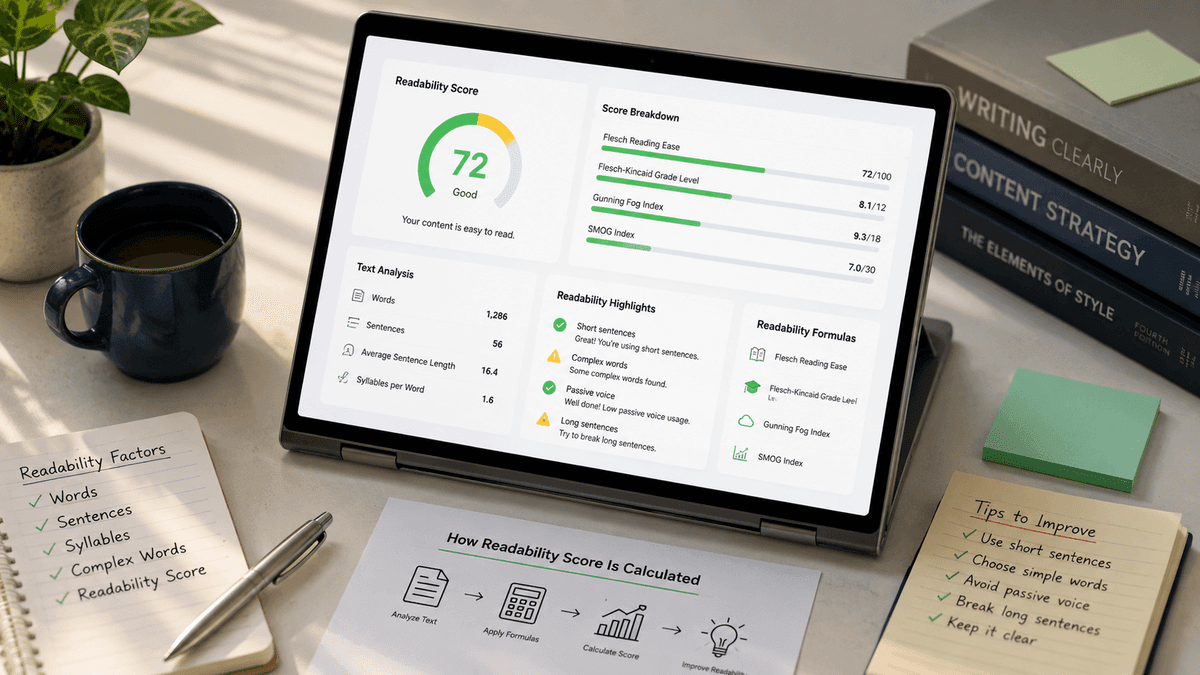
A readability checker is a tool, usually free and online, that estimates how easy or hard a piece of writing is to understand. You paste in text, and it hands back a snapshot of how your writing behaves on the page.
Depending on the tool, you might get:
- A reading-ease score (a number, usually 0–100)
- An estimated grade level
- Average sentence length
- A count of "difficult" words
- Warnings on specific sentences
- Suggestions for simplifying things
One thing worth being upfront about: a readability checker has no idea whether what you wrote is true, original, persuasive, or even useful.
It's measuring the shape of your sentences, not the substance of your argument.
How Does a Content Readability Checker Work?
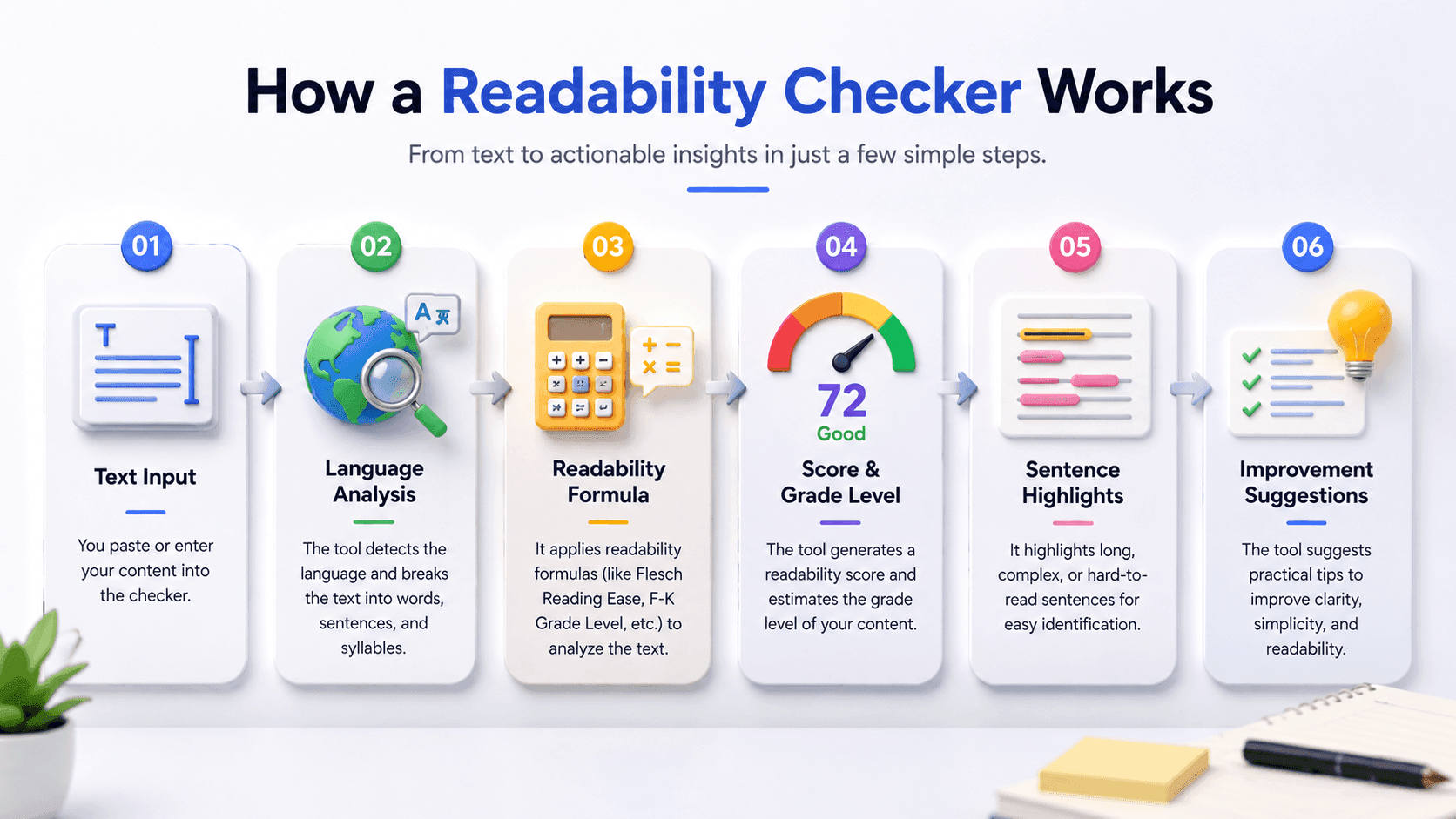
Under the hood, most checkers follow the same basic sequence, whether they're free browser tools or built into writing software. Let's find out what happens between "paste" and "score."
Step 1: The Checker Processes Your Text
First, the tool breaks your writing into pieces so that it can actually count: words, sentences, paragraphs, characters, syllables, and punctuation marks.
Some tools let you paste text directly; others accept a document upload or a URL, but the end result is the same: your writing gets converted into raw counts a formula can work with.
Step 2: It Measures Sentence Complexity
Next, the checker looks at how your sentences are built. It tracks things like:
- Average words per sentence
- How many long sentences have you written
- Sentences carrying multiple clauses
- How much does your sentence length vary
- Run-on sentences
Generally, longer sentences increase the estimated difficulty. But "long" isn't automatically "bad," as a well-built 30-word sentence can still read cleanly, while a clumsy 12-word one can trip readers up.
The formula doesn't know the difference; it just counts.
Step 3: Tool Evaluates Word Complexity
At the word level, the checker is counting syllables per word, tallying up longer words, and often comparing your vocabulary against lists of "familiar" versus "unfamiliar" terms.
Technical language tends to weigh a passage down here, even when that language is exactly what the audience expects.
Step 4: It Applies Readability Formulas
This is where the counts turn into a score. The checker plugs your sentence-length and word-complexity numbers into a mathematical formula.
Different formulas weigh different inputs; some lean on sentence length, some on syllable density, some on character counts or familiar-word lists.
Which is a big part of why two tools can look at the same paragraph and disagree.
Step 5: Readability Checker Produces a Score or Grade Level
Once the formula has crunched your sentence-length and word-complexity numbers, it converts that math into something you can actually act on.
Most checkers land on one of two output styles, and it helps to know which one you're looking at.
A Reading-Ease Score
This is usually a number on a fixed scale. Flesch Reading Ease, for instance, runs from 0 to 100. The higher the number, the easier the text is considered to read.
A score in the 80s might mean your writing is conversational and quick to scan, while something down in the 20s or 30s signals dense, effortful prose.
This kind of score is useful when you just want a fast, at-a-glance read on overall ease, without needing to translate it into anything else.
A Grade-Level Score
Instead of a scale, this output maps your writing onto an approximate U.S. school grade — Grade 6, Grade 9, Grade 12, and so on.
The idea is to estimate the level of reading skill someone would typically need to follow your writing without much strain.
This format tends to be more intuitive for content and marketing teams, since "write this at a Grade 8 level" is a much easier brief to hand a writer than “aim for a Flesch score above 60.”
Some tools will only give you one of these; others display both side by side, or even average several formulas together to produce a single blended result.
Either way, it's worth remembering that both outputs are describing the same underlying analysis from two different angles.
One as a scale, the other as a rough educational benchmark, not two independent judgments of your writing.
Step 6: It Identifies Difficult Areas
More advanced checkers go a step further and flag specific trouble spots: long sentences, dense paragraphs, hard vocabulary, heavy use of the passive voice, tangled structure, weak transitions, repetitive phrasing.
It's worth noting that classic readability formulas don't directly measure most of these modern and AI-assisted tools; this analysis layers on top of the base formula.
Step 7: The Tool Suggests Improvements
Beyond just scoring your text, many checkers go a step further and suggest specific fixes.
Such as splitting a long sentence in two, swapping out a harder word for a simpler one, switching a passive construction to active voice, trimming a filler phrase, defining a piece of jargon, or breaking a dense paragraph into smaller chunks.
Some tools point these out inline, right next to the sentence in question, so you can see exactly what triggered the flag.
Worth keeping in mind: these are suggestions, not rules. The tool doesn't know your audience or your intent; it's just reacting to patterns in the text. Treat the list as a set of things worth a second look, not a checklist you're required to clear.
What Does a Readability Checker Measure?
A readability checker isn't looking at your writing as a whole the way a person would.
Instead, it breaks it down into a handful of measurable ingredients, then weighs each one based on how much it tends to affect comprehension.
Some of these factors, like sentence length, are pretty intuitive. Others, like paragraph density or passive voice, are a bit less obvious but still shape the final number in real ways.
So here's a quick reference for what's actually going into your score:
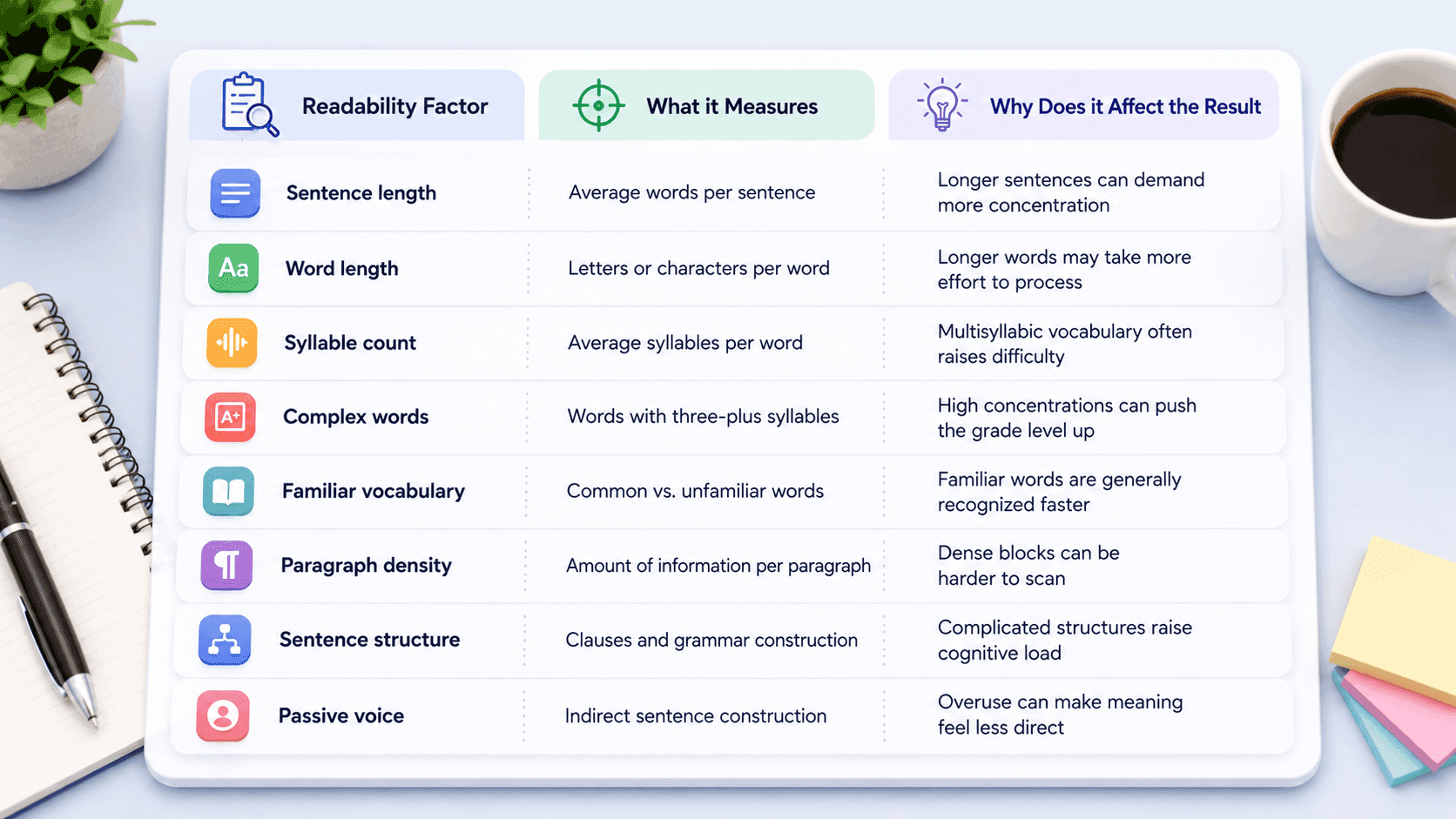
Not every formula measures all of these. Most traditional formulas calculate sentence length and syllables mechanically with no real sense of context, logic, or whether that "difficult" word is actually the correct technical term for your audience.
Which Readability Formulas Do Checkers Use?
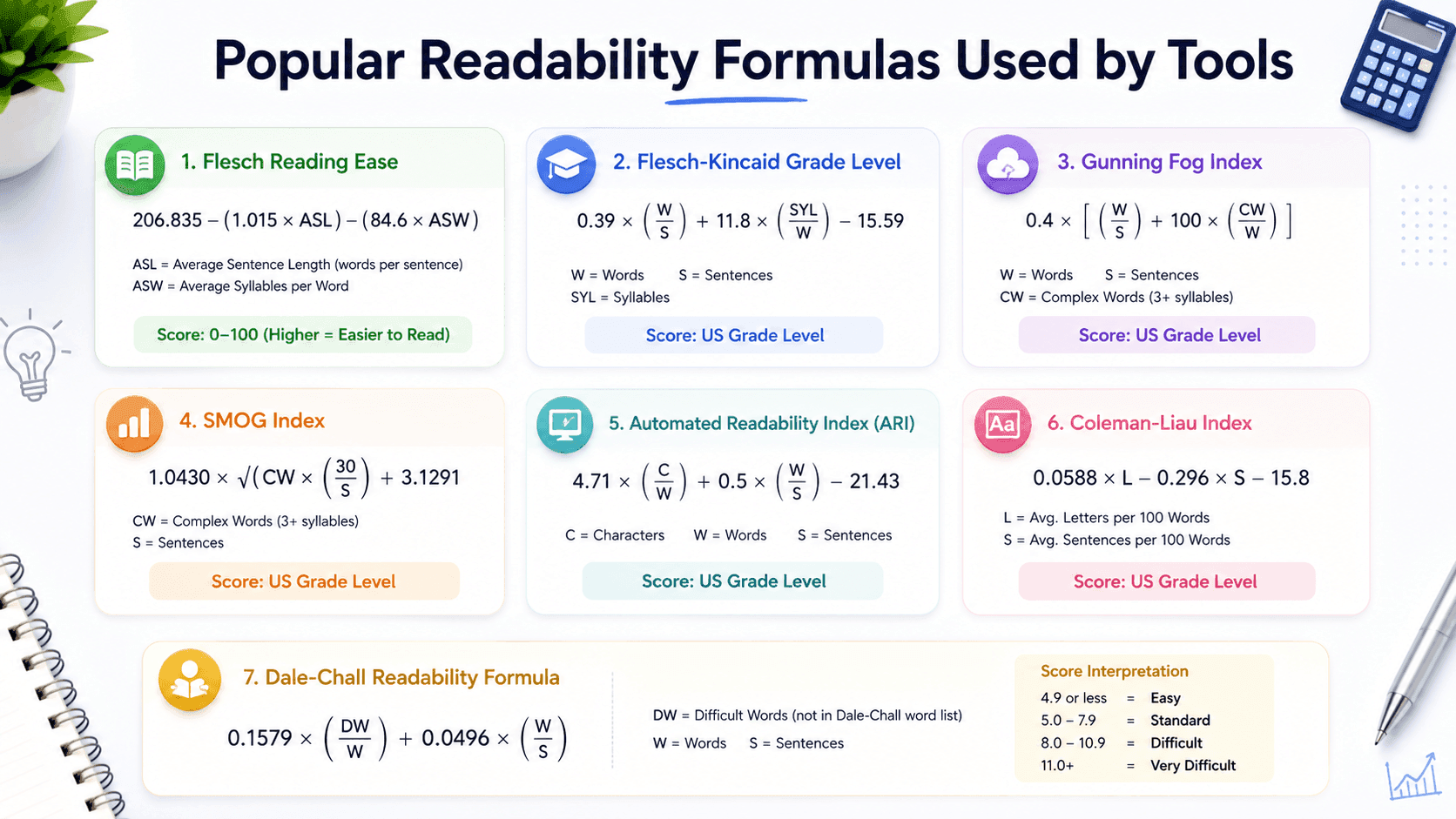
Most checkers lean on one or more established readability formulas. Each is built around a different combination of sentence length, syllables, complex words, character counts, or familiar-word lists.
As the inputs differ, the same stellar essay samples can land on different scores depending on which formula is doing the math. The following are some of the common formulas that most of the readability checkers use -
Flesch Reading Ease
This one looks at two things: how long your sentences are and how many syllables your words have.
Then the tool runs those numbers through a formula and spits out a score from 0 to 100; the higher the score, the easier the text is considered to read.
It's one of the fastest ways to get a general sense of "is this easy or hard," without digging into grade levels.
Example
"The cat sat on the mat" is short and simple; it'd score close to 100. "The feline positioned itself atop the floor covering" says the same thing with longer words and more syllables; its score would drop noticeably, even though the meaning barely changed.
Formula
206.835 − (1.015 × average sentence length) − (84.6 × average syllables per word)
Flesch-Kincaid Grade Level
This uses the same underlying math as Flesch Reading Ease, but instead of a 0–100 score, it converts the result into an approximate U.S. school grade.
If a Flesch-Kincaid readability checker returns "Grade 8" for your text, that means someone with roughly an eighth-grade reading level should be able to follow it comfortably.
It's especially handy when you're trying to reach a specific audience, like when you're writing a landing page that you want a broad, general reader to understand at a glance.
Example
A children's picture book might score around Grade 2–3. A general blog post might land around Grades 7–9. A dense legal contract could easily push into Grade 14+ (college level and beyond).
Gunning Fog Index
This formula also considers sentence length but places extra emphasis on "complex" words, generally those with three or more syllables. The more of those words you pack in, the higher (harder) your score climbs.
One thing to watch for is that it can be unfairly tough on technical writing, since specialized terms often have several syllables no matter how clearly you explain them.
Example
A sentence like "Utilize the aforementioned methodology to optimize outcomes" would score high (difficult) on Gunning Fog, largely because of words like "utilize," "aforementioned," and "methodology," even if the sentence itself isn't especially long.
SMOG Index
SMOG zeroes in almost entirely on polysyllabic words, basically words with three or more syllables, and largely ignores everything else.
It's frequently used in health and medical writing, where making sure people actually understand instructions like medication dosages or symptoms matters more than almost anywhere else.
Example
A patient handout that says "Take this medicine two times a day" will score far easier than one that says "Administer this medication in a twice-daily regimen," even though both sentences are roughly the same length.
Automated Readability Index (ARI)
ARI skips syllables altogether and instead counts characters per word, combined with average sentence length.
Because counting letters is simpler for a computer than counting syllables, ARI is quick and easy for software to calculate, which is part of why it shows up in many automated tools.
Example
"Run the test" is short in both words and characters, so it scores easily. "Execute the diagnostic procedure" has longer words with more characters per word, so ARI marks it as harder even without considering syllables at all.
Coleman-Liau Index
Like ARI, Coleman-Liau skips syllable counting. Instead, it looks at the number of letters per word and the number of sentences per passage, then converts them into an approximate U.S. grade level.
It's a good option when you want a formula that's fast and doesn't rely on guessing syllable breaks, which can get inconsistent between tools.
Example
Two sentences using short, common words ("The plan is simple. We start today.") will score low on the Coleman-Liau Index style. Swap in longer words with the same sentence count ("The strategy is multifaceted. We commence immediately.") and the score climbs, even though the sentence structure barely changed.
Dale-Chall Readability Formula
Instead of measuring word or sentence length directly, Dale-Chall checks your vocabulary against a curated list of words considered familiar to most readers, around 3,000 common words.
Anything outside that list gets treated as "difficult," regardless of how many syllables it has. That makes it behave differently from formulas based purely on length, since a short word can still count as unfamiliar.
Example:
"Kids like to play outside" uses entirely familiar words and scores easily. "Juveniles prefer outdoor recreation" uses shorter, similar-length words, but because "juveniles" and "recreation" aren't on the familiar-word list, Dale-Chall would flag it as harder to read, even though a formula like ARI might not.
Which Readability Formula Should You Actually Trust?
With seven different formulas floating around, it's fair to wonder whether any of them is "right."
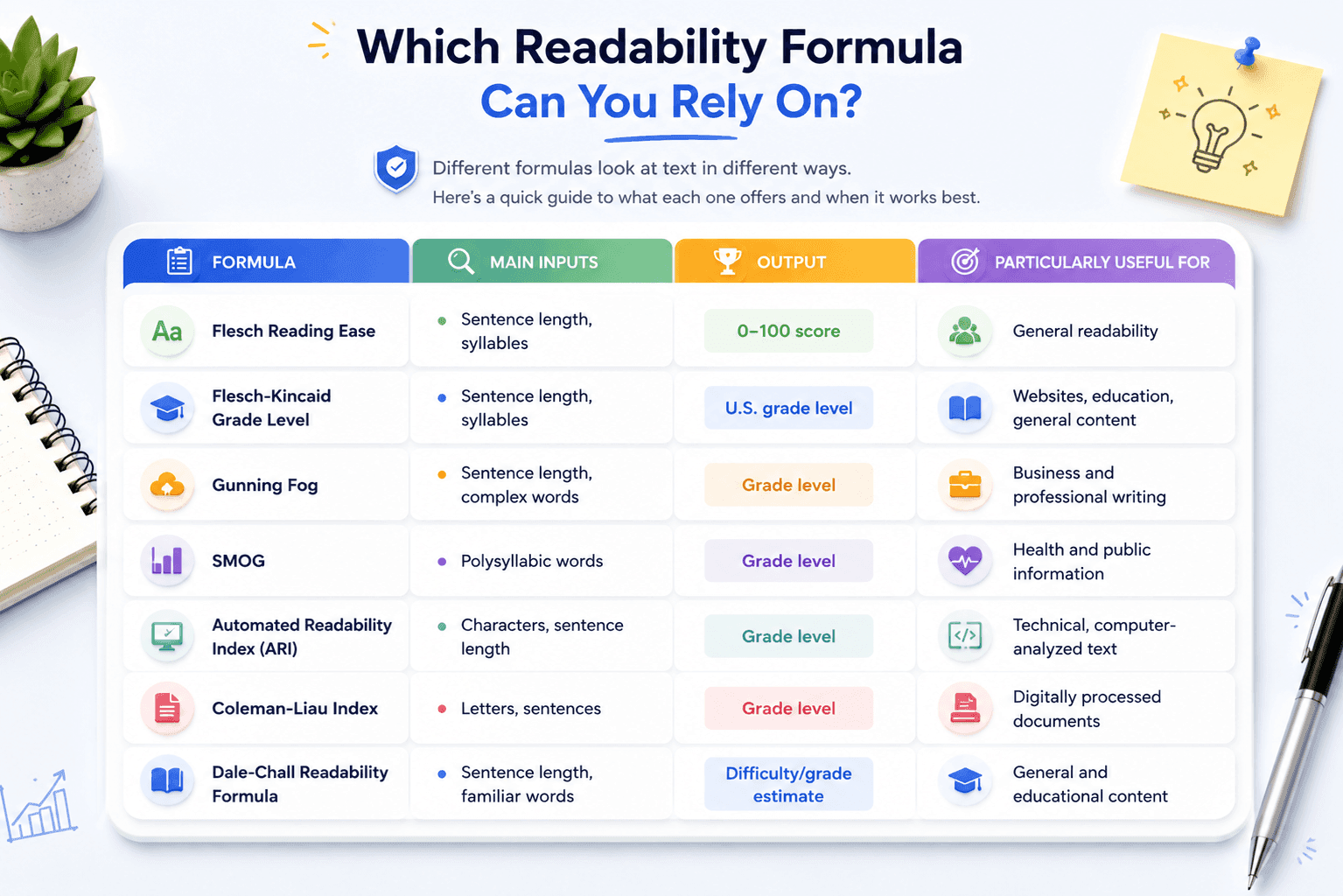
The honest answer is that none of them is universally correct; they're just built to prioritize different things. Some care more about sentence length, some about vocabulary, some about raw character counts.
That’s why picking the right one (or knowing which one your tool is using) comes down to matching the formula's strengths to what you're actually writing.
Here's a side-by-side look at how they stack up:
Why Do Different Checkers Give Different Scores?
If you've ever run the same paragraph through two different tools and gotten two different scores, you're not imagining it.
In fact, it happens more often than you'd think. It's not a bug or a sign that one tool is "wrong." It usually just comes down to how each tool is built and what choices it makes under the hood.
A few common reasons are below to help you understand better:
They May Use Different Underlying Formulas
One tool might run Flesch-Kincaid while another defaults to Gunning Fog or Coleman-Liau. Since each formula weighs sentence length, syllables, or vocabulary differently, the same paragraph can land on genuinely different scores depending on which formula sits behind the scenes.
Syllables Can Be Counted Differently Between Tools
Sometimes syllable counting sounds simple, but edge cases like compound words, contractions, and unusual spellings trip up automated counters in inconsistent ways. A small difference in how syllables are tallied can shift the final score more than you'd expect.
Abbreviations, Headings, Bullet Points, etc. Get Handled Inconsistently
Some tools strip these out before scoring; others count them as regular words or sentences. A page full of headings and short list items can score very differently depending on whether the tool treats those fragments as "real" sentences.
Some Tools Average Multiple Formulas Together
Rather than showing one formula's result, certain checkers blend two or three formulas into a single combined score. That blended number won't match what you'd get from any one formula on its own, even if each individual formula is calculated correctly.
Some Layer AI-based Language Analysis on Top
Beyond traditional math, newer tools add contextual analysis such as judging flow, tone, or clarity in ways a fixed formula never could. That extra layer can pull the final score in a different direction than a purely formula-based tool would.
What Is a Good Readability Score?
A good readability score is one that matches the knowledge, purpose, and expectations of your intended audience. There's no single "correct" number that applies everywhere.
Some practical starting points are the following:
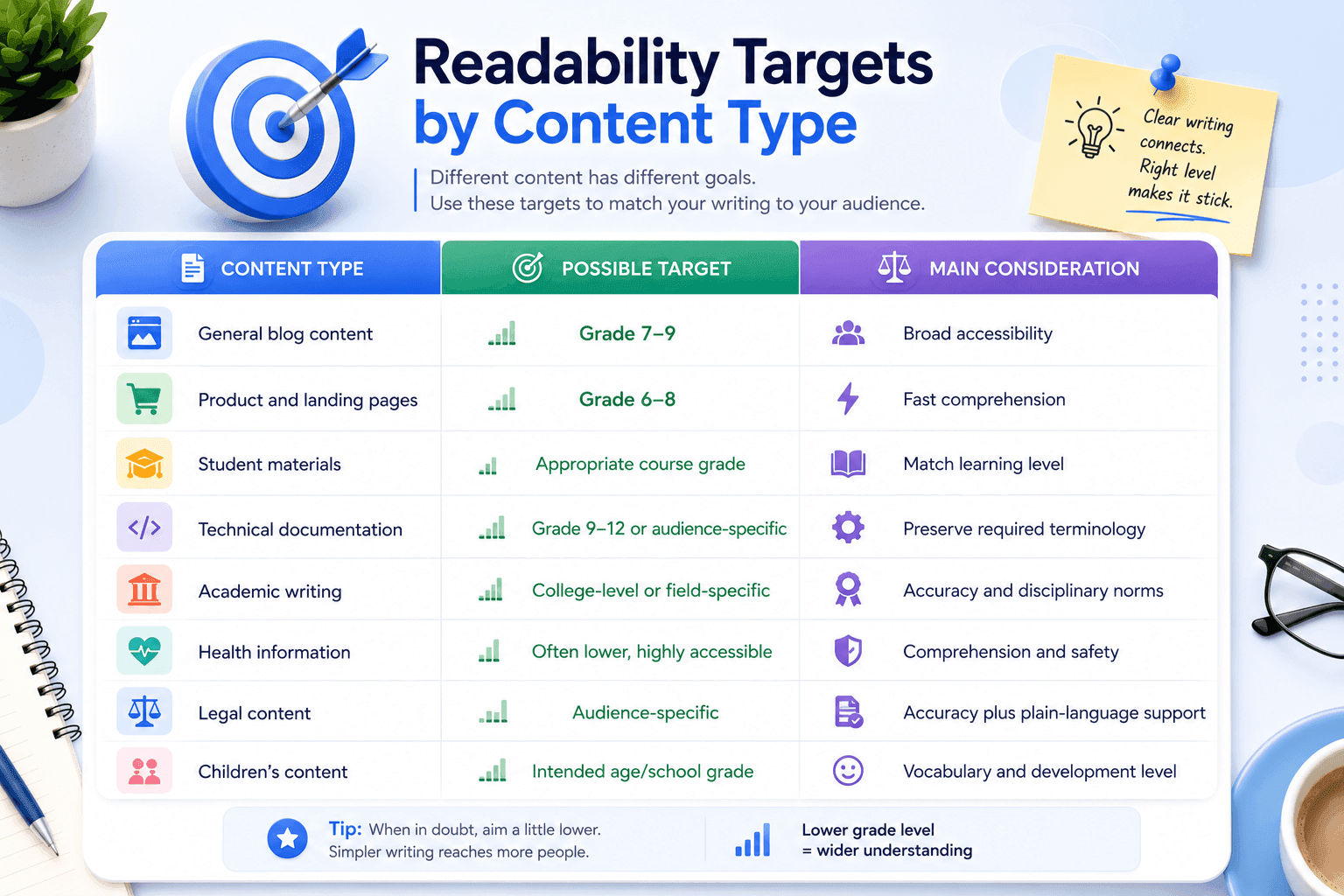
A lot of web-writing guidance points toward roughly an eighth-grade level as a safe target for broad audiences, but the right number for you still depends on who's reading and what they already know.
Readability Score Understanding with Before and After Examples
Numbers and formulas are useful, but nothing makes readability click quite like seeing it in action. Here's the same idea, written two different ways — one that buries the point under formal language, and one that just says it plainly.
Before
The implementation of a comprehensive content strategy necessitates the utilization of various methodologies, which, when appropriately deployed, can facilitate a substantial enhancement in the overall efficacy of an organization's digital communications and, by extension, its capacity to engage meaningfully with its target demographic across a multitude of channels.
That's one 66-word sentence trying to do way too much at once. It's stacked with formal vocabulary ("utilization," "methodologies," "efficacy"), buried in passive construction, and padded with modifiers that don't add meaning; they just add length.
After
A good content strategy uses proven methods to strengthen your digital communications. Done well, it helps you connect with your audience across every channel you use.
Same idea, told in two short, active sentences, roughly a quarter of the original word count, with nothing lost along the way.
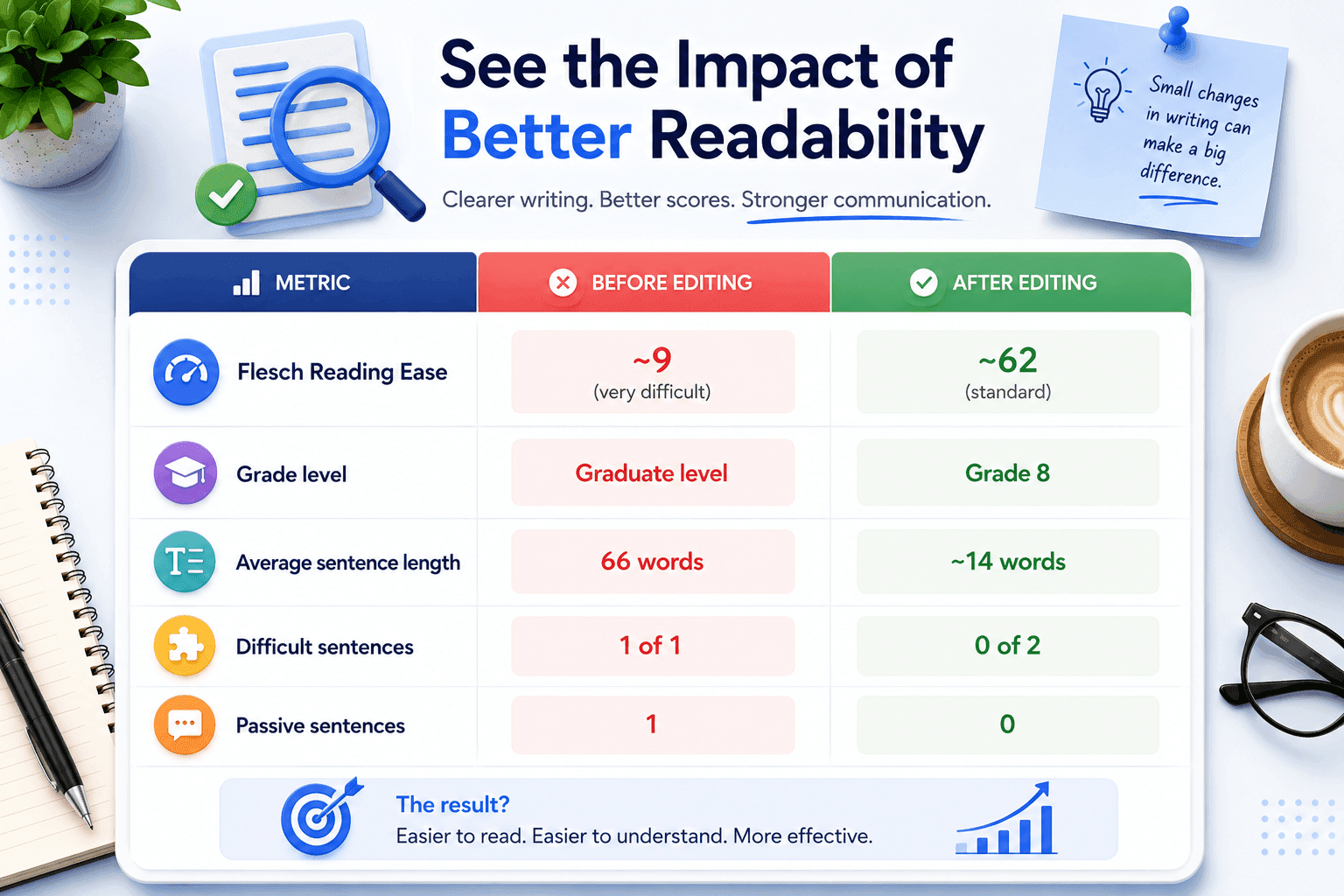
That's the kind of shift a readability checker is built to catch, not just "this is hard to read," but exactly why, and by how much editing closes the gap.
How to Improve Your Content Readability Score
Once you know what's dragging your score down, fixing it is usually straightforward. None of these require a rewrite from scratch, as most are small, targeted edits you can make in minutes. So, here's the checklist:
- Shorten overloaded sentences. Three ideas in one sentence? Split it into two or three.
- Replace unnecessarily difficult words. Simplify where you can but keep specialist terms when accuracy needs them.
- Prefer active voice. "The team reviewed the report" beats "The report was reviewed by the team." CopyChecker's Passive Voice Checker can help you catch these.
- Break up dense paragraphs. One central idea per paragraph, max.
- Use descriptive headings. Let readers scan and navigate without reading every word.
- Explain technical terms. Especially when writing for a beginner or mixed audience.
- Cut unnecessary phrases. "Due to the fact that" → "because."
- Vary your sentence length. All-short-sentences reads as robotic fast, so mix it up.
- Use lists and tables. Some content is just easier to scan than to read as prose.
- Check grammar and punctuation. A great readability score means little with basic errors underneath it. CopyChecker's Grammar Checker, Punctuation Checker, and Proofreader catch what the readability formula won't.
- Read it aloud. Still one of the fastest ways to catch awkward rhythm and overloaded sentences.
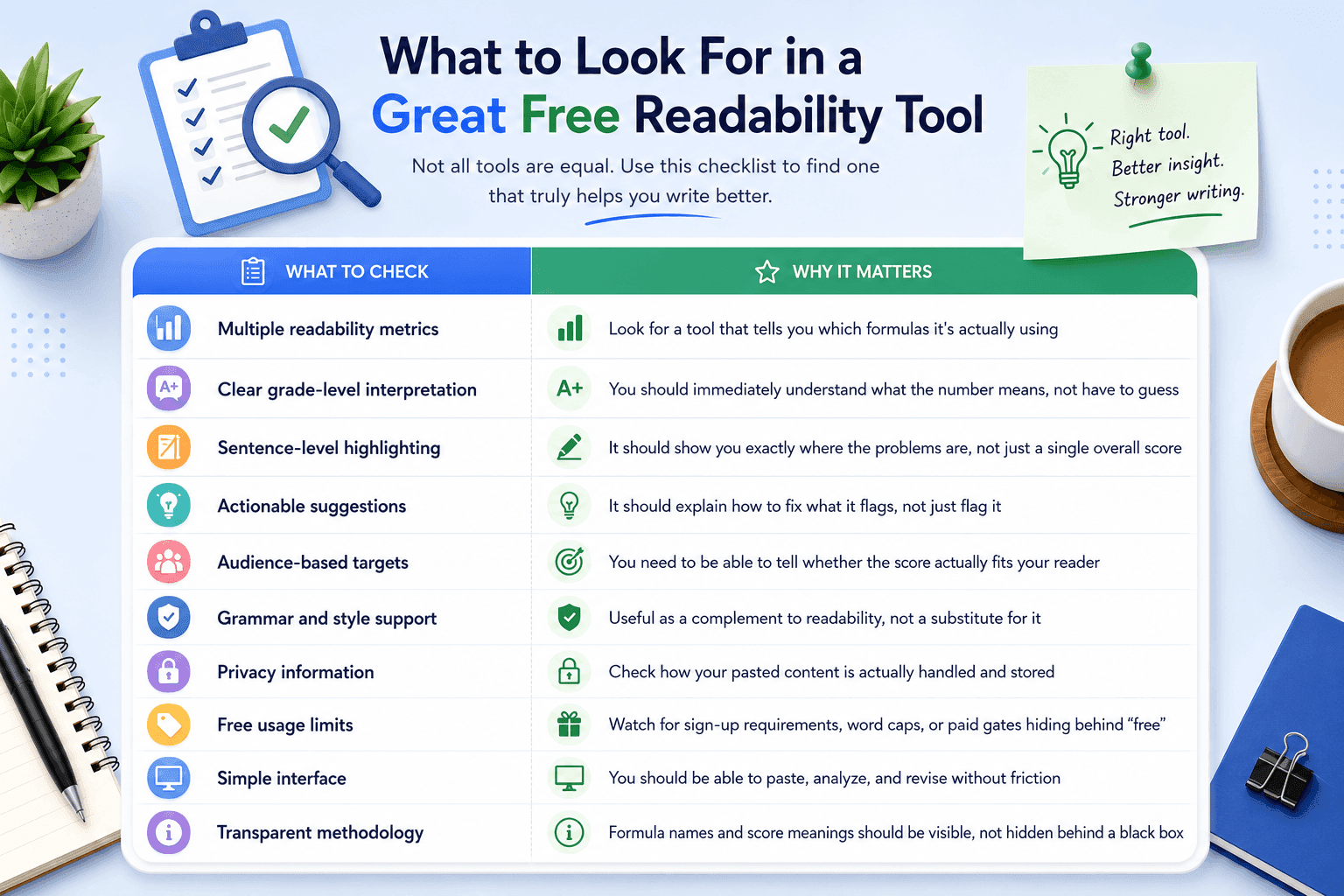
How to Choose the Best Free Readability Checker
Not every tool is built the same. So, let’s find out what's worth checking before you commit to one:
What Are the Limitations of Readability Checkers?
Worth being honest about these before you build your whole editing process around a single number:
- A high readability score doesn't guarantee good writing
- A formula can't verify whether your facts are accurate
- It can't recognize irony, tone, logic, or emotional impact
- Necessary terminology can unfairly inflate the grade level
- Very short samples can produce unstable, unreliable results
- Names, URLs, and abbreviations can throw off the calculation
- Different tools count words, syllables, and sentences differently
- Traditional formulas were built primarily around English
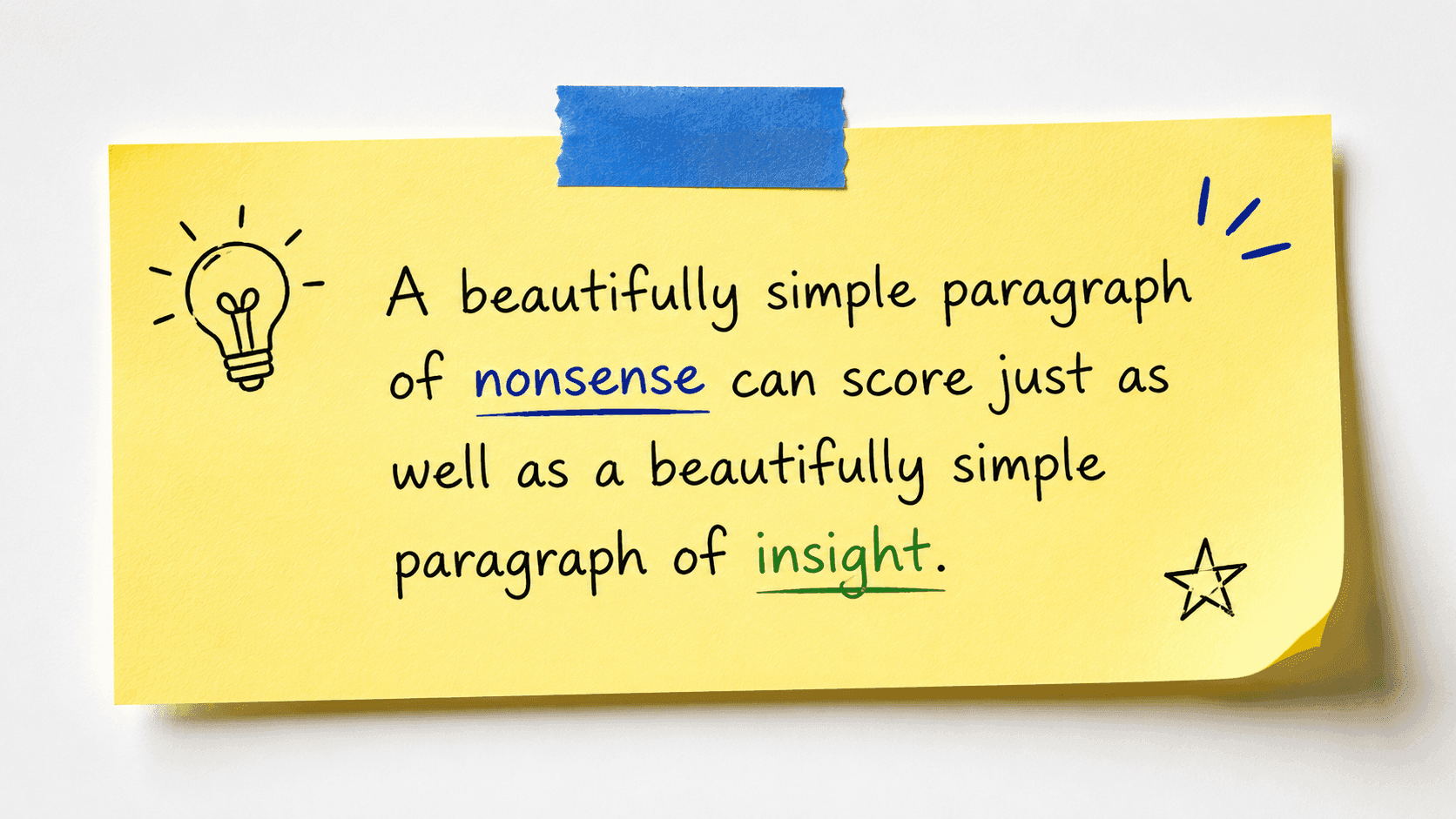
- Easy-to-read nonsense can still score extremely well
- Your intended audience matters more than hitting any universal number
That’s why it is best to use the score as an editing signal, not a rule that replaces your own judgment.
FAQs about How Readability Checker Works
What is a content readability checker?
It's a tool that analyzes writing for sentence length, word complexity, and vocabulary, then produces a score or grade level estimating how easy the text is to read.
What is the difference between an essay and a readability checker?
An essay checker looks at your writing more broadly with grammar, structure, argument flow, citations, and sometimes plagiarism or overall essay quality, but a readability checker only measures how easy the text is to read and gives you a score or grade level.
What grade level should website content be written at?
Most general web content aims for roughly Grade 7–9, balancing accessibility with the topic's natural complexity.
What does a readability grade level mean?
It estimates the U.S. school grade a reader would need to comfortably understand the text, not a judgment of the reader's intelligence.
Why do readability checkers give different scores?
Different formulas, different syllable-counting rules, and different handling of things like URLs and abbreviations all lead to varied results.
Are AI readability checkers better than traditional checkers?
They're different; not strictly better. AI tools can assess context and tone, but traditional formulas offer a consistent, reproducible baseline.
How much text is needed for an accurate readability score?
Very short samples can produce unstable results, but a few full paragraphs generally give a more reliable read than a single sentence.
Final Takeaway
So, where does all of this leave you?
At the end of the day, a content readability checker basically turns the measurable characteristics like sentence length, word difficulty, syllable count, and vocabulary familiarity into a score or grade level you can actually act on.
Now, different formulas weigh those signals differently, and that's exactly why scores can vary from tool to tool. But that's not something to stress over.
That's really the whole point of this guide.
The score is a signal, not a verdict. Your audience and your purpose should always come first, and the formula just helps you get there a little faster.
And if you're still on the hunt for a checker that actually gets this right one that tells you exactly where your sentences are struggling, and doesn't just throw a number at you and walk away that's exactly what CopyChecker's Readability Checker was built for.
You can also try their amazing writing suite that includes Plagiarism checker, AI Detector, Paraphrasing tool, Citation Generator, and more to make your life easier.
Give your draft a try and see for yourself today!