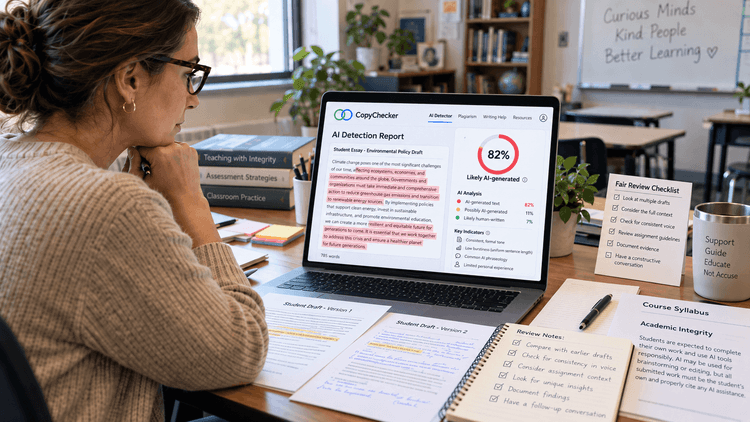
There's a specific kind of paralysis that happens around 11 pm, three browser tabs deep into "how to write a personal statement," staring at a blinking cursor that has somehow made you forget every interesting thing that's ever happened to you.
If that's where you're starting from, you're not behind. You're just missing the one thing that actually unlocks this kind of writing: seeing how it's done, in full, by someone who isn't you, so you can borrow the shape of it without borrowing the words.
That's what this guide is. Below you'll find 15+ personal quality essay examples, grouped by the kind of application they're written for, each one a complete excerpt followed by a plain breakdown of why it works and where it could still be pushed further.
No vague advice to "be authentic." Just real essays, real structure, real reasoning.
So let’s get started -
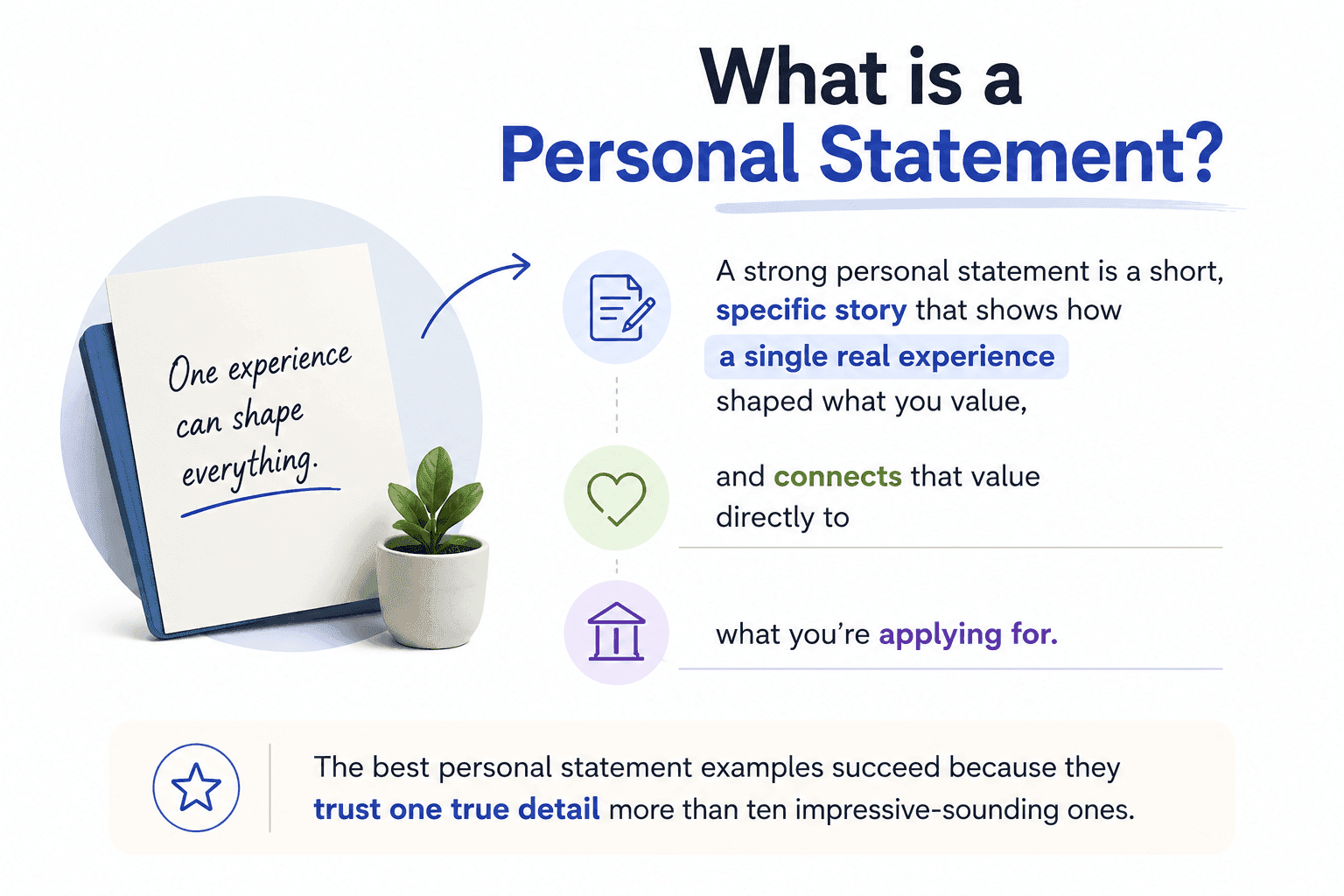
What Makes a Great Quality Essay?
Before you read all the examples, it helps to know what you're actually looking for in them. After reading thousands of these things, the genuinely strong ones, whether they're personal narrative examples for college or a statement of purpose for a PhD program, tend to share the same four qualities.
None of them depend on flawless sentence structure either; that's a separate skill, and if grammar specifically is what's tripping you up, follow a standard essay grammar guide to know all about your mistakes and solve them in detail. What matters here is content, not commas.
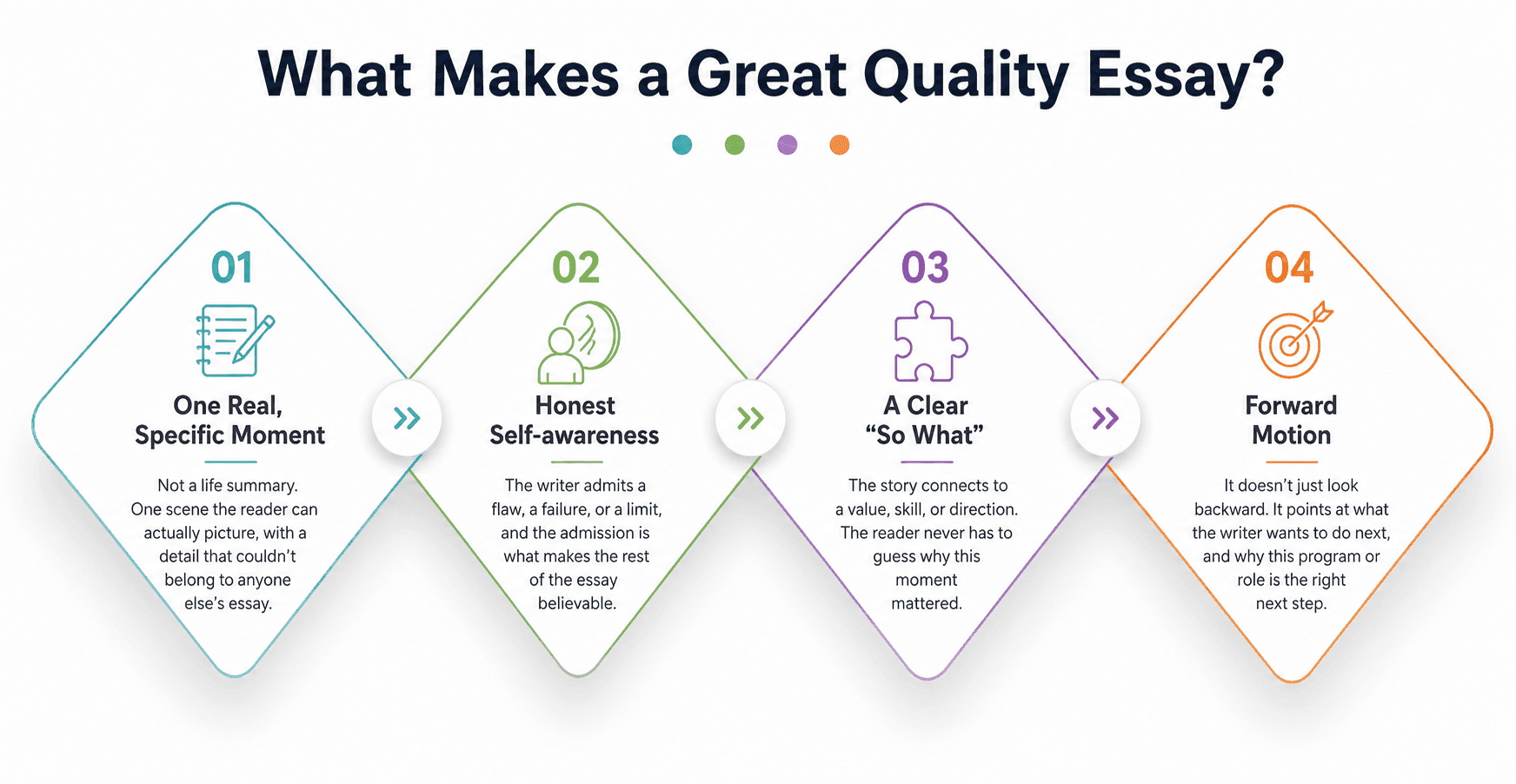
Keep those four in mind as you read. Every breakdown below is built around them.
How to Write a Good Essay for Personal Statements
You don't need a complicated formula. Most personal statements that work, across every category in this guide, follow some version of the same four-part shape.
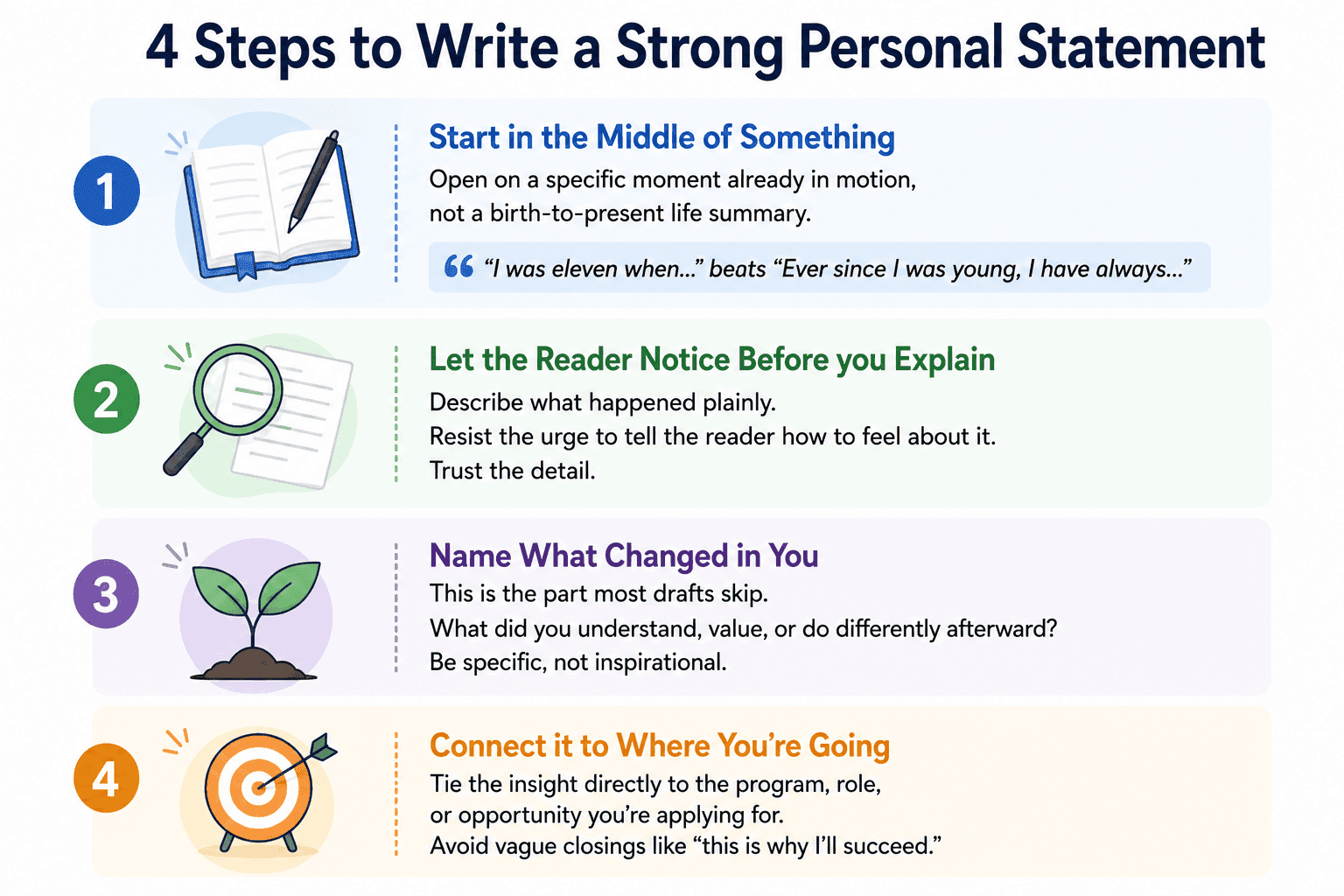
Margin Note: Most weak drafts aren't bad writing; they're missing step 3. They jump straight from "this happened" to "so I should get in," without ever explaining what actually changed.
Just simply remember these before starting your essay -
Now let's get into the examples. We've grouped some of the high quality essay examples into the five categories people search for most: college admissions, graduate school statements of purpose, MBA and business school, scholarships, and job or career statements.
Each one is an original excerpt, not pulled from a real applicant, written to show a structure and a voice worth learning from.
CATEGORY 01 - COLLEGE ADMISSIONS
These are the personal statement examples people search for most, and the ones with the most competition in the "inspiring hardship" genre. The strongest ones below succeed because they resist that genre's worst habit: asking for sympathy instead of earning interest.
 WHY THIS WORKS?
‘The Restaurant Ledger’ can work the best as -
- The "translation" metaphor does double duty: language and emotional labor
- Ties personal history to an academic interest without a forced segue |
- Sensory detail (the notebook, the smell) earns trust before any lesson is stated
- Avoids asking for sympathy so the tone stays observational, not pleading |
Could be stronger: naming one concrete thing the writer wants to build or study, instead of ending on a feeling.
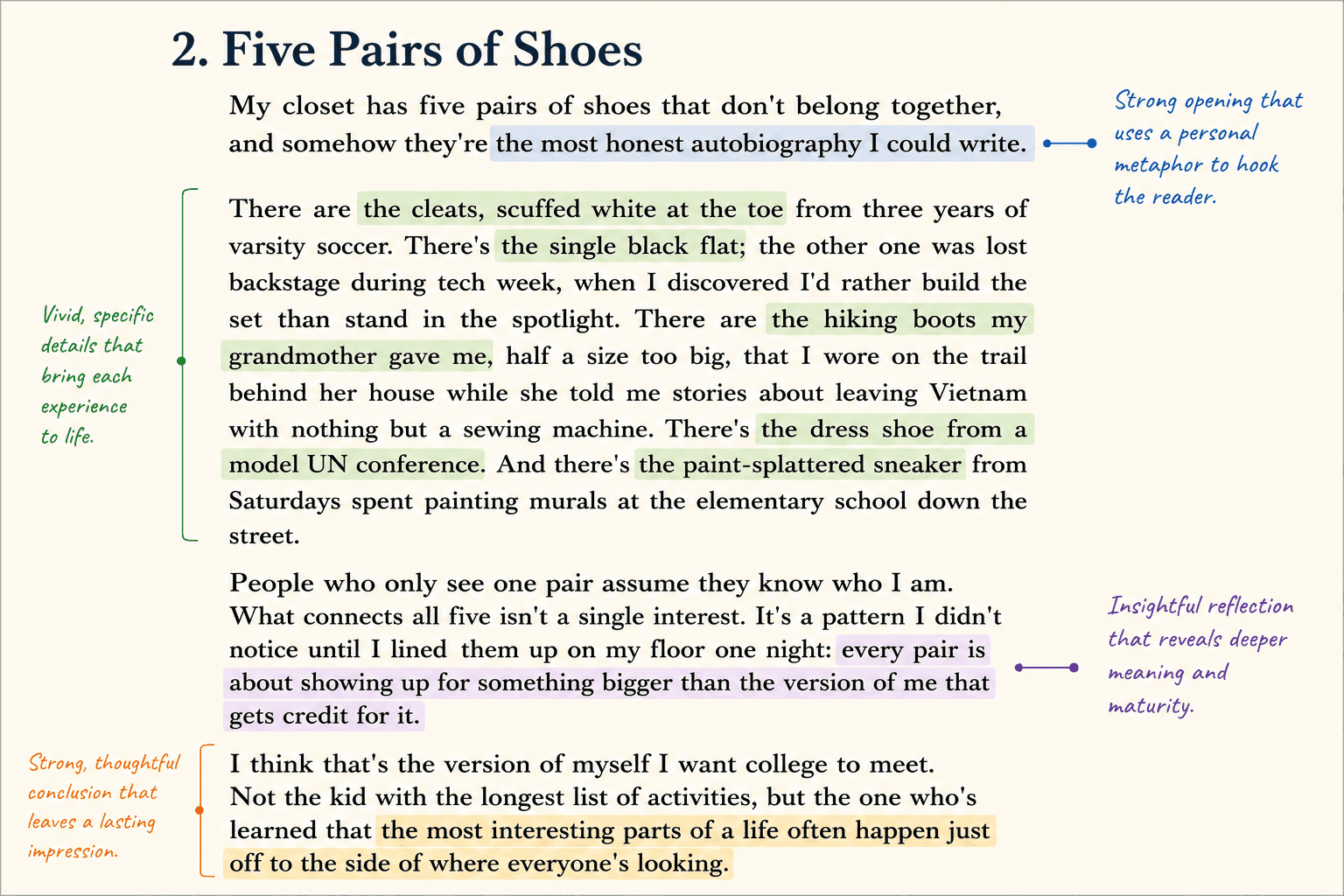
WHY THIS WORKS?
The essay can be your pick as it has -
- A real montage essay: the object unifies the story instead of decorating it
- Trusts small details instead of over-explaining each activity
- The insight feels earned because it arrives from an ordinary moment, not a dramatic one
- Shows range without reading like a resume |
Could be stronger: giving the grandmother a slightly more room as it's the richest thread and currently the most compressed.
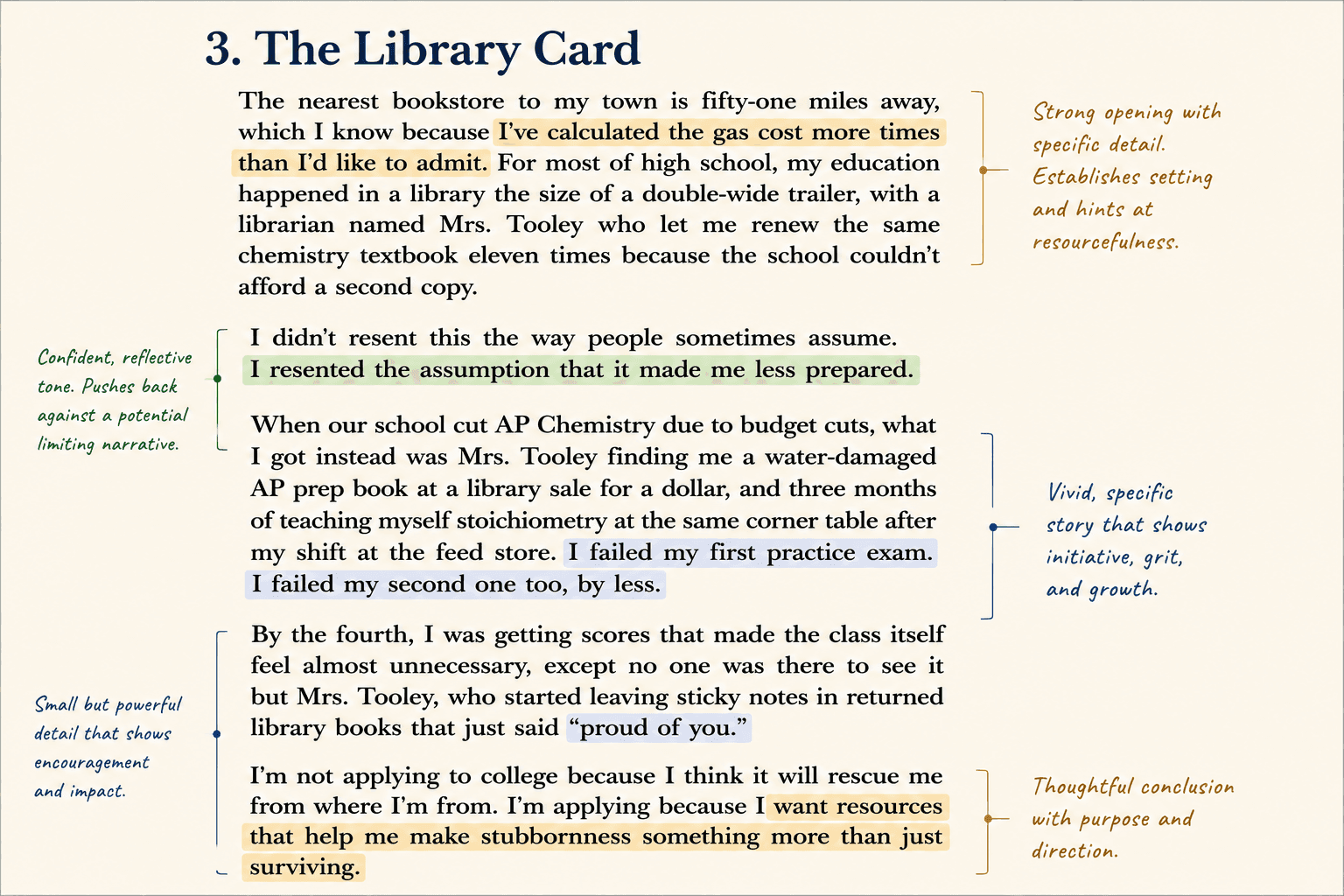
WHY THIS WORKS?
The essay on ‘The Library Card’ can be your inspiration as it provides -
- Pivots from hardship to agency fast ("I resented the assumption")
- The Mrs. Tooley detail adds warmth without derailing the focus
- Reframes a failure (failing twice) as the actual point of the story
- Honest about hardship without making it the entire pitch
Could be stronger: connecting the self-taught chemistry more explicitly to an intended major.
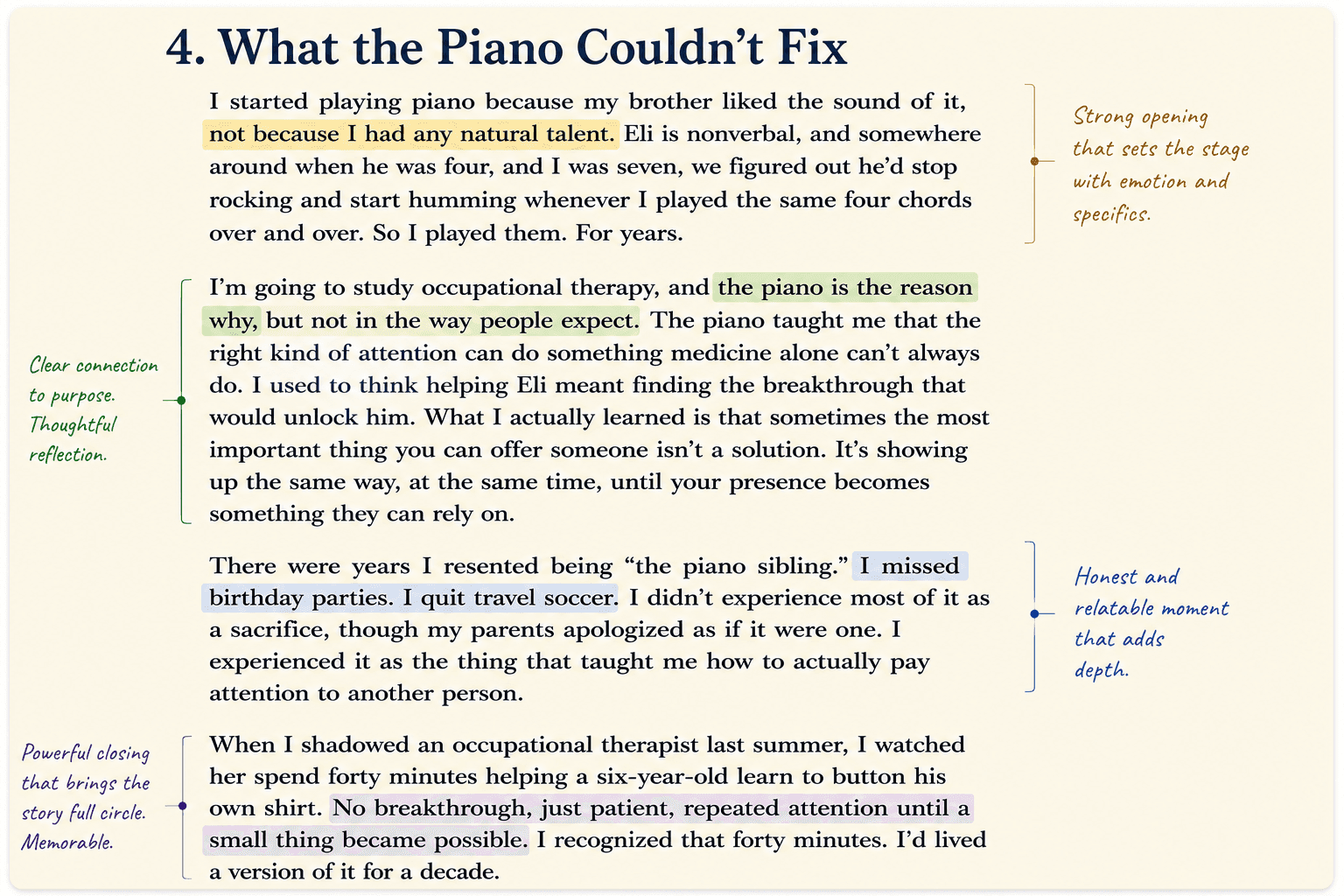
WHY THIS WORKS?
This 'What the Piano Couldn't Fix' essay can be your perfect example as it has -
- The concrete anchor (four chords) keeps an emotionally heavy topic grounded
- Honesty about resentment and cost makes the reflection trustworthy
- The OT shadowing scene mirrors the piano scene, so the career link feels discovered
- Centers the narrator's growth, not the sibling's disability, as the subject
Could be stronger: trimming the family/sacrifice paragraph slightly to give the professional connection more room at the close.
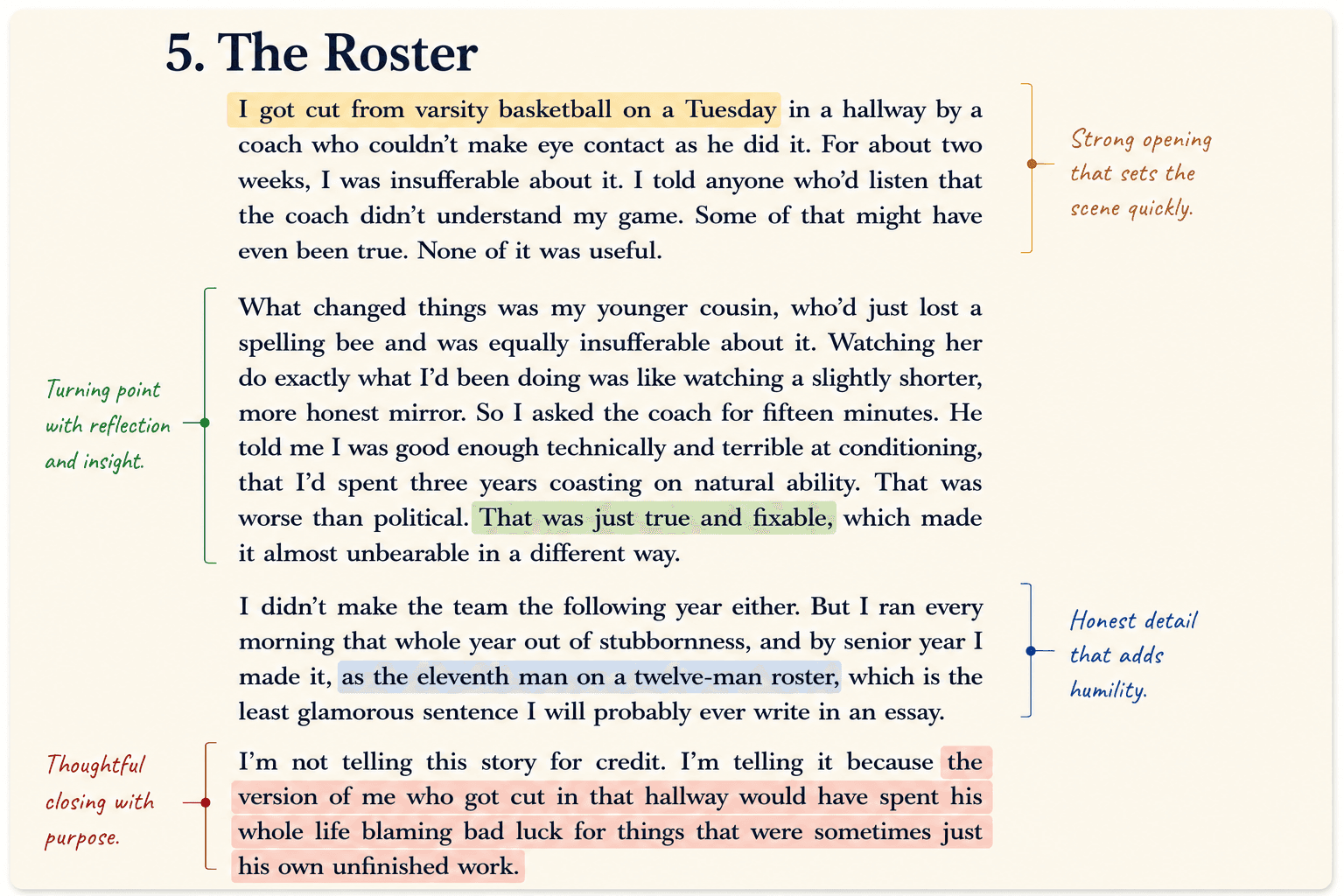
WHY THIS WORKS?
Because the essay on ‘The Roaster’ simply shows -
- Self-deprecating honesty disarms the reader immediately
- The cousin mirror moment lets self-awareness arrive naturally, not through forced introspection
- Resists a fairy-tale ending — "eleventh man" is more believable than a triumphant comeback
- Closes on a reframed value, not a victory lap
Could be stronger: one more sentence on what "unfinished work" the writer plans to keep doing differently going forward.
CATEGORY 02 - STATEMENT OF PURPOSE
Graduate programs are reading for something slightly different than undergrad admissions. They want to see that you can identify a real, specific gap in a field and that you already have early evidence you can work on closing it. These statements of purpose examples show what that looks like in practice.
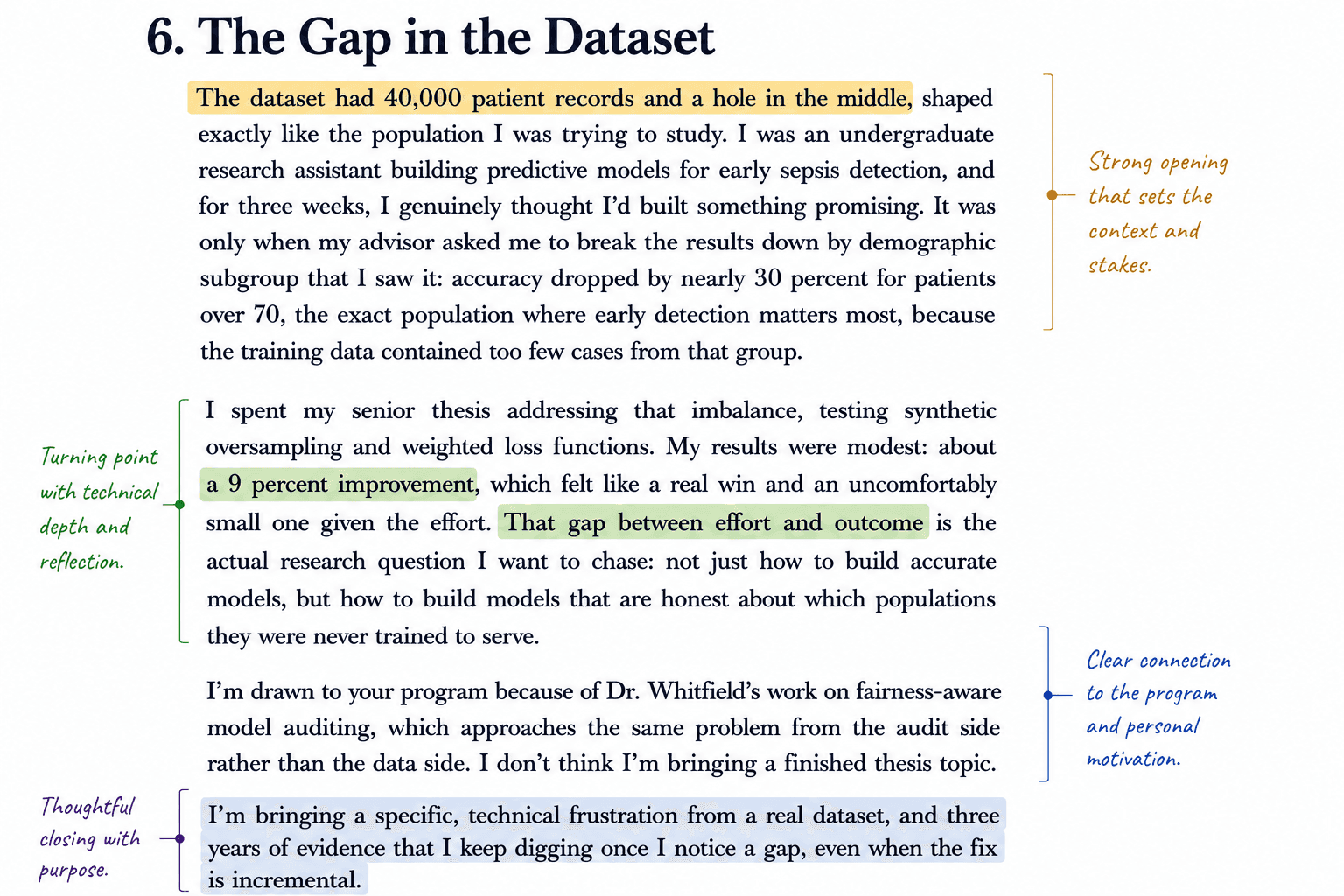
WHY THIS WORKS?
You can rely on ‘The Gap in the Dataset’ essay as it -
- Opens with a concrete technical detail, not "I've always loved data"
- Admitting the fix only achieved modest results reads as more credible than an inflated win
- Name a specific faculty member with a real intellectual connection, not name-dropping
- Makes a case for fit without falsely claiming a fixed dissertation topic
Could be stronger: mentioning one specific tool or technique already mastered, to reassure technical readiness.
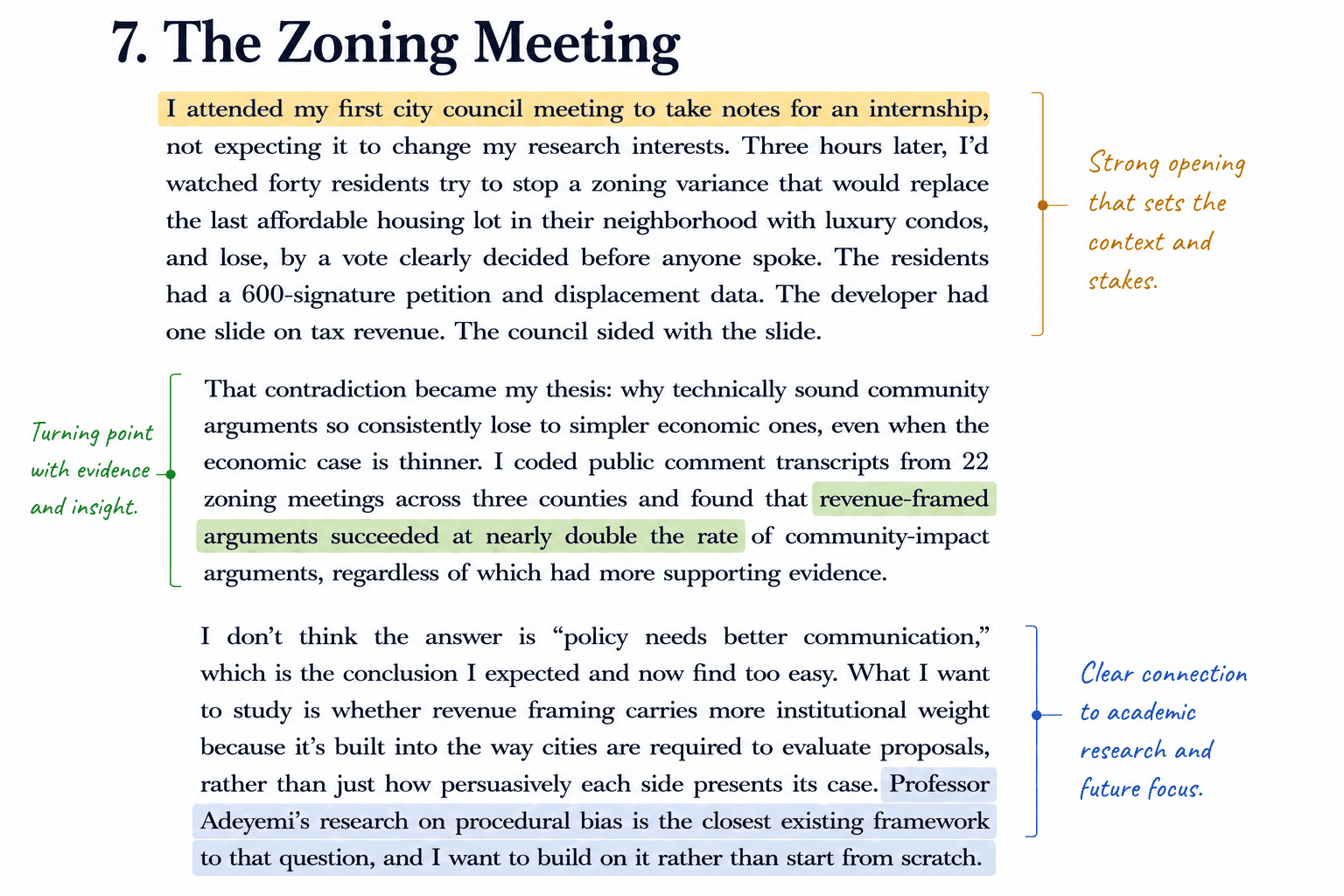
WHY THIS WORKS?
It is because the essay on ‘The Zoning Meeting’ can be your ideal pick as this one -
- Grounds an abstract policy question in one vivid scene before zooming out to data
- Shows existing research competence (22 transcripts, a real finding) rather than just interest
- Rejects an easier first conclusion with a strong signal of critical thinking
- Faculty connection is tied to an actual research gap, not flattery
Could be stronger: naming a specific method's skill, like qualitative coding software, to round out research readiness.
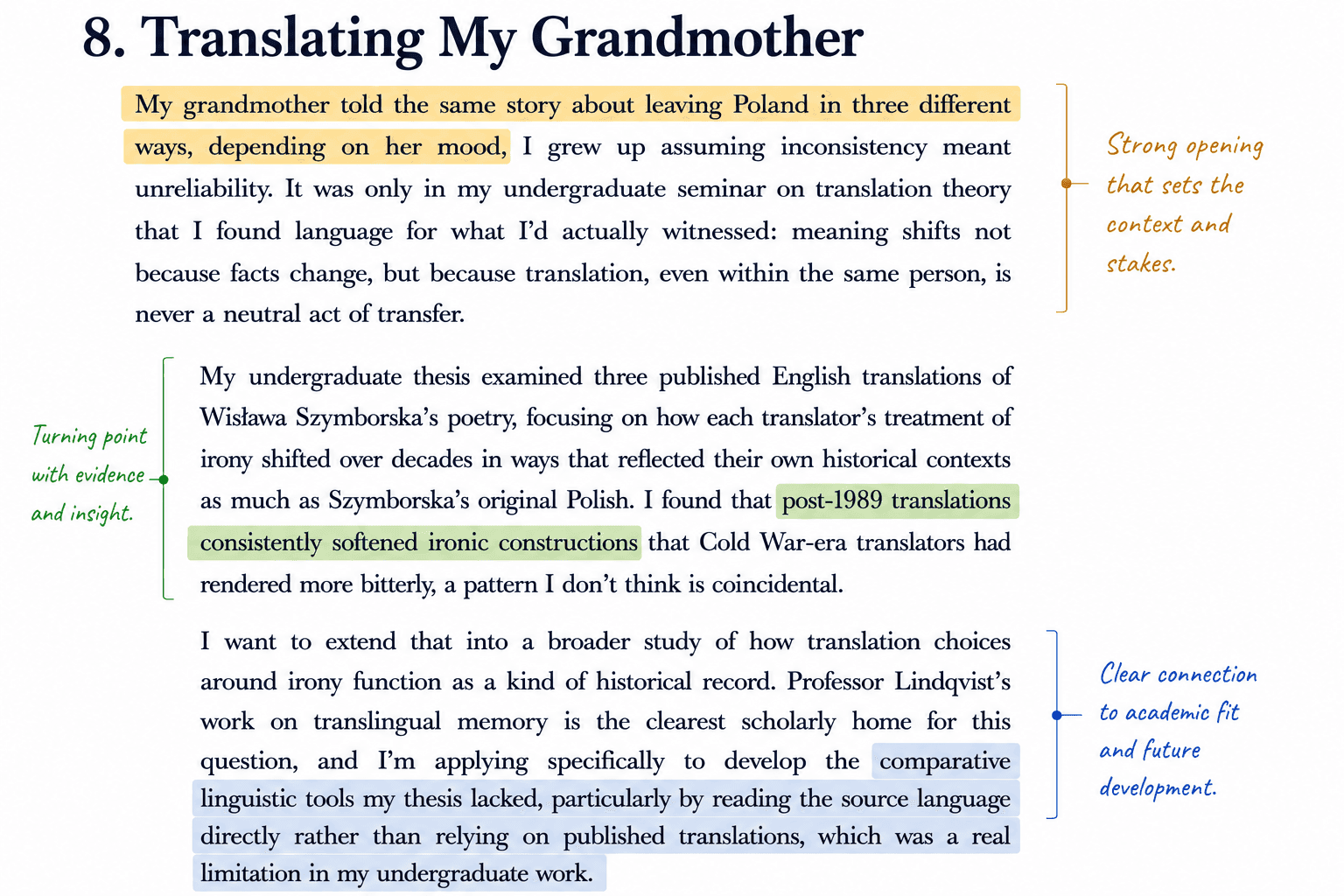
WHY THIS WORKS?
The essay on ‘Translating My Grandmother’ can be your top priority example as it shows -
- The grandmother anecdote is a genuine intellectual seed, not a sentimental color
- Shows real completed research with a specific, falsifiable finding
- Self-aware about a real limitation, which signals maturity over overselling
- A distinctive voice, especially in how personal and academic threads intertwine
Could be stronger: explicitly naming language proficiency, since it's directly relevant to research feasibility here.
CATEGORY 03 - BUSINESS & MBA
MBA essays carry their own unwritten rule: admissions committees aren't just reading for ambition, they're reading for self-awareness about your own ceiling. All the strongest essay titles will make you realize that the writer has identified a real gap in their ability, then explain precisely why this program closes it.
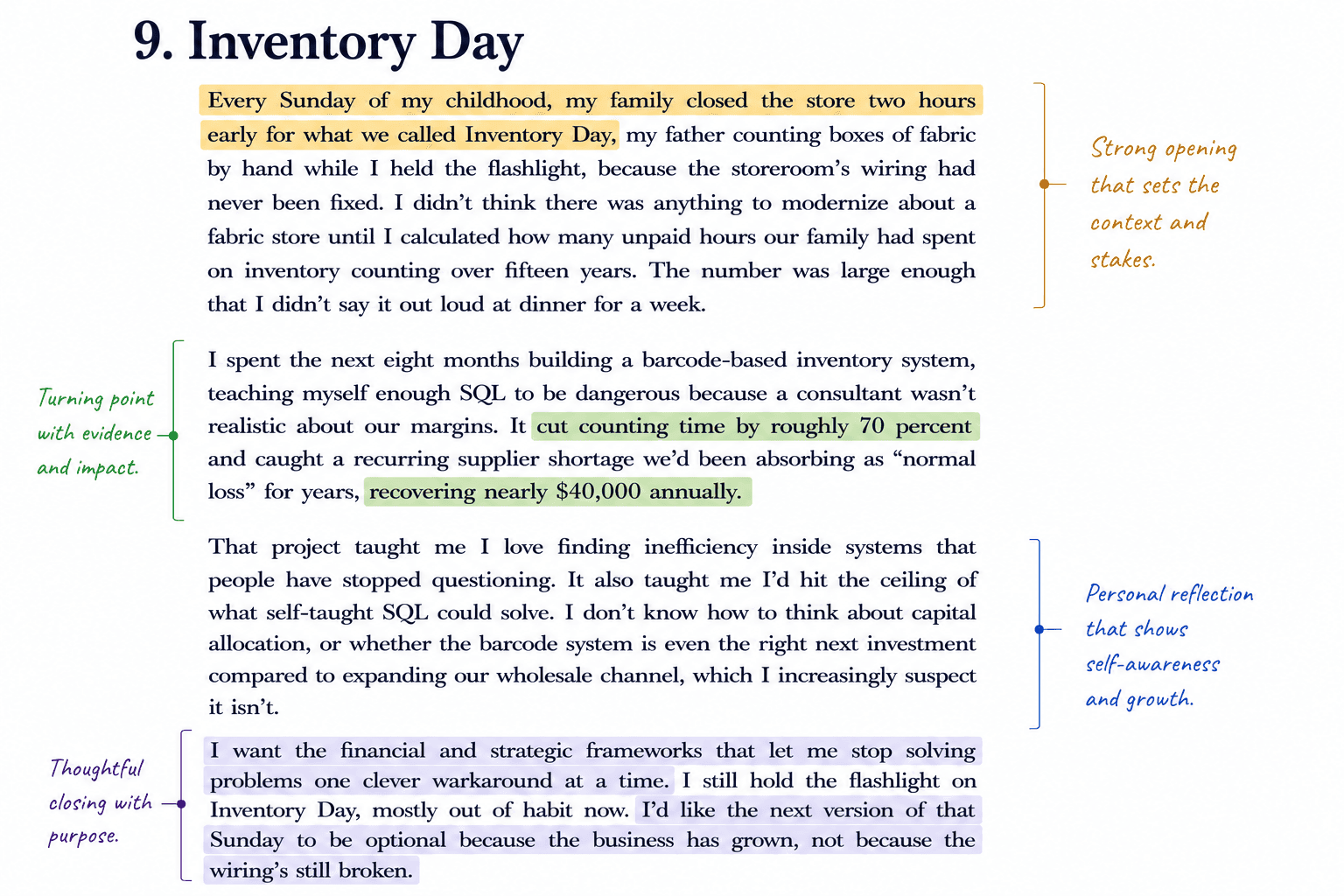
WHY THIS WORKS?
‘Inventory Day’ essay might be your suitable choice to get inspired, as it represents -
- Concrete financial detail ($40,000 recovered) makes the impact verifiable, not vague
- Honest about hitting a ceiling shows exactly why an MBA is needed, not just wanted
- Frames the gap as the actual argument for admission, rather than overselling expertise
- The flashlight callback closes the essay without sentimentality
Could be stronger: naming one specific course area, like operations strategy, to sharpen the "why this program" angle
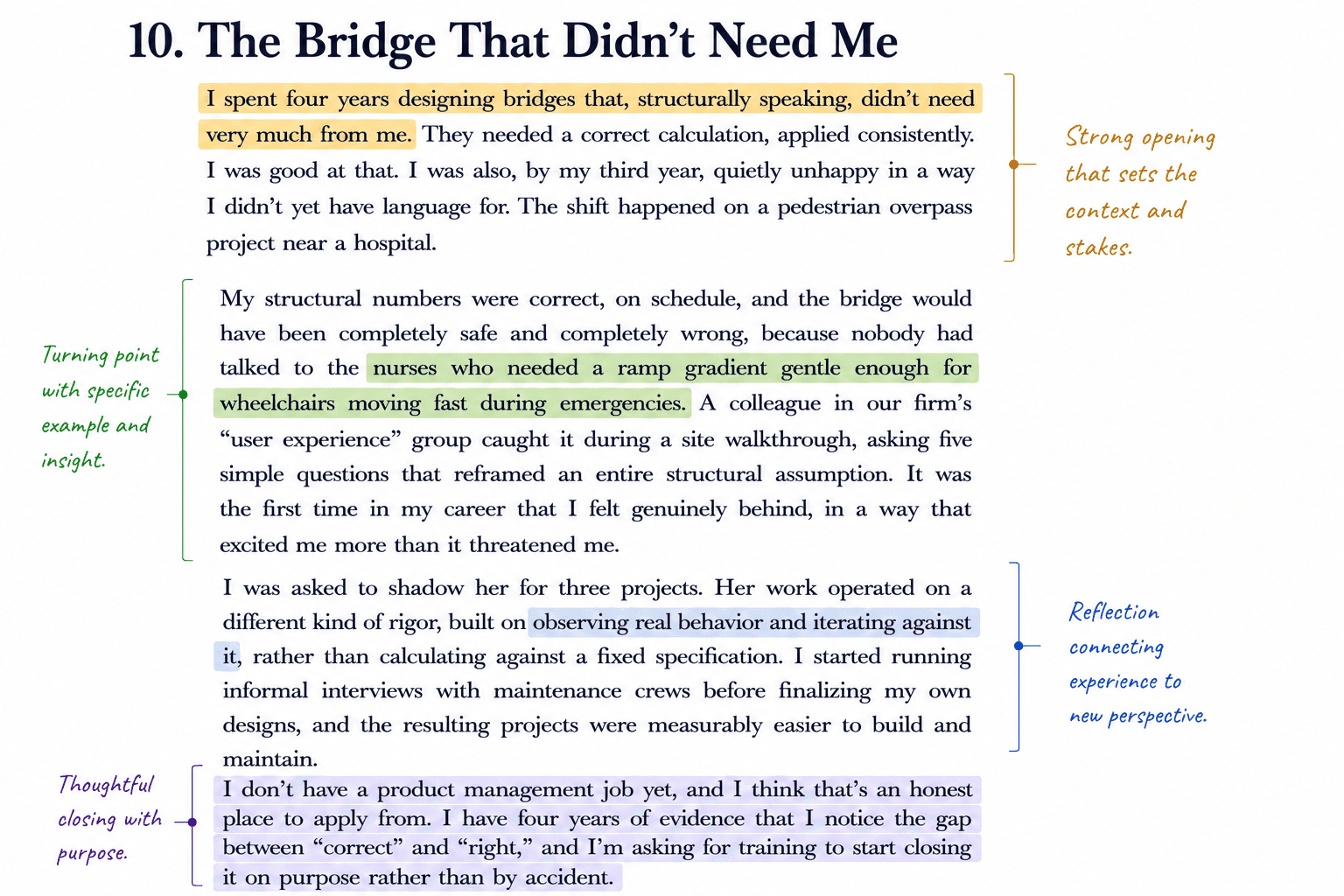
WHY THIS WORKS?
This essay, 'The Bridge That Didn't Need Me' can be your inspiration as a personal statement as it has -
- A specific professional moment motivates the pivot, not a vague "I want more impact"
- Honestly frames the lack of PM experience as a transparent starting point
- Shows behavior change already underway, before the MBA even starts
- Never disparage the previous career, keeping the tone mature and forward-looking
Could be stronger: naming a specific PM framework already being explored independently, mirroring the self-teaching detail in Example 9.
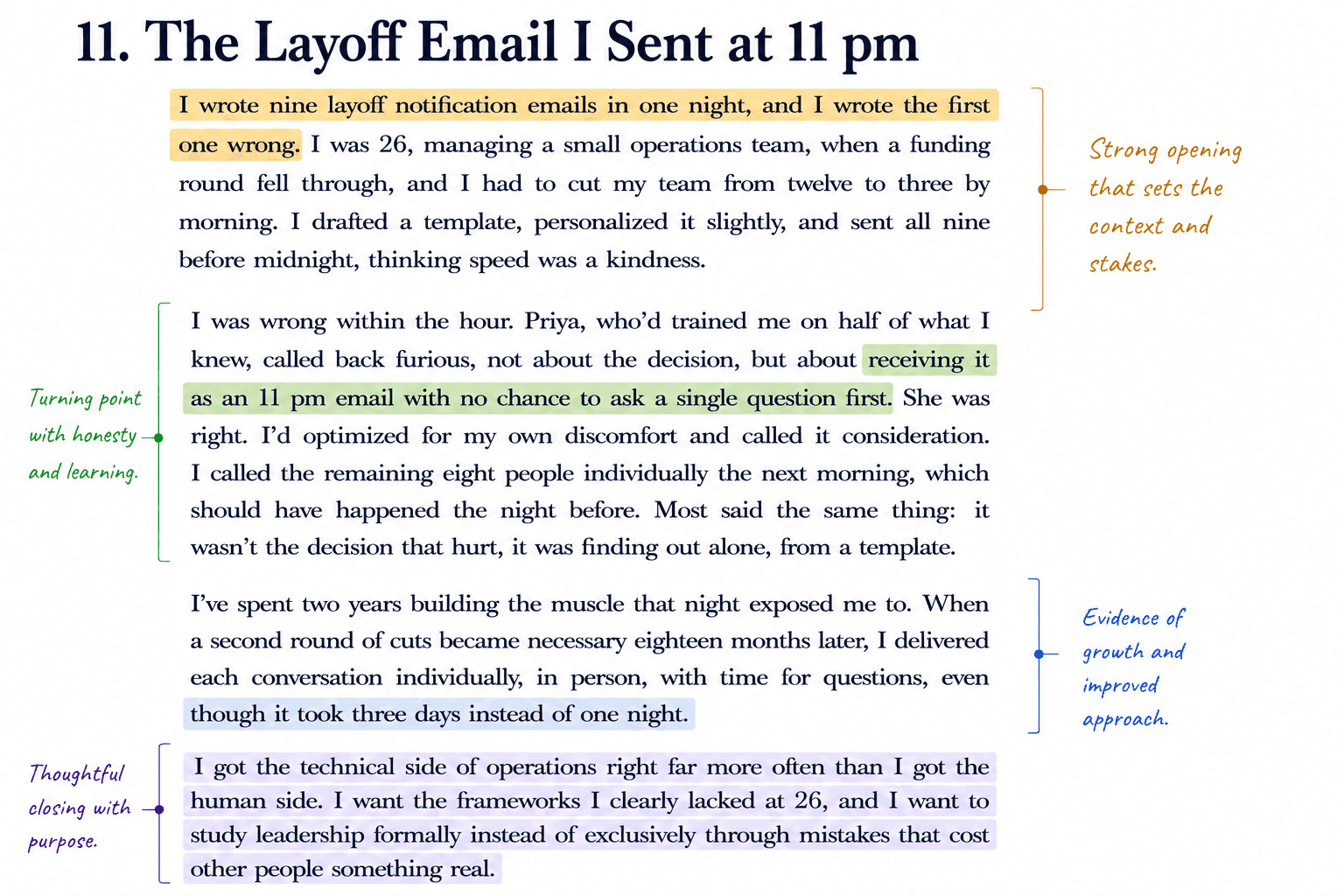
WHY THIS WORKS?
You can try out ‘The Layoff Email I Sent at 11 pm’ essay because it -
- Leads with genuine, owned professional failure that counts as rare and memorable in MBA essays
- Name a real person and her legitimate criticism, making accountability concrete
- Demonstrates behavior change with evidence, not just stated remorse
- The thesis is specific enough to feel like real self-knowledge, not essay-formula humility
Could be stronger: closing with the type of role where this people-first approach would be applied next.
CATEGORY 04 - SCHOLARSHIP
Scholarship essays carry a unique tension: committees want honesty about need, but the strongest personal narrative examples in this category never let hardship become the entire pitch. Agency, not pity, is what gets remembered.
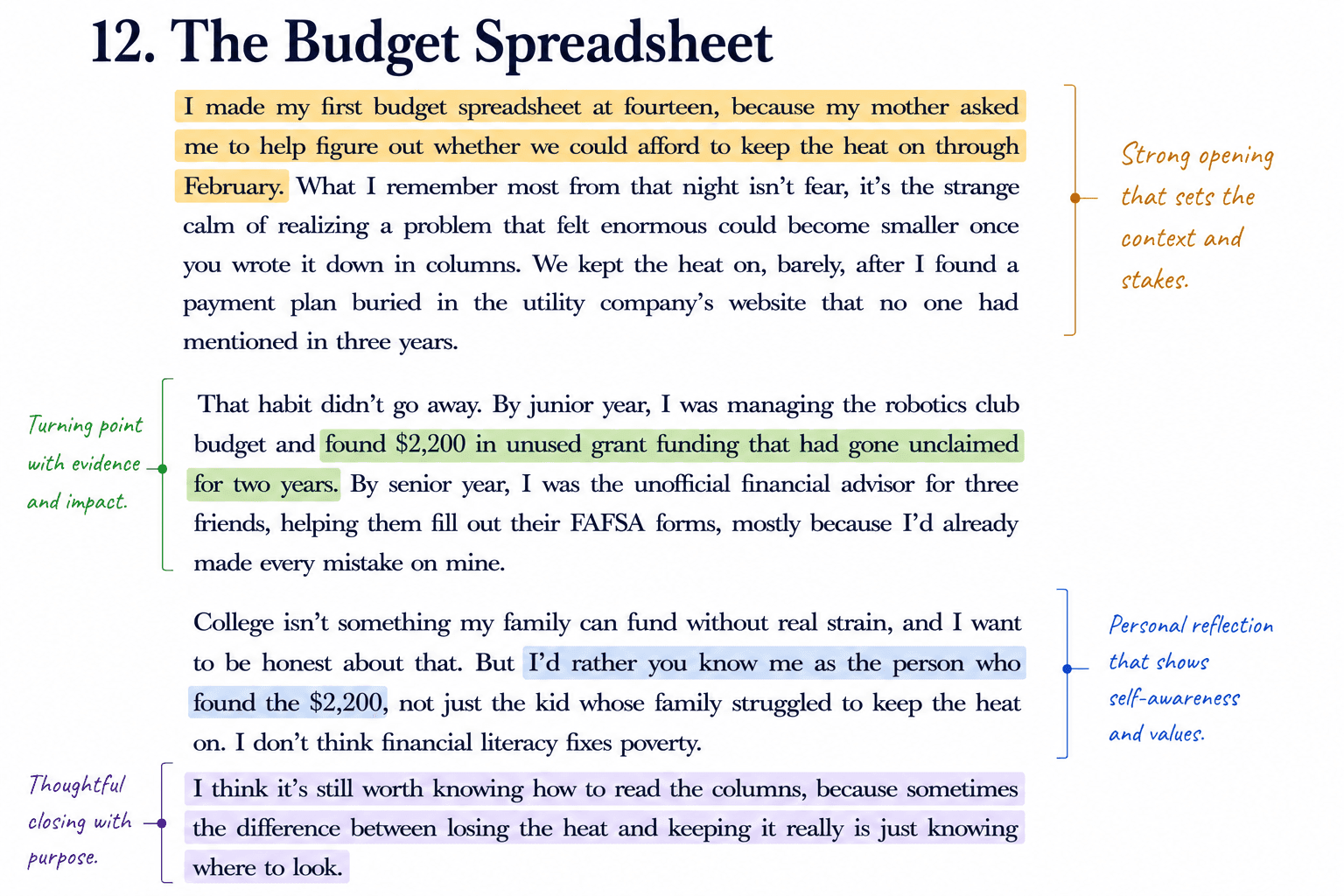
WHY THIS WORKS?
The essay on ‘The Budget Spreadsheet’ can be your perfect motivation as it -
- Complicates the "tragedy" framing early, establishing agency right away
- A recurring motif (the spreadsheet, the columns) links hardship to demonstrated skill
- The $2,200 detail is specific and verifiable, carrying more weight than "leadership"
- Closes by honestly limiting its own claim, which reads as intellectually mature
Could be stronger: naming the specific area of finance the writer wants to pursue.
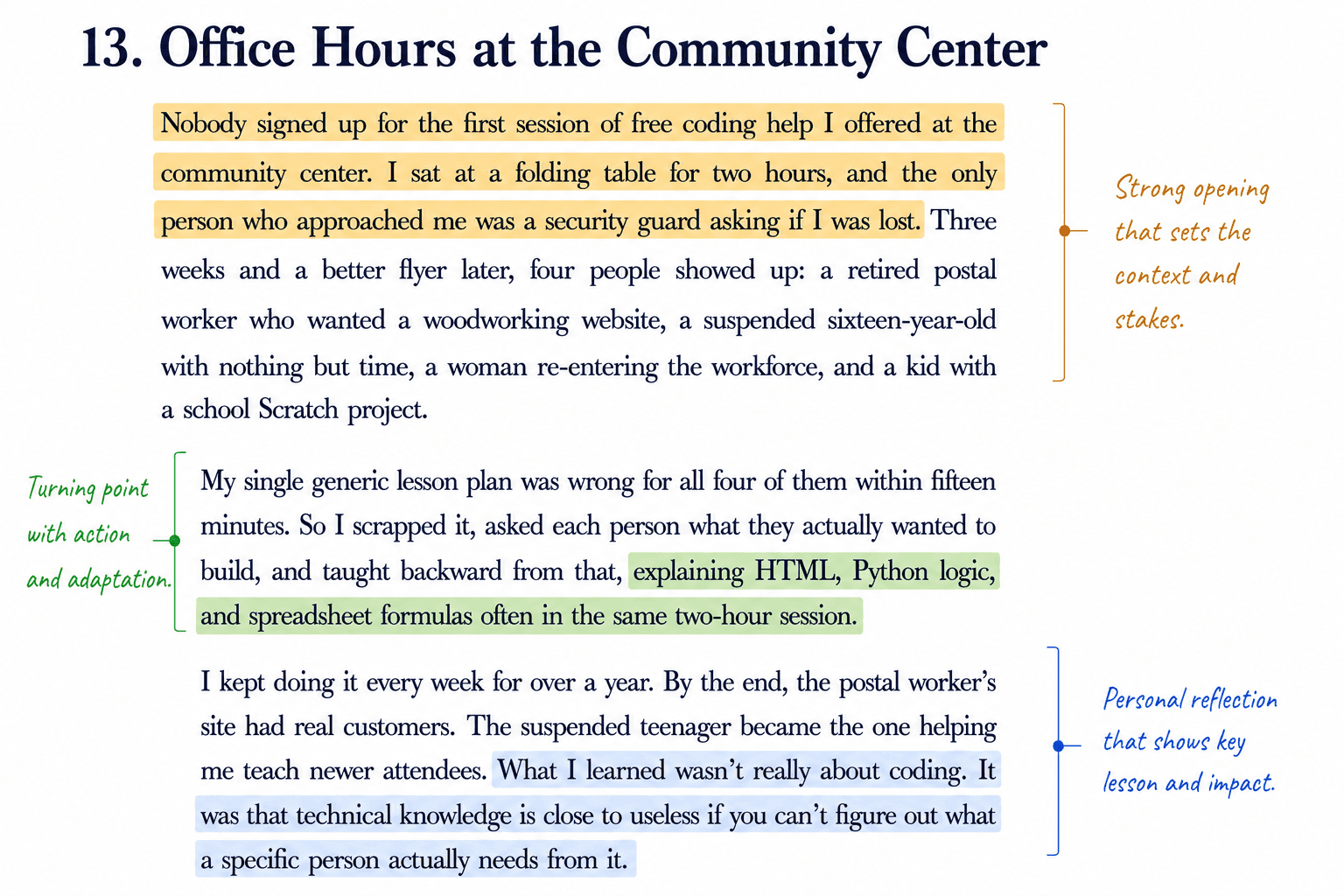
WHY THIS WORKS?
You can certainly follow this essay on ‘Office Hours at the Community Center’ as it -
- Opens with an unglamorous failure instead of an inflated success story
- The four attendees' different needs make the "teach backward" insight feel earned
- The teenager-becomes-teacher payoff emerges naturally, avoiding cliché
- Closes with a genuine point of view about technology, not a platitude
Could be stronger: naming a specific project the writer wants to pursue in college, building on this work.
CATEGORY 05 - JOB & CAREER
Career-change and promotion statements work differently: there's no admissions committee looking for potential, just a hiring manager or panel asking, "Why should this specific gap not matter?" These two examples show how to answer that directly.
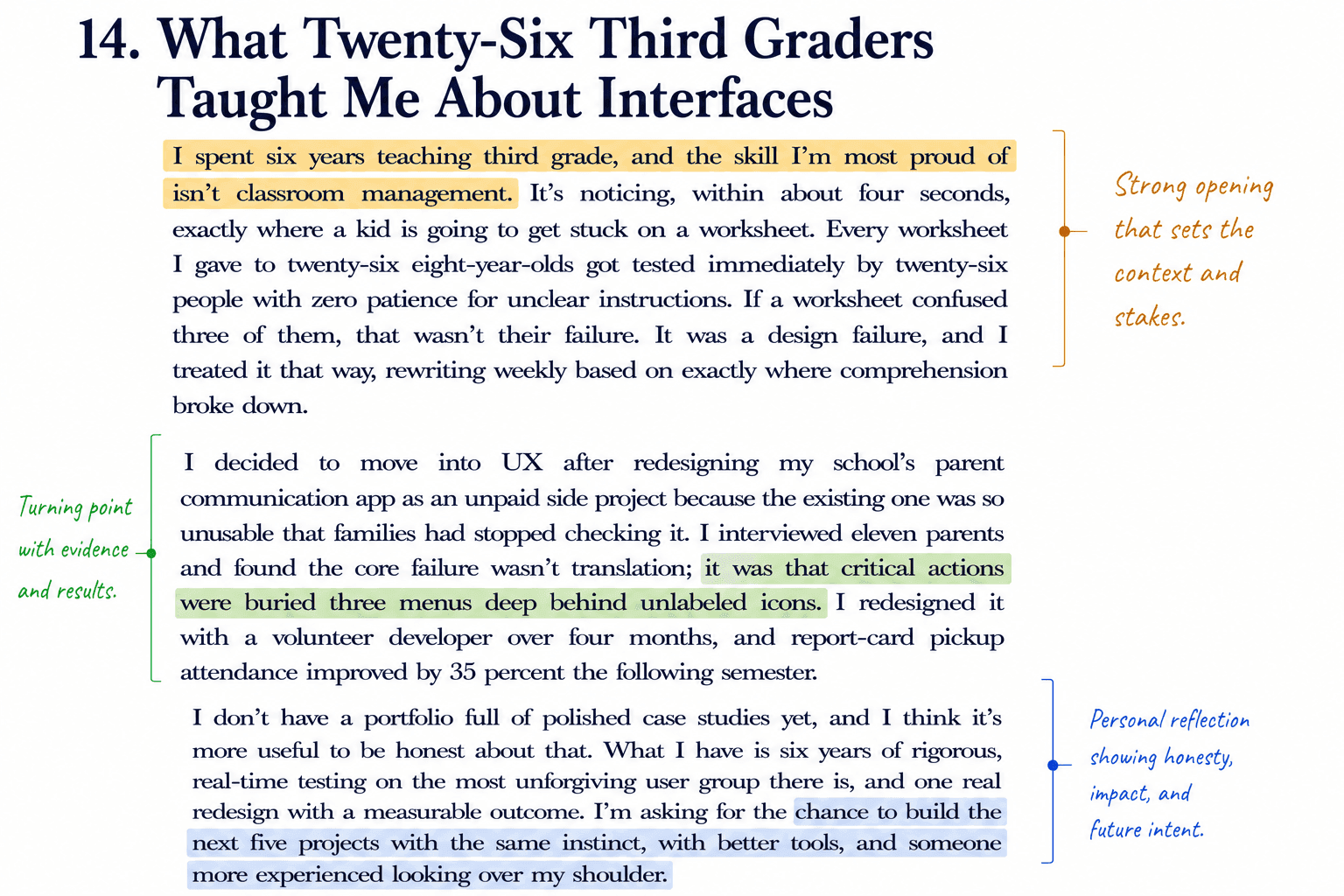
WHY THIS WORKS?
The whole essay can be your best companion to write your own, as it -
- Explains the teaching-to-UX connection directly instead of asserting it as obvious
- The parent-app project provides a measurable outcome that functions like a portfolio piece
- Acknowledging the portfolio gap reads as self-aware, not insecure
- Specific research detail (interviewing parents) shows real UX methodology, not just enthusiasm
Could be stronger: naming the type of company or product where this background is most directly relevant.
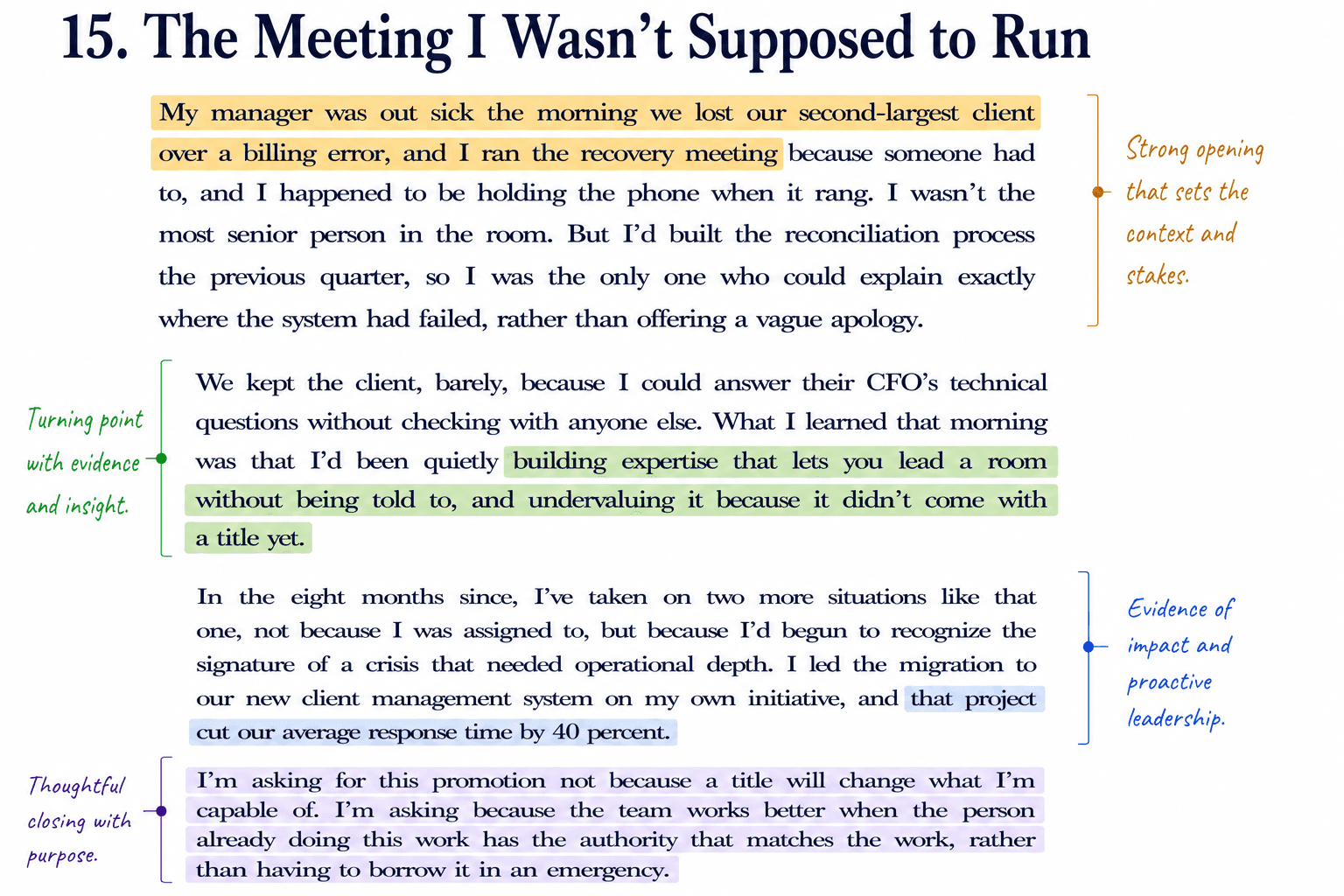
WHY THIS WORKS?
The 'The Meeting I Wasn't Supposed to Run' can be your ultimate catalyst as this one -
- Opens with a high-stakes scene that demonstrates leadership instead of claiming it
- Acknowledging the seniority gap builds credibility rather than undermining the case
- A second measurable achievement (40 percent improvement) shows the first wasn't a fluke
- Cleverly reframes the ask: matching authority to capability, not requesting more capability
Could be stronger: naming a specific area of responsibility the writer hopes to take on with the new title.
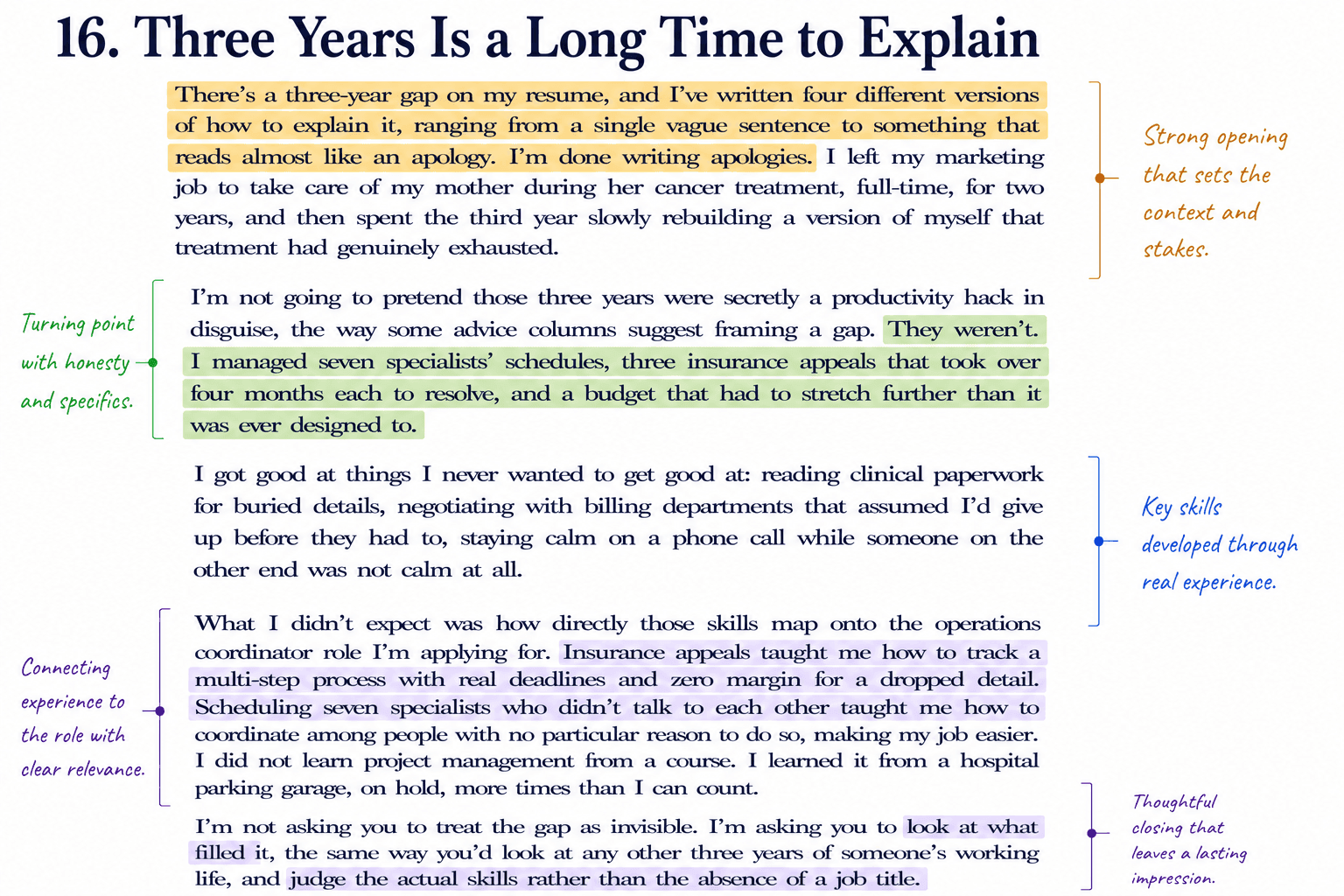
WHY THIS WORKS?
This ‘Three Years Is a Long Time to Explain’ can be your go to solution as it -
- Names the gap directly in the first line instead of trying to bury or minimize it
- Refuses the cliché of reframing hardship as secretly a "growth journey," which builds trust
- Draws concrete, specific parallels between caregiving tasks and the target role's actual requirements
- Closes by asking for a fair evaluation rather than sympathy, which keeps the tone confident
Could be stronger: one line on what kind of long-term role or industry the writer hopes this experience leads toward next.
How to Check Your Essay Before You Submit It
Reading great examples gets you most of the way there. The last step, the one that's easy to skip when you're exhausted from rewriting the same 600 words for the tenth time, is checking the draft itself with fresh eyes.
That's where a tool like CopyChecker earns its place in the process, not as a replacement for your voice, but as the last set of eyes before you hit submit.
| Grammar Checker | AI Detector | Plagiarism Checker |
|---|---|---|
| Catches the small slips that are nearly invisible after your fifteenth read-through, without flattening your actual sentence style. | If you used AI for brainstorming or a first pass, this checks how your final draft reads, so it sounds like you, not a template. | Useful if you borrowed structure or phrasing from examples like the ones above. It flags accidental overlap before an admissions reader does. |
None of this replaces the work of actually living through the moment you're writing about. But a personal statement is the one piece of writing where small wording problems get noticed disproportionately, simply because the reader is looking for reasons to remember you, good or bad.
A clean final check just makes sure they remember you for the right ones.
FAQs on Quality Essay Examples
A few questions come up almost every time someone starts working from examples like the ones above. Here's what's worth knowing before you start your own draft.
What's the difference between a personal statement and a personal narrative?
They overlap heavily. A personal statement is usually the formal application document itself (for college, grad school, or a job). A personal narrative is the storytelling technique most strong personal statements use to convey their point, built around a single real scene rather than a list of accomplishments.
How long should a personal statement be?
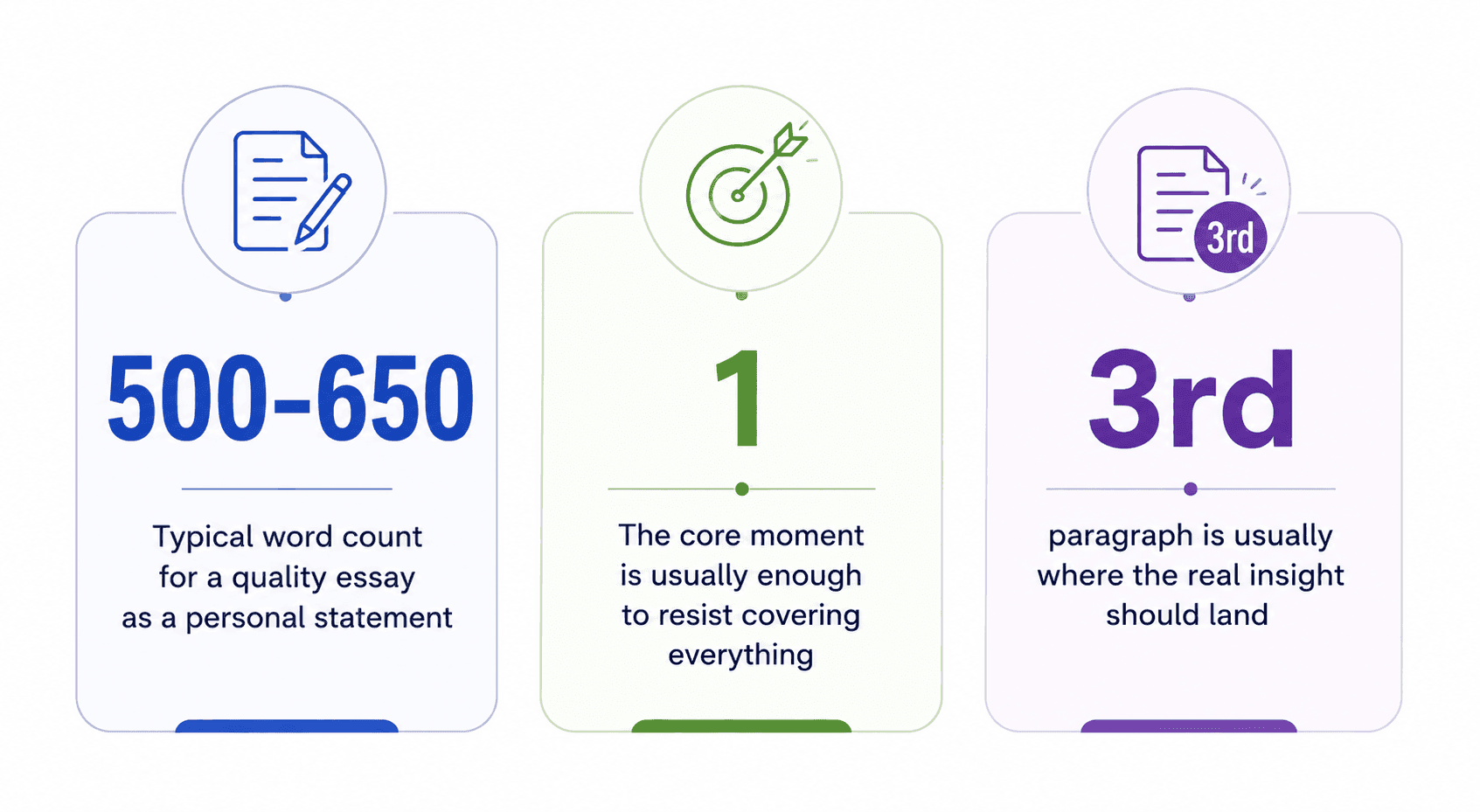
Most college personal statements run 500–650 words. Graduate statements of purpose are often longer, sometimes 800–1,000 words, since they need to cover research interests and fit with more specificity. Always follow the program's stated limit over any general rule.
Should I write about a tragedy or hardship to stand out?
Only if it's genuinely the truest story you have to tell, and even then, the hardship itself isn't what makes the essay work. What works is what you did with it: the choice, the skill, the value that came out of it. Several of the examples above use real hardship, but none of them lead with it as the main selling point.
Is it okay to use AI tools while writing a personal statement?
Using AI to brainstorm structure or get unstuck is generally fine, but the final draft should sound like you, with details only you could know. Most admissions readers and hiring panels can tell the difference between a templated draft and a specific, lived-in one, which is exactly the gap every example above is built to close.
How many drafts does a strong personal statement usually take?
More than most people expect. Several of the writing guides referenced for this piece note that strong essays often go through ten or more drafts. The goal of an early draft is just to get the true story down. The goal of later drafts is to cut everything that isn't that story.
Final Tips on Quality Essay Writing in 2026
With AI-written drafts flooding admissions offices and hiring panels alike, the bar for what reads as genuine has actually gone up, not down.
The tips below are less about polishing or paraphrasing sentences and more about protecting the one thing no template can fake: a voice that sounds like an actual person sat down and wrote it.
- Read your draft out loud. If a sentence doesn't sound like something you'd actually say, cut it.
- Cut your opening paragraph entirely once, as an experiment. Often, the essay actually starts in paragraph two.
- Ask someone who knows you well whether the essay sounds like you. Not whether it's "good," whether it sounds like you.
- Avoid thesaurus words you wouldn't use in conversation. Plain language reads as more confident, not less impressive.
- Make sure the last paragraph is doing real work, not just restating the introduction in different words.
- Run a final grammar and originality check before submitting, simply because fatigue makes the smallest errors invisible to the person who wrote them.
The examples above don't have a single shared topic, tone, or background. What they share is a writer who trusted one real, specific moment enough to slow down and actually look at it, instead of reaching for the version of their life that sounded most impressive on paper.
That's the actual skill underneath every high quality essay example in this guide, and it's the one thing every reader, whether they're an admissions officer, a professor, or a hiring manager, is quietly hoping to find.
End Note for Quality Essay Examples
Great personal statement examples aren't templates to copy; they're proof that a true, specific story will always beat a polished, generic one.
Whether you're drawing on personal narrative examples for a college application, modeling a statement of purpose for grad school, or simply looking for personal quality essay examples to study the shape of, the lesson is the same: write the one moment only you lived through, then say plainly what it taught you.
Once your draft is ready, give it one last honest read with CopyChecker, which helps you with a full writing suite to make sure your essay sounds like you, reads clean, and is fully original before it lands in front of the people deciding your next chapter.