Finally, you've just finished writing your research paper.
Even after checking grammar and running it through a plagiarism checker, you found that everything looks good.
You're really proud of yourself!
But then comes the part that makes most people scratch their heads, and that’s the citations page at the end.
Do you call it a Bibliography? Or a Reference page? Are they even the same thing?
Unfortunately, you're now staring at these two words, wondering which one to use, and everything feels annoying again.
If you ever fall into this kind of situation, then let me tell you you’re definitely not suffering alone. To be honest, this is one of the most common points of confusion for students, researchers, and writers at all levels.
They are certainly not the same thing, and using the wrong one can actually hurt your credibility as an individual, even after all those struggles.
As you’re already here, don’t worry anymore -
Because in this article, we'll break down the difference between bibliography vs references by looking at examples, explain when to use each one, and help you walk away with complete clarity on this topic.
So let’s get started with -
What Is a Bibliography?
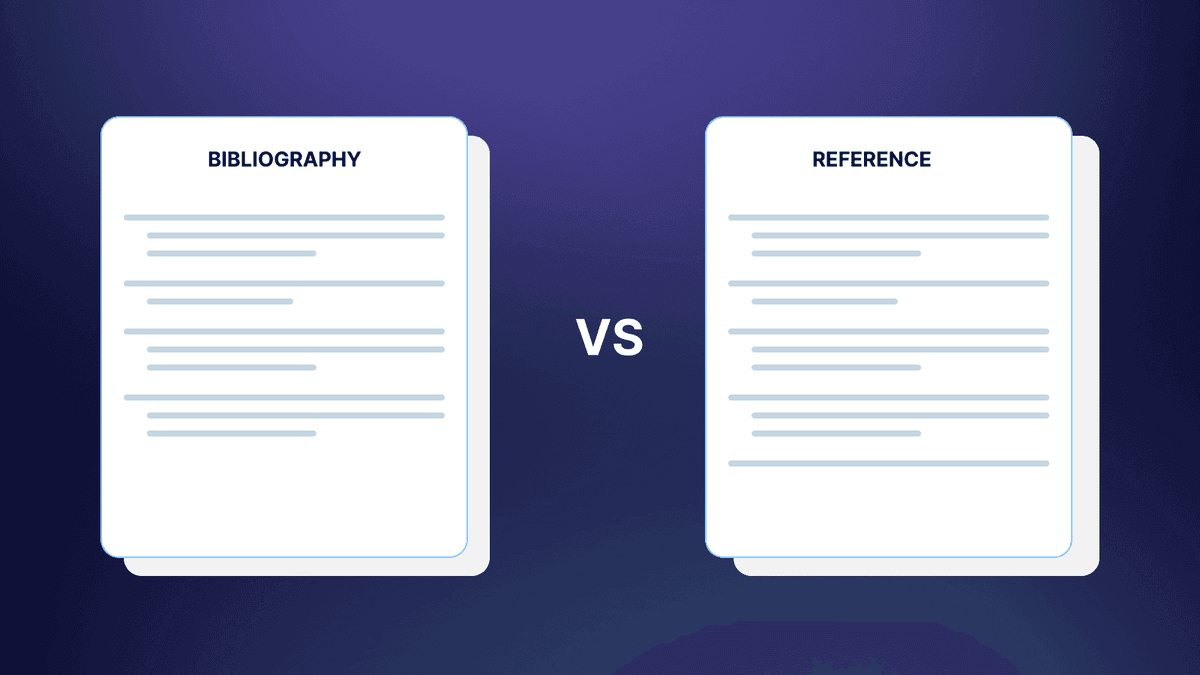
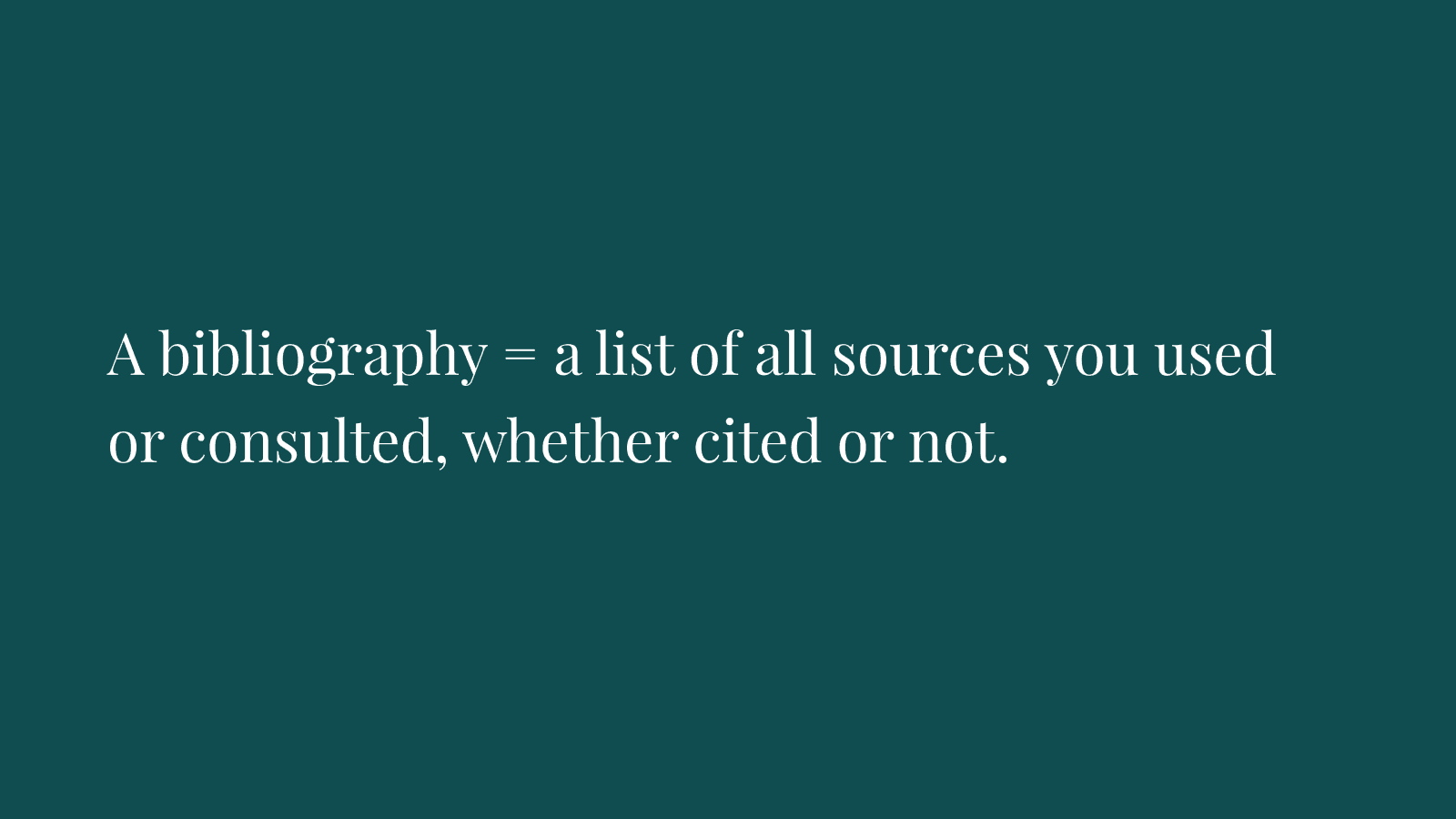
A bibliography is broader than a reference list. It includes not just the sources you cited in your paper, but also sources you read, consulted, or used for background research, even if you never directly quoted or referenced them in the text.
To be more specific,
What Is a Bibliography Page Used For?
A bibliography page shows the reader something beyond just what you quoted. Basically, it shows how deeply you researched a topic. You can consider it as the full paper trail of your intellectual work.
Here's where and why a bibliography page is used:
Chicago/Turabian Style
The primary home of the bibliography format is the Chicago style. It's used widely in history, theology, philosophy, fine arts, and parts of the social sciences.
In Chicago style, the bibliography page appears at the very end of the document and lists every source that shaped your thinking, whether you cited it directly or not.
Turabian style (commonly used in university-level papers) is essentially a student-friendly version of Chicago, and it follows the same bibliography conventions.
One important thing to know is that bibliography entries are formatted differently from endnotes or footnotes in the Chicago style.
The author's name is inverted (Last, First), and the punctuation between elements uses periods rather than commas. This trips up a lot of students who mix up footnote format with bibliography format.
Here's a side-by-side example using the same source, formatted both ways:
Chicago Footnote (or Endnote) format:
1. John A. Smith, The Science of Writing Clearly (Oxford: Oxford University Press, 2021), 45.
Chicago Bibliography format:
Smith, John A. The Science of Writing Clearly. Oxford: Oxford University Press, 2021.
Notice the differences:
- The footnote starts with the author's first name, John A. Smith
- The bibliography flips it — Smith, John A. (last name first, followed by a comma)
- The footnote uses commas to separate elements and includes the specific page number you referenced
- The bibliography uses periods between elements and has no page number because it refers to the whole work, not one specific page
Same source for citation. But two completely different formats depending on where it appears in your document.
This is exactly why copying a footnote and pasting it into your bibliography (or vice versa) is a mistake that's easy to make but just as easy to spot.
Books, Theses, and Long-Form Research
Longer academic works like dissertations, theses, and published books almost always include a bibliography rather than a simple reference list. Why? Because these documents represent months or years of research.
The bibliography gives readers (and examiners) a complete picture of every source the author engaged with. In a PhD dissertation, for example, the bibliography can run several pages long and is considered a mark of scholarly rigor.
When You Want to Show the Full Depth of Your Research
Even outside of a specific style requirement, some writers choose to include a bibliography simply to demonstrate that their work is well-grounded.
A thorough bibliography signals to the reader: "I didn't just Google this instead; I read widely, consulted multiple perspectives, and built my argument on a solid foundation."
What Is a Reference Page?
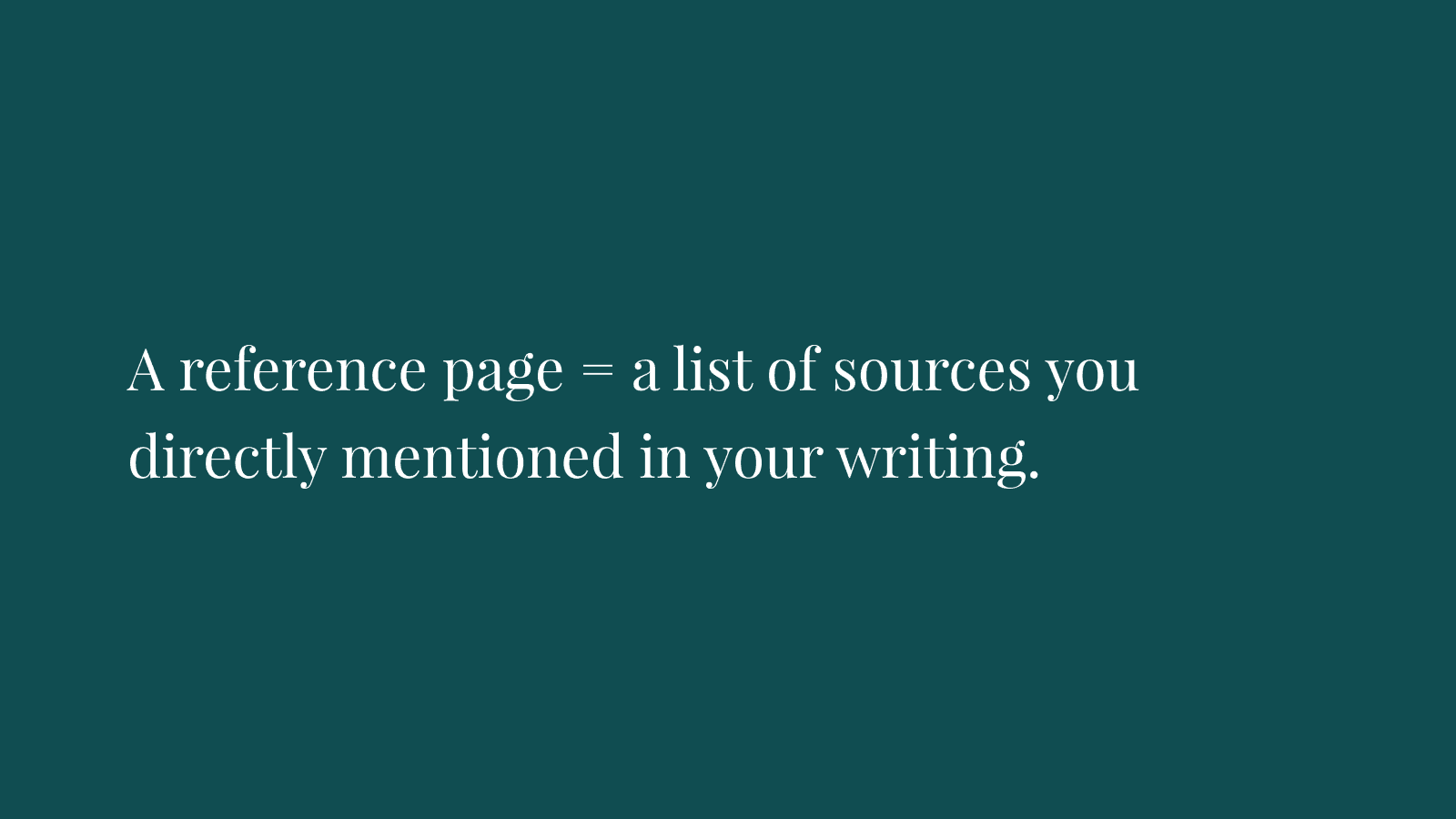
Let's start with the basics. A reference page (also called a reference list) is a list of all the sources you actually cited inside your paper or article.
Think of it this way: every time you mention someone else's idea, quote their words, or use their data inside your writing, you create an in-text citation. Basically, the reference page is where all those in-text citations are fully listed at the end of your document.
To be more specific,
What Is a Reference Page Used For?
A reference page serves one clear purpose, and that is accountability. It reminds your reader, "Every source I mentioned in this paper is right here! So, you can look it up, verify it, and read more if you want." The whole thing simply builds trust between the writer and the reader.
Any kind of reference page is most commonly used in these three major citation styles:
APA (American Psychological Association)
The American Psychological Association or APA is the most widely used academic citation style in the world. It's the go-to format in fields like psychology, education, nursing, social work, and the social sciences.
To cite in APA style formatting, the sources page is always titled "References".
The entries are listed in alphabetical order by the author's last name, and the publication year is placed near the beginning of each entry (right after the author's name) because in these fields, the recency of a source really matters.
MLA (Modern Language Association)
Mainly, areas like literature, language studies, film, and the arts and humanities prefer MLA style. In case of MLA format, the reference page is called a "Works Cited" page, not a "References" page or a "Bibliography."
This is an important distinction. Just like APA, a Works Cited page in MLA only lists sources you directly cited in your paper. Nothing more.
Chicago/Turabian Style
Among APA, MLA, and Chicago styles, the last one is considered a bit more flexible. It's used mainly in history, theology, and some social sciences.
When the Chicago style uses a reference list format (called "Notes and Bibliography" or "Author-Date" style), the sources page may be titled either "References" or "Bibliography," depending on the sub-format being used.
This is one reason people sometimes get confused between reference pages and bibliographies. So here, the Chicago style, other than APA and MLA, actually blurs the line a little.
The key rule for a reference list is that,
If you cited it in your paper, it goes on the list. If you didn't cite it, it does NOT go on the list.
The Core Difference of Bibliography vs References
At a glance, a reference page and a bibliography might look identical; both sit at the end of a document, both list sources, and both follow a structured format.
But underneath that surface similarity, they serve very different purposes and follow very different rules.
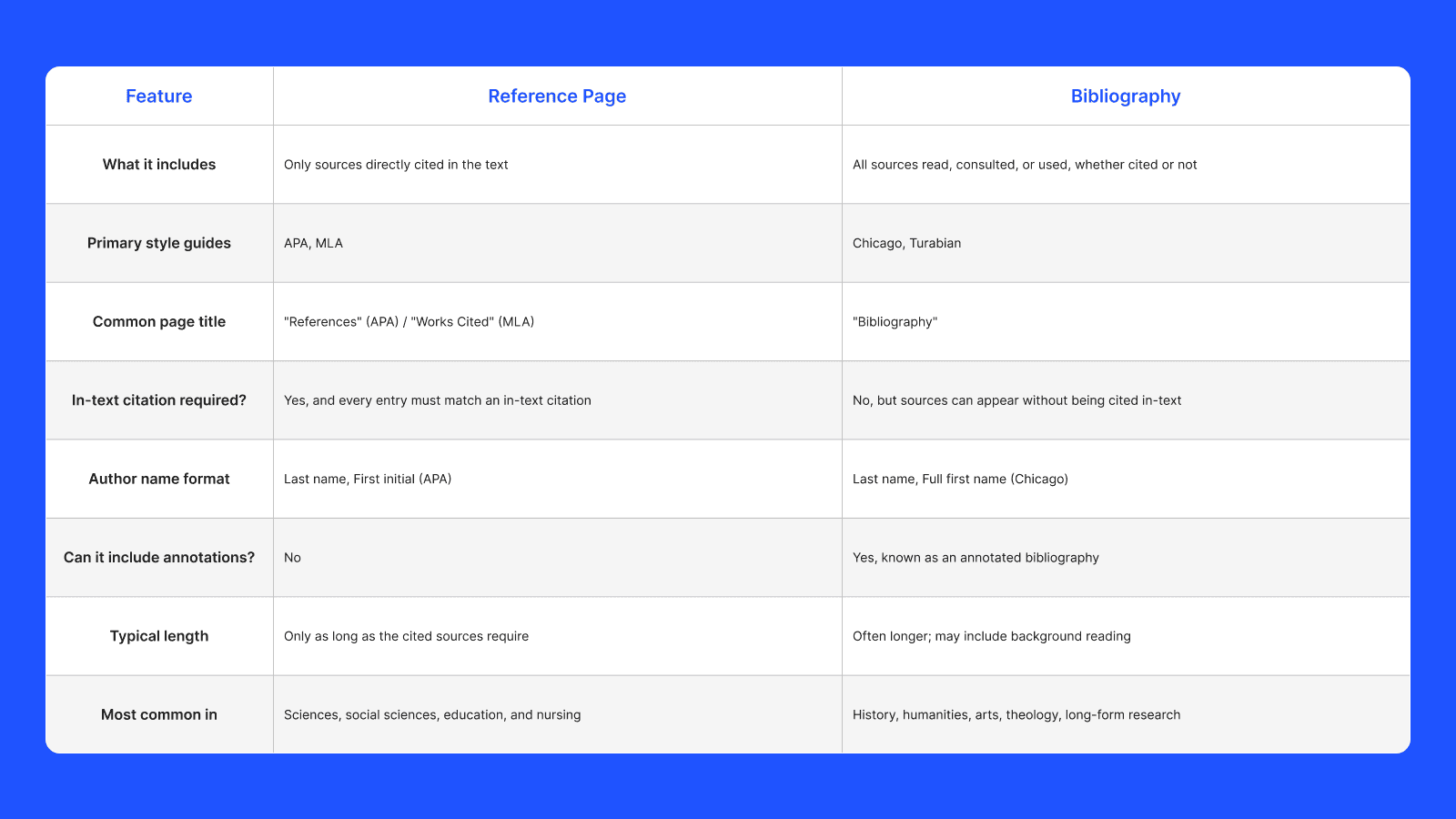
A reference page is like a receipt that only records what you actually used. Whereas a bibliography is more like a reading log that captures everything you engaged with.
To make things easier, here's a full side-by-side breakdown:
Bibliography vs References Examples for Better Understanding
Let's make this even clearer with a real comparison.
Suppose you're writing a paper on climate change. You cite three studies directly in your text. But you also read five other reports to understand the topic, even though you didn't quote them.
Your Reference Page would look like this (APA):
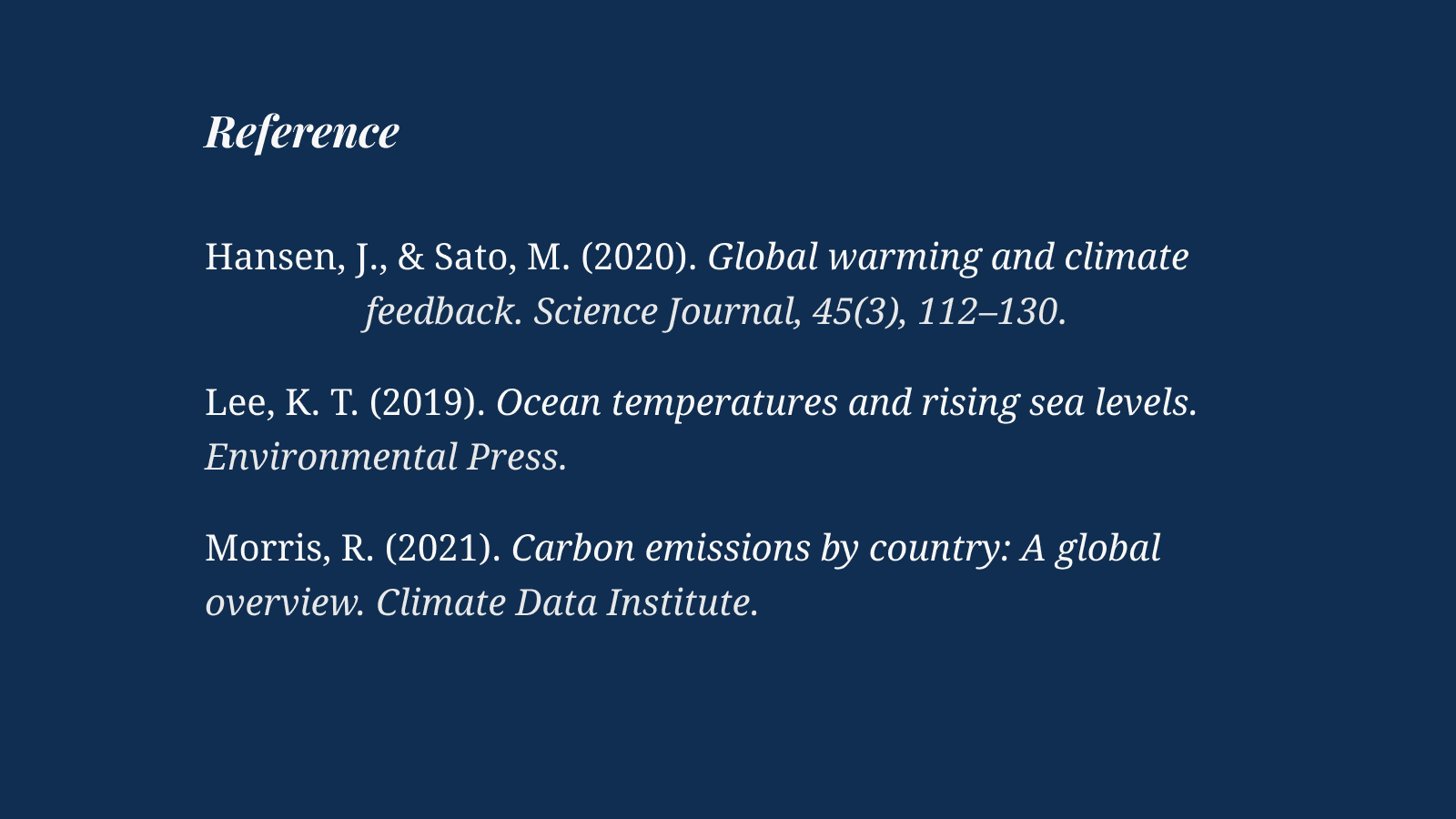
(Only 3 entries — the ones you actually cited.)
Your Bibliography citation examples would look like this (Chicago):
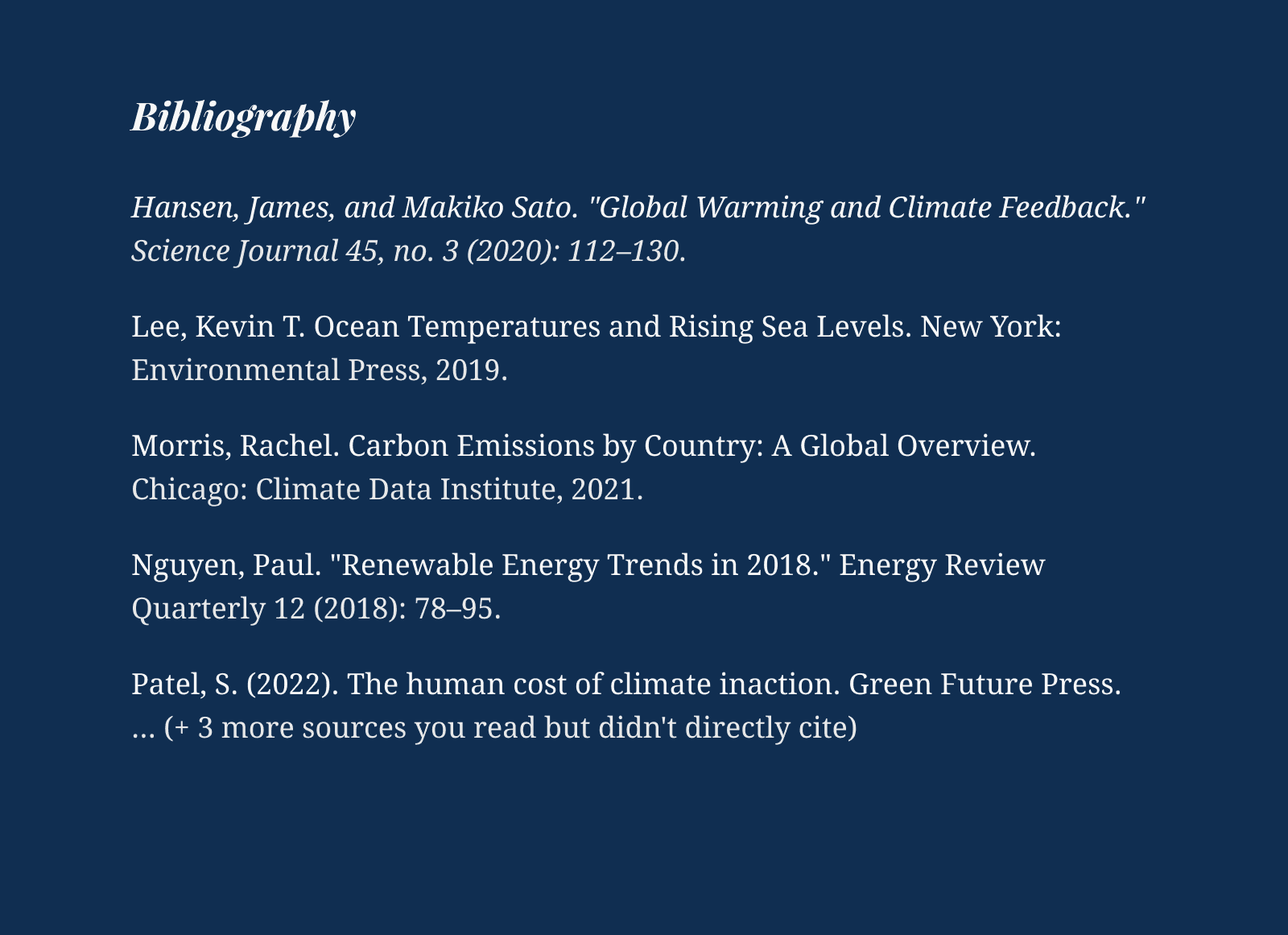
(8 entries — all sources you consulted, cited or not.)
This is the clearest way to see the bibliography vs references list distinction in action.
Which One Should You Use from the list of References vs Bibliography?
Knowing the difference between a reference page and a bibliography is one thing, but knowing which one to actually use in your document is where it gets practical.
And the honest answer is: it depends on three things, such as your field of study, your citation style APA, MLA, etc., and what your professor or editor explicitly asks for.
The biggest mistake students make is assuming they have a free choice. In most academic settings, you don't.
So, below is a quick guide based on your writing context, so you can decide which one is okay for you:
Use a Reference Page (References List) if:
- Your style guide is APA or MLA
- You're writing for a psychology, education, nursing, or social sciences paper
- Your professor specifically asks for a "References" or "Works Cited" page
Use a Bibliography if:
- Your style guide is Chicago or Turabian
- You're writing a history paper, an arts thesis, or a book
- You want to show a wider scope of reading
- Your professor specifically asks for a "Bibliography."
Remember that when in doubt, don’t forget to check your style guide or ask your instructor. Most academic institutions have specific requirements, and using the wrong format can cost you marks.
Tip: Many students use bibliography and references interchangeably. But in formal academic writing, this can be a serious mistake. Always check your citation style requirements before choosing a title for your sources page.
Can You Put References and Bibliography Together?
Yes, and in some documents you might actually see both!

Some longer academic works (like theses, dissertations, or books) include:
- A reference list — sources directly cited in the text
- A bibliography — a broader list of recommended or consulted reading
This approach is more common in the humanities and book-length works. For most standard essays and papers, you'll only need one or the other.
Common Mistakes People Make with Citations
A 2021 study published in the International Journal for Educational Integrity found that,
Nearly 36% of students admitted to copying text without proper citation at least once.
Even an unintentional plagiarism issue can lead to serious academic consequences that you don’t want to face.
But now that you understand the difference between bibliography and reference list, here are a few common mistakes you must need to avoid:
Listing Sources You Didn't Cite on Your Reference Page
This is a red flag in APA and MLA styles. Your reference page should only contain sources with matching in-text citations.
Using the Wrong Format for Your Style Guide
No matter what kind of document you cite, whether it can be a paper, letter, or PDF to cite with APA, MLA, and Chicago style, remember that all have different rules. Basically, for how authors, dates, and titles are written. Mixing them up is one of the most common citation errors.
Missing information in your bibliography citation
Every bibliography citation needs an author name, publication title, year, and publisher (and sometimes location). So, missing any of these makes your citation incomplete.
Not citing at all and risking plagiarism
This is the big one. Whether you use a reference page or a bibliography, always credit your sources. Failing to do so is plagiarism, even if it's accidental. Before submitting your work, you can also run it through a plagiarism checker to spot matching passages that may need a citation, rewrite, or closer review.
How Citation Errors Can Hurt Your Writing
Even if your actual writing is brilliant, poor citations can undermine your credibility. And that might happen when -
- Readers can't verify your sources — which makes your arguments look weaker
- Professors and editors notice — and they deduct marks or reject submissions
- It can look like plagiarism — even when it isn't intentional
The good news? Avoiding these problems is simple with the right tools and a little attention to detail.
Use CopyChecker to Protect Your Writing Within Seconds
Before you submit any paper, article, or research document, it's smart to run it through any reliable online plagiarism checkers. Even with proper citations, content can accidentally overlap with published work, and you want to catch that before anyone else does.
That's where CopyChecker comes in.
CopyChecker is a free, fast, and reliable plagiarism checker that helps you to -
- Detect duplicate or copied content in seconds
- Check your work before submission
- Protect your academic or professional reputation
- Write with confidence, knowing your content is original
Whether you're a student working on a research paper, a blogger writing SEO content, or a professional submitting reports, CopyChecker makes sure your writing is clean, original, and ready to go.
Check Your Content for Free on CopyChecker →
It takes less than a minute, and it could save you from a very avoidable problem.
Frequently Asked Questions about Bibliography vs References
The distinction between a bibliography and a reference list remains one of the most misunderstood concepts among students and researchers alike. The following FAQs address exactly that.
What is a bibliography vs references in one sentence?
A bibliography lists all sources you used or read, while a reference list only includes sources you directly cited in your writing.
Can I use the words "bibliography" and "references" interchangeably?
In casual conversation, yes. In formal academic writing, no. They refer to different things and are used in different citation styles.
Is a bibliography the same as a works cited page?
Not exactly. A "Works Cited" page is the MLA version of a reference list — only cited sources. A bibliography is broader and typically used in the Chicago style.
What is a bibliography page in a school paper?
It's the last page of your paper that lists all sources you used, whether you directly quoted them or just read them for background. It's common in Chicago-style papers.
Do all papers need a bibliography or reference page?
Yes, any academic paper that uses outside sources needs a citation list. Whether it's a reference page or bibliography depends on your citation style.
Final Thoughts
The bibliography vs references debate isn't really a debate at all, but once you understand the difference, the answer becomes clear.
References are only for what you cited, and the Bibliography is for everything you used or consulted
The style guide you're following (APA, MLA, Chicago) will tell you which one to use. When in doubt, ask your professor or editor.
Try out CopyChecker AI Citation Generator now!