Suppose you're polishing an essay, an email, or a blog post after all those late-night efforts. You read each sentence out loud, and it sounds fine, so you move on.
Then someone who might be your teacher, editor, or that one friend who loves grammar rules so much they won't break them at all circles a comma and writes "comma splice" next to it.
You stare at the page and think what did that little comma even do wrong?
Trust me, you're not alone in this case.
The comma splice is one of the most common punctuation mistakes in English writing, and it sneaks into the work of beginners and confident writers alike.
And the good news? Once you see how it works, you'll spot it everywhere, and fixing it becomes second nature.
So for that all you need is to go through the whole blog, without further ado let’s jump into -
What Is a Comma Splice?
A comma splice happens when you join two complete sentences using only a comma, with no connecting word in between.
That's it. That's the whole problem.
Here's an example:
Incorrect: I love coffee, I drink it every morning.
Look closely. "I love coffee" is a full sentence. "I drink it every morning" is also a full sentence.
A comma alone isn't strong enough to glue two complete sentences together; it just doesn't have the grammatical muscle for the job.
So, when you force it, you get a comma splice.
Why Does Comma Splicing Even Matter?
You might be thinking: it's one comma, who cares? Fair question.
But punctuation is one of those things readers never notice when it's right, and always notice when it's wrong.
A single misplaced comma can shift how a sentence is read, how a writer is judged, and how much effort someone has to put in just to understand a simple thought.
Here's what's actually at stake every time a comma splice slips through:
- Readers lose their footing - A comma splice forces people to pause mid-sentence and re-read it, trying to figure out where one idea ends, and the next begins, and that little stumble breaks the flow you worked hard to create.
- "Rough draft" energy creeps in -High quality essays, resumes, client emails, and articles all lose polish the moment a comma splice shows up, no matter how strong the actual ideas underneath are.
- Credibility takes a hit - Teachers, editors, and hiring managers notice these slips, often before they even register your argument, and a clean, well-punctuated sentence is what earns their trust in the first place.
- Fixing it costs almost nothing - Unlike deeper structural or clarity issues, comma splices are quick to spot and even quicker to correct once you know the four fixes ahead.
What's an "Independent Clause" in Comma Splice?
Before comma splices make full sense, there's just one piece of grammar vocabulary worth learning, and it's a lot less intimidating than it sounds.
It's called an independent clause, and once you understand it, spotting comma splices becomes almost automatic.
So what is it? An independent clause is just a group of words that's complete enough to stand on its own as a sentence.
Nothing fancy; it’s just that if it has all three things below, it qualifies:
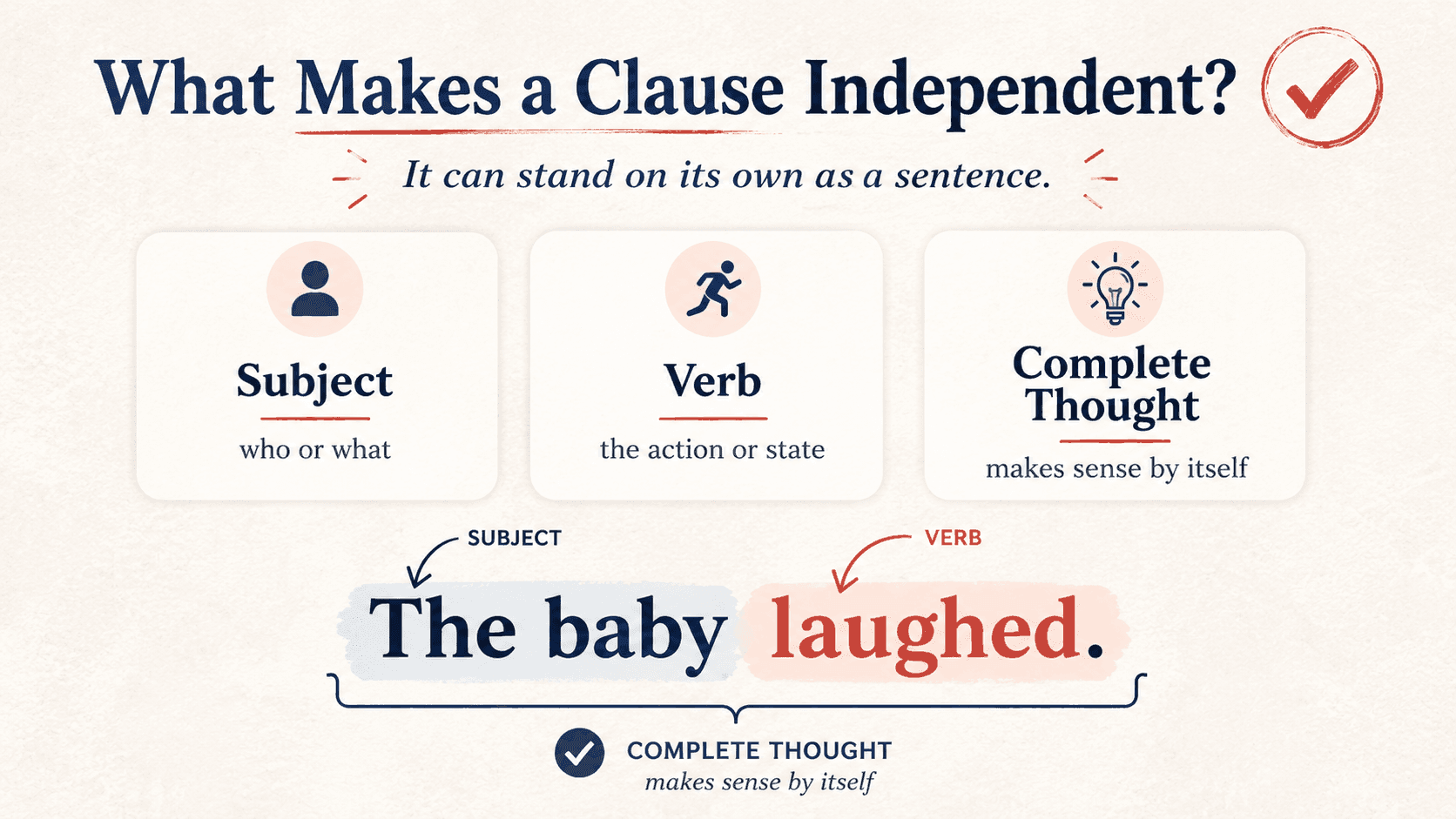
Given a simple example: The baby laughed.
Break it down, and you'll see all three pieces in place —
The baby is the subject, laughed is the verb, and the sentence makes complete sense by itself without needing anything added before or after it.
That's exactly what makes it an independent clause. So now, let’s understand why this matters specifically for comma splices.
Basically, a comma splice only happens when two of these independent clauses, two mini-sentences that could each survive on their own, get squeezed together using nothing but a comma.
Once you can recognize an independent clause on sight, finding the comma splice hiding in a sentence becomes a lot easier.
Comma Splice Examples to Spot the Pattern
Definitions are useful, but nothing beats seeing the common punctuation or grammar mistake laid out in front of you.
So, glance through the examples below and notice the shape they all share: a comma sitting between two halves that could each stand alone as their own sentence -
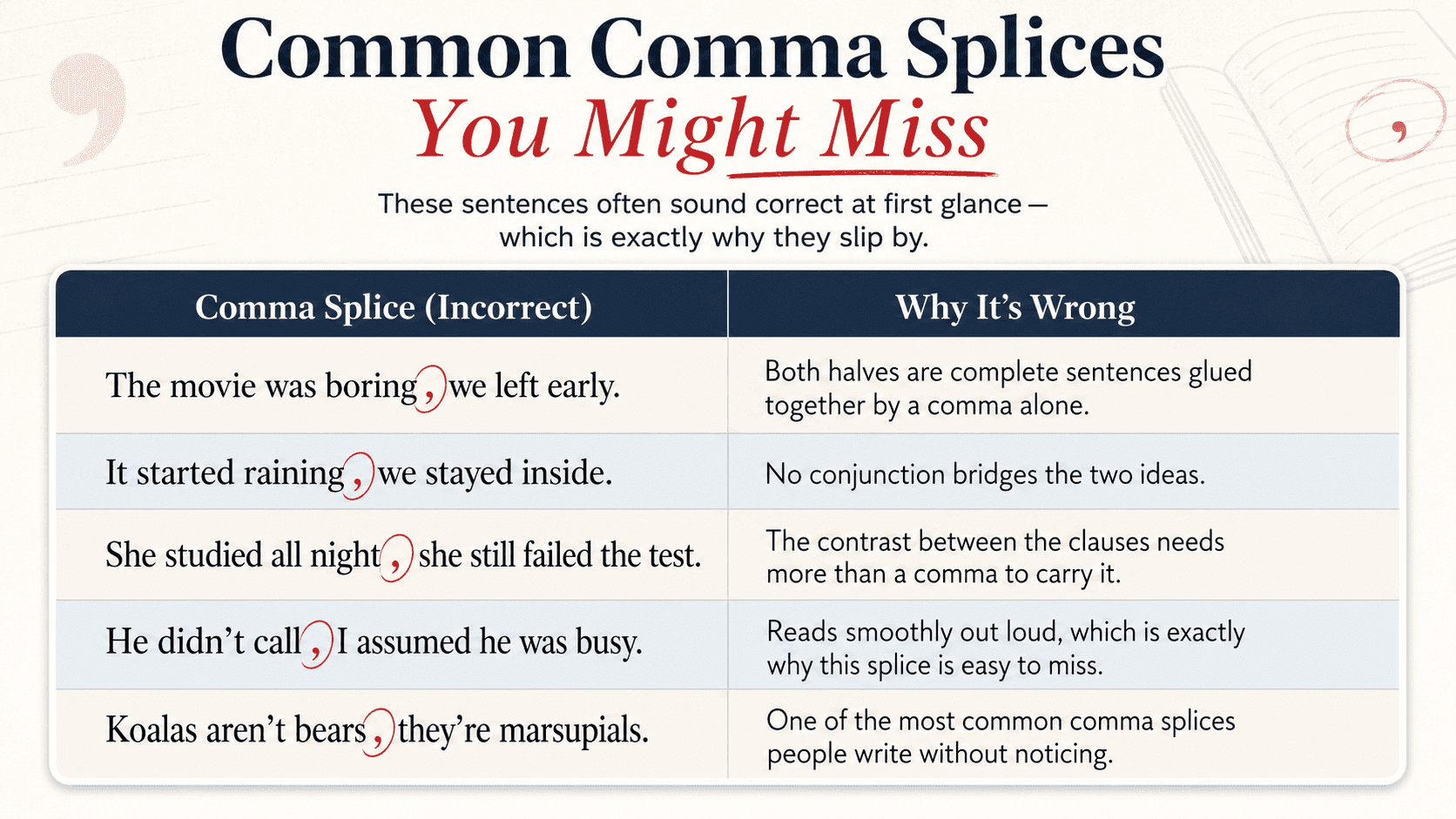
Once you see a handful of these, the pattern jumps out: comma, complete sentence on the left, complete sentence on the right.
Comma Splice vs. Run-On Sentence - What's the Difference?
These two terms get used interchangeably so often that most people assume they're the same mistake, but they're not, even though they come from a very similar place.
Both happen when two complete sentences get pushed together without the right kind of punctuation holding them apart, but the way each one fails is slightly different.
Here's a side-by-side look that makes the difference obvious at a glance:
 Both are punctuation errors, and both come from the same root issue, which is simply independent clauses that aren't properly connected.
The upside is they share the exact same fixes, which we're about to cover.
How to Fix a Comma Splice with 4 Easy Methods
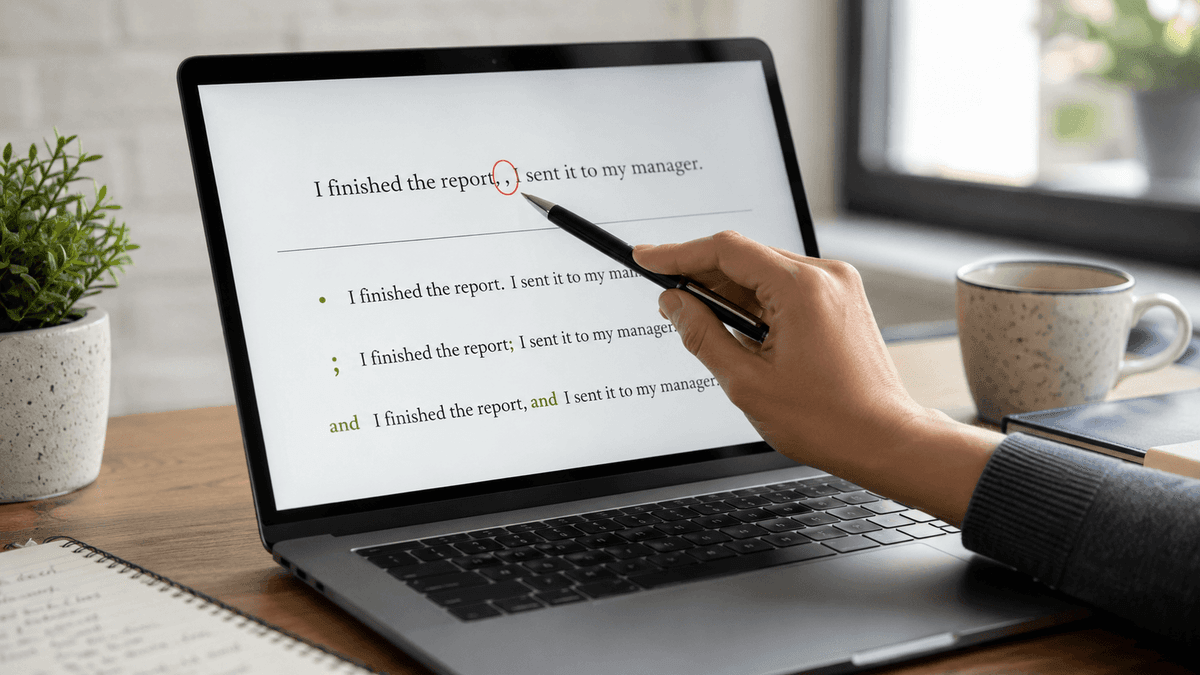
There's no single "correct" fix; basically, it depends on the rhythm and tone you want. That’s why here are four reliable ways to repair a comma splice -
1. Split It Into Two Sentences
The simplest option. Just swap the comma for a period.
Before: I love coffee, I drink it every morning.
After: I love coffee. I drink it every morning.
Best for: short, punchy writing or when the two ideas don't need to feel tightly connected.
2. Add a Coordinating Conjunction
Keep the comma, but add a small connecting word right after it and, but, or, nor, so, yet, for (remember the acronym FANBOYS).
Before: It started raining, we stayed inside.
After: It started raining, so we stayed inside.
Best for: showing how two ideas relate (cause, contrast, addition).
3. Use a Semicolon
Swap the comma for a semicolon when the two ideas are closely related, and you want them in one sentence without a connecting word.
Before: She studied all night, she still failed the test.
After: She studied all night; she still failed the test.
Best for: formal writing or when the contrast between the two ideas is strong and obvious.
4. Use a Semicolon + Transition Word
For extra clarity, pair a semicolon with a transition word like however, therefore, meanwhile, or moreover.
Before: He didn't call, I assumed he was busy.
After: He didn't call; therefore, I assumed he was busy.
Best for: academic and professional writing where precision matters.
Your Comma Splice Cheat Sheet (Pin This One)
Think of this as the emergency exit sign for comma splices, the one chart you glance at when you're not sure which fix to grab. One broken sentence, four working escape routes:
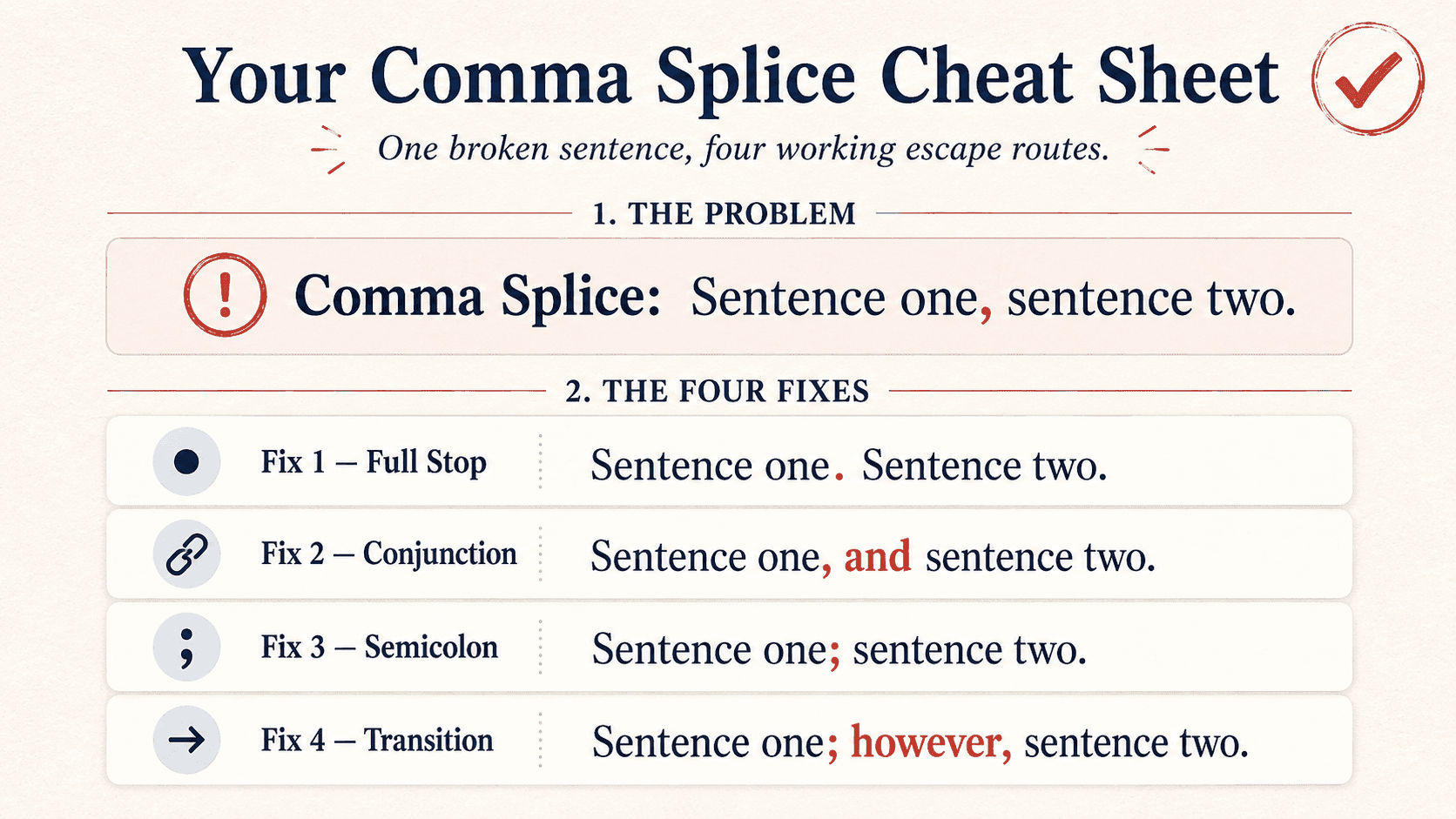
Screenshot it, sketch it on a sticky note, save the image, or whatever works, as this one cheat sheet covers roughly 99% of comma splice situations you'll ever run into.
When Is a Comma Splice Okay?
Here's a twist most grammar guides skip, and this is -
Comma splices aren't always "wrong" in every context.
In creative writing, casual or SEO blog posts, or dialogue, short comma splices are sometimes used on purpose to create a breathless, conversational rhythm. Famous authors have done it for stylistic effect for centuries.
Example (intentional, stylistic): I came, I saw, I conquered.
The catch? This only works when you know the rule well enough to break it deliberately, and it should be used sparingly.
In essays, business writing, reports, or anything meant to look polished and professional, it's best to stick with the standard fixes above.
Common Comma Splice Mistakes to Watch For
Knowing the rule doesn't always prevent the mistake, but comma splices have a sneaky way of slipping past even confident, experienced writers because they often sound fine when read aloud.
In fact, comma splices rank among the punctuation errors flagged most often in student and professional writing habits alike, alongside general comma misuse and apostrophe errors.
The following are the specific traps worth watching for:
- A comma sneaks in before words like "however," "therefore," or "moreover" - These words look and feel like conjunctions, but grammatically, they aren't; basically, they need a semicolon or period in front of them, not just a comma.
- Two closely related ideas get treated like a single list item - Even when two complete thoughts feel like they belong together, they still need stronger punctuation than a comma to be joined correctly.
- The sentence gets long enough to lose track of itself - The more words piled into a sentence, the easier it becomes to lose sight of where one independent clause ends, and the next one starts.
- "It sounds right out loud" gets mistaken for "it's grammatically correct" - Spoken rhythm and written grammar follow different rules, which is exactly why this error hides so well during a quick read-through or using our free grammar checker.
Here's a fact worth remembering: a single comma splice on a school paper can be enough to lower a grade, and in professional or workplace writing, comma errors have even contributed to costly legal disputes.
Small mistake, surprisingly real consequences.
Comma Splice Practice to Test Yourself
Reading about comma splices is one thing; actually catching them is a different skill, and it only gets sharper with practice.
Before scrolling down to the answers, try working through these three sentences yourself: spot where the comma splice is, then decide which of the four fixes from earlier would work best.
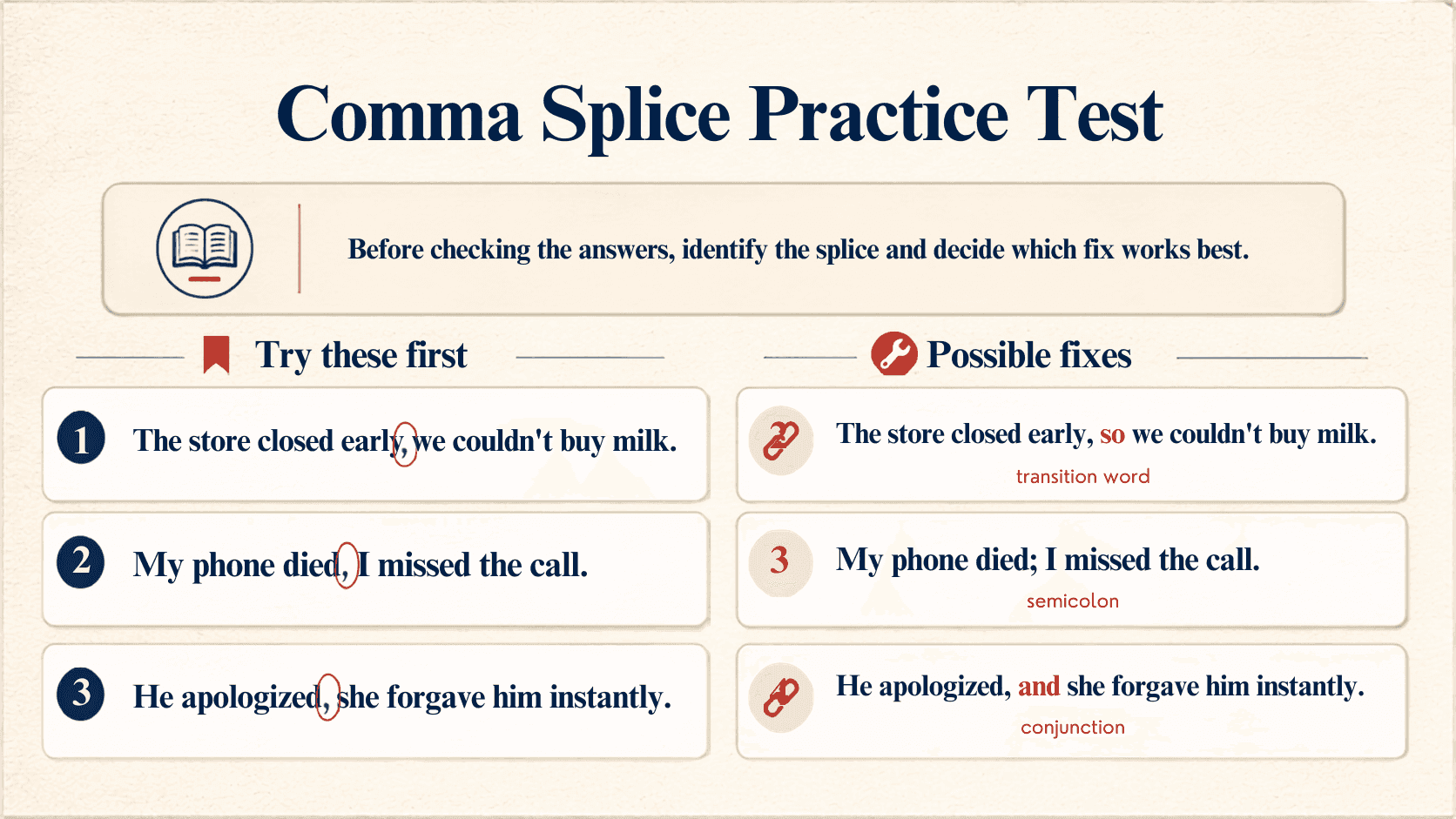
If even one or two of your answers matched, you've already started training your eye to catch this mistake, and that's the real skill that sticks long after this article.
FAQs
What exactly is a comma splice in simple terms?
A comma splice is when two complete sentences are joined using only a comma, with no word or stronger punctuation mark connecting them.
Is a comma splice always grammatically wrong?
In formal and academic writing, yes, it's considered an error. In creative or casual writing, short comma splices are sometimes used on purpose for stylistic rhythm.
What's the easiest way to fix a comma splice?
Splitting the sentence into two separate sentences with a period is usually the simplest and safest fix.
What's the difference between a comma splice and a run-on sentence?
A comma splice uses a comma (but no conjunction) to join two complete sentences. A run-on sentence joins them with no punctuation at all.
Can I use "however" or "therefore" after a comma to fix a splice?
No, words like however, therefore, and moreover need a semicolon or period before them, not just a comma, since they aren't true conjunctions.
Why do comma splices happen so often, even to good writers?
They usually happen when two thoughts feel closely related in your head, so a comma feels "natural" even though grammatically it's too weak to connect two full sentences.
Do comma splices affect grades or professional writing?
Yes. Teachers and editors often flag them, and in professional documents, comma splices can make writing look careless even if the content is strong.
How can I quickly check my writing for comma splices?
Read each sentence and check whether the words before and after the comma could each stand alone as a full sentence. If both can, you likely have a comma splice, or use a dedicated checking tool to catch it automatically.
Final Words on Comma Splice
The truth is, even after learning all the rules above, comma splices are easy to miss in your own writing. Your brain already knows what you meant to say, so it skips right over the broken punctuation while reading.
That's exactly the gap CopyChecker's Comma Splice Checker is being built to close.
Instead of manually scanning every sentence for two independent clauses joined by a lonely comma, you'll be able to paste in your text and instantly see exactly where your splices are hiding.
Plus, you’ll get suggested fixes using the same methods covered in this guide (split, conjunction, semicolon, or transition word).
To make your writing journey simpler, try CopyChecker’s writing suite and make your life less complicated!
Want first access when the Comma Splice Checker launches?
Keep an eye on CopyChecker, your commas will thank you.