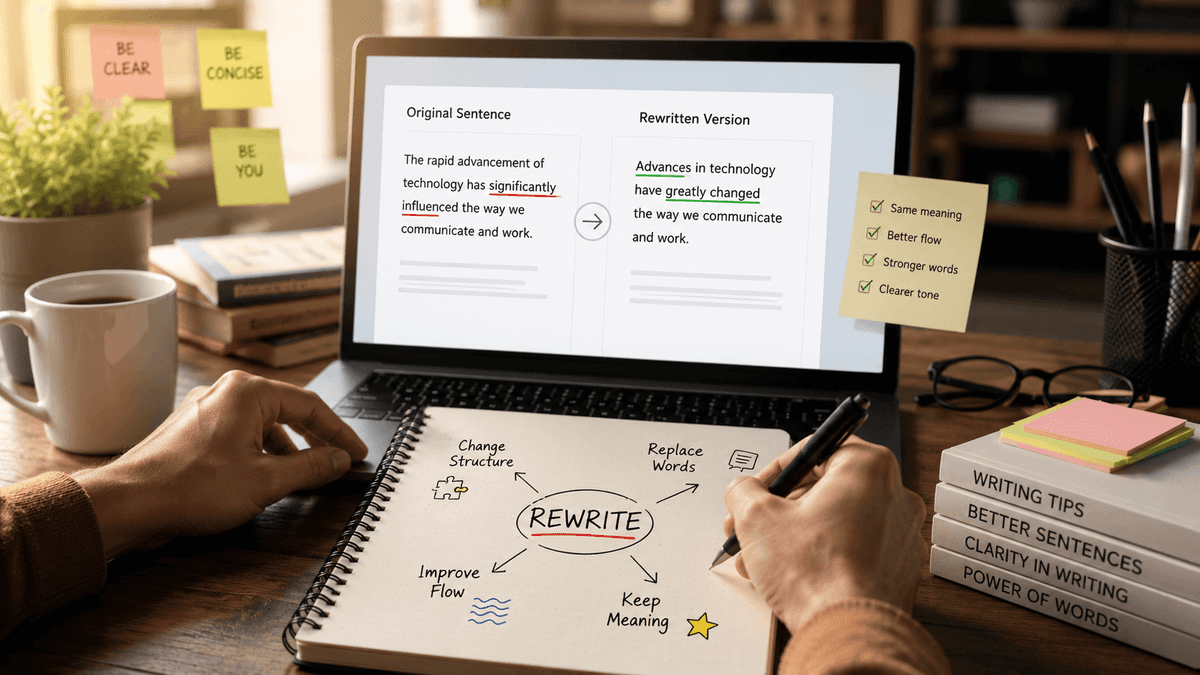
You change a few words. Rearrange the sentence. Replace two or three terms with synonyms.
It looks different, so you assume the job is done.
Then you read it again and realize something is off.
The sentence is smoother, but the meaning is no longer exactly the same.
Maybe “may” became “will.” Maybe an important condition disappeared. Maybe the tone became stronger than the original. Sometimes, one tiny change is enough to turn an accurate sentence into a misleading one.
That is the real challenge when you rewrite a sentence. The goal is not simply to make it look different. The goal is to change the wording or structure while protecting the original message.
This matters whether you are rewriting an essay, improving awkward writing, paraphrasing a source, simplifying a difficult sentence, or trying to make your content clearer.
And no, replacing every word with a synonym is not the solution. That usually creates the sort of sentence that technically exists but wishes it did not.
In this guide, you’ll learn how to rewrite a sentence without changing its meaning, how to spot the details you must preserve, which rewriting methods actually work, and how to check your final version for mistakes.
By the end, you should be able to look at almost any sentence and know exactly what you can change and what you should leave alone.
So without further ado, let’s get started -
What Does It Mean to Rewrite a Sentence?
To rewrite a sentence means to communicate its original message through different wording or structure.
Consider this sentence:
The school postponed the sports event because of heavy rain.
It could be rewritten as:
Because of heavy rain, the school delayed the sports event.
You can see the structure where some words have changed, but the basic message is still the same:
- The school made the decision.
- The event was delayed.
- Heavy rain caused the delay.
Sentence rewriting may involve changing vocabulary, word order, proper tone of voice, or sentence length. But it should not change the facts or create a new claim.
Here is another example to make things clear:
Original: The new reading program may improve students’ vocabulary.
Correct rewrite: Students’ vocabulary could improve through the new reading program.
Incorrect rewrite: The new reading program will improve every student’s vocabulary.
The incorrect version changes “may” to “will” and adds “every student.” That ultimately turns a possibility into a guarantee and introduces information that was not present in the original sentence.
That is why good rewriting begins with meaning, not synonyms.
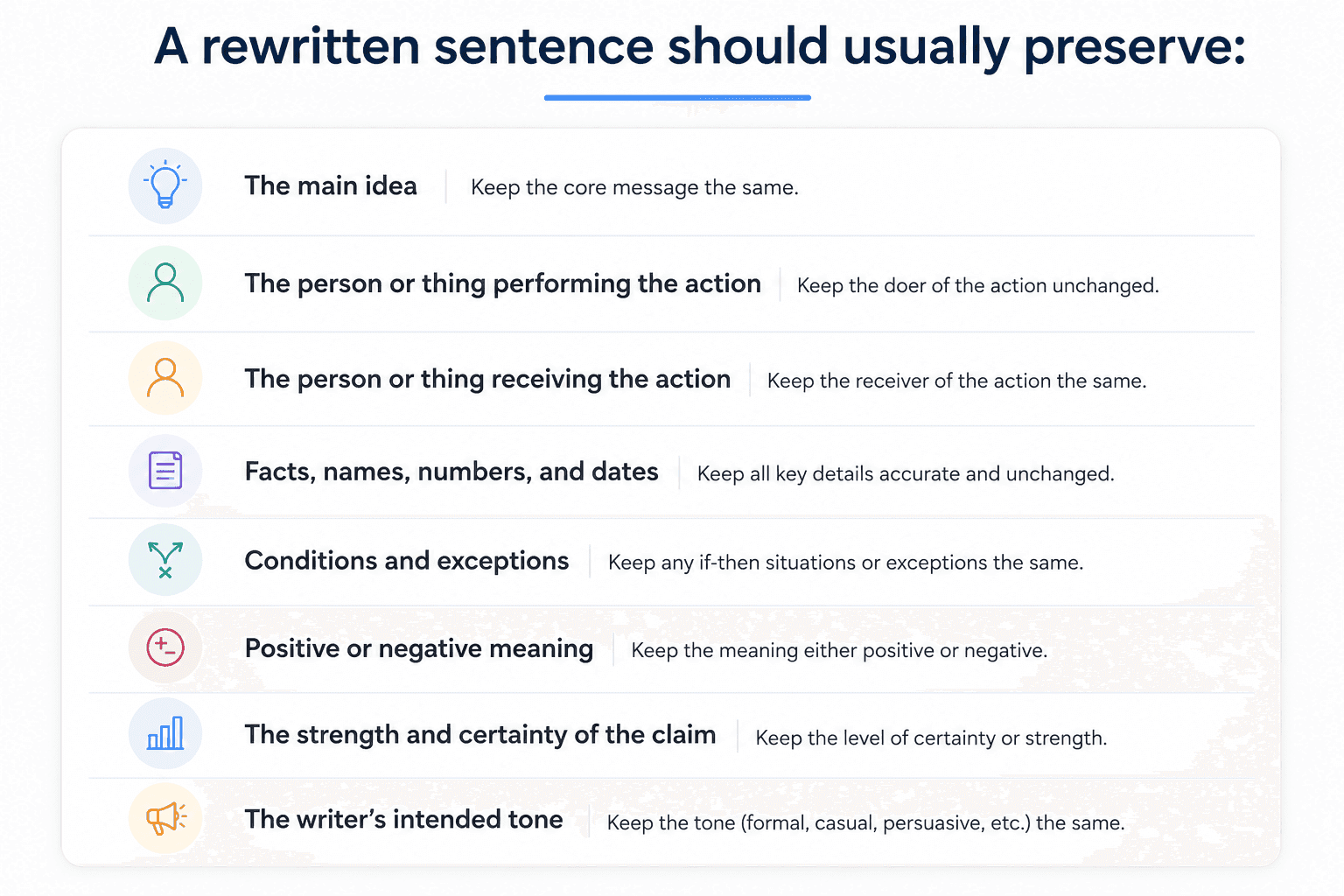
You may change how the idea is presented, but not what the idea says.
Now that you already know what it is, let’s find out -
How to Rewrite a Sentence Without Changing the Meaning
The safest way to rewrite a sentence is to understand it first, protect its key details, and then change its form. You can use the following techniques separately or combine them to rewrite whatever you want -
Step 1: Understand the Original Meaning
Read the sentence carefully before trying to rewrite it. Ask what the writer is actually saying rather than focusing only on individual words.
You can use these questions:
- Who or what is the sentence about?
- What happened?
- Who performed the action?
- Why did it happen?
- When did it happen?
- Is the statement certain or only possible?
- Does it include a condition or exception?
- Is the sentence positive or negative?
Consider this example:
If the weather improves, the team may play on Saturday.
This sentence contains three important details:
- The game depends on better weather.
- Playing is only a possibility.
- Saturday is the proposed day.
A careless rewrite might say:
The team will play on Saturday.
That version removes the condition and changes a possibility into a certainty.
A correct rewrite would be:
The team might play on Saturday if the weather gets better.
Before changing any words, explain the sentence to yourself in simple language. When you understand the message clearly, you are less likely to damage it during rewriting.
Step 2: Identify the Main Idea
The main idea is the central message that must survive every change.
For example:
The library extended its opening hours so that students could study after school.
The main idea is:
The library now stays open longer to give students more study time.
Details such as the library, longer hours, students, and after-school study are all part of that message.
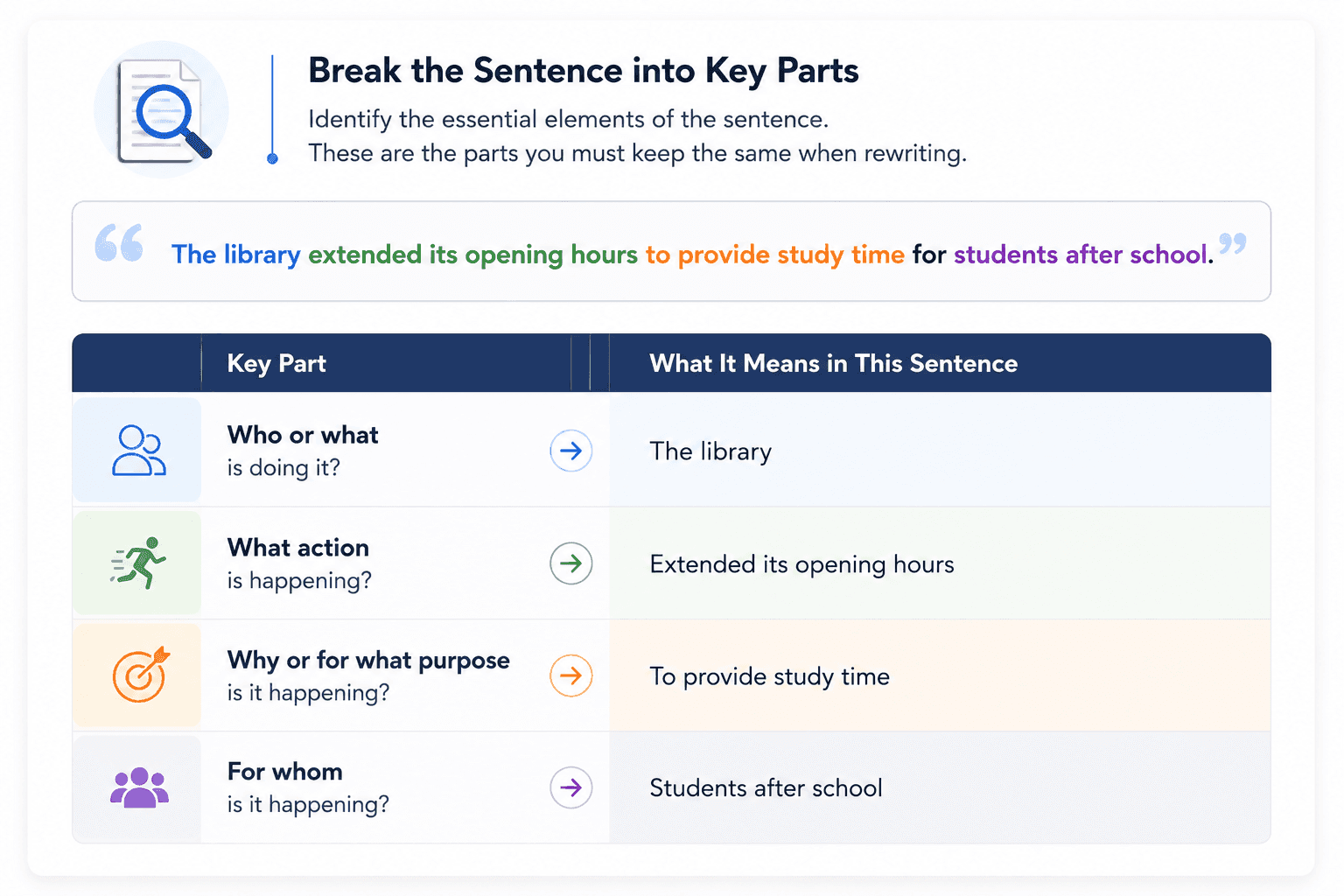
Once these elements are clear, you can rebuild the sentence:
To give students more time to study after school, the library began staying open longer.
This method is especially useful when rewriting long or complex sentences. Instead of wrestling with the original word by word count, reduce it to its core meaning and rebuild it naturally.
Step 3: Change the Sentence Structure
Changing sentence structure is often more effective than simply replacing words.
You can:
- Move information to the beginning or end
- Change the order of clauses
- Turn a phrase into a clause
- Turn a clause into a phrase
- Begin with the cause instead of the result
- Begin with the result instead of the cause
Original:
The company closed the office early because the storm was becoming stronger.
Rewritten:
Because the storm was becoming stronger, the company closed the office early.
Only the order has changed. The same event, action, and reason remain.
Here is a more noticeable structural change:
Original:
Students who practice regularly often become more confident speakers.
Rewritten:
Regular practice often helps students develop confidence when speaking.
The second sentence changes both the grammatical rule on structure and vocabulary while preserving the main message.
So, try not to rearrange words randomly. The new sentence should sound natural and show the same relationship between ideas.
Step 4: Use Contextually Accurate Synonyms
A synonym is a word with the same or a similar meaning. Synonyms can help you reword a sentence, but they must fit the context.
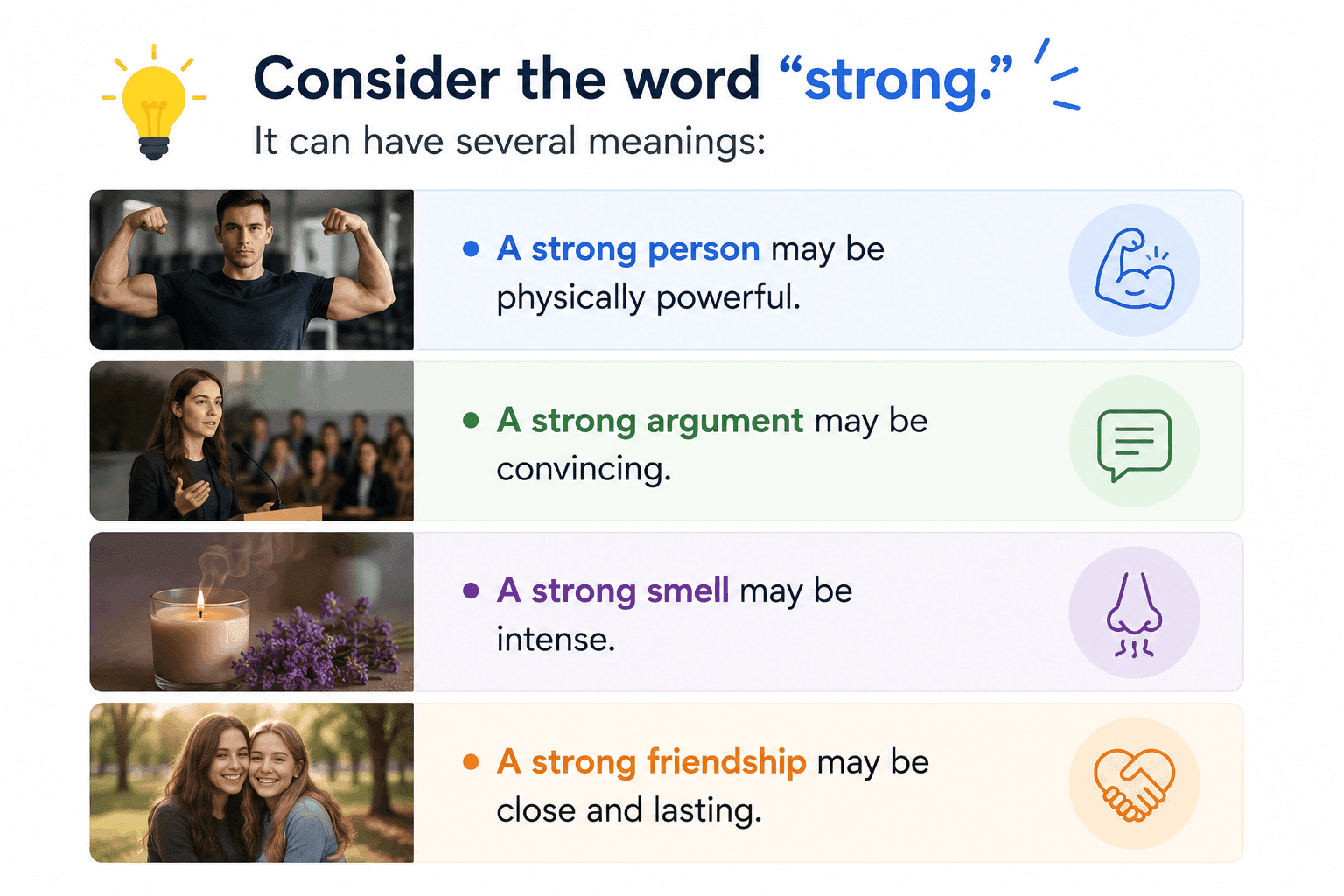
One synonym will not work in every situation.
Original:
The evidence provides strong support for the argument.
Good rewrite:
The evidence offers convincing support for the argument.
Poor rewrite:
The evidence provides muscular support for the argument.
“Muscular” can mean physically strong, but arguments tend not to visit a gym.
When choosing a synonym, check:
- Does it have the correct meaning here?
- Does it have the same level of strength?
- Does it fit the sentence grammatically?
- Is it too formal or too casual?
- Does it change the emotional tone?
- Is it commonly used in this context?
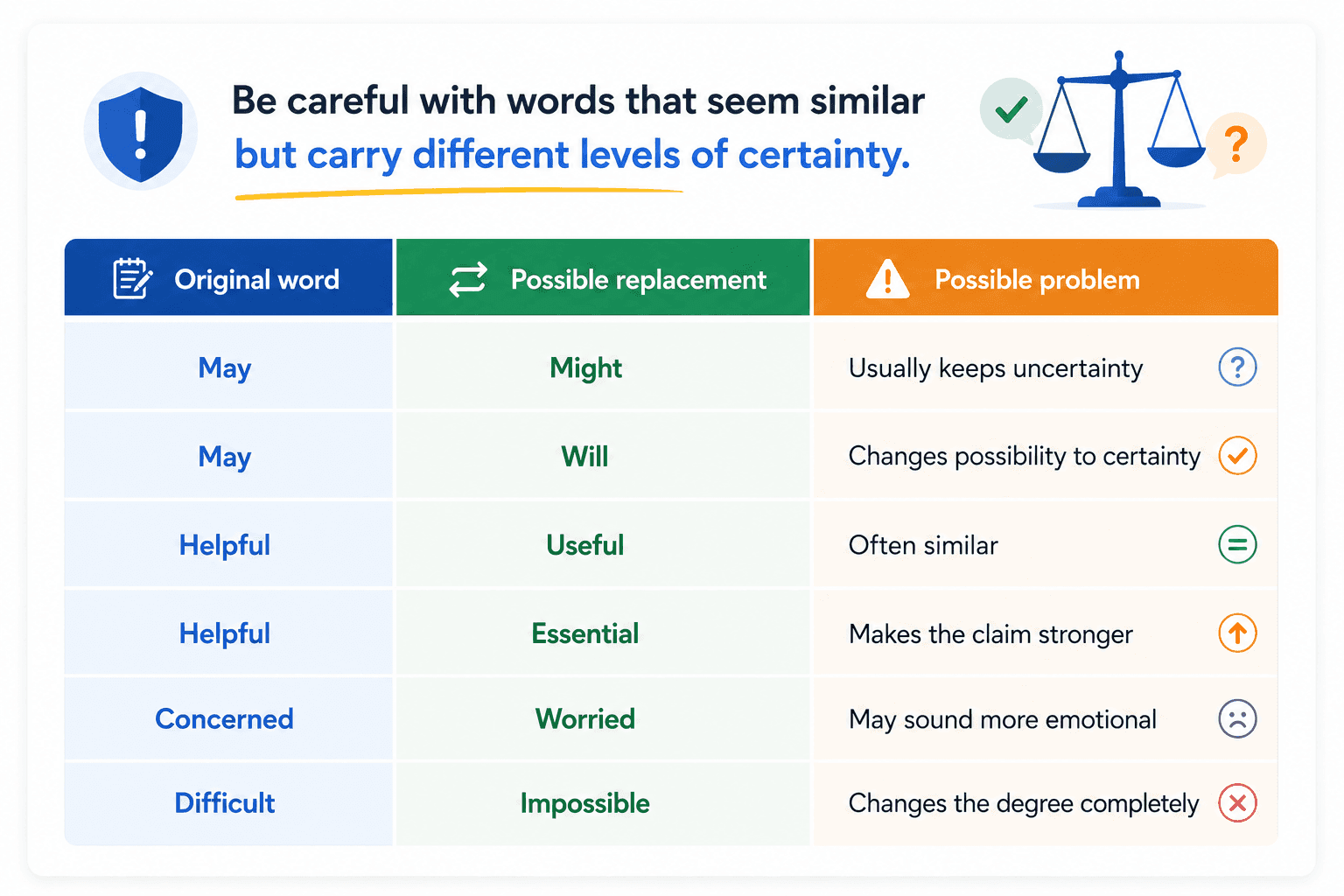
A thesaurus can suggest words, but it cannot fully understand your intended meaning. The final decision still requires context.
Step 5: Change Active and Passive Voice
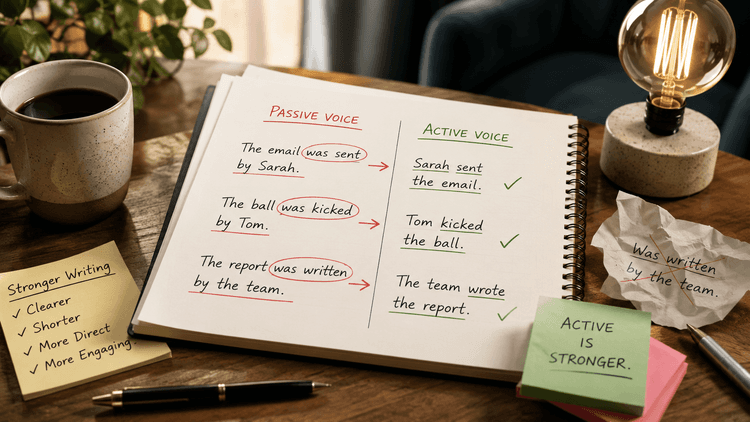
A sentence in active voice places the person or thing performing the action first.
The teacher reviewed the essays.
A sentence in passive voice places the receiver of the action first.
The essays were reviewed by the teacher.
The basic event remains the same:
- The teacher performed the review.
- The essays received the action.
Changing voice can help you create a different sentence structure.
Active:
Scientists discovered the new species in 2024.
Passive:
The new species was discovered by scientists in 2024.
However, passive voice can sometimes remove important information:
The new species was discovered in 2024.
This version does not say who made the discovery. That may be acceptable when the person is unknown or unimportant, but it is not an exact rewrite if the original writer wanted to credit the scientists.
Active voice is often clearer because it shows who is responsible for an action.
Plain-language guidance also commonly recommends active voice when it helps readers identify the actor quickly.
Still, passive voice checking remains useful when the action or result deserves more attention than the actor.
Step 6: Reorder Clauses
A clause is a group of words containing a subject and a verb. Many sentences contain two or more clauses that can be rearranged.
Original:
We remained indoors because the air quality was poor.
Rewritten:
Because the air quality was poor, we remained indoors.
The meaning does not change because the relationship between the cause and result stays clear.
Another example can be like this:
Original:
Although Lina was nervous, she completed the presentation.
Rewritten:
Lina completed the presentation although she was nervous.
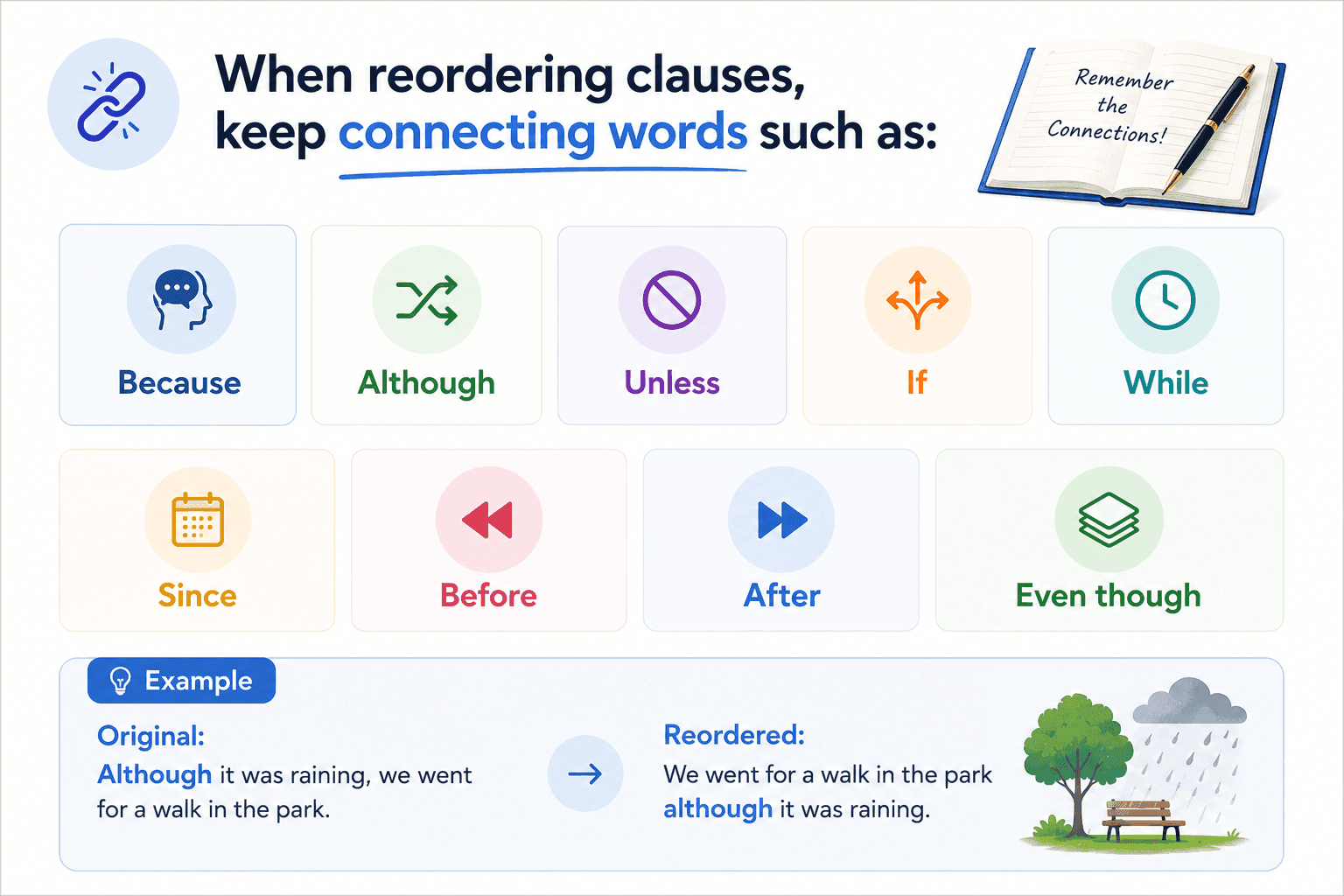
These words show relationships between ideas. Removing or replacing them carelessly can change the meaning.
Compare:
Sam went outside although it was raining.
with:
Sam went outside because it was raining.
The first sentence shows contrast. The second gives rain as the reason. One conjunction changed the entire relationship.
Step 7: Remove Redundant Words
Redundant words repeat an idea that is already clear. The examples include:
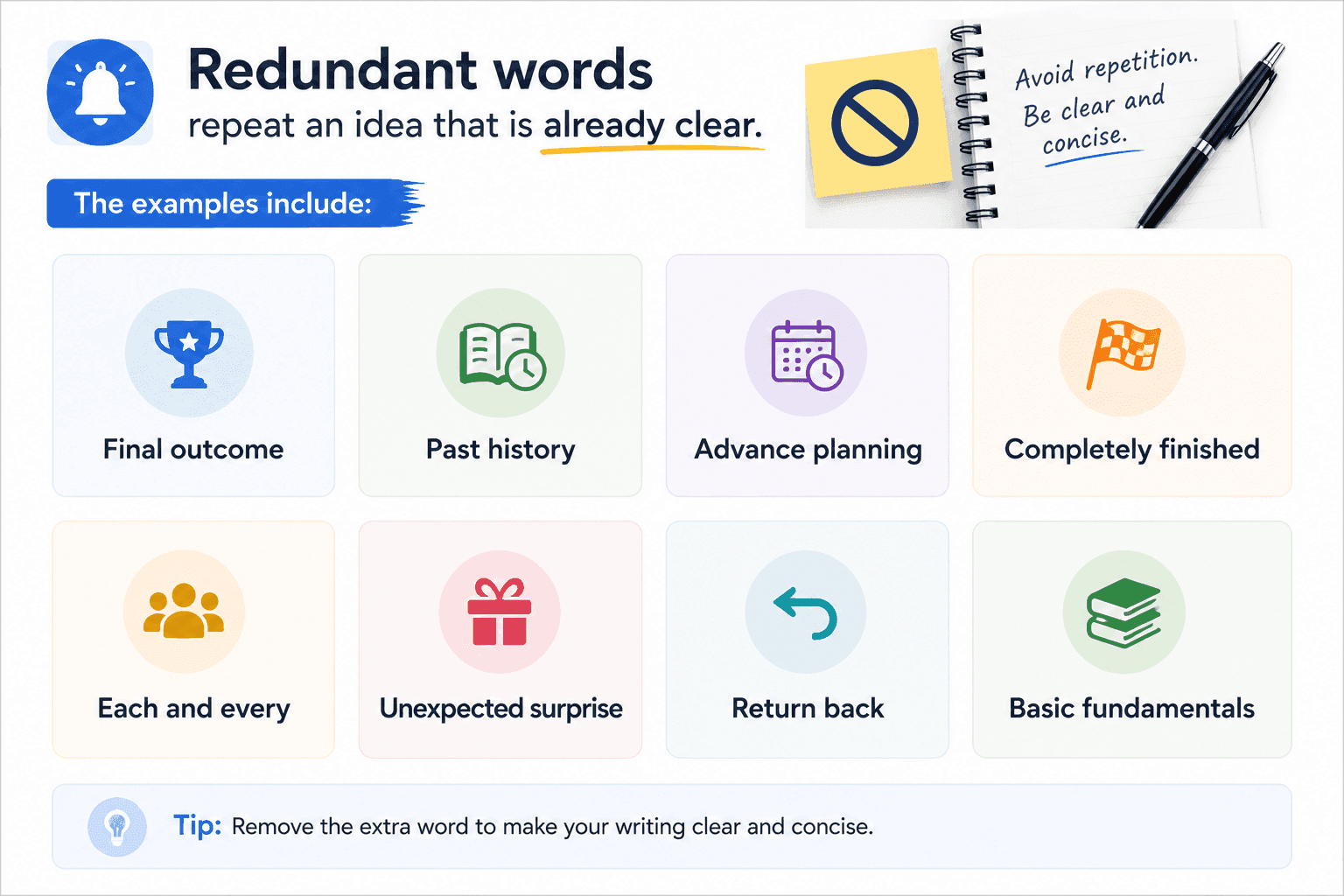
Removing these words can create a cleaner sentence without changing its meaning.
Original:
The final outcome of the competition surprised everyone.
Rewritten:
The outcome of the competition surprised everyone.
Original:
The two twins wore matching jackets.
Rewritten:
The twins wore matching jackets.
Be careful, though. Not every descriptive word is unnecessary.
The small red bag was left beside the door.
Removing “small” or “red” changes the information.
A word is redundant only when it repeats something already included in another word or adds nothing useful.
Clear writing basically depends on more than short sentences and easy vocabulary.
Research on readability working process has noted that context, organization, logical connections, and the amount readers must infer also affect comprehension.
Step 8: Split or Combine Sentences
Long sentences can sometimes be divided into shorter ones. Short related sentences can also be combined to improve flow.
Splitting a long sentence usually looks like this -
Original:
The school introduced a digital library that allows students to borrow electronic books from home without visiting the main library building.
Rewritten:
The school introduced a digital library. Students can now borrow electronic books from home without visiting the main library building.
The same information remains, but the message is easier to process.
Combining short sentences can be like the following -
Original:
Rina finished the report. She checked the figures. She emailed it to her manager.
Rewritten:
After checking the figures, Rina finished the report and emailed it to her manager.
However, this example creates a small timing problem. It suggests that Rina checked the figures before finishing the report.
If the original order matters, a safer rewrite is:
Rina finished the report, checked the figures, and then emailed it to her manager.
That tiny word “then” protects the sequence.
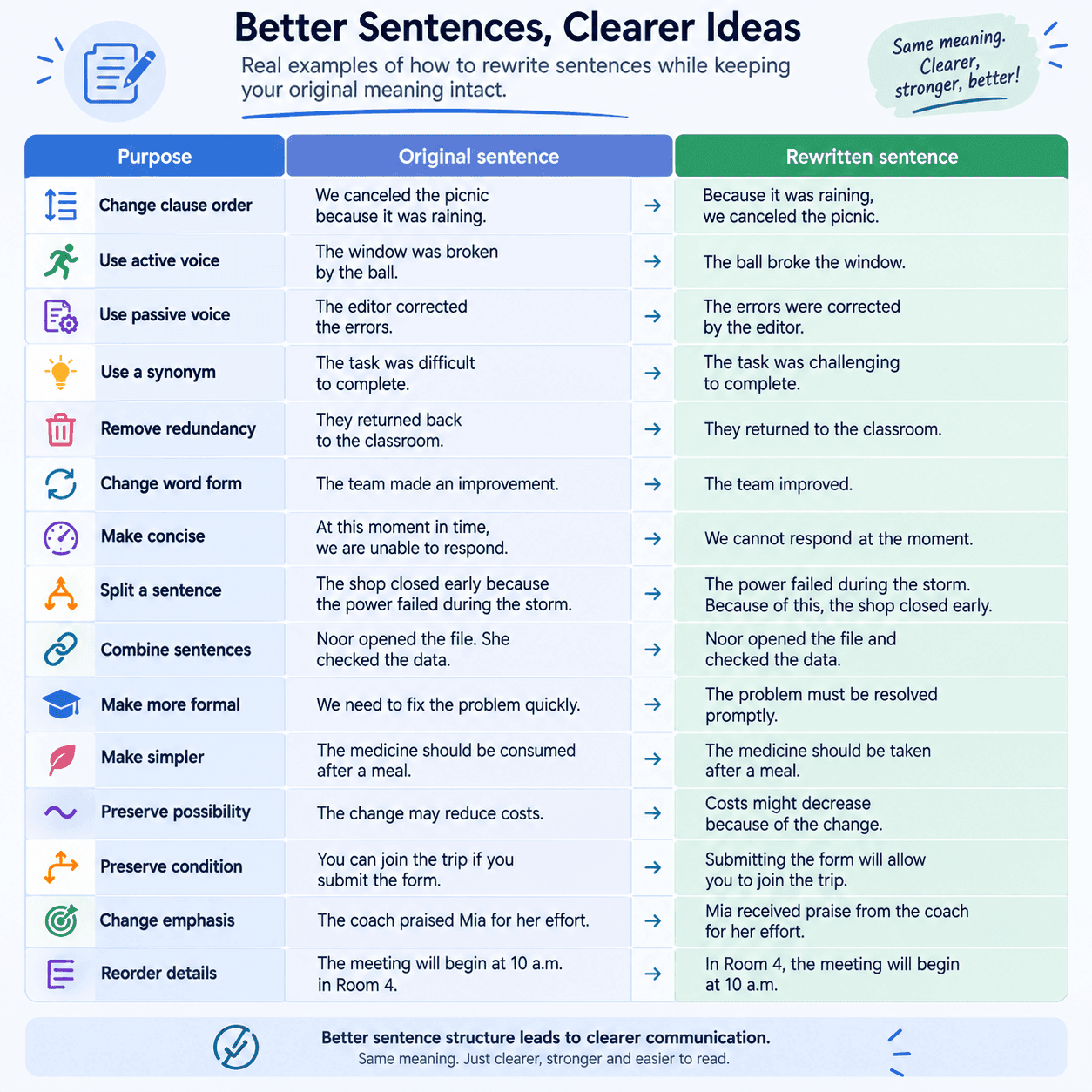
 Examples of Rewritten Sentences to Understand Better
Sometimes, the easiest way to understand sentence rewriting is to see it in action. A rule may sound simple in theory, but comparing an original sentence with its rewritten version makes the difference much clearer.
The examples below show how you can change sentence structure, word choice, voice, clause order, or length while still keeping the original message accurate.
Pay attention not only to what changes, but also to what stays the same, because preserving the meaning is the most important part of a successful rewrite.
How to Check Whether the Meaning Has Changed
A rewritten sentence can sound smoother, clearer, and more professional while still saying something different from the original.
That is why rewriting should never end with, “This sounds better.”
Once you’re happy with the rewrite, compare it with the original to make sure you haven’t kept too much of the same wording. For important academic or published work, you can also run it through a plagiarism checker to spot similarities you may have missed.
The checks below will help you confirm that your rewritten sentence is not only well written, but also accurate and faithful to the original idea -
Compare the Main Claim
The main claim is the point the sentence asks the reader to believe.
Original:
Regular sleep can help students concentrate in class.
Main claim:
Regular sleep may improve concentration.
Rewrite:
Students may concentrate better in class when they get regular sleep.
The claim remains the same.
Now compare this version:
Students with regular sleep always achieve higher grades.
That is not a rewrite. It adds an absolute claim about grades, which the original sentence never mentioned.
Ask:
- Does the sentence make the same point?
- Has a possibility become a fact?
- Has a fact become only a possibility?
- Has the rewrite added a conclusion?
- Has it removed an important limitation?
Try summarising both sentences in five to ten words. If the summaries differ, the meaning may have changed.
Check the Subject and Object
The subject usually performs the action. The object usually receives it.
Consider:
The principal thanked the students.
- Subject: the principal
- Action: thanked
- Object: the students
A correct passive sentence rewrite example is:
The students were thanked by the principal.
An incorrect rewrite is:
The students thanked the principal.
The same people and verb appear, but their roles have been reversed.
Pronouns can also create confusion:
Adam told Yusuf that he had won the prize.
Who won the prize: Adam or Yusuf? The sentence is unclear. A rewrite should resolve the problem only when the surrounding context provides the answer. Otherwise, it should not guess.
Possible versions include:
Adam told Yusuf, “You have won the prize.”
or:
Adam told Yusuf that Adam had won the prize.
The correct choice depends on the intended meaning.
Preserve Conditions and Qualifiers
Conditions state when, where, or under what circumstances something is true.
Qualifiers limit the strength or scope of a statement.
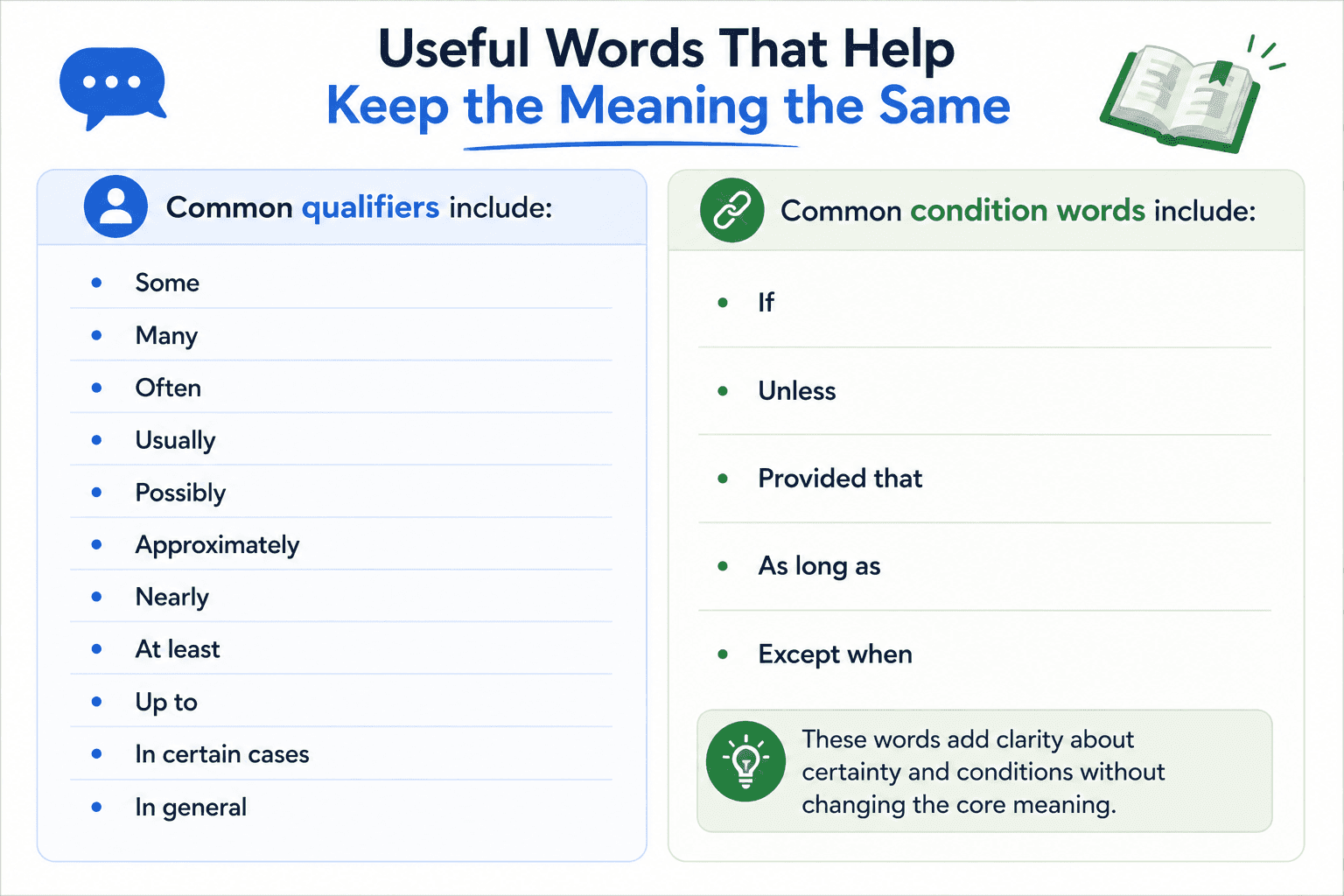
Original:
Some users may experience delays during busy periods.
A correct rewrite is:
During busy periods, certain users might experience delays.
An incorrect rewrite is:
Users experience delays.
The incorrect sentence removes “some,” “may,” and “during busy periods.” A limited possibility has become a general fact.
Qualifiers may look small, but they control the accuracy of the claim.
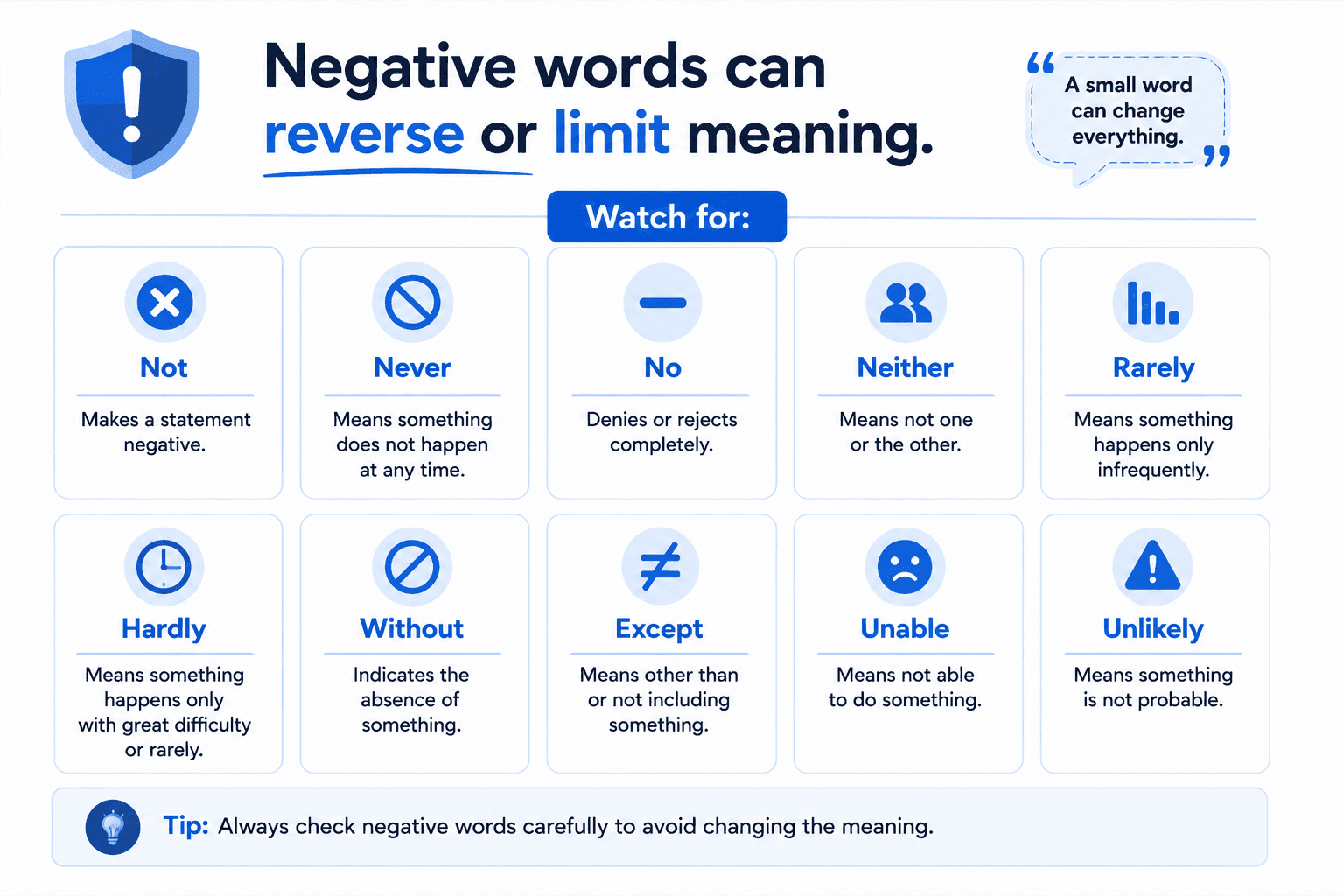
Check Negatives
Negative words can reverse or limit meaning. Watch for:
Original:
The software is not available on older devices.
Correct:
Older devices cannot use the software.
Incorrect:
The software is available on older devices.
One missing word has produced the opposite message.
Double negatives also require care:
It is not uncommon for beginners to make this mistake.
This means:
Beginners commonly make this mistake.
It does not mean the mistake is rare.
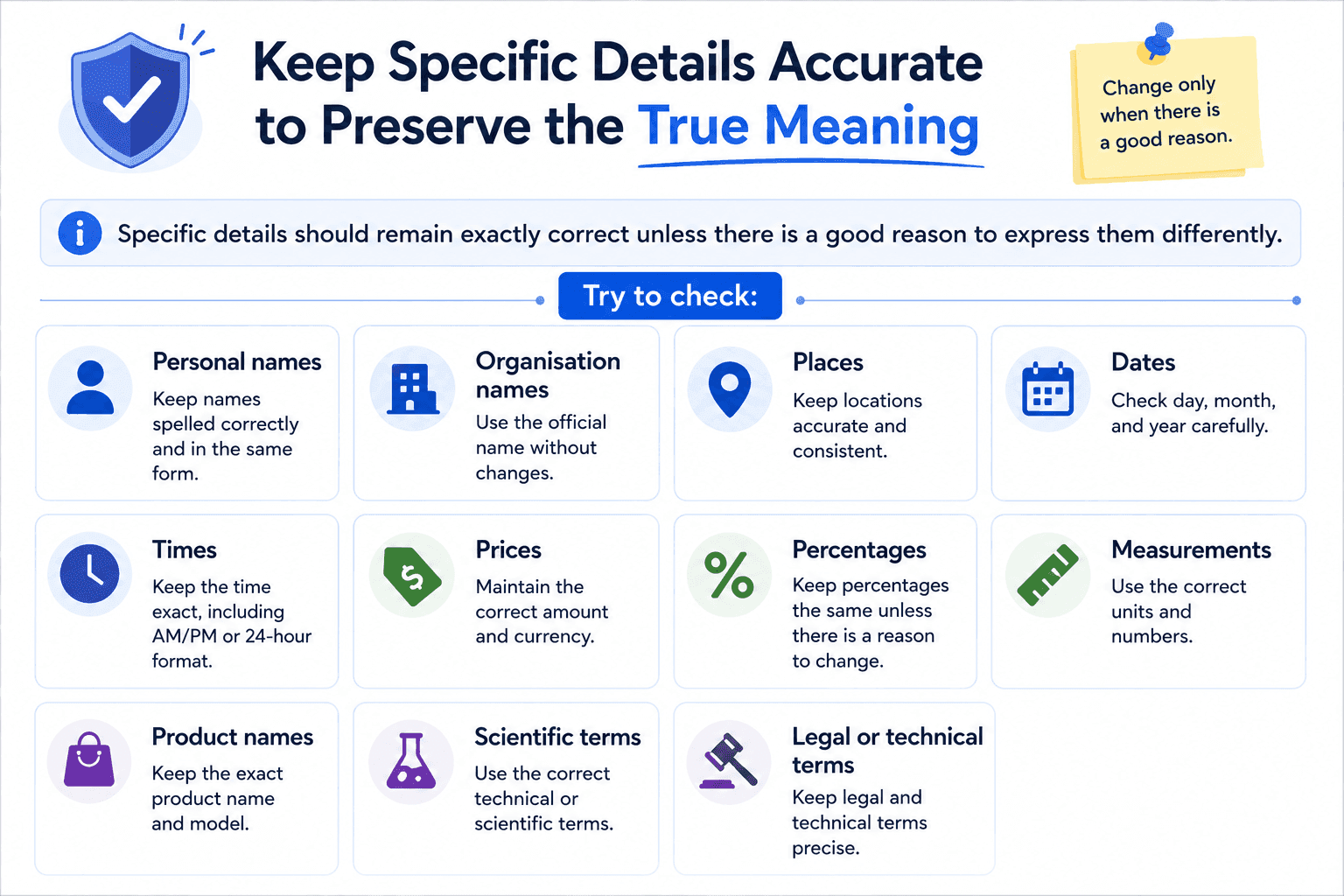
Verify Facts, Names, Numbers, and Dates
Specific details should remain exactly correct unless there is a good reason to express them differently. Try to check:
Original:
The course begins on September 12 and lasts eight weeks.
Correct:
Beginning on September 12, the course will continue for eight weeks.
Incorrect:
The two-month course begins in September.
Eight weeks and two calendar months are not always identical. The incorrect version also removes the exact date.
Numbers can sometimes be expressed in another form:
Half of the participants completed the survey.
May become:
Fifty percent of the participants completed the survey.
This is accurate because one-half equals 50 percent. However, do not convert or round numbers unless you are certain the result is equivalent.
Read the Sentence in Context
A sentence does not live alone. Its meaning may depend on the sentences around it.
Consider:
This approach worked better.
By itself, the sentence is unclear. Better than what? Which approach?
A rewrite such as:
This method produced stronger results.
May sound smoother, but it still depends on earlier information.
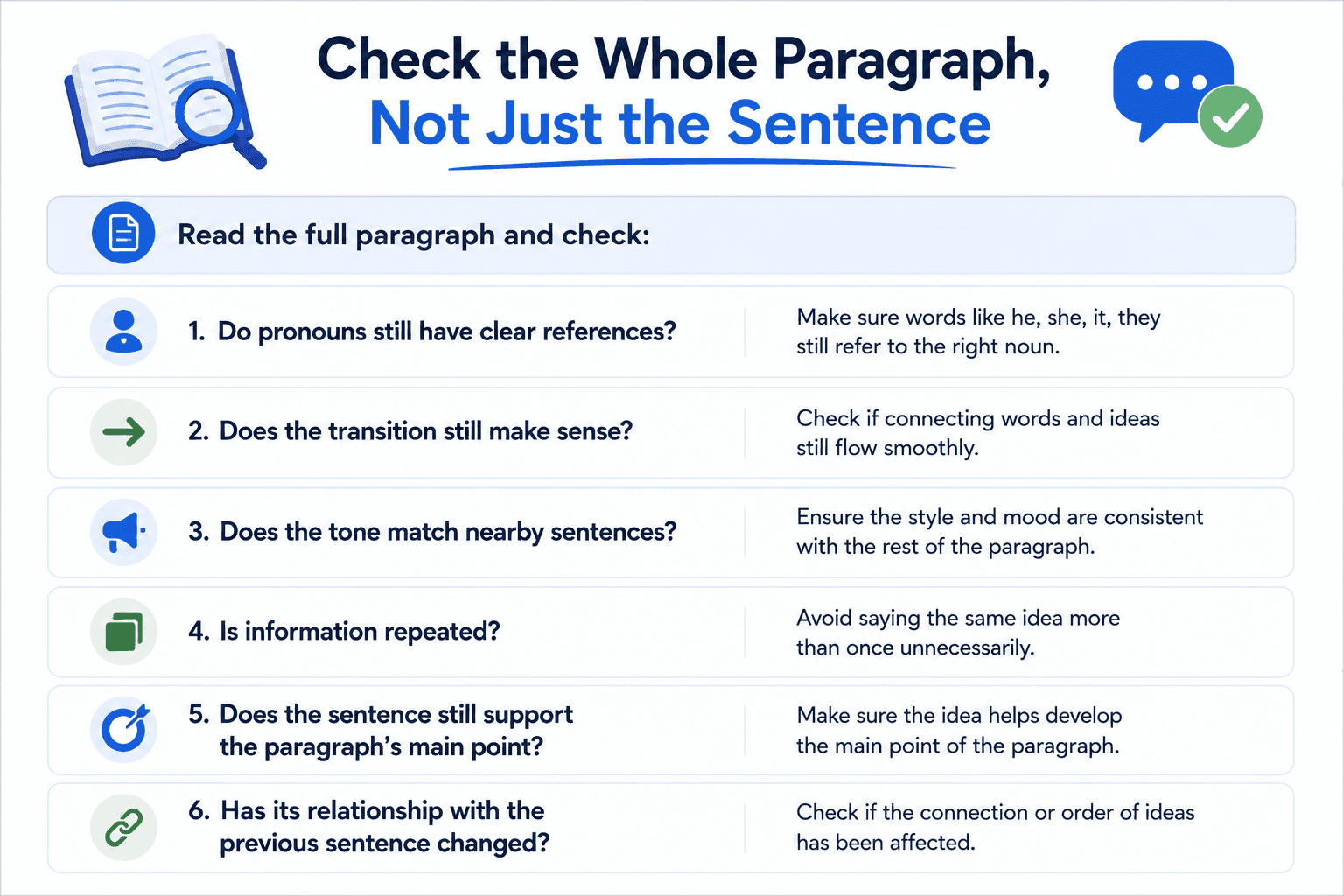
Context also explains why readability cannot be judged by word length and sentence count alone. Organization, background knowledge, cohesion, and logical connections also affect whether readers understand a passage.
Common Sentence-Rewriting Mistakes that You Must Avoid
Rewriting a sentence may seem simple until one small change quietly ruins the original meaning.
These mistakes are easy to miss because the rewritten sentence often looks perfectly fine at first glance.
The key is to remember that good rewriting is about making it different without changing what the writer actually meant.
So, the mistakes below are some of the most common reasons rewritten sentences become inaccurate, awkward, or misleading.
1. Replacing Every Word With a Synonym
Word-for-word synonym replacement is sometimes called patchwriting. It often keeps the original structure while producing awkward or inaccurate language.
Original:
The teacher gave the students clear instructions.
Mechanical rewrite:
The educator delivered the pupils transparent directions.
The result sounds unnatural because:
- “Transparent” is not the best synonym for “clear” in this context.
- “Delivered directions” sounds overly formal.
- “Pupils” may not match the original audience or regional style.
A better rewrite is:
The students received clear guidance from their teacher.
Change the sentence as a complete unit, not as a row of separate vocabulary boxes. If your rewrite still feels stiff or unnatural, an AI humanizer can help smooth out awkward phrasing and make it sound more natural while keeping the intended meaning.
2. Removing Modal Verbs
Modal verbs show possibility, ability, permission, advice, or obligation. Some of the common modal verbs include:
- Can
- Could
- May
- Might
- Must
- Should
- Will
- Would
They are not interchangeable.
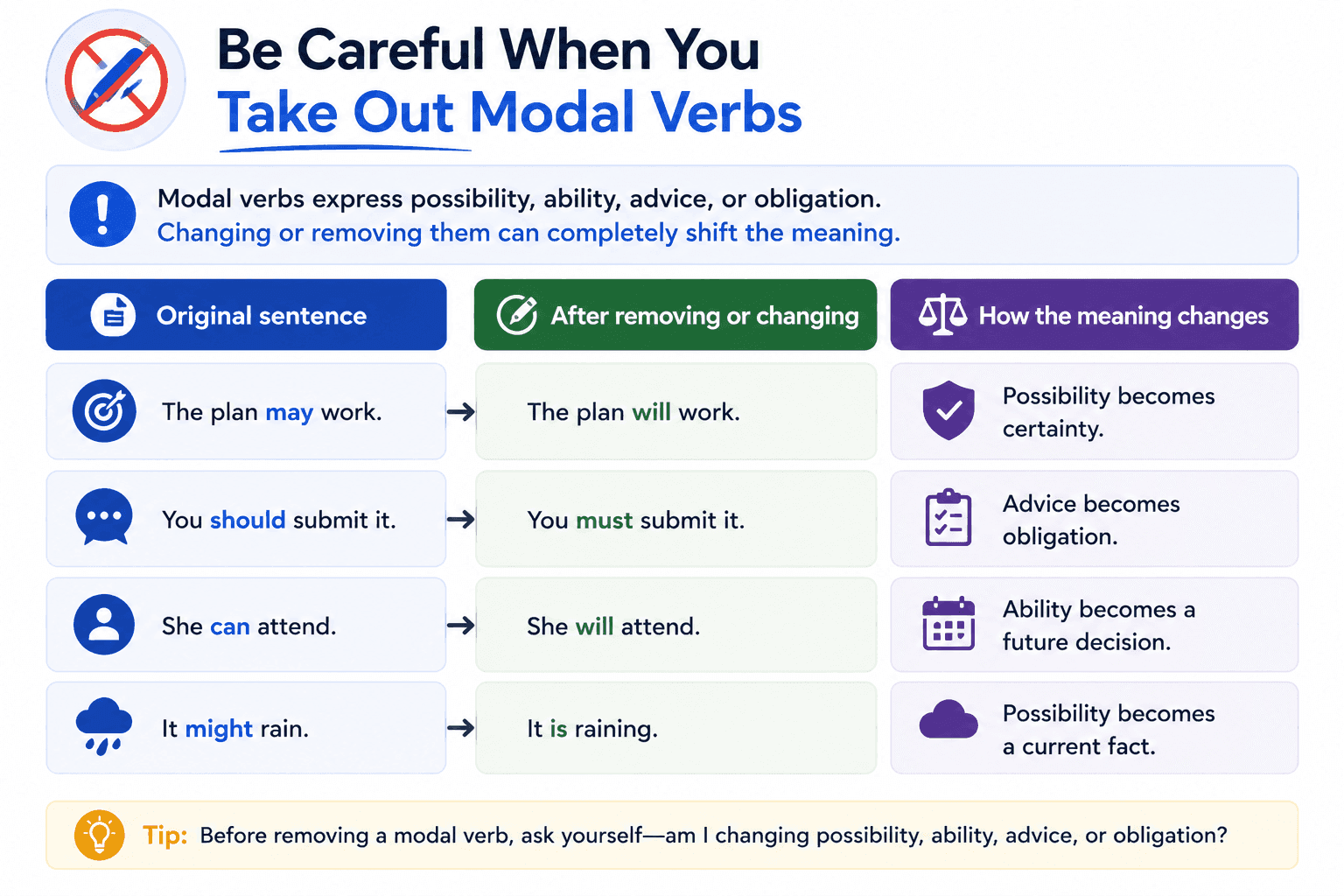
Always preserve the function of the original modal verb.
3. Removing Conditions
A condition limits when a statement applies.
Original:
Customers can receive a refund if they return the product within 14 days.
Incorrect rewrite:
Customers can receive a refund.
The new sentence makes the refund appear unconditional.
Correct rewrite:
Returning the product within 14 days allows customers to request a refund.
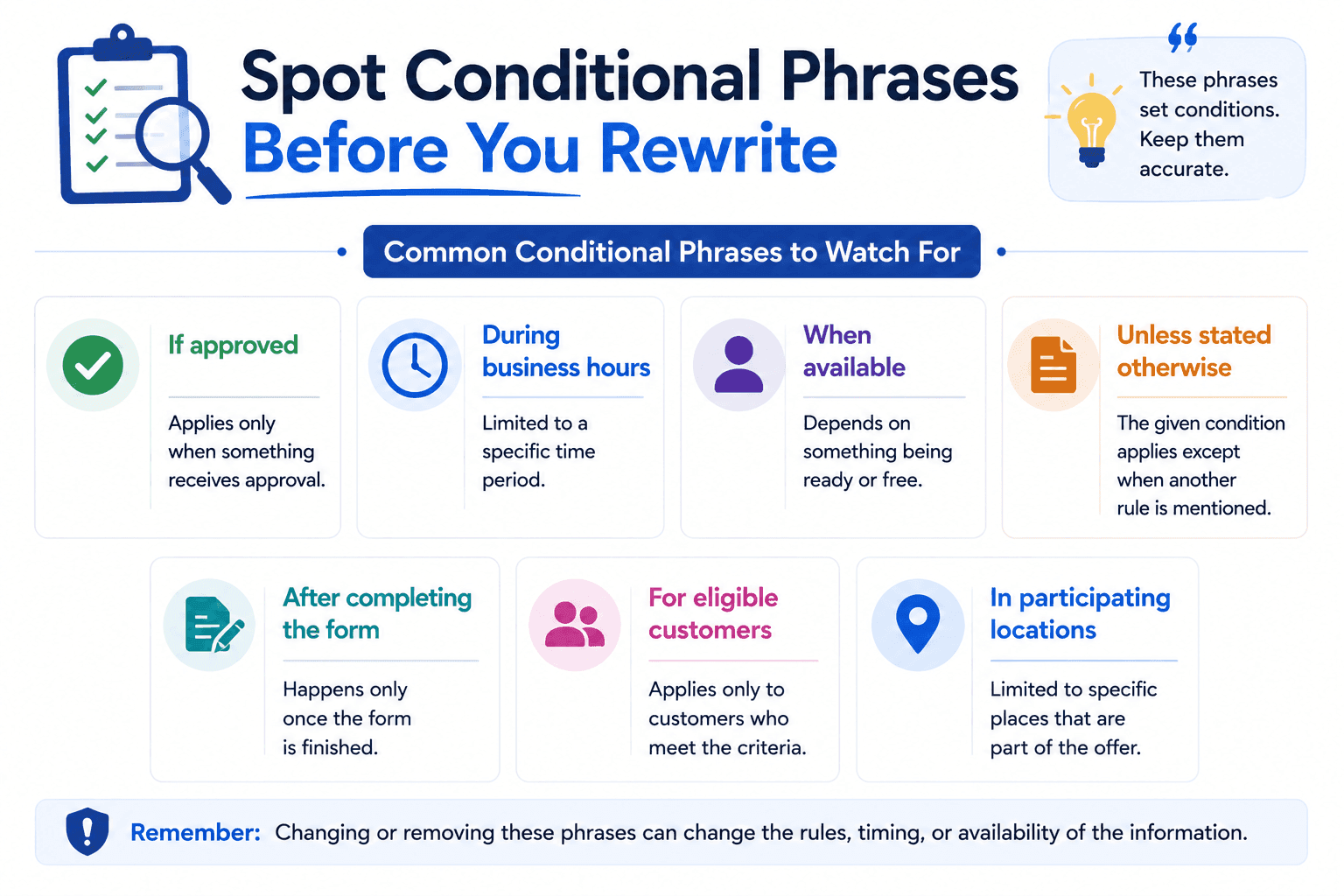
Removing one of these phrases may create a misleading promise.
4. Changing Positive and Negative Meaning
Negatives can be lost when sentences are shortened or reorganized.
Original:
The evidence does not prove that the treatment is ineffective.
This sentence does not say the treatment works. It only says there is not enough evidence to prove that it fails.
A misleading rewrite would be:
The treatment is effective.
That conclusion is not supported.
Be especially careful with phrases such as:
- Not impossible
- Not always
- Not necessarily
- Cannot confirm
- No evidence of
- Unlikely to
- Failed to prove
These phrases carry more nuance than a simple yes-or-no statement.
5. Strengthening or Weakening the Claim
A rewrite should keep the same level of confidence.
Original:
The program may help improve attendance.
Too strong:
The program improves attendance.
Much too strong:
The program guarantees perfect attendance.
Too weak:
The program is somehow connected with attendance.
The first sentence presents a possible benefit. The rewrite must preserve that cautious level of certainty.
Watch for changes such as:
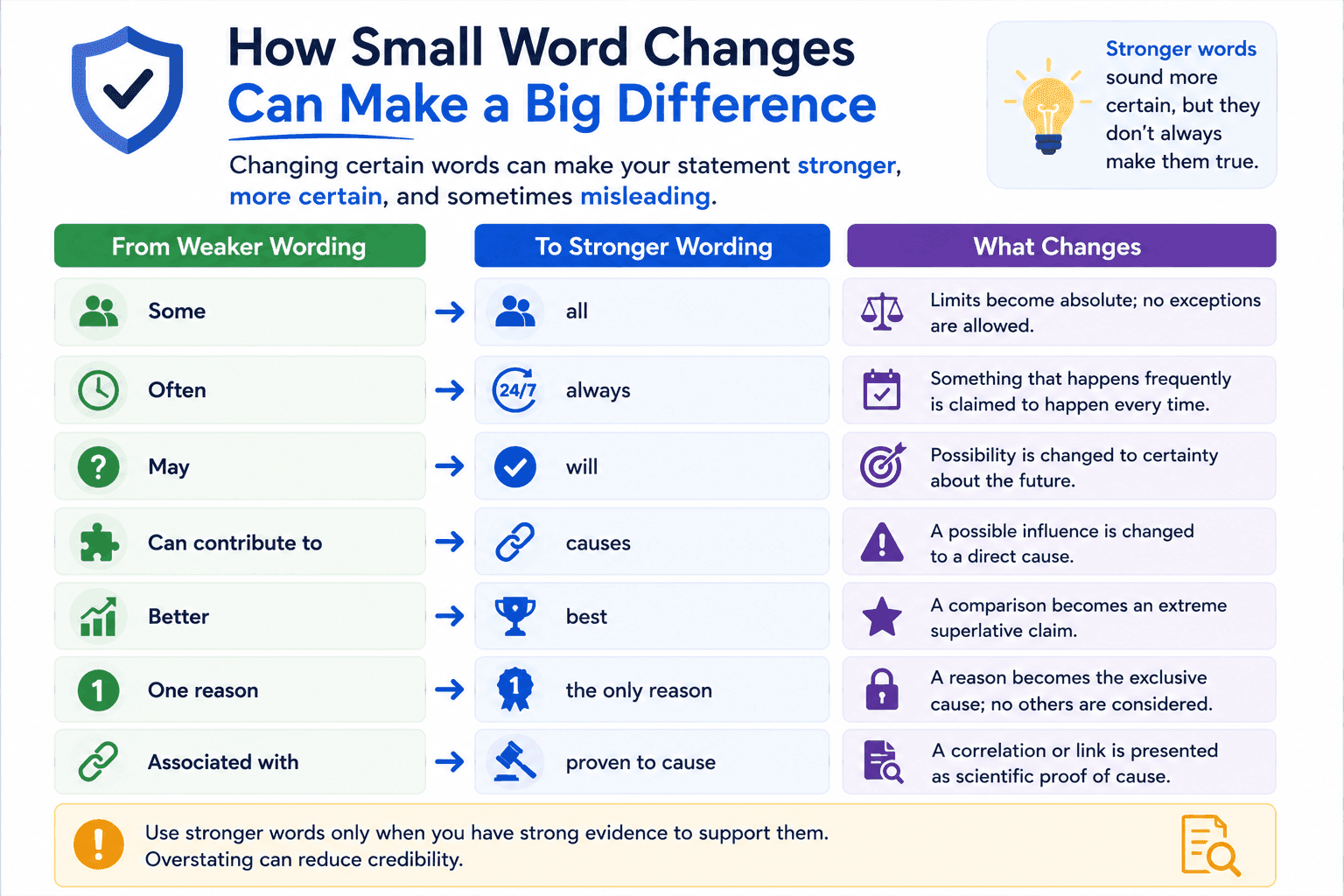
These substitutions may create factual errors even when the sentence sounds confident and polished.
6. Adding New Information
Rewriting should not introduce facts, opinions, reasons, or examples that were absent from the original.
Original:
The café added more tables to its outdoor area.
Incorrect rewrite:
Due to rising customer demand, the popular café added 20 new tables to its outdoor area.
The rewrite adds:
- A reason
- A judgment that the café is popular
- A specific number
Unless those details appear in the source or surrounding context, they should not be included.
A correct rewrite is:
More tables were added to the café’s outdoor seating area.
Creative writing part allows invention. Accurate rewriting does not.
7. Keeping Too Much Original Wording
Changing one or two words may not create an independent rewrite.
Original:
Online learning gives students greater control over when and where they study.
Weak rewrite:
Online education gives learners more control over when and where they study.
Stronger rewrite:
Students can choose their study time and location more freely when learning online.
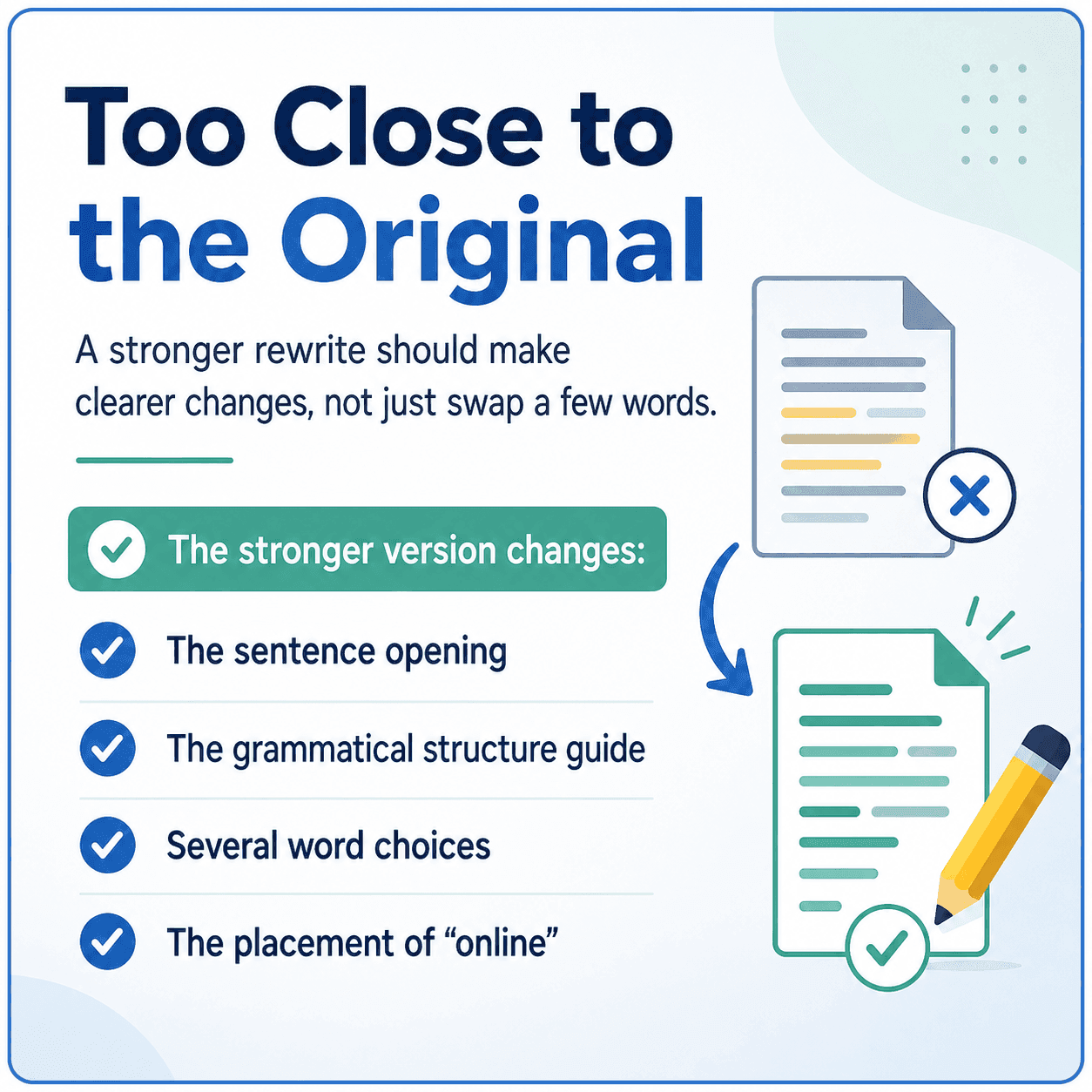
Even after a strong rewrite, cite the source when you borrow an idea.
While correcting all your paraphrasing-related issues, let’s know about -
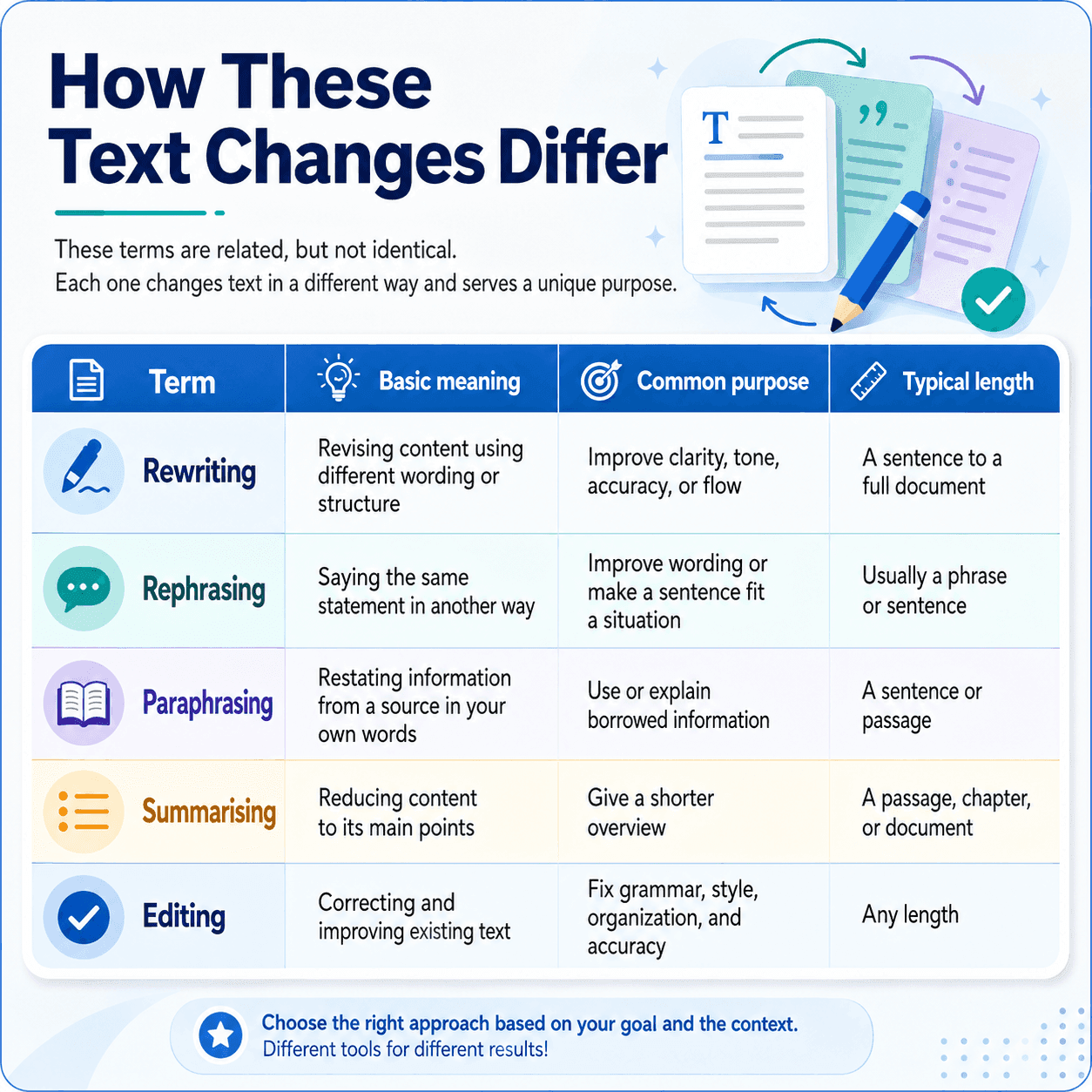
Rewriting vs Rephrasing vs Paraphrasing vs More - What’s the Difference?
Rewriting, rephrasing, and paraphrasing are often used as if they mean the same thing. They are closely related, but each one serves a slightly different purpose.
For example, you might rewrite a sentence to make it clearer, rephrase it to change how it sounds, or paraphrase it without plagiarism count when explaining someone else’s idea in your own words.
The differences may seem small, but understanding them matters, especially in academic writing, professional communication, and situations where you need to avoid plagiarism.
The comparison below shows what each term means, when it is commonly used, and how it differs from the others.
How to Use a Sentence Rewriter to Rewrite A Sentence
Sometimes you know what a sentence should say, but finding a clearer or more natural way to say it is where you get stuck.
You change a few words, undo them, try again, and somehow end up with a sentence that sounds worse than the original.
That is where a sentence rewriter can help.
Instead of starting from scratch, a sentence rewriter can suggest alternative wording, restructure the sentence, simplify complicated phrases, or give you several versions of the same idea within seconds.
A rewriting tool can occasionally change an important detail, make a claim stronger, or choose wording that does not fit the context.
So, the best approach is to use the tool for ideas and then review the result yourself.
Here is a simple step-by-step process to rewrite a sentence with a sentence rewriter while keeping the original meaning clear and accurate.
1. Choose the Sentence
Select the sentence you want to improve. Include enough context when the sentence contains unclear pronouns or references.
For example, instead of entering only:
This caused the problem.
Include the previous sentence so the tool understands what “this” refers to.
2. Paste the Text into the Tool
Enter the sentence into the input box. Check whether the tool has a word or character count limit before submitting a long passage.
3. Select the Appropriate Mode
A sentence rewriting tool may provide modes such as:
- Standard
- Fluent
- Formal
- Simple
- Academic
- Shortened
- Expanded
- Creative
Choose a mode based on your goal.
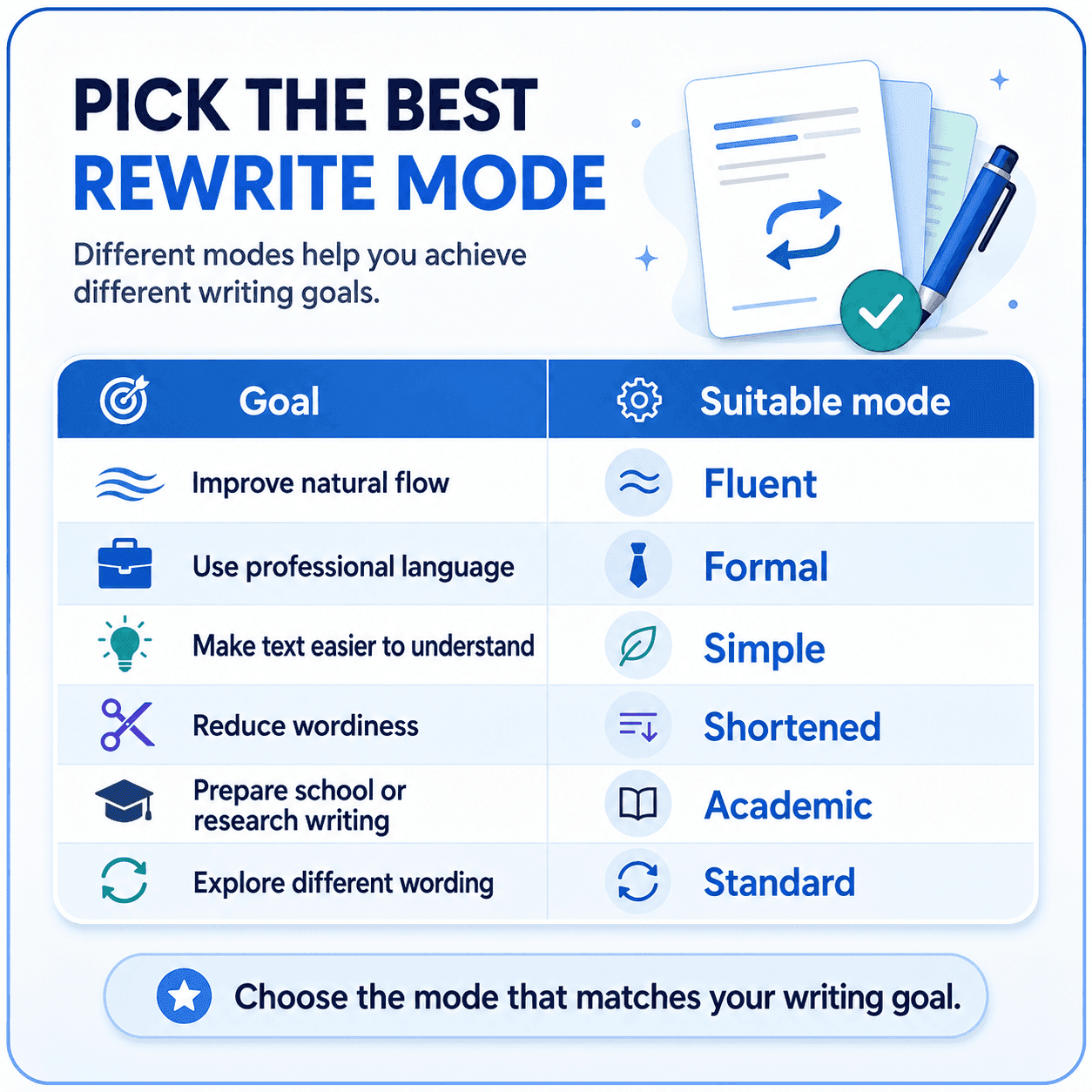
Creative modes may change more of the original text, so they require closer checking.
4. Generate the Rewrite
Review all available versions rather than automatically choosing the first one. One option may preserve the meaning better, while another may have a more natural structure.
5. Compare it With the Original
Use the meaning checklist:
- Is the main point unchanged?
- Are the same people and objects involved?
- Are all facts accurate?
- Are conditions still present?
- Is the level of certainty the same?
- Has any new information appeared?
- Does the tone suit the situation?
A text difference checker can also help you see which words and phrases were changed. It cannot judge meaning by itself, but it makes comparison easier.
6. Edit the Output
Do not treat generated text as untouchable. Replace awkward words, restore missing details, and adjust the sentence so it sounds natural in the full paragraph.
7. Check Grammar and Readability
A grammar checker tool can identify punctuation, agreement, spelling, and sentence-structure problems. A readability checker can help show whether the text may be too complex for its intended readers.
Readability scores should be treated as guides rather than unquestionable verdicts.
Research has long noted that formulas based mainly on sentence length and word difficulty cannot fully measure context, interest, organization, or the knowledge a reader brings to the text.
8. Check Sources When Necessary
When the rewritten sentence contains information from another person’s work, add the required citation. A sentence rewriter changes language, not ownership of the idea.
FAQs about Rewriting a Sentence
Can I rewrite a sentence without changing its meaning?
Yes, you can change its wording, clause order, grammatical form, or voice while preserving the original facts and intent.
Is changing synonyms enough to rewrite a sentence?
No. Synonym replacement alone can produce unnatural wording or change the meaning. Changing the sentence structure is usually more effective.
How do I know whether my rewrite has the same meaning?
Compare the subject, action, facts, tone, conditions, negatives, and level of certainty in both versions.
Can AI rewrite sentences accurately?
AI can create useful alternatives, but the result should be checked for changed facts, missing conditions, incorrect tone, or added information.
Does rewriting a sentence prevent plagiarism?
Rewriting can make the wording original, but you must still cite the source when the idea or information belongs to someone else.
Can I change active voice to passive voice without changing meaning?
Usually, yes. The basic action remains the same, although the emphasis may shift from the person performing the action to the action or recipient.
What words should not be removed while rewriting?
Do not carelessly remove negatives, modal verbs, quantities, dates, names, conditions, exceptions, or technical terms.
How much should I change when paraphrasing?
Change the wording and structure enough to express the idea independently. There is no fixed percentage that guarantees an acceptable paraphrase.
Should paraphrased sentences include citations?
Yes, when the information or idea comes from another source, a citation is normally required even when the wording is completely changed.
End Note
Rewriting a sentence successfully is not about finding the fanciest synonyms. It is about protecting the original message while improving the way that message is expressed.
Start by understanding the sentence clearly and identifying the details that must stay the same. Then adjust the structure, wording, voice, or length carefully.
Before using the final version, compare it with the original and check the facts, conditions, negatives, and qualifiers.
If you are struggling to find a natural alternative, you can use CopyChecker’s Sentence Rewriter to generate different ways of expressing the same idea.
It can be especially useful when you want to reword a sentence, improve clarity, or explore a different structure without starting from scratch.
Just remember to review the result and make sure the intended meaning is still intact.
The best rewrite is not simply the one that looks different from the original. It is the one that remains clear, natural, accurate, and faithful to what the sentence was meant to say.