If you're wondering how to become a proofreader, you might already have one useful instinct.
It can be noticing a missing apostrophe on a restaurant menu before deciding what to eat.
Turning that instinct into a career, however, takes more than spotting typos.
To become a proofreader, you need strong grammar and language skills, knowledge of professional proofreading methods, familiarity with style guides, and plenty of deliberate practice.
You don't need years of paid experience to start.
Honestly, you can develop your proofreading skills, build a portfolio, choose a specialty, and gradually start taking professional work.
If you want to become a proofreader, this guide will walk you through every step.
So, let’s get started without any further ado -
What Does a Proofreader Do?
A proofreader performs one of the final checks before written material is published, submitted, printed, or sent to its audience. The job commonly involves spotting:
- Spelling and typographical errors
- Grammar mistakes
- Punctuation problems
- Missing or repeated words
- Capitalization inconsistencies
- Formatting differences
- Incorrect numbering and headings
- Style inconsistencies
O*NET describes the proofreading occupation as detecting and marking grammatical, typographical, and compositional errors and checking corrected proofs to make sure changes were made properly.
But when people learn about proofreading, they often get confused between two similar terms.
One is proofreading, and the other is editing.
So let’s know more about them in the following section -
Which One Should You Take from Proofreading vs. Editing?
Proofreading and editing both improve written content, but they usually happen at different stages and solve different problems.
Editing focuses on strengthening the writing itself.
An editor may reorganize paragraphs, rewrite unclear sentences, remove repetition, improve the flow of ideas, or suggest larger content changes.
Proofreading comes later. Instead of reshaping the message, a proofreader checks whether the nearly finished version is accurate, clean, consistent, and ready to publish.
| Proofreading | Editing |
|---|---|
| Usually happens near the end | Usually happens earlier |
| Corrects surface-level errors | May make substantial changes to the content |
| Checks spelling, grammar, punctuation, and consistency | Improves structure, clarity, flow, and argument |
| Preserves the writer's established message | May reshape how the message is presented |
| Focuses on making the final version error-free | Focuses on making the writing stronger overall |
For someone learning how to become a proofreader, knowing that boundary of editing the same content is important.
Your job is not to rewrite every sentence you dislike. It is to recognize what genuinely needs correcting and leave intentional writing choices alone.
Now that you know the difference, let’s dive into the most awaited part of this article -
How to Become a Proofreader in 8 Simple Steps in 2026
Before applying for proofreading jobs, it’s helpful to understand what the path looks like.
Becoming a proofreader is more about building practical skills you can use on real writing than collecting qualifications.
The good news is you don’t need to master everything at once.
You can build these skills step by step, which is much more realistic than expecting to become a professional proofreader overnight.
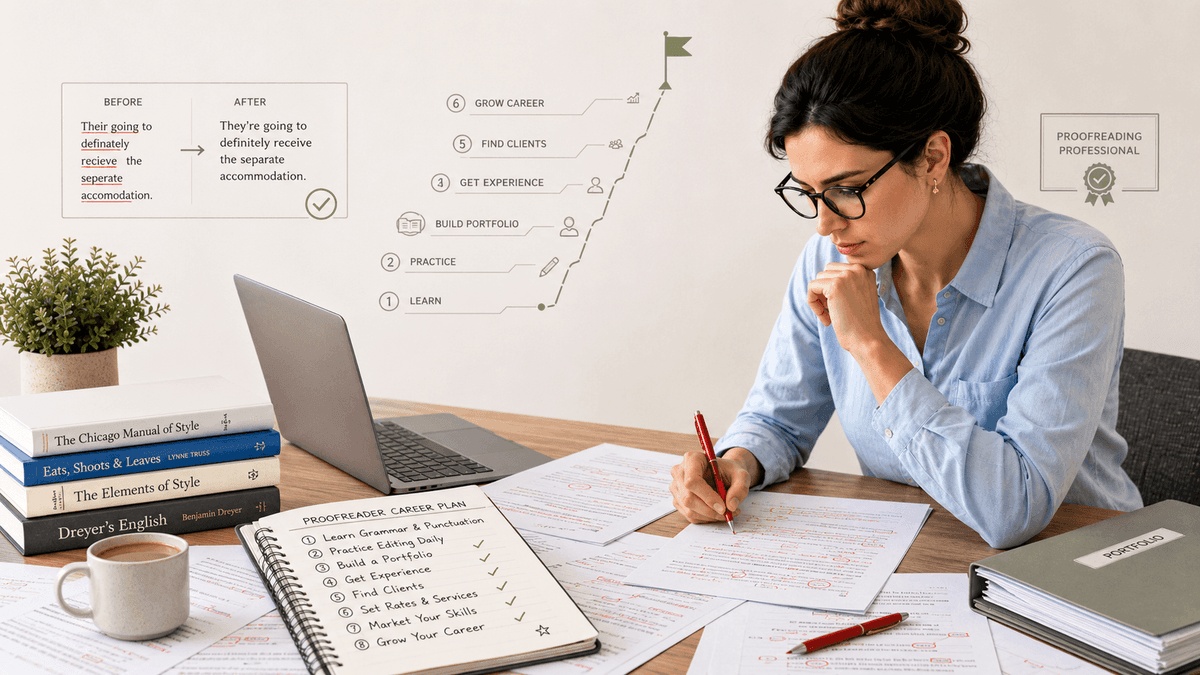
So, here are 8 simple steps to become a proofreader:
Step 1: Strengthen Your Grammar and Language Skills
Start with grammar, punctuation, spelling, sentence structure, word usage, and consistency.
Instead of memorizing rules randomly, learn the mistakes that appear repeatedly in real writing.
Subject-verb disagreement, sentence fragments, run-ons, comma splices, misplaced modifiers, apostrophe errors, and tense shifts are good places to begin.
A reliable guide to common grammar mistakes and how to fix them gives practical examples of many errors a beginner should learn to recognize.
But there's a catch: knowing English well doesn't automatically make someone a good proofreader.
Research into error detection found that errors in highly predictable sentences and common words can actually be easier to overlook.
Your brain is very good at seeing what it expects to see, which is charming until someone is paying you to find what shouldn't be there.
Step 2: Learn How Professional Proofreading Works
Professional proofreading needs a process. Instead of reading the document three times in exactly the same way, give each pass a purpose. For example:
- Check spelling and word errors.
- Check grammar and punctuation.
- Review capitalization, numbers, names and terminology.
- Inspect headings, formatting, spacing and layout.
- Review your own corrections.
You'll also need some familiarity with style guides such as The Chicago Manual of Style, AP Stylebook, APA, and MLA.
The relevant guide depends on the industry and client.
Don't assume every grammar rule you've heard since school is absolute either. Usage depends on context and style.
You just have to know some of the basic grammar rules that are often broken is a useful introduction to that distinction.
Step 3: Practice Proofreading Regularly
This is where aspiring proofreaders actually improve.
Find a short article, essay, email, product page, report, or other piece of text. Proofread it manually before checking it with anything else.
Then try something surprisingly effective: read it aloud.
In two experiments, researchers found that proofreading aloud improved detection of both typographical and contextual errors compared with silent proofreading.
You can also isolate specific weaknesses.
If incomplete sentences keep fooling you, practice with any trustworthy Sentence Fragment Checker tool.
If punctuation is your recurring nemesis, try out a Comma Splice Checker and study why each flagged construction is wrong.
Finally, run your manually checked text through any good proofreader tool.
Don't automatically accept everything.
Compare its suggestions with your own corrections and record the mistakes you missed.
After several sessions, you'll start discovering your personal error patterns.
That's much more useful than simply being told you're "good at grammar."
Step 4: Choose a Proofreading Niche
You don't have to proofread every kind of document. Common proofreading niches include:
- Books and manuscripts
- Academic papers
- Business documents
- Website and blog content
- Marketing copy
- Educational materials
- Technical documentation
- Legal or medical material
Specialization can make it easier to develop subject knowledge and position yourself for more focused proofreading jobs.
Academic proofreading, for instance, involves different expectations from marketing copy.
Beginners interested in that area can study a validated, proven essay grammar guide to see how problems such as run-ons, fragments, tense consistency, and academic word choice appear in longer writing.
Step 5: Learn the Tools Professional Proofreaders Use
Modern proofreading involves more than a red pen. Become comfortable with:
- Microsoft Word Track Changes
- Google Docs Suggesting mode
- PDF comments and annotations
- Dictionaries and style references
- Document comparison features
- Digital proofreading tools
If you’re proofreading academic, web, or published content, a plagiarism checker can also be useful for spotting matching passages that may need a closer look or proper attribution.
O*NET includes Microsoft Word, Adobe Acrobat, Adobe InDesign, Adobe InCopy, and style-guide databases among software associated with proofreading work.
A grammar checker can also be useful as an additional review layer, as it checks grammar, spelling, punctuation, sentence structure, clarity, and related writing issues.
The key phrase is additional review layer.
A professional proofreader still needs to understand context and decide whether a proposed correction is appropriate.
Step 6: Build a Proofreading Portfolio
One awkward problem confronts every beginner:
How do you get proofreading experience when clients want proof of experience?
Create the evidence yourself.
Build three to five strong proofreading portfolio samples. For each one, consider showing:
- A short original passage
- Your marked-up version
- The corrected version
- A few notes explaining important corrections
Include different types of writing if you haven't chosen a niche yet.
You can also offer to proofread material for a local organization, small business, student group, nonprofit, or someone in your professional network.
Get permission before publicly displaying anyone else's material.
Your portfolio isn't supposed to prove you've corrected a million words. It should prove you know what you’re doing with the words in front of you.
Step 7: Choose Between Freelance and Employed Proofreading
There are two broad routes into a proofreading career.
A freelance proofreader can choose clients, set rates, work remotely, and gradually specialize.
The trade-off is that you'll also need to find clients, meet deadlines, market yourself, and manage inconsistent workloads.
An employed proofreader may have a more predictable schedule and income but less freedom over projects.
You don't necessarily need to choose one forever.
Beginners can apply for online proofreading jobs while accepting smaller freelance assignments to build experience.
Step 8: Start Looking for Proofreading Work
Once you have practice and portfolio samples, start looking where proofreading is actually needed. Potential clients and employers include:
- Publishers
- Authors
- Marketing agencies
- Content teams
- Businesses
- Universities and academic services
- Media organizations
- Freelance marketplaces
- Remote job boards
Create a short professional introduction that explains your niche, experience, proofreading tools, turnaround time, and the types of documents you handle.
Expect some employers or clients to test your proofreading ability before hiring you.
Treat those tests seriously.
They reveal more about your actual skill than another paragraph on your résumé claiming you're “detail-oriented.”
As you got the steps while focusing on that, let’s know about -
What Skills Do You Need to Become a Proofreader?
Successful proofreaders need more than a good understanding of spelling and punctuation.
The job requires you to spot small errors, stay focused on detailed text, follow specific writing standards, and make accurate corrections without unnecessarily changing the writer’s meaning or voice.
Some of these abilities come from language knowledge, while others develop through regular proofreading practice and working with different types of content.
The most important proofreading skills include:
- Strong command of language
- Attention to detail
- Grammar and punctuation knowledge
- Concentration
- Research skills
- Consistency checking
- Familiarity with style guides
- Time management
- Clear communication
- Confidence using document-review software
O*NET specifically lists attention to detail, cautiousness, and dependability among the important work styles associated with proofreaders.
Another useful quality is being willing to question yourself.
A study examining proofreading performance found that participants tended to be overconfident about their ability to detect errors.
That’s a good reason to use checklists, multiple passes, and second-review tools instead of assuming your first read caught everything.
Now the most common question that arises whenever it's about proofreading is that -
Do You Need Qualifications to Become a Proofreader?
There is no single route into professional proofreading.
A background in English, journalism, communications, publishing, or another writing-heavy subject can be useful.
Specialized areas such as medicine, law, science, and academia may require stronger subject knowledge.
A proofreading course or certificate can also help you learn editorial conventions, proofreading marks, style guides, and workflow.
But qualifications alone don't demonstrate accuracy.
Your practice results, portfolio, ability to follow a style guide, and performance on proofreading tests can provide much stronger evidence of what you can actually do.
If you want to learn proofreading in a structured way, several reputable online platforms offer courses for beginners and advanced learners.
For example, Coursera and Udemy both have proofreading and editing courses that cover grammar, style guides, and practical proofreading exercises.
These courses often include real-world assignments, feedback, and certification options, helping you gain both knowledge and credibility as you start your proofreading journey.
So you know what you have to do, right?
Now comes the most important question, and it’s nothing but -
How Much Do Proofreaders Make?
Proofreading salary ranges basically depend on experience, location, industry, specialization, and whether you're employed or freelance.
According to 2025 U.S. wage data reported by O*NET using Bureau of Labor Statistics data, proofreaders and copy markers had a median wage of $24.58 per hour, or $51,120 annually.
Freelance rates vary more widely because proofreaders may charge per hour, word, page, or project.
The occupation is also changing. O*NET reports about 12,000 U.S. workers in 2024 and projects approximately 1,900 openings per year from 2024 to 2034, largely including replacement openings even as overall employment is projected to decline slightly.
That makes developing specialist knowledge and modern digital proofreading skills especially worthwhile.
Can You Become a Proofreader With No Experience?
Yes, you can become a proofreader with no professional experience, but that doesn't mean you can't prepare.
A practical beginner pathway for how to become a proofreader is:
Learn → practice → identify weaknesses → create samples → build a portfolio → take smaller projects → collect testimonials → specialize → increase your rates.
Practice deliberately rather than proofreading random pages endlessly.
Study the errors you miss and understand why you missed them if you want to master how to become a proofreader.
For example, learning why passive constructions sometimes make sentences harder to follow is more useful than treating every passive sentence as automatically wrong.
You can find out passive voice examples that can help you understand that distinction more clearly.
Common Mistakes New Proofreaders Should Avoid
Learning what not to do is just as important as learning how to proofread correctly.
Beginners often change too much, rush through the text, or rely too heavily on automated tools instead of using their own judgment.
A good proofreader should know the scope of the assignment, follow the required style, and make only the changes that genuinely improve accuracy and consistency.
When a sentence genuinely needs rewording rather than a simple correction, a paraphrasing tool can help you explore clearer alternatives. Just make sure rewriting is actually within the scope of the job before changing the author’s wording.
Watch out for these common mistakes:
- Editing when the assignment only requires proofreading
- Trusting automated suggestions without checking context
- Rewriting sentences unnecessarily
- Proofreading too quickly
- Trying to catch every type of error in one pass
- Ignoring formatting and layout
- Forgetting the required style guide
- Changing specialist terminology without checking it
- Failing to review your own corrections
Also remember that readability and grammatical correctness aren't identical. A sentence can be technically correct and still be exhausting to read.
A trustworthy guide explaining how content readability is measured is useful background for understanding that difference.
FAQs on How to Become a Proofreader
How long does it take to become a proofreader?
There is no fixed timeline. Someone with strong language skills may start practicing and building a portfolio quickly, while specialist proofreading may require additional training.
Can I become a proofreader without a degree?
Yes. A relevant degree can help, particularly in specialist areas, but practical proofreading ability, subject knowledge, portfolio samples, and experience also matter.
Is proofreading a good work-from-home job?
A remote proofreading job is a good fit because you can handle documents, comments, corrections, and client communication digitally. Freelance proofreading is therefore one route for people seeking location-flexible work.
Can I become a proofreader with no experience?
Yes. Start by practicing on real content, building a few proofreading samples, and taking small projects to gain experience.
Do you need a proofreading certification to become a proofreader?
No. A certification can help, but clients and employers usually care more about your accuracy, skills, portfolio, and proofreading test performance.
Are proofreaders still in demand in 2026?
Yes. Proofreaders are still needed for publishing, academic, business, legal, technical, and other content where human judgment and context matter.
How do I get my first proofreading job?
Build a small portfolio, choose a niche, and start applying through freelance platforms, job boards, agencies, or direct outreach. Small beginner projects can help you collect testimonials and experience.
Can proofreading be a full-time career?
Yes. Proofreaders work with publishers, businesses, authors, educational organizations, agencies, and specialist industries. Some combine proofreading with editing or other editorial services.
What is the best way to practice proofreading?
Proofread real-world text slowly, use separate passes for different error types, read difficult sections aloud, and compare your corrections with a reliable second review. Most importantly, track recurring mistakes so your practice targets weaknesses instead of repeating what you're already good at.
Start Practicing Your Proofreading Skills
Learning how to become a proofreader ultimately comes down to doing the work repeatedly and learning from the errors that escape you.
All you have to do is take one short piece of writing. Proofread it manually. Read it aloud. Check punctuation and formatting separately.
Then use CopyChecker’s online proofreader as a second review and compare the results.
Keep a record of what you missed.
Over time, that list becomes more than a collection of mistakes.
It becomes a map showing exactly what you need to improve before taking on professional proofreading work.
So start now and see the magic!