


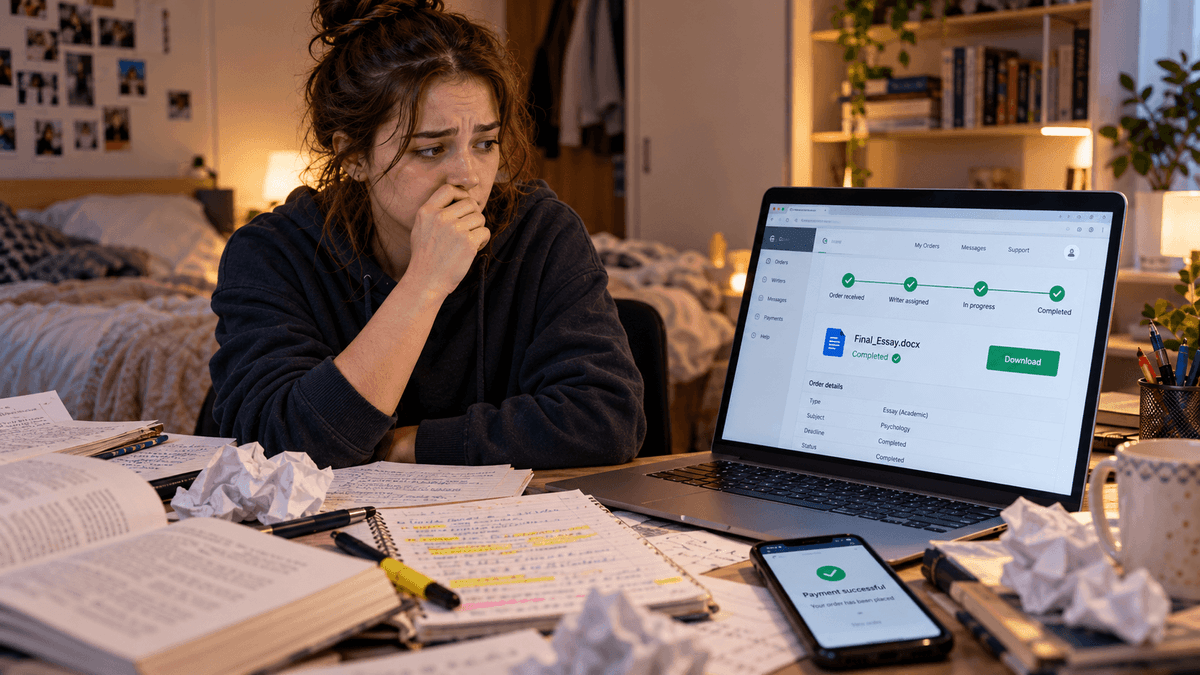
It's almost midnight, and an important assignment is due tomorrow.
You've spent hours researching, rewriting paragraphs, and trying to make sense of your notes.
Meanwhile, your classmate seems unusually relaxed. No messy drafts, no last-minute panic.
Just a finished assignment, ready to submit.
The secret? Someone else wrote it for them.
And while that might sound like an easy way out, there's a serious academic integrity issue hiding behind it: contract cheating.
Contract cheating happens when students have someone else complete their academic work and submit it as their own.
Money doesn't even have to change hands.
A friend writing your essay for free can cross the same line.
But here's where things get tricky.
Students get help from tutors, writing centers, and editing tools all the time.
Surely, not all of that counts as cheating?
So, when does getting academic help turn into academic misconduct?
Let's break down what contract cheating really means, how it differs from plagiarism, and how to recognize the line between legitimate support and dishonest shortcuts.
What Is Contract Cheating in Education?
Contract cheating is a form of academic misconduct in which students outsource their assessed work to someone else and present the completed work as their own.
The third party might be a professional writer, an online assignment service, a classmate, a tutor, or even a family member.
Importantly, the arrangement doesn't have to involve payment.
According to Australia's Tertiary Education Quality and Standards Agency (TEQSA), contract cheating can include outsourcing assignments, improperly using file-sharing platforms, or arranging for someone else to take an examination.
Here's a simple example:
Daniel has a 2,000-word research paper due on Friday.
Instead of conducting research and writing the paper himself, he hires an online writer to complete it.
The writer produces an original essay, and Daniel submits it under his own name.
Although the essay might contain no copied passages, Daniel has misrepresented who completed the work.
That's contract cheating.
The key issue isn't whether the writing is original.
It's whether the student genuinely completed the assessment they were supposed to do.
But paying someone to write an essay is just one example.
Contract cheating can happen in several other ways, including situations where students might not even realize they're crossing the line.
So, what does contract cheating actually look like beyond buying an essay?
Let's look at its most common forms.
What Are the Common Types of Contract Cheating?
Contract cheating goes far beyond purchasing essays from suspicious websites.
It can happen through familiar people, apparently legitimate academic services, and online platforms.
Here are six common forms.
1. Essay Mills and Assignment Writing Services
An essay mill is a commercial service that produces academic assignments for students, usually for a fee.
Some advertise customized essays, research papers, dissertations, or homework solutions.
They might promise original writing, fast delivery, or a particular grade.
However, an essay written specifically for a student is still outsourced work if the student submits it as their own.
This is different from the other types of plagiarism students might encounter.
For example, buying a custom history essay and submitting it for credit is contract cheating, even if the seller claims it is plagiarism-free.
2. Academic Ghostwriting
Basically, academic ghostwriting involves someone writing assessed academic content while another person takes credit for it.
A ghostwriter might complete an entire assignment or contribute substantial sections to a dissertation, research report, or other assessed project.
The distinction comes down to authorship.
Receiving feedback is different from having someone develop your arguments, analyze your findings, and write your conclusions.
3. Friends or Family Completing Assignments
Not all contract cheating involves strangers or commercial services.
Suppose a student asks an older sibling to write their sociology assignment.
The sibling agrees, doesn't request payment, and produces a completely original paper.
Is that still cheating?
Yes, when the assessment requires the student to complete the work independently.
This is why contract cheating extends beyond buying academic papers.
Even unpaid help can become academic misconduct when someone else performs the student's assessed work.
4. Unauthorized Tutoring and Editing
Tutoring is generally intended to help students understand a subject.
However, it can cross into contract cheating when the tutor completes the assessment instead of helping the student learn.
Consider these two situations:
- Acceptable help: A tutor explains how to structure an argumentative essay and provides feedback on the student's own draft.
- Unacceptable help: A tutor develops the entire argument, writes the essay in high quality, and gives it to the student for submission.
The same distinction applies to editing.
Correcting spelling, grammar, and punctuation may be allowed under university rules.
However, rewriting entire sections, adding original arguments, or completing the analysis can exceed permitted assistance.
Quick Tip: Before using an external editor or tutor, check what your institution allows. Permission depends on the assignment and academic-integrity policy, not the service's advertising.
5. Exam Impersonation and Outsourced Coursework
Contract cheating isn't limited to written assignments.
A student might pay someone to complete an online exam, solve graded programming problems, produce a design project, or participate in an assessed activity on their behalf.
For example, asking a freelancer to build an application for a graded programming assignment can be contract cheating if the student submits it as their own work.
The subject and submission format may change, but the underlying problem remains the same: someone else completes the assessment.
6. Assignment Sharing and Purchased Solutions
File-sharing platforms can help students exchange study materials, but they can also facilitate academic misconduct.
Imagine downloading a completed assignment from another student's account and submitting it with minor changes.
If the material is not authorized for reuse, this can be part of plagiarism cases, contract cheating, or other academic misconduct, depending on the circumstances.
This distinction matters because using a worked example to understand a topic isn't the same as submitting someone else's completed solution.
Now, we've covered the different ways contract cheating can happen.
But knowing the types is one thing; recognizing them in everyday academic situations is another.
After all, some situations are obvious, while others can leave students wondering whether they've crossed the line.
So, let's look at a few realistic examples to understand what counts as contract cheating and what falls under legitimate academic support.
What Are Some Real-Life Examples of Contract Cheating?
Sometimes, the difference between legitimate support and contract cheating isn't immediately obvious.
Consider these fictional but realistic student situations.
| Student situation | Is it contract cheating? | Why? |
|---|---|---|
| Sarah pays a freelancer to write her essay. | Yes | Someone else completes her assessed work. |
| James asks his brother to finish his assignment for free. | Yes | Payment isn't required for unauthorized outsourcing. |
| Emma hires a tutor to explain a difficult mathematical concept. | Generally no | She receives instruction but completes the work herself. |
| Noah buys a completed programming project and submits it. | Yes | He claims someone else's work as his own. |
| Mia uses an approved writing center to review her essay structure. | Generally no | Feedback supports her own writing process. |
| Olivia copies paragraphs from an online article without citations. | Not necessarily contract cheating | This is plagiarism, but it doesn't automatically involve outsourcing. |
| Ethan hires an editor to rewrite his entire dissertation chapter. | Potentially yes | Substantive rewriting can amount to unauthorized authorship assistance. |
These examples highlight something students often overlook: getting help isn't automatically cheating, but submitting work completed by someone else can be.
A Simple Test Before Accepting Academic Help
Ask yourself three questions:
- Who is doing the actual thinking and writing? Are you developing the arguments and producing the answers?
- Could you explain the submitted work yourself? Do you understand the reasoning, evidence, and conclusions?
- Does your institution allow this kind of assistance? Have you checked the relevant instructions?
If you're uncertain about the third question, ask your instructor before submitting the work.
Being able to explain an outsourced assignment doesn't make it acceptable.
The work must also comply with the rules governing the assessment.
But there's another important distinction worth understanding.
Remember Olivia from our earlier examples?
She copied paragraphs from an online article without citing the source.
That's plagiarism, but it doesn't necessarily mean she committed contract cheating.
So, if both involve presenting someone else's work as your own, what exactly makes contract cheating different from plagiarism?
Let's clear up that confusion.
Contract Cheating vs. Plagiarism: What's the Difference?
Contract cheating and plagiarism are related forms of academic misconduct, but they aren't exactly the same.
Plagiarism generally involves using someone else's words, ideas, or work without appropriate acknowledgment.
Contract cheating focuses on having someone else complete assessed work and misrepresenting its authorship.
This means a student can commit contract cheating without copying a single sentence from an existing source.
Here's how they compare:
| Aspect | Contract Cheating | Plagiarism |
|---|---|---|
| Main problem | Misrepresenting who completed the assessment | Improperly using or attributing another person's work |
| Example | Paying someone to write an original essay | Copying an article without citation |
| Requires payment? | No | No |
| Involves copied text? | Not necessarily | May involve copied wording or uncredited ideas |
| Can plagiarism software help? | Sometimes, but matching alone cannot prove outsourcing | Can flag matching text for review |
| Is it academic misconduct? | Yes, where it breaches assessment rules | Yes |
| Can both happen together? | Yes | Yes |
Looking at these differences, one thing becomes clear: contract cheating is about who completes the work, while plagiarism is about how someone else's work or ideas are used and acknowledged.
But here's something interesting.
These two forms of academic misconduct aren't always separate.
In fact, a single assignment can involve both contract cheating and plagiarism at the same time.
How does that happen?
Let's look at an example.
Can Contract Cheating and Plagiarism Happen Together?
Absolutely.
For example, a student might purchase an essay that contains paragraphs copied from published research without proper citations.
In that case, the student has submitted outsourced work and may also have submitted plagiarized material.
However, the reverse isn't always true.
A student who independently writes an essay but forgets to acknowledge a source might commit unintentional plagiarism without engaging in contract cheating.
Similarly, changing the wording of an existing source doesn't automatically make its ideas yours.
Understanding the difference between paraphrasing and plagiarism can help students avoid misrepresenting their sources.
Remember: A plagiarism-free document isn't necessarily an academically honest submission. Proper attribution and genuine authorship are separate responsibilities.
And that brings us to another question that's becoming increasingly relevant in education -
Does Using AI Count as Contract Cheating?
AI writing assistants have introduced another question into academic integrity discussions: Is using AI to complete an assignment a form of contract cheating?
The answer depends on how the technology is used and how the institution classifies unauthorized assistance.
Traditional contract cheating involves outsourcing assessed work to another person or service.
Some universities address prohibited AI-generated work under broader academic-misconduct rules rather than labeling every instance as contract cheating. T
The related question of whether using AI is plagiarism requires its own distinction.
For example:
| AI-related Activity | Academic Integrity Consideration |
|---|---|
| Using AI to brainstorm possible research questions | May be permitted if the course allows it |
| Using an approved tool to check spelling and grammar | Often permitted within specified limits |
| Asking AI to explain a difficult concept | May be acceptable as study support |
| Generating a complete essay and submitting it as independent work | Likely misconduct when prohibited by assessment rules |
| Using AI to fabricate citations or research findings | Academic misconduct |
| Using AI to rewrite another person's assignment for submission | May involve plagiarism, unauthorized AI use, or other misconduct |
The real question isn't simply whether AI was involved.
It's whether the student used it in a way that complies with the assessment's requirements.
For instance, reviewing grammar suggestions with an approved grammar checker may be acceptable, while allowing an AI system to produce the entire analysis could violate the rules.
Practical Advice: Check your syllabus, assignment instructions, and university AI-use policy. Where disclosure is required, explain which tools you used and how they contributed to your work.
Whether it's AI, an online writing service, or help from another person, the boundaries ultimately depend on what an assessment allows.
But knowing these rules doesn't necessarily mean every student follows them.
Some students still turn to contract cheating, even when they're aware of the academic risks.
So, what pushes students to take that chance?
Is it simply about getting better grades with less effort, or are there other pressures behind the decision?
Let's look at some of the common reasons.
Why Do Students Engage in Contract Cheating?
If the consequences can be serious, why do students still outsource their assignments?
The reasons are more complicated than simply wanting an easy grade.
Academic Pressure and Tight Deadlines
Students often balance multiple assignments, exams, jobs, and personal responsibilities.
When several deadlines overlap, paying someone to finish an assignment can seem like a convenient escape.
However, outsourcing the work creates additional risks rather than solving the underlying problem.
Lack of Confidence
Some students struggle with research, academic writing, unfamiliar subjects, or studying in a second language.
Rather than asking for support, they may assume they cannot complete the assignment successfully.
Fear of Failure
Academic expectations, scholarships, grades, and family pressure can make failure feel unacceptable.
As a result, students may seek shortcuts when they believe they have no other options.
Misleading Assignment Service Advertising
Commercial writing services often present themselves as ordinary academic support providers.
Promotional claims about customized assignments or plagiarism-free writing can blur the distinction between legitimate learning assistance and unauthorized outsourcing.
And when you put all these factors together, it's easier to understand why some students end up turning to contract cheating.
But here's something worth thinking about.
Are these just occasional cases involving a handful of students, or is contract cheating more common than we might expect?
Researchers have actually investigated this question, and their findings offer a clearer picture of how widespread the practice has been.
Let's take a look at what the research tells us.
How Common Is Contract Cheating?
Research suggests the problem is significant, although reported rates vary across studies and definitions.
In a 2018 systematic review published in Frontiers in Education, researcher Philip M. Newton examined 71 survey samples from 65 studies involving 54,514 participants.
Across those historical samples, 3.52% of participants reported participating in commercial contract cheating.
The review also found a higher figure of 15.7% in the subset of samples collected from 2014 onward.
These figures are historical research findings, not estimates of how many students engage in contract cheating today.
The author also noted limitations in sampling and self-reporting.
Nevertheless, the findings show why universities treat contract cheating as an important academic-integrity issue.
But recognizing that the problem exists is one thing.
Figuring out whether a particular student has actually outsourced their work is another.
Think about it.
If someone pays a writer to create an entirely original essay, there might not be a single copied sentence for plagiarism software to flag.
So, how do universities identify contract cheating when the submitted work appears original?
Let's explore the methods they use and why detecting outsourced work isn't always straightforward.
How Do Universities Detect Contract Cheating?
One of the biggest misconceptions about contract cheating is that universities can detect it simply by running an assignment through plagiarism-detection software.
In reality, identifying outsourced work can be much more complicated.
Universities may examine writing patterns, document information, the student's understanding of the assignment, and other evidence.
1. Changes in Writing Style and Academic Performance
Instructors sometimes notice significant differences between a student's submitted assignment and their previous work.
For instance, an essay might use unfamiliar terminology, unusually advanced arguments, or a writing style that differs substantially from earlier assignments.
However, writing differences alone don't establish misconduct.
Students improve, receive legitimate support, and adapt their writing styles.
Therefore, unusual writing patterns should be treated as potential indicators rather than proof. That same caution matters when considering how teachers detect AI writing.
2. Document Metadata, References, and Draft History
Documents can contain information about their creation and editing history.
Depending on the file format, instructors may examine details such as:
- Document author information
- Creation and modification dates
- Editing history
- Unusual formatting or templates
- References that don't support the assignment's arguments
For example, a submitted document may contain another person's name in its author properties.
Still, metadata isn't conclusive. Shared devices, document templates, and legitimate collaboration can also explain unusual file properties.
An instructor may also ask students to explain their research process or provide earlier drafts.
Australia's TEQSA guidance on contract cheating detection emphasizes gathering relevant evidence and allowing students to respond to concerns.
3. Plagiarism Checkers and Authorship Review
A plagiarism checker can help identify similarities between an assignment and other available text.
This is useful for reviewing unattributed quotations, copied passages, and potential source misuse.
However, contract cheating presents a different challenge.
Suppose someone is paid to write a completely new essay.
Because the document may not contain substantial copied text, a similarity report might show very few matches.
That doesn't prove the work was completed independently.
Likewise, a high similarity score doesn’t automatically prove contract cheating. If the percentage itself is confusing, it helps to understand what plagiarism similarity scores actually mean.
Properly quoted passages, references, and standard terminology can all contribute to text matches.
Important distinction:
- A similarity report helps identify matching text.
- An authorship review considers whether the student produced the work.
- An academic misconduct decision should consider reliable evidence and the institution's procedures.
For students reviewing their own work, checking source attribution before submission can help prevent accidental plagiarism.
It should not be treated as a way to verify or conceal outsourced authorship.
And this is exactly why universities need to look beyond similarity scores and consider the full picture before reaching a decision.
After all, an accusation of contract cheating isn't a minor matter.
If an investigation confirms that a student has submitted someone else's work, the consequences can affect much more than a single assignment.
So, what actually happens when a student is found responsible for contract cheating?
Is failing the assignment the worst possible outcome, or can the consequences follow them beyond university?
Let's look at the academic, personal, and potential legal risks involved.
What Are the Consequences of Contract Cheating?
The consequences of contract cheating in universities can extend beyond receiving a low grade.
Exact penalties vary by institution, the severity of the misconduct, and whether the student has previous academic-integrity violations.
1. Academic Penalties
Possible consequences include receiving zero marks for an assessment, failing a course, or being required to repeat an assignment or module.
2. Suspension or Expulsion
Serious or repeated misconduct may result in suspension or expulsion, depending on university regulations.
In some circumstances, disciplinary outcomes may also affect scholarships, progression, or professional training.
The consequences of plagiarism may overlap, although the underlying misconduct is not identical.
3. Loss of Knowledge and Skills
Even when outsourced work receives a high grade, the student misses the learning that the assignment was designed to develop.
For example, purchasing a programming project might help someone pass an assessment without developing the skills needed for later courses or employment.
4. Privacy and Blackmail Risks
Commercial cheating services may request personal information, student details, assignment instructions, or access to academic systems.
Sharing these details creates potential privacy and security risks.
Some students may also face threats or demands for further payment from providers who know they have engaged in misconduct.
5. Legal Risks for Commercial Providers
The legal position varies between countries.
In England, legislation introduced in 2022 made certain commercial essay-writing services and their advertising criminal offenses.
The Quality Assurance Agency (QAA) explains this legal development in its contract-cheating guidance.
However, violating a university's academic rules isn't automatically the same as committing a criminal offense.
Students and service providers may face different legal responsibilities depending on the jurisdiction.
The Bigger Picture: Contract cheating can affect grades, academic standing, personal security, and future learning opportunities. A completed assignment may solve an immediate deadline problem while creating much larger ones.
With so much at stake, avoiding contract cheating is clearly a better choice than dealing with its consequences later.
But that doesn't mean students have to struggle through every assignment alone.
Remember the examples we discussed earlier?
Getting feedback from a tutor, using a grammar checker, or asking someone to explain a difficult concept isn't necessarily cheating.
The important thing is knowing where legitimate academic support ends and unauthorized assistance begins.
So, how can students get the help they need without putting their academic integrity at risk?
Let's walk through some practical ways to do exactly that.
How Can Students Avoid Contract Cheating?
Avoiding contract cheating doesn't mean refusing every form of outside help.
It means knowing which support is permitted and keeping responsibility for your own assessed work.
Here are six practical habits that make a difference.
1. Read Your Academic Integrity Guidelines
Before starting an assignment, review your institution's academic-integrity policy.
Look for instructions covering collaboration, tutoring, proofreading, AI assistance, citations, and independent work.
If something is unclear, ask your instructor instead of relying on advice from a third-party service.
2. Break Large Assignments Into Smaller Tasks
A major research paper can feel overwhelming when you treat it as one enormous project.
Instead, divide it into manageable stages:
- Understand the research question.
- Find and evaluate relevant sources.
- Create an outline.
- Draft one section at a time.
- Review citations and arguments.
- Proofread the final submission.
This approach makes it easier to identify problems early and request legitimate academic support.
3. Use Tutors for Guidance, Not Completed Answers
A tutor should help you understand concepts, improve your reasoning, and develop skills.
For example, asking someone to explain a mathematical formula is different from paying them to complete your graded problem set.
A useful rule is to seek explanations and feedback rather than ready-to-submit answers.
4. Keep Your Own Research Notes and Drafts
Maintain records of your research process, including source details, outlines, notes, and previous drafts.
These materials help you track how your argument developed and avoid losing important citations.
They may also help explain your writing process if questions arise about a submission.
5. Review Paraphrasing and Citations Carefully
Good academic writing often involves explaining existing research in your own words.
Learning how to paraphrase without plagiarism is more useful than simply swapping words.
However, paraphrasing doesn't eliminate the need to acknowledge the original source.
When summarizing or rewriting research, make sure you:
- Understand the original meaning.
- Write the explanation independently.
- Preserve the author's intended ideas.
- Cite the source correctly.
- Clearly distinguish your conclusions from someone else's findings.
A final plagiarism check may help reveal passages that need closer citation review, but it cannot replace proper research and attribution.
For a longer paper, a research-paper plagiarism review should also consider citations, quoted material, and source context.
6. Ask for Help Before the Deadline Becomes a Crisis
If you are struggling with an assignment, contact your instructor, academic adviser, writing center, or student support service.
Many institutions provide legitimate academic assistance, and some offer extensions or other support when students face difficult circumstances.
The earlier you ask, the more options you may have.
Now, following these practices can help you stay on the right track throughout the writing process.
But what about that final moment, when your assignment is finished and you're just about to hit submit?
How can you be sure you haven't unintentionally crossed any academic integrity boundaries along the way?
Before handing in your work, take five minutes to review a few important things.
Think of it as one final check to make sure your submission genuinely reflects your own effort.
The Five-Minute Academic Integrity Check
Before submitting your next assignment, ask or work through a more detailed academic integrity checklist for students:
- Did I complete the assessed work myself?
- Have I acknowledged the sources behind borrowed ideas?
- Was all outside assistance permitted?
- Can I explain my arguments, methods, and conclusions?
- Have I followed the institution's rules for using AI and editing tools?
If you cannot confidently answer one of these questions, review the relevant requirement before submitting.
But what if you've already crossed that line?
Maybe you paid someone to complete an assignment, shared your login details with an online writing service, or accepted help that went beyond what your university allows.
Does that mean it's too late to do anything about it?
Not necessarily.
While you can't undo what's already happened, you can still take steps to protect yourself, avoid making the situation worse, and seek appropriate guidance.
So, let's look at -
What Should You Do If You've Used a Contract Cheating Service?
Sometimes students recognize the seriousness of contract cheating only after contacting or paying an assignment service.
If that happens, the next step is to avoid making the situation worse.
First, stop outsourcing additional work.
Don't continue using the service simply because you have already paid for it.
Next, protect your personal information. If you shared an account password, change it and enable multifactor authentication where available.
Keep relevant messages, receipts, and communications, especially if the service threatens you or demands additional payments.
Then, seek confidential guidance from an appropriate university support service, student advocate, or academic adviser.
Ask about your institution's procedures and available options.
If someone is blackmailing or threatening you, report the threat through appropriate university, platform, or law-enforcement channels.
Remember that asking for guidance does not guarantee a particular disciplinary outcome.
However, accurate advice is safer than letting an unethical service control what happens next.
FAQs About Contract Cheating
Is contract cheating considered plagiarism?
Not exactly. Contract cheating involves outsourcing academic work, while plagiarism involves using someone else's work or ideas without proper acknowledgment. Both can overlap.
Can contract cheating happen without paying money?
Yes. Having a friend, classmate, or family member complete your assignment can count as contract cheating, even without payment.
Can Turnitin detect contract cheating?
Turnitin can flag text similarities, but it cannot reliably prove contract cheating through similarity scores alone. Additional evidence may be needed.
Is using AI to complete an assignment contract cheating?
It depends on university policies. Submitting prohibited AI-generated work may constitute academic misconduct, but not necessarily contract cheating.
Is hiring someone to proofread an essay contract cheating?
Not always. Basic proofreading may be allowed, but substantial rewriting or adding original content can violate academic integrity rules.
What happens if a student gets caught contract cheating?
Penalties may include assignment failure, course failure, suspension, or expulsion, depending on the university's policies and severity of the violation.
Is contract cheating illegal?
Laws vary by country. In England, certain commercial essay-writing services are illegal, while students generally face separate academic consequences.
How is contract cheating different from collusion?
Contract cheating involves outsourcing assessed work, while collusion involves unauthorized collaboration. Both can constitute academic misconduct.
Why is contract cheating difficult to detect?
Outsourced assignments may contain original text that plagiarism checkers cannot identify as copied. Universities often need additional authorship evidence.
Final Thoughts on Contract Cheating
Contract cheating isn't simply about buying an essay.
It's about presenting someone else's academic work as your own, whether the person was paid or helped for free.
And while academic pressure can make outsourcing seem tempting, it doesn't replace genuine learning or protect students from the consequences.
The better approach is to understand your institution's rules, use legitimate academic support, document your research process, and take responsibility for your own writing.
Before submitting, it's also worth checking whether you've properly acknowledged the sources you've used.
A tool like CopyChecker's plagiarism checker can help you identify matching text and spot passages that may need a closer look at their citations.
Just remember, a clean similarity report doesn't automatically mean your work meets every academic integrity requirement.
After all, an assignment isn't just about submitting a finished document.
It's to develop the knowledge and skills that make the work worth doing.


