Finishing a research paper feels good until one final question appears: Did I accidentally use something too closely?
Maybe you cited every source you remember using.
Maybe your reference list looks perfect.
Still, a sentence from an article you read three weeks ago may sound suspiciously familiar.
A paragraph in the literature review may follow its source too closely.
Or your plagiarism checker may suddenly show a similarity percentage that looks much scarier than it actually is.
This is why checking a research paper for plagiarism should involve more than uploading the file and staring at a percentage.
A proper plagiarism review means checking matched sources, citations, quotations, paraphrases, reused material, tables, figures, and the context of each similarity before deciding whether anything needs fixing.
All of these are part of maintaining academic integrity before submission, not simply achieving a low score.
So, instead of chasing an arbitrary “safe” percentage, use a simple workflow:
Scan → Review → Verify → Correct → Recheck
Think of these as five stages of the same review process.
First, you scan the paper to find possible matches.
Then, you review those matches to understand why they appeared.
After that, you verify whether the source is cited or quoted correctly, fix anything that needs attention, and run one final check before submission.
We’ll go through that process in the same order, starting with -
How Do You Check a Research Paper for Plagiarism?
A practical research paper plagiarism check usually looks like this:
- Finish your citations and reference list.
- Prepare the near-final manuscript.
- Run it through a plagiarism checker.
- Review individual source matches.
- Separate legitimate similarity from problematic overlap.
- Fix missing citations, quotations, or close paraphrases.
- Check reused material from your previous work.
- Review tables, figures, and captions.
- Run another plagiarism check.
- Perform one final manual citation review.
Notice that only one step involves looking at the percentage.
That is intentional.
The score can point you toward possible overlap, but it cannot tell you whether a match is properly cited, correctly quoted, harmless technical language, or something that actually needs fixing.
To make the scan more useful, clean up obvious citation and source issues before you upload the paper.
So before we look at plagiarism checkers and similarity reports, start with a quick pre-scan review of the manuscript itself.
What Should You Check Before Running a Plagiarism Scan?
A plagiarism checker works much better as a final review tool than as a substitute for proper research habits.
Before uploading your paper, spend a few minutes checking the basics.
Make Sure Borrowed Ideas Have Citations
Plagiarism is not limited to copied sentences.
If an argument, finding, theory, statistic, interpretation, or distinctive idea came from another source, it generally needs attribution even when you rewrite it completely in your own words.
Purdue OWL puts the principle simply: identify where information came from.
Consider these two examples:
Problematic:
Social isolation significantly affects academic motivation among university students.
If that conclusion came from another study, rewriting its wording does not make the finding yours.
Better:
Previous research has linked social isolation with lower academic motivation among university students (Author, Year).
The wording changed, but more importantly, the source remained visible.
Check Direct Quotations
Any exact wording borrowed from a source should be clearly distinguished from your own writing and cited according to the required style.
Depending on the citation style and quotation length, this may involve:
- quotation marks;
- a block quotation;
- an author and date;
- a page or paragraph number;
- a complete reference-list entry.
Compare In-Text Citations With Your Reference List
Look for both directions:
- Is every source cited in the paper included in the reference list?
- Is every reference-list entry actually cited in the paper?
This is also a good point to use an appropriate citation with examples guide or citation generator if you are unsure about APA, MLA, Chicago, or Harvard formatting.
Separate Your Notes From Source Text
Accidental plagiarism often begins long before the final draft.
A researcher copies useful wording into their notes, returns to those notes several days later, and no longer remembers which lines were copied verbatim.
A safer note-taking system marks material as:
- direct quote
- paraphrase
- summary
- your own observation
That tiny habit can prevent a very annoying problem later.
Once your citations are in place, your quotations are clearly marked, and your notes are separated from source wording, the paper is ready for the actual plagiarism check.
Now we can move from preparation to the scan itself, so let’s dive into -
How to Check a Research Paper for Plagiarism Step-by-Step
Once the paper is prepared, you can begin the plagiarism review.
This stage is not just about uploading the manuscript and waiting for a percentage to appear.
Taking the process step by step makes the report much easier to interpret.
So, instead of reacting to every highlighted sentence, you can look at each match in context and decide what action, if any, is actually needed -
Step 1: Choose a Plagiarism Checker Suitable for Research Papers
Not every plagiarism checker is equally useful for academic work.
A basic checker may compare your document with publicly available webpages.
Research papers, however, often need comparison against much broader scholarly collections.
When comparing the best plagiarism checkers for research papers, look at:
- academic and scholarly source coverage;
- journal and publication databases;
- source-level match reports;
- maximum document length;
- DOCX or PDF support;
- privacy policies;
- document storage policies;
- repository settings;
- quotation and bibliography exclusions;
- accessibility of matched sources.
For context, Crossref's Similarity Check service uses iThenticate and compares manuscripts with published academic content and general web material.
Crossref says its similarity database includes more than 78 million full-text scholarly content items.
That does not mean every researcher needs that specific service.
It demonstrates why database coverage matters when checking academic manuscripts.
Research tip: Before uploading unpublished findings, thesis chapters, patent-related work, or confidential research, check what the service does with submitted documents.
Convenience is lovely.
Accidentally storing unpublished research somewhere you did not intend is less lovely.
Step 2: Check the Near-Final Version of the Paper
Run the plagiarism scan when your research paper is reasonably close to submission.
Why not scan the first rough draft?
Because significant rewriting afterward can introduce:
- new citations;
- missing references;
- copied notes;
- additional quotations;
- citation-reference mismatches.
Checking a draft can still be useful during writing, but the final plagiarism review should happen on the final or near-final manuscript.
Upload the complete document where possible, including:
- title;
- abstract;
- main text;
- quotations;
- references;
- table or figure captions.
This gives you a clearer picture of where the similarity actually occurs.
If this is your first time running a paper through one, the basic process of using a plagiarism checker is fairly simple: add the document, run the scan, and then inspect the matches rather than stopping at the score.
Step 3: Look at the Similarity Score, Then Move Past It
A plagiarism checker may show something like:
Similarity: 12%
That number immediately becomes the most emotionally interesting object on the screen.
Humans do love a percentage.
But it is only a starting point.
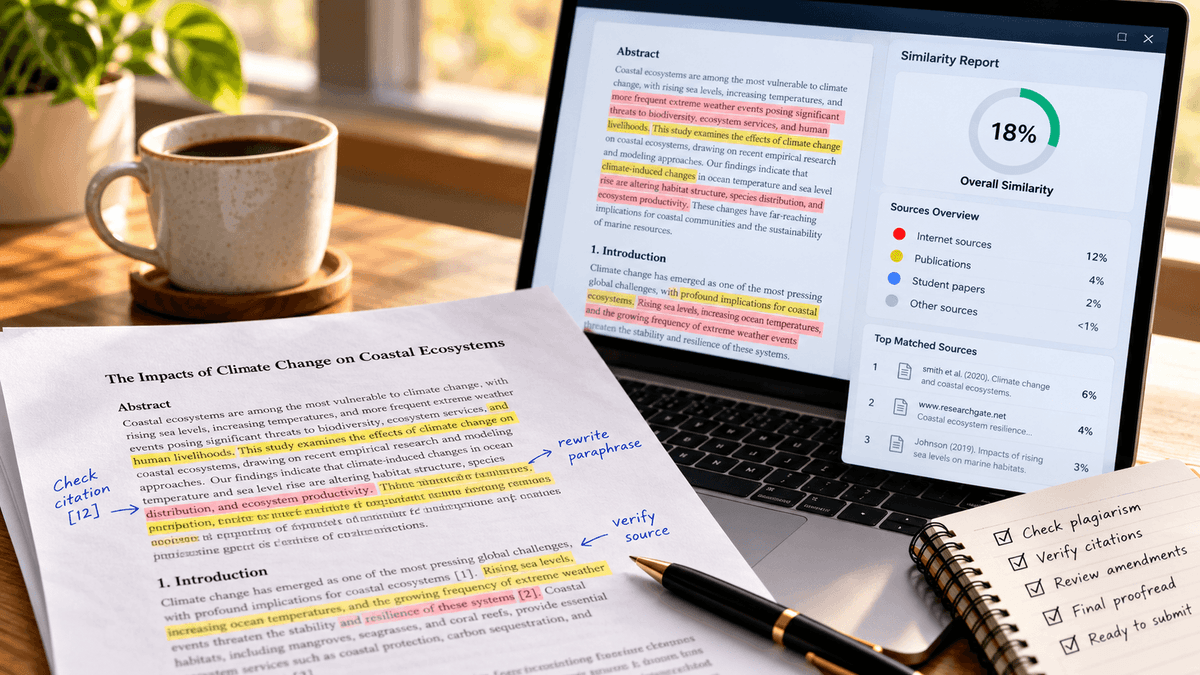
A similarity score normally represents the proportion of text that resembles content in the tool's comparison sources.
Turnitin explicitly explains:
“Turnitin does not check for plagiarism.”
Instead, it identifies similar text for review.
Crossref gives similar advice for scholarly manuscripts and warns against automatically rejecting a paper simply because it crosses a predetermined similarity-score threshold.
Questions around what plagiarism percentage is acceptable usually start here, but the percentage makes much more sense once you know what produced it.
So, rather than asking, “Is 12% good or bad?”, the better question is:
What is making up that 12%?
It could include properly cited quotations, references, standard academic phrases, technical terminology, or passages that genuinely need attention.
The score alone cannot separate those for you.
That is why the next step is to understand what a similarity report can actually tell you and where human judgment still has to take over.
Similarity Report vs. Plagiarism Judgment
A similarity report is useful because it shows where your paper overlaps with existing sources.
What it cannot do is interpret that overlap for you.
A highlighted sentence might be a properly cited quotation, a standard technical phrase, a close paraphrase, or genuinely unattributed text.
The report can point you to the match, but deciding whether it's acceptable still requires context.
This distinction is important before you start editing, because not every highlighted passage needs to be rewritten.
| A similarity report can show | It cannot automatically determine |
|---|---|
| Matching text | Whether plagiarism occurred |
| Sources containing similar wording | Whether every match is inappropriate |
| Percentage of matching content | Whether the paper should be rejected |
| Large and small source matches | The author's intent |
| Areas worth reviewing | Whether attribution is academically sufficient |
Once you understand that difference, the report becomes much easier to use.
Instead of reacting to every highlight, you can review each match and decide what kind of overlap you are actually looking at.
That is the next step.
How to Review Each Match in a Plagiarism Report
Once you move past the overall similarity score, the real review begins.
At this stage, the goal is not to make every highlighted sentence disappear.
The goal is to understand why each match appeared and whether it needs attention.
Some matches are completely legitimate, while others may point to weak paraphrasing, missing citations, copied wording, or reused material.
The easiest way to do that is to group matches into a few common types, such as the following -
1. Properly Quoted and Cited Text
Suppose a sentence matches its original source exactly, but it is:
- inside quotation marks;
- correctly attributed;
- supported by an appropriate citation.
That may be perfectly legitimate.
The plagiarism checker found similarity, which is exactly what it was designed to find.
You do not need to rewrite every correctly quoted sentence simply to make a percentage smaller.
However, a paper containing too many quotations can still have an originality problem of a different kind: not enough independent analysis.
2. Citation Is Present, but the Wording Is Too Similar
This is a common problem in student and academic writing.
Example:
Source:
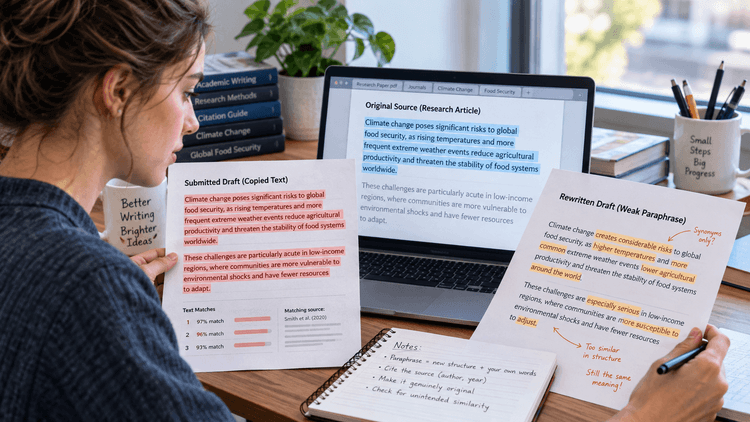
Digital learning environments can improve student engagement when learners receive timely feedback.
Too-close paraphrase:
Online learning environments may improve student engagement when students are given timely feedback (Author, Year).
A citation is present, but the sentence structure and phrasing remain extremely close.
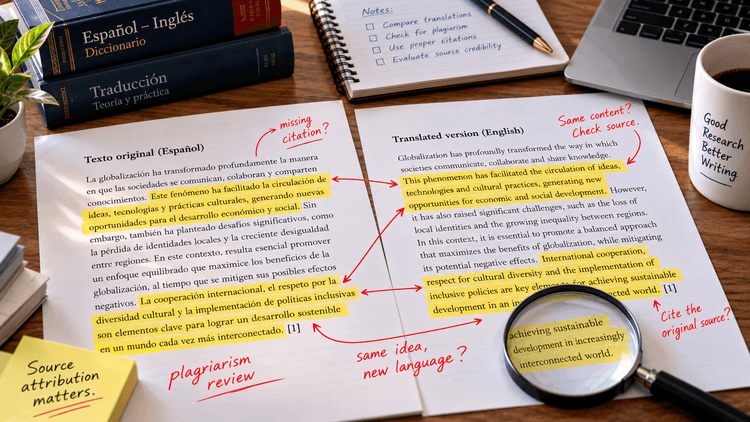
This is sometimes described as patchwriting, where a writer makes limited substitutions while preserving much of the original structure.
This is where the line between poor paraphrasing and plagiarism can become surprisingly thin.
A better approach is to understand the point first and then rebuild it around your own argument.
For example:
Students tend to participate more actively in online courses when instructors respond quickly enough for feedback to influence the next stage of learning (Author, Year).
Same underlying idea. Different construction. Attribution preserved.
3. Paraphrased Idea With No Citation
This is easy to miss because plagiarism checkers primarily work with textual similarity.
Imagine you completely rewrite another researcher's theory in your own words but never cite that researcher.
A similarity checker may find very little matching text.
The academic problem still exists.
Purdue OWL notes that a paraphrase is a legitimate way to use another person's ideas when it is accompanied by appropriate documentation.
So remember:
Paraphrasing changes the wording. It does not change ownership of the idea.
4. Exact Text With No Citation or Quotation Marks
This deserves immediate attention.
If exact or nearly exact wording has been taken from another source without attribution, either:
- quote it correctly and cite it;
- paraphrase it genuinely and cite it;
- remove it if the information is unnecessary.
Do not simply replace five words with synonyms.
That changes the vocabulary, not the underlying problem.
5. Common or Unavoidable Technical Language
Not every highlighted phrase is meaningful evidence of plagiarism.
A research paper may legitimately contain terms such as:
- “multiple linear regression analysis”
- “95% confidence interval”
- “randomized controlled trial”
- standard instrument names;
- chemical compounds;
- technical procedures;
- recognized theoretical terminology.
Trying to rewrite every technical phrase just to lower a similarity score can actually make your paper less accurate.
Review the match in context and leave necessary terminology alone when appropriate.
6. References and Bibliographic Information
Reference entries naturally resemble the same references appearing in millions of other papers.
Authors' names, article titles, publication years, DOIs, and journal names cannot become magically original every time somebody cites them.
Turnitin notes that references and quotations can contribute to similarity because the system is identifying matching text.
Some plagiarism systems let reviewers exclude bibliography or quoted material from the report.
Use those options carefully rather than assuming excluded text can never contain problems.
7. Your Own Previous Work
A match may lead directly back to something you wrote earlier.
That deserves its own review.
Reusing your own text doesn't fit the same situation as copying another author, but academic publishing has specific expectations around self-plagiarism, text recycling, and duplicate publication.
We will return to that shortly.
For now, once you know how to identify the main types of matches, the next step is to look at -
Which Parts of a Research Paper Need the Closest Plagiarism Review?
A match in the literature review may point to close paraphrasing or missing attribution, while overlap in the methodology section may come from standard technical language.
That is why you should judge each section in context rather than treating them the same way.
Start with the parts of the paper where reused wording or source dependence can be easiest to overlook.
Abstract
The abstract is short, which means reused wording can become proportionally noticeable.
Watch for text copied from:
- a thesis abstract;
- conference submission;
- preprint;
- previous article;
- project proposal.
If the work has appeared elsewhere in some form, follow the relevant journal or institutional disclosure rules.
Introduction
Introductions frequently combine broad background claims with previous research.
Check whether:
- definitions came from specific authors;
- background claims require citations;
- previous studies have been summarized accurately;
- familiar source wording has slipped into your draft.
Literature Review
The literature review deserves especially careful attention.
Researchers often read several papers on one topic and then write while those sentence structures are still fresh in memory.
Look for:
- close paraphrasing;
- patchwriting;
- missing citations;
- source-by-source summaries with little synthesis;
- paragraphs that rely heavily on one author's wording;
- claims whose citations do not actually support them.
A literature review should show how you understand and connect the research, not simply rearrange somebody else's sentences.
Methodology
Methods sections are unusual because some terminology and procedural descriptions may naturally resemble existing papers.
For instance, researchers using the same:
- validated questionnaire;
- laboratory protocol;
- statistical model;
- sampling technique;
- established experimental procedure
may need some identical technical language.
COPE's guidance on text recycling recognizes that the significance of reused material depends partly on where in the paper the overlap occurs.
Limited reuse around standard methods may be treated differently from overlap involving results or conclusions.
So do not destroy a precise methodology section just to make a similarity percentage prettier.
Accuracy still matters.
Results
Unexplained overlap in the results section deserves closer scrutiny.
Results should generally represent the findings of the study being reported.
Check carefully for:
- results already published elsewhere;
- duplicated datasets;
- reused tables;
- previously reported findings;
- copied interpretation accompanying results.
COPE distinguishes text recycling from the more serious issue of redundant or duplicate publication involving repeated data or ideas.
Discussion
The discussion is where your interpretation should become most visible.
Review sentences that resemble:
- another author's explanation;
- a previous paper from your research group;
- your own earlier publication;
- a source used heavily during drafting.
If the interpretation came from another researcher, acknowledge them.
If it is your interpretation, write it as yours.
Tables, Figures, and Captions
Plagiarism is not restricted to paragraphs.
You also need to consider:
- reproduced charts;
- adapted figures;
- diagrams;
- photographs;
- tables;
- captions;
- illustrations.
Purdue's plagiarism guidance specifically lists visual materials such as diagrams, illustrations, charts, and pictures among material that may require credit.
If you reproduce or adapt a figure, check both attribution and permission requirements.
Remember that copyright and plagiarism are not the same thing, so giving credit does not automatically settle every permission issue.
Once you have reviewed the paper section by section, the overall similarity score becomes easier to interpret.
By this point, you should have a better idea of which matches are harmless and which ones actually need attention.
That leads to one of the most common questions researchers have -
What Similarity Percentage Is Acceptable for a Research Paper?
There is no universal similarity percentage that automatically makes a research paper acceptable or unacceptable.
Some universities, instructors, journals, or publishers may set their own thresholds.
Those are local policies, not universal laws of academic writing.
Crossref explicitly advises editors not to use a similarity-score cutoff as an automatic manuscript rejection rule. Matches should be assessed in context.
Consider two hypothetical papers.
Paper A: 18% Similarity
Most matches come from:
- references;
- properly quoted definitions;
- standard methodology language;
- dozens of tiny unrelated phrases.
Paper B: 6% Similarity
Almost all of it comes from one uncited paragraph copied from another journal article.
Paper B may have the smaller number while containing the more serious problem.
Instead of Chasing a Target Percentage, Check:
- Where does the similarity occur?
- How long is each matching passage?
- Is the original source cited?
- Is exact wording clearly quoted?
- Is the paraphrase sufficiently independent?
- Does the overlap involve results or previously published work?
- Does your university or target journal specify a policy?
Tip: Treat your similarity score like a smoke detector, not a court verdict. It points you toward something worth checking.
By this stage, you should know which matches are harmless and which ones genuinely need attention.
The next part of the review is about dealing with those problem matches one by one, because the right fix depends on what caused the similarity in the first place.
How to Fix Plagiarism or Problematic Similarity in a Research Paper
Once you understand why a passage matched, fixing it becomes much easier.
Different problems need different corrections, so the goal is not to rewrite everything the checker highlights.
Instead, deal with each match based on what is actually wrong: a missing citation, a close paraphrase, reused text, or something else.
The table below gives you the quickest way to match the problem with the right fix.
Understanding the different types of plagiarism also helps here, because missing attribution, patchwriting, direct copying, and self-reuse do not call for exactly the same response -
| Problem | What to do |
|---|---|
| Missing citation | Add the appropriate source citation |
| Exact wording without quotation marks | Quote and cite it, or paraphrase and cite |
| Too-close paraphrase | Rewrite after fully understanding the source |
| Citation but no quotation marks | Format exact wording as a quotation |
| Excessive quotation | Summarize or synthesize when appropriate |
| Uncredited idea | Add attribution even if wording is original |
| Citation/reference mismatch | Correct the citation or reference entry |
| Reused previous text | Cite or disclose earlier work where required |
| Reused table or figure | Add attribution and check permission requirements |
| Standard technical terminology | Usually keep it if rewriting would reduce accuracy |
What you should not do is randomly replace words until the plagiarism checker becomes happier.
For example:
“The results demonstrate a significant association…”
becoming
“The findings showcase an important relationship…”
does not automatically create an original sentence.
Good paraphrasing involves restructuring the thought, not decorating copied syntax with synonyms.
And because close paraphrasing is one of the most common reasons a research paper gets flagged, it is worth slowing down here and doing it properly.
A fuller paraphrasing-without-plagiarism process is especially useful when a source-heavy paragraph is difficult to rewrite independently. So let’s talk about -
How to Paraphrase Research Without Plagiarizing
Paraphrasing sounds simple until you try doing it with a dense journal article written by someone who apparently considered punctuation an unnecessary luxury.
A safer process is:
1. Read the Passage Until You Understand It
Do not start rewriting while you are still decoding the sentence.
2. Identify the Core Point
Ask:
What is the author actually saying?
Ignore the exact wording temporarily.
3. Put the Original Source Aside
Purdue OWL recommends setting the original passage aside before drafting the paraphrase.
This reduces the temptation to follow the original sentence structure.
4. Explain the Idea in Your Own Context
Connect the information to the purpose of your paragraph.
Instead of reproducing the source's sequence, ask how the idea supports your argument.
5. Compare Both Versions
Make sure:
- the meaning remains accurate;
- distinctive wording has not been copied;
- sentence structure is sufficiently different;
- technical terms have not been distorted.
6. Cite the Source
Even excellent paraphrasing still requires attribution when the underlying information or idea belongs to somebody else.
If awkward wording is the problem rather than attribution itself, a paraphrasing tool can help you explore a different sentence structure, but the source still needs to be cited when the idea is borrowed.
Quick Paraphrasing Test
After writing, ask:
If the citation disappeared, would a reader wrongly assume this idea originated with me?
If the answer is yes, the citation belongs there.
That is why paraphrasing and citation checking should never be treated as separate tasks.
Once you are confident the wording is genuinely your own, the next step is to know -
How to Check Citations While Reviewing a Research Paper
A plagiarism check and citation review should happen together.
Go through your manuscript and ask five questions.
Does Every Borrowed Claim Have Attribution?
Not every sentence needs a citation.
Your own:
- analysis;
- observations;
- study results;
- logical transitions;
- conclusions drawn directly from your findings
do not automatically require external attribution.
But ideas, evidence, data, theories, and findings taken from other researchers usually do.
Are Exact Quotations Clearly Identified?
Check quotation marks, block quotation formatting, and location information where your citation style requires them.
Does Every In-Text Citation Have a Reference?
A citation such as (Rahman, 2025) is not very helpful if Rahman's work has vanished mysteriously from the reference list.
Does Every Reference Appear in the Paper?
References left over from earlier drafts should either be used appropriately or removed.
Is the Formatting Consistent?
Use the required style throughout:
- APA
- MLA
- Chicago
- Harvard
- another journal-specific system
A citation generator can speed up formatting, but still inspect the output.
Metadata occasionally contains errors, because apparently even bibliographic databases enjoy keeping researchers humble.
Once the citations are in order, there is one more source-related issue worth checking: matches that come from your own earlier work.
So now let’s talk about -
What Is Self-Plagiarism in a Research Paper?
Self-plagiarism, often discussed as text recycling, generally involves reusing material from your own earlier work without appropriate acknowledgment, disclosure, or justification.
COPE defines text recycling as situations where sections of the same text appear across an author's publications, usually without attribution.
It also distinguishes text recycling from duplicate publication, which involves repeated data or ideas.
Common situations include:
- Copying paragraphs from your previous paper;
- Reusing thesis material in a journal manuscript;
- Copying an earlier literature review;
- Reusing a methodology description;
- Republishing the same results;
- Reproducing your previous tables or figures.
Is Reusing Your Methods Section Always Wrong?
Not necessarily.
The answer depends on:
- how much text was reused;
- why identical language is necessary;
- whether the earlier work is acknowledged;
- journal policy;
- copyright;
- whether data or results are also being republished.
COPE advises editors to evaluate text recycling case by case using factors such as its amount, location, acknowledgement, article type, and possible copyright issues.
When in doubt, cite the earlier publication and check the target journal's author guidelines.
At this point, you have reviewed both outside sources and your own previous work.
But software still cannot catch every attribution problem, especially when an idea has been rewritten so thoroughly that little or no matching text remains.
That is where a manual review becomes useful and that takes us to -
Can You Check a Research Paper for Plagiarism Manually?
Yes, but manual checking works best alongside plagiarism-detection software rather than replacing it.
Try these methods.
Method 1: Search Distinctive Phrases
If a sentence suddenly sounds much more polished or stylistically different from the surrounding paper, search for a distinctive phrase from it.
This can help identify wording accidentally carried over from research notes.
Method 2: Compare Paraphrases With Their Original Sources
Open both versions side by side. Check:
- sentence structure;
- distinctive phrases;
- sequence of ideas;
- attribution.
Method 3: Trace Claims Back to Your Notes
For literature-heavy papers, verify which source supports each major claim.
Method 4: Audit Citations and References
Check citations in both directions:
text → reference list and reference list → text
Method 5: Review Visual Material
Do not forget:
- graphs;
- tables;
- images;
- diagrams;
- captions.
Manual review is especially useful for idea attribution, which text-matching software may not detect.
Still, manual checking has its limits.
You cannot realistically compare an entire research paper against thousands of webpages, journals, and academic publications on your own.
That is where a plagiarism checker becomes useful again.
So that takes us to the next question which is -
Free vs. Paid Plagiarism Checkers for Research Papers
Both free and paid plagiarism checkers can be useful, but they are not always built for the same kind of review.
The right choice depends on the type of paper you are checking, how thorough the review needs to be, and whether the tool can handle unpublished research safely.
Let’s get to know more about them -
| Feature | Free plagiarism checker | Research-focused or premium checker |
|---|---|---|
| Basic web comparison | Often available | Usually available |
| Academic database coverage | Varies considerably | Often broader |
| Full research papers | May have word limits | More commonly supported |
| Detailed source reports | Varies | Usually more detailed |
| Citation exclusions | Limited or varies | Often available |
| Privacy controls | Must be checked | Must still be checked |
| Best for | Early review or shorter work | Thesis, dissertation, manuscript review |
Do not assume “paid” automatically means suitable for confidential research.
Before submitting an unpublished manuscript, investigate the service's privacy and storage policies regardless of price.
For a detailed tool comparison, understanding best plagiarism checkers for research papers can help you compare database coverage, limits, privacy, and reporting features.
But if your paper contains unpublished findings, thesis material, or research that has not yet been made public, choosing a checker deserves an extra level of care.
At that point, you are not only asking how well the tool detects similarity, but also what happens to your manuscript after you upload it.
So before using any checker for unpublished work, review a few specific features first.
How to Choose a Plagiarism Checker for an Unpublished Research Paper
Before uploading valuable unpublished work, check these factors.
1. Academic Source Coverage
Can it compare against scholarly publications, or mainly webpages?
2. Source Transparency
Can you see where matches came from?
A number without sources is much less useful.
3. Document Length
Long dissertations and journal manuscripts can exceed limits on basic tools.
4. File Support
Check whether it accepts formats such as:
- DOCX;
- PDF;
- TXT.
5. Privacy
Read what happens after upload.
6. Document Storage
Determine whether submitted files are stored and, if so, for how long.
7. Repository Policies
Some academic systems can compare new submissions with previously submitted papers.
8. Similarity Report Quality
A useful report should let you inspect actual passages and their sources rather than merely display a percentage.
Crossref's Similarity Check, for example, produces reports that highlight potential matches so editors can assess manuscript originality rather than treating the score itself as the decision.
Once you have checked the tool itself, the final step is to make sure the paper is ready to leave your hands.
By now, you should have reviewed the matches, fixed genuine problems, checked citations and reused material, and confirmed that the checker is suitable for your manuscript.
That leaves one last pass before submission.
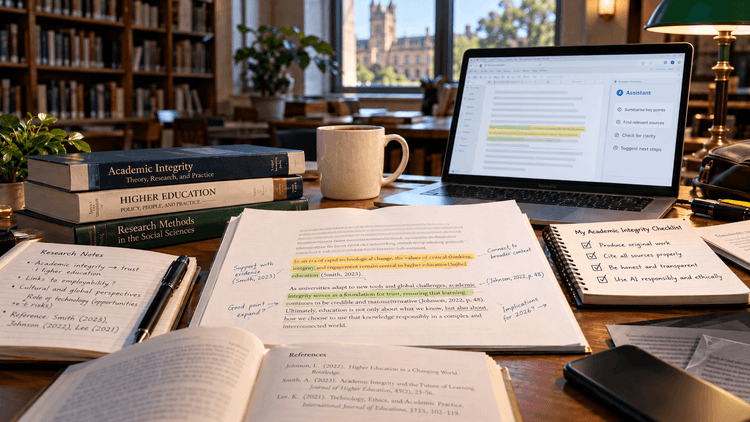
Research Paper Plagiarism Final Pre-Submission Checklist
Before clicking Submit, run through this list.
Sources and Citations
- Every borrowed idea has appropriate attribution.
- Direct quotations are clearly marked.
- In-text citations match reference-list entries.
- Unused references have been removed.
- Tables and figures are properly attributed.
- Citation style is consistent.
Similarity Report
- I reviewed individual matches, not just the overall score.
- Large matches have been checked first.
- Close paraphrases have been rewritten where necessary.
- Legitimate technical terminology has not been awkwardly rewritten.
- Reference-list matches have been interpreted correctly.
- Matches to my own previous work have been reviewed.
Research-Paper Sections
- Abstract checked.
- Introduction checked.
- Literature review checked carefully for patchwriting.
- Methodology overlap reviewed in context.
- Results checked for previously published material.
- Discussion checked for borrowed interpretations.
- Tables, figures, and captions checked.
Final Review
- Revisions have been completed.
- The updated paper has been scanned again if needed.
- Remaining matches have been manually reviewed.
- Journal or institutional plagiarism policies have been checked.
If you can work through that list without finding anything unresolved, the paper is in much better shape for submission.
Once originality and citations are settled, an essay checker can give the draft one more pass for grammar, clarity, and structure.
Even so, a few mistakes can undo an otherwise careful plagiarism review.
Most of them happen when writers focus too much on the score and not enough on what the matches actually mean.
Common Mistakes When Checking a Research Paper for Plagiarism
A plagiarism checker is helpful, but using it badly can create new problems.
Trying to Reach 0% Similarity
Zero is not automatically the ideal score. References, quotations, technical language, and common phrases can produce legitimate matches.
Replacing Words With Synonyms
This creates awkward writing and may still leave the original sentence structure intact.
Removing Citations to Reduce Similarity
Never remove a necessary citation simply because it contributes to a match.
That turns a harmless match into a potentially serious attribution problem.
Assuming Anything With a Citation Is Safe
A citation does not permit copying several sentences almost verbatim without quotation marks.
Ignoring Self-Matches
A source showing your own name still deserves review.
Ignoring Tables and Images
Academic integrity applies to visual and data-based material too.
Treating the Overall Percentage as the Verdict
The source matches tell the story. The percentage merely tells you where to start reading.
Frequently Asked Questions
How can I check my research paper for plagiarism?
Upload the near-final paper to a reliable plagiarism checker, review each source match, correct citation or paraphrasing problems, and scan the revised version again.
What percentage of plagiarism is acceptable in a research paper?
There is no universal acceptable percentage. Institutions and journals may set their own requirements, while individual source matches and context matter more than the overall score.
Is 10% similarity plagiarism?
Not necessarily. A 10% similarity score only means that some text matched other sources; properly cited quotations, references, and standard phrases may contribute to it.
Is 20% similarity too high for a research paper?
Not automatically. Review where the 20% comes from before judging it, and follow any specific threshold required by your institution or journal.
Can a research paper have 0% similarity?
Yes, but 0% is neither required nor proof that no academic-integrity problem exists. Even Turnitin notes that very small matches can sometimes round to 0%.
Does cited text count as plagiarism?
Properly quoted and cited material is generally not plagiarism, although plagiarism software may still identify it as matching text.
Can paraphrasing still be plagiarism?
Yes. If you use another person's idea without attribution, or follow the original wording too closely, a paraphrase can still create a plagiarism problem.
Does the reference list increase a similarity score?
It can. Bibliographic entries naturally match the same references used in other publications, so reference matches should be reviewed in context.
Can I check plagiarism without Turnitin?
Yes. Many other plagiarism checkers are available, but their academic database coverage, document limits, privacy practices, and reporting quality can differ.
What is the best plagiarism checker for research papers?
Choose one with strong academic-source coverage, transparent source reports, suitable document limits, and clear privacy policies rather than choosing only by price or the percentage it produces.
What is self-plagiarism in research?
Self-plagiarism or text recycling involves reusing material from your own previous work without appropriate acknowledgment or disclosure where it is required.
Should I check my paper for plagiarism before journal submission?
Yes. A pre-submission review can reveal close paraphrases, missing citations, reused material, and other issues while you still have time to correct them.
Final Thoughts
Checking a research paper for plagiarism is not about beating a plagiarism checker or forcing the score below an arbitrary number.
It is about being able to answer a more useful question:
Can a reader clearly tell which ideas, words, evidence, and findings are mine and which came from other sources?
A good pre-submission workflow therefore looks like this:
Scan the paper → inspect the matches → verify the sources → correct genuine problems → check again.
Spend the most time on the literature review, citations, close paraphrases, previously published material, and unusually large matches.
Treat standard terminology, references, and legitimate quotations in context rather than rewriting them blindly.
The result is not merely a lower similarity score.
It is a research paper with clearer attribution, stronger academic integrity, and fewer unpleasant surprises after submission.