You finish your assignment, read it one last time, and hit submit feeling pretty confident.
You cited your sources. You did not copy and paste. You even rewrote the difficult parts in your own words.
Then the similarity report comes back.
One paragraph is highlighted.
You open the source beside your writing and stare at both versions.
The words are different.
So why does your paragraph still look suspiciously similar?
This is where many students get stuck.
Poor paraphrasing is not automatically plagiarism, but it can cross that line when your version follows the original wording, sentence structure, or flow of ideas too closely.
And sometimes, even a completely rewritten sentence can create a problem if the original source is not credited.
That is why simply asking, “Did I change enough words?” will not tell you much.
The better question is:
Did I genuinely explain this idea in my own way, or did I simply rebuild the author's sentence using different words?
The difference can be surprisingly small on the page, but academically, it matters a lot.
So let's look at where poor paraphrasing ends, where plagiarism begins, and how you can tell which side your writing falls on.
Is Bad Paraphrasing Plagiarism?
Not always.
Imagine you read this sentence:
The example passages in this section are created only for demonstration.
You understand the idea and try to explain it in your own way, but your new sentence ends up confusing or slightly changes the original meaning.
That is still a bad paraphrase, but the main problem is the quality and accuracy of the writing, not necessarily plagiarism.
Now imagine something different.
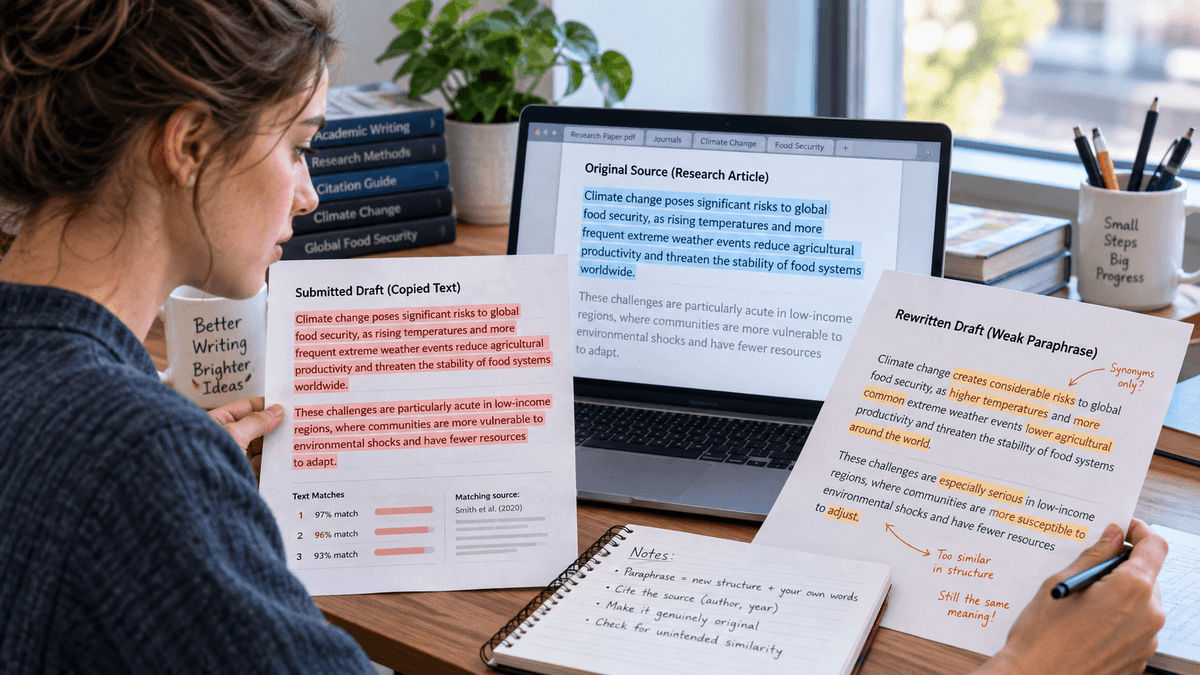
Instead of explaining the idea yourself, you keep almost the same sentence pattern and simply replace a few words with synonyms.
The sentence may look different, but much of the original writing is still underneath it.
That is where poor paraphrasing can start moving toward plagiarism.
So before deciding whether a weak paraphrase is actually plagiarism, it helps to separate two problems: poor writing and overly close borrowing.
Let’s find out -
When Poor Paraphrasing is Mainly a Writing Problem?
Not every weak paraphrase means you have copied from the source.
Sometimes you understand the main idea and genuinely try to explain it in your own words, but it still doesn't come out very well.
In situations like these, the problem is mainly how well you paraphrase the idea, not whether you stole someone else's writing.
Your paraphrase might be weak because:
- the sentence sounds unnatural;
- you misunderstood part of the source;
- your wording is unnecessarily complicated;
- you removed an important detail;
- the sentence does not fit smoothly with the rest of your paragraph.
These problems still matter.
A confusing or inaccurate paraphrase can weaken your argument and misrepresent what the original author actually said.
But on their own, they do not automatically make the passage plagiarism.
If the source use is fine and the real problem is awkward wording, spelling, punctuation, or sentence flow, run the final version through any reliable Grammar Checker so you can clean up those writing issues without confusing them with plagiarism.
And if your sentence has become so complicated that even you need to read it twice, the Readability Checker can help you see whether the wording is harder to understand than it needs to be.
The situation changes when the problem is no longer just how clearly you explained the idea, but how much of the original writing you carried into your version.
That brings us to the other side of the line -
When Poor Paraphrasing Can Become Plagiarism
Suppose you understood the source perfectly, but instead of explaining the idea naturally, you worked through the original sentence piece by piece.
You changed one word here, replaced another with a synonym there, and perhaps moved a phrase around.
By the end, the sentence looks different enough at first glance.
But when you place it beside the source, something becomes obvious: the original sentence is still doing most of the work.
This is where poor paraphrasing can become a plagiarism problem.
The risk becomes much higher when you:
- keep the same sentence structure as the source;
- replace original words one by one with synonyms;
- reuse distinctive phrases without quotation marks;
- follow the exact same sequence of ideas;
- mix copied phrases with your own writing;
- paraphrase an author's idea but forget to cite the source.
Think of it this way.
Good paraphrasing starts with the idea.
Patchwork plagiarism basically starts with the original sentence.
That small difference changes everything because once your writing follows the source too closely, you are no longer dealing with a weak paraphrase.
You may be dealing with patchwriting. That takes us to our next question about -
What Is Patchwriting or Mosaic Plagiarism?
Patchwriting happens when you try to paraphrase a source, but your version stays too close to its vocabulary, phrasing, or sentence structure.
It is also commonly discussed as mosaic plagiarism.
A typical patchwritten sentence looks original at first glance because several words have changed.
But when you place it beside the source, the skeleton of the original sentence is still easy to see.
Indiana University of Pennsylvania describes patchwriting as making small changes such as deleting, replacing, rearranging, or borrowing pieces of source material instead of creating a genuinely independent paraphrase.
Patchwriting is only one way plagiarism can appear.
Direct copying, self-plagiarism, accidental plagiarism, and improper attribution can create very different problems; that’s why understanding different types of plagiarism is necessary.
What makes patchwriting a little more complicated is that it does not always happen because someone is deliberately trying to copy.
A writer can genuinely be trying to paraphrase and still stay too close to the original without realizing it.
That’s why it’s important to know that -
Patchwriting Is Not Always Intentional
Sometimes patchwriting happens simply because the source is difficult to understand or the writer is unsure how to explain the idea in a different way.
It can also happen when you keep looking back at the original sentence while writing.
Without noticing, you may start following the same sentence pattern, order of ideas, or wording.
Other common reasons include:
- not fully understanding the source;
- struggling with unfamiliar academic language;
- copying too much of the original wording into notes;
- trying to rewrite one sentence word by word;
- feeling unsure about how much of the original structure needs to change.
So patchwriting does not always mean a student intentionally tried to cheat.
It is one of several ways unintentional plagiarism can happen when notes, quotations, citations, and paraphrases are not handled carefully.
But even when it happens by accident, the final paragraph can still be too dependent on the original source. That is why it is important to know -
How Close Is Too Close When Paraphrasing?
Unfortunately, there is no magical number.
You cannot safely say:
“I changed 60% of the words, so this is definitely a paraphrase.”
You also cannot rely on a rule such as:
“As long as no four words match, I'm safe.”
Purdue OWL notes that some instructors use rules involving consecutive matching words, but also describes this as a gray area and recommends checking your instructor's expectations.
Instead of counting changed words, a better test is to look at how independently you wrote the sentence.
Did you simply edit the original sentence piece by piece?
Or did you first understand the idea and then explain it using your own wording, structure, and flow?
That distinction tells you far more than any percentage ever could.
Still, when two versions are sitting in front of you, it is not always easy to judge how close is too close.
That is where a few simple warning signs can help.
How to Check If Your Paragraph is Too Close to the Source
Even after you understand the difference between proper paraphrasing and patchwriting, judging your own sentence can still be tricky.
When you have been staring at the same source for a while, a sentence can feel original simply because you changed several words.
But once you compare the two versions carefully, you may notice that the same structure, phrasing, or order of ideas is still there.
So instead of asking only, “Did I change enough words?”, compare your paraphrase with the original source and look for a few warning signs.
These clues can help you spot when your writing may still be too dependent on the source -
| Warning Sign | What It May Mean | What to Do |
|---|---|---|
| You changed nouns and verbs but kept the same sentence pattern | You may be synonym swapping | Rebuild the sentence from the idea |
| Your points appear in exactly the same order | Your writing may depend too much on the source | Reorganize the information around your own purpose |
| Several unusual phrases remain unchanged | You may be borrowing distinctive language | Quote and cite them or rewrite them |
| You cannot write without keeping the source open | You may be following the wording instead of the meaning | Close the source before drafting |
| You added a citation but the sentence still looks almost identical | Citation may not solve the wording problem | Rewrite or use a direct quotation |
| Your wording is original but you forgot the source | You have an attribution problem | Add the proper citation |
Quick tip: After reading your source, explain the idea aloud as if you were telling a classmate what it means. That explanation will often sound much more natural than a sentence created by replacing words one by one.
These warning signs are useful, but they become much easier to recognize when you can actually see the differences side by side.
So let's compare an original passage, a poor paraphrase, and a stronger paraphrase to see exactly where the line starts to become clearer -
Original vs Poor Paraphrase vs Acceptable Paraphrase
Here is where the difference becomes much easier to see.
The following example is created specifically for this guide, so there is no outside passage being reproduced.
Original example
Students often understand difficult material better when they explain the main idea in their own words instead of repeatedly reading the same paragraph.
Poor paraphrase
Learners often understand complicated material more effectively when they describe the main concept using their own words rather than continuously reading the same section.
At first, this looks different.
“Students” became “learners.”
“Difficult” became “complicated.”
“Explain” became “describe.”
But compare the structure.
Original
Students often understand → difficult material → better → when they explain → the main idea → in their own words → instead of repeatedly reading.
Poor version
Learners often understand → complicated material → more effectively → when they describe → the main concept → using their own words → rather than continuously reading.
Almost every part travels in the same order.
That is the danger of synonym swapping. The vocabulary changes while the sentence underneath barely moves.
Acceptable paraphrase
Putting an idea into a personal explanation can reveal whether a student actually understands it, whereas simply rereading the source may only create a feeling of familiarity.
Now the information has been rebuilt.
The new version:
- begins from a different point;
- uses a different sentence structure;
- changes the way the comparison is presented;
- expresses the idea naturally instead of editing the original sentence.
If this idea came from a real source, the writer would still need to cite that source.
The easiest way to spot the difference
Ask:
Could I have written this sentence without seeing the original sentence in front of me?
If the answer is probably not, your version may still depend too much on the source, and it is worth rewriting it again.
If you understand the source but are struggling to find a clearer way to express the idea, a trustworthy Paraphrasing Tool can help you explore alternative wording and sentence structures.
But here is an important point: realizing that your paraphrase is too close does not automatically mean you were trying to copy.
Sometimes writers cross that line without noticing it at all. So let’s find out -
Can You Plagiarize Even If You Did Not Mean To?
Yes, improper source use can happen accidentally.
A student might forget a citation, mix copied notes with original notes, misremember which words came from the source, or create a paraphrase that remains much closer to the original than intended.
This is often described as accidental plagiarism or unintentional plagiarism.
However, intent and institutional consequences are not exactly the same question.
Different schools and instructors may handle these situations differently.
Purdue, for example, discusses patchwriting as plagiarism while also explaining that it is not always deliberate academic dishonesty and can happen when writers are still learning how to work with unfamiliar ideas.
That is why students should avoid assuming either extreme:
“I didn't mean to copy, so it cannot be plagiarism.”
or:
“My paragraph has similarity, so I must have cheated.”
Neither conclusion is automatically true.
The better approach is to inspect what actually happened in the writing.
Look at the wording, the sentence structure, the source, and how the idea was credited.
That’s why understanding how to avoid plagiarism goes beyond paraphrasing and covers other habits that help prevent source-use mistakes across an entire paper.
And that brings up another common question -
Does a Citation Fix a Poor Paraphrase?
Not always.
This is one of the most common misunderstandings about paraphrasing.
A citation answers one question:
Where did this information or idea come from?
It does not automatically answer another:
Did I copy the author's wording or structure too closely?
Harvard specifically warns that a paraphrase may still be too close to the original even when a citation is included.
Think of citation, quotation, and paraphrasing as three different jobs.
A Citation Gives Credit
If the idea came from someone else, the citation tells the reader whose idea it is.
Quotation Marks Identify Exact Words
If you intentionally keep distinctive wording from the source, quotation marks show readers that those words are not yours.
Paraphrasing Creates an Independent Explanation
A proper paraphrase expresses the source's meaning using your own language and sentence construction.
You often need more than one of these at the same time.
For example:
Paraphrase + citation = normal academic source use.
Exact wording + quotation marks + citation = direct quotation.
Nearly copied wording + citation only = potentially still a problem.
So if your sentence falls into that last category, adding a citation is not the end of the job.
The wording or structure itself may still need to change.
The good news is that fixing it usually does not mean making the sentence more complicated.
It means stepping away from the original wording and rebuilding the idea more naturally.
So now let’s talk about -
How to Fix a Paraphrase That Is Too Close
You do not need to attack the sentence with a thesaurus until every simple word has been replaced by something unnecessarily impressive.
Try this instead:
1. Understand
Read the original until you genuinely know what it means.
If you cannot explain the idea simply, you probably are not ready to paraphrase it.
2. Close
Move the source out of view.
This forces you to work from your understanding rather than copy its sentence pattern.
Harvard recommends putting the original source aside while drafting for exactly this reason.
3. Rewrite
Explain the point naturally. You may:
- start from a different idea;
- combine related details;
- split one sentence into two;
- change what information receives the most emphasis.
Do not change the meaning just to make the wording look different.
4. Compare
Open the original again.
Check:
Did I accidentally reuse a phrase?
Did I copy the same sentence pattern?
Did I preserve the original meaning accurately?
5. Cite
Credit the source using the citation style required for your assignment.
If you need help formatting the reference, use the Citation Generator, then check the final citation against your instructor's requirements.
Once you have gone through these steps, there is one more useful thing to do before you submit: check the paragraph again with fresh eyes.
Even a paraphrase that feels finished can still contain a copied phrase, a missing citation, or a sentence structure that stayed too close to the source.
Before You Submit, Check These 6 Warning Signs
A thirty-second check can catch problems that are surprisingly easy to miss.
Paraphrase checklist
- I changed the sentence structure, not only individual words.
- I can explain the idea without constantly looking at the source.
- My version still represents the original meaning accurately.
- Any distinctive wording I kept is clearly quoted where necessary.
- I cited ideas, information, or arguments that came from another source.
- My paragraph sounds like part of my writing, not an edited version of someone else's paragraph.
If you hesitate over several of these points, revise before submitting.
That hesitation is useful information.
Paraphrasing is only one part of a final paper review, though.
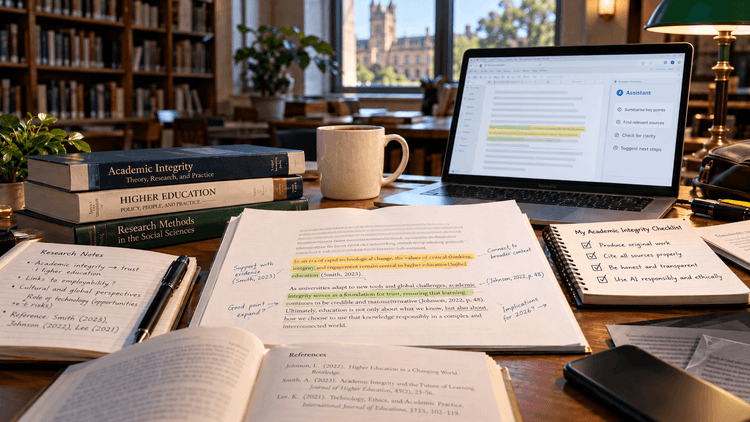
Any suitable Academic Integrity Checklist for Students walks through citations, paraphrasing, plagiarism matches, AI use, references, and other things worth checking before submission.
And if the source use is already sorted but you still want to review the overall essay structure, grammar, and clarity, you can run the finished draft through the Essay Checker.
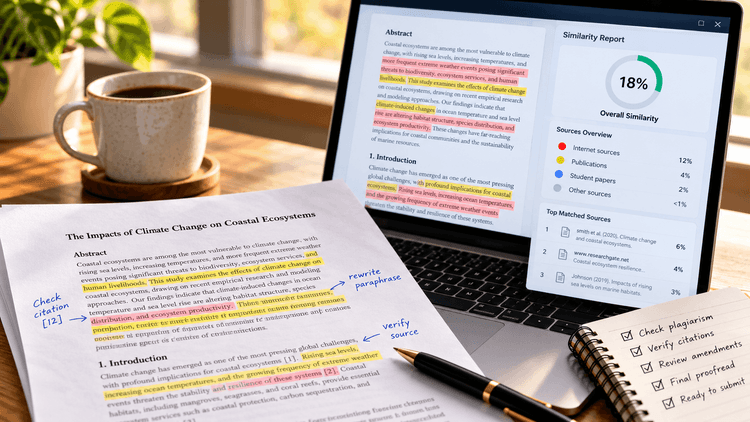
But sometimes you only notice a paraphrasing problem after a plagiarism or similarity checker highlights the passage.
If that happens, the next step is not to panic over the score. It is to look closely about -
What If Your Paraphrase Was Flagged for Plagiarism?
First, do not panic over the percentage alone.
A similarity result tells you that something matched. It does not explain the context by itself.
References, common phrases, correctly quoted material, titles, and other legitimate text can contribute to similarity.
Instead, inspect the individual matches.
Start with the highlighted passage
Open the matching source beside your paragraph.
Then ask:
- Which words actually match?
- Is the sentence structure similar?
- Did I keep a distinctive phrase?
- Is the source cited?
- Should any wording be placed inside quotation marks?
- Could I explain this idea more independently?
If the passage still feels uncomfortably close, rewrite it from your understanding of the source.
You can also run your draft through CopyChecker's Plagiarism Checker to find matching text that deserves a closer review.
If you have not used a similarity tool before, our guide on how to use a plagiarism checker explains how to run a check and review the report rather than simply staring suspiciously at the percentage.
The goal is not simply to chase a lower percentage.
The goal is to understand why something matched and whether that match is actually a problem.
Useful habit: Check important assignments before the deadline, not three minutes before submission. A similarity result is much more useful when you still have time to investigate and revise it.
Once you understand what caused the match, deciding what to do next becomes much easier.
Quick Decision Guide on What to Do With A Flagged Paraphrase
Even after checking the wording, structure, and citation, you may still be unsure what the right next step is.
A flagged paraphrase does not always need the same fix.
Sometimes the wording is too close.
Sometimes the citation is missing.
In other cases, the sentence is original enough, but the meaning has changed.
So instead of treating every similarity match as the same problem, look at what exactly is wrong with the passage first.
Use this guide to match the issue with the most sensible next step -
| If Your Paraphrase… | What You Should Do |
|---|---|
| Uses genuinely independent wording and structure and includes a citation | Usually keep it |
| Changes words but follows the original sentence closely | Rewrite it |
| Keeps an unusual or distinctive phrase | Quote and cite that wording |
| Is fully rewritten but has no citation | Add attribution |
| Mixes pieces of the source with your own sentences | Check for patchwriting |
| Changes what the original author actually meant | Correct the meaning |
| Still seems borderline after revision | Check your school's policy or ask your instructor |
There is no single percentage, number of changed words, or similarity score that can replace this judgment.
The safest paraphrase is one that shows you understood the source first and wrote second.
FAQs
Is bad paraphrasing plagiarism?
Not automatically. A paraphrase may simply be unclear or inaccurate. It becomes a plagiarism concern when it borrows too much wording or structure, or fails to credit the original source properly.
Can paraphrasing still be plagiarism if I cite the source?
Yes. A citation gives credit for the idea, but a paraphrase may still be too close to the source's original wording or sentence structure.
Harvard specifically warns about inadequate paraphrasing even when a citation is present.
Is changing a few words enough to avoid plagiarism?
No. Replacing words with synonyms while keeping the same sentence structure is a common form of poor paraphrasing or patchwriting.
What is Patchwriting?
Patchwriting means rewriting a source with small changes while staying too close to its original words, phrases, or sentence structure. It is sometimes called mosaic plagiarism.
How close is too close when paraphrasing?
There is no universal percentage or number of matching words. Focus on whether your language and sentence construction are genuinely independent from the source.
Do I need to cite something if I completely rewrite it?
Usually, yes, if the idea, information, argument, or finding came from another source. Changing the wording does not make the underlying idea yours.
Can accidental plagiarism happen?
Yes. Writers may forget citations, confuse copied notes with their own writing, or unintentionally paraphrase too closely. Institutional rules for handling these situations can vary.
Does a plagiarism checker prove that I plagiarized?
No. A similarity checker identifies matching or potentially overlapping text.
The matches still need to be reviewed in context to decide whether they represent proper quotation, common wording, references, or a genuine source-use problem.
Final Takeaway
The difference between plagiarism vs poor paraphrasing is not simply whether your sentence sounds good.
A badly written paraphrase can still be original.
A polished sentence can still be too close to its source.
The real issue is how you used someone else's material.
If you understand the idea, express it using your own language and structure, preserve the original meaning, and give proper credit, you are much closer to responsible paraphrasing.
If you find yourself changing individual words while keeping the original sentence underneath, stop.
That is usually where poor paraphrasing starts turning into patchwriting.
And if you are uncertain about your own draft, inspect the actual matches rather than guessing from memory.
A plagiarism check can help you locate passages worth reviewing before you submit.