Paraphrasing isn’t automatically plagiarism. But simply changing a few words doesn’t make borrowed work yours either.
Using someone else’s idea without giving them credit is plagiarism. And improper paraphrasing, no matter how many words you swap, can still cross that line. This usually happens in three ways:
- You paraphrase the source but don’t cite it.
- You cite the source but only swap out a few words.
- You cite the source, but your version still follows the original wording or structure too closely.
Proper paraphrasing means understanding the source, expressing the idea genuinely in your own words and structure, and giving credit where it’s due.
In this guide, we’ll break down exactly when paraphrasing becomes plagiarism, how to avoid it, and how to paraphrase correctly.
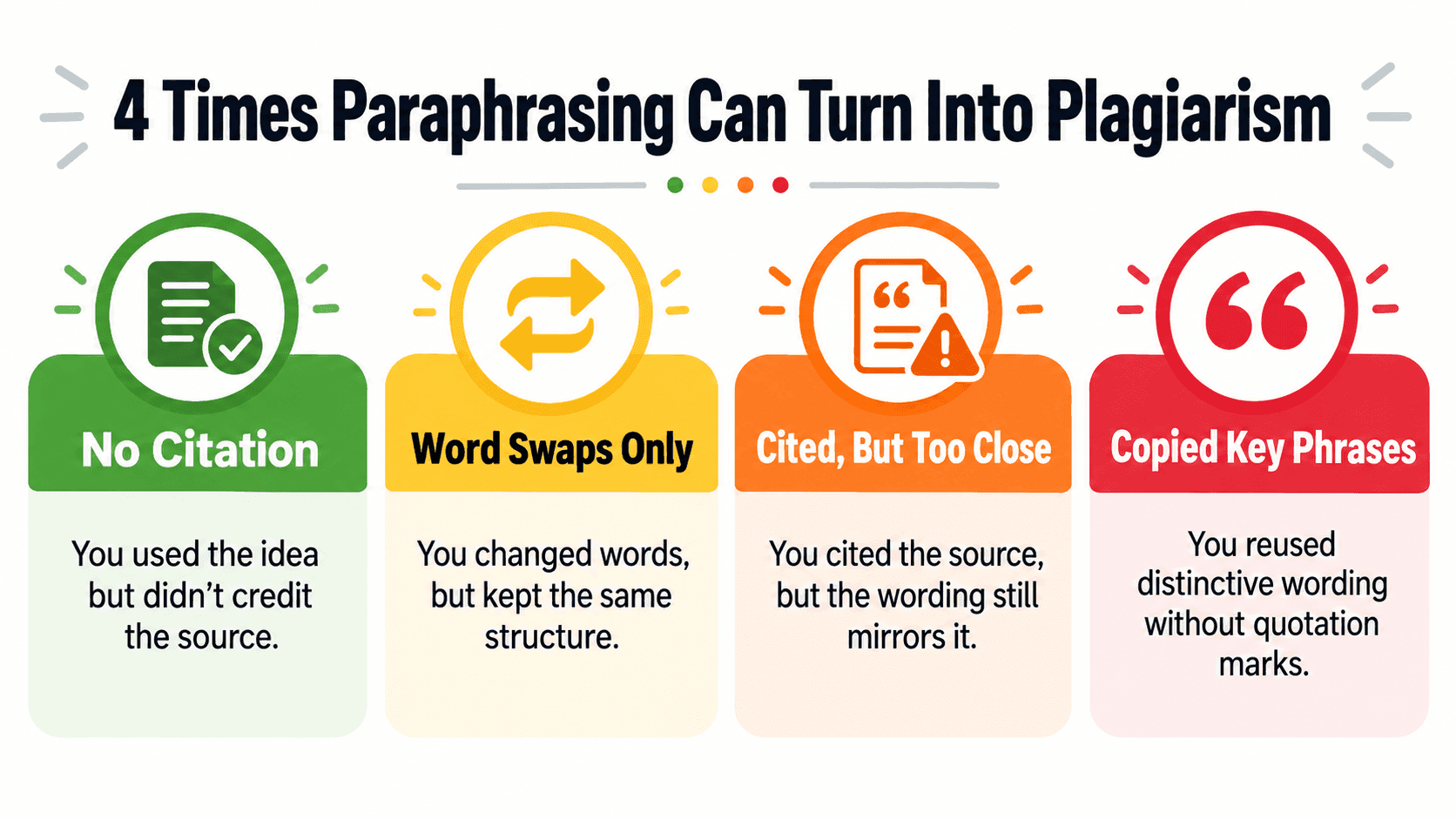
4 Times Paraphrasing Can Turn Into Plagiarism
Paraphrasing itself is not a problem. It’s simply a technique that shows you understand a source well enough to explain its idea in your own way. Personally, I think it’s one of the best ways to test your understanding of a topic.
But when you’re creating original work, and referencing external sources, just changing the original sentence isn't enough.
Missing proper citations or wording it too closely to the original will count as plagiarism.
Here are the four major reasons why paraphrasing is counted as plagiarism:
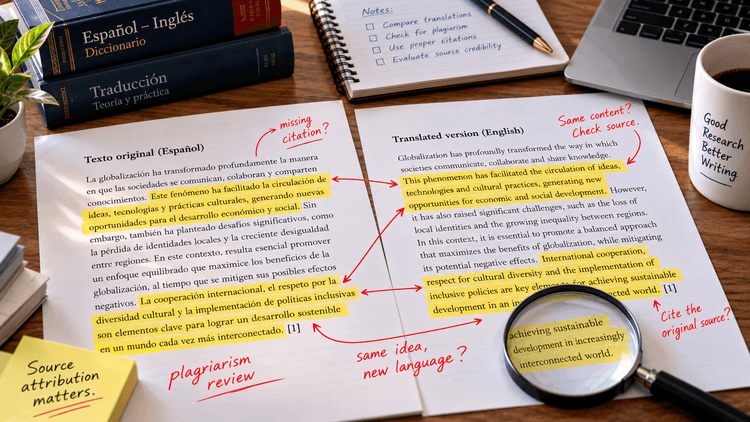
1. Paraphrasing Without Citation
Missing citations is the cardinal sin of plagiarism. It really doesn’t matter whether you missed it unintentionally—you didn’t credit your source.
Taking inspiration and ideas from others, or using external references without citing their work, is paraphrasing plagiarism even if you change the wording. The idea isn’t yours; it’s theirs.
Suppose you read an interesting argument in a journal article. Once you understand it, close the article, and explain the idea completely in your own words.
Good paraphrasing? So far, yes.
But if you present that idea in your essay without citing the original author, there's still a problem.
For example, source text like this:
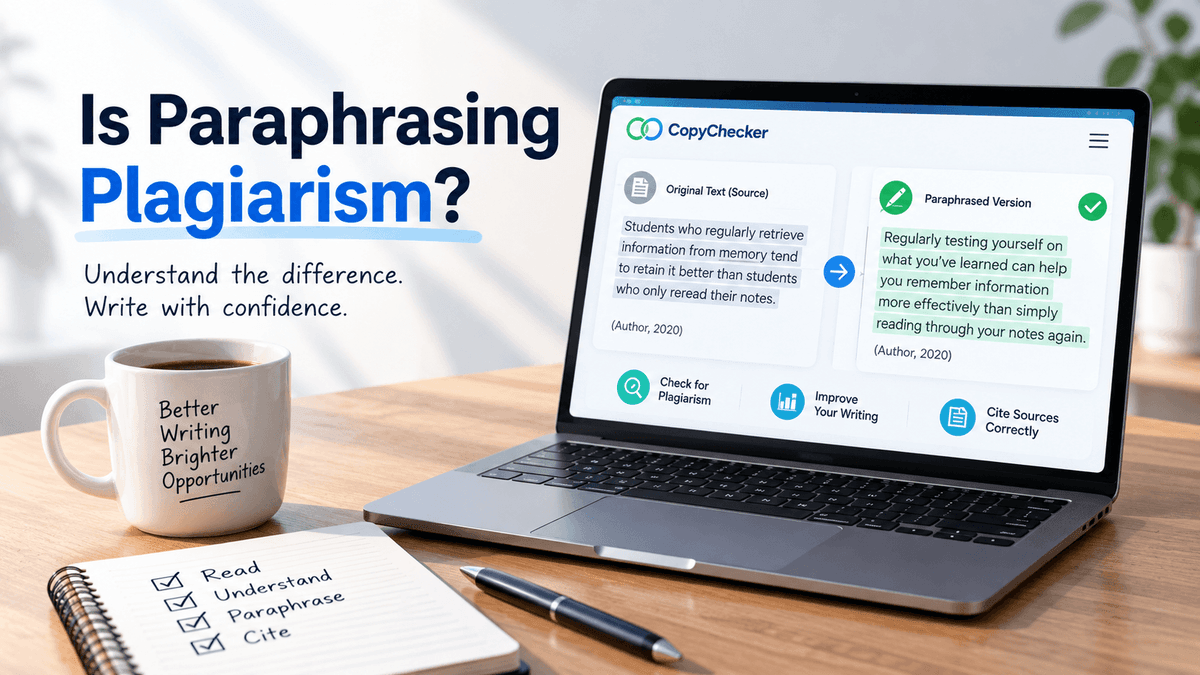
Students who regularly retrieve information from memory tend to retain it better than students who only reread their notes.
You rewrite it to:
Regularly testing yourself on what you've learned may help information stay in your memory longer than simply reading the same notes again.
Sure, the wording is different. The structure has changed too. But if that finding came from another author's research, the source still needs to be credited. Rewriting handles the language; citing tells the reader where the information came from.
2. Changing Words but Keeping the Same Structure
Swapping out a few words from a source material and calling it yours is the second way your paraphrased text will get flagged as duplicate content.
It’s the same problem—the idea isn’t yours. Unfortunately, to many students' disappointment, simply swapping words doesn’t make your essay original.
This is where synonym swapping mostly gets students into trouble. A sentence like:
Regular exercise can improve students' concentration and reduce stress during demanding academic periods.
Becoming:
Frequent exercise can increase students' focus and decrease stress during difficult academic periods.
That isn’t the most original of work. You need to rebuild the idea using your own sentence structure and natural way of explaining it, while keeping the original meaning intact.
3. Citing the Source but Staying Too Close
So far, we’ve talked about missing citations and paraphrasing poorly. But adding a citation yet still doing a bad job paraphrasing doesn’t save you from plagiarism.
If you're paraphrasing, rewrite the source genuinely in your own words and structure, then cite it.
Also don’t be afraid to use trusty quotations. If you need to keep the author's exact wording, treat that wording as a quotation instead.
4. Copying Distinctive Phrases Without Quotation Marks
Not every word from a source has to disappear when you paraphrase. Common terms such as climate change, machine learning, or working memory may simply be standard language in the subject.
Distinctive wording is different.
If an author uses an unusual, memorable, or highly specific phrase and you carry that exact phrase into your writing, changing the rest of the sentence may not be enough:
The policy created “a revolving door of temporary solutions” rather than addressing the underlying problem.
Shouldn't turn it into:
The policy offered a revolving door of temporary solutions instead of fixing the deeper problem.
Most of the sentence changed, but the distinctive phrase was copied. Quote the words if they’re important; otherwise, simply express the idea differently.
Idea and Word Theft: The Core Issue With Paraphrasing
Most paraphrasing plagiarism comes down to one of two problems:
- You take the idea without giving credit
- You take too much of the source’s wording or structure
They’re related, but they’re not the same. Get these two things right when paraphrasing or using outside sources, and you’ll avoid the main reasons a paraphrase becomes plagiarism.
Idea Theft
If an argument, research finding, interpretation, theory, statistic, or conclusion came from another source, you need to make that clear with a citation.
Rewriting the information completely does not transfer ownership of the idea to you.
That’s why a paraphrase can be well written, completely different from the source, and still constitute plagiarism if the original author is not acknowledged.
The wording is yours; the idea, or the research finding isn’t yours. So, a citation is a must in this case.
Word Theft
The opposite problem happens when you do cite the source, but your version remains too close to the original.
Maybe you replace several words with synonyms. Maybe you rearrange a clause.
Or perhaps you rewrite most of the sentence but keep a distinctive phrase exactly as the author wrote it. That may still be too close.
A proper paraphrase should express the source’s meaning through your own wording and sentence structure. If you need to keep distinctive wording from the original, quote it rather than presenting it as part of your paraphrase.
And citation doesn’t fix overly close rewriting. You can credit the source and still plagiarize its language if you've only made surface-level changes.
Do You Always Need to Cite When Paraphrasing?
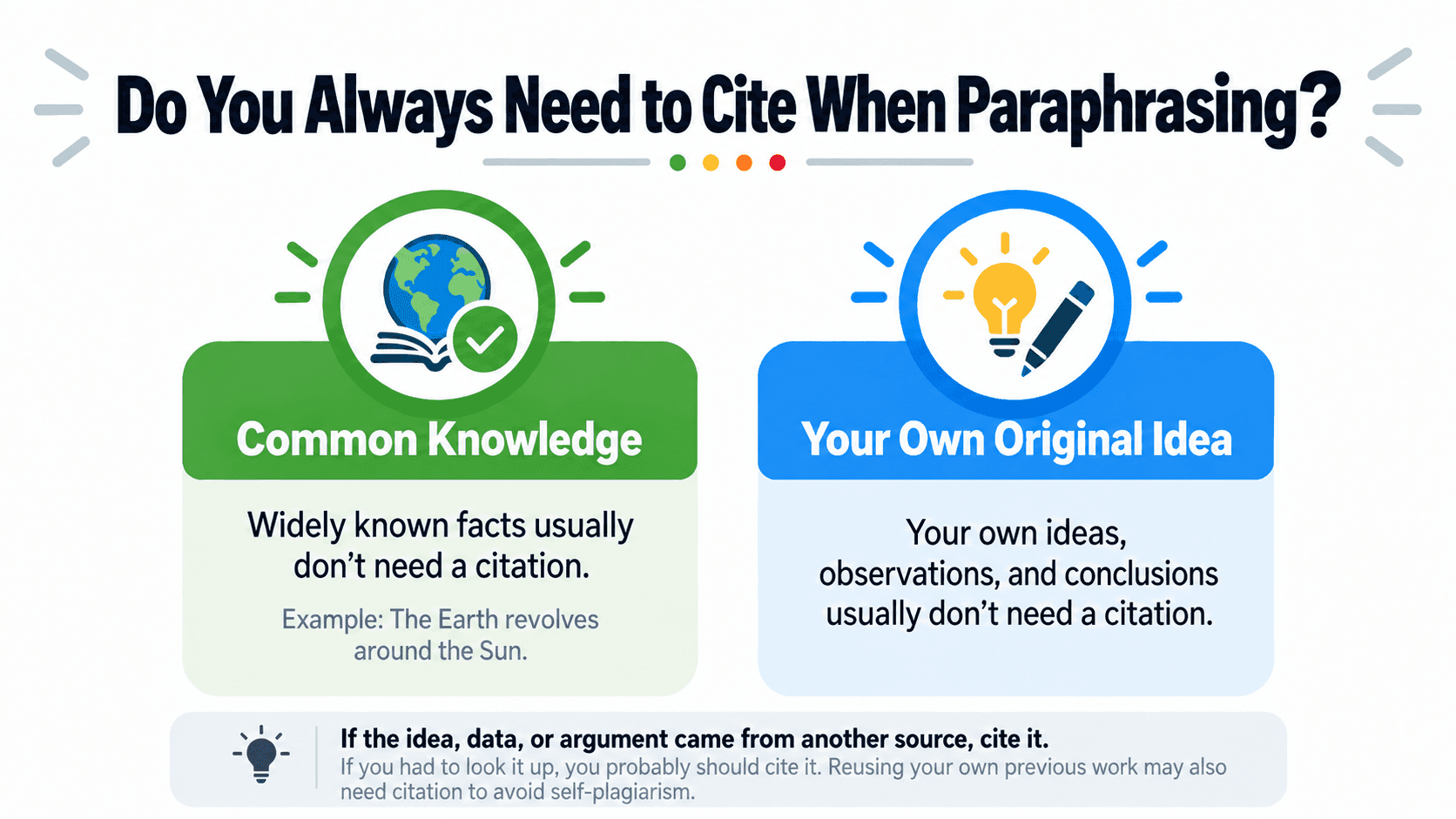
You don’t need to cite when paraphrasing if the information is:
- Common knowledge
- Your own original idea
Usually, you need a citation when the idea, argument, data, or finding came from another source.
Common knowledge consists of facts that are widely known, easy to verify, and not tied to a specific author, such as the fact that the Earth revolves around the Sun. You don’t need a citation for that.
Your own ideas, observations, and conclusions also don’t need citations. If you developed the point yourself rather than taking it from another source, there’s nobody else to credit.
The tricky part is deciding what actually counts as common knowledge. A fact may be obvious in one subject but unfamiliar in another.
And if the information comes from a specific study, report, or researcher, it usually isn’t common knowledge just because it sounds familiar. If you had to look it up, there’s a good chance you should cite it.
What Is Patchwriting?
Patchwriting happens when you try to paraphrase a source, but your version still follows too closely follows the original wording, vocabulary, or sentence structure.
It often looks like a paraphrase on the surface. But underneath, the source is still doing most of the writing.
Here’s a simple example:
original:
Social isolation can reduce students’ sense of belonging and negatively affect academic motivation.
Patchworked:
Social separation can decrease students’ feeling of belonging and negatively influence their academic motivation.
The second version changes several words, but the sentence still follows almost the exact same structure and sequence of ideas. That’s patchwriting.
Patchwriting isn’t always deliberate plagiarism. Students often do it when they’re working with unfamiliar material, technical language, or an argument they don’t yet fully understand.
The University of Michigan notes that patchwriting can even be part of the learning process. How so you wonder?
By looking closely at the parts where students struggle to explain in their own words.
If you’re looking at the original sentence and changing it piece by piece, you’re much more likely to patchwrite.
That’s why patchwriting can be a warning sign that you need to understand the source better before paraphrasing it.
Read the passage again, work out what the author is actually saying, then put the source aside and explain the idea from memory.
In other words, patchwriting may begin as a learning problem. But if it stays in your final work, it can become a plagiarism problem.
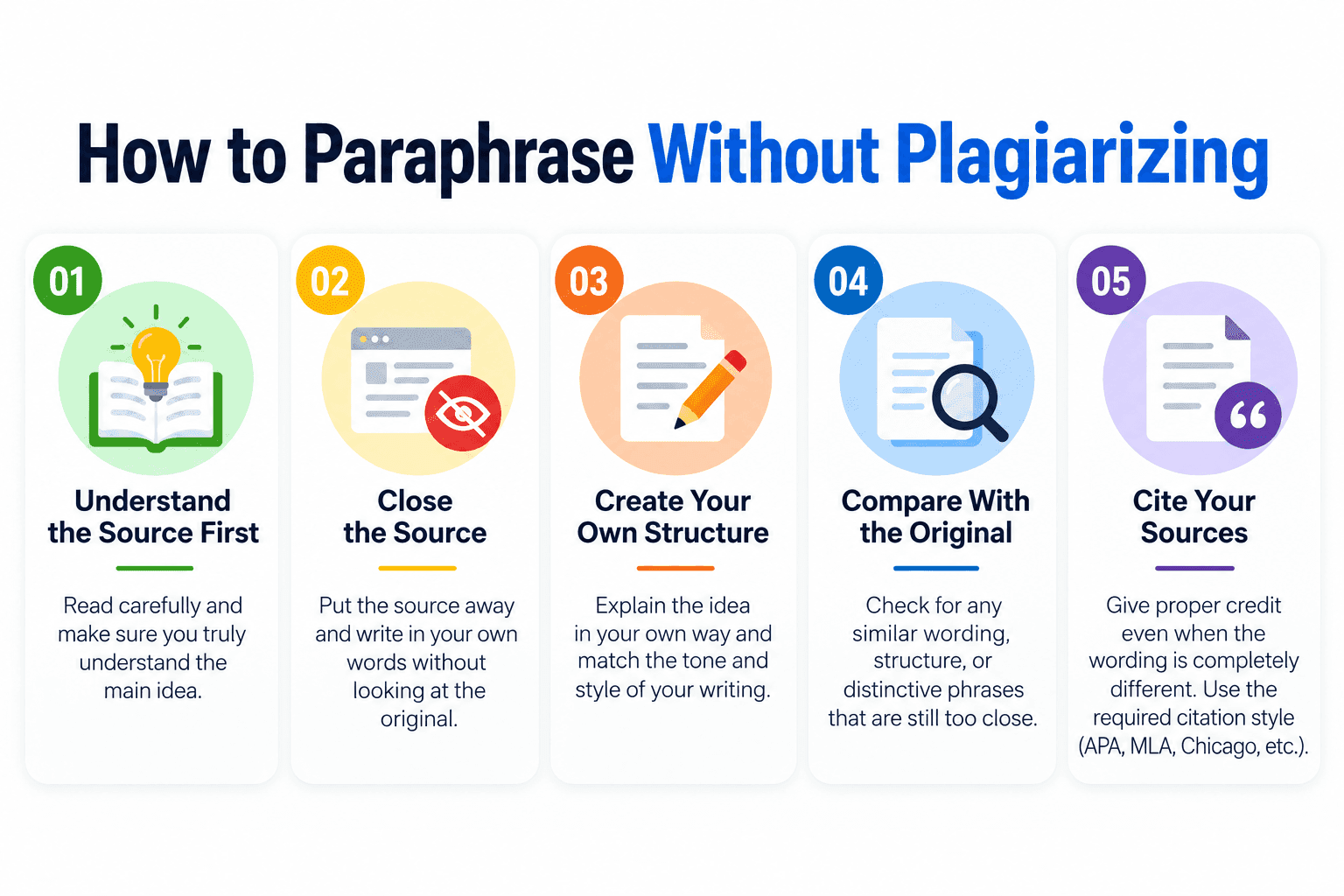
How to Paraphrase Without Plagiarizing
Good paraphrasing is less about changing words and more about rebuilding the idea in your own way.
That sounds simple. In practice, most bad paraphrasing happens because people start rewriting before they fully understand what the source is saying. Here are some tips to help you avoid plagiarism when paraphrasing.
1. Understand the Source First
You can’t paraphrase what you don’t understand. So, the first step of good paraphrasing is to understand your source.
Read the passage until you can explain its main point without copying its language. Test your understanding of a topic by asking clarifying questions, such as "What is the author trying to tell here?"
If you’re still relying on the original sentence to make sense of the idea, you’re probably not ready to paraphrase it yet.
This matters even more with technical or academic sources. Sometimes the wording feels difficult because the idea itself is difficult. Replacing a few complicated words won’t fix that.
2. Close the Source
Once you understand the idea, stop looking at the original for a moment. This is one of the easiest ways to avoid patchwriting.
When the source is sitting in front of you, it’s tempting to follow its wording, sentence order, and structure without realizing it. You end up editing the original.
But the goal is to explain it, or present the information to make your own point. So read it, understand it, then look away. Explain the source without
3. Create Your Own Structure
This is where you can actually provide genuine original value. It’s the creative bit you can own. You already know what the source is saying; you can explain it in your own words.
Now it’s time to integrate the information into your own essay, or research—whatever it is you’re writing.
Fit the information to match the tone and style of your paper or essay. Adding your unique voice can greatly improve how the paraphrase reads.
4. Compare Your Version With the Original
Once you’ve finished, go back and compare both versions. Look for anything that feels suspiciously familiar.
Look for whether the sentence structure is the same or are there distinctive phrases you copied without noticing?
A good paraphrase should be different enough in expression while still staying faithful to the source.
5. Cite Your Sources
Finally, give credit to the original source. Even when the wording and structure are completely different, the underlying idea still came from someone else.
The exact citation format will depend on the style you’re using, such as APA, MLA, or Chicago. But the principle stays the same: make it clear whose idea you’re using. If you're unsure how to format your references, you can use a citation generator to cite the sources you've paraphrased in the required style.
Paraphrasing Example: Wrong vs Right
The easiest way to understand proper paraphrasing is to compare a few versions of the same source.
Here’s a simple example to demonstrate right vs wrong paraphrasing:
| Version | Example | What’s Wrong/Right? |
|---|---|---|
| Original Passage | Students who regularly test themselves on material tend to remember it better than students who only reread their notes. | This is the source idea and wording. |
| Uncited Paraphrase | Students often remember information better when they actively test their knowledge rather than simply rereading their notes again. | The wording and structure are different, but the idea still came from the original source. Without a citation, the reader may assume the idea is yours. |
| Patchwriting With Citation | Students who frequently test themselves on study material tend to remember it better than students who only review their notes (Author, 2025). | The source is cited, but the sentence still follows almost the same wording and structure. A citation doesn’t fix an overly close paraphrase. |
| Proper Paraphrase With Citation | Active recall appears to support stronger memory than passive review, which may explain why self-testing can be more effective than repeatedly reading notes (Author, 2025). | The idea is expressed through different wording and structure; the original meaning is preserved, and the source is credited. |
Note: The citation examples are only in-text. For an actual essay, or paper, you’ll need to add both in-text and full citations.
Paraphrasing vs Quoting vs Summarizing
Paraphrasing isn’t the only way to use information from another source. You can also quote or summarize it.
The right choice depends on what you want to keep from the source. Whether you want to keep the idea, exact wording, or the main point will dictate whether paraphrasing, quoting, or summarizing is the right way to go.
| Method | What You Do | When to Use It | Citation Needed? |
|---|---|---|---|
| Paraphrasing | Explain a specific idea in your own words and structure | When the idea matters more than the original wording | Usually, yes |
| Quoting | Use the author's exact words | When the wording itself is important | Yes |
| Summarizing | Condense a larger passage or argument into its main points | When you only need the bigger picture | Usually, yes |
Are AI Paraphrasing Tools Safe to Use?
AI paraphrasing tools can be safe to use, but it depends on what you use them for.
Using a tool such as an AI paraphraser to improve the wording of your own writing is very different from putting someone else’s paragraph into it. You’re just handing off the plagiarism to them too at that point.
Using a Tool on Your Own Writing
If you wrote the original text yourself, using an AI paraphraser to make a sentence clearer and less repetitive generally doesn’t constitute a plagiarism issue.
Some schools or instructors may limit which AI writing tools you can use. So if your course has an AI-use policy, check that before relying heavily on a paraphraser.
Using a Tool to Rewrite Someone Else’s Source
Imagine copying a paragraph from a research paper, running it through an AI paraphraser, and then placing the rewritten version into your essay without citing the paper.
The sentences may look different, but the ideas still came from the original author.
That can still be plagiarism. So an AI paraphraser should never be treated as a machine that turns borrowed work into original work.
Can a Paraphrasing Tool Make Text Plagiarism-Free?
A tool may substantially rewrite a passage, reducing obvious word-for-word similarity. But that doesn’t answer the more important questions.
A sentence may sound smoother while becoming less precise, more absolute, or simply wrong. This is especially risky with research findings, technical definitions, statistics, or arguments where small wording changes matter.
So don't just copy the generated version and move on. Compare it with the source and check that the meaning survived the rewrite.
What About AI Detection?
Running text through a paraphrasing tool doesn’t guarantee that it will stop being identified as AI-written.
False positives are a big problem with AI detectors. These tools can mistakenly flag human content as AI.
You’re much better off using AI paraphrasing and writing tools to help with expression, not to hide where the writing or ideas came from.
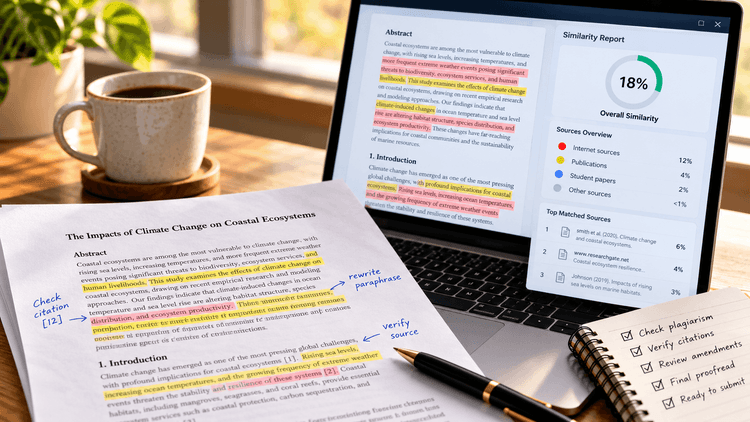
Detect Paraphrasing Plagiarism With CopyChecker
CopyChecker can detect paraphrased plagiarism, including cases where the copied material has been rewritten rather than copied word for word.
That matters because plagiarism isn’t always a neat copy-and-paste job. Someone may replace words, rearrange parts of a sentence, or slightly rephrase a passage while keeping much of the original content intact.
CopyChecker scans for both exact and partial similarities and then shows you a similarity score.
So, if a paraphrase still shares meaningful similarities with material already published elsewhere, CopyChecker can flag those areas for review.
Similarity Is Not Always Plagiarism
Plagiarism checkers can identify similarity. It can’t decide the academic context for you.
For example, a correctly quoted and cited passage may produce a match without it being plagiarised.
On the other hand, a heavily rewritten idea with no citation might show little similarity while still be considered plagiarism because the original author wasn’t credited.
Instead, use CopyChecker to find suspicious overlap, review the highlighted passages and available sources, and make a judgement call yourself.
Academic institutions know this. Which is why they have policies for acceptable percentages for plagiarism.
Quick Paraphrasing Checklist
Before you submit a paraphrase, run through these six questions:
- Is the wording genuinely mine? Avoid copying distinctive phrases or simply replacing a few words.
- Did I change the structure? Your version shouldn’t follow the original sentence pattern line by line.
- Did I preserve the meaning? A paraphrase should change the expression, not what the author actually said.
- Did I cite the source? If the idea came from someone else and isn’t common knowledge, give them credit.
- Did I quote any exact wording? If you keep the author's distinctive words, use quotation marks and cite them.
- Is my version still too similar to the source? Read both side by side. If yours feels like an edited version of the original, rewrite it again.
Once you've checked that your paraphrase is accurate, properly cited, and written in your own words, give it one final review. A grammar checker can help you catch any spelling, punctuation, or grammatical mistakes before submitting your work.
Frequently Asked Questions
Is paraphrasing plagiarism if you cite?
Not if you cite and paraphrase properly. But citation alone doesn't make an overly close paraphrase acceptable.
Is paraphrasing without citation plagiarism?
Yes, if you're presenting someone else's idea, argument, research, or interpretation without acknowledging where it came from.
How much do you have to change to avoid plagiarism?
There is no safe percentage of words you need to change. What matters is whether you've independently expressed the meaning using your words and structure.
Do you need to cite every paraphrase?
You need to make it clear which information came from which source. You don’t need to add citations after every sentence.
Is changing words into synonyms considered paraphrasing?
Replacing words with synonyms while keeping the same sentence structure is closer to patchwriting than proper paraphrasing and can be flagged as plagiarism.