You finish your assignment, run it through a plagiarism checker, and see a 15% similarity score.
Your first thought is probably something like: Is 15% too high? Do I need to rewrite everything? Is this going to be a problem?
That reaction makes sense, but the number alone does not tell the full story.
The most important thing to know is this: there is no universally acceptable plagiarism percentage, and a similarity score is not the same as a plagiarism score.
If you actually copy someone else's work and present it as your own, the goal should always be 0% plagiarism.
A similarity score is different. It simply shows how much of your writing matches text found in other sources.
Those matches may come from properly used quotes, references, common phrases, technical terms, templates, or genuinely copied text.
That is why a score like 15% or 20% does not automatically mean your work contains that much plagiarism.
Turnitin explains the same distinction in its Similarity Report: it identifies matching text, but the score itself does not decide whether plagiarism has happened.
What This Score Really Means
- Actual plagiarism: Aim for 0%.
- Similarity: Some similarity is completely normal.
- 15% similarity: Could be acceptable.
- 20% similarity: Does not automatically mean plagiarism.
- 0% similarity: Is not automatically better.
A simple way to remember it is:
The percentage tells you where to look. The matches tell you what actually happened.
So instead of immediately trying to lower the number, open the report and look at what is creating the similarity.
And if you see a match you honestly didn't mean to copy, don't panic. Things like missing citations, forgotten quotation marks, or writing too closely to a source can lead to unintentional plagiarism.
So, let's start with the question most people want answered first -
Is There a Universal “Safe” Plagiarism Percentage?
No. A university, journal, professor, publisher, and freelance client can all set completely different requirements.
That is the problem with advice like: “Anything under 20% is safe.”
It sounds wonderfully simple.
Reality, in its usual inconsiderate fashion, is not.
Consider these two papers:
| Paper | Similarity | What the Report Shows | Bigger Concern? |
|---|---|---|---|
| Paper A | 8% | Most of it comes from one uncited source | Yes |
| Paper B | 18% | References, legitimate quotations, and standard terminology | Probably less concerning |
Paper B has the larger number.
Paper A may have the bigger plagiarism problem.
That is because the percentage alone cannot tell you whether the matched text was used properly.
You still need to look at where the matches came from, how much came from a single source, and whether the original author was properly credited.
Plagiarism itself can also take several forms, from direct copying to mosaic plagiarism, poor paraphrasing, and reuse of previous work.
If those differences are unclear, understanding the different types of plagiarism can make a similarity report much easier to interpret.
So the takeaway here is simple:
Don't ask only, “Is my percentage low enough?” Ask, “What is actually making up that percentage?”
Once you start looking at similarity that way, the next question becomes much easier to answer: what similarity range is usually considered acceptable in different situations?
Now that you know there is no universal rule, then -
What Similarity Range Is Usually Acceptable in Plagiarism?
There is no single similarity percentage of plagiarism that is considered acceptable everywhere.
A score that may be fine for a university assignment could be too high for a particular journal, while blogs and freelance projects often follow completely different standards.
The more useful way to read a similarity score is to consider where the content will be submitted, what caused the matches, and what rules apply in that context.
The ranges below reflect common expectations you may encounter, but treat them as reference points, not automatic pass-or-fail limits.
So, let's check them out -
| Context | What You May Encounter | What You Should Actually Check |
|---|---|---|
| University assignment | Institution-specific rules; sometimes 15–25% | Matched passages and university policy |
| Thesis/dissertation | Some institutions require under 20% | Overall score + similarity from individual sources |
| Journal manuscript | Can be stricter, sometimes around 10–20% | Journal-specific policy, self-overlap, individual matches |
| Blog/SEO content | No universal percentage | Original value, copied passages, attribution |
| Freelance/client work | Client-specific | Contract requirements and unexplained overlap |
Notice the deliberately annoying phrase “some institutions.”
That's because different institutions really do set different limits.
Muhammad Ali Jinnah University, for example, says dissertations, theses, project reports, and other technical reports should have less than 20% total similarity and less than 5% similarity from a single source.
Boston University Graduate Medical Sciences similarly says its similarity index should generally be below 20%, but warns that a low score can still contain passages that need correcting.
So when somebody online declares that “17% is safe everywhere,” don't reorganize your academic career around that person.
A better approach is to treat the percentage as a starting point, then look at the rules for where your work is actually going.
For students, that usually means checking two things first:
- Your university's academic-integrity policy and
- What the Turnitin similarity report is actually showing.
And that brings us to the context where this question comes up most often.
What Universities and Turnitin Plagiarism Similarity Reports Indicate?
For students, similarity scores usually become important when an assignment, thesis, or research paper is checked before submission.
Many universities use Turnitin, a system that compares submitted writing with existing sources such as websites, publications, and previously submitted papers.
It then creates a similarity report showing how much of the text matches other material.
But here is the important part:
A Turnitin score does not mean that the same percentage of your paper is plagiarized.
So if your report shows 17% similarity, it does not automatically mean:
“17% of this paper is plagiarism.”
It simply means that 17% of the text matched something in Turnitin's comparison sources.
To know whether those matches are actually a problem, you have to look at what was matched and how that material was used.
For example, similarity can come from:
- properly used quotations
- references and bibliography entries
- citations
- common academic phrases
- technical terms
- standard methodology wording
- university templates
- previously submitted work
- genuinely copied passages
Those matches clearly do not all deserve the same level of concern.
A Real Turnitin Example on Why a Higher Score Can Be Better
Turnitin gives a useful example in its own guidance.
One student copies part of a source directly and receives a 20% similarity score.
Another student uses several sources, quotes them properly, and includes the correct references.
That student's report shows 22% similarity.
The second student has the higher percentage, but the first student's paper has the more serious problem.
That is why 20% similarity does not mean 20% plagiarism.
The number tells you how much text matched.
It does not explain why it matched.
Turnitin can also exclude certain types of text when calculating a report, including bibliographies, quoted text, cited text, and small matches.
In its newer report, the minimum small-match filter can start at 8 words.
So even the final percentage can change depending on the report settings being used.
The practical lesson is simple: never judge a paper from the percentage alone.
Look at the matched passages first.
Is 15% Similarity Acceptable for a Thesis?
It can be.
A 15% similarity score may be perfectly acceptable at one university and require more review at another.
That is because universities can set their own rules for theses, dissertations, and assignments.
So instead of asking only:
“Is 15% low enough?”
ask:
“What is making up that 15%?”
Open the report and check:
- whether one source makes up a large part of the score
- whether quotations are clearly marked
- whether borrowed ideas are properly cited
- whether the bibliography is being counted
- whether technical phrases are creating small matches
- whether some text comes from your earlier work
- what your department's own similarity policy says
That last point matters most.
A percentage that is fine under one university's rules may not be accepted by another.
If you're checking a paper before submission, you can also review the broader writing quality with an essay checker after dealing with originality.
A useful rule to remember is:
Don't ask only, “Is my similarity score too high?” Ask, “Why is my similarity score this high?”
Once you understand where the matches come from, even a higher score becomes much easier to judge.
What Can a High Similarity Report Really Contain?
Suppose your thesis comes back with a 31% similarity score.
At first, that can look worrying.
But it would be a mistake to assume that 31% of the paper is automatically plagiarized.
So you open the report and look at what is actually contributing to the score.
| Match Type | Contribution to Raw Score | What You Find |
|---|---|---|
| Reference list | 7% | Legitimate |
| Proper quotations | 5% | Correctly cited |
| Standard methodology wording | 4% | Needs review, but may be normal |
| University template | 3% | Legitimate |
| Technical terminology | 2% | Low concern |
| Correctly cited close matches | 3% | Review |
| Overly close paraphrasing | 4% | Rewrite |
| Uncited copied passage | 3% | Must fix |
| Raw similarity | 31% | |
| Clear problem areas in this example | 7% |
This is only an example, but it shows why the large percentage at the top of a report does not tell the full story.
In this case, much of the 31% comes from references, quotations, technical wording, and other explainable matches.
The parts that actually need attention are much smaller.
A similarity checker can show you where your text matches other sources, but you still need to decide whether each match is acceptable.
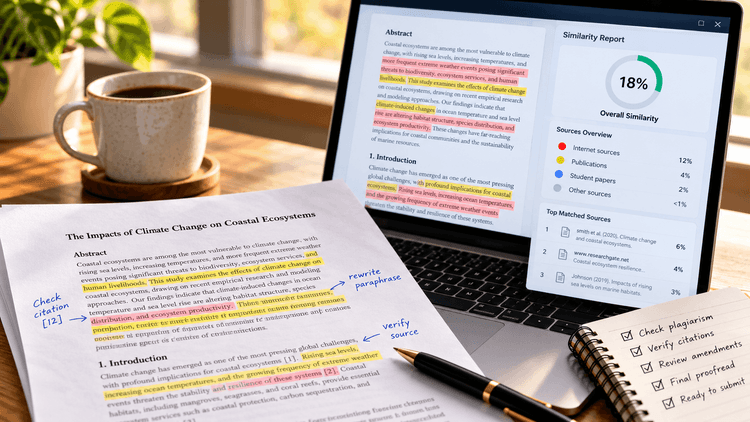
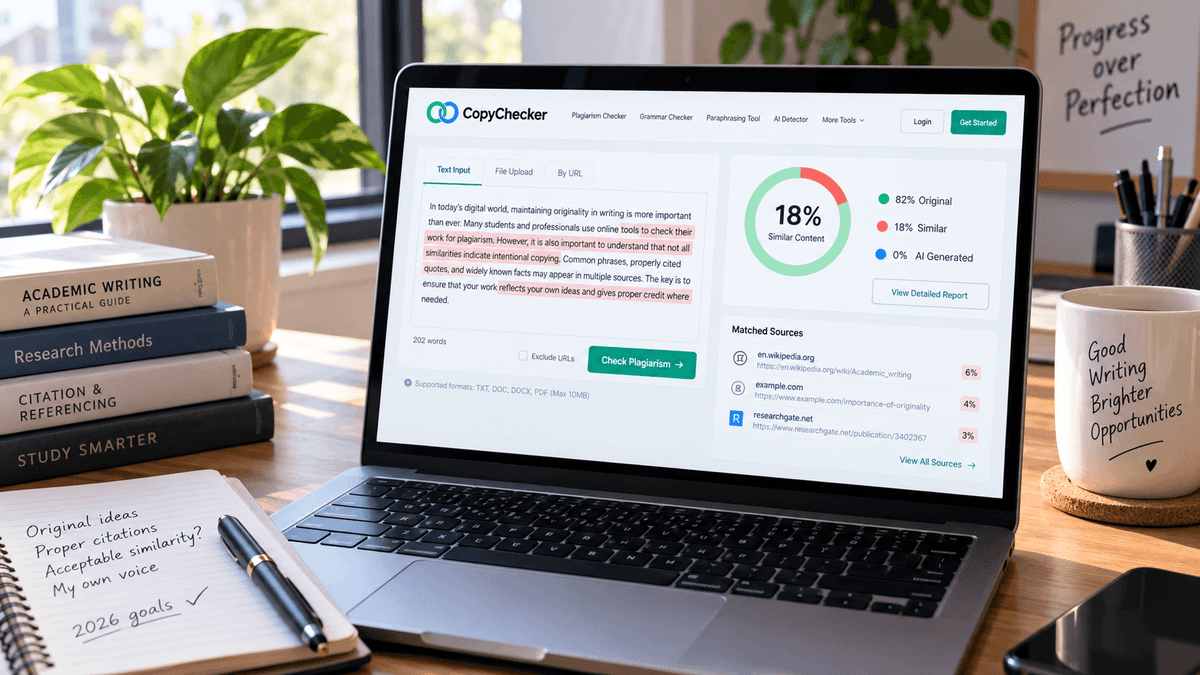
That is why using a reliable plagiarism checker before submission can be useful. Instead of seeing only one percentage, you can review the similarity score, unique-content score, highlighted matches, and available source details to understand where the overlap comes from.
And if a highlighted passage turns out to be too close to the original source, simply changing a few words is not enough.
Good paraphrasing means understanding the source and explaining the idea naturally in your own words and sentence structure.
You still need to give credit when the idea came from someone else.
If that line sometimes feels unclear, understanding the difference between paraphrasing and plagiarism can help you spot passages that need more than a quick rewrite.
Turnitin Can Exclude Quotes, References, and Small Matches
This is one of the most useful features to understand when interpreting a Turnitin report.
Its current exclusion filters can remove:
- bibliography
- quoted text
- cited text
- small matches
from the similarity calculation.
Turnitin currently sets 8 words as the minimum small-match threshold in its newer report.
That matters because short technical expressions and common wording can otherwise make a report look busier than it really is.
Now you might be thinking -
What Journals and Publishing Sectors Typically Require in Plagiarism Percentage
Academic publishing can be considerably stricter.
But again, no journal has a universal similarity threshold.
Different journals can set different rules, even within the same publisher.
Let’s talk about a real example on a journal with a 10% cutoff,
Elsevier's Molecular Catalysis currently says manuscripts with a similarity index above 10%, including self-plagiarism, are automatically rejected at the editorial level.
That does not mean “Elsevier allows 10% plagiarism.”
It means one specific Elsevier journal has established that similarity rule.
That distinction matters.
A Springer Nature guide to Crossref Similarity Check/iThenticate recommends paying close attention to individual source matches.
Its rule-of-thumb guidance says:
- individual sources around 1–5% generally show little indication of a problem when properly handled
- figures above roughly 10% deserve screening
- anything above 20% should receive more careful review
The guide also emphasizes something more important than the numbers, and that is always to examine the match context.
So before submitting research, check the journal's:
- Author guidelines
- Plagiarism policy
- Text-recycling policy
- Self-plagiarism policy
- Overall similarity limit
- Individual-source limit
Researcher Tip
A manuscript with 14% total similarity spread across 20 legitimate sources tells a very different story from a manuscript where 11% comes from one article.
The second number deserves your attention first.
And yes, you can plagiarize your own previous writing in some academic and publishing contexts.
If that sentence sounds contradictory, understanding self-plagiarism goes deeper into why previously published work may still need disclosure or citation.
The key takeaway for publishing is simple: journals usually care about where the similarity comes from, not just the final percentage.
But once we move away from academic publishing, the rules change again.
Bloggers, marketers, and website owners are less likely to worry about a journal's similarity limit.
Their bigger question is usually whether similar or repeated content can hurt originality, rankings, or search visibility.
That brings us to another commonly confused issue -
Plagiarism Acceptance Ratio in Content Marketing and SEO
Bloggers and marketers face a slightly different version of this confusion, so they ask, “How much duplicate content can Google tolerate?”
First, duplicate content and plagiarism are not interchangeable terms.
Plagiarism
Using another person's words, ideas, or work without appropriate attribution.
Duplicate Content
The same or substantially similar content appearing at multiple URLs.
Google explicitly says that some duplicate content on a website is normal and is not a violation of its spam policies.
Duplicate URLs can appear because of:
- tracking parameters
- product filters
- regional versions
- HTTP/HTTPS variations
- print versions
- mobile/desktop variants
Google may group those similar URLs and choose a canonical version to represent them in search.
So there is no meaningful:
“15% plagiarism is safe for SEO”
rule.
For bloggers, the better question is whether you're bringing original value, analysis, examples, experience, or perspective to the topic.
If you're working from sources, learning how to paraphrase without plagiarism is infinitely more useful than trying to make copied paragraphs different enough to sneak beneath a percentage threshold.
What Similarity Limits Do Freelance Clients Usually Set?
Freelance writing has no universal plagiarism limit either.
A client might require:
- less than 10% similarity
- less than 5%
- no source above 2%
- “100% original content”
- a particular checker report
If a contract gives you a threshold, that becomes the practical rule for that project.
But still investigate why a match exists before rewriting it.
Brand names, quotations, product specifications, legal phrases, and standard terminology can naturally overlap.
Three paragraphs that mysteriously resemble your client's biggest competitor deserve rather more attention.
Freelancer Test
For every major highlighted match, ask:
“If the client clicked this source and asked why my sentence looks like theirs, could I explain it confidently?”
If yes, good.
If your immediate strategy is to pretend Slack is down, review the paragraph again.
Writers who regularly work from research should also know the common ways plagiarism happens accidentally, especially through messy notes, forgotten citations, and close paraphrasing.
So, now let’s talk about -
Why Similarity Scores in Plagiarism Can Be Misleading
A similarity tool can identify overlapping words.
It cannot independently understand every reason why they overlap.
Take these examples.
Case A
A researcher uses an exact sentence from a study, places it inside quotation marks, and cites the source properly.
Likely result: A strong textual match.
Case B
A writer takes someone else's idea, heavily rewrites the language, and publishes the argument without attribution.
Here, the possible result can be much weaker direct textual similarity.
Yet Case B can raise the more serious originality issue.
That is why even a low similarity score should not be treated as a certificate of ethical purity suitable for framing.
It is also why plagiarism detection should not be confused with AI detection.
A plagiarism checker compares writing against existing sources for overlap.
Whereas an AI detector looks for linguistic and statistical patterns associated with AI-generated text.
So, the proper explanation of how AI detectors work breaks that difference down in more detail.
The same paper could theoretically have:
| Similarity | AI Detection | Possible Situation |
|---|---|---|
| Low | Low | Mostly original human writing |
| High | Low | Human writing with many source matches |
| Low | High | Original text with patterns an AI detector flags |
| High | High | Requires review on both fronts |
Different score. Different technology. Different question.
Combining the two because they both contain percentages merely creates a larger, more sophisticated headache.
So, now let’s dive into one of the most important areas of
How to Lower Your Similarity Score the Right Way
The goal isn't to beat a plagiarism checker.
The goal is to fix writing that is genuinely too close to a source.
1. Start With the Largest Match
Don't obsess over twenty tiny matches before reviewing the source responsible for 8% of your paper.
2. Decide Why It Matched
Ask whether the highlighted passage is:
- a quotation
- a citation
- a reference
- technical wording
- a common phrase
- previous work
- an overly close paraphrase
- genuinely copied text
3. Paraphrase From Understanding
Read the source.
Understand it.
Move the source out of sight.
Then explain the idea naturally in your own structure.
For a deeper workflow, follow these steps to paraphrase without plagiarism instead of the classic student ritual of replacing “important” with “significant” and hoping academia is fooled.
A paraphrasing tool can help you explore alternative wording, but the final version still needs your judgment and proper attribution.
4. Cite Ideas, Not Just Quotes
Changing the words doesn't change where the idea came from.
If a statistic, theory, argument, research result, or finding originated elsewhere, cite it.
5. Use Quotations When Exact Wording Matters
Sometimes paraphrasing makes a sentence worse.
If the original wording is important, quote it correctly and provide attribution rather than mangling it solely to reduce the similarity score.
6. Check for Accidental Plagiarism
Forgotten quotation marks and incomplete citations are easier to miss than direct copy-pasting.
A quick review of the common causes of unintentional plagiarism can help catch these before submission.
7. Recheck the Revised Draft
Run the edited version through the CopyChecker Plagiarism Checker again.
Compare:
- similarity percentage
- highlighted matches
- matching sources
- areas you edited
The purpose isn't just to watch 23% become 11% and get a tiny dopamine hit.
Make sure the actual problematic passages are gone.
For academic essays, you can then run the cleaned draft through a final Grammar Checker so originality fixes haven't left behind awkward sentences or new mistakes.
FAQs about What Percentage of Plagiarism Is Acceptable
Is 15% Plagiarism Acceptable for a Thesis?
If you mean 15% similarity, it may be acceptable depending on your university's rules and what caused those matches. If you mean 15% genuinely copied and unattributed material, that content needs attention. Always review your institution's policy.
How Much Similarity Index Is OK?
There is no universally acceptable similarity index. Some institutions require scores below 20%; others use different thresholds or review matches individually.
Does Turnitin Count Quotes and References as Plagiarism?
Turnitin detects similar text. It does not automatically declare a quote or bibliography entry plagiarism. Its current Similarity Report can exclude bibliography, quoted text, cited text, and small matches from the score.
What Turnitin Similarity Score Is Acceptable?
No single acceptable Turnitin score applies to every university. Check your institution's policy, then review the individual matches. Turnitin's own 20% versus 22% example shows why the bigger number isn't necessarily the worse submission.
What Similarity Percentage Do Journals Reject At?
There is no universal rejection percentage. Some journals reject manuscripts above 10% similarity editorially, while others use different approaches. Always read the policy for the specific journal you are submitting to.
Is Duplicate Content the Same as Plagiarism for SEO?
No. Duplicate content refers to substantially similar material appearing at different URLs. Google says some duplicate content is normal and does not violate its spam policies.
Is Paraphrasing Enough to Avoid Plagiarism?
Not automatically. A paraphrase should genuinely restructure and restate the information, and you still need to credit the original source when the idea came from someone else. For example, see the guide on paraphrasing vs. plagiarism.
Can You Accidentally Plagiarize?
Absolutely. Poor note-taking, missed citations, forgotten quotation marks, close paraphrasing, and reused work can all create unintentional plagiarism.
Can You Plagiarize Yourself?
Yes, depending on the academic or publishing context. Reusing previously submitted or published material without disclosure can become self-plagiarism or inappropriate text recycling.
Can 0% Similarity Be Realistic?
Yes. But it isn't necessary for every legitimate piece of writing. Turnitin notes that 0% can be relatively rare in long-form assignments requiring quotations and citations.
What Plagiarism Score Is Safe?
No plagiarism score is universally safe. A much better standard is no unexplained copying + correct attribution + responsible paraphrasing + compliance with the policy that applies to your work.
Final Words
So, what percentage of plagiarism is acceptable?
For genuine plagiarism, zero should be the goal.
For similarity, there isn't one magical number that works for every thesis, research paper, journal manuscript, blog post, or client project.
A score of 10%, 15%, or 20% is information.
Not a verdict.
Open the report.
See where the matches came from.
Check quotations and citations.
Investigate large individual sources.
Fix passages that genuinely rely too heavily on someone else's wording.
And if you're submitting or publishing something important, run the final version through the CopyChecker Plagiarism Checker before it leaves your hands.
You can review the similarity percentage, unique-content percentage, highlighted matches, and available source details rather than trying to judge originality from one intimidating number.
Because ultimately, the goal isn't to make a checker happy.
It's to know that the work you're putting your name on is actually yours.