You have been grading papers for what feels like forever.
Most of them follow a familiar rhythm.
You know how your students usually explain an idea, the kinds of words they reach for, even the mistakes they tend to make.
Then one paper suddenly feels different.
The first page sounds completely normal.
A few paragraphs later, the writing becomes unusually polished.
The vocabulary gets more advanced.
The citation style changes.
Then you reach a sentence and think:
Wait... have I read this somewhere before?
So you run the paper through a plagiarism checker.
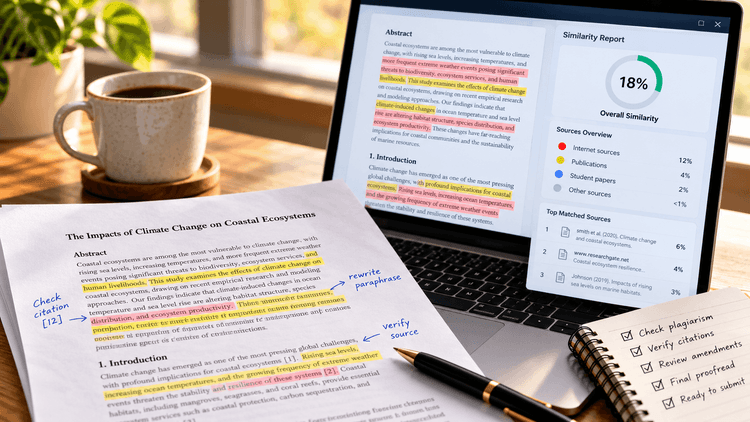
A similarity score appears.
And now you have a new problem.
What are you actually supposed to do with that number?
A high percentage does not automatically mean the student plagiarized.
A low one doesn't guarantee everything is original either.
Even a suspicious change in writing style is only a clue, not proof.
That is why checking a student paper for plagiarism is less about catching someone and more about following the evidence carefully.
You need to know what matched, why it matched, whether the source was used correctly, and which parts of the paper actually deserve a closer look.
The good news is that you do not need to investigate every sentence like an academic detective.
With the right process, you can move from a vague feeling of “something seems off here” to a much clearer conclusion using your knowledge of the student's writing, a plagiarism checker, source verification, and human judgment.
So, let’s talk about -
How to Check a Student Paper for Plagiarism Easily
Checking a paper for plagiarism works best when you follow the same process every time instead of jumping straight to the similarity score.
The goal is simple: first spot anything unusual, then use a plagiarism checker to narrow down possible matches, and finally verify those matches before making any judgment.
The following is the full process at a glance -
| Step | What to Do |
|---|---|
| 1. Read | Read the paper once and note unusual writing or citation changes. |
| 2. Check | Run the paper through a plagiarism checker. |
| 3. Review | Look at individual matches instead of judging the overall score. |
| 4. Filter | Separate legitimate quotes, citations, references, and incidental matches. |
| 5. Verify | Compare suspicious passages with the original sources. |
| 6. Document | Save the relevant evidence before taking further action. |
Think of it as:
Read → Check → Review → Filter → Verify → Document
Now that you have the overall process in mind, one thing is worth understanding before we go through each step in detail.
A plagiarism checker plays an important role in this workflow, but it is only one part of the process.
It can show you where a paper matches existing material, but it cannot always tell you why that match exists or what you should conclude from it.
So before relying on any score or highlighted passage, let’s find out -
What Can a Plagiarism Checker Actually Tell You?
A plagiarism checker is very good at finding textual similarity.
It can show you that part of a student's essay resembles material found elsewhere and, depending on the tool, help you locate likely sources.
What it cannot do is look at a highlighted paragraph and announce, with the wisdom of an academic tribunal, “Guilty.”
Turnitin makes this distinction explicitly.
Its similarity score represents the percentage of text that matches material in the searched databases.
The score itself does not determine whether plagiarism occurred.
Cornell University gives instructors a similar warning: a similarity report identifies matching text, but it does not determine whether that material was used and cited correctly.
Cornell also notes that similarity checking may miss many cases of paraphrasing.
So the useful way to think about a plagiarism checker is: It tells you where to investigate. You decide what the match means.
But that raises another question: if software cannot catch or interpret everything, how much can you spot just by reading the paper yourself?
Quite a bit, actually.
Teachers have one advantage no plagiarism checker has: context.
You know the assignment, you have seen the student's previous work, and you often notice when something suddenly doesn't sound quite like them.
Still, that instinct alone has limits.
So, let’s find out -
Why Manual Checking Alone Isn't Enough Anymore
Teachers can often notice things a plagiarism checker can't. You know the student, the assignment, and what their writing usually sounds like.
For example, you might notice:
- A sudden change in writing style — short, simple sentences suddenly become highly academic.
- Unusually advanced vocabulary — words or phrases feel very different from the student's usual work.
- Inconsistent citations — the citation style changes halfway through the paper.
- Missing references — a source appears in the essay but never makes it into the reference list.
- Sections that simply feel different — one paragraph sounds as though it belongs in another paper entirely.
These clues are useful because you have context that software does not.
But manual checking has a pretty obvious limit where you cannot remember everything ever published on the internet.
Even an experienced teacher cannot compare one essay against millions of webpages, academic articles, books, journals, and previously submitted papers.
Turnitin, for example, says its comparison sources can include billions of active and archived webpages, previously submitted work, and tens of thousands of journals, periodicals, and publications.
So each side does something different -
- You Notice: Tone changes, unusual wording, weak citations, and anything that does not fit the student's normal work.
- The Plagiarism Checker Finds: Matching text and potential sources across a much larger collection of content.
- You Take the Decision: Whether those matches are legitimate source use or need further investigation.
Think of it this way:
You provide the context. The checker provides the comparison.
And when you use both together, you get a much more reliable picture of what is actually happening in the paper.
So the real question is not whether you should rely on manual review or a plagiarism checker.
It is how to use both in the right order without wasting time or jumping to conclusions.
That is where a consistent checking process helps. So let’s see -
Ways to Check a Student Paper for Plagiarism Step by Step
Now that you know what plagiarism checkers can do and what it can't do, and why your own judgment still matters, let’s put both together.
The goal here is not to hunt for a reason to penalize a student.
It is to follow the same fair process every time so that you can move from suspicion to evidence without skipping important steps.
You do not need to overanalyze every sentence either.
Start broad, narrow your attention only when something deserves a closer look, and verify before reaching any conclusion.
Here is how that process works in practice -
Step 1: Do a Quick Manual Read First
Before plagiarism check, first read the paper once.
Don't turn the first reading into a forensic investigation.
Just notice anything that feels inconsistent.
Maybe the vocabulary changes suddenly.
Perhaps one section uses British spelling while the rest uses American English.
A student who has struggled with citations all semester suddenly produces three perfectly formatted scholarly paragraphs.
Those details deserve attention, but they don't prove plagiarism.
Students improve.
Writing changes when they revise.
Tutors help.
Grammar tools exist.
Some students simply write more confidently about topics they understand well.
So when something catches your attention, mark it mentally or add a note.
Then keep reading.
Teacher tip: Look for clusters of inconsistencies rather than one unusual sentence. A vocabulary shift combined with different formatting and an unfamiliar source is more useful to investigate than one surprisingly elegant phrase.
Step 2: Run the Paper Through a Plagiarism Checker
Now give software the boring job humans are spectacularly unsuited for: comparing thousands of words against enormous amounts of published material.
You can use any reliable plagiarism checker to run the paper through a similarity check and identify passages that may need closer inspection.
Don't begin with the mindset:
“I need to find plagiarism.”
Instead, ask:
“Is any of this writing unusually similar to another source?”
That small change helps keep the review objective.
Once the check finishes, resist the urge to stare only at the big percentage at the top.
A paper with 32% similarity is not automatically worse than one with 12%.
The source of that similarity matters much more.
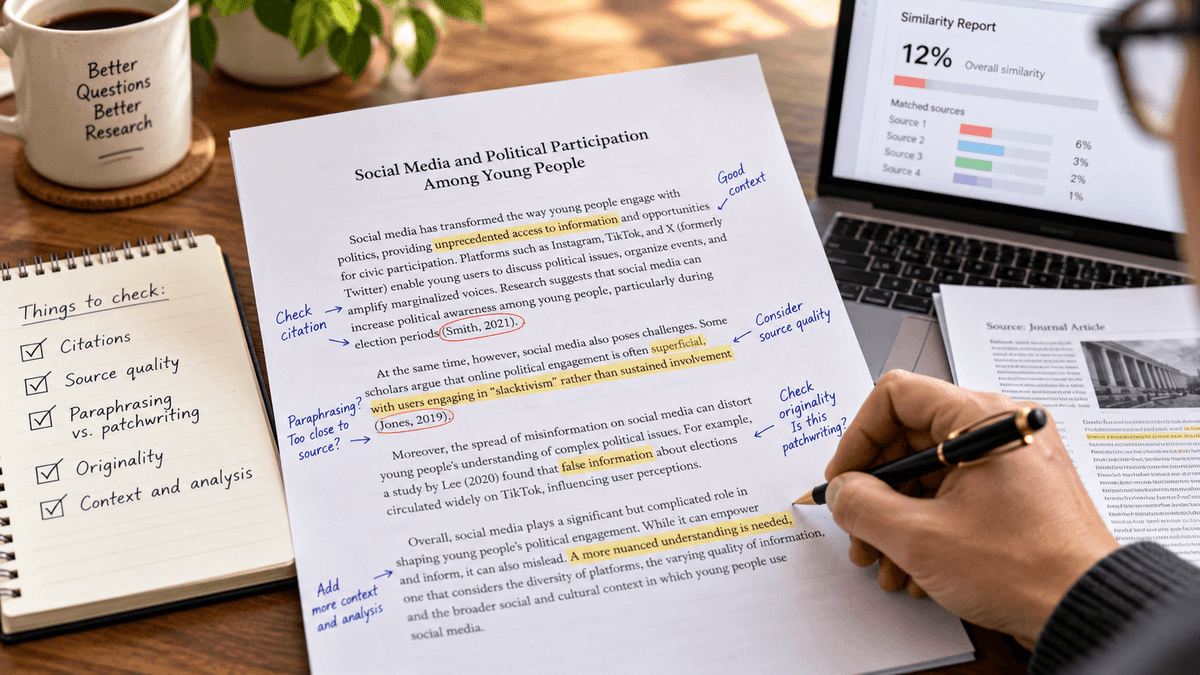
Step 3: Review the Matches, Not Just the Similarity Score
Suppose two papers produce these results.
Paper A: 31% similarity
A large part comes from the bibliography, correctly quoted passages, and several small common phrases.
Paper B: 17% similarity
Almost all of it comes from two long paragraphs that closely match one website and contain no quotation marks or citations.
Which one deserves closer attention?
Probably Paper B.
That is why you should treat a similarity score as a map, not a verdict.
Turnitin even groups matches in its newer report according to issues such as material that is not cited or quoted, material that may be missing quotation marks, and material that may be missing a citation.
Let’s see an example of what a 31% similarity report might really mean
| Match | What You Find | What It May Mean | Next Step |
|---|---|---|---|
| 8% | Bibliography/reference entries | Expected similarity | Set aside |
| 6% | Correctly quoted and cited material | Legitimate source use | Check citation format |
| 3% | Short common phrases | Probably incidental | Review briefly |
| 14% | Two nearly identical uncited paragraphs | Meaningful concern | Compare with source |
The report still says 31%.
But the teacher's real focus is the 14% uncited section.
That distinction matters so much that it’s better to understand the proper explanation of what percentage of plagiarism is acceptable.
Interesting fact: Even a very high similarity score can have an innocent explanation.
Even Turnitin gives the example of a student's final draft matching an earlier stored version of the same paper, potentially producing an extremely high or even 100% result.
Numbers need context. Humanity survives another percentage.
Step 4: Separate Legitimate Matches From Problematic Ones
Now clean up the report mentally. A match may come from:
- A properly quoted passage
- A bibliography or reference entry
- An assignment template
- Standard terminology
- A commonly used phrase
- Text the student has correctly cited
None of those should automatically be treated the same way as an uncited copied paragraph.
There is one important catch, though.
Having a citation does not automatically make copied wording acceptable.
Imagine a student copies three sentences almost word for word and adds a citation at the end.
The source has been acknowledged, but the language may still require quotation marks.
So ask two separate questions:
Did the student identify the source?
and
Did the student represent the source's words appropriately?
Those are not always the same thing.
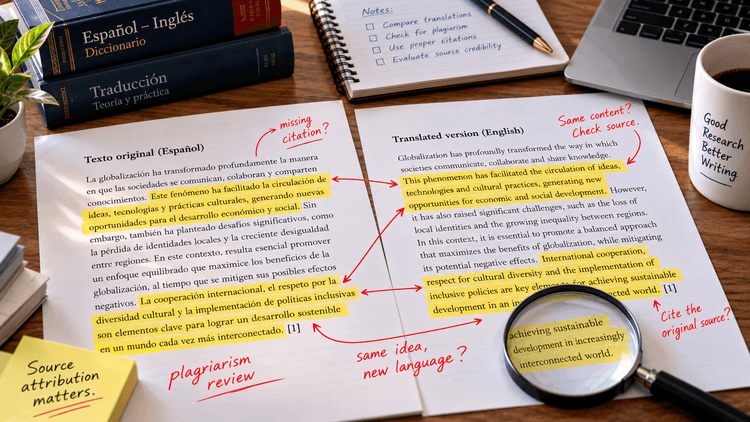
Step 5: Compare Suspicious Passages With the Original Source
This is where a possible match becomes something you can actually evaluate.
Open the source and put the two passages side by side.
Check whether the student:
- Copied the wording exactly
- Changed only a few words
- Followed almost the same sentence structure
- Properly quoted direct language
- Credited the underlying idea
- Accurately represented what the source says
Also, don't assume the first URL shown in a similarity report must be where the student copied the material.
The same passage can appear on several websites.
Turnitin notes that when identical wording matches several sources, the report selects a top source and can also show overlapping sources.
The page displayed first may therefore be a matching source, not necessarily the original source.
Teacher tip: For a particularly distinctive sentence, put a short part of it in quotation marks and search the web.
This can sometimes reveal earlier versions or original publications that a report did not surface first.
And remember that no database contains everything.
University of Washington guidance notes that material outside a comparison database can go undetected, meaning an apparently “original” result is not airtight proof that no plagiarism occurred.
Step 6: Document What You Found Before Taking Action
If the evidence still concerns you, don't jump immediately from “match found” to penalty.
Save what you used to reach your conclusion.
That might include the submitted paper, relevant report, questionable passages, source material, citations, and a brief explanation of why each passage deserves attention.
UW–Madison's academic misconduct guidance specifically recommends keeping a copy of the student's work, highlighting material that may not be original, and preserving corresponding passages from the sources.
NC State goes even further: its Office of Student Conduct says it will not accept a referral based solely on the similarity score.
It expects supporting material such as the report, student paper, matching source material, and the instructor's analysis.
In other words:
Document the evidence, not merely the percentage.
And with that, you have the full checking process from beginning to end.
But one part is worth revisiting.
Remember Step 1, when you read the paper before running any software?
That first read can tell you more than you might expect, especially when you know what kinds of changes deserve your attention.
You are not trying to “catch” plagiarism by instinct.
You are simply looking for clues that suggest it may be worth investigating further
So, let’s find out!
Manual Signs That Deserve a Closer Look
By this point, you already know that a plagiarism checker can help uncover matching text.
But sometimes the first clue appears before you run any software.
While reading a paper, you may notice small changes that make you pause: the writing suddenly sounds different, a citation does not quite fit, or one paragraph feels much more polished than everything around it.
These signs do not prove that a student has plagiarized.
They simply tell you, “This part may be worth checking more carefully.”
The trick is knowing which clues deserve attention and what to do next instead of relying on instinct alone.
The table below gives you a quick way to turn those observations into practical next steps:
| Manual Red Flag | What It Might Indicate | What to Do Next |
|---|---|---|
| Sudden change in vocabulary | Borrowed material or outside help | Compare with surrounding sections |
| Writing style changes midway | Material may come from another source | Search a distinctive phrase |
| Citation style suddenly changes | Text may have been copied with formatting | Verify the cited source |
| Source appears in text but not references | Incomplete attribution | Locate the source |
| Citation does not support the sentence | Citation error or source misuse | Trace the original claim |
| Several unusually polished paragraphs | Borrowed material or legitimate improvement | Investigate, don't assume |
| Unusual phrase appears online verbatim | Possible direct copying | Compare both passages |
| References the student seems unable to explain | Possible source misuse | Verify references and follow policy |
Notice how often the “next step” is check, compare, or verify rather than accuse.
That's intentional.
A red flag is a reason to look closer, not a conviction.
And once you do look closer, the issue may not be as simple as finding a sentence that was copied word for word.
Some forms of plagiarism are obvious.
Others are much harder to spot because the student may have changed the wording, mixed several sources together, or cited the source incorrectly rather than leaving it out completely.
So before we move further into the checking process, it helps to know what kinds of problems you may actually be looking for. It is because -
Not Every Plagiarism Problem Looks Like Copy-and-Paste
Plagiarism can be much messier than somebody copying a Wikipedia paragraph and hoping nobody notices.
You may encounter direct copying or plagiarism, where wording is reproduced without proper quotation or attribution.
Then there is patchwriting, where students rearrange, lightly rewrite, or mix pieces of source language.
A student may also paraphrase too closely, changing vocabulary while preserving most of the original structure.
Citation problems can also occur when the source is mentioned, but its words or ideas are not represented properly.
And depending on your institution or assignment rules, reusing substantial parts of previous work may create another academic-integrity issue.
So by now, one thing should be pretty clear: plagiarism does not always arrive as an obvious block of copied text.
Sometimes the problem is easy to spot.
Other times, you have to look at the wording, source use, citations, and context together before you can understand what actually happened.
That is another reason exact-match software alone cannot make the final judgment.
It may find the footprints. You still have to work out where they lead.
Of course, doing that level of investigation for every single paper would be exhausting, especially when you are grading an entire class.
You do not need to examine every small match with the same intensity.
A better approach is to quickly identify which papers and passages genuinely deserve a closer look, then spend your time there.
Now, the major question here is -
What Actually Matters for Educators from Free vs. Paid Plagiarism Checkers
The word free is attractive.
So is the word premium. Neither tells you whether a plagiarism checker is actually useful.
For teachers, the important questions are practical:
Can you see the matched passages?
Can you inspect the likely sources?
How broad is the material being searched?
Can legitimate matches be separated from questionable ones?
Does the service support the document length and volume you need?
And there is another factor that deserves far more attention:
What happens to the student's paper after you upload it?
Some institutional similarity systems may retain submitted work in repositories for future comparisons.
The University of Washington and Cornell both provide specific guidance on storing student submissions and repository settings.
Before uploading student work to any third-party checker, especially a free one, check its privacy policy and your institution's rules for handling student data.
Are Free Plagiarism Checkers Reliable Enough for Grading Decisions?
They can be perfectly useful for screening and investigation.
They should not be the sole basis for a misconduct decision.
Neither should a paid checker be.
A premium subscription doesn't magically turn similarity into proof.
Use tools such as the trustworthy Plagiarism Checker or AI Detector to identify possible matches quickly, then review those matches using the process above.
Common Mistakes Teachers Make When Checking for Plagiarism
By now, you have a process for checking a paper and a better idea of what different kinds of plagiarism can look like.
Still, even with a good checker in front of you, a few shortcuts can easily lead to the wrong conclusion.
Here are some common mistakes to avoid.
1. Treating the Similarity Score as a Plagiarism Percentage
This is probably the easiest mistake to make.
A report says 28% similarity, so it is tempting to read that as:
“28% of this paper is plagiarized.”
But that is not what the number means.
The score tells you how much text matched material found elsewhere.
Some of that similarity may come from quotations, references, common terminology, or other perfectly legitimate content.
So instead of asking:
“How high is the percentage?”
Ask:
“What is actually creating that percentage?”
That question usually tells you far more.
2. Using One “Acceptable” Percentage for Every Assignment
Another tempting shortcut is setting a fixed rule such as:
Below 20% = fine.
Above 20% = problem.
Unfortunately, assignments do not work that neatly.
A literature review with dozens of citations may naturally produce more similarity than a personal reflection.
A paper that relies heavily on quoted primary sources may also look very different from an original research essay.
The assignment type, citation requirements, and source use all matter.
That is why no single similarity percentage works as a universal pass-or-fail line.
3. Looking at the Total Score but Ignoring the Individual Sources
The overall score is only the starting point.
Imagine two papers both show 25% similarity.
In one paper, that 25% comes from dozens of tiny references and correctly quoted passages.
In the other, almost all of that 25% comes from one uncited article.
Same number. Completely different situation.
Always look at which sources contributed to the report and how much text matched each one.
That is often where the real story is hiding.
4. Assuming a Citation Automatically Makes Copied Text Acceptable
A student may include the correct source and still use it incorrectly.
For example, they might copy several sentences almost word for word, add a citation through citation generator at the end, but leave out quotation marks.
The source has been acknowledged, but the wording may still have been reproduced improperly.
So when reviewing a match, check both:
- Was the source credited?
- Was the source's wording used appropriately?
A citation solves one problem. It does not automatically solve every source-use problem.
5. Assuming the First Matching Website Is the Original Source
A plagiarism checker may show you a webpage containing the same passage as the student's paper.
That does not necessarily mean the student copied from that exact page.
Content gets reposted, syndicated, quoted, and duplicated across the web all the time.
So if a passage matters to your decision, trace it a little further.
Look for the earliest or most authoritative version of the material before concluding where the text came from.
6. Treating a Writing-Style Change as Proof
Remember those manual red flags we covered earlier?
They help you know where to investigate.
They are not proof by themselves.
A student may suddenly write better because they revised carefully, received legitimate feedback, understood one section better than another, or simply had a very good day.
Miracles remain technically possible.
Use changes in tone, vocabulary, or writing quality as a reason to check the passage, not as the final verdict.
7. Taking Action Before Saving the Evidence
Suppose you find a genuinely concerning match.
Before contacting the student or starting a formal process, preserve what you found.
Save the relevant report, the student's wording, the matching source, and any notes that explain why the passage concerned you.
That way, your decision is based on a clear record rather than reconstructing everything later from memory.
It also gives you something concrete to discuss if the student is asked to explain their work.
The same caution applies to another number teachers increasingly see: AI-detection percentages.
Just like a similarity score, an AI score needs context before it can support any serious conclusion.
Understanding how teachers should interpret AI detector results explains how to approach those results without turning a probability score into an automatic penalty.
The broader lesson is simple:
Scores can point you toward a problem. They should not make the decision for you.
What to Do When the Evidence Suggests Plagiarism
Once you've gathered strong evidence, move from detection to your institution's academic-integrity process.
That process may involve meeting with the student, allowing them to explain how they researched and wrote the paper, consulting a department or academic-integrity office, and filing documentation.
UW–Madison, for example, advises instructors to present the concern and evidence, give the student a chance to respond, and approach the conversation with an open mind before deciding.
Policies vary by institution, so don't substitute a plagiarism checker or an internet article for your school's procedure.
Prevention is worth attention too.
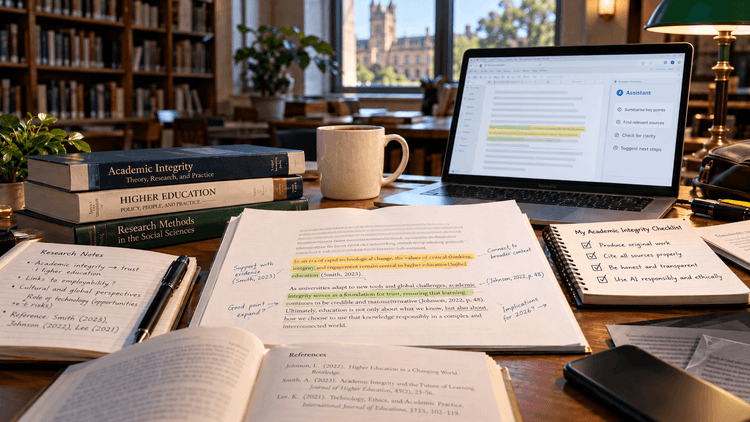
That’s why sharing an Academic Integrity Checklist for Students before submission can help students catch citation, paraphrasing, source-use, and disclosure problems while they can still fix them.
Teacher's Plagiarism Review Checklist
Before you close the report, ask yourself:
Before checking: Did I read the paper normally? Did I notice any genuine inconsistencies rather than simply unusual writing?
During checking: Did I inspect individual matches and their sources? Did I separate quotations, references, and other legitimate similarities? Did I look beyond the headline percentage?
Before deciding: Did I compare the questionable material with the original source? Did I preserve the evidence? Did I check my institution's policy? Have I given context and student explanation the weight they deserve?
If those answers are yes, you have done something far more useful than simply “checking for plagiarism.”
You have actually reviewed the evidence.
Frequently Asked Questions
What is the Best Way to Check a Student Paper for Plagiarism?
Read the paper first, run it through a plagiarism checker, review the actual matches, and verify suspicious sections against the original sources. Use the score as a starting point, not the final judgment.
How can Teachers Spot Plagiarism without Software?
Look for abrupt changes in vocabulary, tone, formatting, citation style, source use, or writing quality. You can also manually search for distinctive phrases and verify suspicious references. None of these signs proves plagiarism on its own.
Does a High Similarity Score Always Mean Plagiarism?
No. High similarity can come from quotations, references, templates, or other legitimate matches, while a low score does not guarantee originality.
What Percentage of Plagiarism is Acceptable in a Student Paper?
There is no universal acceptable percentage because similarity depends on the assignment and how you use sources. See What Percentage of Plagiarism Is Acceptable for a full breakdown.
How do I read a Turnitin Similarity Report Correctly?
Focus on the individual matches and their sources rather than the overall percentage. Check whether matched text is quoted, cited, expected, or genuinely concerning.
Can Plagiarism Checkers Detect Paraphrasing?
Some can detect close paraphrasing, but heavily rewritten ideas may be harder to identify. Manual source comparison is still important.
Are Free Plagiarism Checkers Reliable Enough for Teachers?
They can help with initial screening, but no checker should make a grading or misconduct decision on its own. Always review the actual evidence.
Is it Safe to Upload Student Papers to a Free Plagiarism Checker?
Not always. Check how the tool stores and uses uploaded work, and make sure it follows your institution's student-data and privacy rules.
Check the Evidence, Not Just the Score
Checking a student paper for plagiarism is not about finding the highest percentage and calling the case closed.
It is about understanding what matched, why it matched, and whether that match actually points to a problem.
That is why the process works best when you combine your own knowledge of the student with a reliable plagiarism check, source comparison, and proper documentation.
And when you have several papers to review, the first part does not need to become another exhausting task.
You can use the CopyChecker Plagiarism Checker to quickly scan a paper for matching content and identify the sections that deserve a closer look.
Instead of manually searching every suspicious sentence, you can narrow your attention to the matches that actually need verification.
From there, follow the same process every time:
Read → Check → Review → Filter → Verify → Document
The checker helps you find the evidence faster.
Your judgment is what gives that evidence meaning.