You find a useful research paper written in Spanish.
One paragraph explains your topic perfectly.
So, you translate it into English, change a few words, and add it to your assignment.
You did not copy the original Spanish words.
Does that mean the writing is now yours?
No.
If the idea, explanation, argument, data, or wording came from another source, changing the language does not change who created it.
Moreover, using that translated material without proper credit can become translation plagiarism.
This issue is easy to miss because the final text may look completely different from the source.
Still, academic integrity is about more than matching words.
It is also about being honest about where your information and ideas came from.
Simple Rule: A new language does not create a new owner.
Throughout this guide, we will move from the basics to the situations that are easier to misunderstand.
So, let's start with the most important question -
What Is Translation Plagiarism?
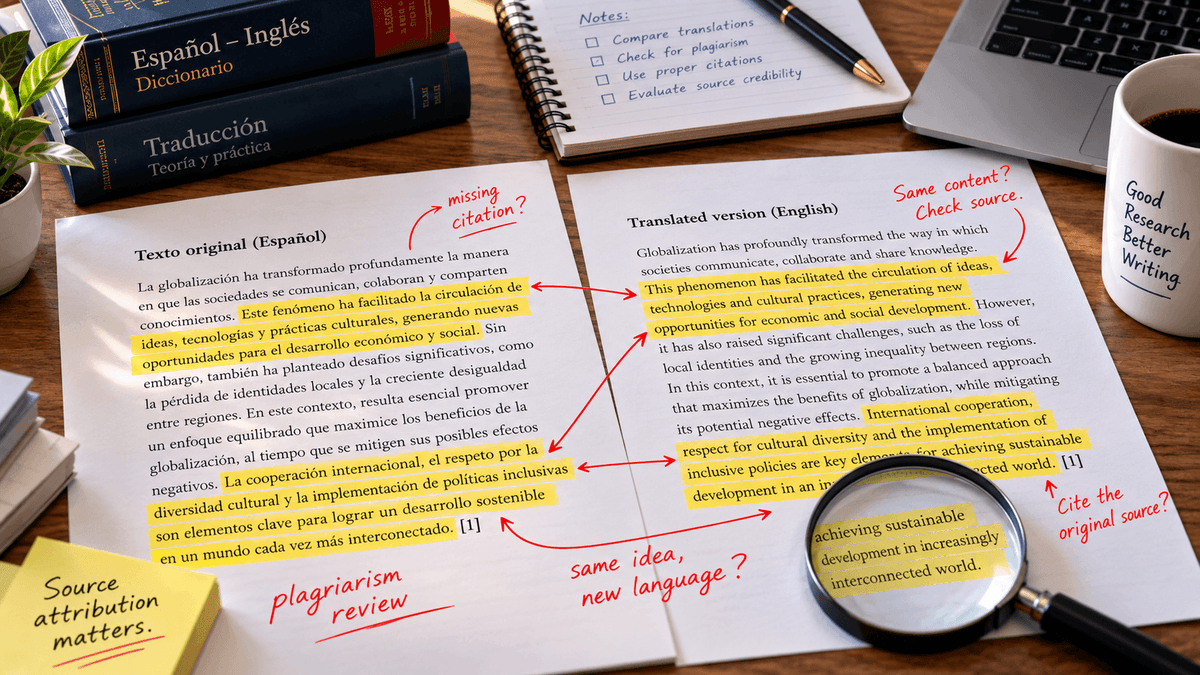
Translation plagiarism happens when you translate someone else's words, ideas, findings, arguments, or other original material into another language and present it without giving proper credit to the source.
The important part is not the language.
It is the ownership of the original work.
For example, imagine that a researcher writes this idea in another language:
Students often remember information better when they actively explain it rather than only rereading it.
You translate the idea into English and include it in your paper as if you developed the point yourself.
That can still be plagiarism.
The sentence may now use completely different words, but the intellectual contribution still came from someone else.
The translation itself is not wrong.
In fact, researchers, students, journalists, and writers translate information every day.
The problem begins when the original source disappears.
That distinction is important because not every translated sentence should be treated the same way.
Some cases are clearly plagiarism, while others are perfectly acceptable when you properly acknowledge the source.
Before we go deeper into examples, citation, and detection, let's see -
Translation Plagiarism at a Glance
The easiest way to understand translation plagiarism is to compare a few common situations side by side.
So, here is a quick comparison before we look at each situation more closely -
| Situation | Is It Translation Plagiarism? |
|---|---|
| Translating another author's paragraph without a citation | Yes |
| Translating an author's idea and citing the original source | Usually no |
| Clearly presenting a translated quotation with a citation | Usually no |
| Translating your own original notes | No |
| Translating your previously published work and presenting it as completely new | It may be self-plagiarism |
| Using Google Translate on text you wrote yourself | Not plagiarism by itself |
| Translating another student's assignment and submitting it | Yes |
| Translating common knowledge | Usually no citation is needed |
Remember: Plagiarism does not disappear just because two texts are written in different languages.
That is why the next question is more useful than simply asking whether translation is allowed.
Is Translating Something Considered Plagiarism?
Translating something is not automatically plagiarism.
But translating another person's work without proper attribution can be.
There is an important difference.
Safe Use
Original foreign-language source → understand the information → translate or explain it → cite the source
Unsafe Use
Original foreign-language source → translate it → remove the source → present it as your own work
Suppose a German article contains an original argument about climate policy.
You translate that argument into English.
The argument still belongs to the original author.
Even if you:
- change the sentence structure,
- replace several words,
- shorten the explanation,
- use Google Translate,
- use DeepL,
- ask an AI tool to translate it,
- or rewrite the translation afterward,
you still need to acknowledge where the original idea came from.
Before using translated material, ask:
“Would I need to cite this if the source were already written in English?”
If the answer is yes, translating it usually doesn't remove that responsibility.
That gives us the basic rule.
But in real assignments, translation plagiarism is not always this obvious.
Sometimes an entire paragraph is translated.
Other times, only an idea, research finding, statistic, or small part of a source is reused.
So, now that we know when translation can become plagiarism, the next step is to see -
What Does Translation Plagiarism Look Like?
Translation plagiarism is not always obvious.
Sometimes a full paragraph is translated directly. Other times, only an idea, finding, or small part of a source is reused.
The following are some common examples -
Example 1: Translating a Paragraph Without Citation
Imagine a Spanish source says, in simple terms:
Regular sleep helps students maintain attention and memory during learning.
A student translates the idea and writes:
Getting enough sleep improves a student's ability to focus and remember information while studying.
The English sentence is not copied word for word.
Still, the information came from the Spanish source.
If that idea was specific to the author's research or explanation, the student should cite it.
Better Approach - Getting enough sleep may support attention and memory during learning (Author, Year).
Now the reader can see that the idea came from research rather than from the student's own discovery.
Example 2: Translating and Then Changing a Few Words
Some students assume a translated passage becomes original after a few extra changes.
It does not.
For example:
Source in another language: Social media use before bedtime can reduce sleep quality among teenagers.
Translated version: Using social platforms at night may negatively affect how well teenagers sleep.
Edited version: Teenagers may sleep worse when they spend time on social networks before bed.
The wording changes each time.
The underlying claim does not.
If the claim came from another author or study, the source still matters.
Quick Tip: Changing words can change a sentence. It does not automatically change authorship.
Example 3: Combining Translations From Several Sources
Translation plagiarism can also happen when a writer takes small pieces from different sources.
For example:
- one idea is translated from a French article,
- another comes from a Spanish thesis,
- one statistic comes from a German report,
- and a few connecting sentences are written by the student.
The finished paragraph may look original.
But if the borrowed parts are not credited, the paragraph may contain mosaic or patchwork plagiarism.
This is why plagiarism is not limited to copying one large block of text.
Several different types of plagiarism can overlap in the same piece of writing.
Example 4: Translating Research Findings, Data, or Arguments
Translation plagiarism is not limited to sentences. You can also misuse:
- research findings,
- statistics,
- theories,
- original arguments,
- interpretations,
- tables,
- data,
- methods,
- models,
- or conclusions.
Imagine that a researcher in Japan publishes a study showing a new relationship between two factors.
You read the study, translate the key finding, and describe it as your own observation.
You may not have copied one sentence.
Still, you have taken an intellectual contribution without proper credit.
That is the bigger issue.
Example 5: Translating Someone Else's Assignment
Suppose your friend wrote an essay in Bengali.
You translate the entire essay into English and submit it for your own class.
The teacher may never see the Bengali version.
That does not make the English version original.
This can involve more than translation plagiarism.
Depending on the situation and school policy, it may also involve complete plagiarism, collusion, or academic misconduct.
This example shows the clearest side of the problem: translation can hide the original wording, but it cannot turn someone else's work into your own.
Still, not every use of translation is dishonest.
Students often get confused and assume that any translated sentence, source, or piece of research is automatically risky.
It is not.
The real difference is whether the translated material is your own, properly credited, or based on information that does not require attribution in the first place.
So, after looking at what translation plagiarism can look like, it helps to look at the other side of the line -
What Is Not Translation Plagiarism?
Not every use of translation is dishonest.
This distinction matters because students sometimes worry so much about plagiarism that they start treating every translated sentence like contraband.
Here are situations that are usually different.
Translating Your Own Original Writing
Suppose you write an original paragraph in Bengali and later translate your own paragraph into English.
You are not stealing someone else's idea.
The original writing is yours.
However, different rules may apply if you have already submitted, published, or had the first version assessed.
We will return to that issue later.
Using a Properly Credited Translation
You can use translated material when you clearly acknowledge its source.
For example, you may quote a passage from a translated book and provide the required citation.
Depending on your citation style, you may also need to identify the translator.
The main goal is transparency.
Your reader should be able to understand:
- who wrote the original work,
- which source you used,
- and, when relevant, who translated it.
Translating Information and Citing the Original Source
You do not always need to quote translated material.
You can read a foreign-language source, understand its meaning, explain the idea clearly in your own writing, and cite the source.
That is normal academic research.
The citation tells readers where the information came from.
Translating Common Knowledge
Not every fact needs a citation.
For example:
Water freezes at 0°C under standard atmospheric pressure.
Translating that statement from another language doesn't suddenly make it someone else's unique intellectual property.
However, you should normally cite specific interpretations, original research findings, unusual claims, or distinctive explanations.
When unsure, check the source.
This gives us a useful boundary: translation alone is not the problem.
What matters is whether you are using someone else's original contribution without proper credit.
That distinction becomes even more important when translation is mixed with rewriting.
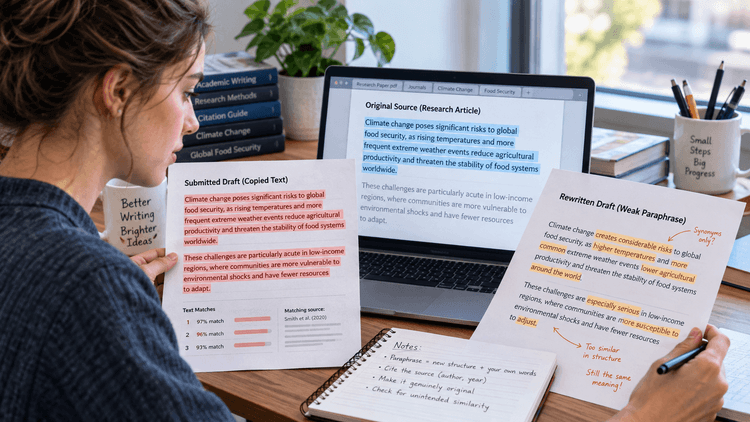
A student may translate a source, change the sentence structure, replace several words, and assume the result is now original.
At that point, translation overlaps with another common issue: paraphrasing plagiarism.
So, to understand where the two meet and where they differ, let’s see -
Translation Plagiarism vs Paraphrasing Plagiarism
Translation plagiarism and paraphrasing plagiarism are closely related, but they are not exactly the same.
| Translation Plagiarism | Paraphrasing Plagiarism |
|---|---|
| Information moves from one language to another | Information usually stays in the same language |
| Words may change completely | Words and sentence structure are rewritten |
| The original idea remains | The original idea remains |
| A citation may still be required | A citation may still be required |
| Exact text matching may be harder | Textual similarities may be easier to notice |
The main connection is simple.
In both cases, different wording does not automatically create original authorship.
A good paraphrase changes how an idea is expressed while still crediting the source.
A translation changes the language used to express the idea.
Neither process should hide where a borrowed idea came from.
Think of it this Way: Paraphrasing changes the packaging. Translation changes the language. Neither one changes the original creator.
That comparison helps explain one part of the issue, but translation plagiarism does not exist in isolation.
Depending on how the material is used, it can overlap with several other forms of plagiarism too.
So, before moving into accidental cases and prevention, it helps to see how translation plagiarism connects with the broader plagiarism landscape.
Let’s talk about -
Translation Plagiarism vs Other Types of Plagiarism
Translation plagiarism can overlap with several other plagiarism types.
Direct Plagiarism
Direct plagiarism happens when someone copies another person's words without proper credit.
Translation plagiarism is different because the words may no longer match the original language.
Mosaic or Patchwork Plagiarism
A writer may translate small parts of several sources and join them together.
This can create both translation plagiarism and mosaic plagiarism.
Idea Plagiarism
You can copy an idea without copying its wording.
If you translate and present an original theory, argument, or interpretation as your own, the main problem may be idea plagiarism.
Self-Plagiarism
You can also run into problems when translating your own previously submitted or published work and presenting the translation as new.
The exact rules depend on the situation, such as whether the original work was published, graded, or submitted before.
For a broader explanation of how self-plagiarism differs from direct, mosaic, accidental, and other forms, see our guide to different types of plagiarism.
So far, the examples we have looked at may sound intentional.
But translation plagiarism does not always happen because someone is deliberately trying to hide a source.
That brings us to another important question.
Can Translation Plagiarism Be Accidental?
Yes. Translation plagiarism can happen by accident.
Not every missing citation is part of an evil academic master plan.
Sometimes the problem starts much earlier, during research.
A student may translate notes from several sources and later forget which sentence came from which article.
A few days later, those translated notes may look like the student's own writing.
Here are some of the common causes:
- forgetting to save the original source,
- mixing translated notes with personal notes,
- copying translated text into a draft too early,
- losing page numbers,
- assuming translated wording does not require citation,
- using AI translation without recording the source,
- or confusing a source's idea with common knowledge.
Most of these problems have one thing in common: the source gets separated from the translated note.
So, a simple way to prevent that confusion is to organize translated research notes so the source, the translated information, and your own explanation stay clearly separate.
A Simple Note-Taking Method for Translated Sources
One reason accidental translation plagiarism happens is that translated notes can start looking like your own writing after a few days.
A simple way to prevent this is to keep three things separate while researching:
- Where the information came from,
- What the source actually says,
- How you plan to explain the idea in your own writing.
Use a table like this:
| Source | Translated Notes | My Own Explanation |
|---|---|---|
| Author, year, page, URL or DOI | The meaning of the relevant passage translated into your working language | How you understand the idea and how you may use it in your paper |
For example:
| Source Details | Translated Source Note | My Own Explanation |
|---|---|---|
| Rahman, 2025, p. 42 | Students remember information better when they explain ideas actively instead of only rereading them. | I can use this research to support my point that active learning may improve memory. |
The first column helps you find and cite the original source later.
The second column reminds you that the information came from someone else's work, even if you translated it.
The third column is where you record your own understanding, argument, or planned use of the source.
This creates a clear boundary between borrowed information and your own thinking.
Keeping that record also helps you document your writing process if questions come up later.
It also makes citation much easier because the source details are already attached to the note.
Student Tip: Add the citation while taking the note. Do not tell yourself, "I'll find the source later." Future-you has other plans and apparently enjoys making present-you suffer.
Tracking the source solves one part of the problem.
But students often have another concern -
Does Using Google Translate, DeepL, or AI Cause Translation Plagiarism?
No. Using a translation tool does not automatically cause plagiarism.
What matters is whose material you are translating and how you use it.
Google Translate and Source Attribution
Suppose you wrote a paragraph yourself in Spanish and use Google Translate to convert it into English.
That is not plagiarism simply because software translated it.
Now imagine you copy another author's Spanish paragraph into Google Translate and submit the English result without a citation.
That is different.
The translation tool did not create the plagiarism.
The missing attribution did.
Machine Translator Tools Like DeepL
The same rule applies to DeepL and similar tools.
Machine translation can help you understand or convert text.
It does not transfer ownership of the original writing to you.
If you translate another person's research, ideas, or unique explanation, keep track of the source.
AI Translation and Academic Integrity
AI tools can also translate text.
Again, there are two very different situations:
Your original text + AI translation
and
Someone else's text + AI translation + no citation
The first may be allowed depending on your school's AI rules.
The second can still involve plagiarism.
You should also check whether your teacher, university, publisher, or journal requires disclosure when you use AI tools.
Quick Rule - The tool is not the source
If an AI system translates a research paper for you, the research paper remains the source.
Citing the AI translator instead of the original author does not properly credit the intellectual work.
So far, the rule is fairly straightforward: translation tools can change the language, but they do not change authorship.
That leads to a practical question students often ask next.
If translated plagiarism can look completely different from the original wording, then the next question is -
Can Plagiarism Checkers Detect Translated Plagiarism?
Some plagiarism-checking systems can identify certain forms of translated or cross-language similarity, but translation plagiarism is usually harder to detect than copied text.
Traditional plagiarism detection often depends heavily on matching words and phrases.
Translation changes those words.
For example:
Original: Regular exercise improves mental well-being.
A translation into another language and back again might become:
Translated version: Frequent physical activity can support psychological health.
Very few words now match.
The meaning, however, is close.
More advanced detection methods may look beyond exact wording and examine things such as:
- semantic similarity,
- meaning,
- sentence relationships,
- multilingual patterns,
- shared citations,
- structure,
- or translated versions of source material.
Even then, no tool should be treated as a perfect judge of plagiarism.
A similarity score checker can point to material that deserves attention.
A human still needs to examine what happened.
Important: A similarity match is evidence to review. It is not automatically proof of plagiarism.
To understand those limits better, it helps to look at the specific reasons for -
Why Is Translation Plagiarism Harder to Detect?
Cross-language plagiarism creates an unusual problem.
The source and the copied version can communicate nearly the same idea while sharing almost none of the same words.
Several things make detection difficult.
- The Vocabulary Changes: A translated sentence may contain no exact word match with its source.
- Sentence Structure Can Change: Different languages organize ideas differently. A sentence that starts with the subject in one language may be reordered during translation.
- Translation Is Not Always Literal: A good translator often focuses on meaning rather than replacing words one by one.
- Translation Can Be Combined With Paraphrasing: Someone might translate a source and then rewrite the translation again. The final wording may be several steps away from the original.
- The Original Source May Be Difficult to Access: A source might exist in a local database, printed journal, university repository, or website that a checker does not index.
- Languages Have Different Digital Resources: Some languages have far more searchable online material than others. Because of these limits, students should not depend on software alone. Good research habits are still the strongest protection.
These limits explain why students should not depend on plagiarism software alone.
The safer approach is to record the source, represent the meaning accurately, and credit the original author from the start.
So, instead of asking only whether a checker can find translated material, the more useful question is -
How Do You Properly Use a Source Written in Another Language?
Foreign-language sources can add valuable research to an essay or paper.
You do not need to avoid them.
You simply need a clear process, so try the following section -
1. Save the Original Source First
Before translating anything, record:
- author's name,
- publication title,
- article or chapter title,
- year,
- page number,
- DOI or URL,
- and original language.
Do this before copying information into your notes.
It takes less than a minute and can save an hour of source hunting later.
2. Read for Meaning Before Translating
Do not immediately translate one sentence and paste it into your essay.
Read enough of the surrounding section to understand what the author actually means.
A sentence taken alone may lose important context.
3. Keep Translated Notes Separate
Clearly mark translated research in your notes.
For example:
TRANSLATED NOTE — SOURCE 04
This makes it much harder to mistake borrowed material for your own writing later.
4. Explain the Idea in Your Own Structure
After understanding the source, close it or move it away from your writing window.
Then explain the idea based on your understanding.
Your sentence structure should follow your argument, not the original author's sentence.
However, rewriting sentences does not remove the need to cite when the underlying information comes from the source.
5. Cite the Original Source
Your citation should point readers toward the material that actually provided the information.
If a French research paper gave you the finding, that research paper is the source.
Google Translate is not.
6. Identify Your Translation When Needed
When you translate a direct quotation yourself, some citation styles or institutions may expect you to identify it as your own translation.
For example, a writer may note:
translated by the author
or
my translation
The exact format depends on the citation style.
7. Check Your Institution's Rules
Schools, universities, journals, and publishers may use different rules for translated quotations and AI-assisted translation.
Check the instructions for your assignment rather than assuming one rule applies everywhere.
But one practical question still remains -
How Do You Cite a Translated Source?
You may be using a published translation, such as an English edition of a book originally written in Italian.
Or you may be working from the original-language source and translating the passage yourself.
The citation approach changes slightly depending on which one applies, so let’s see -
Using a Published Translation
Suppose you read an English edition of a book originally written in Italian.
You should cite the edition you actually used.
Depending on your citation style, the reference may also include the translator's name and original publication details.
Translating a Passage Yourself
If you personally translate a sentence or quotation from its original language, cite the original source.
You may also need to tell the reader that the English wording is your translation.
For example:
"Translated passage appears here" (Author, Year, p. 24, my translation).
This is only a general example.
APA, MLA, Chicago, Harvard, and individual universities can have different requirements.
If formatting the reference is the difficult part, a citation generator can help build the citation while you still verify the source details and required style.
What You Should Not Do
Do not write:
Source: Google Translate
Especially when Google Translate only converted someone else's published research into English.
The translation service helped with language.
It did not create the research.
That same idea applies when the material is your own.
Translating your own writing does not create a completely new piece of work either, especially if you already submitted, graded, or published the original version.
So, after looking at how to credit translated sources from other people, there is one more important case to consider -
Is Translating Your Own Previous Work Self-Plagiarism?
It can be.
This surprises people because you cannot literally steal your own ideas.
However, self-plagiarism is mainly about presenting previously used work as new.
Suppose you publish an article in Portuguese.
A year later, you translate the same article into English and submit it to another journal as a completely new study.
The language changed.
The research did not.
Depending on the publication rules, you may need:
- disclosure,
- permission,
- a citation to the earlier work,
- acknowledgment of the original publication,
- or approval from the publisher.
Citation and permission are not the same thing, which is why copyright and plagiarism can overlap without being identical.
But What About Personal Notes?
Translating your own unpublished notes is different.
If you write private notes in Bengali and later turn them into an English essay, you are still developing your own original material.
The key question is whether you already submitted, had assessed, or published the previous work.
At this point, the pattern should be clear: whether the source belongs to someone else or to your earlier work, the main issue is transparency.
You need to know where the material came from, when attribution or disclosure is required, and how to keep translated content from looking more original than it really is.
The good news is that avoiding translation plagiarism is usually much simpler than fixing it after the fact.
How to Avoid Translation Plagiarism in Simple Ways
Avoiding translation plagiarism becomes much easier when you treat translated research like any other source.
Cite Ideas, Not Only Exact Words
Students sometimes think citations are only needed after direct quotations.
They are not.
If a specific argument, finding, method, or interpretation came from another author, cite it even when you translated and rewrote it.
Do Not Translate Paragraphs Sentence by Sentence
Sentence-by-sentence translation keeps you very close to the original structure.
Instead:
- Read the source.
- Understand the main point.
- Set the source aside.
- Explain the information in the context of your own argument.
- Add the citation.
This creates more natural writing.
If the wording still feels too close or awkward after you understand the source, a paraphrasing tool can help you explore a different structure, but you still need to attribute the original idea.
Keep Source Details With Every Note
Never create a translated research note without attaching its source.
A simple label works:
Smith, 2025, p. 18 — translated research note
Now you know exactly where it came from.
Clearly Mark Translated Quotations
If you translate an exact quotation, do not make readers guess.
Identify it according to your required style.
Separate Common Knowledge From Original Research
You do not need to cite every basic fact.
However, original findings, unusual statistics, distinctive arguments, and specific interpretations normally need attribution.
Review Every Paragraph Before Submission
Ask:
- Where did this idea come from?
- Is this my analysis?
- Did I learn this from a source?
- Did I translate any part of it?
- Is the citation still attached?
These questions catch many problems before submission.
For a broader prevention process, check out any reliable guide on how to avoid plagiarism.
Once those habits are in place, one final step is still worth taking -
How to Check Your Work Before Submission
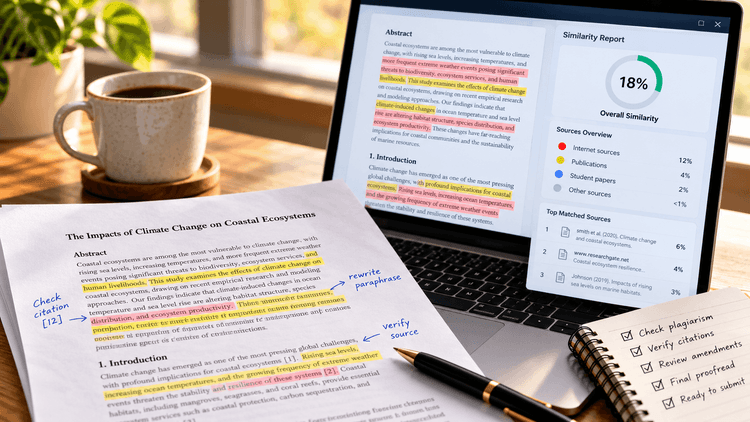
A final plagiarism review should involve more than a single percentage. This is especially important when you check a research paper for plagiarism before submission, because citations, quotations, paraphrases, and similarity matches all need to be reviewed together.
Use this five-step process.
Step 1: Review Your Translated Notes
Make sure each translated note still has its original source attached.
Step 2: Check Citations
Look closely at passages based on foreign-language research.
Make sure borrowed ideas have suitable attribution.
Step 3: Run a Plagiarism Check
A Plagiarism Checker can help you identify matching or similar content that deserves review.
Do not treat the score as a pass-or-fail grade.
Look at the actual matches.
Step 4: Review Each Important Match
Ask why the similarity exists.
It may be:
- a quotation,
- a reference,
- standard terminology,
- common wording,
- close or poor paraphrasing,
- or unattributed source material.
Step 5: Fix the Cause
If a passage is too close to a source, rewrite it properly.
If the source is missing, add the citation.
If you used exact wording, use quotation marks when appropriate.
Best practice: Fix the writing problem, not just the similarity percentage.
After you complete those five steps, do one final scan before submitting.
At this stage, you are not looking for new research or rewriting the whole paper.
You are simply making sure that every translated idea, quotation, note, and source is handled clearly.
A quick checklist makes that final review much easier.
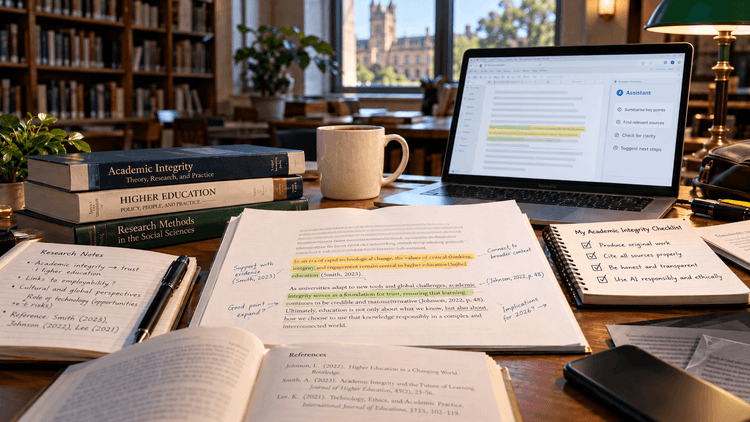
For issues beyond translated sources, an academic integrity checklist can also help you review citations, paraphrasing, AI use, outside assistance, and other pre-submission concerns.
Translation Plagiarism Checklist
Before submitting your work, run through this list.
Source Check
- I saved the original source for every translated research note.
- I know which ideas came from foreign-language sources.
- My citations point to the actual sources I used.
- I did not cite a translation tool as the creator of someone else's research.
Writing Check
- I did not translate entire paragraphs and present them as original writing.
- My paraphrases use my own sentence structure.
- Borrowed ideas are clearly separated from my own analysis.
- Translated quotations are clearly identified where required.
Tool Check
- I reviewed any translation produced by Google Translate, DeepL, or AI.
- I checked my institution's rules for AI-assisted translation.
- I reviewed plagiarism or similarity matches instead of trusting only the final score.
FAQs About Translation Plagiarism
Is Translating a Text Considered Plagiarism?
Not by itself. Translation becomes plagiarism when someone else's original words, ideas, findings, or arguments are translated and presented without proper attribution.
Is It Plagiarism If I Translate Something and Change the Words?
It can still be plagiarism. Changing the language and wording does not make someone else's idea yours. Cite the original source when required.
Do I Need to Cite Something I Translated Myself?
Usually yes, if the underlying material came from another source. Cite the original work. For a direct translated quotation, you may also need to identify the translation as your own.
Is Using Google Translate Considered Plagiarism?
No. Google Translate is simply a translation tool. However, translating someone else's work with it and submitting the result without credit can still be plagiarism.
Can Plagiarism Checkers Detect Translated Text?
Sometimes. More advanced systems may identify some cross-language or semantic similarities, but translated plagiarism can be harder to detect than direct copying. No checker should be treated as perfect.
Is Translating My Own Previous Paper Plagiarism?
It may be self-plagiarism if you already submitted or published the earlier paper and present the translation as completely new work. Disclosure or citation may be required.
Can I Use Foreign-Language Sources in an English Essay?
Yes. Foreign-language sources can strengthen your research. Keep the original source details, represent the meaning accurately, and cite the source properly.
One Final Question
Ask yourself:
Could a reader tell which ideas are mine and which came from other people?
If the answer is yes, your source use is much more likely to be clear and responsible.
End Note
Translation gives students and researchers access to ideas from around the world.
That is a good thing.
The problem appears only when translation hides where those ideas came from.
You do not need to avoid foreign-language research, Google Translate, AI translation, or translated books.
You need to use them transparently.
Keep the source. Understand the idea. Write carefully. Credit the original creator.
Then review your work before submission.
If you are unsure whether part of your draft is too close to existing material, a plagiarism checker can help you examine possible similarities and source matches.
Use the report as a review tool, not as a final verdict.
Because when it comes to translation plagiarism, the simplest principle is still the strongest:
The language may change. The source does not.