You are halfway through a blog post when you check the word count.
1,187 words.
Now the doubts start.
“Is this too short?” or “Should I push it to 1,500?, ”
“Do I need 2,000 words for SEO?” or maybe “Will Google take this article seriously if I stop here?”
So you add another paragraph. Then another example.
Maybe one more section that you are not even sure the reader needs.
And suddenly, instead of improving the article, you are simply feeding the word counter.
That is the problem with searching for one “perfect” blog post length.
There is no single ideal word count for every blog post. A detailed guide may genuinely need 2,000 words or more, while a simple question could be answered properly in 600.
For many informational articles, 1,500 to 2,500 words can be a useful planning range.
But it should stay exactly that: a planning range, not a rule you have to obey.
The right blog post word count depends on what your reader came to learn, how complex the topic is, and how much explanation is needed to give them a complete answer.
Google makes this especially clear.
Its Search guidance asks creators to consider whether they are writing to a certain word count simply because they believe Google prefers it.
The answer is refreshingly simple:
Google does not have a preferred word count.
So instead of looking at your draft and asking:
“How can I make this article 2,000 words?”
Try asking:
“Have I answered everything the reader needs without adding filler?”
That question changes the way you think about blog length. Because the goal is not to make every article long. The goal is to make every article feel complete.
So without further ado, let’s start with -
Does Blog Post Word Count Matter for SEO?
To be honest, word count can affect how much information you are able to provide, but a higher word count does not automatically affect SEO.
This distinction is important.
A longer article has more room for explanations, examples, statistics, comparisons, FAQs, and related questions. That can make it more useful.
But adding 800 unnecessary words just to make an article longer doesn't give it a hidden SEO advantage.
So, if there is no magic number, where should you start?
A blog post can range from a few hundred words to several thousand.
Basically, the useful range depends largely on the type of article you are creating and how much information the reader expects.
That’s why a quick announcement does not need the same space as a step-by-step tutorial. And a detailed evergreen guide will naturally need more room than a simple definition.
The following info can be a practical starting point for you -
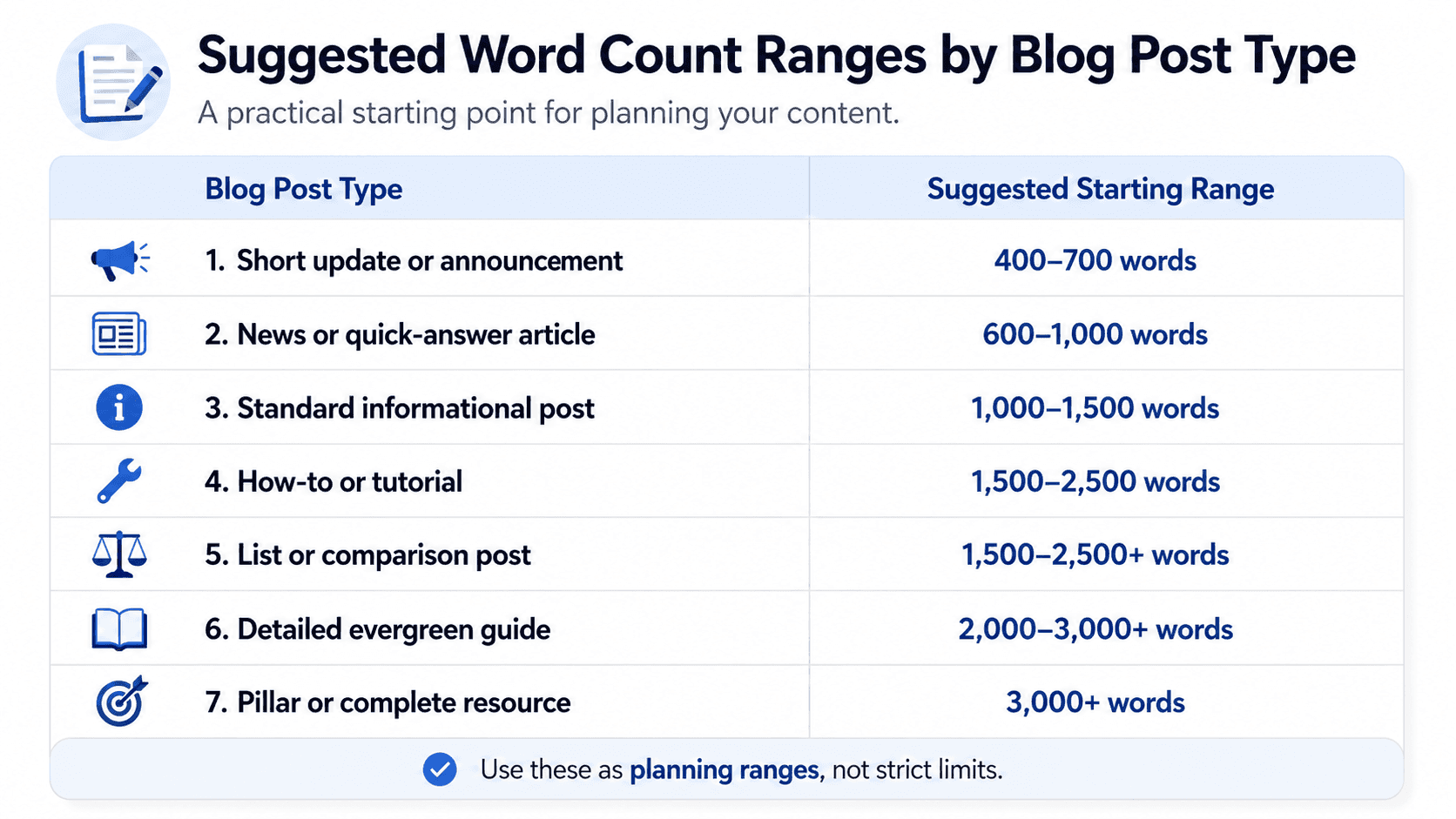
These ranges are useful for planning, not strict limits.
Semrush, for example, suggests roughly 400–700 words for press releases, 600–1,000 for news articles, 1,000–1,500 for informational posts, 1,500–2,500 for detailed guides, and 3,000+ for pillar content.
But two articles should not be forced into the same word count just because they both happen to be called “blog posts.”
A 700-word article explaining how to take a screenshot may answer everything the reader needs.
A 700-word beginner guide to technical SEO would probably leave quite a few questions hanging around awkwardly.
The topic decides how much space you need. Your job is to notice when the answer is complete.
In the next section, we will find out about -
Does Google Have an Ideal Word Count?
Google's current people-first content quality guidance focuses on whether a page provides original information, useful analysis, complete coverage, clear sourcing, and a satisfying experience for the reader.
It specifically warns against writing to a certain length because you think search engines want that number.
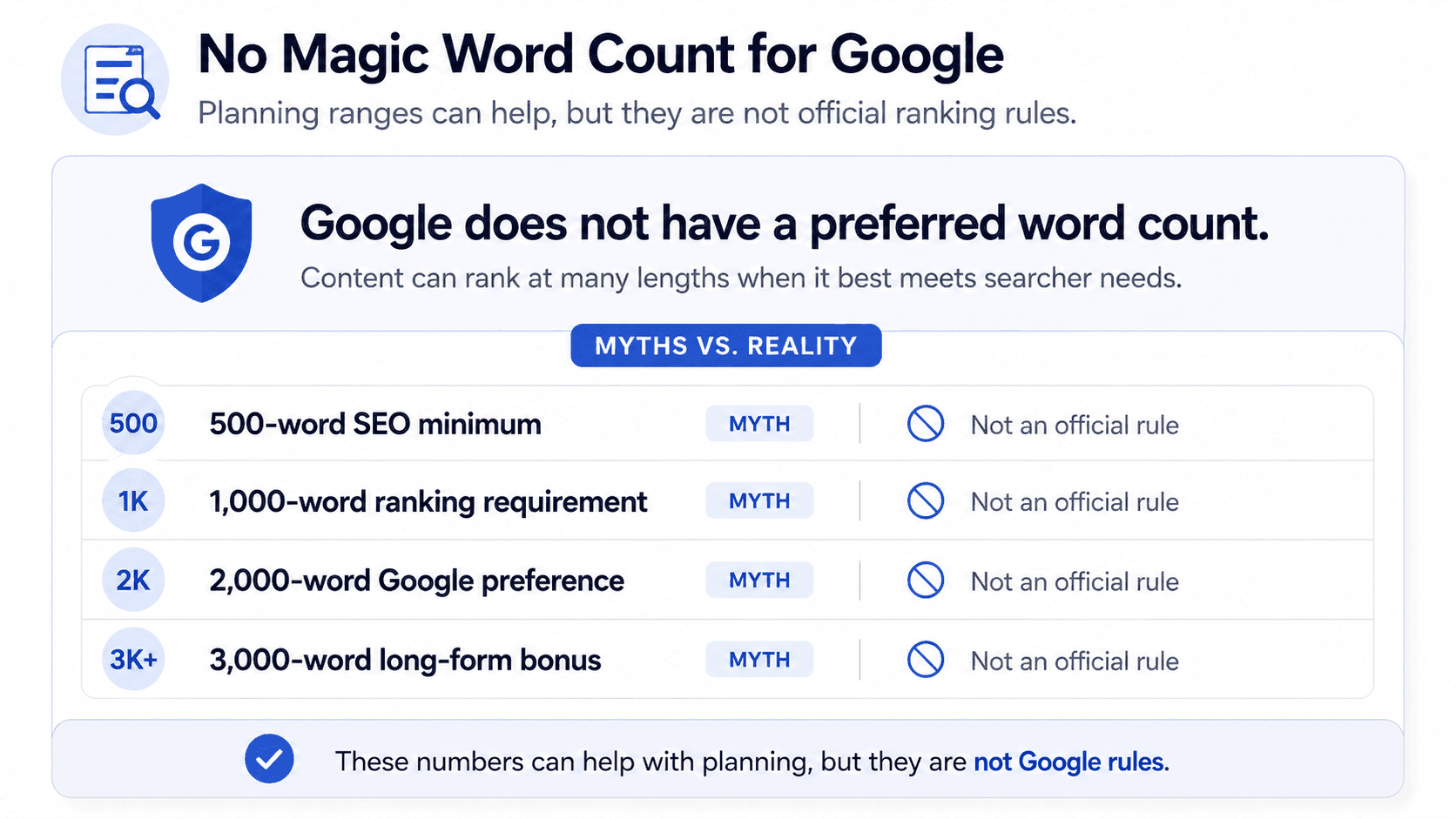
Google's Search Essentials also recommends using the words people search for in important places such as the page title and main heading while keeping the content useful and people-first.
So the focus should be topic coverage, not reaching a number on a word counter.
Now let’s clear a common confusion on -
Why Do Longer Blog Posts Often Perform Well?
Long articles can still perform very well. The reason is usually what those extra words allow the writer to do.
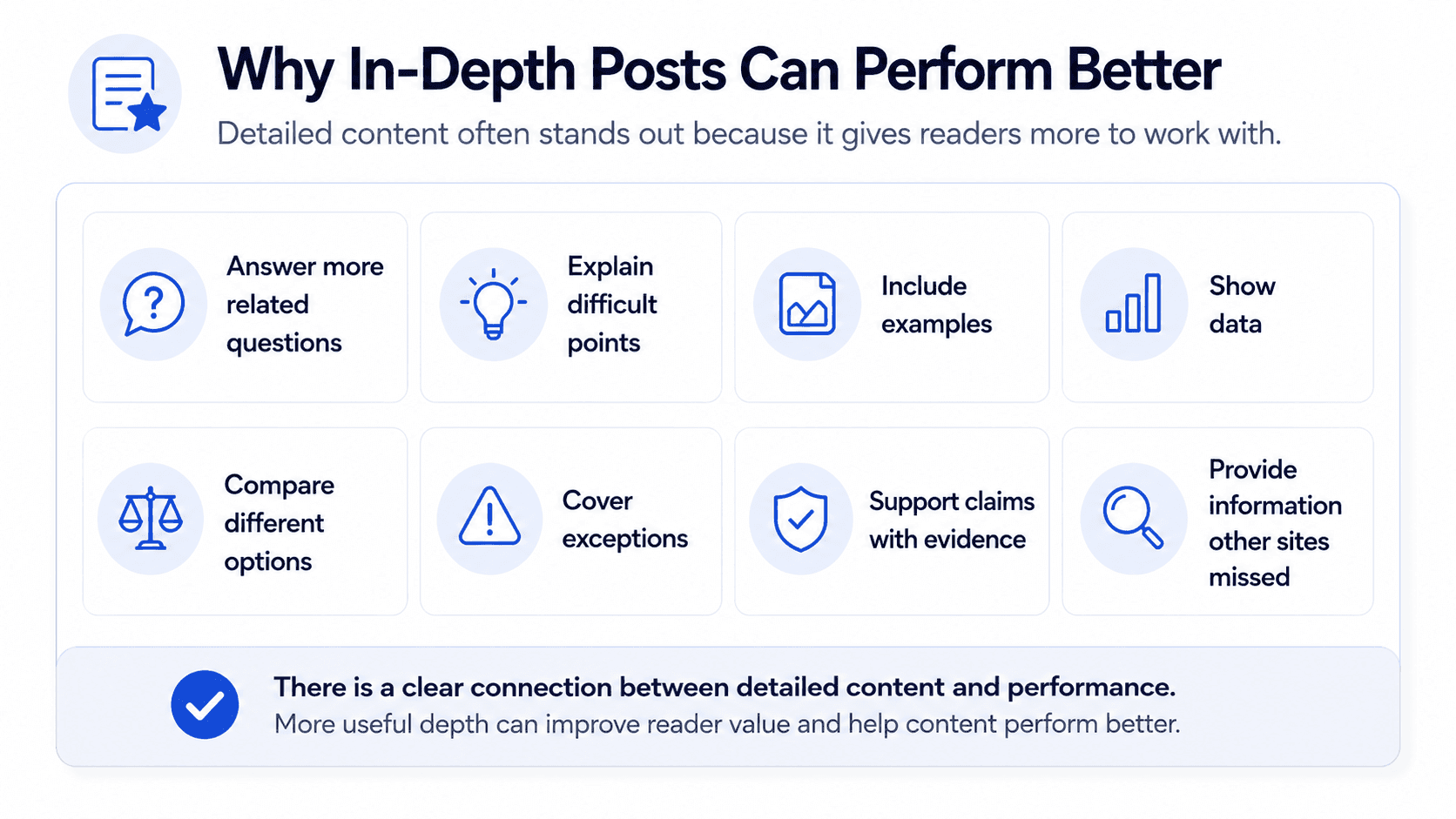
There is data showing a connection between detailed content and performance.
Backlinko analyzed 11.8 million Google search results and found that the average first-page result contained about 1,447 words.
However, the same study found no direct relationship between having a higher word count and ranking higher once pages were already on the first page.
That is an important detail. The study does not mean 1,447 is an ideal word count.
It means successful pages in the dataset happened to average around that number. Coverage and quality matter more than copying the average.
Long-form content can also offer more material worth referencing.
In a separate analysis of 912 million blog posts, Backlinko found that content above 3,000 words received an average of 77.2% more referring-domain links than content below 1,000 words.
Again, this is correlation.
A weak 4,000-word article does not deserve links simply because it is long.
Detailed research, original data, useful examples, charts, definitions, and expert insights are often what make long articles link-worthy.
Basically, the words themselves are not magic. What you put inside them matters.
So, in this moment, the question you may ask -
Can Short Blog Posts Rank?
Yes. A short article can positively affect ranking factors when a short answer matches search intent.
Imagine someone searches:
How many teaspoons are in a tablespoon?
They probably do not need a 2,500-word history of teaspoons.
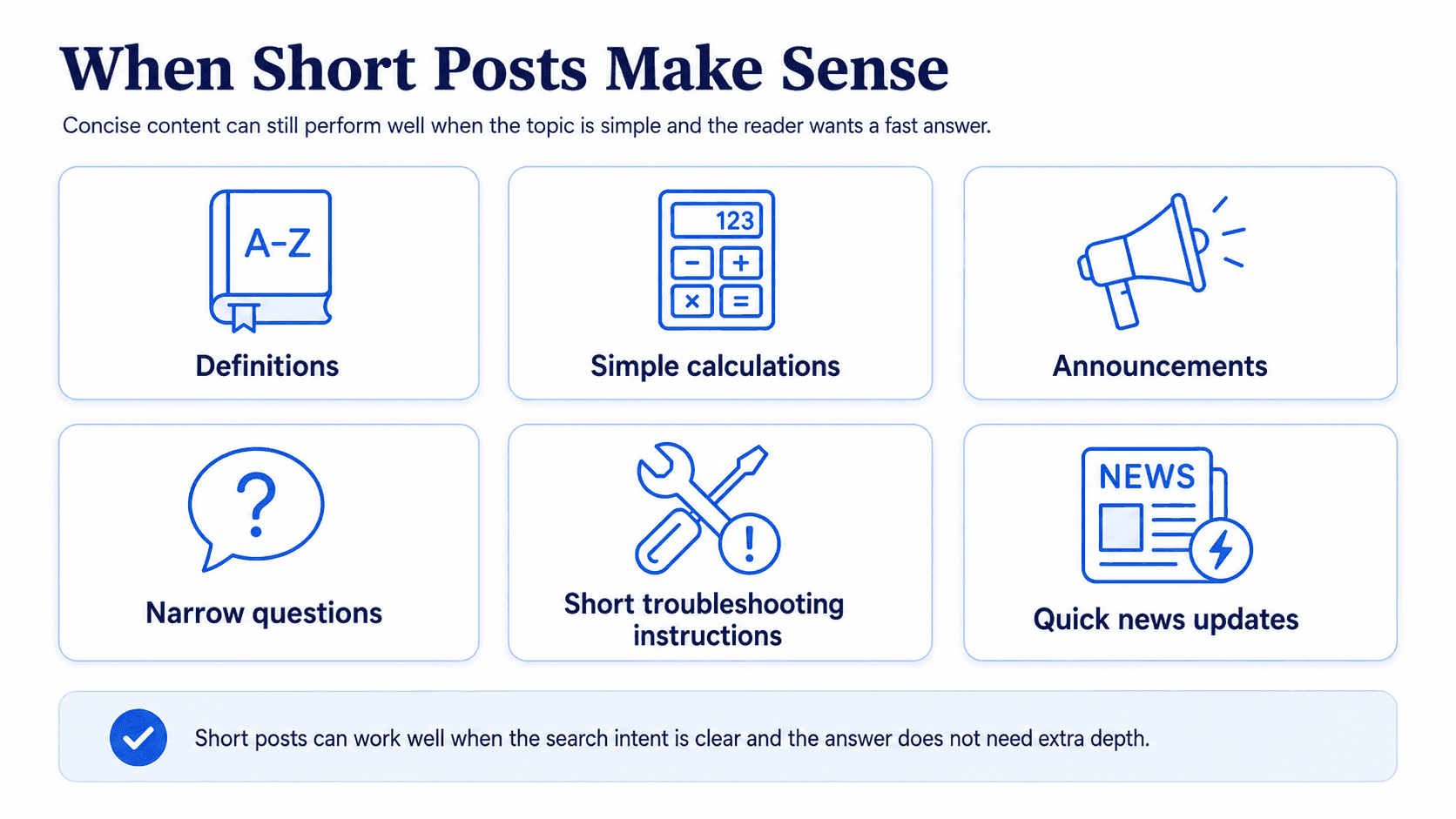
Semrush gives a useful example from its own research. For one search intent, pages ranking near the top ranged from around 554 words to more than 3,200 words.
Different lengths were able to compete because word count alone was not deciding the result.
A short page becomes a problem when the topic clearly requires more information, and the article stops before the reader has a complete answer.
So now you might be thinking -
What Is the Average Blog Post Word Count?
To be exact, average and ideal are two different things.
Average blog post word count tells you what publishers are producing. Ideal word count tells you how much content your own topic needs.
Orbit Media's 2025 annual blogger survey provides one of the more useful recent benchmarks. The survey included 808 content marketers and found that the average article published in 2025 contained 1,333 words.
That is especially interesting because the average had been rising for years before beginning to fall again.
Long-form content was still associated with stronger reported performance. Among publishers creating articles of 2,000+ words, 39% reported strong results, compared with the survey's overall benchmark of 21%.
But there is an important warning here too.
The survey measures what marketers report, not a direct Google ranking rule. So 1,333 words should not become your new target for every article.
Think of averages as reference points, not instructions.
In the next section, we will jump into one of the major topics to answer your burning question on the ideal word count for blog posts, so let’s see -
Ideal Blog Post Word Count by Content Type
To be specific, the type of content is one of the easiest ways to estimate how many words you may need.
A short update, a how-to guide, and a detailed comparison all serve different purposes, so they shouldn't be expected to be the same length.
For example, a simple announcement may only need a few hundred words, while a tutorial may require more space for steps, examples, screenshots, and troubleshooting tips.
In the same way, a pillar guide can naturally become much longer because it covers several related questions in one place.
So instead of choosing one fixed word or character count for every article, it is more useful to match the length to the format and the amount of information the reader expects.
Here is a practical breakdown by content types:
Short Blog Posts and Updates
It usually stays between 400–800 Words. Most of the short-form content works best when the reader needs one clear piece of information.
 A short article should still provide enough context to make sense on its own.
If the reader can understand the topic and take the next step without searching elsewhere, the post may already be long enough.
Informational Blog Posts
This kind of content mostly stays within 1,000–1,500 words. The range often works well for focused informational topics.
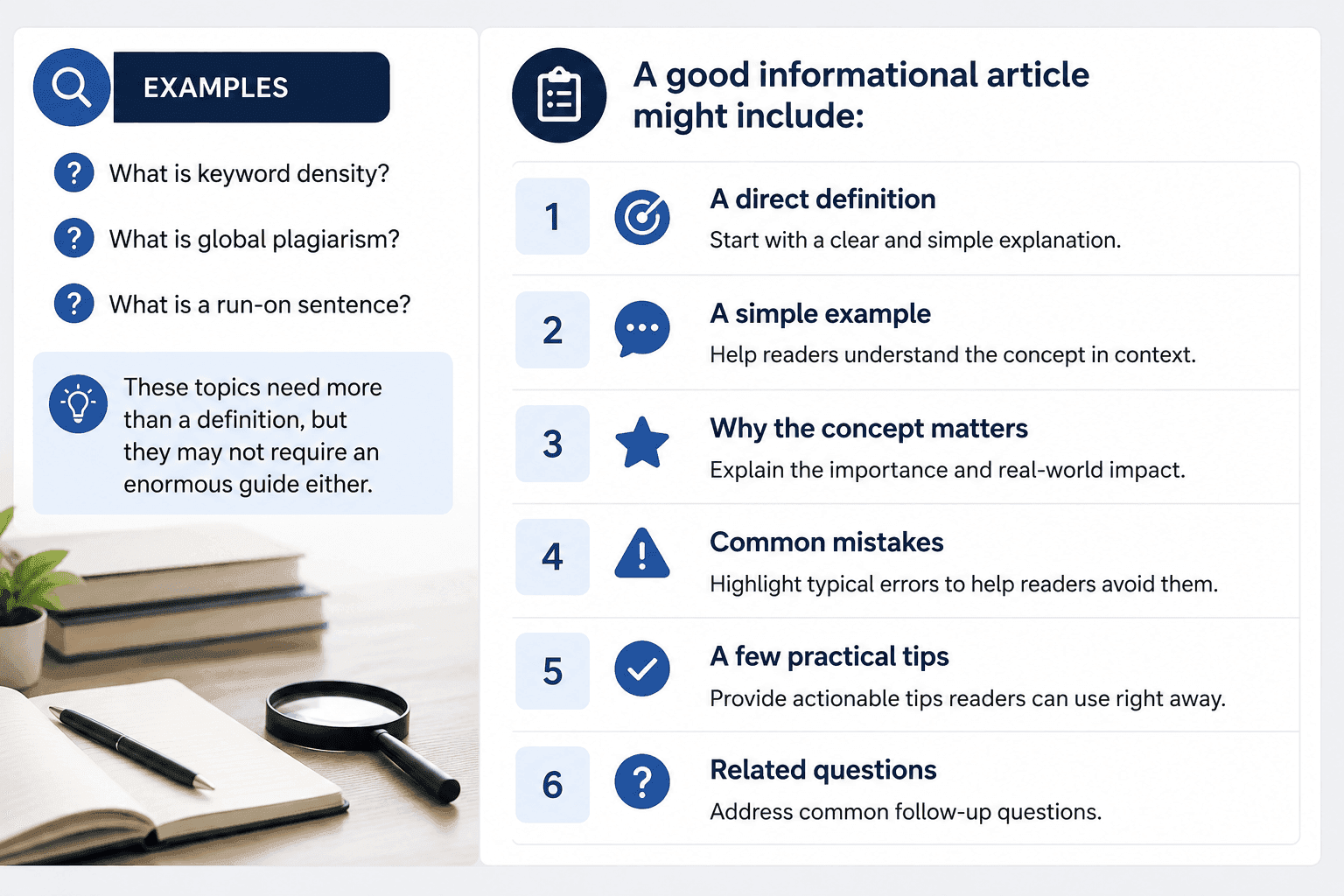
Once those needs are covered, adding five more sections simply to increase the word count usually makes the article worse.
How-To and Tutorial Posts
This sort of blog content usually contains 1,500–2,500 words. Tutorials often need more room because readers are trying to complete a task.

For example, How to Download Facebook Videos may need separate instructions for Windows, Mac, mobile devices, online tools, and bulk conversion.
The length comes naturally from the number of useful methods.
If there are only three real steps, however, there is no reason to invent twelve.
List Posts and Comparison Articles:
Mainly 1,500–2,500+ words can be counted as a good one. The ideal word count for a list article depends heavily on the number of items and how much explanation each one needs.
A list of ‘20 Common Grammar Mistakes’ may be useful at 1,200 words.
A comparison of “15 Best Grammar Checkers” could easily exceed 3,000 words if every tool is properly tested and compared.
A better planning formula is:
Number of items × useful information per item = natural article length
Do not start by deciding the article needs 3,000 words and then stretch each entry until the reader loses the will to continue.
Long-Form Guides
2,000–3,000+ words are more than okay with this kind of content. Detailed guides deserve more space when they cover several connected questions.
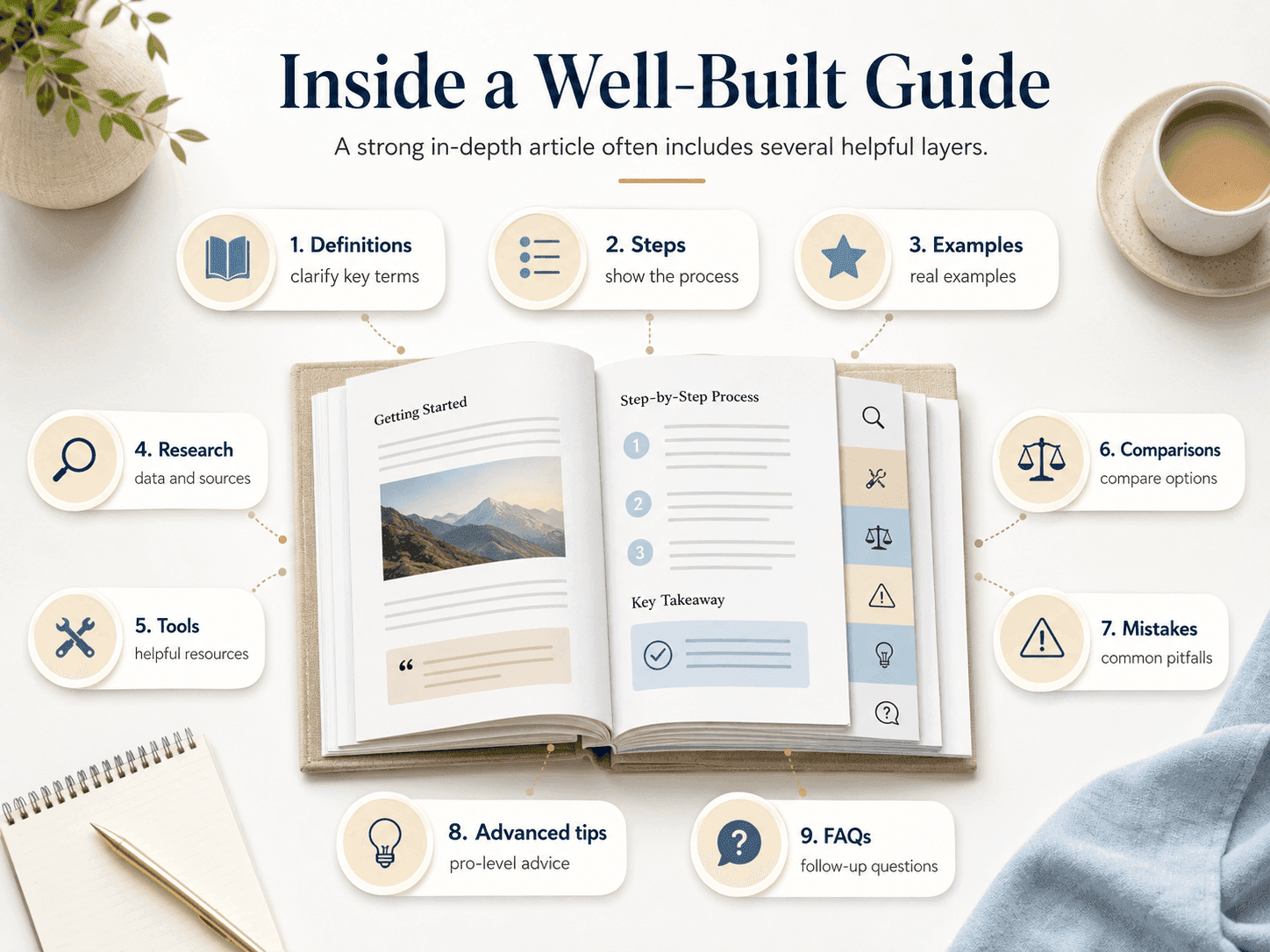
A 3,000-word guide can feel shorter than a repetitive 1,500-word article when every section gives the reader something new.
Pillar Content:
3,000+ to unlimited words are the limit of this criterion. Pillar pages usually cover a broad topic and connect several smaller ideas.
Examples might include:
- Complete Guide to Plagiarism
- Beginner's Guide to SEO
- Complete Grammar Guide to Writing
- Guide to Reverse Image Search
These pages can naturally become long because they function as reference resources.
Still, 3,000 words should not be treated as an entry fee.
If a complete resource takes 2,400 words, publishing another 600 words of filler does not make it better.
So now the main question you need to answer is -
How to Determine the Ideal Word Count for Your Blog Post
Instead of choosing a number first, use the topic to build the number.
The right word count usually becomes much clearer once you understand what the reader wants, how much explanation the topic needs, and what questions the article should answer.
A simple topic may only need a short, focused post, while a detailed guide can naturally require much more space.
The goal is not to stretch the article by paraphrasing or modifying until it reaches a target. It is to include enough useful information to make the post feel complete without adding filler.
Here is a simple process you can follow:
1. Identify What the Searcher Wants
Before deciding how long the article should be, first understand what the person is actually trying to find.
Two keywords can look similar but require very different levels of detail.
Someone searching for a quick definition may be satisfied with a short answer, while someone looking for a complete guide may expect examples, steps, comparisons, and extra context.
Knowing the search intent helps you avoid writing too little or adding unnecessary sections just to increase the word count.
Someone searching “what is a comma splice?” probably wants a definition and examples.
Someone searching “how to fix comma splices” may also need methods, exercises, and common mistakes.
The keywords look similar, but the amount of information needed is different.
2. Study What the Topic Requires
Once you understand the search intent, the next step is to look at how much information the topic actually needs.
This is where reviewing competing pages can help, but the goal is not to copy their length or structure.
Instead, study the areas they consistently cover.
If several strong pages answer the same subtopics, those points may be important for readers who search for that subject.
At the same time, look for missing details, weak explanations, or useful questions that competitors have overlooked.
You may find that several strong pages explain:
- the main definition
- three causes
- five examples
- common mistakes
- FAQs
Those repeating ideas can show what readers expect to learn. Then look for what is missing.
Remember that your goal should not be to produce the longest version. Instead, your goal should be to produce the most complete, useful version.
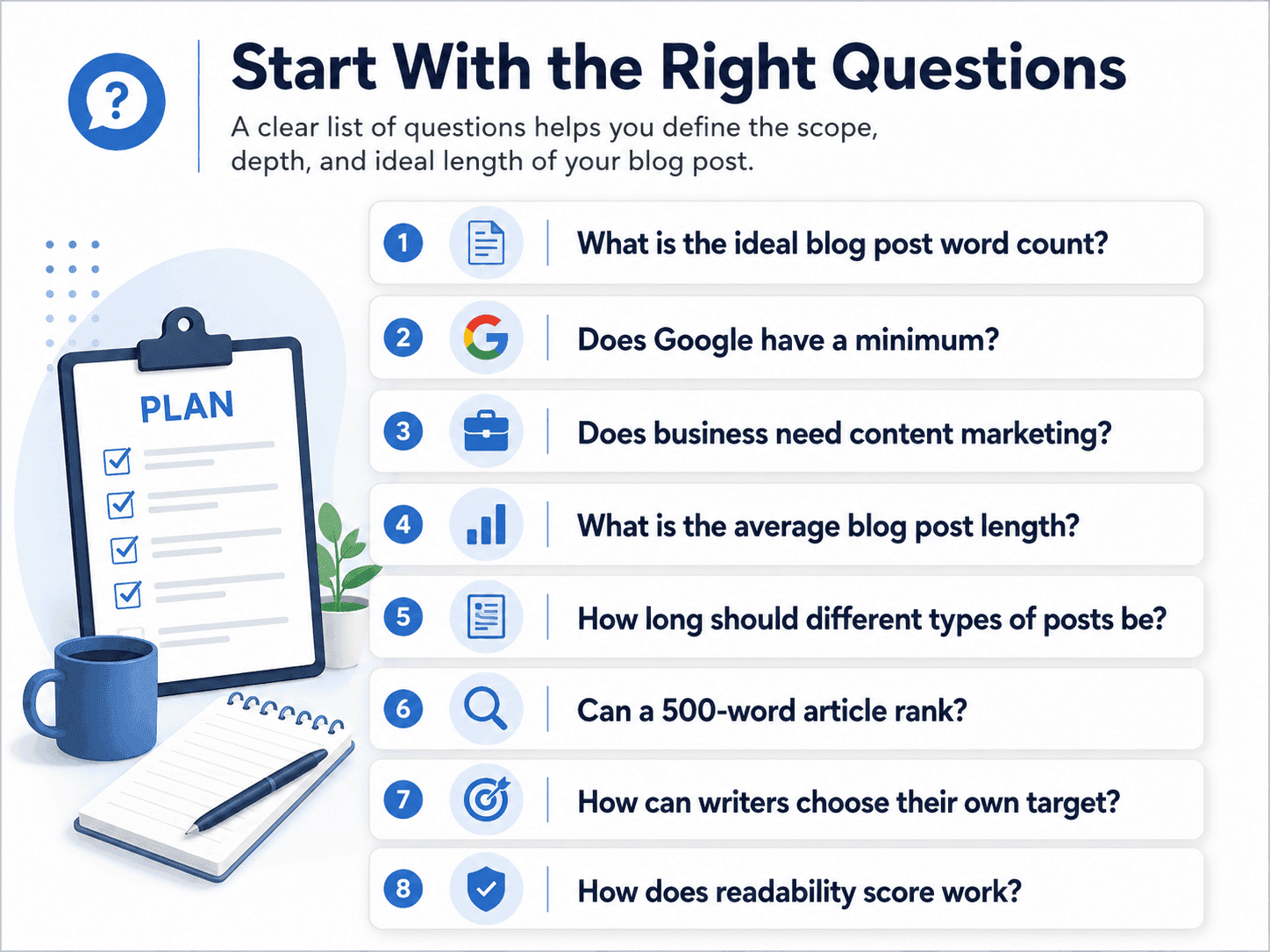
3. List the Questions the Article Must Answer
Before writing, create a simple list of questions the article should answer.
This helps you see how much information the topic really needs and prevents you from adding sections just to make the post longer.
Think about the main question first, then add the smaller questions a reader may have after that.
If the article answers those points clearly, the word count will usually grow naturally from the topic instead of from a fixed target.
For this kind of article:
Those questions become the article structure. Word count then grows from actual reader needs rather than filler.
4. Consider the Reader's Knowledge
Not every reader needs the same level of explanation. A beginner may need a little extra background before the main point makes sense, while an experienced reader may want you to get straight to the useful details.
For example, if you are explaining passive voice checking tricks to beginners, you may first need to explain what duplicate URLs are and why they can cause problems.
A technical SEO professional probably already knows that, so repeating the basics would only slow them down.
This is why the same topic can end up with very different word counts depending on who you are writing for.
Sometimes the extra words are helpful. Sometimes they are just making an expert scroll more than necessary.
5. Edit After You Reach the Answer
Your first draft does not need to land on the perfect word count. Trying to hit an exact number while writing can actually make the article feel forced.
Focus on answering the topic properly first. Once the main points are covered, go back and have a proofreader with a fresh eye look it over.
This is usually where you notice repeated ideas, long explanations, or sections that sounded useful while writing but do not really add much.
The goal is simple: keep what helps the reader and remove what only makes the article longer.
Remove:
- repeated explanations
- long introductions
- obvious statements
- unrelated examples
- sections created only for keywords
- sentences that say the same thing twice
Add information only when something useful is missing. That is a much healthier use of a word-count target.
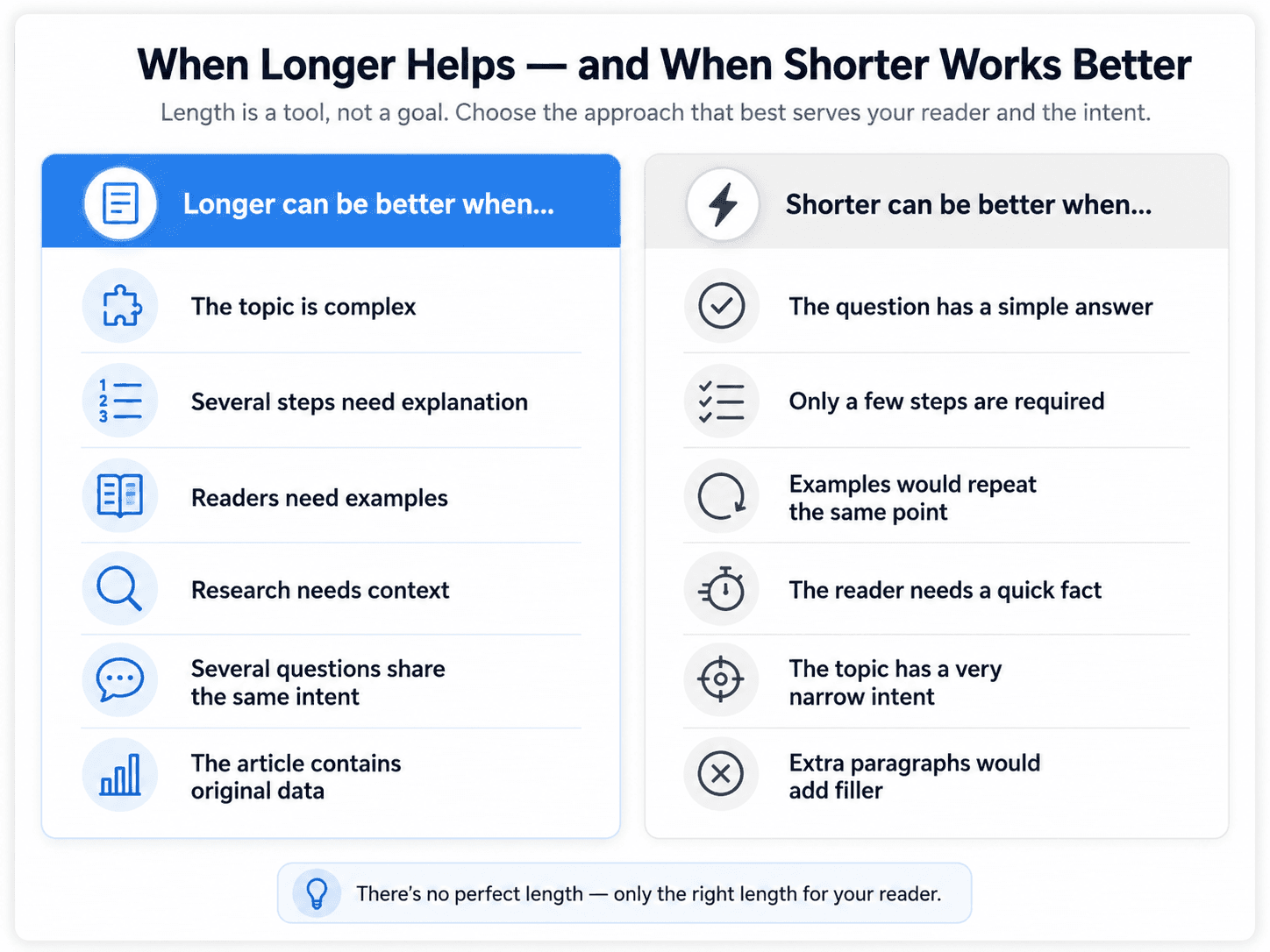
Is a Longer Blog Post Always Better?
No. Longer is better only when the extra length adds useful information.
A longer article can be helpful when the topic needs detailed explanations, examples, comparisons, research, or step-by-step guidance.
In those cases, more words give the writer enough space to answer the reader’s questions properly.
But extra length can also make an article weaker when it only repeats the same ideas, adds unrelated details, or stretches a simple answer unnecessarily.
So instead of asking whether a post is long enough, ask whether every section is helping the reader understand the topic better.
Here is a simple way to judge it:
A 900-word article that solves the problem is better than a 2,500-word article that hides the solution.
Readers came for information, not an endurance test.
So, now that you got your answer, let’s see -
How to Check Your Blog Post Word Count
Once your draft is complete, check its count on sentences as well as words before publishing.
You can use the CopyChecker to see the numbers in your draft quickly.
Then ask four questions:
- Did I answer the main search question?
- Did I cover the important related questions?
- Is any section too thin to be useful?
- Can I remove anything without making the answer weaker?
Suppose you expected an article to be around 1,800 words, but the finished draft is 1,350 words.
Do not add 450 words automatically.
Read it first.
If something important is missing, add it.
If the article already gives a complete answer, 1,350 may be exactly the right number.
Remember that a word counter should help you measure your writing. It should not control it.
Blog Post Word Count Mistakes to Avoid in 2026
Word count can be a useful guide, but it becomes a problem when the number starts making the writing decisions for you.
It is easy to get too focused on reaching 1,000, 1,500, or 2,000 words and forget what the reader actually came to learn.
You may start adding extra examples, repeating the same idea in a different way, or creating sections that do not really need to be there.
A better approach is to treat word count as a reference, not a target you must hit at any cost.
So, before publishing, ask yourself whether the essay checking feels complete, easy to follow, and useful from beginning to end.
If a section is only there to make the post longer, it probably does not need to stay.
Here are some common word count mistakes that can make a blog post less useful:
Writing Exactly 2,000 Words Because Someone Told You To
You may have heard advice such as, “Every SEO blog post should be at least 2,000 words.”
The problem is that not all topics need the same amount of space.
If you have answered the main question, covered the important details, added useful examples, and reached 1,760 words, there is no reason to force another 240 words into the article just to reach a round number.
Those extra words often turn into repeated explanations or unnecessary sections.
On the other hand, if you reach 2,000 words and an important part of the topic is still missing, stopping just because you reached your target can leave the article incomplete.
So do not let the number decide when the article is finished. If the answer is complete at 1,760 words, stop. If the topic genuinely needs 2,400 words, keep writing.
Adding Filler to Match Competitors
Checking competing articles can help you understand how deeply the topic clusters are being covered, but copying their word count is a different matter.
Suppose a competitor has a 3,000-word blog ranking well. It can be tempting to think your article also needs to reach 3,000 words.
But take a closer look at what those words contain.
The competitor may have included original research, screenshots, expert comments, real examples, comparison tables, minimal sentence rewriter usage, or detailed instructions.
Simply adding six generic paragraphs to your own article will not give readers the same value.
You might technically reach the same word count while still providing much less useful information.
Instead of asking:
“How many words did they write?”
Ask:
“What useful information did they include, and can I explain this topic even better?”
Compare information, depth, and usefulness, not just word count.
Assuming Longer Automatically Means Better SEO
It is easy to see studies about long-form content strategy performing well and conclude that longer articles automatically rank better.
The relationship is not that simple.
For example, Orbit Media's 2025 survey found that a higher percentage of marketers publishing articles over 2,000 words reported strong results.
That is useful data, but it does not prove that crossing the 2,000-word mark caused those results.
Writers who create longer articles may also spend more time researching the topic, adding original data, improving examples, editing carefully, creating visuals, building links, and promoting the finished content.
All of those things can contribute to better performance.
So the lesson should not be:
“Make every article longer.”
A better lesson is:
“Give important topics the depth they genuinely need.”
A useful 2,500-word guide can perform very well. So can a focused 900-word answer when that is all the searcher needs.
Ignoring Search Intent
This is probably one of the biggest word count mistakes because it affects the entire article.
Before deciding how long a post should be, think about what the person searching for that topic actually wants to do.
If someone wants a quick definition or a simple answer, they may not want to read through 2,500 words to find it.
Imagine searching for a straightforward question and landing on an article that spends several paragraphs explaining the history of the topic before giving you the answer.
You would probably start scrolling quickly or leave the page altogether.
On the other hand, someone searching for a complete guide on blog creation, comparison, or a beginner's tutorial may expect much more detail.
This is why the same word count cannot work for every search.
A short answer can feel perfect when the intent is simple. The same length can feel incomplete when the reader needs detailed guidance.
Start with the question the reader is trying to answer. Then give them enough information to solve it properly.
Write for the question first. Count the words second.
Frequently Asked Questions About Blog Post Word Count
Is 500 Words Enough for a Blog Post?
Yes, 500 words can be enough for a blog post when the topic is narrow and can be answered completely in that space.
Is 1,000 Words Enough for a Blog Post?
Yes, 1,000 words is enough for many focused informational posts. Check whether the article answers the main question, explains the important details, and leaves the reader with enough information to act.
Is 2,000 Words Too Long for a Blog Post?
No, 2,000 words is not too long when the topic needs that level of detail. Tutorials, comparisons, research articles, and evergreen guides can easily reach 2,000 words without feeling long.
What Is the Minimum Word Count for an SEO Blog Post?
Google does not publish a minimum word count for SEO. Its guidance focuses on useful, reliable, people-first content rather than reaching a fixed word count.
Does Google Prefer Longer Blog Posts?
No, Google does not state that longer blog posts receive a ranking advantage simply because they contain more words. In fact, Google's guidance specifically says it does not have a preferred word count.
How Long Should a Blog Post Be for SEO?
For many detailed informational topics, roughly 1,500–2,500 words can be a reasonable starting range, but there is no universal SEO target.
How Many Words Should a Beginner Blog Post Contain?
Start by choosing one clear topic and answering it properly. For many focused topics, 800–1,500 useful words are easier to research, organize, and edit than an oversized guide. Quality writing habits matter more than reaching an impressive number.
Should Every Blog Post Have the Same Word Count?
No. Different topics need different amounts of information. A news update, product comparison, tutorial, definition, and complete guide serve different purposes. Giving all five the same word-count target would ignore how readers actually use them.
Wrapping Up
The best blog post word count is the number of words required to answer the reader's question completely, clearly, and without unnecessary filler.
For detailed informational posts, a range around 1,500–2,500 words can be useful when planning.
Current publishing data also gives us some reference points: Orbit Media found an average article length of 1,333 words in its 2025 survey, while Backlinko's large search-result study found an average of 1,447 words among first-page Google results.
So, neither number is a target you need to chase.
It’s best when you start with search intent. Cover the topic properly. Use examples and facts when they improve the answer. Finally, remove repeated ideas.
Then check the final length with CopyChecker's Word Counter.
If the reader gets the answer they came for without wishing you had stopped five paragraphs earlier, your word count is probably doing its job.