Suppose you just finished a sentence, add a period, and move on.
Then you read it again.
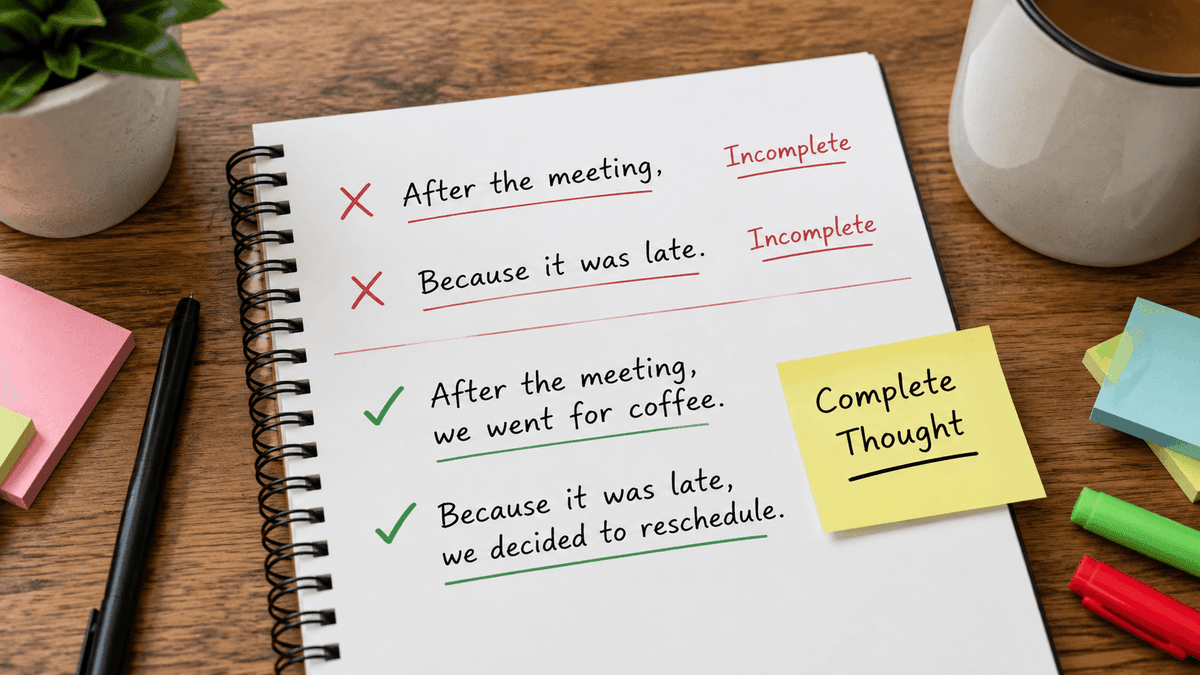
Because I forgot to set the alarm.
Something feels off.
The words make sense. There is even a subject and a verb. Still, your brain is waiting for the rest of the story.
Because you forgot the alarm... what happened?
Now compare it with:
I missed my morning class because I forgot to set the alarm.
That unfinished feeling is one of the easiest ways to notice a sentence fragment.
And fragments are not always this obvious. Some are only two or three words long.
Others can stretch across an entire line and still fail to form a complete sentence. A few
are not even mistakes at all when writers use them deliberately for emphasis.
The tricky part is that fragments do not always look incomplete.
Some contain a subject and a verb. Some are surprisingly long.
And some sound natural enough that you may read past them several times without noticing anything wrong.
So instead of memorizing another painfully dry grammar definition, let's learn through actual sentence fragment examples, corrections, and a few simple tests you can use on your own writing.
20+ Sentence Fragment Examples and Corrections
Want the examples first?
Fair enough. Grammar has made people wait long enough.
Here are some common sentence fragment examples and their corrected versions.
| Sentence Fragment | What's Wrong? | Correct Sentence |
|---|---|---|
| Because the store was closed. | Incomplete dependent clause | We went home because the store was closed. |
| Forgot my wallet at home. | Missing subject | I forgot my wallet at home. |
| The little café beside our office. | Missing main verb | The little café beside our office serves amazing coffee. |
| Running across the parking lot. | Missing subject and complete verb | Maya was running across the parking lot. |
| To finish the assignment before midnight. | No independent clause | Liam stayed awake to finish the assignment before midnight. |
| Although everyone agreed with the idea. | Incomplete dependent clause | Although everyone agreed with the idea, we postponed the decision. |
| Which made everyone laugh. | Dependent clause standing alone | His unexpected comment made everyone laugh. |
| Especially during the winter. | Added detail without a complete sentence | The roads become dangerous, especially during the winter. |
| Such as books, notebooks, and pens. | Example phrase standing alone | Bring your study materials, such as books, notebooks, and pens. |
| The students waiting outside the classroom. | No complete main verb | The students were waiting outside the classroom. |
| After we finished dinner. | Incomplete thought | After we finished dinner, we watched a movie. |
| Walked all the way back home. | Missing subject | She walked all the way back home. |
| My new laptop with the larger screen. | Missing predicate | My new laptop with the larger screen works much faster. |
| Trying to remember his password. | No independent clause | Daniel sat quietly, trying to remember his password. |
| Unless the weather improves. | Incomplete dependent clause | We will cancel the trip unless the weather improves. |
| Including several international students. | Phrase without an independent clause | The group included several international students. |
| Before starting the presentation. | Incomplete phrase | Before starting the presentation, Nina checked her notes. |
| The restaurant at the end of the street. | Missing main verb | The restaurant at the end of the street closes at ten. |
| Because she practiced every evening. | Leaves the reader waiting | She improved quickly because she practiced every evening. |
| To learn how the software works. | Infinitive phrase standing alone | I watched the tutorial to learn how the software works. |
| Who lives in the apartment upstairs. | Relative clause standing alone | I met the woman who lives in the apartment upstairs. |
| Waiting for someone to answer the phone. | Missing independent clause | I spent ten minutes waiting for someone to answer the phone. |
| Even though we arrived early. | Incomplete dependent clause | Even though we arrived early, all the seats were taken. |
| Especially the chocolate cake. | Incomplete added detail | I enjoyed every dessert, especially the chocolate cake. |
Notice something?
Fragments come in different shapes, but they share one problem: something the reader needs is missing.
Let's figure out exactly what.
What Is a Sentence Fragment?
A sentence fragment is a group of words presented as a sentence, even though it does not express a complete thought.
A complete sentence normally needs:
- a subject
- a complete main verb
- an independent thought
For example:
Emma laughed.
Subject: Emma
Verb: laughed
Complete thought: Yes
That tiny two-word sentence is perfectly complete.
Now look at this:
Because Emma laughed.
Subject? Yes.
Verb? Yes.
Complete sentence?
No.
The word because turns the statement into a dependent clause. Your brain naturally expects an explanation:
Because Emma laughed... what happened?
This is why simply hunting for a subject and verb is not always enough. A dependent clause can contain both and still be a fragment.
Sentence fragments are only one of several structural errors that can slip into otherwise good writing.
Problems such as subject-verb disagreement, tense shifts, run-ons, and comma splices often appear alongside them.
Which is why learning the patterns behind other common grammar mistakes can make proofreading much easier.
Quick Fact: Longer Does Not Mean More Complete
Compare these:
Dogs bark.
Complete.
Now:
Running through the crowded airport while carrying three suitcases and desperately trying to reach the gate before boarding ended.
Fragment.
The second example is enormous compared with the first, yet it still lacks a proper independent clause.
So forget counting words.
Sentence length does not determine whether a sentence is complete.
The same idea applies to paragraphs. A short paragraph is not automatically underdeveloped, just as a short sentence is not automatically a fragment.
If you're trying to judge structure rather than grammar, the question of how many sentences should be in a paragraph depends much more on purpose and development than on reaching a fixed number.
Most Common 7 Types of Sentence Fragments
Once you recognize the patterns behind fragments, they become much easier to spot.
Here are seven common types.
1. Sentence Fragments Missing a Subject
Every ordinary declarative sentence needs someone or something to perform or experience the action.
Consider:
Fragment: Forgot to lock the door.
Who forgot?
Your reader should not have to conduct a criminal investigation to find the subject.
Fix it by adding one:
Correct: Alex forgot to lock the door.
More examples:
Fragment: Arrived ten minutes late.
Correct: The teacher arrived ten minutes late.
Fragment: Has been working all weekend.
Correct: Maria has been working all weekend.
Fragment: Decided to order pizza instead.
Correct: We decided to order pizza instead.
Quick test
Ask:
Who or what is doing this?
If the sentence does not answer that question, check for a missing subject.
2. Sentence Fragments Missing a Main Verb
Sometimes a sentence introduces a person, place, object, or idea but never tells us anything about it.
Fragment: The beautiful house near the beach.
Okay.
What about it?
Correct: The beautiful house near the beach belongs to my grandparents.
Another example:
Fragment: My best friend from university.
Correct: My best friend from university moved to Canada last year.
Watch out for sentences packed with descriptive details. They can feel complete because there are lots of words, but description alone does not create a full sentence.
3. Dependent Clause Fragments
This is one of the most common traps.
A dependent clause may contain a subject and verb but begin with a word that makes it depend on another idea.
Look at:
Fragment: Because I forgot my umbrella.
We have:
Subject: I
Verb: forgot
Yet the sentence is incomplete.
Fix 1: Add an independent clause
Correct: I got soaked because I forgot my umbrella.
Fix 2: Remove the dependency word when appropriate
Fragment: Although the movie was nearly three hours long.
Correct: The movie was nearly three hours long.
Fragment Warning Words
Pay extra attention when a sentence begins with:
| Common Warning Words | |
|---|---|
| because | although |
| since | when |
| though | whenever |
| even though | while |
| unless | before |
| after | until |
These words are not bad. Poor little conjunctions have enough problems without being blamed for everything.
They simply often introduce dependent clauses, which usually need an independent clause to complete the thought.
4. -ing Sentence Fragments
Words ending in -ing frequently fool writers because they look like verbs.
Consider:
Fragment: Running toward the bus.
We know there is running.
We do not know who is running, and the phrase does not contain a complete verb construction.
Fix it:
Correct: Kevin was running toward the bus.
Or attach the phrase to a complete sentence:
Correct: Running toward the bus, Kevin nearly dropped his phone.
Another example:
Fragment: Sitting quietly beside the window.
Correct: The cat was sitting quietly beside the window.
A sentence can contain something that looks like a verb and still lack a complete main verb, which is why simply circling every action-looking word does not always solve the problem.
5. To-Infinitive Fragments
Phrases beginning with to + verb can also appear sentence-like.
For example:
Fragment: To get a better score on the test.
Ask:
Who wants the better score?
What are they doing to get it?
We need more information.
Correct: Noah studied every evening to get a better score on the test.
Another example:
Fragment: To find a cheaper flight.
Correct: We compared several airlines to find a cheaper flight.
The infinitive phrase explains purpose, but it usually cannot carry the entire sentence by itself.
6. Added-Detail Fragments
This type sneaks into writing when someone finishes a sentence and then adds another little piece of information as if it were a separate sentence.
Example:
Fragment: I enjoy outdoor activities. Especially hiking and cycling.
The second part belongs with the first.
Correct: I enjoy outdoor activities, especially hiking and cycling.
Another:
Fragment: The course covers several writing problems. Such as comma splices and sentence fragments.
Correct: The course covers several writing problems, such as comma splices and sentence fragments.
Words and phrases worth watching include:
- especially
- such as
- including
- for example
- particularly
They frequently introduce extra information rather than complete sentences.
7. Relative Clause Fragments
Fragments can also begin with words such as who, which, or that.
Consider:
Fragment: Which made everyone nervous.
What made everyone nervous?
We are missing the main idea.
Correct: The lights suddenly went out, which made everyone nervous.
Another example:
Fragment: Who works at the pharmacy near my house.
Correct: I spoke with the woman who works at the pharmacy near my house.
A relative clause describes or adds information about something else, so it normally needs that something else nearby.
How Can You Tell If a Sentence Is a Fragment?
You do not need to memorize every grammar term in existence.
Use this four-step fragment test instead.
Step 1: Find the Subject
Ask:
Who or what is this sentence about?
Consider:
Went to the library after class.
Who went?
Nobody knows.
That is your first warning.
Step 2: Find the Main Verb
Ask:
What is the subject doing, being, having, or experiencing?
Example:
The old bookstore across from our university.
Subject?
The old bookstore.
Main verb?
None.
Fragment detected.
Step 3: Look for Dependency Words
Imagine you see:
Although the meeting ended early.
You already have:
- subject: meeting
- verb: ended
But although tells your brain another thought should follow.
Try reading it naturally:
“Although the meeting ended early...”
You instinctively wait.
That waiting feeling is useful.
Step 4: Ask Whether It Can Stand Alone
Imagine someone walks into the room, says only the sentence, and leaves.
Would you understand the complete message?
The baby is sleeping.
Yes.
Because the baby is sleeping.
Because the baby is sleeping... what?
Fragment.
The Five-Second Fragment Check
Ask:
- Who or what?
- Doing what?
- Is the main verb complete?
- Does the thought depend on another sentence?
- Does it make sense by itself?
If one answer causes trouble, inspect the sentence more closely.
How to Fix a Sentence Fragment
Finding a fragment is only half the job.
Fortunately, fixing one usually involves one of five simple moves.
1. Add the Missing Subject
Fragment: Forgot about the deadline.
Fixed: I forgot about the deadline.
Simple.
2. Add the Missing Verb
Fragment: The woman in the green jacket.
Fixed: The woman in the green jacket waved at us.
Now something actually happens.
A thrilling development for the sentence.
3. Complete the Dependent Thought
Fragment: Although the hotel was expensive.
Add the missing independent clause:
Fixed: Although the hotel was expensive, we decided to stay there.
4. Connect the Fragment to a Nearby Sentence
Sometimes everything you need is already sitting one sentence away.
Incorrect:
We canceled the picnic. Because heavy rain was expected.
The second thought explains the first, so combine them.
Correct:
We canceled the picnic because heavy rain was expected.
This is often the cleanest fix.
5. Rewrite the Sentence
Do not force yourself to repair every fragment by adding random words.
Sometimes a full rewrite sounds better.
Fragment: The presentation being much longer than expected.
Possible repair:
The presentation was much longer than expected.
Cleaner.
If the grammar is technically repairable but the sentence still sounds clumsy, it may help to rethink its structure entirely.
These methods for rewriting a sentence without changing its meaning are useful when a small grammatical patch would leave the wording awkward.
If the fragment still sounds awkward after you complete it, you may need to rephrase the sentence rather than simply add a missing word. This can help you create a clearer, more natural sentence while keeping the original meaning.
Sentence Fragment vs. Complete Sentence
The difference is simple:
A complete sentence can stand independently. A sentence fragment cannot.
| Sentence Fragment | Complete Sentence |
|---|---|
| Because Sarah arrived late. | Sarah missed the introduction because she arrived late. |
| The children in the garden. | The children played in the garden. |
| Waiting outside the station. | We were waiting outside the station. |
| To buy a new computer. | Ryan saved money to buy a new computer. |
| Although everyone was tired. | Although everyone was tired, we continued working. |
There is another useful lesson here:
Short Does Not Mean Fragment
Consider:
I agree.
Two words.
Complete sentence.
Or:
Stop!
One word.
Still acceptable as a complete command because English imperatives can have an understood subject, essentially “You stop.”
Meanwhile:
Because the enormously complicated project that everyone had been discussing for several months.
Very long.
Still incomplete.
Grammar can be annoyingly unimpressed by word count.
Sentence Fragment vs. Run-On Sentence
Sentence fragments and run-on sentences are almost opposite problems.
A fragment does not contain enough independent sentence structure.
A run-on incorrectly combines complete independent clauses.
Compare them:
| Areas | Sentence Fragment | Run-On Sentence |
|---|---|---|
| Main problem | Incomplete thought | Complete thoughts joined incorrectly |
| Example | Because I was tired. | I was tired I went home. |
| What it needs | Completion or connection | Proper separation or connection |
| Correct version | I went home because I was tired. | I was tired, so I went home. |
So:
Fragment = not enough
Run-on = complete clauses connected incorrectly
If the second problem sounds suspiciously familiar, these run-on sentence examples show how to identify the independent clauses and choose the right fix.
There is one more sentence-boundary error worth separating from both: the comma splice.
Consider:
Incorrect: I was tired, I went home.
Both sides could stand alone as complete sentences, but a comma has been left trying to connect them without help.
If that distinction still feels fuzzy, the explanation of what a comma splice is breaks down why it happens and the four common ways to repair one.
Conveniently, English found ways to cause trouble when a sentence has too little structure, too much structure, and the wrong punctuation between structures.
Nobody can accuse the language of lacking variety.
Are Sentence Fragments Always Wrong?
No.
And this is where grammar gets more interesting.
Sentence fragments are usually errors in formal and academic writing when they occur accidentally, but intentional fragments can work beautifully in creative writing, advertising, dialogue, headlines, and informal communication.
Imagine a thriller:
He opened the door.
Nothing.
Not a sound.
Technically, those last two are fragments.
Stylistically?
They work.
Now imagine a research paper:
The experiment produced unexpected results. Especially in the final group.
That fragment feels accidental.
Better:
The experiment produced unexpected results, especially in the final group.
A Useful Rule
Use a fragment intentionally when you know why you are breaking the normal sentence pattern.
If you did not realize it was a fragment, it probably needs fixing.
This is also why blanket advice like “never use sentence fragments” is not particularly helpful.
English has plenty of supposed grammar rules that writers can sometimes break when context and purpose justify it.
The important distinction is intentional versus accidental.
For essays and other formal assignments, where accidental fragments can make an argument look unfinished, it also helps to review sentence structure alongside the other issues covered in an essay grammar guide before submitting.
An Interesting Writing Statistic
Sentence fragments are only one part of clear writing, but broader writing assessments show why sentence-level control matters.
In the 2011 National Assessment of Educational Progress writing assessment, only 27% of U.S. eighth- and twelfth-grade students performed at or above the Proficient level.
That assessment measured broader writing ability, not sentence fragments specifically, so the number should not be treated as a “fragment error rate.”
Still, it illustrates something teachers and editors know rather painfully well: producing consistently clear, controlled writing is a learned skill rather than something everyone automatically masters.
And that is actually encouraging.
Sentence fragments are not mysterious mistakes you either “have a talent for” or don't.
They are patterns.
Once you recognize the patterns, you can fix them.
Can You Spot the Sentence Fragments?
Time for a quick test.
Some of the sentences below are fragments.
Some are perfectly complete.
No, we are not making every answer “fragment.” That would be less of a quiz and more of an ambush.
1. Because my laptop suddenly stopped working.
Answer: Fragment.
The dependent clause tells us why something happened but never tells us what happened.
Possible correction: I couldn't finish the report because my laptop suddenly stopped working.
2. The dog slept.
Answer: Complete sentence.
Subject: dog
Verb: slept
Complete thought: yes.
Two words can do the job perfectly well.
3. Walking through the city after midnight.
Answer: Fragment.
Who was walking?
Correction: We were walking through the city after midnight.
4. When everyone finally arrived, we ordered dinner.
Answer: Complete sentence.
“When everyone finally arrived” is dependent, but it is connected to the independent clause “we ordered dinner.”
5. The enormous tree behind our house.
Answer: Fragment.
The sentence gives us a subject but does not tell us anything complete about it.
Correction: The enormous tree behind our house fell during the storm.
6. Maya laughed.
Answer: Complete sentence.
Short. Clear. Complete.
7. Especially on Friday evenings.
Answer: Fragment.
It adds detail without telling us what happens on Friday evenings.
Correction: The restaurant gets crowded, especially on Friday evenings.
8. Although I had already seen the movie twice.
Answer: Fragment.
The word although makes us expect another idea.
Correction: Although I had already seen the movie twice, I watched it again.
9. I forgot my keys, so I called my roommate.
Answer: Complete sentence.
Both ideas are properly connected.
10. To become more confident when speaking English.
Answer: Fragment.
It tells us a purpose but not who is doing what.
Correction: Priya joined a conversation group to become more confident when speaking English.
Quick Sentence Fragment Checklist
When proofreading, stop at each suspicious sentence and ask:
- Does it have a clear subject?
- Does it have a complete main verb?
- Does it express a complete thought?
- Can it stand on its own?
- Does it begin with a word like because, although, when, if, or while?
- Is an -ing phrase pretending to be the main verb?
- Does it begin with added-detail wording such as especially or such as?
- Would joining it to the sentence before or after it make more sense?
If the answer reveals something missing, you have probably found a fragment.
When proofreading a longer draft, it is also worth remembering that fragments may not be the only errors hiding there.
A free grammar checker can help you review agreement, spelling, punctuation, tense consistency, and other grammar issues after you have checked the sentence boundaries yourself.
FAQs About Sentence Fragments
What is a sentence fragment example?
“Because I missed the bus.” is a sentence fragment because it leaves the thought incomplete. A complete version would be: “I was late because I missed the bus.”
What are the most common types of sentence fragments?
The most common types are fragments missing a subject, a complete verb, or an independent clause. Dependent clauses and -ing phrases also frequently appear as fragments.
How can you identify a sentence fragment?
Check whether the sentence has a clear subject, a complete main verb, and a thought that can stand alone. If the reader is left asking “who?”, “what happened?”, or “then what?”, it may be a fragment.
Can a sentence fragment have a subject and a verb?
Yes. A dependent clause can contain both and still be incomplete. For example, “Although Mia finished the report.” has a subject and verb but still needs an independent clause.
Is a short sentence always a sentence fragment?
No. Sentence length does not determine whether a sentence is complete. “Birds fly.” is a complete sentence, while a much longer group of words can still be a fragment.
Is “because I was tired” a sentence fragment?
Yes, when it stands alone, because it makes the clause dependent. It becomes complete in a sentence such as “I went to bed because I was tired.”
What is the difference between a sentence fragment and a run-on sentence?
A sentence fragment is incomplete, while a run-on sentence contains complete clauses joined incorrectly. For example: “Because I was tired.” is a fragment, while “I was tired I went home.” is a run-on.
How do you fix a sentence fragment?
Add the missing subject or verb, complete the unfinished thought, or connect the fragment to a nearby independent clause. The best fix depends on what the original sentence is missing.
Are sentence fragments always grammatically wrong?
Not always. Writers sometimes use fragments intentionally in dialogue, headlines, advertising, or creative writing for emphasis. In formal or academic writing, accidental fragments are usually best corrected.
How can I check my writing for sentence fragments?
Read each sentence independently and check whether it contains a complete thought with a subject and main verb. For longer drafts, CopyChecker's sentence fragment checker can help flag sentences that may need a closer look.
Final Takeaway
Sentence fragments become much less intimidating once you stop judging sentences by their length and start checking their structure.
Remember the basic idea:
A complete sentence needs an independent thought.
If you encounter something like:
Because the deadline changed.
Ask:
What happened because the deadline changed?
If you see:
The new employee near the window.
Ask:
What about the employee?
If you find:
Working until midnight.
Ask:
Who was working?
Those tiny questions expose fragments remarkably quickly.
The trouble comes when you are proofreading an essay, article, report, or long assignment with dozens of sentences.
After rereading the same paragraph several times, your brain already knows what you meant, which makes incomplete thoughts surprisingly easy to glide past.
That is where a second check can help.
Paste the draft into the Sentence Fragment Checker to find sentences that may be missing a subject, a complete verb, or an independent thought.
Then use the rules and examples above to review each flagged line and decide whether it needs a correction or whether the fragment was intentional.
Because once you can see what is missing, fixing the sentence is usually the easy part.