You’ve just finished an interview for your assignment.
You've collected some useful quotes, interesting facts, and maybe even a fresh perspective on your topic.
Now comes the part that can get a little confusing about how do you cite an interview in your paper?
Should you include the person's name in brackets?
Does the interview need a reference-list entry?
And what if you conducted the interview yourself?
The good news is that interview citations aren't as complicated as they might seem.
You just need to know what type of interview you're citing and which citation style your assignment requires.
For example, APA usually treats private interviews as personal communications, while MLA includes them in Works Cited.
Chicago often uses footnotes, and published interviews follow their own source-specific rules.
Sounds like a lot to remember?
It doesn't have to be.
In this guide, we'll break down how to cite an interview in APA, MLA, and Chicago, with simple examples for personal, published, online, and research interviews.
But before getting into each citation style, let's start with the basics and see -
How Do You Cite an Interview?
To cite an interview, identify whether it was a personal conversation or a published source.
Then use the required citation style, such as APA, MLA, or Chicago, to record the interviewee's name, interview date, and any necessary publication details.
Here's a quick comparison.
| Citation Style | Personal interview | Published interview |
|---|---|---|
| APA 7th edition | In-text citation only; no reference-list entry | Cite the published source |
| MLA 9th edition | Usually include a Works Cited entry | Include publication details in Works Cited |
| Chicago 18th edition | Usually cite in the text or a footnote | Cite according to the published source and Chicago system |
Let's use one example throughout the guide.
Imagine you interviewed Jordan Smith, a high school teacher, on March 15, 2026, about how students use technology in classrooms.
Here's how you would cite that personal interview:
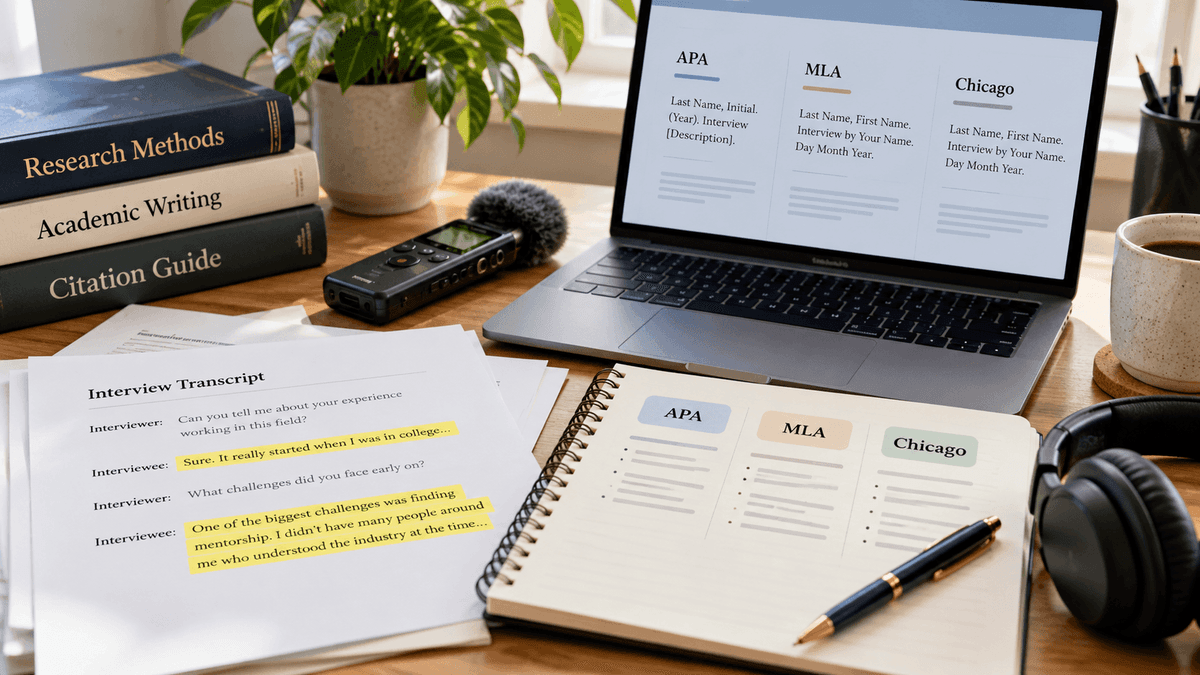
APA: (J. Smith, personal communication, March 15, 2026)
MLA Works Cited: Smith, Jordan. Personal interview. 15 Mar. 2026.
Chicago footnote: Jordan Smith, interview by author, March 15, 2026.
Note: Jordan Smith and the interview details are fictional examples created for this guide.
Notice the difference?
APA puts the interview details directly in the text.
MLA generally includes the interview in Works Cited, while Chicago often uses a footnote.
So, there's no single citation format that works for every assignment.
The correct format depends on the style you're using and the type of interview you're citing.
Now, before we get into the step-by-step examples for each style, there's one small thing worth doing first: making sure you have all the information needed to create an accurate citation.
After all, even the right citation format won't help much if you've forgotten the interviewee's name or the date of the conversation.
Let's see exactly what details you should collect -
What Information Do You Need to Cite an Interview?
You don't need a complicated citation system to get started.
Just collect the important information while it's still fresh in your mind.
Here's what to look for:
- Interviewee's name: The person answering the questions.
- Interviewer's name: The person who conducted the interview.
- Interview date: When the conversation took place.
- Interview title: If the interview has a published title.
- Publication details: Website, newspaper, podcast, or other source.
- Source location: URL, DOI, page number, or timestamp when applicable.
Now, you might be wondering: Do I really need all this information for every interview?
Not necessarily.
Let's say you found an interview with a scientist on a news website.
Since the interview is published, you'll need details about the article, including its title, publication date, and website.
But what if you interviewed that same scientist privately over Zoom?
There's no published article, website link, or public recording to reference.
In that case, the person's name and interview date may be enough, depending on your citation style.
See the difference?
The information you need depends on where the interview came from and whether other people can access it.
And that brings us to an important distinction you should understand before choosing a citation format.
Not every interview is treated the same way.
Some are private conversations, while others are published for everyone to read, watch, or listen to.
So, let’s check out how do you tell them apart -
Personal vs. Published Interviews: What's the Difference?
Now that you know what information to collect, there's one more thing to figure out: Are you citing a personal interview or a published interview?
It might seem like a small difference, but it can completely change how you write your citation.
Both interviews might discuss the same topic, but citation styles handle them differently because one is privately shared while the other is publicly available.
Here's a simple comparison to help you understand.
| Personal interview | Published interview |
|---|---|
| You conduct it privately | It appears in a publicly available source |
| Readers usually cannot access it | Readers can normally find the original source |
| Examples include private conversations, calls, and emails | Examples include newspaper articles, podcasts, and YouTube videos |
| Citation rules depend on the style | Citation follows the published source's format |
Remember: Recording a private interview doesn't automatically make it a published interview. What matters is whether the recording or transcript is accessible to your readers.
Now that you know which information to collect, let's put it into the correct format.
How to Cite an Interview in APA Style (7th Edition)
If you're writing a psychology, education, social science, or research paper, you may be asked to use APA style.
APA follows a simple principle: references should help readers find the original sources.
That's why a private interview is handled differently from an interview published online.
How to Cite a Personal Interview in APA
A personal interview is a conversation that your readers cannot retrieve independently.
It might happen face-to-face, over the phone, through Zoom, or by email.
In APA 7th edition, these interviews are treated as personal communications.
You cite them in your writing, but you do not add them to the reference list.
APA Personal Interview Citation Format:
(First initial. Last name, personal communication, Month Day, Year)
Example:
(J. Smith, personal communication, March 15, 2026)
You can use this in two ways.
Parenthetical Citation:
Many teachers believe practical exercises help students understand difficult topics (J. Smith, personal communication, March 15, 2026).
Narrative Citation:
J. Smith (personal communication, March 15, 2026) explained that practical exercises can help students understand difficult topics.
Both are acceptable ways to credit a personal interview.
Notice that the second example introduces the interviewee naturally within the sentence.
This can make your writing easier to follow, especially when you're discussing someone's opinions or experiences.
Why Doesn't APA Require a Reference-List Entry?
Because other readers can't normally access your private conversation.
A reference list is meant to help readers locate the sources you used. Listing an unavailable interview wouldn't help them retrieve it.
This rule is explained in Purdue University's APA guidance.
How to Cite a Published Interview in APA
Suppose you didn't interview Jordan Smith yourself.
Instead, you read an interview with Jordan on a news website.
That changes the citation.
A publicly available interview is generally cited according to the format of the source where it appears.
For example:
- A newspaper interview follows newspaper article rules.
- A podcast interview follows podcast citation rules.
- A YouTube interview follows video citation rules.
- A published interview transcript follows the rules for its source type.
For a news article, the reference generally includes the article's author, publication date, article title, publication name, and URL.
APA Online Newspaper Article Format:
Author, A. A. (Year, Month Day). Title of the article. Publication Name. URL
The article author isn't necessarily the person being interviewed.
Make sure you identify who created the published work, then credit the interviewee clearly in your writing.
This is an important detail because interview citations aren't always filed under the interviewee's name in APA.
If you're citing several published sources, a reliable Citation Generator can help you format supported source types.
Always review the generated citation against the original publication details.
How to Cite Research Participant Interviews in APA
Here's something students often miss.
Imagine you're conducting ten interviews as part of a research project about student learning habits.
Those participants aren't simply outside sources you're quoting.
Their responses are part of the original data you collected for your study.
APA handles these differently from ordinary personal communications.
For example, you might write:
One participant described online classes as more convenient but less interactive.
Or:
Participant 4 explained that recorded lectures allowed them to review difficult lessons.
You don't automatically add personal communication citations for each participant because their statements are part of your research findings.
You should instead follow the reporting and ethical requirements of your study, including protecting confidential identities.
This is part of academic integrity which is showing where evidence comes from without exposing participants who were promised confidentiality.
Useful Distinction: An expert you privately interviewed to support an essay is usually a personal communication in APA. Someone participating in your original research study is treated as a research participant.
Now, what happens if your teacher asks for MLA instead?
Let’s find them out -
How to Cite an Interview in MLA Style (9th Edition)
MLA is common in literature, language, history, and humanities assignments.
Unlike APA, MLA generally includes personally conducted interviews in the Works Cited section.
The format is still straightforward once you know which details belong where.
How to Cite a Personal Interview in MLA
Let's return to the interview with Jordan Smith.
You conducted it on March 15, 2026.
MLA Personal Interview Format:
Last Name, First Name. Personal interview. Day Month Year.
Works Cited Example:
Smith, Jordan. Personal interview. 15 Mar. 2026.
The corresponding in-text citation is much shorter.
MLA In-text Citation:
(Smith)
Here's how it looks in a sentence:
Students often respond better when classroom activities connect to real-life situations (Smith).
If you've already mentioned Jordan Smith in the sentence, you don't need to repeat the surname in parentheses unless it's needed for clarity.
Example:
During the interview, Jordan Smith explained that connecting lessons to everyday situations helps students stay interested.
Notice that MLA does not use the interview date in the in-text citation the way APA does.
Instead, the full details appear in Works Cited.
How to Cite a Published Interview in MLA
Published interviews need a little more information.
Imagine Jordan Smith appears in a magazine interview about modern teaching.
A typical MLA citation would include the interviewee's name, interview title, interviewer when relevant, publication name, publication date, and location information.
MLA Published Interview Format:
Last Name, First Name. "Title of Interview." Interview by Interviewer Name. Publication Name, Day Month Year, URL.
The exact entry depends on how the interview was published and credited.
A titled interview might use the published title, while an interview without a title may use a description.
And if you're citing an online article, use the actual published information rather than creating a title yourself.
How to Cite a Recorded Interview in MLA
What if you recorded your interview but never published it?
For example, you recorded a Zoom conversation with a local business owner for a college assignment.
MLA provides guidance for privately recorded interviews, including ways to document the interview in Works Cited or explain the source using a global note.
A global note is a note that gives readers information about a group of sources, such as several privately recorded interviews.
For most ordinary student assignments, a clearly identified personal interview entry is a simple starting point.
If your project involves multiple recorded research interviews, follow your instructor's preferred documentation method.
So far, we've covered APA and MLA. Chicago offers another option, and it works a little differently.
That brings us to the next question -
How to Cite an Interview in Chicago Style (18th Edition)
Chicago style is commonly used in history, humanities, and academic publishing.
It has two citation systems:
- Notes and Bibliography: Uses footnotes or endnotes.
- Author-Date: Uses citations in the text, usually with a reference list.
Your instructor should tell you which system to follow.
Let's start with Notes and Bibliography, since it's especially common in humanities writing.
Chicago Notes and Bibliography for Personal Interviews
Suppose you're discussing Jordan Smith's experience in a history or education paper.
Instead of using brackets after the sentence, you can place a superscript number that leads to a footnote.
Chicago personal interview footnote format:
- First Name Last Name, interview by author, Month Day, Year.
Example:
- Jordan Smith, interview by author, March 15, 2026.
In your paper, the sentence might read:
Jordan Smith described how classroom technology changed student participation over time.¹
The corresponding footnote gives readers the interview details.
Unpublished interviews are usually cited in the text or notes.
A separate bibliography entry is generally unnecessary, although certain projects may require one.
Chicago Notes and Bibliography for Published Interviews
Now imagine you're citing an interview published in a magazine.
You would normally follow the citation format for the published source, while identifying the interviewee and interviewer as appropriate.
For an online published interview, you may need:
- Interviewee's name
- Interview title
- Interviewer's name
- Publication name
- Publication date
- URL
The published source may also be included in your bibliography.
Chicago Author-Date Interview Citations
Chicago's Author-Date system looks more like APA because it uses citations within the text.
For a published interview, use the applicable author-date source format and provide a matching reference-list entry.
However, private interviews and other unpublished personal communications are generally cited in the text rather than listed in references.
For example, you could write:
In a March 15, 2026, interview with the author, Jordan Smith described several changes in classroom teaching.
The key is to distinguish information readers can retrieve from private conversations they cannot.
Quick Reminder: Chicago Notes and Bibliography and Chicago Author-Date aren't interchangeable. Choose the system required for your paper and use it consistently.
Now you know the main citation styles.
But interviews don't always happen in person, so let's look at a few common situations -
How to Cite Different Types of Interviews
Interviews don't always happen face-to-face anymore.
You might interview someone over coffee, exchange questions through email, have a conversation on Zoom, or come across an interesting interview on YouTube or a podcast.
While the way interviews happen has changed, the basic citation rules haven't changed much.
You don't need to learn a completely different citation style for every platform.
What matters most is whether the interview is privately shared or publicly available, and which citation style you're following.
The same idea applies to phone calls, Zoom meetings, podcasts, and video interviews.
Each may require different source details, but the first step is always identifying what kind of interview you're using.
Let's go through these common interview types one by one -
1. How to Cite an Email Interview
An email interview is usually considered a personal communication when the conversation is private.
For example, if a university professor answers your questions through email, you would normally use a personal communication citation in APA.
APA example:
(J. Smith, personal communication, March 15, 2026)
In MLA, you can document the correspondence according to MLA's email or interview guidance, depending on how the exchange is being presented.
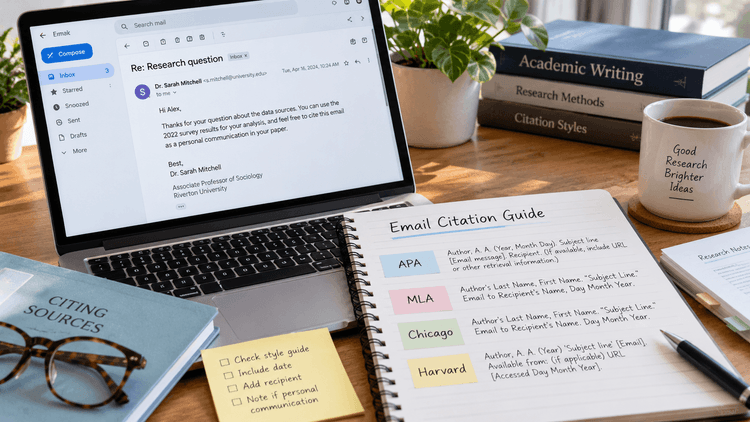
For a deeper explanation of citing private messages, find out more about how to cite an email.
2. How to Cite a Phone or Zoom Interview
A phone call or Zoom meeting doesn't automatically change your citation style.
A private Zoom interview is generally treated much like a private face-to-face interview.
For instance, if you interview a teacher over Zoom and cite the conversation in APA, it normally counts as personal communication.
But if the interview is later published on an accessible website, cite that published version instead.
Tip: Save the interview date and relevant notes immediately. It's surprisingly easy to remember what someone said but forget when they said it.
Keeping those notes with your drafts is also an easy way to document your writing process, especially for a research assignment.
3. How to Cite a YouTube or Video Interview
Let's say you're researching climate change and find a scientist's interview on YouTube.
Since the video is publicly available, cite the video as a published source.
For an APA YouTube citation, you'll generally need the channel or credited creator, upload date, video title, platform name, and URL.
APA YouTube video reference format:
Channel Name. (Year, Month Day). Title of video [Video]. YouTube. URL
When discussing a specific statement in the video, a timestamp can help your reader find it.
For example, an APA direct quotation from a video can use a timestamp instead of a page number.
Make sure you don't confuse the person speaking in the interview with the person or organization responsible for publishing the video.
4. How to Cite a Podcast Interview
Podcast interviews are another common research source.
Imagine you're writing about entrepreneurship and hear a business owner discuss their first startup on a podcast.
The citation usually follows the podcast episode format rather than the format for a private interview.
You'll typically need:
- Podcast host or credited creator
- Episode title
- Publication date
- Podcast name
- Publisher or production company, where required
- URL
If you're quoting a specific statement, record its timestamp while listening.
That small habit makes checking your quotation much easier later.
5. How to Cite an Interview Transcript
A transcript is a written record of an interview.
If the transcript is publicly available, cite the published transcript according to its source format.
If it's a private transcript you created from an unpublished interview, follow the relevant personal interview or research documentation rules.
For archived transcripts, include the archive or collection information required by your citation style.
If the transcript is stored as a scanned PDF, you may need to extract searchable text with OCR before you can locate the exact words you want to quote.
Check the extracted text against the scan.
Important: A transcript's existence doesn't necessarily mean it's publicly available.
By now, you should have a clearer idea of how to cite different types of interviews, whether they're personal conversations, online videos, podcasts, or transcripts.
But getting the citation format right is only part of the process.
What happens when you want to include someone's exact words in your assignment?
Or when you'd rather explain what they said in your own words?
Both approaches are common in academic writing, and both require proper attribution.
The difference is in how you present the interviewee's ideas.
Now let's look at them without losing the original meaning or forgetting to give credit -
How to Quote or Paraphrase an Interview in Your Paper
Imagine you asked Jordan Smith whether technology improves learning.
Jordan gives you a thoughtful answer about how interactive lessons benefit students.
You now have two ways to use that information: quote the exact words or explain the idea in your own words.
Quoting an Interview Directly
Use a direct quotation when the interviewee's exact wording is important.
For example:
“Students learn better when they can connect a lesson to something they already understand.”
Fictional interview quotation for illustration.
You would follow this statement with the appropriate citation.
Don't change the speaker's meaning when shortening a quote, and make sure the words genuinely came from the interview.
For publicly available recordings, timestamps can make quotations easier to verify.
Paraphrasing an Interview
You don't always need to copy someone's exact words.
Sometimes it's clearer to explain what they said in your own language.
For example:
Jordan Smith explained that connecting new lessons to familiar experiences can improve students' understanding.
This is a paraphrase.
Although the sentence uses different wording, the idea still belongs to the interviewee.
It needs appropriate attribution.
If you're struggling to express an idea clearly, any trusted Paraphrasing Tool can help you explore alternative wording.
Just remember that changing the words doesn't remove the need for a citation.
You can also understand more about if paraphrasing means plagiarism to get the difference between proper paraphrasing and copying someone's work.
Using Interviews as Research Evidence
An interview can give your paper something ordinary sources sometimes lack: a firsthand perspective.
For example, a published report might describe how schools use technology, while interviewing a teacher can reveal how those changes affect everyday classroom activities.
Both can be valuable, but they serve different purposes.
An interviewee's experience is evidence of their perspective.
It doesn't automatically prove that everyone has the same experience.
Use interviews alongside other reliable sources when you're making broader claims.
According to a research study by Thelwall and Nevill, research using qualitative methods became more common across many academic fields during the period they examined.
Interviews were especially prominent among the qualitative methods studied.
This shows why interviews can be valuable not only for student assignments but also for academic research.
But there's something else worth remembering.
Unlike information from a published article, an interview may contain personal stories, original opinions, or details that aren't available anywhere else.
That makes accurate quoting, proper attribution, and correct citations especially important.
And this is where students sometimes make mistakes.
You might correctly quote an interviewee but forget to include the citation.
Or you might treat a published interview like a private conversation and use the wrong reference format.
These mistakes are easy to make, especially when you're working with several sources at once.
Fortunately, they're also easy to avoid once you know what to look for.
Let's go through them before they affect your assignment -
Common Interview Citation Mistakes and How to Avoid Them
Most interview citation mistakes aren't complicated.
They usually happen when writers use the rules for one citation style while working in another.
Here's what to check.
| Common mistake | How to fix it |
|---|---|
| Adding a private interview to an APA reference list | Cite it as personal communication in the text when applicable |
| Treating a published interview as private communication | Cite the published article, video, podcast, or transcript |
| Confusing the interviewer with the interviewee | Check each person's role in the published source |
| Forgetting the interview date | Record it when conducting or reviewing the interview |
| Using APA formatting in MLA Works Cited | Follow the specific rules for your assigned style |
| Quoting without attribution | Identify the speaker and include the necessary citation |
| Treating research participants as ordinary APA personal communications | Follow the rules for reporting original research data |
Another easy mistake is trusting a citation generator without checking the output.
Generators can help with formatting, but they cannot always identify the correct source type or tell whether your interview is privately accessible.
For more examples of citation problems, review common citation mistakes and how to avoid them before you start.
The good news is that you don't have to go through your entire paper again to catch every small error.
A quick review of your interview citations can help you spot missing details, incorrect formats, and attribution mistakes before they become a problem.
So, before you submit your assignment, let's go through a few simple checks to make sure your interview citations are accurate and complete -
How to Check Your Interview Citation Before Submission
You've finished writing your paper, included the interview quotes, and added your citations.
Everything seems ready to submit, right?
Almost.
Even when you understand the citation rules, it's easy to overlook a missing date, misspelled name, or incorrectly formatted reference.
And after spending so much time on your assignment, you probably don't want a small citation mistake to affect your work.
The good news is that checking your interview citations doesn't have to take much time.
Just follow these four steps before submitting.
Step 1: Identify the Interview Type
Start by checking what kind of interview you've cited.
Was it a private conversation you conducted, an interview published online, or an interview with a participant in your research?
This matters because each type may follow different citation rules.
For example, APA treats private interviews as personal communications, while published interviews are cited according to their source format.
Make sure you've chosen the correct category before moving on.
Step 2: Check the Details
Next, compare your citation with the original interview or your notes.
Check the interviewee's name, interview date, title, and publication information, where applicable.
If you're citing a published interview, make sure the URL works and the details match the original source.
Even something as simple as an incorrect publication date can make it harder for readers to find the interview.
Step 3: Verify the Citation Style
Now, check whether your citations follow the required style consistently.
For example, APA personal interviews usually need only in-text citations, while MLA generally requires a Works Cited entry.
Chicago may use footnotes, depending on the citation system.
If you're working with published interviews, CopyChecker's Citation Generator can help format supported source types.
Just remember to review the result, especially when dealing with personal interviews or unusual sources.
Step 4: Review your Quotations and Paraphrases
Finally, go through the parts of your paper where you've used information from interviews.
Have you clearly identified who said what?
Are your direct quotations accurate?
Did you give credit when explaining an interviewee's ideas in your own words?
You can use CopyChecker Plagiarism Checker to look for text that matches existing sources.
However, a plagiarism checker can't verify a private conversation or confirm whether you've credited the correct speaker.
You'll need to check those details yourself.
For longer assignments, checking a research paper for plagiarism before submission also means reviewing quotations, source matches, and citations in context.
If the paper still needs a final language check, an online proofreader can help you review wording and punctuation without replacing the citation checks above.
Once you've completed these checks, you can feel more confident that your interview citations are clear, accurate, and consistent with your required style.
And that's really what proper citation comes down to: giving credit to the right person in a way your readers can understand and, when possible, verify.
An academic integrity checklist for students can also help you check broader submission requirements alongside your citations.
Before we wrap up, let's quickly answer a few common questions students still have about citing interviews.
FAQs About Interview Citations
Do you need to cite an interview you conducted yourself?
Yes. If you use information from an interview you conducted, you should credit the interviewee following your required citation style.
Do personal interviews go in the APA reference list?
No. APA 7 treats private interviews as personal communications, so they only need in-text citations. Original research interviews follow different rules.
How do you cite an interview with no author or title?
For personal interviews, use the interviewee's name. For published interviews, follow your citation style's rules for missing information.
How do you cite an anonymous interview?
Use an agreed pseudonym or participant label to protect the interviewee's identity, following your institution's research guidelines.
Can you cite an interview without a recording or transcript?
Yes. You can cite an interview using accurate notes, the interviewee's name, and the date. A recording isn't always necessary.
How do you cite an interview with multiple interviewees?
Identify the interviewees according to your citation style, and clearly credit the person whose words or ideas you're using.
Is an interview a primary source?
Yes, an original interview is generally a primary source because it provides firsthand experiences, opinions, or information.
Do you need to cite an interview if you paraphrase it?
Yes. Even when you explain an interviewee's ideas in your own words, you must still give them proper credit.
Final Thoughts on Citing an Interview
Learning how to cite an interview gets much easier once you know what kind of source you're working with.
APA usually treats private interviews as personal communications.
MLA generally documents them in Works Cited, while Chicago often uses notes or information in the text.
Published interviews follow the rules for their source type.
The trick is to identify your interview correctly, collect the right details, and use one citation style consistently.
And before submitting your paper, you can use CopyChecker's Citation Generator for supported published sources and review your writing with its plagiarism-checking tools.
A good interview can add a valuable human perspective to your paper.
A clear citation makes sure that perspective gets the credit it deserves.