Suppose you've spent hours working on your assignment.
Then you've found a book that explains your topic perfectly, picked out the important information, and used it to support your arguments.
Your paper is almost ready to submit.
But when you start writing the reference list, you get stuck.
Should you write the author's full name or just their initials?
Where does the publication year go?
And why do different websites show different formats for the same book?
It's confusing, especially when you just want to finish your assignment without making a citation mistake.
Here's something worth knowing and that is APA, MLA, and Chicago don't follow the same citation rules.
APA places the publication year right after the author's name, while MLA and Chicago bibliography entries place it near the end.
Even the publisher's city, which older citation guides often include, is no longer required for modern books in these styles.
So, how do you cite a book correctly without mixing up the formats?
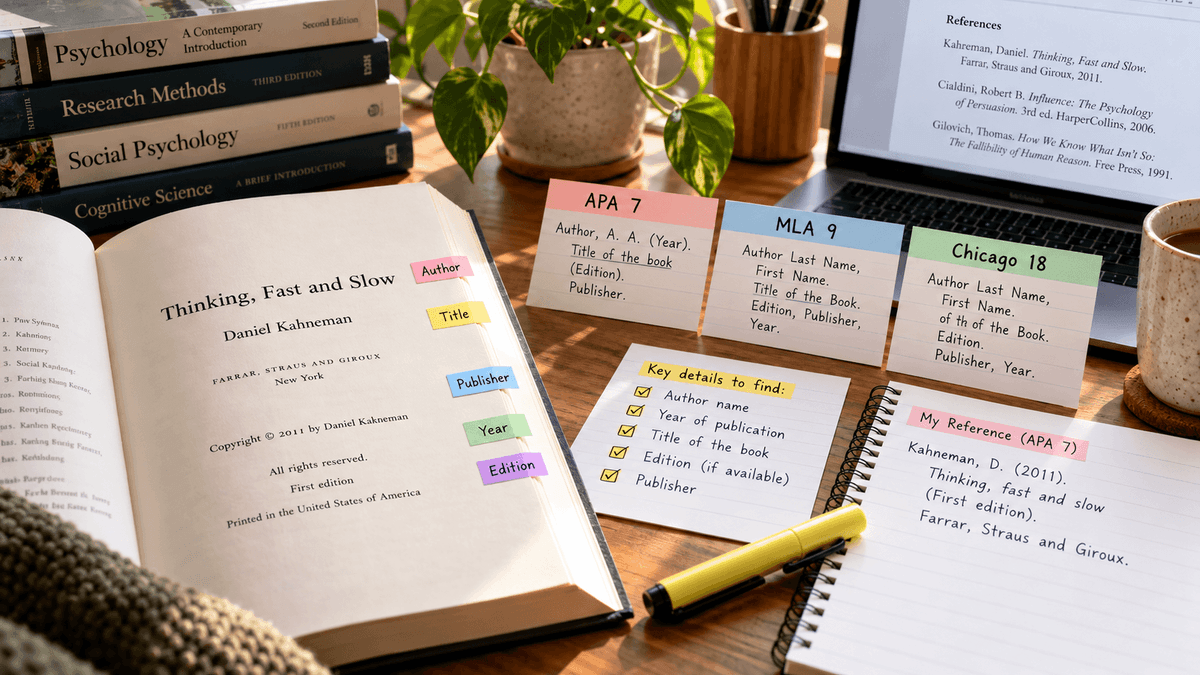
The easiest way is to follow the rules for your required citation style and compare them with a real example.
Like the following -
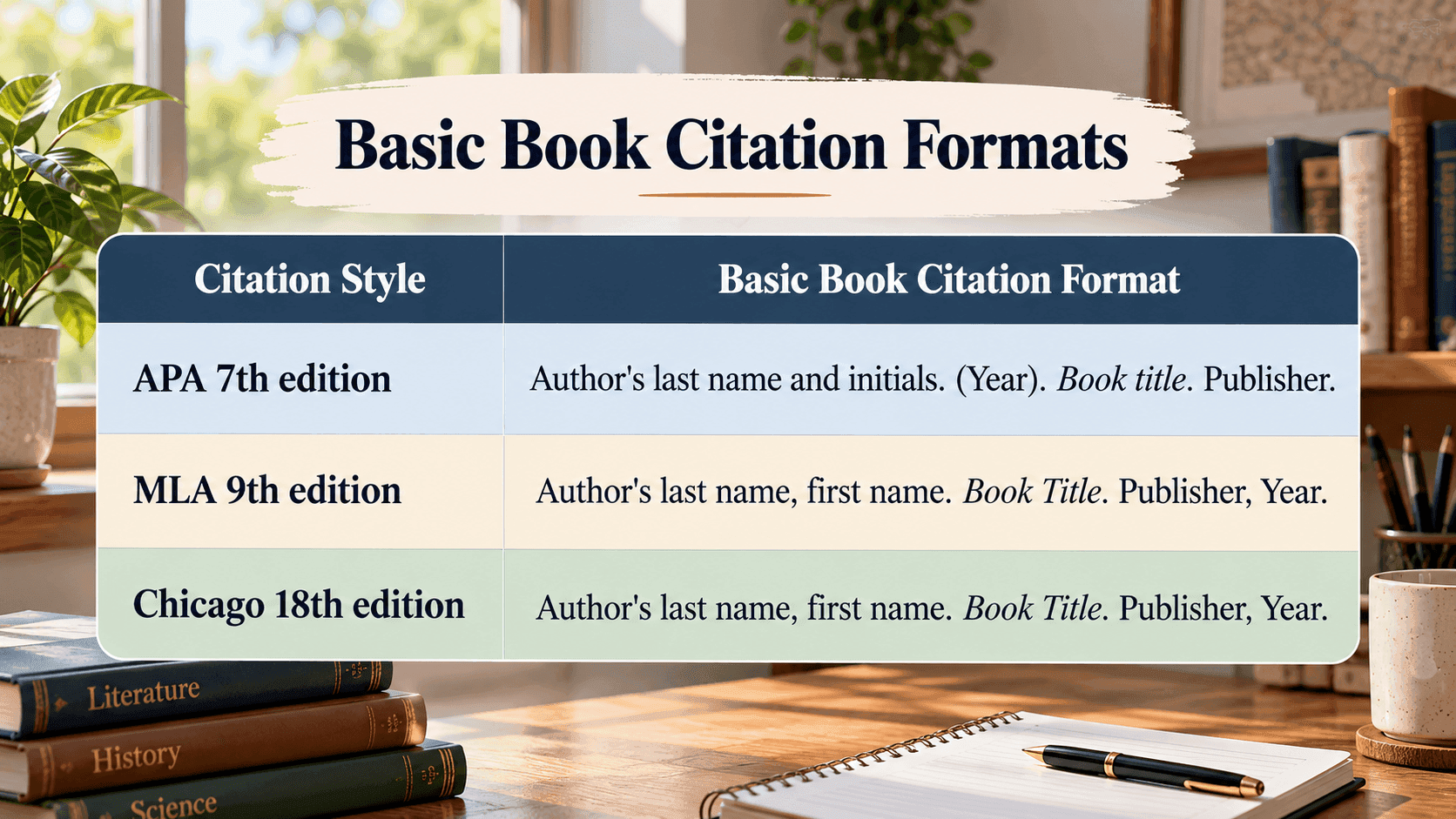
These formats give you a starting point, but you also need to know how to handle in-text citations, multiple authors, ebooks, and edited books.
Let's see how each one works using a real book -
How Do You Cite a Book in APA 7th Edition?
To cite a book in APA 7th edition, write the author's last name followed by their initials.
Add the publication year in parentheses, the book title in italics, and the publisher's name.
You don't need the publisher's city or state.
APA is commonly used in psychology, education, nursing, and other social sciences.
APA 7th Edition Book Citation Format
Template:
Author, A. A. (Year). Title of book: Subtitle. Publisher.
Let's use a real example.
John Green's The Anthropocene Reviewed: Essays on a Human-Centered Planet was published by Dutton in 2021.
APA Reference:
Green, J. (2021). The anthropocene reviewed: Essays on a human-centered planet. Dutton.
Notice how the book title is written.
Although the original title uses capital letters for its main words, APA follows sentence case.
That means you capitalize the first word of the title, the first word after a colon, and any proper nouns.
Most other words stay lowercase.
Also notice that APA uses J. instead of John's full first name.
How Do You Cite a Book In-Text in APA?
In APA 7th edition, an in-text citation includes the author's last name and publication year.
When quoting directly, you also include the page number.
You can place the citation at the end of a sentence or introduce the author naturally in your writing.
There are two common ways to do this.
Parenthetical Citation:
(Green, 2021)
Narrative Citation:
Green (2021) examines different parts of everyday life.
A parenthetical citation places the author and year together in parentheses.
A narrative citation mentions the author's name in your sentence, followed by the year.
When you quote a specific sentence from a printed book, add the page number:
(Green, 2021, p. 42)
The page number above is only a formatting example. Replace it with the page where your quotation actually appears.
For a paraphrase, APA does not normally require a page number, although including one can help readers find a specific passage.
What If the Book Has an Edition Number or DOI?
Some books, especially textbooks, are published in several editions.
If you're using the second edition, third edition, or another numbered edition, include that information after the title.
Template:
Author, A. A. (Year). Title of book (3rd ed.). Publisher.
The edition number stays outside the italic formatting.
If a book has a DOI, add it at the end in URL form:
For an online book without a DOI, include a stable public URL when appropriate.
Books accessed through most academic databases do not need a database name or ordinary database link.
These rules also apply when citing digital books in APA.
For other online sources, such as articles published directly on websites, follow the rules for citing a website in APA.
How Do You Cite a Book in MLA 9th Edition?
To cite a book in MLA 9th edition, start with the author's last name and first name.
Write the book title in italics, followed by the publisher and publication year.
MLA uses title case for book titles and does not require the publisher's location.
MLA is widely used in literature, languages, and humanities subjects.
MLA 9th Edition Book Citation Format
Template:
Author's Last Name, First Name. Title of Book: Subtitle. Publisher, Year.
Using John Green's book, the citation becomes:
MLA Works Cited Entry:
Green, John. The Anthropocene Reviewed: Essays on a Human-Centered Planet. Dutton, 2021.
Compare this with the APA reference.
The book, author, and publisher are the same.
However, three things have changed:
- MLA uses the author's full first name instead of initials.
- The book title uses title case rather than sentence case.
- The publication year appears after the publisher, without parentheses.
MLA also calls the source list Works Cited, while APA uses References.
How Do You Cite a Book In-Text in MLA?
In MLA 9th edition, a typical in-text citation includes the author's last name and the page number where the information appears.
You don't usually include the publication year.
If you mention the author in your sentence, only the page number goes in parentheses.
Parenthetical Citation:
(Green 42)
Narrative citation:
Green explores how people value everyday experiences (42).
Notice that there is no comma between the author's name and the page number.
Also, don't write "p." before the page number in a standard MLA in-text citation.
The number 42 is illustrative here. You should always replace it with the correct page number from your copy.
How Do You Cite a Book With Two or More Authors in MLA?
For a book with two authors, include both names in the Works Cited entry.
Template:
Last Name, First Name, and First Name Last Name. Book Title. Publisher, Year.
The first author's name is reversed, but the second author's name stays in its usual order.
For three or more authors, write the first author's name followed by et al.
Template:
First Author's Last Name, First Name, et al. Book Title. Publisher, Year.
Et al. means “and others.”
The same general rule applies to MLA in-text citations: use both surnames for two authors and the first surname plus et al. for three or more.
How Do You Cite a Book in Chicago 18th Edition?
In Chicago 18th edition, a book citation usually includes the author's name, italicized book title, publisher, and publication year.
The notes and bibliography system uses footnotes or endnotes within the paper and a bibliography at the end.
Publisher locations are no longer required for books published since 1900.
Chicago is especially common in history, arts, and other humanities subjects.
There are two Chicago citation systems:
- Notes and Bibliography: Uses numbered notes and usually a bibliography.
- Author-Date: Uses the author's name and year within the text, followed by a reference list.
Let's start with notes and bibliography.
Chicago 18th Edition Bibliography Format
Template:
Author's Last Name, First Name. Book Title: Subtitle. Publisher, Year.
Example:
Green, John. The Anthropocene Reviewed: Essays on a Human-Centered Planet. Dutton, 2021.
This looks similar to MLA, but Chicago has its own rules for punctuation, notes, and other details.
A bibliography usually appears at the end of your paper, with entries arranged alphabetically by the authors' last names.
You can also explore the difference between a bibliography and references if you're unsure which list your assignment requires.
How Do You Cite a Book in a Chicago Footnote?
In Chicago 18th edition's notes and bibliography system, place a small superscript number after the sentence that uses the source.
The matching footnote gives the author's name, book title, publisher, year, and the page you're citing, when applicable.
Full footnote template:
- First Name Last Name, Book Title (Publisher, Year), page number.
Example:
- John Green, The Anthropocene Reviewed: Essays on a Human-Centered Planet (Dutton, 2021), 42.
The page number is illustrative, not a verified location for a specific quotation.
Here's the important difference:
In a bibliography, the author's last name comes first.
In a footnote, the author's name appears in its normal order.
A footnote also commonly includes the specific page where you found the information.
If you're new to this system, understanding how to write footnotes will help you use the correct numbering and placement.
What Is a Shortened Chicago Footnote?
When you cite the same book again, you can usually use a shortened note instead of repeating the full citation.
Template:
- Last Name, Short Book Title, page number.
Example:
- Green, Anthropocene Reviewed, 58.
Chicago 18th edition favors shortened citations rather than relying on "Ibid." to refer back to a previous source.
This makes citations easier to understand even when notes are moved, added, or removed during editing.
How Do You Cite a Book in Chicago Author-Date Style?
Chicago 18th edition also has an author-date system.
It places the publication year immediately after the author's name in the reference list.
In the text, the author, year, and page number appear together when a specific page is needed.
Reference List Example:
Green, John. 2021. The Anthropocene Reviewed: Essays on a Human-Centered Planet. Dutton.
In-text Citation:
(Green 2021, 42)
Again, the page number is illustrative.
The author-date system is commonly used in sciences and social sciences that follow Chicago style.
Always check which Chicago system your instructor requires before formatting your paper.
APA vs. MLA vs. Chicago: What's the Difference?
APA, MLA, and Chicago all help readers find the books you've used.
The main difference is how they arrange author names, dates, titles, and references within the text.
Here's a side-by-side comparison.
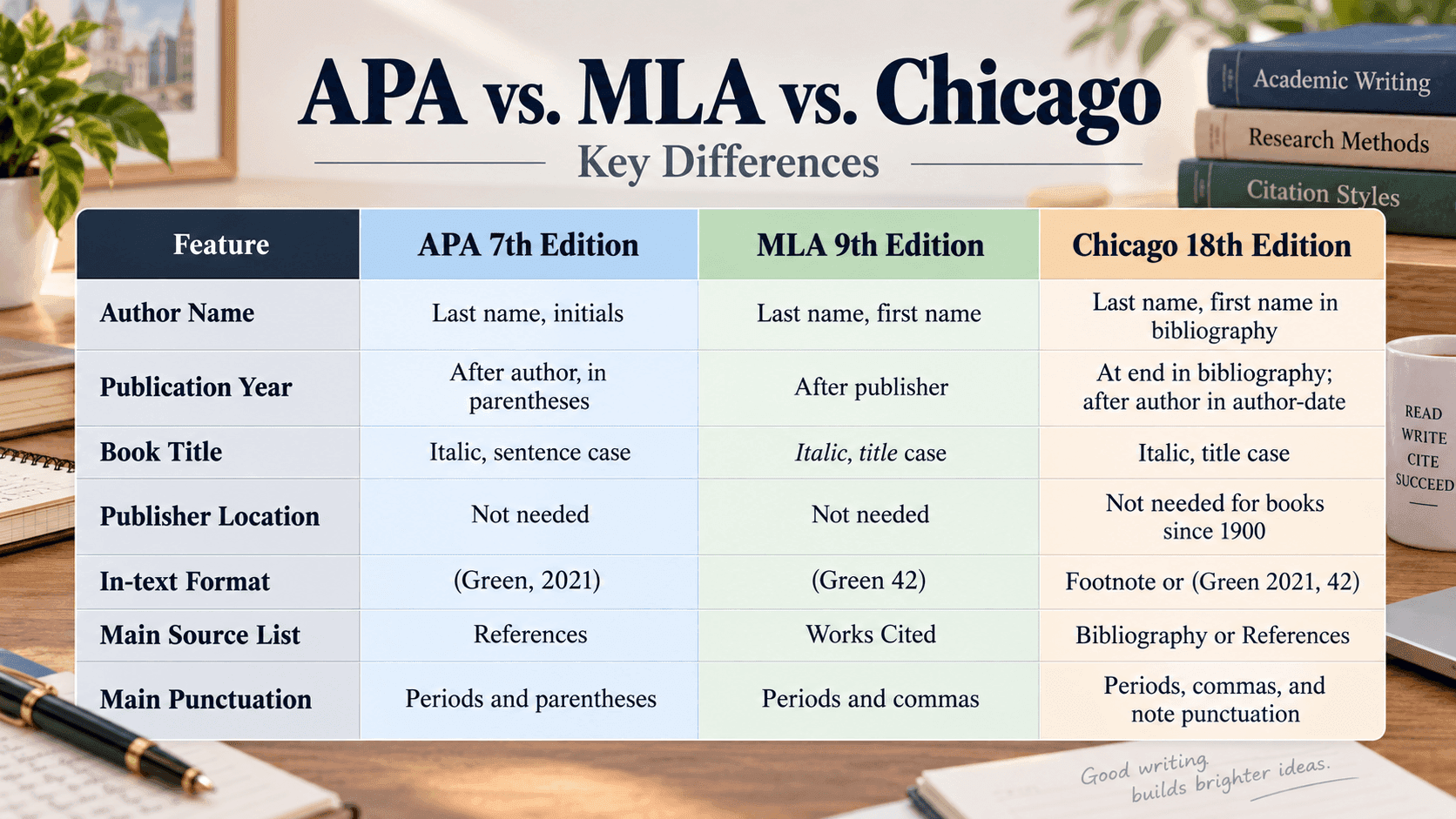
All page numbers in this comparison are illustrative.
The Same Book in All Three Citation Styles
APA 7th Edition
Green, J. (2021). The anthropocene reviewed: Essays on a human-centered planet. Dutton.
MLA 9th Edition
Green, John. The Anthropocene Reviewed: Essays on a Human-Centered Planet. Dutton, 2021.
Chicago 18th Edition
Green, John. The Anthropocene Reviewed: Essays on a Human-Centered Planet. Dutton, 2021.
This comparison also shows why choosing the correct citation style matters.
MLA and Chicago bibliography entries may look identical for a simple book with one author.
Their differences become much clearer when you cite inside the paper or work with unusual source types.
Do You Need the City of Publication in a Book Citation?
No, not for most modern books. APA 7th edition and MLA 9th edition don't require the publisher's city.
Chicago 18th edition also removed the requirement for books published since 1900.
Older Chicago instructions may still include cities, which can cause confusion.
For example, you might see an older Chicago citation containing:
Dutton's city of publication followed by the publisher name and year.
In Chicago 18th edition, a modern book normally needs only the publisher and year in that part of the citation.
What Changed in Chicago 18th Edition?
Chicago's 18th edition, released in 2024, simplified several citation rules.
One important update was removing the publisher's location from references to books published since 1900.
Books published before 1900 are a special case.
Chicago may use the publication place instead of the publisher name, depending on the source.
This is why a nineteenth-century book may have a different citation structure from a book published in 2021.
When checking citation examples online, make sure you're looking at guidance for the 18th edition rather than an older version.
How Do You Cite Special Types of Books?
Not every book has one author, one edition, and a printed cover.
You might be using a textbook written by several people, a chapter from an edited collection, or an ebook downloaded from a library.
The citation changes slightly depending on what you're using.
Here are the most common cases.
How Do You Cite a Book With Multiple Authors?
When citing a book with multiple authors, the number of names you include depends on the citation style.
APA 7th edition normally lists up to 20 authors in the reference list.
MLA 9th edition shortens entries with three or more authors.
Chicago 18th edition uses a different limit.
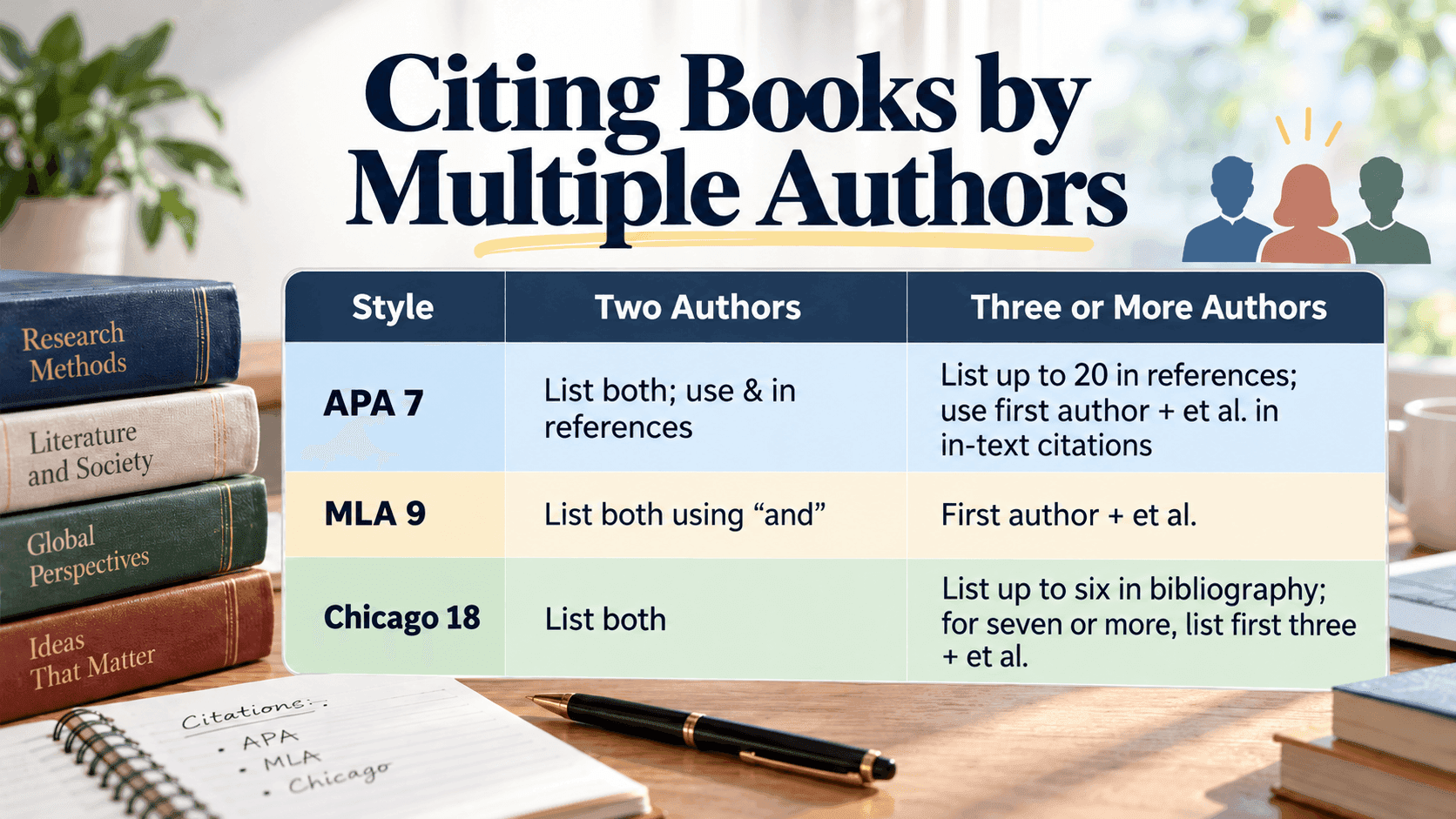
APA has an additional rule for references containing 21 or more authors: list the first 19, insert an ellipsis, and then add the final author.
In Chicago notes, works with three or more authors generally use the first author followed by et al.
Example Templates for Two Authors:
APA: Last, A. A., & Last, B. B. (Year). Book title. Publisher.
MLA: Last, First, and First Last. Book Title. Publisher, Year.
Chicago: Last, First, and First Last. Book Title. Publisher, Year.
Use the names and order shown in the book.
How Do You Cite a Book With No Author?
If a book has no named author or responsible organization, begin the citation with its title.
The remaining information follows the normal order for your citation style.
However, check whether the book names an editor or translator who should be credited before treating it as anonymous.
APA 7th Edition:
Title of book. (Year). Publisher.
MLA 9th Edition:
Title of Book. Publisher, Year.
Chicago 18th Edition:
Title of Book. Publisher, Year.
Alphabetize the entry using the title according to your style's rules.
Some books have an organization or institution listed as the author rather than an individual person.
In those cases, use the organization's name instead of assuming the book has no author.
How Do You Cite an Edited Book?
An edited book brings together material selected or arranged by one or more editors.
If you're citing the entire collection, credit the editor in the main citation.
If you're using one chapter written by someone else, cite that chapter's author instead.
APA 7th Edition Template:
Editor, A. A. (Ed.). (Year). Title of book. Publisher.
For two or more editors, use (Eds.).
MLA 9th Edition Template:
Last Name, First Name, editor. Book Title. Publisher, Year.
For multiple editors, use “editors.”
Chicago 18th Edition Template:
Last Name, First Name, ed. Book Title. Publisher, Year.
Use "eds." for multiple editors.
The editor's role matters because editing a collection is not the same as writing every chapter inside it.
How Do You Cite a Chapter in an Edited Book?
When a chapter has its own author and appears in a book with editors, cite the chapter rather than treating the entire book as the chapter author's work.
Include the chapter title, book title, editor names, and publication details required by your citation style.
APA 7th Edition Template:
Chapter Author, A. A. (Year). Title of chapter. In E. E. Editor (Ed.), Title of book (pp. xx–xx). Publisher.
MLA 9th Edition Template:
Chapter Author's Last Name, First Name. "Chapter Title." Book Title, edited by First Name Last Name, Publisher, Year, pp. xx–xx.
Chicago 18th Edition Bibliography Template:
Chapter Author's Last Name, First Name. "Chapter Title." In Book Title, edited by First Name Last Name. Publisher, Year.
Chicago 18th edition no longer requires the full chapter page range in a bibliography entry.
A footnote should still identify the specific page being cited when applicable.
Remember: You generally cite the book as a whole when the same author wrote the entire book. Separate chapter citations are especially useful when different authors contributed different chapters.
How Do You Cite a Second or Third Edition of a Book?
To cite a later edition, include the edition number after the book title.
APA places it in parentheses, while MLA and Chicago normally write it as a separate element.
This helps readers find the same version you used.
APA:
Author, A. A. (Year). Book title (2nd ed.). Publisher.
MLA:
Last, First. Book Title. 2nd ed., Publisher, Year.
Chicago:
Last, First. Book Title. 2nd ed. Publisher, Year.
If the cover doesn't mention an edition number, don't automatically add “1st ed.”
Also, don't confuse an edition with a printing.
A new printing may contain the same content, while a revised edition may have new chapters, page numbers, or other changes.
How Do You Cite an Ebook or Online Book?
An ebook is usually cited much like a printed book. APA 7th edition uses the same basic format for both.
MLA 9th edition may include the ebook version or website, while Chicago 18th edition may identify the electronic format, URL, or database.
APA 7th Edition:
Author, A. A. (Year). Book title. Publisher. DOI or stable URL, if applicable.
APA does not require labels such as Kindle or EPUB.
MLA 9th Edition:
Last, First. Book Title. E-book ed., Publisher, Year.
For books read on websites, include the relevant website or container details and a URL when required.
Chicago 18th Edition:
Last, First. Book Title. Publisher, Year. Electronic format, URL, or database information as appropriate.
For example, Chicago may identify a Kindle edition when that is the version you consulted.
If an ebook has no stable page numbers, cite a chapter, section, or another available location marker according to the style's rules.
Avoid using device-specific location numbers that another reader may not be able to reproduce.
How Do You Cite a Translated Book?
To cite a translated book, include the original author's name and credit the translator.
APA 7th edition places the translator information after the title.
MLA 9th edition uses "translated by," and Chicago 18th edition also identifies the translator.
APA 7th Edition Template:
Author, A. A. (Year). Book title (A. A. Translator, Trans.). Publisher.
MLA 9th Edition Template:
Last, First. Book Title. Translated by First Name Last Name, Publisher, Year.
Chicago 18th Edition Template:
Last, First. Book Title. Translated by First Name Last Name. Publisher, Year.
For republished or translated works, APA may also require the original publication year at the end of the reference and both years in the in-text citation.
This is especially important when working with classic literature that has been translated or published in different versions.
How Do You Cite a Book Written by an Organization?
Some books are written by organizations rather than individual authors.
These are called corporate authors or group authors.
In most cases, start the citation with the organization's name.
APA 7th Edition Template:
Organization Name. (Year). Book title. Publisher.
If the author and publisher are the same organization, APA omits the publisher to avoid repetition.
MLA 9th Edition Template:
Organization Name. Book Title. Publisher, Year.
Chicago 18th Edition Template:
Organization Name. Book Title. Publisher, Year.
However, when the organization is both the author and publisher, MLA and Chicago may also require adjustments based on how the work is credited.
Check the title page carefully before deciding who the author is.
What Are the Most Common Book Citation Mistakes?
Book citations may look simple, but a small formatting error can cause problems in a reference list.
The most common mistakes happen when students mix rules from different citation styles or use information from the wrong edition.
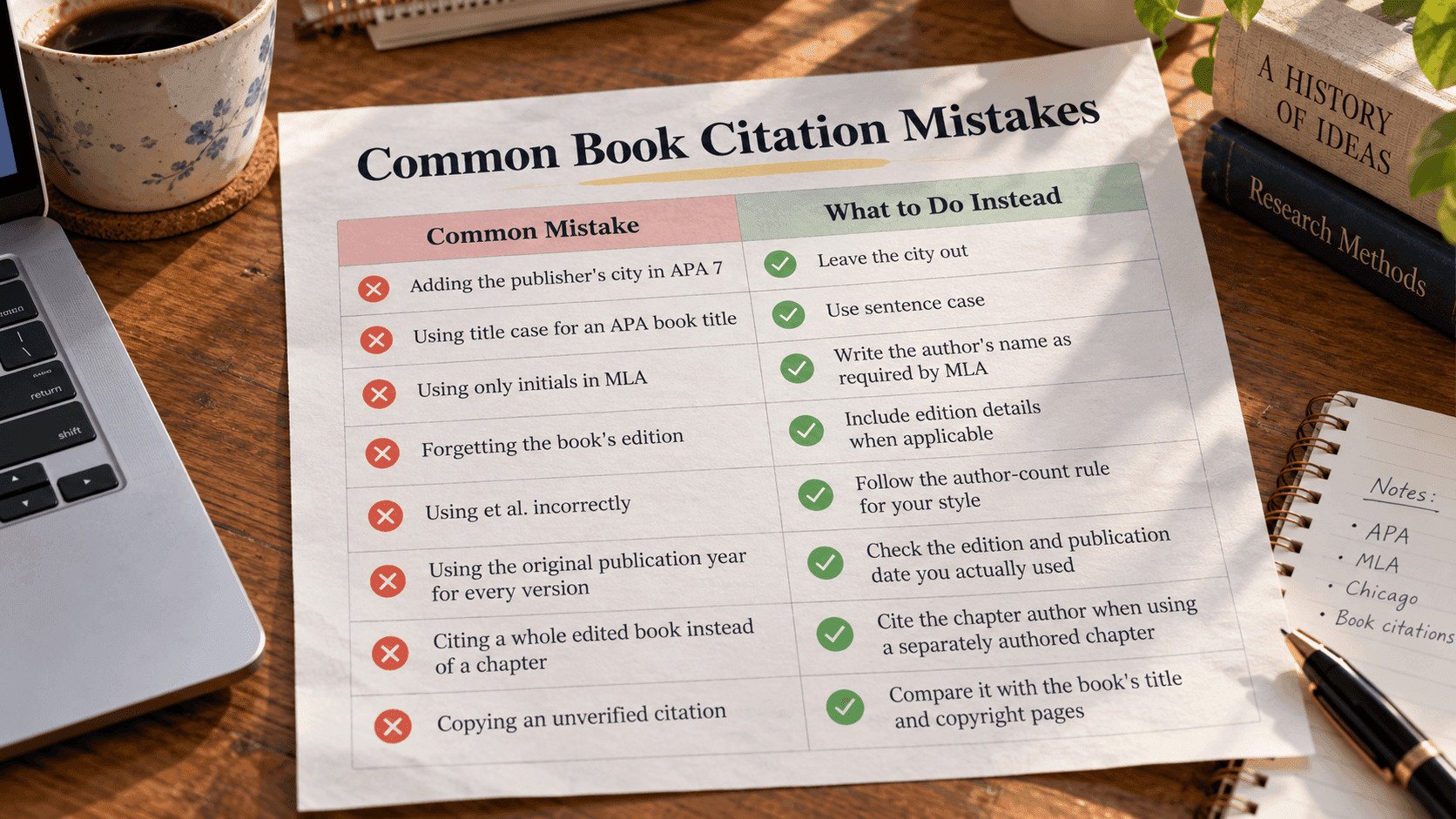
Another common mistake is mixing in-text citations and reference-list formats.
For example, (Green, 2021) is correct for a basic APA paraphrase, but MLA normally uses an author and page number instead.
Even if the source information is accurate, mixing two citation styles can make the finished paper inconsistent.
For more examples of problems students often miss, see these common citation mistakes.
How Can You Cite a Book Automatically?
You can create a book citation with an online citation generator instead of typing every part manually.
Enter the book's title, ISBN, or DOI when supported, choose the citation style, and review the generated reference before adding it to your assignment.
This is useful when you have several books to cite or need to switch between citation styles.
Here's a simple process:
- Open the CopyChecker Citation Generator.
- Search for your book using its title, ISBN, or another supported identifier.
- Select APA, MLA, Chicago, or another available citation style.
- Check the author's name, title, publication year, publisher, and edition.
- Copy the completed citation into your reference list.
The ISBN is a book's identifying number.
You can usually find it near the barcode or on the copyright page.
However, even an automatic citation may contain missing or incorrect details.
For example, a database might return the paperback publication year when you're using the hardcover edition.
That's why checking the citation against your actual book matters.
If you're preparing a school or university assignment, a citation generator for students can help organize the process.
The goal isn't just to create a citation quickly. It's to create one that matches the source you really used.
How Do You Cite Books Without Plagiarizing?
Citing a book gives credit to its author, but correct citation alone does not automatically prevent plagiarism.
You must also show which ideas came from the source, use quotation marks for exact wording, and paraphrase information properly when writing in your own words.
Imagine that you're explaining a chapter from a book.
You understand the author's point, but you copy several sentences and change only a few words.
Adding a citation doesn't automatically make that a proper paraphrase.
A better approach is to read the passage, understand its meaning, and explain the idea in your own sentence structure.
Then cite the source.
If you use the author's exact words, place them in quotation marks and include the required citation information.
These are important parts of learning how to avoid plagiarism.
After finishing your paper, you can also use a plagiarism checker to identify text that may overlap with existing sources.
The report helps you review possible similarities. It does not decide by itself whether you have committed plagiarism.
Cited the book? Now check your writing.
Before submitting your assignment, check your paper for plagiarism to spot matching passages that may need a closer look.
Remember to review the context of each match rather than judging your paper by a single similarity score.
FAQs About Citing a Book
How Do You Cite a Book in APA Format?
In APA 7th edition, list the author's last name and initials, year in parentheses, italicized book title, and publisher. Add a DOI or URL when required.
How Do You Cite a Book in MLA Format?
In MLA 9th edition, write the author's full name, italicized book title, publisher, and year. In-text citations use the author's last name and page number.
How Do You Cite a Book in Chicago Style?
In Chicago 18th edition, list the author's name, italicized book title, publisher, and year. Use footnotes or author-date citations, depending on the system.
Do You Need the Publisher's City When Citing a Book?
No. APA 7th edition and MLA 9th edition omit the publisher's city. Chicago 18th edition also omits it for books published since 1900.
How Do You Cite a Book With No Author?
Start with the book title, followed by the year and publisher in the order required by your citation style. Alphabetize the entry by its title.
How Do You Cite an Ebook?
Cite an ebook like a printed book, including the author, title, publisher, and year. Add a DOI, URL, or ebook format when your citation style requires it.
How Do You Cite an Edited Book?
Start with the editor's name and identify their role: "(Ed.)" in APA, "editor" in MLA, or "ed." in Chicago. Cite individual chapters separately when needed.
Do You Italicize a Book Title in APA, MLA, and Chicago?
Yes. All three styles italicize book titles. APA uses sentence case, while MLA and Chicago use title case.
Final Thoughts
Learning how to cite a book doesn't have to mean memorizing dozens of punctuation rules.
Start by finding the correct author, title, publisher, year, and edition.
Then follow the format required by your teacher or institution.
APA 7th edition puts the year near the beginning.
MLA 9th edition places it after the publisher.
Chicago 18th edition offers different systems depending on how you cite sources within the paper.
Once you understand these differences, even unfamiliar book citations become easier to manage.
And before submitting your work, take a moment to check both your references and your writing.
CopyChecker's writing tools can help you finish that process: create references with the online citation tool, review matching text with the Plagiarism Checker, and improve sentence clarity with the Grammar Checker.
A well-cited paper doesn't just follow formatting rules.
It makes your research easier for someone else to trust and verify.