You've spent hours researching, reading articles, and putting your ideas together.
Your essay is finally complete, the grammar looks good, and you've added all your references.
You're just about to hit Submit when you decide to check your citations one last time.
And that's when things get confusing.
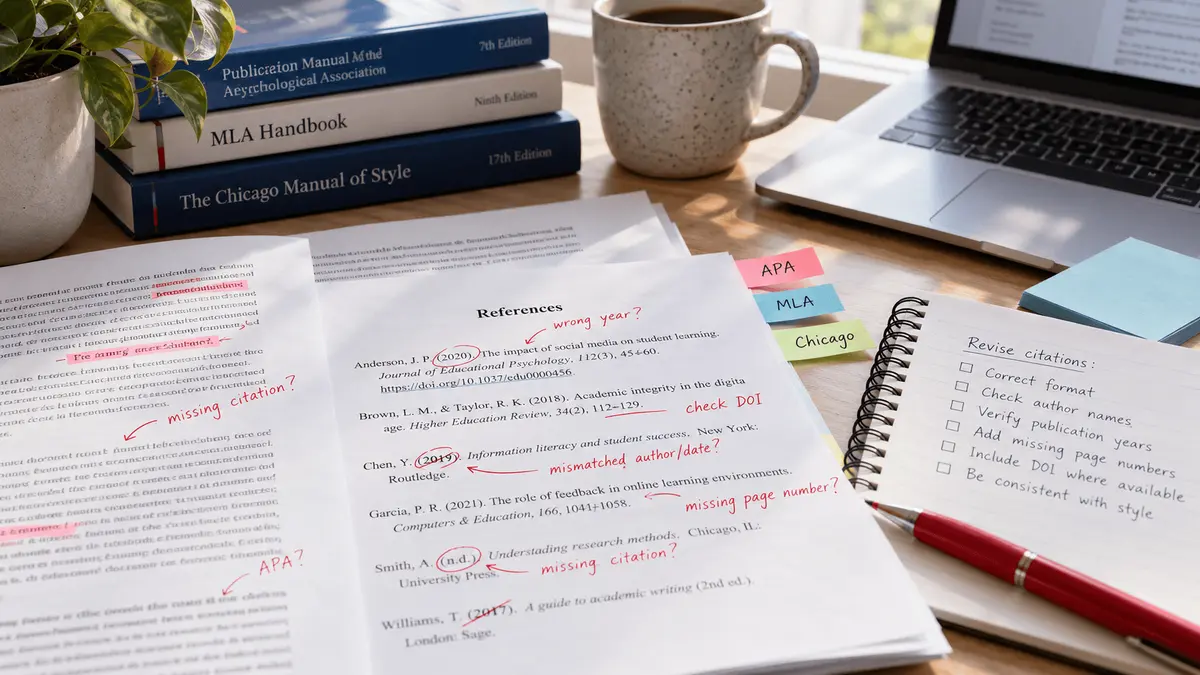
One source has the wrong publication year.
Another appears in your essay but is missing from the reference list.
Then you notice a direct quotation without a page number.
You try fixing them, only to realize that APA, MLA, and Chicago don't even follow the same citation rules.
Now you're wondering: How many other citation mistakes have I missed? And could any of them affect my grade or even be considered plagiarism?
If this sounds familiar, you're not alone.
Citation mistakes can happen even when you've done your research carefully.
Sometimes it's a missing comma or an incorrect date.
Other times, it's a citation that doesn't properly credit the original author.
But you don't have to figure everything out by yourself.
In this guide, I'll walk you through 40 common citation mistakes and how to avoid them, one by one.
For each mistake, you'll see what went wrong, an incorrect and correct example, and a simple way to fix it.
By the end, you'll have a practical checklist to review your citations, correct common errors, and submit your essay or research paper with more confidence.
But remember that the names, titles, dates, and sample quotations used in the examples below are fictional.
They show how citation rules work and should not be used as real academic sources.
So, without further delay, let’s get started with -
What Are Citation Mistakes?
Citation mistakes are errors in how you credit the sources used in your writing.
They happen when you forget to cite information, enter incorrect source details, or fail to follow the required citation format.
For example, imagine you read a study by Taylor published in 2022. You use its findings in your assignment but write (Taylor, 2023) instead of (Taylor, 2022).
That's a citation error.
The author is correct, but the date doesn't match the source.
Now imagine you use the study's findings without mentioning Taylor at all.
That's a more serious problem because the original researcher isn't receiving credit.
Most citation errors fall into three categories:
- Missing attribution: You use someone's words, ideas, or research without properly identifying the source.
- Incorrect source information: You enter the wrong author, title, date, URL, or other publication details.
- Formatting mistakes: You use the wrong punctuation, capitalization, layout, or citation style.
Here's a quick comparison:
| Citation mistake | Example | Why it Matters |
|---|---|---|
| Missing in-text citation | A borrowed idea has no citation | Can raise plagiarism concerns |
| Wrong publication year | (Taylor, 2023) instead of (Taylor, 2022) | Makes the source harder to identify |
| Incorrect citation style | MLA formatting in an APA assignment | Does not follow assignment requirements |
| Missing reference | A cited study is absent from References | Readers cannot easily find the source |
| Incorrect quotation | Exact words appear without quotation marks | Can make copied wording appear original |
| Broken or wrong DOI | DOI leads to another article | Prevents accurate source verification |
One thing worth remembering is that not every citation mistake is plagiarism.
Forgetting a hanging indent is very different from using another person's ideas without credit.
Still, both are worth fixing because accurate citations help readers trust your work and trace the information back to its source.
Now that you know what citation mistakes are and why they matter, let's get into the part that will actually help you fix them.
40 Common Citation Mistakes and How to Avoid Them
Citation errors aren't always obvious. Sometimes they're as small as a missing comma.
Other times, they involve citing a source you never actually read.
To make these mistakes easier to understand, we've divided them into six groups.
A. Common In-Text Citation Mistakes
An in-text citation is a short reference placed within your writing.
It tells readers where a particular idea, fact, or quotation came from.
Getting these citations right matters because a reference list alone doesn't show which source supports each statement.
1. Forgetting to Add an In-Text Citation
One of the most common citation mistakes is using information from a source without including an in-text citation.
You might remember adding the source to your reference list and assume that's enough.
Unfortunately, readers still need to know which part of your writing comes from that source.
Incorrect (APA 7):
Regular reading can help students develop stronger vocabulary skills.
Correct (APA 7):
Regular reading can help students develop stronger vocabulary skills (Taylor, 2022).
The corrected version identifies where the claim came from.
How to Avoid:
Add citations as you write instead of saving all your referencing work until the end.
Whenever you include someone else's specific research, findings, or arguments, make the source clear.
2. Citing a Source Only in the Reference List
Here's a mistake that catches many students: the source appears in the bibliography, but nowhere in the actual essay.
A reference list tells readers which works you've cited.
It doesn't automatically connect each source to the statements in your writing.
Incorrect:
Your essay discusses Taylor's research findings without mentioning Taylor. The complete Taylor reference appears only at the end.
Correct (APA 7):
Taylor's (2022) research examines how reading habits relate to students' language development.
The full Taylor reference should also appear in the reference list.
How to Avoid:
Compare your in-text citations with your reference entries.
In APA and MLA, every source cited in the text should have a matching entry, apart from specific exceptions such as APA personal communications.
3. Writing the Wrong Author's Name
Imagine spending an hour reading an article and then citing the wrong author. Not the most helpful way to reward all that research.
This often happens when students confuse an article's author with its editor, the website's name, or another researcher mentioned in the article.
Incorrect (APA 7):
(Johnson, 2022)
Correct (APA 7):
(Jordan, 2022)
In this example, Jordan is the actual author.
How to Avoid:
Check the author information on the original publication, not just a search result or a citation copied from another website. For journal articles, confirm the author names on the article itself.
4. Using the Wrong Publication Year
Publication dates are especially easy to mix up when you're working with updated websites, revised books, or several papers by the same author.
Incorrect (APA 7):
(Taylor, 2024)
Correct (APA 7):
(Taylor, 2022)
The cited work was published in 2022.
How to Avoid:
Record the publication year when collecting your sources.
If you're using a newer edition of a book, cite the edition you actually consulted.
For webpages, don't automatically use the current year or the copyright year shown in the footer.
5. Leaving Out Page Numbers in Direct Quotations
When you copy someone's exact words, your reader should be able to find the original passage.
In APA 7, direct quotations normally require a page number or another suitable locator.
Simply mentioning the author and year isn't enough.
Incorrect (APA 7):
"Regular reading builds vocabulary" (Taylor, 2022).
Correct (APA 7):
"Regular reading builds vocabulary" (Taylor, 2022, p. 15).
The page number tells the reader exactly where to find the quotation.
How to Avoid:
Record page numbers when taking notes. For sources without page numbers, APA allows suitable alternatives, such as paragraph numbers or section headings.
Remember that MLA and Chicago have different rules for quotation locators.
6. Putting the Citation in the Wrong Place
A citation should make it clear which information it supports.
If you place it carelessly, readers may struggle to understand where the borrowed material ends.
Incorrect (APA 7):
"Reading supports learning." (Taylor, 2022, p. 15)
Correct (APA 7):
"Reading supports learning" (Taylor, 2022, p. 15).
In a standard APA parenthetical quotation, the final sentence period comes after the citation.
How to Avoid:
Review punctuation around quotations and parenthetical citations.
Also, place citations close enough to their supporting information that readers can identify the source without guessing.
7. Using "Et Al." Incorrectly
The term et al. means "and others." It's used to shorten citations with multiple authors, but the rules aren't identical across citation styles.
For example, APA 7 generally uses et al. for works with three or more authors from the first in-text citation, unless more names are needed to distinguish sources.
Incorrect (APA 7, three authors):
(Taylor, Brown, & Lee, 2022)
Correct (APA 7):
(Taylor et al., 2022)
How to avoid it: Check the author rules for your chosen citation style. Don't assume that the same et al. format works everywhere.
8. Repeating the Same Author Citation Unnecessarily
Repeating information that is already clear can make a sentence awkward.
Incorrect (APA 7):
Taylor (2022) examined students' reading habits (Taylor, 2022).
Correct (APA 7):
Taylor (2022) examined students' reading habits.
The author and year are already included in the sentence, so the second citation adds nothing.
How to Avoid:
Decide whether a narrative citation or a parenthetical citation fits the sentence better.
Use one clear form rather than combining both unnecessarily.
For longer discussions of the same source, follow your style's rules for keeping attribution clear across sentences and paragraphs.
9. Failing to Distinguish Works by the Same Author and Year
Suppose Taylor published two different studies in 2022.
How would readers know which one you're discussing?
In APA 7, you distinguish such works using lowercase letters.
Incorrect (APA 7):
(Taylor, 2022)
Used for two different works by Taylor.
Correct (APA 7):
(Taylor, 2022a)
(Taylor, 2022b)
The matching reference entries must use the same letters.
How to Avoid:
When the same author has multiple works from the same year, check the reference-list ordering and assign the letters consistently.
10. Citing a Source With No Author Incorrectly
Not every source has an individual author.
Some reports are written by organizations, while others have no author information at all.
A common mistake is inventing an author or treating the word "Anonymous" as the author when the work wasn't actually credited that way.
Incorrect (APA 7):
(Anonymous, 2022)
Correct (APA 7, if no author is identified):
(Student Learning Report, 2022)
Here, Student Learning Report is a fictional report title.
How to Avoid:
Look for an organization or group author first.
If no author is identified, APA generally moves the title into the author position.
Use "Anonymous" as the author only when the work is explicitly credited that way.
B. Common Reference List and Bibliography Mistakes
Your in-text citations may look perfect, but readers still need enough information to find the original sources.
That's where your reference list, Works Cited page, or bibliography comes in.
11. Forgetting to Add a Source to the Reference List
You've cited an author several times in your essay, but their work is missing from the final references.
This often happens when students delete sections during editing or forget to transfer a source from their notes.
Incorrect:
Your paper includes:
(Jordan, 2023)
But no Jordan entry appears in References.
Correct (APA 7):
The citation appears in the text, and the reference list includes the source, such as:
Jordan, M. (2023). Understanding academic writing. Sample Press.
How to Avoid:
Search your document for each author's name and make sure the related reference exists.
The reference details must also match the actual work.
12. Including Sources You Never Cited
Adding extra references doesn't automatically strengthen a research paper.
For a standard APA reference list, works should generally be included because they were cited in the paper.
Incorrect:
Your References page contains ten research articles, but the paper cites only six. The other four were background reading.
Correct:
Include the six cited works in your APA References list.
How to Avoid:
Remove unrelated entries, but check your assignment instructions first.
Some instructors ask for a broader bibliography of sources consulted, even if they weren't directly cited.
13. Misspelling a Source Title
A reference title should identify the actual publication.
Even a small spelling error can make the source harder to search for.
Incorrect:
Methods of Academic Writting
Correct:
Methods of Academic Writing
Assume the second version matches the publication's official title.
How to Avoid:
Copy bibliographic information carefully from the original publication or publisher's record, then check it against your chosen citation style.
14. Using Incorrect Title Capitalization
APA and MLA don't format titles in the same way.
APA 7 commonly uses sentence case for titles of books and journal articles in reference entries. MLA generally uses title case for titles.
Incorrect (APA 7 book title):
The Guide To Academic Writing
Correct (APA 7 book title):
The guide to academic writing
How to Avoid:
Learn whether your required style uses sentence case or title case for the specific type of publication.
Don't simply copy the capitalization from the cover or webpage.
15. Forgetting Italics or Quotation Marks
Different source types have different title-formatting rules.
A book title, journal title, and article title may need different treatment.
Incorrect (APA 7 book reference):
Jordan, M. (2022). The guide to academic writing. Sample Press.
Correct (APA 7):
Jordan, M. (2022). The guide to academic writing. Sample Press.
The book title should be italicized.
How to Avoid:
Identify the source type before formatting its reference.
In APA, book titles and journal titles are typically italicized, while journal article titles are not.
16. Arranging References in the Wrong Order
Readers expect reference lists to follow an organized system.
In APA and MLA, entries are generally arranged alphabetically by the first element of the entry, usually the author's surname.
Incorrect order:
- Taylor
- Brown
- Anderson
Correct order:
- Anderson
- Brown
- Taylor
How to Avoid:
Sort your references after you've finished adding sources.
Pay attention to multiple works by the same author and entries without an individual author.
17. Forgetting Hanging Indents
A hanging indent means the first line of a reference begins at the left margin, while later lines are indented.
APA and MLA use hanging indents of 0.5 inches for reference or Works Cited entries.
Incorrect:
Jordan, M. (2022). The guide to academic writing.
Sample Press.
Both lines begin at the left margin.
Correct:
Jordan, M. (2022). The guide to academic writing.
Sample Press.
The second line is indented.
How to Avoid:
Use your word processor's hanging indent setting rather than inserting spaces manually.
Manual spacing can break when text changes.
18. Writing an Incorrect DOI
A DOI, or Digital Object Identifier, is a permanent identifier used for many academic publications.
Entering the wrong DOI can direct readers to an unrelated paper or produce an invalid link.
Incorrect (APA 7):
doi:10.1234/example
Correct format (APA 7):
https://doi.org/10.1234/example
This is a format demonstration, not a verified DOI.
How to Avoid:
Check whether the source has a DOI.
If it does, copy the correct identifier and use the format required by your citation style.
Test the link to confirm it points to the right publication.
19. Linking to a Website's Homepage Instead of the Source
Imagine citing an article about climate change but linking only to the website's homepage.
Your reader now has to search the entire website to find the article you used.
Incorrect:
Correct:
https://example.org/research/climate-change-report
The URLs above are illustrative.
How to Avoid:
Link to the specific article, report, or document whenever your citation style requires a URL.
If a stable DOI exists and the style prefers it, use that instead.
20. Adding the Same Reference More Than Once
Duplicate references make a bibliography look poorly checked and can confuse readers.
This can happen when you import the same source twice or create separate entries for different sections of the same publication.
Incorrect:
Jordan, M. (2022). The guide to academic writing. Sample Press.
Jordan, M. (2022). The guide to academic writing. Sample Press.
Correct:
Jordan, M. (2022). The guide to academic writing. Sample Press.
How to Avoid:
Review your complete reference list for repeated titles and identical publication details.
Keep one entry for a source unless you're genuinely citing different editions or separate works.
C. Citation Mistakes That Can Lead to Plagiarism
Some citation problems go beyond formatting. They affect whether you're giving proper credit for words and ideas.
This is where knowing how to avoid plagiarism becomes just as important as knowing how to format a reference.
21. Paraphrasing Without Citing the Source
Paraphrasing means explaining someone else's information in your own words.
But changing the wording doesn't make the original idea yours.
Original idea (fictional source):
Students who review their lessons regularly may remember information for longer periods.
Incorrect paraphrase:
Reviewing lessons often can help students remember what they've learned for a longer time.
Correct paraphrase (APA 7):
Reviewing course material regularly may support longer-term memory (Taylor, 2022).
The corrected sentence acknowledges the original source.
How to Avoid:
Always record where a borrowed idea came from, even if you've completely rewritten the sentence.
If you're unsure, read is paraphrasing plagiarism? to understand where legitimate paraphrasing ends and improper borrowing begins.
22. Using Direct Quotations Without Quotation Marks
When you copy exact wording from a source, a citation alone may not be enough.
Readers must also be able to tell which words belong to the original author.
Incorrect (APA 7):
Taylor explains that reading builds critical thinking (Taylor, 2022, p. 15).
The phrase "reading builds critical thinking" is copied word for word from the fictional source.
Correct (APA 7):
Taylor (2022) explains that "reading builds critical thinking" (p. 15).
How to Avoid:
Use quotation marks for short direct quotations and follow the appropriate block-quotation rules for longer passages.
Record the page number or locator at the time you copy the quotation.
23. Changing Only a Few Words and Calling It Paraphrasing
Replacing a few words with synonyms while keeping the original sentence structure is often called patchwriting.
Even with a citation, overly close paraphrasing can be a problem.
Original passage (fictional):
Regular physical activity can improve concentration and support better learning outcomes among students.
Incorrect paraphrase:
Regular physical activity can improve concentration and support better learning outcomes among students.
Correct paraphrase (APA 7):
Taylor (2022) suggests that students may benefit academically from staying physically active, partly because exercise can support concentration.
Notice the difference. The corrected version changes both the wording and the sentence structure while preserving the central idea.
How to avoid it:
Read the source, close it, explain the idea from your understanding, and compare your version with the original.
Then cite the source.
For better understanding try to learn more about how to paraphrase without plagiarism.
24. Citing a Source You Haven't Actually Read
Suppose Taylor's 2022 book discusses research by Jordan published in 2018.
You want to mention Jordan's findings, but you've only read Taylor's book.
Citing Jordan as though you personally consulted the original study would be misleading.
Incorrect (APA 7):
(Jordan, 2018)
Correct (APA 7):
(Jordan, 2018, as cited in Taylor, 2022)
In this situation, your APA reference list normally includes Taylor's work, the source you actually read.
How to Avoid:
Find and read the original publication whenever possible.
When that's not possible, follow your citation style's rules for secondary sources.
25. Citing Common Knowledge Unnecessarily
Not every fact needs a citation.
For example, basic information that is widely known and undisputed in your subject area usually doesn't require one.
Unnecessary citation in most contexts:
Water freezes at approximately 0°C under standard atmospheric pressure (Taylor, 2022).
Better:
Water freezes at approximately 0°C under standard atmospheric pressure.
How to avoid it: Ask whether your intended readers would reasonably recognize the information as common knowledge.
However, specialized findings, unusual statistics, original interpretations, and disputed claims should normally be cited.
When you're unsure, giving appropriate attribution is often safer than leaving the source unclear.
26. Using One Citation for Multiple Unrelated Claims
A single citation shouldn't make it look as if one source supports information taken from several different publications.
Incorrect (APA 7):
Regular sleep helps memory. Physical activity supports concentration. Group discussions can encourage participation (Taylor, 2022).
Suppose Taylor only studied sleep, while the other claims came from different sources.
Correct (APA 7):
Regular sleep helps memory (Taylor, 2022). Physical activity supports concentration (Brown, 2021). Group discussions can encourage participation (Lee, 2023).
How to Avoid:
Check whether every claim is supported by the citation next to it.
When combining information from several studies, cite each relevant source clearly.
27. Reusing Your Previous Work Without Permission
You wrote an excellent essay last semester. Naturally, you'd like to reuse part of it in another assignment.
But submitting substantial previously assessed work as new work may violate your institution's academic integrity rules.
Incorrect:
You copy several paragraphs from a previously submitted assignment into a new paper without telling your instructor.
Correct:
You ask whether reuse is allowed and, where required, acknowledge the earlier work using the citation or disclosure format your institution specifies.
How to Avoid:
Check your school's rules on self-plagiarism and recycled assignments before reusing previous work.
28. Citing a Source That Doesn't Support Your Claim
A citation may be correctly formatted but still be misleading.
For example, you could attach a research paper to a statistic that the paper never reports.
Incorrect (APA 7):
Exercise increases memory performance by 90% (Taylor, 2022).
Suppose Taylor's fictional study reports no such percentage.
Correct:
Taylor (2022) discusses a possible relationship between physical activity and memory performance.
This corrected wording is appropriate only if it accurately reflects the study.
How to Avoid:
Reopen the source and confirm that it supports the exact claim you're making.
Pay special attention to numbers, comparisons, and strong words such as "proves," "always," and "never."
D. APA, MLA, Chicago, and Harvard Citation Style Mistakes
Citation styles are designed to create consistency.
The problem starts when students mix their rules.
A citation may contain all the correct information but still be formatted incorrectly for the assignment.
29. Mixing APA and MLA In-Text Citation Formats
APA uses an author-date system.
MLA commonly uses the author's name and a relevant locator, such as a page number.
Incorrect for an APA 7 assignment:
(Taylor 15)
Correct (APA 7):
(Taylor, 2022, p. 15)
How to Avoid:
Confirm the required citation style before you start writing.
If your instructor asks for APA, don't copy MLA-style examples from unrelated websites.
30. Including the Publication Year Unnecessarily in MLA Citations
MLA in-text citations normally don't require the publication year.
They direct readers to the Works Cited entry using the author or title and a location when available.
Incorrect (MLA 9):
(Taylor, 2022, p. 15)
Correct (MLA 9):
(Taylor 15)
How to Avoid:
Use MLA's author-page pattern when the source has numbered pages, and avoid adding APA punctuation or labels such as "p." to ordinary MLA parenthetical page references.
If the source has no page numbers or other relevant locator, the author name alone may be sufficient.
31. Confusing Chicago Footnotes With Author-Date Citations
Chicago offers two major citation systems: Notes and Bibliography, and Author-Date.
Both are valid, but they aren't interchangeable.
Incorrect for an assignment requiring Chicago Notes and Bibliography:
Reading may support learning (Taylor 2022, 15).
Correct approach:
Reading may support learning.¹
The superscript number points to a footnote, such as:
- Morgan Taylor, The Guide to Academic Writing (Sample Press, 2022), 15.
How to Avoid:
Check which Chicago system your instructor requires.
Notes and Bibliography uses footnotes or endnotes, while Author-Date uses parenthetical citations and a reference list.
32. Repeating Full Chicago Footnotes Instead of Using Shortened Notes
In Chicago Notes and Bibliography, the first note typically supplies full publication information.
Later notes can usually use a shortened form.
Unnecessarily repetitive subsequent note:
- Morgan Taylor, The Guide to Academic Writing (Sample Press, 2022), 15.
Better shortened note:
- Taylor, Guide to Academic Writing, 15.
How to Avoid:
Use a shortened author-title form for later notes when appropriate.
Repeating a full note isn't the same as omitting a source, but shortened notes make the paper cleaner and easier to read.
33. Assuming Every Harvard Referencing Guide Uses Identical Rules
Harvard referencing commonly uses an author-date approach, but universities may have different requirements for punctuation, capitalization, page numbers, and reference entries.
Incorrect approach:
Use a random Harvard referencing example without checking your school's requirements.
Correct approach:
Follow the Harvard referencing guide provided or recommended by your university.
How to Avoid:
Ask which Harvard variant your assignment requires.
Avoid mixing examples from several university guides without checking whether their rules agree.
E. Citation Mistakes With Websites, PDFs, Videos, and Online Sources
Not every source is a printed book or journal article.
Students now research using online reports, digital books, videos, webpages, PDFs, and social media posts.
These formats can be useful, but they also introduce new referencing problems.
34. Using the Wrong Date for a Website Citation
A website may show several dates: publication date, last updated date, copyright date, and the date you accessed the page.
These dates serve different purposes.
Incorrect (APA 7):
Jordan, M. (2026). Understanding academic writing. Example Learning.
The article was published in 2022, and 2026 is only the website's footer copyright year.
Correct (APA 7):
Jordan, M. (2022). Understanding academic writing. Example Learning. https://example.org/academic-writing
How to Avoid:
Look for the article's publication date or a meaningful content-update date.
Don't automatically treat a website-wide copyright date as the date of the individual article.
If no publication date is available, APA may require "n.d." rather than a guessed year.
35. Citing Every PDF as a Webpage
A PDF is a file format, not a publication type.
A PDF might contain a journal article, government report, ebook, dissertation, or conference paper.
Each type can require different citation details.
Incorrect approach:
Cite a downloadable journal article as a generic webpage because it was opened in a browser.
Correct approach (APA 7 journal-article pattern):
Jordan, M. (2022). Reading habits and learning outcomes. Journal of Student Learning, 5(2), 10–20.
This is a fictional journal reference with no DOI.
How to Avoid:
Identify what the PDF actually contains.
Look at its title page, journal information, publisher, authors, and publication date before creating the citation.
36. Citing an Entire Website Instead of the Specific Video or Page
If you use information from a particular YouTube video, citing YouTube's homepage doesn't help readers find the material.
The same problem occurs when you reference the homepage of a news site instead of the article you used.
Incorrect:
Source: https://www.youtube.com
Correct (APA 7 video pattern):
Study Channel. (2022, May 10). How students can improve study habits [Video].
YouTube. https://www.youtube.com/watch?v=VIDEO_ID
This is a fictional example. VIDEO_ID is a placeholder.
How to Avoid:
Save the direct link, title, creator, and publication date of the exact content you consulted.
If you're quoting a particular moment in a video, use a suitable timestamp in your in-text citation when required.
37. Forgetting the Organization That Created a Report
Reports published by government agencies, research organizations, and educational institutions may use a group author rather than a named individual.
Leaving out that organization can make the source difficult to identify.
Incorrect (APA 7):
(2022). Student learning report. https://example.org/report
Correct (APA 7):
Example Education Institute. (2022). Student learning report. https://example.org/report
How to Avoid:
Look for the issuing organization on the report's cover or title page.
In APA, if the author and publisher are the same, the publisher name is omitted from the reference entry.
F. AI and Automatic Citation Generator Mistakes
Citation generators can save time.
They can also produce mistakes when the information entered is incomplete or wrong.
AI tools add another concern: a reference can look convincing even when the publication doesn't exist.
38. Using AI-Generated References Without Checking Them
You ask an AI assistant to suggest five academic studies.
It gives you polished titles, author names, journal details, and DOIs.
Everything looks believable.
But what if one of those studies doesn't exist?
Incorrect:
Taylor, M. (2022). Effects of reading on student intelligence. International Journal of Learning Research, 18(4), 100–115.
The example is fictional and has not been verified as a real publication.
Correct approach:
Locate the actual article through the publisher, library database, or another reliable research source.
Then cite its verified publication information.
How to Avoid:
Never assume a generated reference is genuine just because it looks professionally formatted.
Confirm the title, author, year, journal, and DOI against the real source.
39. Trusting Incorrect Information From a Citation Generator
Automatic citation tools depend on the source details they receive or retrieve.
If a journal article is incorrectly identified as a webpage, the generated citation may miss important information.
Incorrect approach:
Enter a journal article URL, accept the wrong source type, and paste the generated reference without checking it.
Correct approach:
Identify the source as a journal article, verify its author, title, journal, volume, issue, pages or article number, and DOI, then generate the citation using the correct details.
How to Avoid:
Use a citation generator to simplify formatting, but check the final output against the original source and the required citation style.
40. Assuming a Citation Generator or Plagiarism Checker Catches Every Error
A citation can follow the correct format and still point to the wrong publication.
Similarly, a plagiarism checker can highlight text similarities without proving that every citation in your paper is accurate.
Incorrect approach:
The tool didn't show any problem, so all my citations must be correct.
Correct approach:
The tool helped me prepare or review my work. I still checked the author details, source links, quotations, and reference entries myself.
How to Avoid:
Use tools for the tasks they are designed to perform.
Any reliable plagiarism checker can help identify matching text for review, while a citation generator helps create formatted references.
Neither replaces reading and verifying your sources.
Now, after going through all 40 citation mistakes, you might be wondering how to remember everything when checking your own assignment.
The good news is that you don't have to go back and review every mistake individually.
Most citation errors can be caught by following a simple checking process, from confirming your citation style to matching your in-text citations with the reference list.
So, let's put everything in the following section -
How to Check and Correct Citation Mistakes Before Submitting
You've seen the most common mistakes. Now comes the useful part: finding them in your own work.
You don't need to memorize every citation rule to catch many of these problems. A careful review process can make a big difference.
Step 1: Confirm the Required Citation Style
Before checking individual references, find out whether your assignment requires APA, MLA, Chicago, Harvard, or another style.
Check the required edition too. For example, APA 7 and APA 6 don't follow all the same rules.
Don't choose a citation style simply because it's the one you already know.
Step 2: Review Every In-Text Citation
Read through your essay and identify information taken from outside sources.
Look closely at direct quotations, paraphrases, research findings, statistics, and specific arguments.
Ask yourself whether a reader can tell which source supports each claim.
If you're quoting directly, confirm that you've included quotation marks or the required block-quotation format and a suitable locator.
Step 3: Match Your Citations With Your References
Open your reference list next to your paper.
Check each in-text citation against its full reference entry. Do the author names and publication years match? Is every cited source included?
For APA and MLA, also look for references that aren't cited anywhere in the paper.
Remember that certain source types, such as APA personal communications, follow special rules.
Step 4: Verify the Original Source Information
Now check the actual publication details.
Make sure the author's name, title, year, publisher, journal information, DOI, and URL are correct.
This step matters even if you used an automatic citation generator.
For faster reference formatting, you can enter verified source information into CopyChecker's Citation Generator, choose the required citation style, and review the result before adding it to your document.
Step 5: Fix Formatting and Consistency
Look for small but noticeable citation errors:
- Incorrect capitalization or italics
- Missing punctuation
- Wrong use of et al.
- Incorrect alphabetical order
- Missing hanging indents
- APA and MLA formatting mixed together
Your references should follow one consistent set of rules throughout the assignment.
Step 6: Complete a Final Plagiarism Review
Citation checking shouldn't end with formatting.
Review passages that use another person's ideas or exact words.
Make sure quotations are clearly marked and paraphrases are genuinely written in your own language.
You can also use a plagiarism checker to find text matches worth reviewing.
However, a similarity result cannot decide whether your citations are academically correct.
For a more detailed process, find the right process of how to check a research paper for plagiarism before submitting it.
By now, you've checked your in-text citations, matched them with your references, verified the original sources, corrected formatting issues, and reviewed your writing for possible plagiarism concerns.
That's a thorough review, but when you're working on a long assignment, it's still easy to forget one small detail.
To make sure nothing important gets missed, here's a quick checklist you can use every time you're about to submit a paper -
Final Citation Checklist Before Submission
Before you hit Submit, give your paper one final check.
- I used the citation style and edition required by my instructor.
- I cited borrowed ideas, research findings, and quotations where needed.
- Every in-text citation clearly identifies the correct source.
- The author names and publication years match the original sources.
- Direct quotations have quotation marks or the required block format.
- Quotation page numbers or other locators are included where required.
- Every in-text citation has a matching reference entry when required.
- My references contain accurate titles, publishers, and publication details.
- DOI links and URLs lead to the correct publications.
- I used consistent punctuation, capitalization, and italics.
- My reference list follows the required alphabetical or other ordering rules.
- I checked any automatically generated citations.
- My paraphrases use my own words and structure while crediting the original sources.
If everything checks out, your citations are in much better shape for submission.
FAQs About Citation Mistakes
What are the most common citation mistakes?
The most common citation mistakes include missing in-text citations, wrong author names, incorrect publication years, missing references, mixing citation styles, and quoting without proper attribution.
What is an example of an incorrect citation?
In APA 7, (Taylor 2022) is incorrectly punctuated. The correct parenthetical format is (Taylor, 2022).
Can citation mistakes count as plagiarism?
Yes. Missing or misleading attribution can create plagiarism concerns when someone else's words or ideas appear as your own. Minor formatting errors alone aren't necessarily plagiarism.
How do I avoid citation mistakes in an essay?
Choose the required citation style, record source details while researching, cite borrowed information as you write, and review every in-text citation against your reference list.
What are the most common APA citation mistakes?
Common APA mistakes include missing publication years, incorrect et al. usage, missing quotation locators, wrong title capitalization, and reference entries that don't match in-text citations.
What are common MLA citation mistakes?
Common MLA errors include adding unnecessary years to parenthetical citations, using incorrect author-page punctuation, missing relevant location markers, and incorrectly formatting Works Cited entries.
Is a reference list enough to avoid plagiarism?
No. A reference list doesn't replace in-text attribution or quotation marks. Readers must be able to identify borrowed ideas and exact wording within the paper.
Do citations always need page numbers?
No. Page-number requirements depend on the citation style and whether you're quoting, paraphrasing, or referring to an entire work. APA direct quotations normally need a page number or another appropriate locator.
Should you cite common knowledge?
Usually not. Widely known, undisputed facts generally don't require citations. However, specialized findings, unusual statistics, and specific interpretations should be credited.
How do you fix a missing reference?
Find the original source, verify its author and publication details, and add the complete entry in the format required by your citation style.
Can AI-generated citations be incorrect?
Yes. AI tools can invent sources or produce inaccurate titles, dates, authors, and DOIs. Always confirm that the publication exists before using the reference.
Final Thoughts
Citation mistakes are easy to overlook, especially when you're managing several sources or working close to a deadline.
A missing publication year, incorrect author name, or forgotten in-text citation may seem small, but it can make your work harder to verify.
The good news is that most common citation mistakes are preventable.
Keep track of your sources from the beginning, understand the citation style your assignment requires, and review your references before submitting.
You don't have to format every reference from scratch, either.
CopyChecker's Citation Generator can help you create citations in APA, MLA, Chicago, Harvard, and other supported formats.
Enter your source information, choose the required style, and check the final reference against the original publication.
A few extra minutes spent checking citations can save you from avoidable corrections later.
More importantly, it helps make your work clear, trustworthy, and properly credited.