You've spent hours researching your topic, reading journal articles, bookmarking useful websites, and finding books that seem perfect for your assignment.
Finally, you've gathered all your sources, and you're feeling pretty confident about your progress.
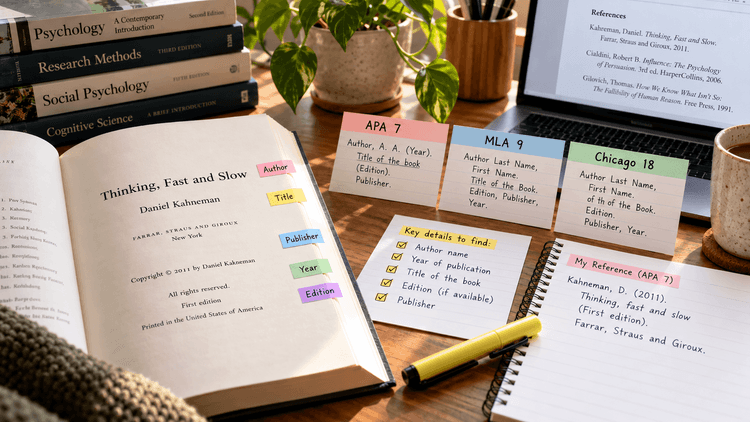
But just when you think you're almost done, your professor adds one more requirement: an annotated bibliography.
And suddenly, you're wondering, “Wait, isn't listing all my sources enough? What exactly am I supposed to write about each one?”
Well, that's where an annotated bibliography comes in.
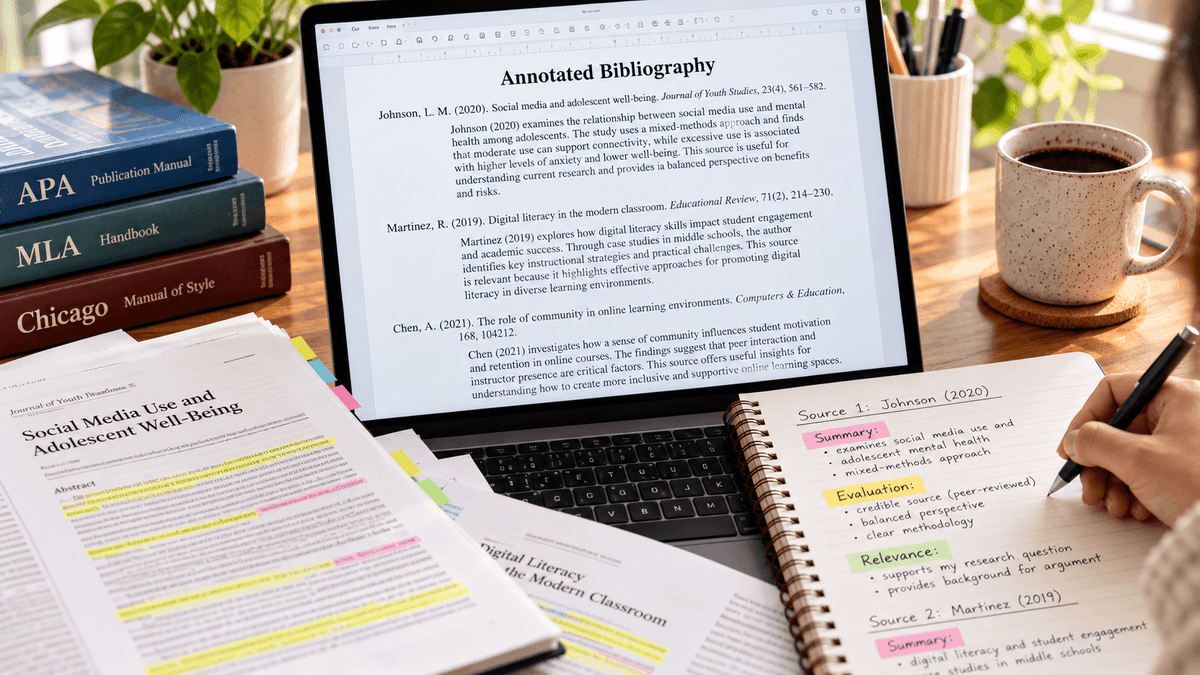
Instead of simply listing your references, you need to explain what each source is about, whether it's reliable, and how it connects to your research.
Sounds like extra work, right?
It doesn't have to be complicated.
Once you understand what goes into an annotation and how to organize everything, the process becomes much easier.
In this guide, you'll learn how to write an annotated bibliography step by step, with practical examples, writing tips, and clear formatting instructions for APA, MLA, and Chicago styles.
So, let's turn that confusing assignment into something you can confidently put together.
Key Takeaways
An annotated bibliography is a list of sources where each citation is followed by a short paragraph called an annotation.
- Annotations summarize a source and may evaluate its quality or explain its relevance.
- A typical assignment may require around 100–300 words per annotation, but your instructor's requirements come first.
- APA 7th edition and common Chicago examples use a 0.5-inch annotation indent, while MLA 9th edition uses a 1-inch indent.
- The basic process is simple: find sources, cite them, write annotations, format, and proofread.
According to Purdue University's Online Writing Lab, annotations may summarize, assess, or reflect on a source, depending on the assignment.
For example, suppose your research topic is whether practice tests improve students' learning.
A regular bibliographic citation would provide the author's name, publication title, date, and other publication details.
Basically, an annotation goes further.
What Is an Annotated Bibliography?
An annotated bibliography is a list of sources, such as books, journal articles, or websites, where each citation is followed by a short paragraph explaining what the source covers and why it matters to your research.
That short paragraph is called an annotation.
Depending on your assignment, it may summarize the source, evaluate its credibility, or explain how it supports your research topic.
Think of it this way.
A regular bibliography tells your reader where your information came from, while an annotated bibliography goes a little further and explains what you learned from those sources and why you chose them.
For example, if you're writing a research paper about climate change, you might include a scientific article as one of your sources.
Instead of just listing its citation, you'd also explain its main findings, how reliable it is, and why it's useful for your research.
Now, you might be wondering how an annotated bibliography differs from a regular bibliography or an abstract.
They may seem similar, but each serves a different purpose, so let’s learn about them -
Annotated Bibliography vs. Bibliography vs. Abstract
When working on a research paper, you'll probably come across terms like bibliography, annotated bibliography, and abstract.
At first, they might seem like different names for the same thing, especially since all three involve presenting information from sources.
But there's an important difference in what each one tells your reader.
While all three help readers understand academic work, they serve different purposes.
Here's a quick comparison to make things clearer -
| Feature | Bibliography | Annotated Bibliography | Abstract |
|---|---|---|---|
| Main purpose | List sources | Explain and assess sources | Summarize one work |
| Includes citations | Yes | Yes | Not usually as a separate citation entry |
| Includes a summary | No | Usually | Yes |
| May evaluate quality | No | Yes | Generally no |
| Explains research relevance | No | Often | Not usually |
For a closer comparison of reference lists and bibliographies, learn more about bibliography vs. references to get the best ideas.
Now that you understand what makes an annotated bibliography different, there's one more thing worth knowing before you start writing: not all annotations serve the same purpose.
Some simply describe a source, while others evaluate it or combine both approaches.
Let's look at these types so you can understand which one your assignment requires.
What Are the Types of Annotations?
There are three common types of annotations: descriptive, evaluative, and combination.
A descriptive annotation explains what a source contains.
An evaluative annotation judges its quality and usefulness.
A combination annotation brings those elements together and may explain how the source supports your research project.
Your assignment will usually indicate which type your professor expects.
| Annotation Type | What it Does | When to Use It |
|---|---|---|
| Descriptive or Informative | Explains the source's topic, purpose, and main ideas | When the assignment asks for a source summary |
| Evaluative or Critical | Examines credibility, strengths, limitations, and relevance | When you must assess research quality |
| Combination | Summarizes, evaluates, and connects the source to your research | When preparing sources for a research paper |
1. Descriptive or Informative Annotation
Imagine you have found a journal article about how students remember information.
A descriptive annotation might explain which study techniques the authors discuss, how they compare them, and what their review concludes.
You are not trying to prove that the article is excellent or flawed.
Your job is to explain its content accurately enough that someone unfamiliar with the article understands its focus.
2. Evaluative or Critical Annotation
Now imagine your professor wants you to assess whether that article is worth including in a research paper.
Instead of stopping at a summary, you would examine the authors' expertise, the evidence they use, and the limitations of their conclusions.
For example, an article reviewing multiple studies may provide a broad picture of a topic, but it might not offer original experimental data.
Identifying that distinction shows that you are evaluating the research rather than simply repeating it.
3. Combination Annotation
A combination annotation does both jobs and adds something especially useful: your perspective as a researcher.
You summarize what the article says, assess its quality, and explain where it belongs in your work.
For example, if you're writing about effective study habits, you might use one article to support your argument with research findings and another to provide practical examples from classrooms.
Neither source has to be perfect. What matters is that you explain what each one contributes to your work.
So, whether you're writing a descriptive, evaluative, or combination annotation, the goal is to help readers understand the source and its value.
But knowing the type is only the beginning.
What exactly should you include when writing an annotation?
Let's break down the key elements that make an annotation clear, useful, and relevant to your research.
What Should an Annotation Include?
Now that you know the different types of annotations, let's look at what actually goes into writing one.
A well-developed annotation usually includes three key elements: summary, evaluation, and reflection.
The summary explains what the source is about and highlights its main ideas.
The evaluation looks at how credible and reliable the source is, including any strengths or limitations.
Finally, the reflection explains how the source connects to your research and why it's worth including.
However, you won't always need all three.
Some assignments only ask for a summary, while others expect you to evaluate the source and discuss its relevance.
The best approach is to check your instructor's requirements before you begin.
To make things easier, let's break down these three elements and see what you should write in each one.
The Three Building Blocks of An Annotation
To write a useful annotation, you need to know what to focus on and what to leave out.
These three elements will help you organize your thoughts without making your annotation unnecessarily long.
1. Summary: What Does the Source Say?
Start by explaining the source's main argument, purpose, methods, and key findings.
Ask yourself: What question does this source answer, and what did the author conclude?
2. Evaluation: Can I Trust and Use It?
Next, consider how reliable the source is. Look at the author's expertise, supporting evidence, publication date, possible bias, and any limitations.
Ask yourself: What makes this source trustworthy, and is there anything I should be cautious about?
3. Reflection: Why Does It Matter to My Research?
Finally, think about how the source fits into your own work.
Does it support your argument, challenge an existing idea, or provide useful background information?
Ask yourself: Where could I use this information in my paper, and what does it add to my research?
One thing worth remembering is that an annotation isn't a miniature research paper.
You don't need to explain every detail or repeat everything the author says.
Just focus on the information that helps readers understand the source and its contribution to your research.
Now that you know what to include, you might be wondering how much you actually need to write.
Should an annotation be a few sentences or a full paragraph?
Let's look at the typical length and what determines it.
How Long Should an Annotation Be?
An annotation often runs between 100 and 300 words, but there is no universal word-count requirement.
A brief descriptive annotation might need only a few sentences, while an evaluative annotation may require several paragraphs.
Always check your professor's instructions before deciding how much to write.
Here's a practical way to think about length.
| Approximate Length | Best Suited For |
|---|---|
| 50–100 words | Short descriptive annotations |
| 100–150 words | Concise summaries with basic evaluation |
| 150–300 words | Detailed evaluation and research reflection |
| 300+ words | Extended annotations when specifically assigned |
Keep in mind that these are general guidelines, not strict rules set by APA, MLA, or Chicago.
A 120-word annotation that clearly explains a source's value can be much more effective than a 250-word annotation filled with unnecessary information.
So, instead of worrying too much about reaching a particular number, focus on covering what your assignment actually asks for.
Now that you know what an annotation should include and how long it needs to be, it's time to put everything together.
Let's walk through the process of writing an annotated bibliography, one step at a time, from choosing your sources to formatting the final document.
How to Write an Annotated Bibliography in Simple Steps
To write an annotated bibliography, begin by choosing credible sources relevant to your research question.
Create a complete citation for each source, organize the entries, and write an annotation that summarizes, evaluates, or reflects on the work.
Finally, apply the required citation style and proofread everything.
Here's how to complete each step without making the process more complicated than it needs to be.
Step 1. Choose Sources that Answer Your Research Question
Start with your research topic, not with a random collection of search results.
Suppose your assignment focuses on whether frequent practice tests improve learning.
You might look for peer-reviewed journal articles, educational research reports, and books about memory and study techniques.
Before saving a source, ask whether it answers your research question, offers credible evidence, and adds something different from what you've already found.
You don't need ten articles that all repeat the same idea.
A smaller selection of sources examining different aspects of the topic can give you a stronger foundation.
Step 2. Create A Citation for Each Source
Once you've selected a source, collect its publication details.
Depending on the source, these might include the author's name, publication year, title, journal or publisher, page range, and DOI or URL.
You can use any reliable citation generator tool to help format references in APA, MLA, Chicago, or Harvard style.
For journal articles, search using the title or DOI. For books, an ISBN can help locate the correct edition.
Remember that a citation generator creates the reference information.
It does not write your annotation or evaluate the quality of your source.
Always review the generated citation for missing or incorrect details.
Step 3. Arrange Your Sources Alphabetically
In a standard author-alphabetized annotated bibliography, arrange your entries according to the authors' surnames.
For instance, entries beginning with Anderson, Brown, and Wilson would appear in that order.
When a source has multiple authors, follow the required citation style's rules for recording their names.
Some assignments, especially MLA projects, may allow an arrangement by topic or date instead. Follow your professor's instructions if they specify another order.
Step 4. Read the Source and Take Useful Notes
This step is where much of the actual thinking happens.
As you read, write down the author's main argument, the evidence used, important findings, and any limitations you notice.
Try using a simple note-taking table:
| Main Argument | Evidence or Approach | Relevance to My Paper |
|---|---|---|
| Practice testing helps long-term learning | Review of research on learning techniques | Supports my discussion of effective study habits |
Don't simply copy sentences from the article's abstract into your notes.
Instead, read the relevant sections and explain the ideas in language you would naturally use.
This helps separate your understanding from the author's wording.
Step 5. Write the Summary in Your Own Words
Now turn your notes into a few clear sentences.
Begin by identifying the source's purpose, then explain its central argument or findings.
If the research method matters to your assignment, include it briefly.
Avoid vague statements such as “This article talks about education and gives useful information.”
That tells your reader almost nothing.
A stronger summary identifies the particular subject and the author's conclusions.
And remember, paraphrasing and summarizing are related but different skills.
An annotation usually requires you to condense the main ideas, not rewrite the original article sentence by sentence.
Step 6. Evaluate the Source's Credibility and Limitations
If your assignment requires critical evaluation, ask what makes the research trustworthy and where its limitations lie.
Consider whether the author has relevant expertise, whether the evidence supports the conclusions, and whether the source's publication date matters for your topic.
You can also compare its findings with those of other researchers.
Be fair in your assessment.
You don't need to invent a weakness merely to sound critical.
If a source is useful but limited in scope, explain that limitation and why it matters.
Step 7. Explain How the Source Fits Your Research
Next, connect the article to your assignment.
Does it provide background information?
Support your argument?
Challenge an assumption?
Offer evidence that another source is missing?
A short reflection might explain that a research review will support the background section of your paper, while an experiment will provide evidence for a particular claim.
This is the part that turns source collection into an organized research strategy.
Step 8. Apply the Required Formatting
When your annotation is ready, format the citation and paragraph according to APA 7th edition, MLA 9th edition, or Chicago 18th edition.
Pay attention to hanging indents, annotation indents, spacing, headings, and alphabetical order.
The exact requirements differ by style, which we'll compare in the next section.
Step 9. Proofread and Check for Text Overlap
Before submitting, read your annotations alongside your notes and check that you've represented each source accurately.
Look for incomplete citations, inconsistent formatting, spelling errors, and sentences that sound too close to the source.
If you repeatedly relied on the original article's wording while drafting, revise the annotation in your own voice and give proper attribution.
You can also check your finished annotations for textual overlap.
A similarity check can identify passages worth reviewing, but it cannot replace your judgment about whether the source is credited appropriately.
How Do You Format an Annotated Bibliography in APA, MLA, and Chicago?
All three citation styles require accurate source information followed by an annotation, but their formatting conventions differ.
APA 7th edition usually places annotations half an inch from the left margin, MLA 9th edition uses a one-inch indent, and Chicago 18th edition permits more flexibility in annotation placement.
Here's how the three styles compare -
| Formatting Feature | APA 7th Edition | MLA 9th Edition | Chicago 18th Edition |
|---|---|---|---|
| Citation format | APA reference | MLA works cited entry | Chicago bibliography entry |
| Usual order | Alphabetical | Alphabetical, unless otherwise assigned | Alphabetical |
| Citation hanging indent | 0.5 inch | 0.5 inch | 0.5 inch |
| Annotation placement | New line below citation | Below the citation | After citation or on a new line |
| Annotation indent | 0.5 inch | 1 inch | Commonly 0.5 inch when separately indented |
| Spacing | Double-spaced | Double-spaced | Often single-spaced within entries |
| Multiple paragraphs | Indent later paragraphs an additional 0.5 inch | Indent later paragraphs | Follow the chosen layout and assignment |
These recommendations are supported by the University of Nevada, Reno's APA guide, University of Alberta Libraries, and Chicago annotated bibliography guidance.
However, remember that these are general formatting conventions.
Your professor's instructions should always come first, especially if they specify different spacing, indentation, or citation requirements.
Now that you have a general idea of how formatting works, let's look at each citation style more closely.
We'll start with APA 7th edition, a commonly used style in psychology, education, and the social sciences, and see how to organize your citations and annotations correctly.
How Do You Format An Annotated Bibliography in APA 7th Edition?
In APA 7th edition, arrange references alphabetically using APA citation rules and a half-inch hanging indent.
Start each annotation on a new line, indent its entire paragraph half an inch from the left margin, and double-space the entries.
Do not add an extra first-line indent to the initial annotation paragraph.
If your annotation contains more than one paragraph, give the first line of each additional paragraph another half-inch indent.
How Much Do You Indent an Annotation in MLA 9th Edition?
In MLA 9th edition, indent the annotation one full inch from the left margin.
The citation itself uses the standard half-inch hanging indent for additional lines.
This distinction makes it easier for readers to separate the source information from your explanation of that source.
According to section 5.132 of the MLA Handbook, annotations can be concise phrases or complete sentences, depending on the assignment.
They are generally limited to one paragraph.
For additional guidance, consult the MLA Style Center.
Its online discussion provides useful background, although the page itself refers to the earlier eighth edition.
How Do You Format An Annotated Bibliography in Chicago 18th Edition?
Chicago 18th edition allows annotations to follow the citation directly or appear on a separate line.
When using a separate paragraph, a half-inch indent is a common choice.
Your bibliography entries should follow either Chicago's notes-and-bibliography system or its author-date system, depending on the assignment.
Chicago offers more than one approach to annotations, so don't assume every university uses an identical layout.
Always check your instructor's guidelines before finalizing your work.
And if your assignment also requires footnotes, our guide on how to write footnotes can help you understand that part of the citation process.
Now that we've covered how to format an annotated bibliography in APA, MLA, and Chicago, you might be wondering what a properly written annotation actually looks like in each style.
After all, understanding the rules is one thing, but seeing them in action makes everything much easier.
So, let's look at some practical examples to see how citations and annotations come together.
Annotated Bibliography Examples in APA, MLA, and Chicago
Examples make the format easier to understand because you can see exactly where the citation ends and the annotation begins.
Below are three original annotations based on the same real research article.
Using one source across three styles makes the differences easier to compare while demonstrating descriptive, evaluative, and combination annotations.
The source is a 2013 research review by John Dunlosky and four coauthors, published in Psychological Science in the Public Interest.
It examines ten learning techniques, including practice testing, rereading, highlighting, and distributed practice.
Its publication details are available from the publisher's article record.
The examples below demonstrate citation wording and annotation content.
Apply the actual paragraph indents and line spacing in your word processor, since a web page does not reliably preserve print formatting.
Example 1. APA 7th Edition Annotated Bibliography
Citation
Dunlosky, J., Rawson, K. A., Marsh, E. J., Nathan, M. J., & Willingham, D. T. (2013). Improving students' learning with effective learning techniques: Promising directions from cognitive and educational psychology. Psychological Science in the Public Interest, 14(1), 4–58. https://doi.org/10.1177/1529100612453266
Annotation
Dunlosky and his colleagues review ten learning techniques frequently used by students and examine how well each technique supports learning across different situations. The authors consider research involving various learners, educational materials, and assessment methods. Their review identifies practice testing and distributed practice as particularly promising strategies for improving learning outcomes. Other approaches, including rereading and highlighting, receive less favorable assessments because their benefits are less consistent. The article also discusses techniques such as self-explanation and interleaving, explaining where existing evidence supports their use and where further research is needed. By bringing together findings from cognitive and educational psychology, the article offers an overview of how different study methods compare and why some may be more effective than others.
Why this Example Works
Notice that the annotation explains the research topic, approach, and conclusions without offering a personal judgment about the authors.
It is descriptive because its main purpose is to tell readers what the source contains.
In your document, the citation should use a 0.5-inch hanging indent, and the entire annotation paragraph should begin 0.5 inches from the left margin.
Example 2. MLA 9th Edition Annotated Bibliography
Citation
Dunlosky, John, et al. "Improving Students' Learning with Effective Learning Techniques: Promising Directions from Cognitive and Educational Psychology." Psychological Science in the Public Interest, vol. 14, no. 1, 2013, pp. 4–58. https://doi.org/10.1177/1529100612453266.
Annotation
This research review provides a useful foundation for examining study strategies because it assesses ten learning techniques using evidence from cognitive and educational psychology. One of its strengths is the attention given to whether findings apply across different learners, materials, and learning conditions. That approach makes the review more informative than a discussion focused on a single classroom or experiment. The authors also distinguish between techniques supported by stronger evidence and those whose usefulness remains uncertain. However, the article is a synthesis of existing studies rather than a new classroom experiment, so it cannot by itself establish how a particular technique will perform in every educational setting. Although the publication is older, its discussion remains valuable as a foundation for research on effective study habits.
Why this Example Works
This annotation does more than report the findings.
It identifies the source's strengths, recognizes its limitations, and considers the value of its evidence. That makes it an evaluative annotation.
When creating your MLA document, leave the citation in MLA Works Cited format and indent the annotation one full inch from the left margin.
Example 3. Chicago 18th Edition Annotated Bibliography
Citation: Notes and Bibliography Style
Dunlosky, John, Katherine A. Rawson, Elizabeth J. Marsh, Mitchell J. Nathan, and Daniel T. Willingham. "Improving Students' Learning with Effective Learning Techniques: Promising Directions from Cognitive and Educational Psychology." Psychological Science in the Public Interest 14, no. 1 (2013): 4–58. https://doi.org/10.1177/1529100612453266.
Annotation
Dunlosky and his coauthors compare ten commonly used learning techniques and assess the research supporting each one. They conclude that practice testing and distributing study sessions over time have especially strong evidence of usefulness, while popular methods such as highlighting and rereading show more limited benefits. The review is particularly helpful because it considers the conditions under which different techniques work, rather than treating every learning strategy as equally effective. Its broad coverage also creates a limitation: the findings summarize research across varied settings rather than providing a specific plan for one course or student population. For my research paper on effective study habits among university students, I would use this article to establish the scientific background for comparing active study methods with more passive approaches. It would also help me identify techniques worth investigating through newer classroom research.
Why this Example Works
This combination annotation brings three elements together.
It summarizes the article's findings, evaluates what the review contributes, and explains exactly how the source will support a research paper.
The example follows Chicago's notes-and-bibliography citation system.
If your professor requests Chicago author-date style, the publication year moves immediately after the author names, and other citation details change accordingly.
For more help with source formatting, try to understand more about how to cite a book and cite a website in APA.
By now, you've seen how an annotated bibliography comes together in APA, MLA, and Chicago styles.
And while these examples give you a useful starting point, knowing what to avoid is just as important as knowing what to include.
Even a well-written annotation can lose its effectiveness because of small mistakes, such as incorrect citations, unnecessary summaries, or missing evaluations.
Let's look at some common mistakes students make and how you can avoid them in your own work.
Common Mistakes to Avoid When Writing an Annotated Bibliography
Even a well-researched annotated bibliography can lose clarity when the citations are inconsistent, or the annotations don't meet the assignment's purpose.
Here are mistakes worth checking before you submit.
1. Copying the Article's Abstract
An abstract can help you understand a study, but it isn't a ready-made annotation.
Copying it or changing a handful of words doesn't demonstrate your understanding of the source.
Read the article, take notes, and write an independent explanation.
2. Summarizing When the Assignment Asks for Evaluation
If your professor wants a critical annotation, explaining the topic isn't enough.
You need to discuss whether the evidence is reliable, whether the author addresses limitations, and how useful the source is for your research.
3. Mixing Citation Styles
An APA citation with MLA punctuation or Chicago-style publication details can make the bibliography inconsistent.
Choose the required style and apply it to every entry.
You can review common citation mistakes before submitting.
4. Forgetting Alphabetical Order or Proper Indents
A bibliography can contain excellent research and still be incorrectly formatted.
Review the order of your entries and apply hanging indents using your document editor's paragraph settings instead of repeatedly pressing the space bar.
5. Writing Too Close to the Original Source
This mistake is especially easy to make when you're summarizing dense academic writing.
You may understand the source perfectly but accidentally preserve too much of its original sentence structure and wording.
This is often called patchwriting.
You can get more ideas about how to paraphrase without plagiarism and when paraphrasing becomes plagiarism after some research by yourself.
Once you've finished writing, using a plagiarism checker can help identify potentially overlapping passages that deserve another look.
Now that you know the common mistakes to watch out for, you're in a better position to write an annotated bibliography that's clear, properly cited, and genuinely your own.
But here's something that can make the process even easier: you don't have to handle every part manually.
With the right approach, you can save time on citations, focus more on your annotations, and review your work before submitting it.
Let's walk through a simple four-step workflow to make that happen -
Build Your Annotated Bibliography Faster With a 4-Step Workflow
Writing an annotated bibliography doesn't have to mean constantly switching between tabs, citation guides, and editing tools.
A simple four-step process can help you focus on understanding your sources while reducing avoidable formatting and writing errors.
Step 1. Generate Your Citations
Use the online citation generator to create references from available publication details. Select the required style and check the output against the source.
Step 2. Write Your Annotations
Read the sources, create your own summaries, and add evaluation or reflection when your assignment requires it. Don't rely on a citation generator to analyze the research for you.
Step 3. Review Potential Plagiarism
Use CopyChecker's text similarity checking tool to identify passages that may overlap with other sources. Examine flagged text and revise or attribute it appropriately.
Step 4. Polish Your Writing
Run your annotations through the Grammar Checker to identify grammar, spelling, and punctuation issues.
Then give the document one final manual review. This workflow doesn't eliminate the thinking involved in academic writing.
It helps you spend more time evaluating research and less time fixing preventable mistakes.
FAQs About Annotated Bibliographies
Do I Need an Introduction for an Annotated Bibliography?
Usually, no. However, if your professor requires one, briefly explain your research topic, the purpose of the bibliography, and how you selected your sources.
Can I Use First Person in an Annotated Bibliography?
Yes, especially when reflecting on how a source supports your research. However, follow your instructor's guidelines, as some assignments require a more objective tone.
How Many Sources Should an Annotated Bibliography Have?
There's no fixed number. Your professor may ask for 5, 10, or more sources depending on the assignment, so always check the requirements.
Is an Annotated Bibliography the Same as A Literature Review?
No. An annotated bibliography examines sources individually, while a literature review combines findings from multiple sources to explore themes, patterns, and research gaps.
Can I Use Websites in An Annotated Bibliography?
Yes, as long as they're credible, relevant, and allowed by your instructor. Prioritize reliable sources such as government websites, universities, and research organizations.
Do Annotated Bibliographies Need In-text Citations?
Usually, no additional in-text citation is needed when discussing the source listed above the annotation. However, information from other sources may require separate citations.
Can I Include Quotations in An Annotation?
Yes, but use them sparingly and cite them appropriately. Annotations should primarily explain and evaluate sources in your own words.
What Makes A Good Annotated Bibliography?
A good annotated bibliography includes accurate citations, clear summaries, thoughtful evaluations, and relevant insights while following the required citation style.
Final Words
Now that you know how to write an annotated bibliography, the process should feel a lot less complicated than it did at the beginning.
Remember, a good annotated bibliography isn't just about listing sources or summarizing what you've read.
It's about showing that you understand your research, can recognize reliable information, and know how each source contributes to your work.
Start by choosing relevant sources, write clear annotations in your own words, and follow the APA, MLA, or Chicago formatting guidelines required by your professor.
Before submitting, review your citations and make sure each annotation serves its purpose.
And here's one final tip: you don't have to spend hours formatting citations manually.
With CopyChecker's Citation Generator, you can create properly structured references in APA, MLA, Chicago, and other supported styles, leaving you more time to focus on understanding your sources and writing meaningful annotations.
Simply enter your source details, choose your citation style, generate your reference, and double-check its accuracy before adding your annotation.