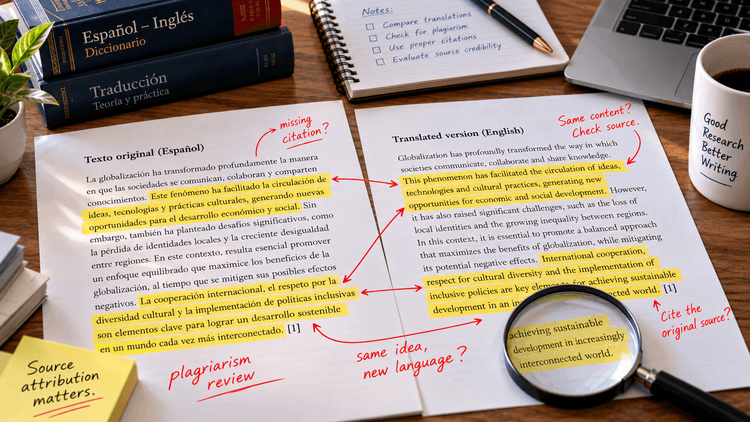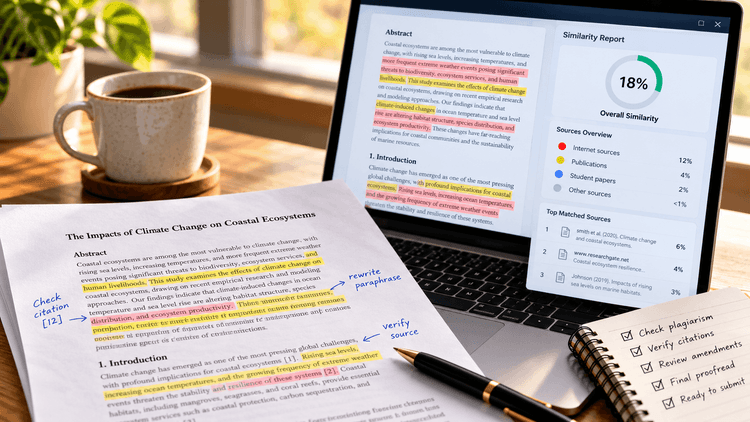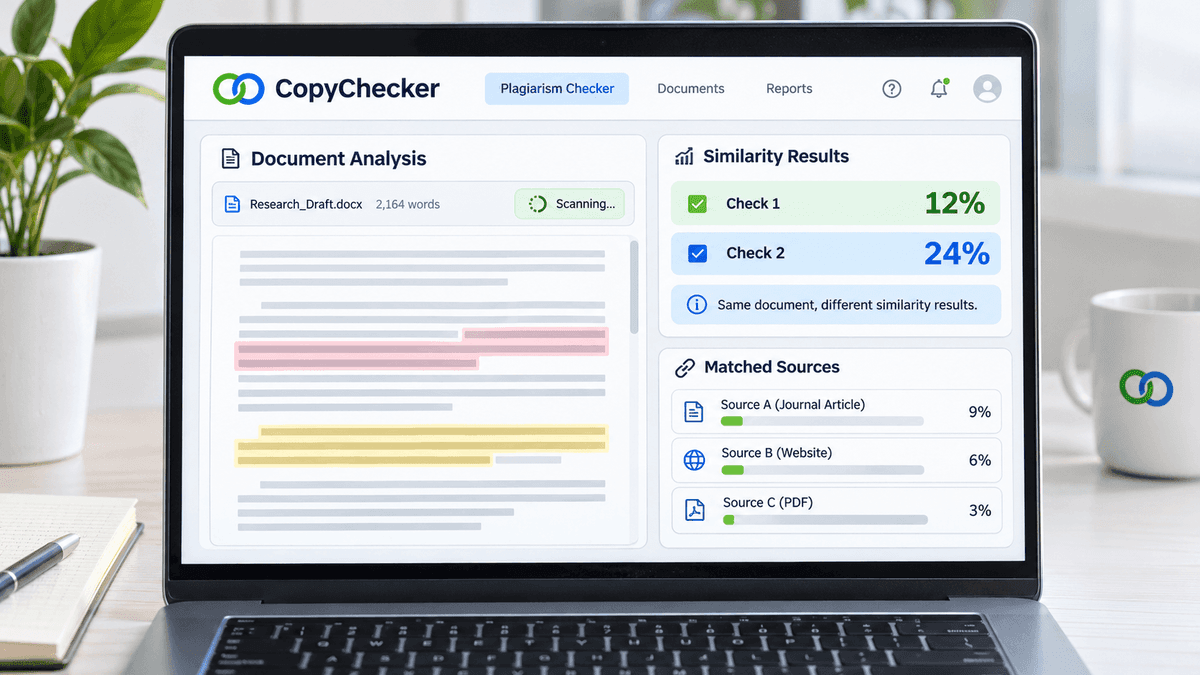
You check a 131-word passage containing a cited quotation.
One plagiarism checker returns 25% similarity; another reports 38.2% matched text. Not a word has changed.
Which score should you trust?
Plagiarism checkers are generally most effective at finding word-for-word matches from accessible sources.
Their reliability becomes less predictable with substantially paraphrased material, unpublished documents, and sources outside their searchable collections.
Even an accurately detected quotation does not necessarily constitute plagiarism.
To understand what these differences mean in practice, we examined four writing scenarios using CopyChecker and compared one of those passages with a Copyleaks report.
The examples reveal why students, educators, and editors should look beyond the headline percentage.
This guide explains how detection works, how accuracy can be measured in a controlled evaluation, and how to interpret similarity reports responsibly.
So let's get started -
What Does “Accurate” Mean for a Plagiarism Checker?
An accurate plagiarism checker should identify known reuse, connect it to relevant sources, and minimize unsupported matches.
A percentage alone cannot tell you how well it achieves those goals.
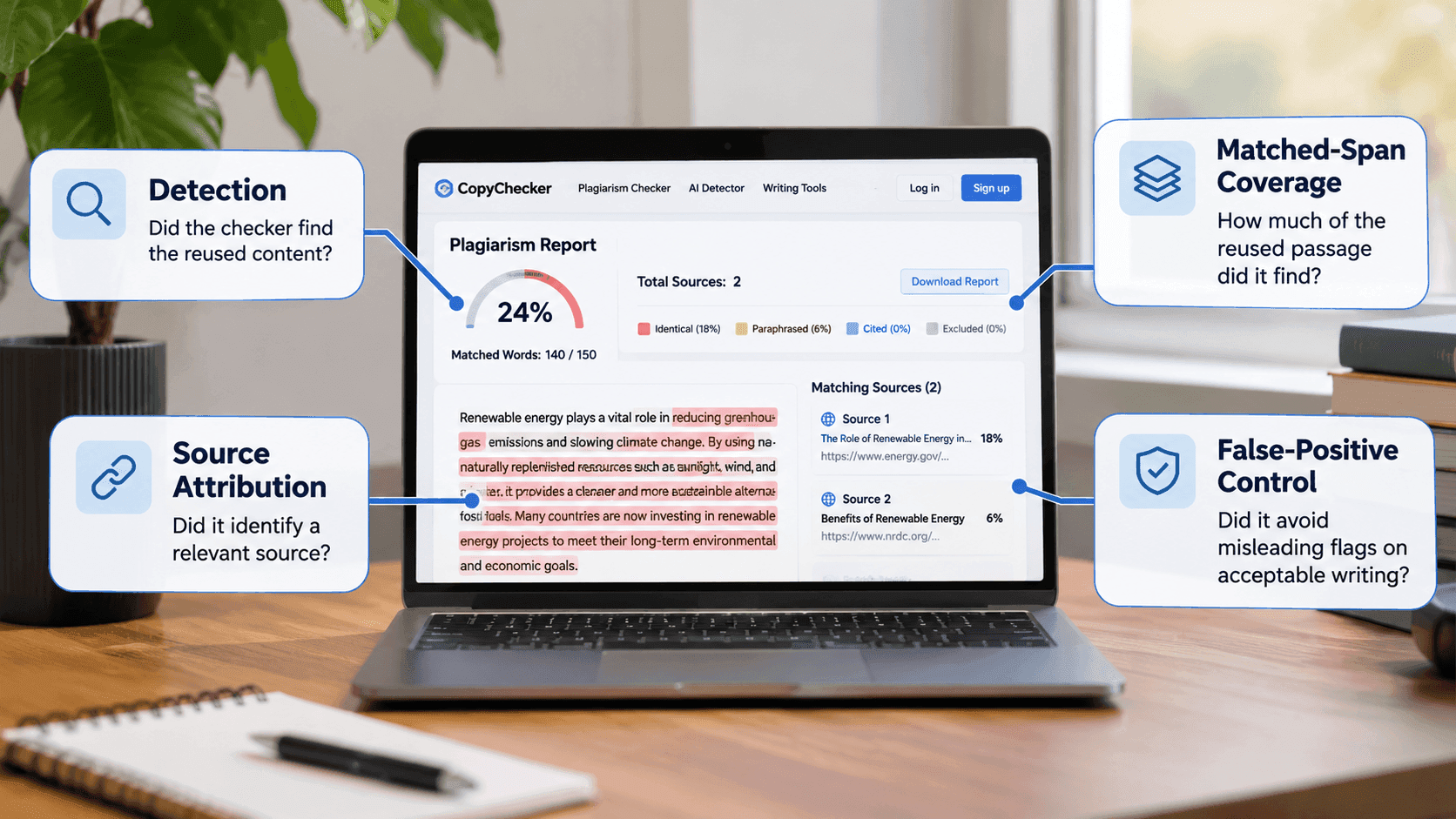
Imagine two checkers find the source of a copied 150-word passage.
One highlights 25 words; the other highlights 140.
Both retrieved the source, but the second detected more of the copied material.
Four dimensions help explain this difference: detection, source attribution, matched-span coverage, and false-positive control.
Report clarity and the ability to recognize paraphrasing are important, too.
Other important considerations include whether a checker recognizes heavily paraphrased material and whether its report makes the detected matches easy to investigate.
A tool that returns a detailed, verifiable source report may be more useful than one that simply displays a percentage without sufficient explanation.
How Do Plagiarism Checkers Work?
Plagiarism checkers work by analyzing submitted text and comparing it against existing content to identify matching or closely related passages.
Depending on the tool, the searchable sources may include publicly accessible websites, academic publications, digital archives, and previously submitted documents.
Some tools compare sequences of words or digital fingerprints of text.
Others examine sentence patterns or semantic relationships to identify potential similarities even when wording changes.
A typical process includes:
- Text Submission: The user pastes their text or uploads a document for analysis.
- Text Analysis: The software examines the submitted content to identify word sequences, phrases, sentence structures, and other recognizable language patterns.
- Source Comparison: The checker searches its available source collections for content that resembles the submitted text.
- Match Evaluation: The software identifies overlapping passages and measures the extent of similarity between the submitted text and the retrieved sources.
- Similarity Reporting: The checker presents its findings through a report containing highlighted passages, similarity percentages, and matching source references, depending on the tool.
Source access matters.
A checker may recognize a paragraph from an indexed article but miss the same wording in a private document it cannot retrieve.
Matching methods matter as well: a word-sequence approach may struggle with extensively rewritten content.
A 2025 systematic review in PLOS ONE examined 189 research papers and identified combined analytical approaches as a promising direction for improving detection.
This research does not establish the performance of any particular commercial checker.
Does a Similarity Score Prove Plagiarism?
No. A similarity score describes overlap detected by a tool, not whether a writer has committed misconduct.
A student with 30% similarity might have properly attributed quotations and references, while a student with 5% might have copied an important passage without acknowledgment.
These example scores cannot determine which student has used sources responsibly.
A correctly cited paraphrase may also generate little matching text, while an accurately quoted passage may generate a substantial match.
Turnitin's official guidance likewise distinguishes a high similarity score from a finding of plagiarism.
Our guide on what percentage of plagiarism is acceptable explains why institutional rules and attribution matter more than a universal numerical threshold.
How to Evaluate Plagiarism Checker Accuracy
Disclosure: CopyChecker publishes this article and provides one of the tools discussed. The completed demonstrations below are limited to four passages tested in CopyChecker, with one also tested in Copyleaks. The larger dataset and numerical exercise are proposed evaluation methods, not completed comparative product research.
Test Dataset Design
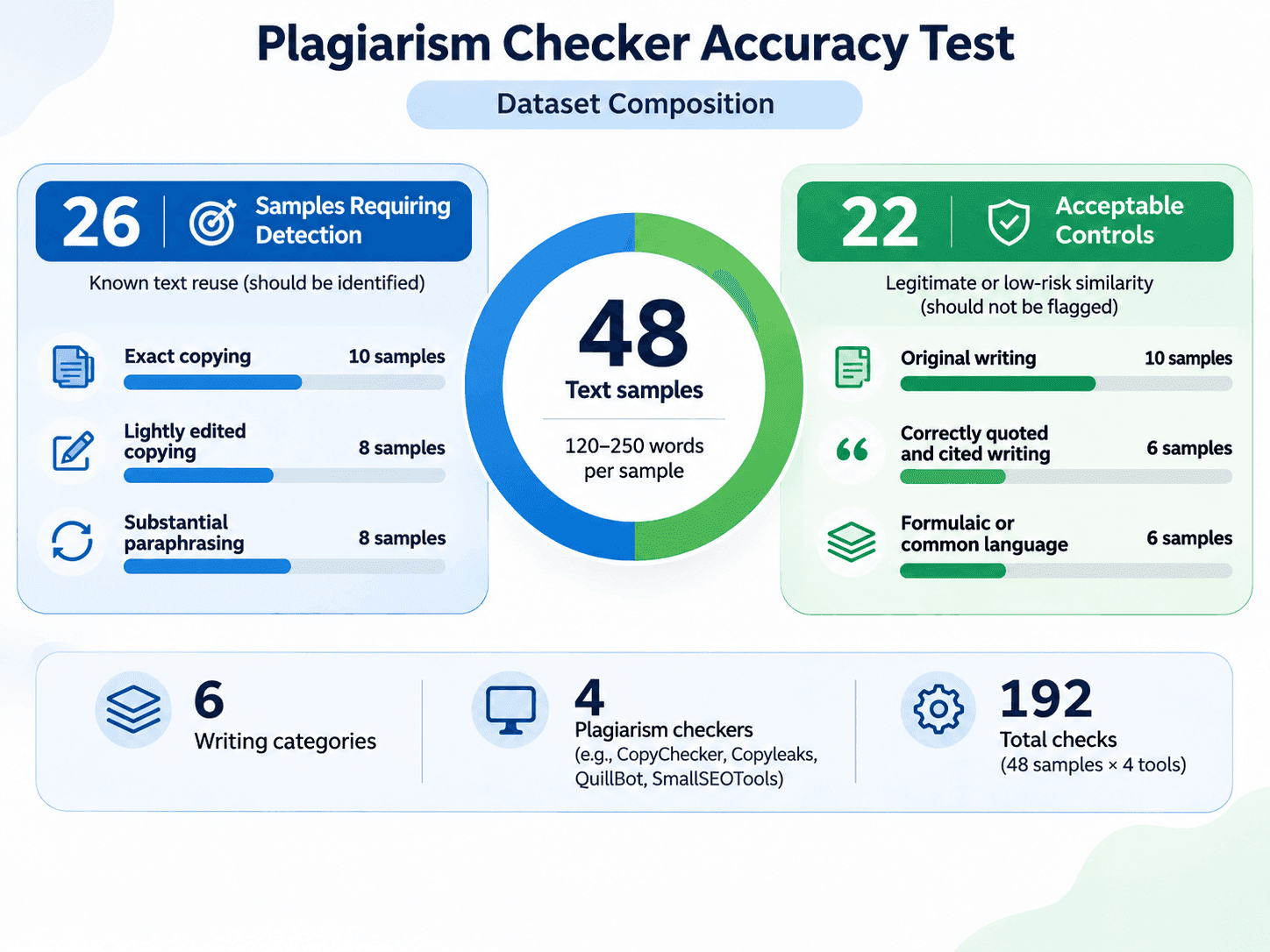
A more comprehensive evaluation could use 48 English-language passages of approximately 120–250 words each, divided into 26 known-reuse cases and 22 acceptable controls.
That balance helps reveal missed reuse as well as misleading flags.
Table 1. Proposed plagiarism checker test dataset
| Category | Samples | Words per sample | Expected outcome | Notes |
|---|---|---|---|---|
| Original writing | 10 | 120–250 | No unsupported suspicious matches | Newly written controls |
| Exact copying | 10 | 120–250 | Matching text and relevant sources identified | Verbatim reuse |
| Lightly edited copying | 8 | 120–250 | Underlying text reuse identified | Minor wording changes |
| Substantial paraphrasing | 8 | 120–250 | Source relationships identified where detectable | Major wording and structure changes |
| Correctly quoted and cited writing | 6 | 120–250 | Legitimate matches recognized in their citation context | Proper attribution |
| Formulaic or common language | 6 | 120–250 | Conventional language not mistaken for misconduct | Conventional phrasing |
| Total | 48 | 120–250 |
Ground Truth and Testing Conditions
Ground truth is the documented reference against which a result is evaluated.
For every source-based sample, record its original source, reused span, modifications, citation status, and expected outcome.
Use permitted source material and check distinctive phrases in original controls before testing.
The PAN text alignment corpus demonstrates how source and target passages can be documented for systematic evaluation of text reuse.
A fair comparison of CopyChecker, Copyleaks, etc. would use identical passages, comparable settings, consistent input methods, and a short testing window.
Document subscription plans, repository access, exclusions, input restrictions, and reviewer decisions.
Predefine what counts as a relevant source and a positive flag; have a second reviewer resolve ambiguous cases.
Completed Demonstrations
On November 29, 2026, four passages were checked with CopyChecker: an exact USGS passage, a substantial paraphrase of that material, a cited historical quotation, and a sample of conventional academic language.
The quotation was also checked with Copyleaks.
The reports show the submitted word counts, percentages, and returned sources.
How Is Plagiarism Checker Accuracy Measured?
Plagiarism checker accuracy can be measured by comparing the tool's reported matches against passages with known reuse and attribution conditions.
Rather than relying on the overall similarity score, a structured evaluation examines four possible outcomes.
| Outcome | Meaning | Example |
|---|---|---|
| True positive (TP) | Known unattributed reuse is correctly detected | A copied paragraph is matched to its original source |
| False positive (FP) | Acceptable writing is incorrectly flagged under the evaluation criteria | An unrelated passage is presented as suspicious reuse |
| True negative (TN) | Acceptable writing is correctly left without misleading flags | An original passage produces no unsupported matches |
| False negative (FN) | Known unattributed reuse is missed | A substantially paraphrased passage goes undetected |
- Precision: TP ÷ (TP + FP) × 100. How often are positive flags supported by the scoring rule?
- Recall: TP ÷ (TP + FN) × 100. How many known reuse cases were detected?
- F1 score: (2 × precision × recall) ÷ (precision + recall), using both inputs as percentages. It balances precision and recall.
- Correct-source attribution: Cases with a verified relevant source ÷ eligible reuse cases × 100.
- Matched-span coverage: Correctly highlighted reused words ÷ known reused words × 100. For substantial paraphrases, sentence or passage alignment may be more appropriate.
Worked Example
Suppose a checker finds 23 of 26 reuse cases and incorrectly flags two of 22 acceptable controls. The following calculations explain the metrics; they are not measured product results.
Table 2. Worked accuracy calculation
| Metric | Example value |
|---|---|
| TP / FP / TN / FN | 23 / 2 / 20 / 3 |
| Precision | 92.00% (23/25) |
| Recall | 88.46% (23/26) |
| F1 | 90.20% |
| Overall classification accuracy | 89.58% (43/48) |
These metrics require known labels and consistent scoring. An individual document's 100% similarity score is not the same as 100% checker accuracy.
Plagiarism Checker Test Results
The five actual reports provide practical demonstrations, rather than enough observations for a statistically meaningful accuracy ranking.
Table 3. Observed report results by writing category
| Sample | Tool | Words | Reported similarity / matched text | Sources |
| EC-01: Exact copy | CopyChecker | 229 | 100% | 1 |
| HP-01: Substantial paraphrase | CopyChecker | 136 | 10% | 1 |
| CQ-01: Cited quotation | CopyChecker | 131 | 25% | 1 |
| FL-01: Formulaic language | CopyChecker | 121 | 23% | 2 |
| CQ-01: Same cited quotation | Copyleaks | 131 | 38.2% | 5 |
Table 4. Interpretation of actual reports
| Sample / tool | Known source retrieved? | Interpretation |
|---|---|---|
| EC-01 / CopyChecker | Yes, USGS | Exact reuse detected; true positive for this demonstration |
| HP-01 / CopyChecker | No, USGS not listed | Some overlap detected, but known source missed |
| CQ-01 / CopyChecker | Yes, National Archives | Legitimate attributed match |
| FL-01 / CopyChecker | Not applicable | Common phrases matched; false-positive risk |
| CQ-01 / Copyleaks | Yes, National Archives | Legitimate attributed match; broader reported overlap |
No measured results are available for original-control or lightly edited categories.
The reports do not support calculating overall precision, recall, F1, or an accuracy ranking for either product.
The following sections explain what each actual observation means.
How Accurate Are Plagiarism Checkers at Detecting Excel Copies?
A similarity score alone cannot explain how reliably a plagiarism checker identifies reused content.
Precision, recall, and source attribution provide additional context about the quality of its findings.
Consider a worked example involving 48 passages, including 26 samples containing known unattributed reuse and 22 acceptable controls.
Suppose a checker successfully identifies 23 of the 26 reuse samples but incorrectly flags two acceptable passages.
Table 2. Example plagiarism checker performance calculation
| Evaluation metric | Example result |
|---|---|
| Total samples | 48 |
| True positives | 23 |
| False positives | 2 |
| True negatives | 20 |
| False negatives | 3 |
| Precision | 92.00% |
| Recall | 88.46% |
| F1 score | 90.20% |
| Overall classification accuracy | 89.58% |
These figures are worked example values rather than measured performance from a commercial plagiarism checker.
In this example, 23 out of 25 positive flags are useful under the evaluation criteria, resulting in a precision score of 92%.
The checker also identifies 23 of the 26 passages containing known reuse, producing a recall score of 88.46%.
However, these overall measurements do not explain whether the checker performs equally well across different types of writing.
Performance Across Different Types of Text Reuse
A more detailed evaluation separates the results according to the writing category.
Table 3. Example detection outcomes by writing category
| Writing category | Total samples | Correct outcomes | Missed or misleading outcomes |
|---|---|---|---|
| Exact copying | 10 | 10 | 0 |
| Lightly edited copying | 8 | 8 | 0 |
| Substantial paraphrasing | 8 | 5 | 3 |
| Original writing | 10 | 9 | 1 |
| Correctly quoted and cited writing | 6 | 6 | 0 |
| Formulaic language | 6 | 5 | 1 |
| Total | 48 | 43 | 5 |
The example demonstrates why plagiarism detection performance should be assessed across multiple writing scenarios.
A checker can identify every directly copied passage while still missing substantially paraphrased material.
It may also identify similarities in acceptable writing that require further investigation.
For students, teachers, and editors, the practical takeaway is that neither a high detection rate nor a low similarity score eliminates the need to review individual matches and their sources.
Plagiarism Checker Test Results
A meaningful plagiarism checker evaluation looks beyond the percentage of matching text.
It examines whether the checker identifies relevant sources, recognizes different forms of text reuse, and avoids misleading matches on acceptable writing.
The following worked evaluation uses 48 sample cases across six writing categories to demonstrate how detection performance can be assessed.
The numerical results are example data rather than measured performance from commercial products.
Overall Tool Performance
Precision, recall, F1 scores, and correct-source attribution provide a more comprehensive understanding of plagiarism detection reliability than similarity percentages alone.
Table 2. Overall plagiarism detection performance
| Tool | TP | FP | TN | FN | Precision | Recall | F1 | Correct-source rate |
|---|---|---|---|---|---|---|---|---|
| Checker A | 23 | 2 | 20 | 3 | 92.00% | 88.46% | 90.20% | 88.46% |
| Checker B | 21 | 3 | 19 | 5 | 87.50% | 80.77% | 84.00% | 80.77% |
| Checker C | 19 | 2 | 20 | 7 | 90.48% | 73.08% | 80.85% | 73.08% |
| Checker D | 16 | 5 | 17 | 10 | 76.19% | 61.54% | 68.09% | 61.54% |
The comparison demonstrates an important distinction between precision and recall.
Checker A identifies 23 of the 26 passages containing known unattributed reuse while producing only two false positives.
Checker C maintains relatively high precision but misses more instances of reused content.
This means that a checker can be highly selective about the passages it flags without necessarily detecting every instance of text reuse.
Correct-source attribution is equally important.
Identifying similar wording without providing a relevant source makes it more difficult for users to investigate the match and determine whether attribution is necessary.
Performance by type of text reuse
Different writing scenarios present different challenges for plagiarism detection software.
Identifying an unchanged paragraph is generally more straightforward than recognizing the same information expressed through substantially different wording.
Table 3. Detection performance by writing category
| Tool | Exact copying | Lightly edited copying | Substantial paraphrasing | Correct quotation handling | Original false positives | Formulaic false positives |
|---|---|---|---|---|---|---|
| Checker A | 10/10 (100%) | 8/8 (100%) | 5/8 (62.5%) | 6/6 (100%) | 1/10 (10%) | 1/6 (16.7%) |
| Checker B | 10/10 (100%) | 7/8 (87.5%) | 4/8 (50%) | 5/6 (83.3%) | 1/10 (10%) | 1/6 (16.7%) |
| Checker C | 9/10 (90%) | 6/8 (75%) | 4/8 (50%) | 6/6 (100%) | 1/10 (10%) | 1/6 (16.7%) |
| Checker D | 9/10 (90%) | 5/8 (62.5%) | 2/8 (25%) | 4/6 (66.7%) | 2/10 (20%) | 1/6 (16.7%) |
The example demonstrates three important patterns in plagiarism detection:
- Exact copying is generally easier to identify: Identical wording provides recognizable text patterns that can be compared against accessible sources.
- Detection becomes more challenging as wording changes: Heavily paraphrased passages may preserve the original meaning while containing few identical phrases.
- Legitimate similarities require careful interpretation: Correct quotations, standard academic expressions, and conventional language can appear in similarity reports without constituting plagiarism.
These differences explain why testing plagiarism checkers exclusively with directly copied passages provides an incomplete picture of their reliability.
Individual Report Interpretation
Overall performance metrics are useful, but examining individual reports provides a clearer understanding of what a plagiarism checker identifies and what it may overlook.
Consider the following six example reports, representing different types of writing.
Table 4. Individual plagiarism report interpretation
| Sample ID | Category | Similarity result | Correct source? | Useful reuse flag? | Human-review findings |
|---|---|---|---|---|---|
| OC-01 | Original writing | 3% | N/A | No | Minor overlap with commonly used expressions |
| EC-01 | Exact copying | 96% | Yes | Yes | Most of the copied passage was identified |
| LE-01 | Lightly edited copying | 74% | Yes | Yes | Source identified despite wording changes |
| HP-01 | Substantial paraphrasing | 4% | No | No | Known reuse was missed |
| CQ-01 | Cited quotation | 25% | Yes | Not applicable | Matching quotation identified with proper source attribution |
| FL-01 | Formulaic language | 12% | N/A | No | Conventional academic expressions require contextual review |
These examples demonstrate why a similarity percentage should never be interpreted without examining the underlying report.
The exact-copy sample produces a high similarity score because most of its wording overlaps with an existing source.
The substantially paraphrased sample, however, receives a low score despite containing unattributed reuse.
The correctly cited quotation produces a higher similarity score than the substantially paraphrased passage, yet its attribution makes the matching content legitimate.
This distinction is especially important in academic writing, where a document with a relatively low similarity percentage may still contain attribution problems, while a document with a higher percentage may use its sources responsibly.
What Do These Results Tell Us About Plagiarism Checker Accuracy?
The worked evaluation demonstrates why plagiarism checker reliability depends on more than the ability to identify identical sentences.
A useful checker should identify meaningful matches, retrieve relevant sources, highlight as much of the reused material as possible, and provide enough information for users to investigate the findings.
Exact copying is generally the most straightforward detection scenario, while substantial paraphrasing, inaccessible sources, and context-dependent attribution present greater challenges.
Ultimately, the most useful plagiarism report is not necessarily the one with the highest similarity percentage.
It is the one that provides relevant, verifiable information that helps readers distinguish legitimate similarities from genuine attribution problems.
How Accurate Are Plagiarism Checkers at Detecting Exact Copies?
Copying unchanged wording from an accessible source is generally a more straightforward detection task than identifying substantially rewritten material.
In our demonstration, CopyChecker analyzed 229 words copied from the USGS water cycle webpage.
It reported 100% similarity, 0% unique content, and one matching source: the USGS page.
The report highlighted the submitted passage and showed a 100% source match.
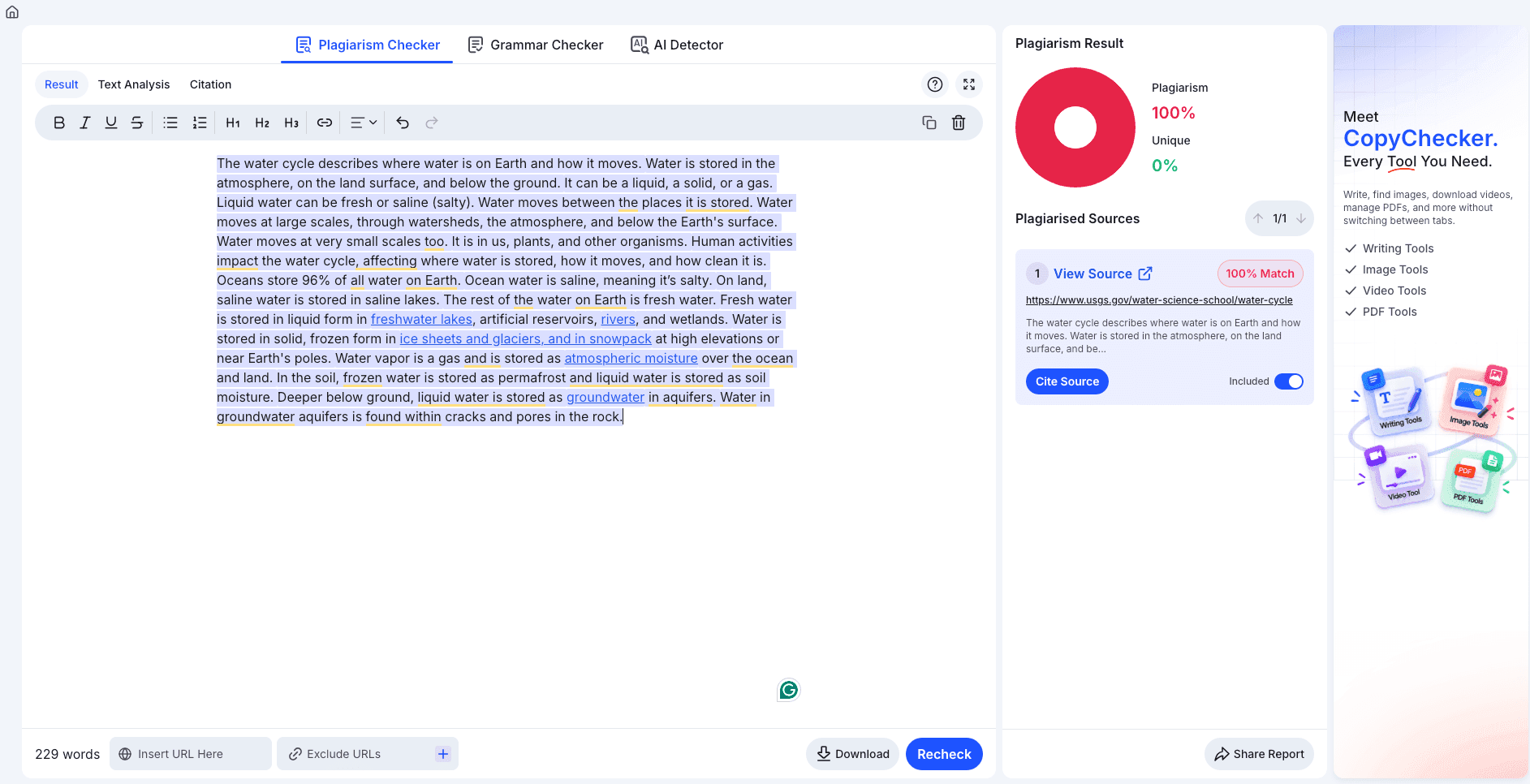
This is evidence of successful detection in one case, not a guarantee that the tool detects all copying.
A checker may miss material in private documents, offline textbooks, restricted publications, deleted pages, or newly published sources.
Short passages may also fall below matching thresholds.
Even when a source is found, the report may highlight only part of the reused material. Both source attribution and matched-span coverage deserve attention.
Can Plagiarism Checkers Detect Lightly Edited or Paraphrased Text?
Some tools recognize modified text, but extensive wording and structural changes can make direct matching harder.
Compare these example sentences:
| Text type | Example |
|---|---|
| Original | Regular maintenance helps extend the useful life of household appliances. |
| Light edit | Routine maintenance helps prolong the useful lifespan of household appliances. |
| Substantial paraphrase | People may need to replace their household equipment less frequently when they take proper care of it. |
Minor substitutions leave recognizable phrases behind.
More substantial rewriting reduces literal overlap, even when the underlying meaning remains similar.
Meaning-based matching may help, but independently written passages can also express similar ideas.
In the USGS demonstration, the exact copy received 100% similarity, while a 136-word rewritten version received 10%.
The latter did not retrieve the original USGS page.
The passages differ in length, so this is not a controlled estimate of the effect of paraphrasing alone.
See Figure 10 below for the actual rewritten-text report.
Paraphrasing is not inherently plagiarism; borrowed ideas may still require attribution. Read our guide on when paraphrasing becomes plagiarism.
How Do Plagiarism Checkers Handle Quotes, Citations, and Common Phrases?
A correctly cited quotation can still appear in a report because its words match an existing source. This is not necessarily a detection error.
We checked a 131-word passage containing a direct quotation from the Declaration of Independence, quotation marks, an in-text citation, a reference, and original commentary.
CopyChecker reported 25% similarity, 75% unique content, and one matching source: the National Archives.
The quotation and reference were visibly highlighted.
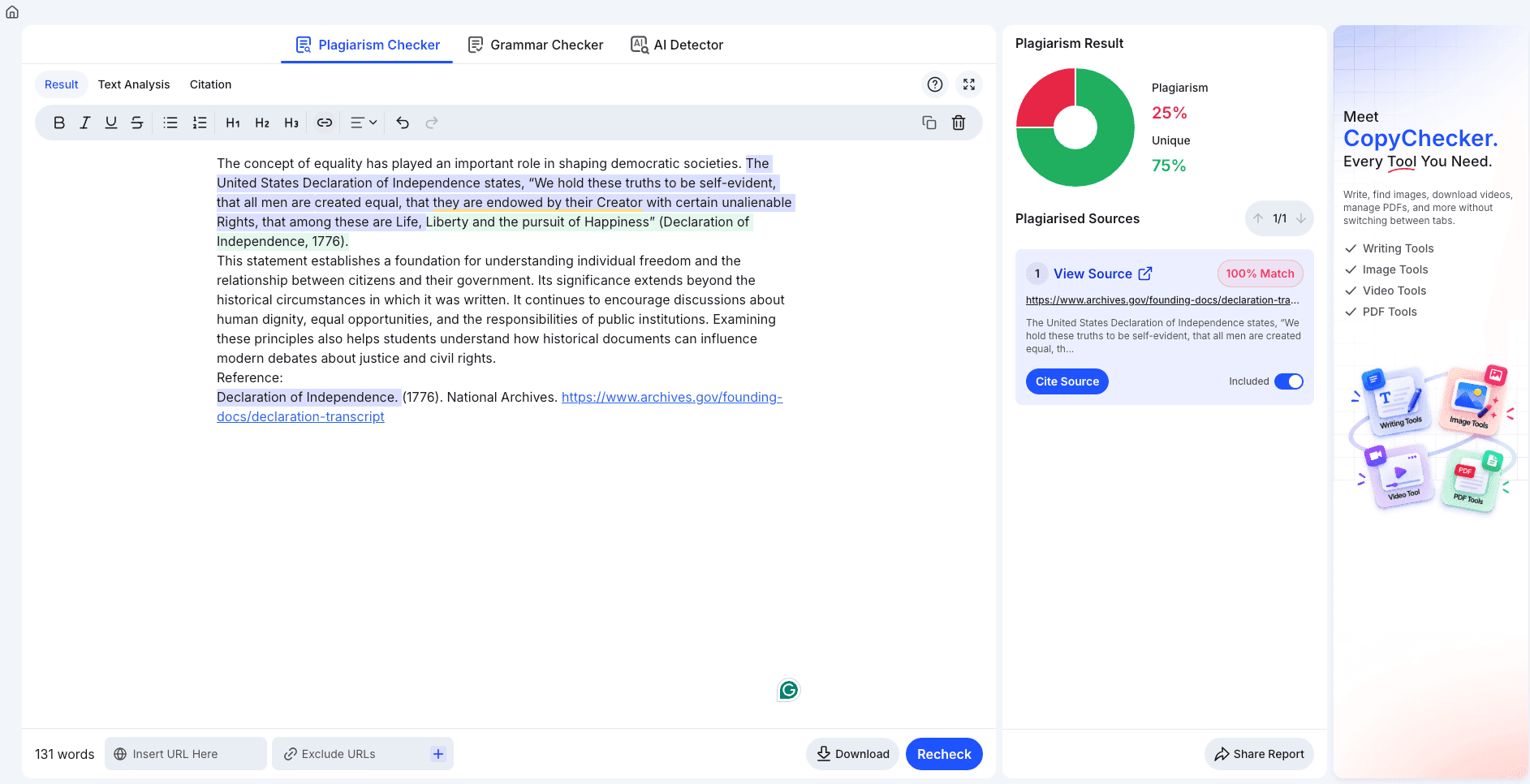
The report correctly identifies overlap, but its percentage alone cannot establish misconduct.
Scientific methods, assignment prompts, standard clauses, technical terms, and bibliographies can also produce legitimate matches.
Some checkers offer quotation, reference, or short-match exclusions.
Where available, changing these settings can change the reported score without changing the document.
A citation generator can help format references, but always verify them against the source and required style.
Can Plagiarism Checkers Produce False Positives and False Negatives?
Yes. A checker can flag acceptable text in a misleading way or fail to find known reuse. The consequences differ, but both require contextual review.
What Is a False Positive in Plagiarism Detection?
A false positive occurs when acceptable writing is incorrectly classified as problematic under a predefined scoring rule.
A genuine match on a conventional expression, however, is not inherently a false positive in text matching.
Our 121-word sample of common academic language produced 23% similarity and two matching sources in CopyChecker.
One highlighted sentence was “The results are presented in the following table.”
Another highlighted sentence referred to factors influencing a study’s outcome.
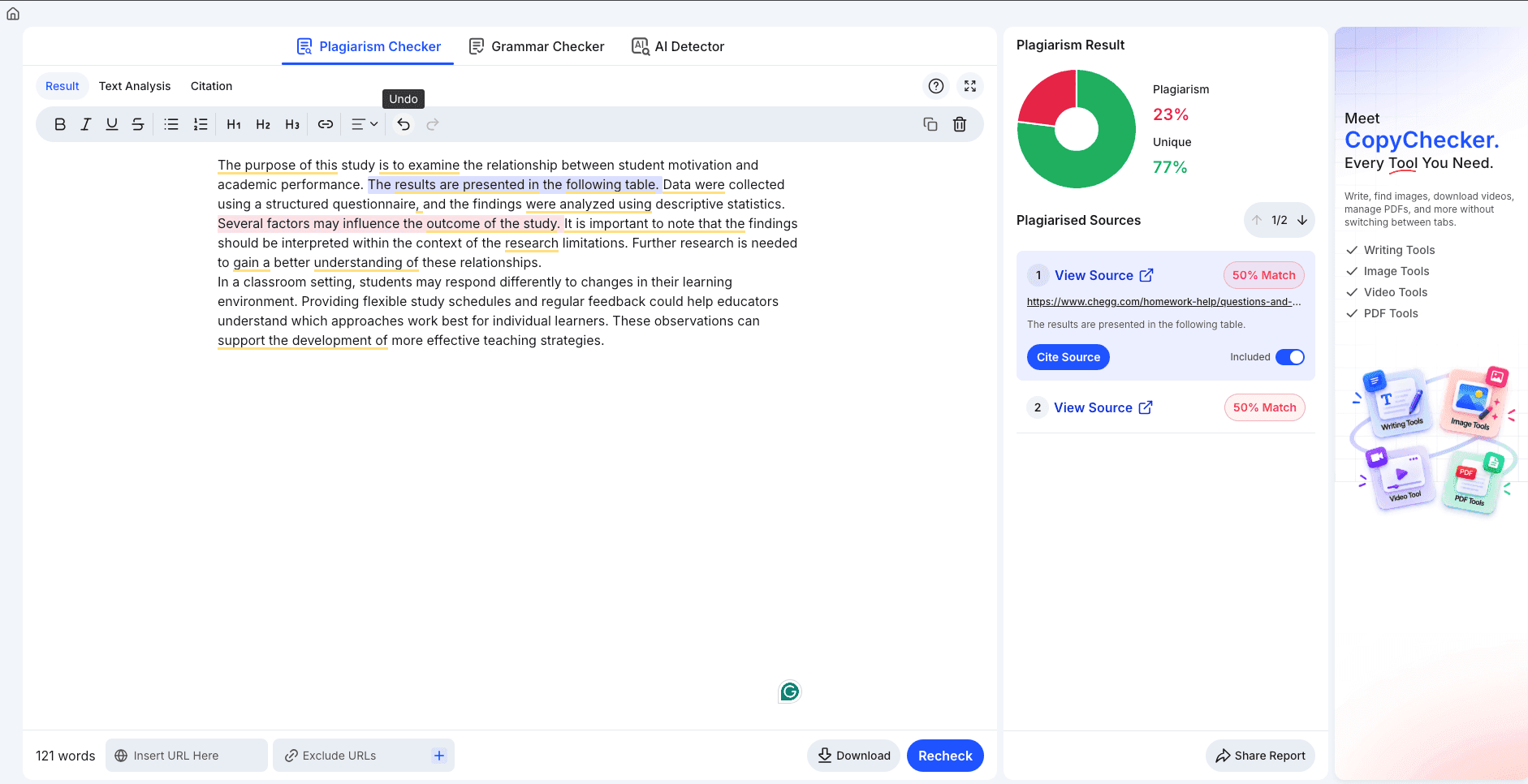
These phrases are not sufficient evidence of copying from a particular author.
The report illustrates a false-positive risk when similarity is treated as misconduct.
It does not independently prove that the underlying text matching was erroneous.
What Is a False Negative in Plagiarism Detection?
A false negative occurs when known reuse fails the detection criteria.
In our 136-word rewritten USGS sample, CopyChecker reported 10% similarity and 90% unique content.
It returned one source on resilientwatershedstoolbox.org, rather than the original USGS page.
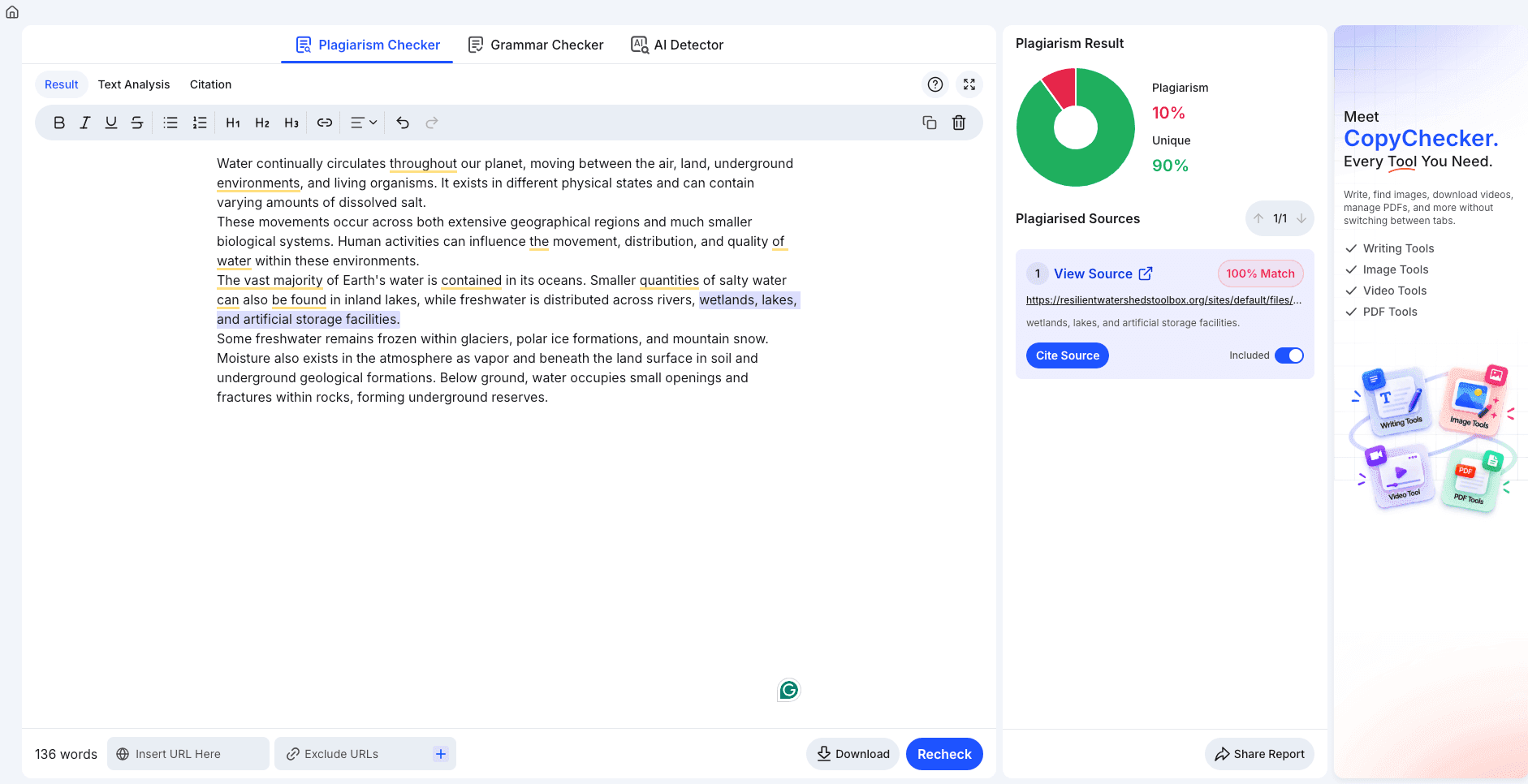
Under a rule requiring identification of the known source, this is a source-attributed detection miss.
It is not a complete absence of matching text. Nor does it establish the tool’s overall paraphrase detection rate.
A low score cannot prove originality.
Conversely, a high score does not necessarily indicate improper reuse.
Reviewing sources, citations, and the writing process is essential.
Why Do Different Plagiarism Checkers Give Different Scores?
CopyChecker and Copyleaks both analyzed the same 131-word cited quotation passage.
CopyChecker reported 25% similarity and one source; Copyleaks reported 38.2% matched text and five results, including the National Archives.
That is a difference of 13.2 percentage points in the reported figures, although the tools may define and calculate their metrics differently.
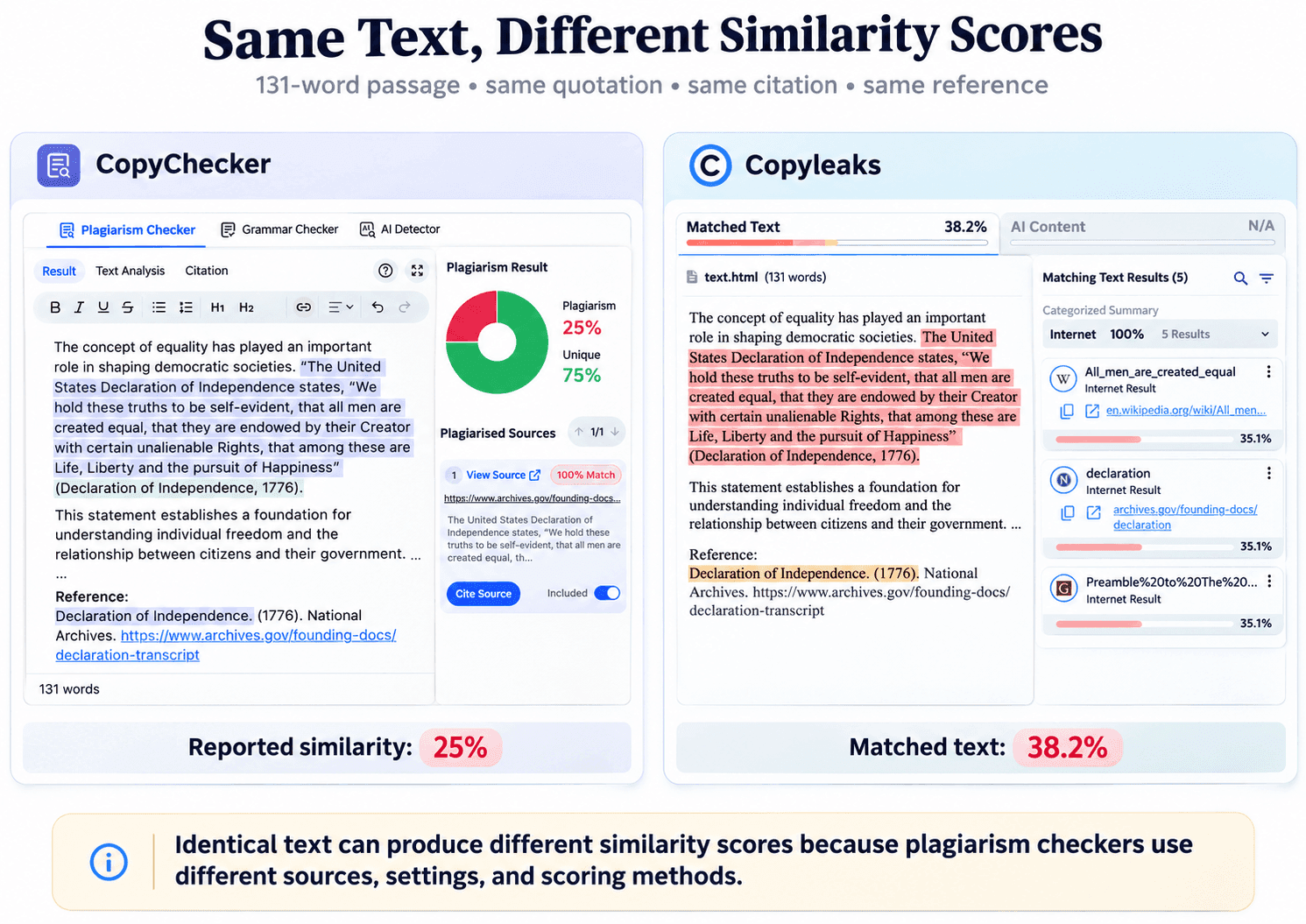
Figure 11: Actual report excerpts from CopyChecker and Copyleaks show different results for identical submitted text.
| Factor | Potential effect |
|---|---|
| Source coverage | Different searchable publications |
| Index freshness | New or updated pages may be missing |
| Private repositories | Previously submitted papers may be available only to some systems |
| Minimum match length | Short matches may be ignored |
| Exclusions | Quotations or references may be omitted |
| Semantic matching | Rewritten material may be detected differently |
| Document extraction | PDF or scanned text may be extracted differently |
| Language support | Detection may vary by language |
| Score calculation | Different definitions or denominators |
Our comparison establishes that the reports differ, but does not isolate which factor caused the difference.
Neither the higher score nor the number of source results alone establishes superior accuracy.
What Are the Main Limitations of Plagiarism Checkers?
Even a reliable plagiarism checker cannot identify every possible form of plagiarism.
The most important limitations include incomplete source coverage, difficulty detecting heavily rewritten text, inconsistent cross-language detection, and the inability to understand a writer's intent.
A plagiarism checker may also struggle to identify borrowed ideas when the wording is entirely different.
Unlike matching a sentence, determining whether an argument or intellectual contribution has been improperly appropriated often requires subject knowledge.
Results can also change over time as source collections and detection methods are updated.
For teachers and editors, this means plagiarism detection software should support an investigation rather than replace professional judgment.
For students, it means a zero similarity score is not a certificate of originality.
How Should Students Use a Plagiarism Checker?
The best way to check an assignment for plagiarism is to combine automated similarity detection with manual source verification and careful citation.
Instead of treating the similarity percentage as a grade, students should use the report to identify passages that may require further attention.
As the earlier examples demonstrate, a high similarity score can include properly attributed material, while a low score can overlook substantially paraphrased content.
If your institution permits external plagiarism checking tools, follow these steps before submitting your assignment.
Step 1: Check Your Draft
Paste your completed draft into a plagiarism checker or upload your document using a supported file format.
Checking a complete draft allows you to review potential similarities before making your final revisions.
Step 2: Review the Highlighted Passages and Sources
Open the relevant matching sources rather than focusing exclusively on the overall similarity percentage.
Compare each highlighted passage with its corresponding source to understand why it was detected.
Step 3: Identify the Type of Similarity
Determine whether the matching material is a correctly cited quotation, a common expression, a reference entry, an overly close paraphrase, or an unattributed copied passage.
Not every highlighted section requires revision.
Step 4: Correct Missing Citations and Inappropriate Paraphrasing
Add quotation marks and citations wherever directly borrowed wording requires attribution.
If a passage follows the original source too closely, rewrite it using your own understanding, reasoning, and sentence structure while retaining the necessary citation.
Our guide on how to paraphrase without plagiarism provides further guidance on responsible paraphrasing.
Step 5: Recheck Your Revised Assignment
Run another plagiarism check after making the necessary corrections. Review any remaining matches to determine whether they are legitimate or require additional attention.
Avoid repeatedly rewriting correctly attributed material simply to reduce your similarity percentage.
Step 6: Keep a Record of Your Writing Process
Retain your research notes, source references, earlier drafts, and document version history. These records can help demonstrate how your work developed if questions about its originality arise.
You can also consult this academic integrity checklist before submitting your final assignment.
Remember, the objective of using a plagiarism checker is not to achieve a zero similarity score.
It is to identify genuine attribution problems, acknowledge borrowed material appropriately, and submit work that reflects your own understanding.
How Should Teachers and Editors Interpret Plagiarism Reports?
Teachers and editors should review the actual matching passages, verify the identified sources, and apply the relevant academic or editorial policy.
A report can help direct attention toward potentially problematic sections, particularly when reviewing long assignments or multiple submissions.
However, the final assessment should consider the assignment requirements, citation conventions, subject-specific language, and the writer's explanation.
An incorrectly formatted quotation, an overly close paraphrase, and an entirely copied essay represent different problems.
They should not automatically receive the same treatment simply because they generate similar percentages.
Where appropriate, allow writers to explain their sources, demonstrate their writing process, or correct citation mistakes.
A reliable review process combines the speed of automated detection with the context that software cannot independently provide.
FAQs
How Accurate are Plagiarism Checkers?
Plagiarism checker accuracy varies by tool, source availability, and type of text reuse. Exact copying from accessible sources is generally easier to identify than heavily paraphrased, translated, or unpublished material.
Can Plagiarism Checkers be Wrong?
Yes. They can identify unrelated similarities or miss genuinely reused content. Reviewing the matched passage and its source helps distinguish meaningful matches from misleading ones.
Why do Different Plagiarism Checkers Show Different Percentages?
They may use different source collections, matching techniques, minimum match lengths, exclusion settings, and similarity calculations. Identical documents can therefore receive different results.
Does A High Similarity Score Mean Plagiarism?
Not necessarily. Properly cited quotations, reference lists, templates, and assignment instructions can contribute to high similarity scores without constituting plagiarism.
Can A Plagiarism Checker Detect Paraphrased Text?
Some tools can recognize lightly edited or semantically similar text. Detection becomes more difficult as wording, structure, and presentation change substantially.
Can A Plagiarism Checker Miss Copied Content?
Yes. A checker may miss material from private, restricted, offline, recently published, or unindexed sources. It may also miss some substantially rewritten passages.
Is A Zero Percent Similarity Score Possible or Desirable?
A zero score is possible, but it is not proof of originality. Academic and professional documents can contain legitimate similarities, so achieving zero should not be the primary objective.
What Should A Student do After Receiving A Plagiarism Report?
Review each highlighted passage, verify the source, correct missing attribution, improve inappropriate paraphrasing, and recheck the revised document.
Can Teachers Rely Only on A Plagiarism Checker?
No. Teachers should combine the report with manual source verification, institutional policy, subject knowledge, and appropriate academic review.
Final Verdict
Plagiarism checkers are useful and generally more dependable for identifying accessible, word-for-word text matches than for detecting every form of unattributed reuse.
Their usefulness depends on source availability, matching techniques, report transparency, and how users interpret the findings.
For students, writers, teachers, and editors, the best approach is to treat similarity reports as investigative evidence rather than final judgments about originality.
Use CopyChecker's Plagiarism Checker to examine your document, inspect the matching sources, and address genuine attribution problems before submission or publication.