AI detectors are supposed to answer a simple question: Was this text written by AI?
Naturally, the answer is rarely that simple.
A detector might confidently flag an obviously AI-written paragraph and then turn around and accuse a completely human-written story of being AI too.
That becomes a fairly serious problem when the result affects a student, writer, employee, or published article.
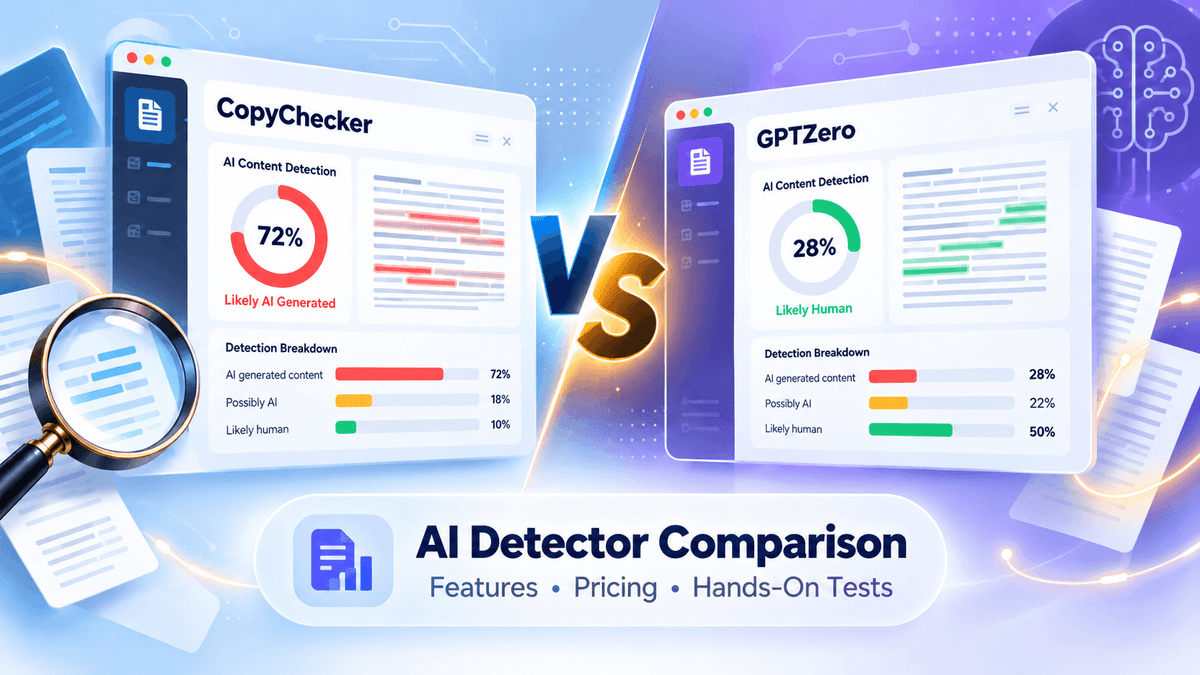
That is why comparing CopyChecker vs GPTZero takes more than putting their pricing pages next to each other.
We tested the same AI-written and human-written samples in both tools to see how they behaved in practice.
We also compared their free allowances, plagiarism checking, result presentation, and overall usefulness.
Here is what we found.
The Main Difference Between CopyChecker and GPTZero
GPTZero makes more sense if your main priority is AI detection, especially if you need a larger free allowance and more features around authorship and writing-process verification.
CopyChecker makes more sense if you want AI detection as part of a broader writing workflow, with plagiarism checking, proofreading, grammar tools, paraphrasing, readability checking, and other utilities available on the same platform.
There is one bigger takeaway, though:
Neither AI detector should be treated as a final verdict.
In our comparison, both tools correctly identified an obviously AI-style paragraph. Both also flagged a short human-written sample as AI-generated.
GPTZero at least warned that the short sample might produce a less accurate result.
That small detail ended up being one of the most useful differences between them.
So let’s see -
CopyChecker vs GPTZero at a Glance
Both tools can detect AI-written content and highlight suspicious text, but they differ in free usage limits, plagiarism checking, browser features, and the users they are mainly built for.
The following comparison reflects publicly available product information reviewed on September 28, 2026.
So, here it is -
| Comparison | GPTZero | CopyChecker |
|---|---|---|
| Main focus | AI detection and authorship analysis | AI detection plus broader writing tools |
| Free AI allowance | 10,000 monthly credits | 500 AI-detection words/month |
| Free plagiarism checking | Available within free credits | 1,500 plagiarism words/month |
| Sentence-level AI highlighting | Yes | Yes |
| Overall AI score | Yes | Yes |
| File uploads | Yes | Yes |
| Mobile/browser access | Yes | Yes |
| Dedicated Chrome extension | Yes | Not currently a core feature |
| Short-text warning observed in our test | Yes | No |
| Entry paid plan | $14.99/month monthly billing | $12.50/month, billed annually |
| Best suited to | AI-focused checking, educators, and higher-volume users | Users wanting several writing checks in one platform |
There is an important detail behind those free-plan numbers.
GPTZero provides a much larger allowance if you mainly need AI detection.
CopyChecker separates usage between different tools.
Its free account includes 500 AI Detector words and 1,500 plagiarism-checking words per month, alongside allowances for other writing tools.
So the difference is not simply “one is free, and one is not.” It is about how you intend to use the allowance.
And once you start checking larger essays, articles, or batches of content, pricing becomes more relevant.
That is where the paid plans start to matter -
GPTZero vs CopyChecker Pricing
Both platforms offer free access, but their paid plans reflect different priorities.
GPTZero puts more of its allowance toward high-volume AI detection.
So before deciding which plan offers better value, let's look at how each platform prices its paid tiers.
GPTZero Pricing
GPTZero's pricing page currently offers a free allowance of 10,000 credits per month.
For heavier use, its publicly listed plans include:
| Plan | Words/month | Monthly billing | Annual billing equivalent |
|---|---|---|---|
| Free | 10,000 free usage | $0 | $0 |
| Essential | 150,000 | $14.99/month | $8.33/month |
| Premium | 300,000 | $23.99/month | $12.99/month |
| Professional | 500,000 | $45.99/month | $24.99/month |
GPTZero also provides larger per-scan limits and additional features as you move through the paid plans.
If you regularly check essays, articles, assignments, or large batches of content, that much larger word allowance is hard to ignore.
CopyChecker Pricing
CopyChecker pricing structures its plans differently because AI detection is only one part of its Writing Suite.
The free account currently includes:
- 500 AI Detector words/month
- 1,500 Plagiarism Checker words/month
- 1,000 Grammar Checker words/month
- 1,000 Paraphraser words/month
- 500 AI Humanizer words/month
Its Creator Suite costs $12.50 per month when billed at $150 annually and currently includes:
- 10,000 AI Detector words/month
- 17,000 plagiarism words/month
- 10,000 paraphrasing words/month
- 3,000 AI Humanizer words/month
- Unlimited Grammar Checker words
A higher customizable plan is listed at $30.83/month when billed annually, with larger allowances for the selected tools.
So Which Is Cheaper?
That depends on what you are buying.
If you mainly need to run lots of AI scans, GPTZero gives you considerably more detection capacity.
If AI detection is one part of a workflow that also includes plagiarism checks, grammar fixes, rewriting, and other content review, CopyChecker’s bundle becomes more relevant.
Comparing them only by monthly price is a bit like comparing a gym membership with a swimming-pool ticket because both technically involve getting sweaty.
How CopyChecker and GPTZero Compare on AI Detection and Writing Features
CopyChecker and GPTZero overlap in several areas, but they are built around different priorities.
Both detect AI-generated writing, highlight suspicious text, and offer plagiarism checking.
CopyChecker expands more into everyday writing and editing tools, while GPTZero goes deeper into authorship verification, writing-process analysis, and education-focused features.
Since AI detection is the main reason to compare them, that is where the differences matter most.
Let’s start with the feature that puts them in direct competition -
AI Detection
Both CopyChecker and GPTZero analyze text for patterns associated with AI-generated writing and provide an overall result.
CopyChecker keeps the process fairly straightforward. It gives users an AI-content score and highlights passages that may have been generated by AI.
GPTZero offers similar sentence-level highlighting but adds more advanced detection features around mixed human-and-AI writing, modified AI text, and authorship analysis.
So if you mainly want a quick AI check, both cover the core job.
If you want more context around how AI may have been used or how the document was produced, GPTZero offers the deeper detection workflow.
There is one limitation they both share, though:
An AI score is still an estimate, not proof of authorship.
That matters most with short or borderline text, as our comparison later shows.
Plagiarism Detection
Both platforms also include plagiarism detection.
CopyChecker gives free users 1,500 plagiarism-checking words per month, separate from its AI Detector allowance. Its plagiarism checker highlights matching text and provides a similarity result.
GPTZero also supports plagiarism scanning through its available credits.
So plagiarism checking is not a major dividing line anymore.
The bigger difference is where it sits in the overall workflow: CopyChecker treats it as one of many writing tools, while GPTZero connects it more closely with originality, citation review, and authorship verification.
Writing and Editing Tools
This is where CopyChecker becomes noticeably broader.
Alongside AI and plagiarism detection, it offers dedicated tools for grammar, proofreading, paraphrasing, readability, tone, sentence fragments, passive voice, comma splices, essay review, summarization, and text counting.
For example, users can move from AI detection into tools such as the Passive Voice Checker, Essay Checker, Sentence Fragment Checker, or Character Counter.
GPTZero also includes grammar and writing feedback, but it generally combines these into broader review features rather than offering a separate tool for every writing problem.
So the difference is fairly simple:
CopyChecker is broader for everyday writing and editing.
GPTZero is more specialized around AI detection, authorship, and document verification.
So How Do Their Feature Sets Really Differ?
Both products have developed into larger writing platforms.
They have simply grown in different directions.
CopyChecker is broader at the individual-tool level.
It offers dedicated tools for AI detection, plagiarism, grammar, proofreading, paraphrasing, tone, readability, sentence problems, counters, essay checking, summarization, citation generation, and other everyday writing needs.
GPTZero goes deeper into authorship and verification.
Beyond AI and plagiarism detection, it now offers citation and hallucination checking, writing-process replay, typing analysis, AI Vision, AI Vocabulary, advanced writing feedback, expert-trained document review, browser integration, and substantial educator-focused functionality.
So choosing between them depends less on which site has the longer feature list and more on what you actually want the platform to do.
Feature lists can only take the comparison so far, though.
The real question is what happens when both AI detectors get the same writing.
So that is what we tested next -
We Tested CopyChecker and GPTZero With the Same Text
Feature pages tell you what software is designed to do.
Testing shows what happens when you actually paste something into it.
We therefore compared the tools using two very different samples.
This was a practical comparison, not a controlled scientific benchmark. Two samples cannot establish the overall accuracy or false-positive rate of either detector.
They can, however, show how confidently these systems can behave in individual cases.
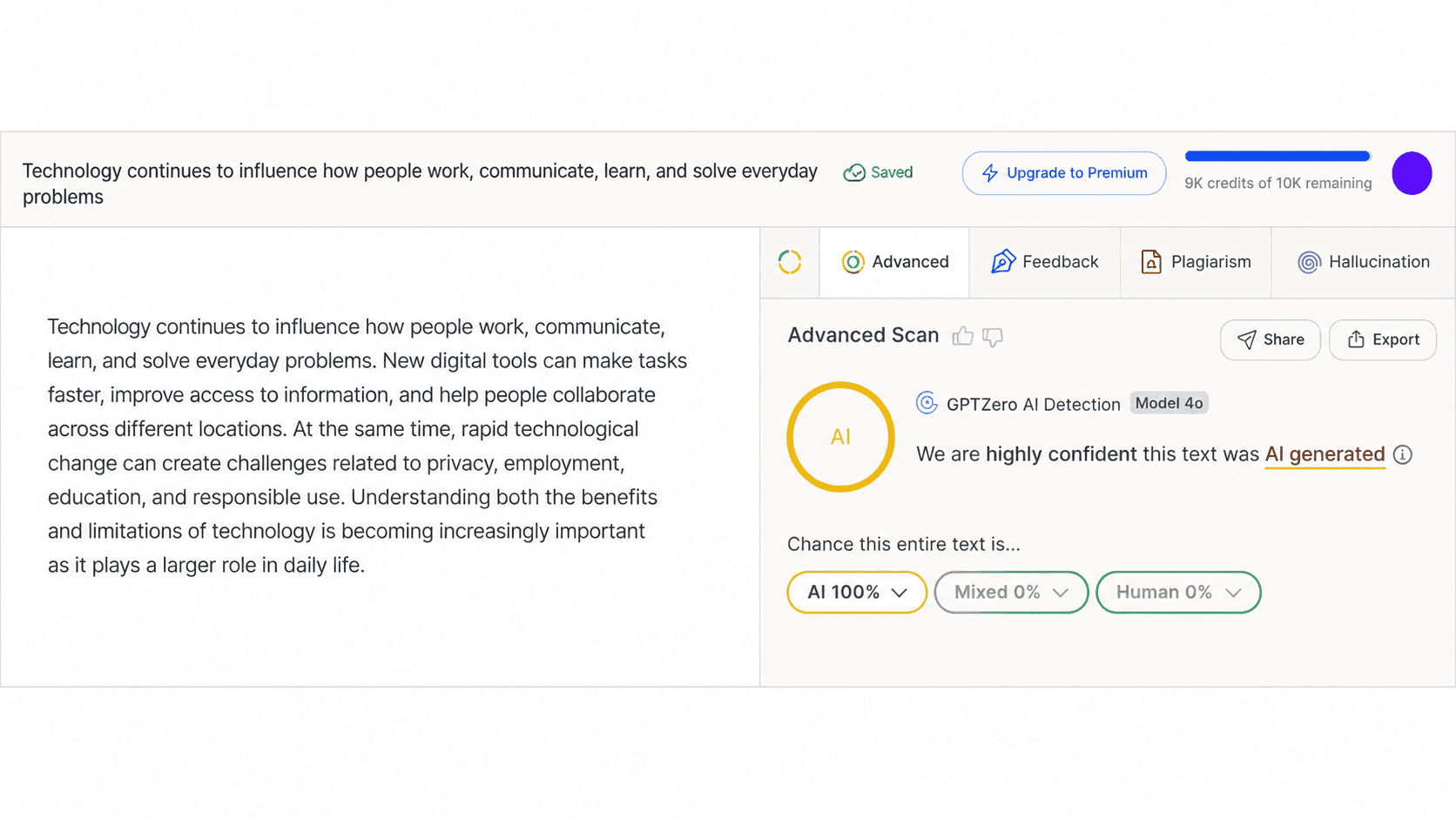
Test 1: Obviously AI-Style Writing
For the first test, we used deliberately generic AI-style writing.
Think polished corporate language, predictable sentence structure, vague benefits, and phrases about leveraging cutting-edge technology.
Basically, a paragraph wearing a tie but carrying very little information.
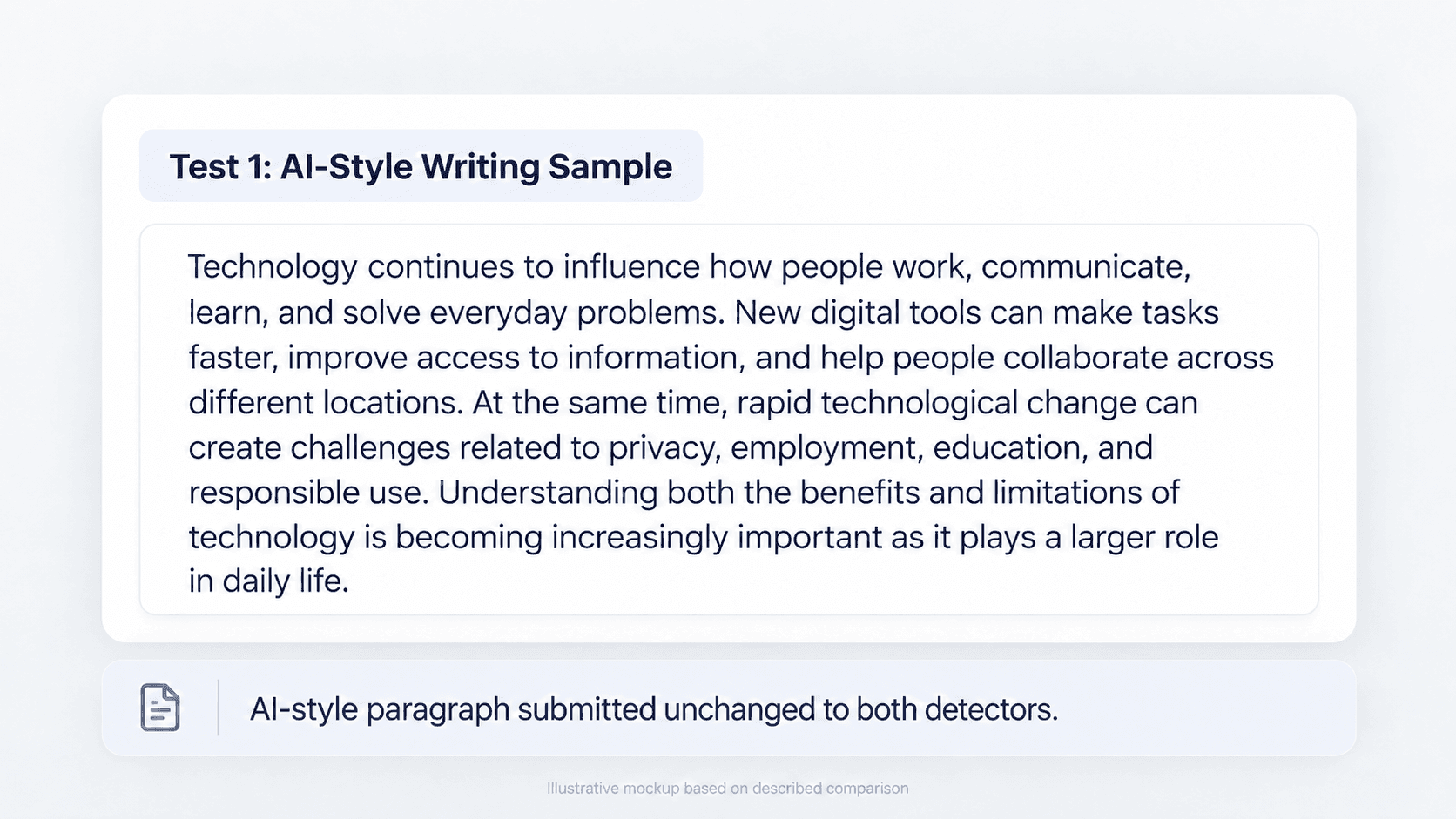
GPTZero Result: 100% AI.
CopyChecker Result: 100% AI-generated.
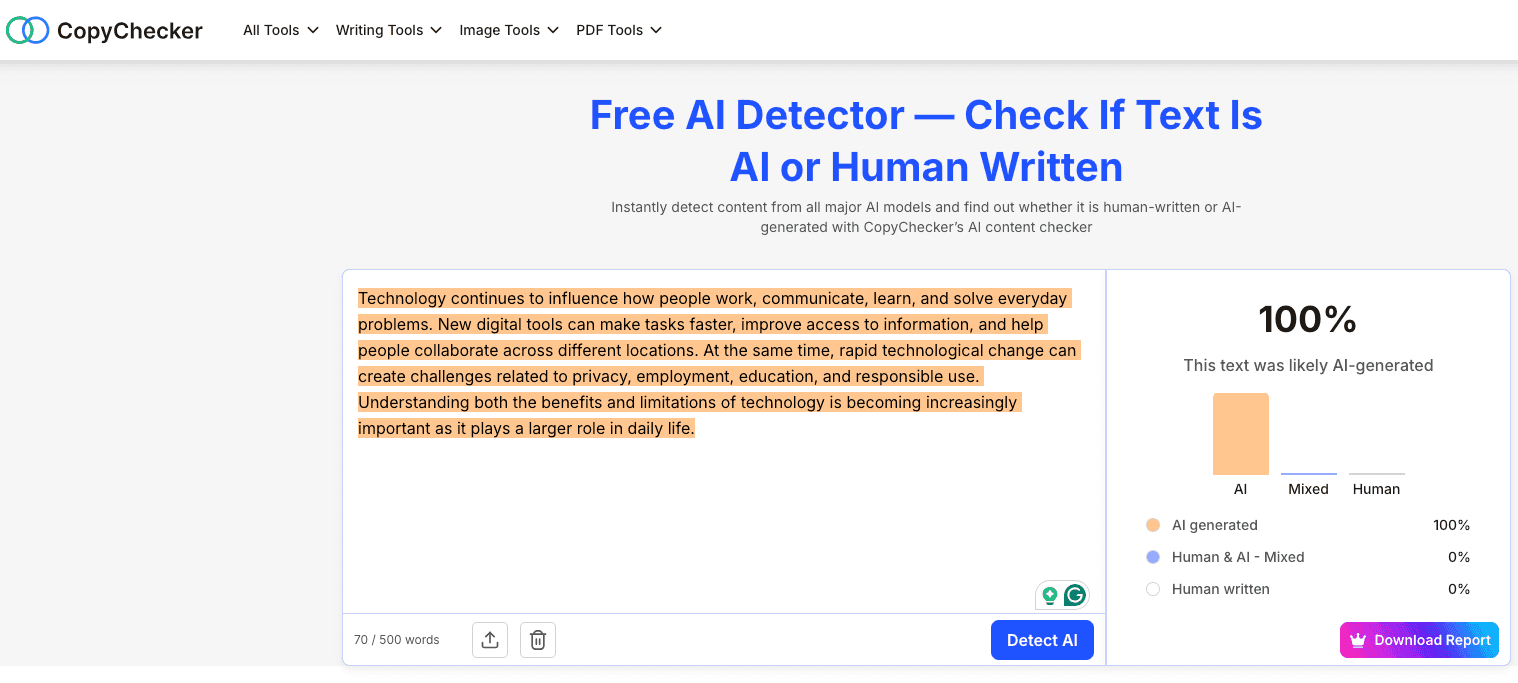
Both tools correctly identified the deliberately AI-style sample.
There was no meaningful disagreement here.
The second test was much more revealing.
Test 2: A Short Human-Written Story
For the second sample, we used a short, casual, human-written story about going to a concert in the rain.
It was around 65 words and included conversational language, a friend's name, and informal wording.
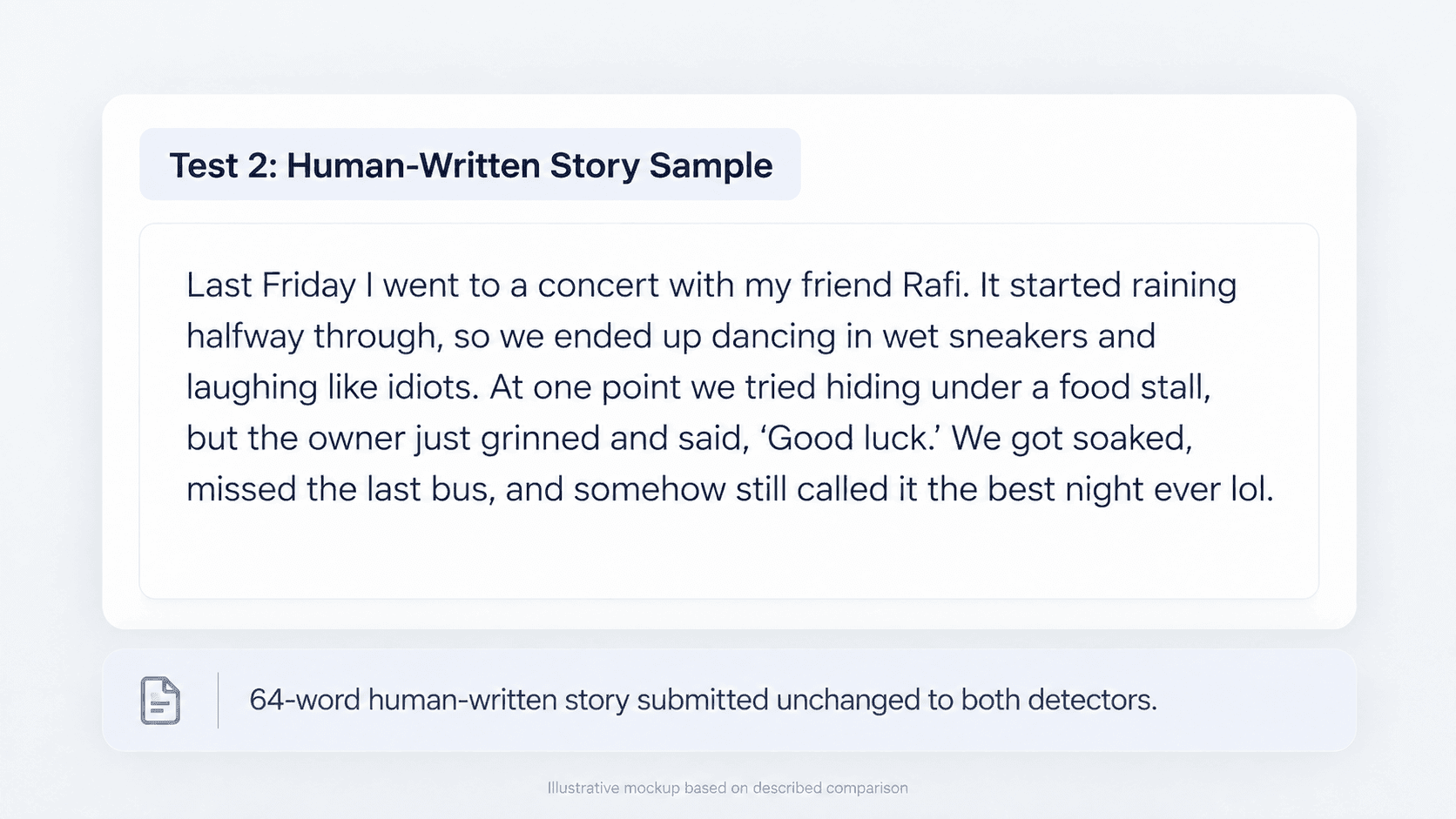
GPTZero Result
GPTZero again reported that it was highly confident the text was AI-generated, giving the sample a 100% AI result.
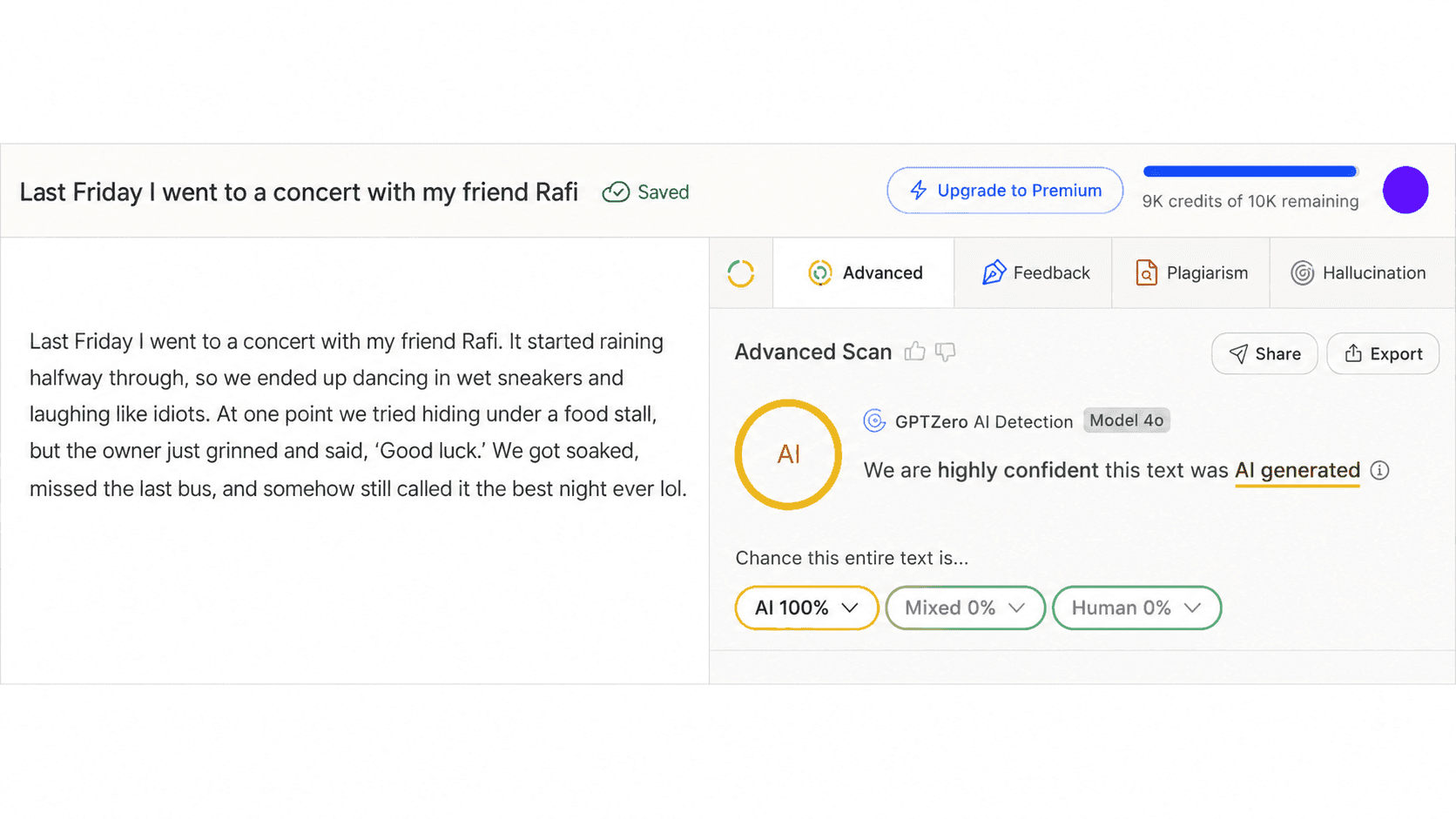
However, GPTZero also displayed an important warning:
“This text is under 100 words. Your result may be less accurate.”
So the classification itself was wrong in our test, but the interface gave the user a reason not to overinterpret it.
CopyChecker Result
CopyChecker also classified the human-written sample as 100% AI-generated.
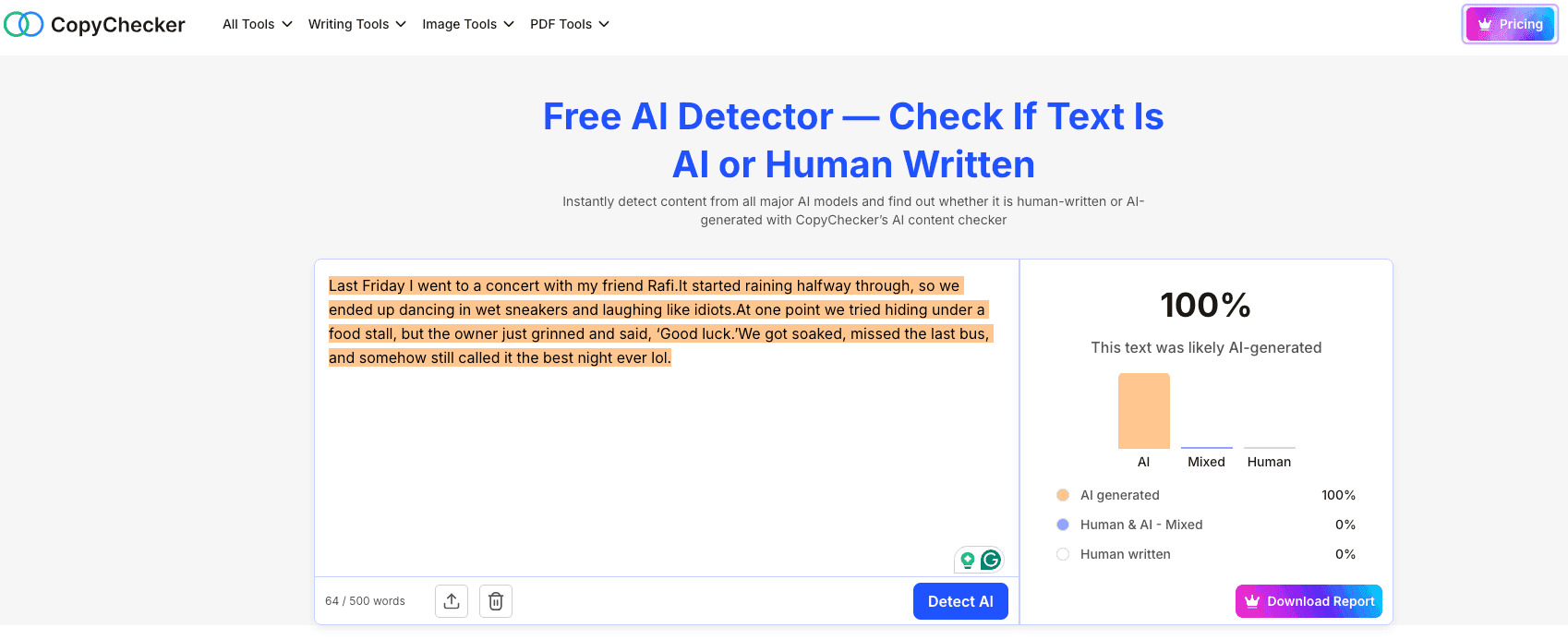
Unlike GPTZero, we did not see an equivalent short-text warning in the CopyChecker result interface during this test.
Why This Result Matters
The human-written sample really was written by a person.
Yet both tools confidently flagged it.
That does not prove that either AI detector is generally inaccurate. Our sample is far too small for such a conclusion.
It shows something much more specific:
A confident AI score can still be wrong.
And short text deserves particular caution.
That raises an obvious question -
Why Are Short Texts Harder for AI Detectors?
AI detectors look for patterns in writing.
Those patterns can include sentence structure, predictability, stylistic consistency, vocabulary choices, and signals learned from large collections of human- and AI-written content.
A 1,500-word essay provides plenty of material to analyze.
A 60-word paragraph does not.
Short human writing can also happen to be clean, predictable, or repetitive.
Meanwhile, AI-written text can be edited until it looks more irregular and personal.
That overlap is one reason AI detection should be treated as a probability rather than a digital fingerprint.
In other words, there is considerably more happening behind an AI percentage than spotting a few suspicious words and declaring that the robots did it.
Which leads to the more practical question.
And that leads to the question that matters most in practice -
Can You Trust an AI Detector Score?
You can use an AI detector score.
You should not blindly trust it.
An AI detector is most useful when it gives you another signal to investigate. Problems begin when people treat that signal as proof of authorship.
If a teacher sees a result such as 98% AI-generated, the number looks impressively definite.
But it does not automatically establish who wrote the assignment.
A responsible review could also consider:
- highlighted passages
- earlier drafts
- document revision history
- previous writing samples
- research notes
- citations
- the writer’s explanation of their process
The same principle applies to publishers, editors, recruiters, and content teams.
Use the detector to decide where to look more closely, not automatically what happened.
Our short-text comparison is a fairly useful demonstration of why.
Let’s start with the areas where GPTZero stands out -
What GPTZero Does Better
GPTZero has some clear advantages for users who primarily care about AI detection. Let’s see -
- Larger Free AI Allowance: Its 10,000 monthly credits make it more practical for people checking multiple essays, documents, or articles.
- Deeper AI-detection Workflow: GPTZero has more features built around authorship, browser-based detection, writing verification, and education.
- More Context Around Detection: In our short-text comparison, GPTZero warned that the result could be less reliable because the sample contained fewer than 100 words.
What CopyChecker Does Better
CopyChecker’s strengths become clearer when AI detection is only one part of the writing process. Its main advantages are:
- Broader Writing Toolkit: AI detection sits beside plagiarism checking, grammar tools, proofreading, readability checking, counters, and sentence-level utilities.
- Separate Free Plagiarism Allowance: Users receive 1,500 plagiarism words in addition to the free AI Detector allowance.
- All-in-one Writing Workflow: Writers can check originality and then continue editing or reviewing the same content using other tools.
- Useful Beyond AI Detection: Tools such as the Word Counter, Passive Voice Checker, Readability Checker, and Proofreader remain useful even when AI detection is not involved.
At this point, the distinction is fairly clear.
GPTZero specializes in AI detection and authorship verification.
CopyChecker covers AI detection plus a wider range of everyday writing tasks.
So, the next step is to turn those differences into something practical and see which tool suits whom.
Who Should Use GPTZero?
GPTZero is particularly worth considering if you are:
- primarily interested in AI detection
- checking a relatively large amount of text
- a teacher reviewing student writing
- interested in browser-based AI detection
- interested in writing-process or authorship evidence
- looking for a larger free monthly allowance
The warning shown during our short-text test is also useful for users who may not already understand the limitations of AI detection.
Who Should Use CopyChecker?
CopyChecker may make more sense if you:
- regularly check both AI content and plagiarism
- want grammar and paraphrasing tools in the same workspace
- prefer separate monthly allowances for different writing tools
- are a student, writer, blogger, or marketer managing several stages of content review
- want an all-in-one writing suite rather than a tool centered mainly on AI detection
You can also move directly from detection into editing tools such as CopyChecker’s Paraphrasing Tool when a sentence genuinely needs rewriting rather than merely checking.
Just be particularly cautious with very short AI-detection samples, regardless of which platform you choose.
So the final choice really comes down to what you need the tool to do most often.
CopyChecker vs GPTZero: Which One Should You Choose?
There is no universal winner because the two tools solve slightly different versions of the same problem.
Choose GPTZero if AI detection itself is your main priority, and you expect to scan substantial amounts of text.
Its larger free allowance and deeper focus on authorship and detection make it particularly relevant for educators and frequent detector users.
Choose CopyChecker if you want AI detection to sit inside a broader writing workflow.
Its free AI allowance is smaller, but the same platform also gives you plagiarism checking and numerous tools for reviewing and improving content.
The more important lesson, though, applies to both:
Do not let one percentage make the decision for you.
A detector can be confident and still be wrong.
Use the score as a signal worth investigating rather than proof that ends the discussion.
Our Testing Methodology
To prevent a two-paragraph experiment from dressing itself up as laboratory science, here is exactly what these tests do and do not establish.
| Methodology Detail | What We Used |
|---|---|
| Test date | September 2026 |
| Detectors compared | CopyChecker AI Detector and GPTZero |
| Test 1 | Deliberately AI-style test passage used in both tools |
| Test 2 | Short, approximately 65-word test passage used in both tools |
| Same input used in each detector? | Yes. Each test used the same passage in CopyChecker and GPTZero |
| Test type | Manual browser-based comparison |
| Accounts/plans | Results were obtained through the product interfaces available during testing; plan-specific features are discussed separately from detector results |
| Evidence retained | Screenshots of both tools' result screens |
| Accuracy benchmark? | No |
| Number of test samples | Two |
| Main limitation | Two samples cannot establish overall accuracy, false-positive rate, false-negative rate, or performance across writing styles |
| Important provenance limitation | The original drafting record does not establish that Test 2 was independently verified as human-authored. It is therefore not used as evidence of a false positive in this article |
FAQs about CopyChecker vs GPTZero
Is GPTZero More Accurate than CopyChecker?
Our small comparison did not establish a clear accuracy winner. Both identified the obvious AI-style sample, and both incorrectly flagged the short human-written sample.
Is CopyChecker Better than GPTZero?
It depends on what you need. GPTZero is more specialized in AI detection and authorship, while CopyChecker combines AI detection with a wider range of writing tools.
Can I Use GPTZero for Free?
Yes. GPTZero currently provides 10,000 free monthly credits that can be used for supported checks.
Is CopyChecker's AI Detector Free?
Yes. CopyChecker currently provides 500 free AI Detector words per month, plus 1,500 plagiarism-checking words and free allowances for several other writing tools.
Does GPTZero Check Plagiarism?
Yes. GPTZero supports plagiarism checking through its available credits.
Does CopyChecker Check Plagiarism?
Yes. CopyChecker has a dedicated plagiarism checker and currently provides free users with 1,500 plagiarism-checking words per month.
Why Can Human Writing Be Detected as AI?
AI detectors identify patterns rather than proving authorship. Human writing can sometimes resemble patterns associated with AI, particularly when the sample is short or highly structured.
Are AI Detectors Accurate on Text Under 100 Words?
Short samples can be less reliable. In our comparison, both tools flagged a roughly 65-word, human-written sample as AI-generated, so using a longer, more representative sample is preferable.
Can Teachers Rely on AI Detector Scores?
AI scores can support a review, but they should not be treated as standalone proof. Drafts, revision history, previous writing, sources, and the student’s writing process provide important additional context.
Final Thoughts
CopyChecker and GPTZero are both useful AI detectors, but they prioritize different things.
GPTZero is the stronger fit when AI detection itself is the main job, especially for users who need larger allowances or deeper authorship-related features.
CopyChecker makes more sense when AI detection is one part of a broader writing process, alongside plagiarism checking, grammar review, proofreading, paraphrasing, and other content tools.
Whichever one you use, treat the result with context.
Give the detector enough text to analyze, review the passages it highlights, and be particularly cautious with short or borderline samples.
If you want to see how your own writing is classified, try CopyChecker’s AI Detector with a longer sample and review both the overall result and the passages it flags.
Because the percentage is useful.
What you do with that percentage matters more.