


Citation Generator for Bloggers
Build your readers' trust and protect your blog from plagiarism claims. Generate properly formatted citations for any source for your websites, articles, books, journals, and more right away.
- Zero cost, as no subscription is needed

- Supports APA, MLA, Chicago, Harvard & more

- Works with URLs, DOIs, ISBNs & more



Why Do Bloggers Skip Citing Sources?
Most bloggers know citations matter, but the process feels slow, confusing, or simply too much effort. Here's what gets in the way:

Different Rules Per Style
APA, MLA, and Chicago each have their own punctuation rules, date formats, and ordering, so getting it wrong undermines your credibility.

Eats Into Writing Time
Manually hunting down names, access dates, and publisher details can eat 20–30 minutes per post, so they focus on writing rather than this.

Risk of Plagiarism Flags
Uncited statistics and quotes leave your blog vulnerable to accusations of plagiarism that can hurt your domain authority and reputation.

Varied Source Types
Citing a YouTube video differs entirely from citing a research paper or a news article, and bloggers need to deal with all of them regularly and properly.
CopyChecker Makes Citing Sources Effortless for Bloggers
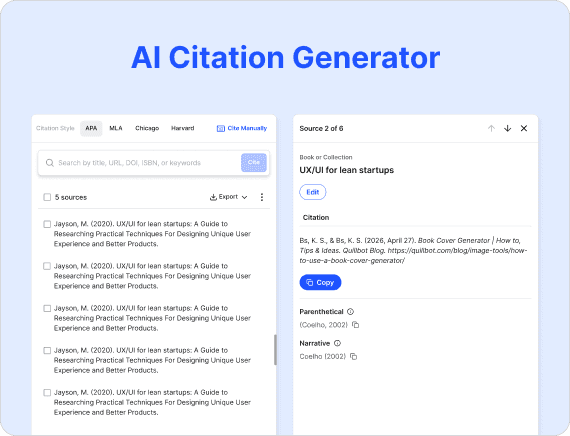
AI-powered citation generator of CopyChecker handles all the formatting for you. Just paste a URL or enter source details, pick your style, and your citation is ready!

Smart Auto-Fill Option
Paste any URL, and CopyChecker automatically pulls the title, author, date, and publisher without requiring manual data entry.

All Major Citation Styles
Switch between APA, MLA, Chicago, Harvard, IEEE, and more with a single click without re-entering your source data.

Instant Results Flawlessly
Get a correctly formatted, copy-ready citation in under 10 seconds, totally built for fast-paced content workflows.

Blog-Safe & Accurate Output
Properly attributed sources protect your blog from plagiarism flags and strengthen your SEO authority signals.
Ready to Cite Your Blog Sources in Seconds?
Join thousands of bloggers who write faster, rank higher, and publish with total confidence.
How to Generate Blog Citations in 4 Simple Steps

Enter Your Final Source
Paste the article URL, book ISBN, or DOI, or manually input the source details you have.

Choose Citation Format
Select the style your publication requires: APA, MLA, Chicago, Harvard, and others.

Generate Citation Instantly
Hit the generate button and receive a perfectly structured citation in seconds.

Copy & Publish Without Worry
Paste the citation directly into your post or footnotes, and go live with confidence.
Frequently Asked Questions
Yes. Citing sources builds reader trust, protects you legally, and is increasingly important for SEO. Google's E-E-A-T guidelines reward content that references credible, authoritative sources. Proper citations signal expertise and transparency.
Absolutely. CopyChecker's citation tool is 100% free to use with no hidden charges, no account required, and no usage limits. Generate as many citations as your content schedule demands.
Yes. CopyChecker supports a wide range of source types common in blog writing: websites, online news articles, journal papers, books, PDFs, YouTube videos, podcasts, and social media posts. Simply paste the URL or enter the details manually.
Most personal and professional blogs use hyperlinks as informal citations. However, if you run a niche blog that cites research (health, science, finance, law), APA or Chicago style footnotes add significant credibility. Our generator supports all formats, so you can choose the one that best fits your audience.
Indirectly, yes. Well-sourced content aligns with Google's E-E-A-T (Experience, Expertise, Authoritativeness, Trustworthiness) quality signals. Posts that reference reputable sources are more likely to be seen as authoritative, which can improve rankings over time.
CopyChecker’s citation engine is built on up-to-date style guides for APA (7th ed.), MLA (9th ed.), and others. While automated tools are highly reliable, we always recommend a quick review, especially for less common source types or academic submissions.
More Tools You Might Find Useful


